Asia-Pacific, Biodiversity, Civil Society, Conservation, Environment, Featured, Headlines, Natural Resources, TerraViva United Nations
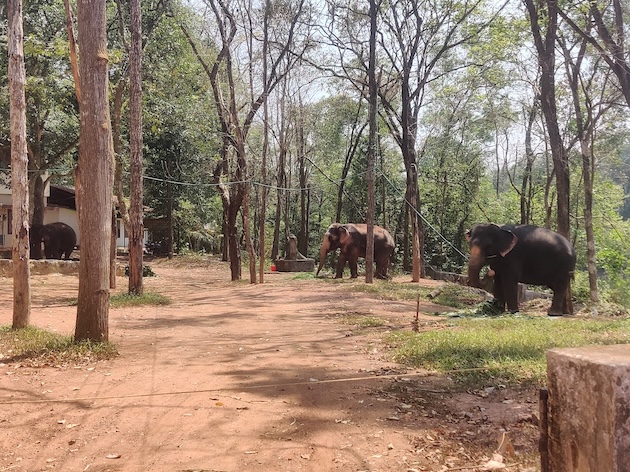
Elephants at the Kappukadu elephant rehabilitation center in Kottoor.
– In the early part of this year, two deaths in Kerala garnered major media attention. A farmer in Wayanad and a female plantation worker in Idukki were killed in two separate events, within a matter of a few days, by wild elephants.
Arikomban, another wild elephant, has become a media favorite recently due to his brushes with human settlements near his habitat. Named so because of his love for ari (rice), the elephant had been relocated from Kerala to Tamil Nadu in 2023 following constant protests from people who also claimed him to be ‘life-threatening.’ Kerala’s news outlets widely covered Arikomban’s relocation.
These aren’t one-off cases in Kerala, which has seen a spike in human–wildlife conflict, especially involving elephants.
According to a news report, 451 people have been killed in wildlife conflicts in the past five years alone in the state, with 102 of them caused by elephants.
However, wildlife biologists and environmentalists have been at odds with the narratives promoted by the media and society regarding what constitutes conflict.
“I think we shouldn’t be using the terminology ‘wildlife conflict’ itself. I would prefer addressing it as ‘negative wildlife interaction,’” says Dr. P.S. Easa, who holds a PhD on Elephant Ecology and Behavior and is a member of the National Board for Wildlife and the IUCN, Asian Elephant Specialist Group.
The conflict between wild animals and humans has been going on for centuries, and what we witness in the current era has been influenced by the transformation in the behavior of both these groups, as well as humans’ perception towards wildlife in general, he adds.
In Kerala’s social framework, the rising phenomenon of human–elephant conflict takes on a much deeper and more complex meaning than the broader topic of conflict with wildlife. Elephants have been an integral part of Kerala’s culture and tradition for centuries—domesticated not just for heavy labor but also as part of temple festivals. In the last few decades, machines have replaced elephants in much of the labor environment in the state, yet the land giants continue to be a part of the festival parades. Animal behavioral experts and activists have been consistently raising their voices against this practice in this century, citing the need to treat elephants as solely wild animals.
Easa refuses to even use the term “domesticated” for them.
“Captive elephants are the only right way to address them in this age and time,” he says.
In 2024 alone, there had been nine reported deaths in Kerala by such captive elephants. The Hindu reported six such deaths, including an elephant mahout, within the first two months of this year. Although there have been stricter rules and regulations in recent years on using captive elephants for temple festivals, they have mostly been restricted to paper. The religious nature of the festivals that these elephants are made to be a part of makes the topic even more sensitive, and political parties tend to stay away from addressing the issue.
Kerala’s elephant reserves have been categorized mainly into four regions, namely Wayanad, Nilambur, Anamudi, and Periyar. Periyar Reserve had the highest count of elephants, followed by the Anamudi Reserve. According to the Kerala Government’s Forest Statistics and the report of the ‘Wild Elephants Census of Kerala,’ the four reserves have a combined total extent of 11,199.049 sq. km., out of which only 1,576.339 sq. km. is assessed to be devoid of elephant population. According to a 2024 official assessment, Kerala had an elephant population of just under 1800, a decline of more than 100 from the previous year.
As Kerala’s elephant reserves border the neighboring states of Tamil Nadu and Karnataka, natural factors that affect the elephant population, like extreme drought and heavy, abrupt rainfall, influence the elephants’ migration across the states during the year.
In Kerala, particularly, shrinking forest habitats caused by deforestation and the increasing presence of human settlements in regions historically occupied by elephant populations, coupled with climate change and the invasive plant species erasing the elephants’ natural food sources, are some of the factors causing unnatural elephant migration, according to experts, and as a consequence, resulting in frequent interactions with humans.
The phrase “descent of wildlife into human settlements” itself is a misnomer, Eesa says.
“In almost all such cases, human settlements had crossed over to those places where the wildlife had existed peacefully before. Wayanad and Idukki are classic examples of this.”
“There was a report that I had come across a while ago—of an ‘elephant attack’ that happened in Sholayar Forest Reserve. Look at the irony of that news. It’s a forest reserve—the habitat belongs to the elephant, not the people who were driving through it. What I’m saying is, every time an elephant conflict is reported, you need to dissect all the circumstances surrounding it. Where—was it within the jungle or outside it? When was it, during the daytime or at night? And how? What were the circumstances leading up to the interaction?” he explains.
The drastic increase in food waste owing to tourism in Kerala has been another factor for wild animals encroaching into human spaces lately. Elephants, wild boars, and monkeys have been observed to have come to human settlements to feed on the food waste.
There is no one, foolproof method to resolve the human–elephant conflict, scientists opine. Easa points out that several techniques that had been fruitful in African countries proved ineffective when used in countries like Sri Lanka and Indonesia.
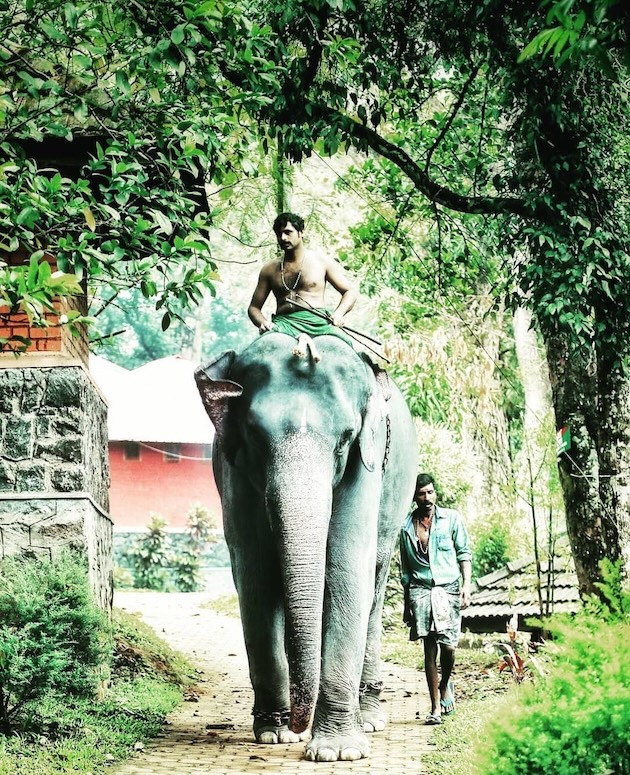
A mahout is seen riding a captive elephant. Kerala continues to make use of elephants for temple festivals and parades.
Wildlife biologist Sreedhar Vijayakrishnan, in an interview given to Mongabay in 2023, suggests five main long-term measures that will help mitigate human-elephant conflict. This includes initiating long-term studies to understand elephant movements and spatiotemporal patterns of conflict, which will help ascertain where and how interventions are required; tracking areas of elephant movement and identifying regions of intense use while installing alert lights at vantage points that can be triggered in case of elephant sightings; raising awareness among local populations to discourage feeding elephants or unwanted interactions; training local rapid response teams to prevent negative interactions and indiscriminate drives; and fitting satellite collars on elephants that frequently cause issues.
Kerala also has an elephant rehabilitation center established in Kottoor, Thiruvananthapuram, for rescuing, rehabilitating, and protecting both captive and wild elephants. The state, like other forest reserves in India, has historically chosen to turn many of the captured conflict-making elephants into ‘Kumkis’ (a Kumki elephant is a specially trained and domesticated elephant used in rescue operations and to train other wild elephants and manage wildlife conflict).
Apart from the above, one of the most effective measures that has been implemented in Kerala is through the Wayanad Elephant Conflict Mitigation Project by the Wildlife Trust of India (WTI). The project, first initiated in 2002–2003 by WTI, has evolved into a successful model for tackling human–elephant conflict in Kerala. The model has focused on relocating human settlements from places identified as ‘elephant corridors’ in the Wayanad district of Kerala. Wayanad, spanning a total of 2,131 sq. km., has an elephant reserve spread over 1,200 sq. km., with an elephant density of 0.25 elephants/sq. km.
Shajan M.A., a Senior Field Officer with WTI who handles the project currently, tells me, “Our method is to buy such sensitive land from the people, including both tribal and other communities, and relocate them to safer regions, away from wildlife conflict.” Ultimately, WTI hands over the purchased land to the Kerala Forest Department.
In regions like the Tirunelli–Kudrakote elephant corridor, the human–elephant conflict had escalated so much that it had resulted in several human deaths. For the communities, leaving a land they had occupied for decades and considered home is never easy, Shajan acknowledges. But of all the tried and tested methods to deal with the human–wildlife conflict, this approach has been the most effective in the long run, he points out.
Shajan also muses on the question of what exactly comprises a ‘conflict.’
“Conflict can hold different meanings. From a monkey stealing food from the house to a tiger or an elephant attack on a human, even leading to deaths, it’s all considered a human–wildlife conflict. Sadly, we, as a society, tend to be reactive once it transforms into a conflict and place the blame wholly on the wildlife.”
IPS UN Bureau Report