Africa, Biodiversity, Civil Society, Climate Action, Climate Change, Conferences, Development & Aid, Economy & Trade, Environment, Featured, Global, Headlines, Ocean Health, Small Island Developing States, TerraViva United Nations
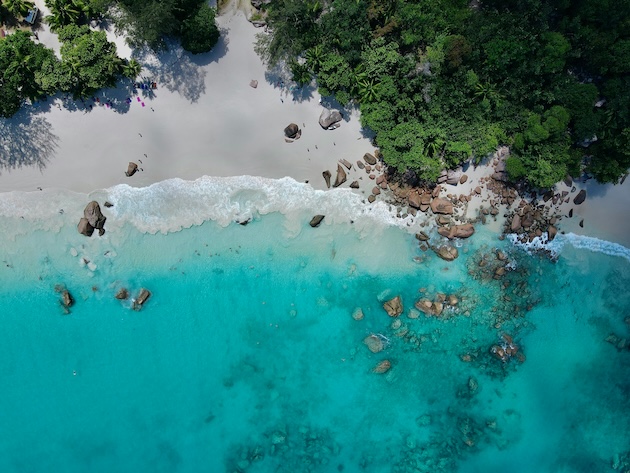
Seychelles’ pioneering blue bond offers a compelling lesson in practical ocean finance. Credit: Michaela Rimakova/Unsplash
– As the world prepares for the Global Environment Facility (GEF) meeting in Samarkand next month, Seychelles’ pioneering blue bond offers a compelling lesson in practical ocean finance.
For small island states, the ocean is not merely a natural resource; it is the foundation of national life, economic opportunity, and long-term resilience against climate threats.
As President of Seychelles, I introduced the blue economy as a national vision as early as 2008. I did so because I believed then—as I do now—that for an island nation spanning 1.4 million square kilometers of ocean, sustainable development must begin with responsible stewardship of our marine resources. Our future depended on learning how to protect biodiversity, manage fisheries sustainably, and build economic models that serve both present needs and future generations. This vision positioned Seychelles as an early advocate for integrating ocean health with national prosperity.
That vision was not developed in isolation. It was strengthened through deliberate steps and high-level conversations that bridged policy ambition with financial innovation. A key milestone came with the debt-for-nature swap, finalized with the Paris Club creditors and The Nature Conservancy in 2014. This landmark agreement restructured approximately US$21.6 million in debt, freeing resources for marine conservation and climate adaptation. It directly led to the creation of SeyCCAT, the Seychelles Conservation and Climate Adaptation Trust, which has since become a vital mechanism for channeling funds into ocean protection, sustainable fisheries, and resilience projects.
As President, I also discussed the blue bond concept directly with the then Prince of Wales, Prince Charles, during the Commonwealth Heads of Government Meeting in Sri Lanka in November 2013.
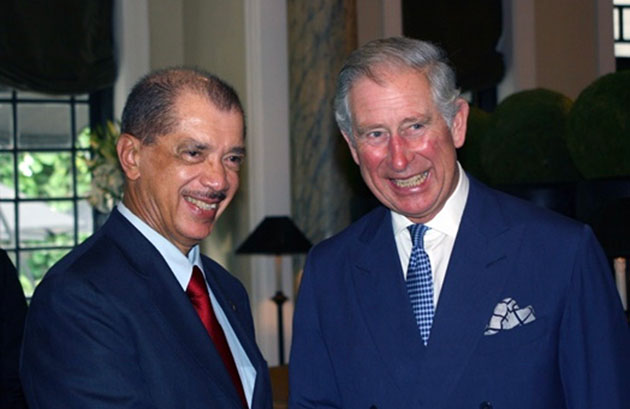
Meeting with the Prince of Wales in Sri Lanka in 2013 at the Commonwealth Heads of Government Meeting (CHOGM). Credit: James Alix Michel
His International Sustainability Unit was already promoting innovative ocean finance mechanisms, and our conversation highlighted the urgent need for small island states to access capital markets tailored to blue economy priorities.
This exchange, combined with early engagement from the World Bank and Commonwealth partners, helped refine the idea into a viable sovereign instrument. It underscored a growing global recognition that traditional financing was inadequate for the unique challenges of climate-vulnerable, ocean-dependent nations.
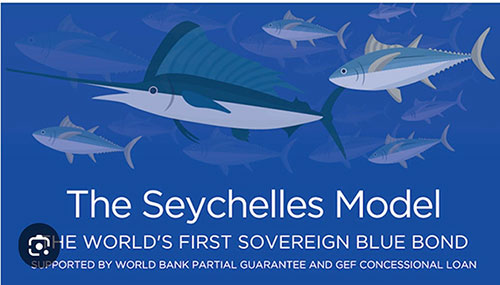
The blue bond represented the culmination of this journey. Structured with technical support from the World Bank, a US$5 million guarantee from the multilateral lender, and a US$5 million concessional grant from the GEF, it raised US$15 million from private investors including Calvert Impact Capital, Nuveen, and Prudential Financial.
On 29 October 2018, Seychelles launched the world’s first sovereign blue bond at the Our Ocean Conference in Bali — an event I had the privilege of attending. This was not just a financial milestone for Seychelles; it was a global proof of concept for ocean-positive investment.
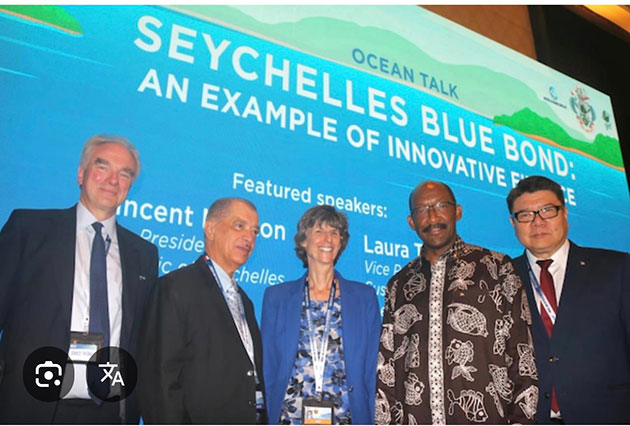
Launch of the Seychelles Blue Bond in Bali at the Ocean Conference in 2018. Credit: James Alix Michel
The bond’s structure was as innovative as its purpose. Proceeds were allocated to expand marine protected areas to 30% of Seychelles’ exclusive economic zone, improve fisheries governance, and develop sustainable blue economy sectors like eco-tourism and seafood value chains. Managed through SeyCCAT and the Development Bank of Seychelles, the funds supported grants and loans for projects that delivered measurable environmental and economic returns. Investors benefited from blended finance that de-risked the instrument, while Seychelles gained long-term capital for priorities that traditional aid could not address.
For small island developing states (SIDS), this model holds profound significance. Nations like Seychelles grapple with high public debt (often exceeding 60% of GDP), acute climate exposure, a heavy reliance on marine resources for 20-30% of GDP, and limited fiscal space. Conventional loans and grants are frequently too rigid, too short-term, or misaligned with ocean realities.
The blue bond demonstrated that sovereign debt instruments can be repurposed for sustainability, attracting private capital while advancing public goods like biodiversity protection and community livelihoods.
Its broader impact extends beyond the US$15 million raised. The Seychelles blue bond lent credibility to the blue economy as a bankable asset class, inspiring subsequent issuances by Gabon (2022), Ecuador (2024), and others. It proved that nature-based solutions and financial innovation are complementary, not competitive. By linking debt restructuring, conservation trusts, and market-based finance, Seychelles created a replicable blueprint that has influenced global discussions at forums like the UN Ocean Conference and G20 sustainable finance tracks.
Yet this success should not be romanticized. Innovative finance alone cannot resolve systemic inequities in the international financial architecture. Blue bonds require robust institutions, transparent governance, technical capacity, and a pipeline of investable projects—foundations that not all SIDS possess. Seychelles benefited from strong political commitment, capable partners like the World Bank and GEF, and a pre-existing conservation framework. Without these, such instruments risk becoming symbolic rather than substantive.
This is precisely why the GEF assembly in Samarkand is so timely. Oceans face escalating crises: overfishing depletes 35% of stocks, plastic pollution chokes marine life, warming waters trigger coral bleaching, and habitat loss threatens 40% of global biodiversity. Yet ocean finance remains woefully inadequate—less than 1% of climate finance targets marine ecosystems, despite the ocean’s role in absorbing 25% of CO₂ emissions and producing 50% of planetary oxygen.
Samarkand offers a platform to scale solutions like Seychelles’ model.
The GEF, as a catalytic funder, should prioritize blue finance architecture for SIDS and coastal states. This means expanding blended finance facilities, providing first-loss guarantees, offering concessional capital, and building capacity for project pipelines. It also requires policy reforms to integrate blue bonds into debt sustainability frameworks, ensuring they complement—rather than compete with—multilateral debt relief initiatives.
Seychelles took a calculated risk in 2008 by centering the blue economy in national strategy. We persisted through debt swaps, presidential diplomacy, and patient institution-building. The blue bond was the reward: a tool that converted vulnerability into opportunity.
As delegates converge on Samarkand, let Seychelles’ story serve as both inspiration and imperative. The blue economy will not thrive on declarations or pilot projects. It demands instruments that harness private capital for public purposes, turning ocean ambition into enduring action. Seychelles opened the door.
The GEF and global community must now widen it—for islands, for coasts, and for the shared blue planet we all depend on.
Note: The Eighth Global Environment Facility Assembly will be held from May 30 to June 6, 2026, in Samarkand, Uzbekistan.
James Alix Michel is the former President of Seychelles (2004–2016) and a global advocate for the blue economy, ocean conservation and climate resilience.
IPS UN Bureau