UN Volunteers – and Their Over Reaching Mission

Civil Society, Democracy, Featured, Global, Headlines, Human Rights, IPS UN: Inside the Glasshouse, TerraViva United Nations

Opinion

UN Volunteers Day is commemorated annually on December 5.

KATHMANDU, Nepal, Dec 4 2023 (IPS) – If there is an agency or program within the UN that I really admire and wish the best for, this is the United Nation Volunteers or UNV. Its overarching mission, mandate and key objectives are paramount for humanity.


Unfortunately, volunteerism is neglected worldwide and its transformative importance never fully understood. There are no single issues affecting our planet and the whole humanity that does not require volunteerism.

That’s why UNV that is technically part of UNDP, has a big role to play. Yet, to some extents, UNV is missing into action as it has been unable to raise to the challenges. It can be an issue of lack of availability of resources or it could be the complex red tape system bogging down the whole UN System.

It can be simply the fact that each agency and program within this galaxy of UN entities is simply not too adept at mainstreaming and embed volunteerism in their operations. For sure, UNV does not lack expertise nor very passionate and capable persons, some of whom I have been able to collaborate with in the past.

They really believe in the cause, in the promotion of volunteerism and they really want to push hard so that development can fully leverage its power. But somehow, considering its expertise, UNV is underperforming.

Probably one of the biggest challenges for an organization like UNV is the difficulty in engaging and involving stakeholders on continuous basis. There are actually some big success stories for UNV on this regard.

For example, the Global Technical Meeting held in July 2020 after months of preparations was a truly, groundbreaking initiative.

The end result was an important blueprint to embed volunteerism in the global development agenda, ensuring that volunteerism could really placed at the center of the pursuing the Agenda 2030 and the Sustainable Development Goals.

Getting the Global Technical Meeting in place took months of preparation and several online discussion groups were created where stakeholders, practitioners and citizens passionate about volunteerism, could contribute. Enabling such forums was remarkable and a true achievement for UNV.

Yet after more than three years since then, no real follow up mechanism has been established. The initial excitement that a new level of global discussion on volunteerism had been achieved, then rapidly declined.

Now I am wondering why in the recently held SDG Summit, to my best knowledge, there was no serious debate on what volunteerism can do to support the implementation of the Agenda 2030.

It is not surprising, therefore, that there has not any apparent and inclusive exercise to revise the implementation of The Plan of Action to Integrate Volunteering into the 2030 Agenda.

Another example is the organization of the International Volunteer Day (IVD) that is celebrated December 5. This can be a great opportunity not only to raise awareness but should also be seen as a key platform to engage and mobilize people throughout the year.

So far, the practice, at countries level, has been to have a sort of coordination mechanism one or at the most two months before the celebrations. While it is important to bring practitioners and stakeholders together for IVD and while I always considered these engagements meaningful, I always felt that we were missing an opportunity.

I always believed that IVD should be not only a big carnival, a moment of joys where local volunteering champions are recognized and duly acknowledged. This component is essential and always needs to be on the front.

At the same time, the day should be used to talk about the less glorious and yet important nitty gritty of policy making. Many might not think of this aspect as strategic.

Yet, if we really want to elevate volunteerism at the center of the Agenda 2030, it is essential to discuss about policies and legislations that can truly empower volunteering efforts for social change.

Think for example about the process of localizing the SDGs? Can’t it be a phenomenal way of engaging and involving citizens? Participation is also a key aspect of volunteerism and a key tenant of the broader concept of civic engagement.

Yet the most important function for IVD is to rally together the whole “movement”, all those love volunteerism: academicians, practitioners, experts, representative of national and international NGOs, donors but also students and any citizens passionate about it.

This means coming forward with extensive planning and collective capacity to execute them, a process that requires months and months of preparation. By my own observation, it was way too late, towards the end of November, when UNV started sharing information about today’s main message.

Even deciding on the theme of IVD could become an exercise of participation with rounds of consultations, ideas contests to provide the best and more meaningful ideas for it. In a way, IVD, in the way I see it, should be seen as the pinnacle of a whole year coordination exercise, not only an end into itself but a catalytic event that stirs the movement to action throughout the year.

UNV has a unique role to help shape this whole dynamic. Conducive to it would be the creation of coordination mechanisms that bring together all the stakeholders. These could take different shapes and forms, from informal working groups to more formal networks and forums.

Based on my own experience, it is wise to start small and then build momentum gradually, step by step. These mechanisms would not only work as info sharing and coordinating platforms but also as groups that plan and execute joint events and activities all year long.

For example, running two or three of such activities, like discussion forums, or awareness trainings at school levels could precede and build excitement around the final big event, IVD. There is no other player that has the mandate and convening power like UNV to bring together such collaborations.

At the same time, I am fully aware that resources at disposal for UNV are not endless especially in times of crises and UNV local country offices have to balance many competing priorities.

That’s why better and more strategic coordination at local level could tremendously help UNV pursue its mission. Another one that deserves attention is the mobilization of UNV Volunteers.

I always felt something odd about such programs. In reality, the program, even if admirable, is basically a full-time paid job. If you compare its stipends or allowances with formal UN jobs, it is clear that a member of UNV just receives a decent remuneration.

Yet the reality is different and more complex. Compared with many local jobs offered by local NGOs, that same package disbursed to an UNV volunteer looks like an awesome salary.

But the compensation aspect is only one problematic side of the equation. The other is the fact that this form of full-time volunteerism promoted by UNV risks to create further confusion about some of the key tenants that are enshrined into it.

I am referring to the cooperative, solidarity driven and generosity filled self-conscious decision of helping, even in very organized forms, others. By no means, I am implying that full time volunteering is intrinsically and necessarily wrong.

It is one of the many ways to support a cause and act selflessly. Yet there are several other experiences of it that are better enabling positive change at grassroots levels, closer to the beneficiaries that can, more easily, become true partners in advancing social justice.

In these examples, international full-time volunteers do get some allowances that provide for their basic expenses and live safely and with dignity. Yet these “privileges” are not too detached from the reality of the hosting countries.

National and International UNV Volunteers are on many ways promoters of positive development outcomes and should be praised for their commitment. Yet there is something wrong when many join the UNV volunteer program, either nationally and internationally, because they know that this is a great launchpad to full fledged careers with the UN.

I have no doubt that UNV is uniquely positioned to enable systemic social and economic progress.Its mandate and mission are more important than ever. Yet from engaging in the global discussions to achieve the Agenda 2030 to rethinking the role of citizens in the delivery of essential services, including ways people can participate in the decision making, volunteerism is the hidden gem of the global development agenda.

In this International Volunteer Day, let’s praise the accomplishments so far realized by UNV. At the same time, let’s work together to ensure that a more agile, proactive organization can turn itself into a much stronger hub of activism, social change and dynamic discussions.

Volunteerism is a too important aspect of our humanity.Only a revamped UNV can leverage it and help it truly become indispensable dimension of our lives, not only in the South but also the North as well.

Simone Galimberti is the Co-Founder of ENGAGE and The Good Leadership. He is based in Kathmandu, Nepal.

IPS UN Bureau

  Source

Human Rights Crucial as Wealthy Nations Reap Energy Transition Benefits

Civil Society, Climate Action, Climate Change, Climate Change Finance, Climate Change Justice, COP28, Development & Aid, Editors’ Choice, Environment, Featured, Global, Headlines, Human Rights, Humanitarian Emergencies, Sustainable Development Goals, TerraViva United Nations

COP28

Yamide Dagnet, the Director for Climate Justice at Open Society Foundations, delves into the intricacies of the negotiations at the United Nations Framework Convention on Climate Change (UNFCCC) 27th session of the Conference of Parties (COP28) in Dubai.

Yamide Dagnet points to the urgency of climate action to meet the Paris Agreements, while protecting frontline communities as about 70 000 attendees grapple with issues during the UN Climate Change Conference COP28. Credit: COP28/Walaa Alshaer

Yamide Dagnet points to the urgency of climate action to meet the Paris Agreements, while protecting frontline communities as about 70 000 attendees grapple with issues during the UN Climate Change Conference COP28. Credit: COP28/Walaa Alshaer

DUBAI, Dec 3 2023 (IPS) – As the world converges for COP 28, the urgency of addressing climate change has never been more palpable. In an exclusive interview with IPS, Yamide Dagnet, the Director for Climate Justice at Open Society Foundations, delves into the intricate details of this pivotal conference—from the unprecedented start to key challenges and opportunities in climate finance. She offers a comprehensive and nuanced perspective on global climate discourse.


As COP 28 unfolds, this interview provides a panoramic view of the complex landscape of climate action. From the challenges of climate finance to the critical role of the private sector and the ethical considerations in technology deployment, Dagnet offers a roadmap for navigating the intricate terrain of climate change, including an urgent call to action urging global leaders, businesses, and civil society to address the challenges that lie ahead collaboratively. As the world grapples with the consequences of climate change, the interview serves as a compass, guiding stakeholders towards a more sustainable and resilient future, and her voice clearly articulates her views that while the just energy and industrial revolution hold immense potential for economic growth in resource-rich nations, it is crucial to protect the rights of frontline communities and activists.

The Start of COP 28

The conference’s initial day set an unprecedented tone. “Positive developments like the creation of the Loss and Damage Fund and sizeable pledges, especially from countries like the UAE, Germany, and the EU, are highlights of this momentum’s emphasis on international solidarity; I hope that the momentum generated on day one will permeate the entirety of COP 28,” Dagnet told Inter Press Service.

Yamide Dagnet, Director for Climate Justice at Open Society Foundations. Credit: TJ Kirkpatrick, Open Society Foundations

Yamide Dagnet, Director for Climate Justice at Open Society Foundations. Credit: TJ Kirkpatrick, Open Society Foundations

Wealthier Nations and Climate Change

Dagnet delves into the role of wealthier nations in the fight against climate change. “While there is an expectation for these nations to fulfil their commitments, reality paints a different picture. Adaptation finance has not seen the necessary investment,” she said while pointing to a critical gap in addressing the immediate impacts of climate change. Looking at the financial dynamics, Dagnet dissected the pledges made by key nations and highlighted the ongoing challenges in reaching the financial targets made since 2009 and outlined in the Paris Agreement. Dagnet contends that “fulfilling pledges and demonstrating seriousness are essential steps for wealthier nations to regain trust and ensure a unified front in the fight against climate change.”

Key Trends in Climate Change Policy

Transitioning into a discussion on key trends shaping climate change policy in the next decade, Dagnet underscored the critical importance of aligning investments with the goals of the Paris Agreement. A concerning trend emerges as she highlights the “doubling of subsidies for fossil fuels, signaling a misalignment with the imperative to transition to clean energy. There is a need to redirect investments toward clean energy, adaptation, and activities in line with the Paris Agreement.”

Delving into philanthropic organizations’ role in supporting climate action, Dagnet says that while some positive dynamics have emerged on loss and damage, much work remains to be done. “Let us not forget that economic and non-economic losses and damages cost several hundreds of thousands of dollars each year.” She says there is a need to prioritize investments in supporting adaptation efforts, acknowledging the urgent need for resilience in the face of climate change impacts. She is hopeful as diverse group of eleven philanthropic organizations committed on December 2 to develop a joint strategic plan, joining the global chorus of voices calling for increased funding and action on climate adaptation.

Balancing Economic Goals and Climate Policies

Dagnet also highlights the challenge of balancing economic goals while adhering to climate policies, emphasizing the integration of climate policy into the broader development agenda. She illustrated the economic risks posed by climate-related disasters, citing examples of hurricanes causing widespread destruction. “Resilient infrastructure is vital, as even substantial economic gains can be wiped out if development projects are not resilient to floods, hurricanes, and other climate-related events,” she said.

Exploring the business sense of investing in reducing emissions, Dagnet highlights that, with the decreasing costs of renewable energy, it is not only an environmental imperative but also financially prudent. “The cost-effectiveness of renewable energy makes a compelling case for nations to prioritize emission reduction efforts, aligning economic goals with sustainable development,” she said.

It also means recognizing that the rare transition minerals needed to scale up the use of renewable energy require a just energy and industrial revolution, which holds immense potential for economic growth in resource-rich nations.

“However, the risk of human rights abuses and other adverse effects should be taken into account and mitigated by focusing on value addition in mineral supply chains by reconciling with the protection of activists and frontline communities, including people’s rights in land use, labor, and conservation of cultural heritage.”

The Role of the Private Sector

Dagnet further delves into the role of the private sector in climate action, focusing on areas such as adaptation and loss and damage. She acknowledged the challenges faced by the private sector in engaging with these aspects, emphasizing the need for them to integrate climate risk into their business models. “While adaptation may not seem immediately profitable, the long-term consequences of inaction are severe,” she says. She suggests that insurance companies need to review their business models, considering how they can better contribute to tackling losses and damages.

Technology for Addressing Climate Change

Turning to the role of technology in addressing climate change, Dagnet discussed the potential and pitfalls. She advocates for a “balanced approach that leverages indigenous knowledge alongside technological solutions. Dagnet highlights the importance of proper assessment, monitoring, safeguards, and global governance to mitigate the risks associated with less-proven and more controversial solutions like geoengineering, carbon dioxide removal, and carbon capture and storage. This is critical for responsible technology deployment, recognizing that while technology can offer solutions, it must be guided by ethical considerations, an understanding of potential risks, and the design of appropriate guardrails to minimize unintended adverse impacts.” She suggested that a holistic approach, which includes both technological advancements and indigenous knowledge, together with a more participatory process bringing various constituencies from both the global north and global south, provides a more robust foundation for addressing climate change challenges in an innovative and equitable way.

Civil Society’s Accountability Role

Dagnet further highlighted the vital role of civil society in holding governments accountable for their climate commitments, including their financial pledges. She contends that efforts to “measure progress and scrutinize government actions are essential tools for civil society to hold governments accountable for their commitments.” She also acknowledged the power of public pressure to drive governments to take more ambitious climate action. Dagnet emphasized the need for a multi-faceted approach, combining legal frameworks, grassroots movements, and international collaboration based on robust data and supported by nuanced and more sophisticated communication strategies, to hold governments accountable on the global stage effectively.

Assessment of International Agreements

Dagnet provided a sober assessment of the international agreements reached so far in the fight against climate change. She also acknowledged that the world is far from achieving its climate objectives, and the window to meet temperature goals is shrinking rapidly. But like many climate justice avengers, she is not defeated and points out ways COP28 and its global stocktake can create an inflection point, with a “course correction pathway” that highlights the need for increased attention to scaling up efforts to keep global temperature increases to 1.5 degrees Celsius and enhance resilience, especially in the face of recent climate-related disasters globally. “No country is immune to the disasters the climate change is unleashing. It is imperative to scale up and speed up efforts to keep fossil fuels on the ground while focusing on building resilience to mitigate the impact of climate change,” she concluded.

IPS UN Bureau Report

  Source

Could These MBA Scholarships Help To Fund Your Business School Dreams?

An MBA is an investment in both your time and money. Data from the Education Data Initiative reports that the average cost of an MBA in the United States is $61,800 – certainly not small change for anyone.

And if you want to study at the top business schools in the country, you’re looking at more than double for the privilege. Harvard Business School estimates a budget of around $225,000 for two years of tuition, health insurance, rent and living expenses.

The typically shorter programs of Europe and Asia Pacific may not be as expensive, however top business schools in these regions still charge at the higher end of the spectrum, with schools like IMD’s MBA priced at CHF 97,500 (US$111.4K), INSEAD’s MBA at just over €90,000 (US$98.2K) and London Business School priced at £115,000 (US$145.5K).

It’s no wonder the decision to pursue an MBA is one that is thought about for years, not months. It’s a major investment in your future, and the return on investment both personally and professionally is compelling as the Forbes MBA ranking confirms. So taking the time for financial planning is essential.

However, for many the cost is prohibitive. Talented professionals with huge potential may hesitate, and many of these often fall disproportionately into underrepresented groups.

To tackle this and ensure that gifted professionals from all walks of life are able to apply and secure a spot on MBA programs, business schools are increasingly launching tailored scholarships to reduce the financial burden.

MORE FOR YOU

Data from the business school accreditation body, AACSB, shows that the total dollar amount of scholarships offered by AACSB member schools globally has increased nearly 16% over the last five years, from US$416,341,425 in 2018-19, to US$482,708,467 in 2022-23. And with business schools increasingly valuing diversity in the MBA classroom, the number of available scholarships is likely to continue to grow.

November is National Scholarships Month, so here are some of the scholarships launched by business schools, and how they are helping an ever widening group of individuals to gain an MBA.

Scholarships for women

According to the Graduate Management Admission Council (GMAC) 2023 Application Trends report, women accounted for 40 percent of applications to business schools worldwide, and there has not been much movement since 2014. However, among the top U.S. and European schools there gender gap is closing.

Wharton was the first among the M7 schools – that also include HBS, Stanford GSB, Chicago Booth, Columbia, MIT Sloan and Northwestern Kellogg – to achieve gender balance, with the incoming MBA class in 2021 including 51.6% women. The school has maintained at least 50% women in the two subsequent years.

Saïd Business School at the University of Oxford has also announced that this year’s MBA intake is 51% female, the first time one of Europe’s top 10 MBA programs has welcomed more women than men.

“We can create a truly diverse community with a multitude of backgrounds,” says Kathy Harvey, Associate Dean, MBA and Executive Degrees at Oxford Saïd. “We hope that by striving for equality in our community, our graduates will go on to champion this throughout their careers.”

The Saïd Business School is among many business schools that partner with the Forte Foundation, a non-profit organization that offers female applicants a scholarship to study at some of the best MBA programs around the world.

Applicants can be from anywhere globally, applying to any MBA program that offers the Forte Fellowships for women – of which more than 55 of the world’s leading MBA programs do, including the likes of Harvard, NYU Stern, Berkeley Haas, Yale SOM and Toronto Rotman in North America, and Cambridge Judge Business School, IE Business School and Alliance Manchester Business School in Europe.

The Forte scholarships give the opportunity for more women to secure an MBA – a stepping stone for future business leadership. Ellis Sangster, CEO of the Forte Foundation, believes that the flexibility of programs has helped boost female numbers. “Changes in curriculum, teaching methods, and technologies have influenced women’s participation and success in business education. Technological advancements have likely facilitated remote and hybrid learning, providing more flexibility and accessibility for women pursuing business education,” says Sangster.

But it is not only third-party organizations that offer female-focused scholarships. Business schools such as Emory’s Goizueta Business School in Atlanta launched a $5million endowment for women to increase female leadership representation, Chicago Booth School of Business launched the Wallman Fellowship, providing full tuition to outstanding female applicants, and Vlerick Business School, in Belgium recently launched their female empowerment scholarship for MBA programs.

Scholarships for minorities

In 2022, 20 of the top 30 US business schools saw a decline in the number of minority participants on their programs. The schools agree that for participants to get the most out of the time on an MBA, a diverse class is essential to ensure that participants face a challenge to their own worldviews, perspectives and ideas.

As Curtis Johnson, a Wharton MBA who is now a Brand Strategy Executive at the Walt Disney Company explains in an interview with BlueSky Thinking, “I struggled with feeling a sense of belonging and the notion that I had something to prove. MBA programs aspire to a culture where students easefully explore each others’ experiences and worldviews. It’s beautiful conceptually – in practice, I was expected to enter into the world of my classmates much more than they would traverse into mine.”

African-American students in the US made up just 8% of MBA seats in 2021, and the picture isn’t much better in Europe. One business school offering scholarships specifically to young, black talented professionals is Imperial College Business School, in London. In 2021, the business school launched its Black Future Leaders scholarship – offering 50% tuition fee to black applicants demonstrating an outstanding track record of leadership or leadership potential.

Alexandra Whitford, a current Masters in Management student at Imperial College Business School and Black Future Leaders scholar, says that the scholarship has been incredibly impactful. “It has provided direct exposure to business networks that would otherwise be daunting to approach as an outsider or difficult to access due to a lack of network,” Whitford says.

Whitford, who is of both British and Malawian heritage, believes that scholarships can be drivers of progress. However, “this interpretation may naively overlook multiple forms of disadvantage or prevailing attitudes that scholarships cannot address in the long term, and there may be bigger policy initiatives needed to get to the root of this social issue,” she says.

Other scholarships focused on ethnicity include those of the National Black MBA Association, a collegiate partnership program offering scholarships to study at some of the most prestigious business schools in the US; Prospanica’s University Partnership Program, a non-profit dedicated to developing Hispanic talent; United Nations Development Program (UNDP) – Africa Program, with which Bradford School of Management recently announced eight fully funded postgraduate scholarships.

Scholarships for LGBTQ+ communities

According to data from Reaching Out MBA (ROMBA) – a non-profit organization offering scholarships to top business schools for LGBTQ+ applicants – only 2.94% of MBA students self-identify as LGBTQ. The ROMBA scholarship educates, inspires, and connects an increasingly diverse LGBTQ+ MBA community, and offers students discount to many top business schools, including Tepper School of Business, MIT Sloan and Duke Fuqua.

The success of this LGBTQ+ scholarship has acted as inspiration for other business schools launching similar initiatives. For instance, ESMT Berlin, in Germany, recently launched its Rainbow Scholarship – offering an MBA discount to LGBTQ+ students who’ve contributed to LGBTQ+ causes and impacted the community. Alan Wang, Full-Time MBA participant at ESMT Berlin and Rainbow scholar says that the scholarship is “more than just a form of financial assistance. It is a badge that serves as a constant reminder of the value and strength found in authenticity and diversity.”

Wang believes “it’s crucial for other schools to launch scholarships like these, particularly if they are committed to fostering diversity and inclusivity. By creating specific scholarships for the LGBT+ community, schools not only attract a diverse pool of talented individuals but also reinforce their commitment to social justice and equality.”

Other initiatives focused on LGBTQ+ participants include the IMPM – an Executive Diploma in Global Management from five top international universities, including Canada’s McGill University’s Desautels Faculty of Management – LGBTQIA+ scholarship, as well as the Point Foundation scholarship, a non-profit organisation who offer LGBTQ+ individual’s scholarships to study at top US business schools, and the University of Edinburgh Business School’s Somewhere MBA LGBTQ+ scholarship.

Socio-economic scholarships

It’s not just ethnicity, gender or sexual orientation that warrants a scholarship to an MBA program. Many business schools understand that those who face the biggest challenge financially in applying to an MBA are those from lower socio-economic backgrounds, who are just as talented as other professionals, but are much more likely to face financial burden from applying to business school. France’s emlyon business school recently launched a new scholarship based on social criteria, which is open to all Masters in Management (MiM) students. The scholarship offers up to 100% of tuition fees for students with financial difficulties, with the mission to support young people who are most in need.

Bénédicte Bost, Director of Sustainability and Social Responsibility at emlyon business school, believes that it is the business schools’ duty to focus on social inclusion, “so that talented students are not prevented from accessing higher education because of their social or geographical origins,” she explains, “The initiative allows students to grasp the full range of possibilities when building their career paths.”

Another scholarship focusing on improving opportunities for those from diverse backgrounds at business school is the recently launched GMAT Talent and Opportunity Scholarship, by the Graduate Management Admissions Council (GMAC). The scholarship is targeted at anyone from an underrepresented group, including women, people with disabilities, ethnic minorities, those who are socio-economically diverse, LGBTQ+ and non-binary candidates.

The scholarship funds part of the application process to a business school of the applicants choosing. The 10 scholars for the first cohort benefit from the Fortuna Ignite program, working with former Directors of MBA Admissions from the top US and European business schools. The scholarship aims to bridge the gap from business schools wanting more diverse students, but diverse students often facing a financial barrier to entry.

“We recognised that while that many business schools and companies are seeking diverse talent – the journey to some of those opportunities can also be fraught with challenges, so our aim was to help alleviate some of those financial and advisory challenges, by supporting the candidates on that pathway, giving them more of equal footing,” says Nalisha Patel, Regional Director for Europe at GMAC. With these students already applying for business schools, Patel believes that “this signals that the scholarship will have a real long-term impact on these students and their personal fulfilment, the learning of their peers, the ecosystem of their business schools, the companies they work for and hopefully therefore society as a whole.”

Other business school initiatives focused on socio-economic backgrounds include the Paul & Daisy Soros Fellowship for New Americans, which supports immigrants and their children as they pursue graduate education; the Flywire Charitable Foundation scholarship, which aims to improve equality, access and affordability for underrepresented individuals and communities working with schools like NEOMA Business School, in France; as well as London Business School’s Sloan Advancing Social Mobility Scholarship, aimed at candidates from diverse socio-economic backgrounds, who face financial hardship.

Industry-focused scholarships

Traditionally, business schools often see the majority of their MBA alumni transition into the similar industries, such as finance and banking, accounting and consulting. However, that is increasingly changing, and more and more participants are using their MBAs to launch their own ventures post-studying. In fact, research by Vlerick Business School found that around half of all business school students wanted to launch their own business one day.

In order to attract would-be entrepreneurs to MBA programs, schools like Porto Business School, in Portugal, are launching scholarships aimed at individuals who want to pursue an MBA degree and have a strong motivation to start or develop their own business ventures. The Entrepreneurship Scholarship empowers aspiring entrepreneurs, “with the goal of individuals not only launching successful ventures, but also bringing fresh ideas and competitive dynamics to the marketplace, stimulating economic growth and fostering a culture of continuous learning and adaptation in business practices,” says Jose Esteves, Dean of Porto Business School.

Luís Fernandes, a Digital MBA student at Porto Business School and entrepreneurship scholar, believes that scholarships like this help to alleviate the three biggest challenges of MBA; the time it consumes, the challenging nature of the programme and the cost. “These 3 variables could leave most people out, so I think having these scholarships really increases the range of candidates. Therefore, with more candidates, we have different points of view, backgrounds, ideas, and diversity. And together we can create better entrepreneurial ventures and business leaders to build a better world,” says Fernandes.

Other scholarships focused on encouraging more graduates to go into diverse and less traditional career paths include the Non-profit Management Scholarship at Vanderbilt University’s Owen Graduate School of Management, the Healthcare Scholarship at Kellogg School of Management, and the Climate Leaders Scholarship at the University of Sussex Business School, in the UK.

With tough economic conditions, finding a scholarship to help alleviate some of the cost of business school could be the deciding factor to applying for business school – it’s certainly worth exploring all options out there.

Source

Right Here, Right Now: ECW’s USD 150 Million Climate Appeal to Save Children at Risk

Civil Society, Climate Change, Climate Change Justice, COP28, Development & Aid, Editors’ Choice, Education, Environment, Featured, Humanitarian Emergencies, Poverty & SDGs, Sustainable Development Goals

Education Cannot Wait. Future of Education is here

Teacher Maria Alberto in her classroom, 3500 classrooms were destroyed by Cyclone Idai in Mozambique. Credit: Manan Kotak/ECW

Teacher Maria Alberto in her classroom, 3500 classrooms were destroyed by Cyclone Idai in Mozambique. Credit: Manan Kotak/ECW

NAIROBI, Nov 28 2023 (IPS) – A catastrophic surge in the frequency, intensity, and severity of extreme weather events has placed children on the frontlines of climate emergencies. Nearly half of the world’s children, or one billion, live in countries at extremely high risk from the effects of the climate crisis. Most of these children face multiple vulnerabilities.


An estimated 80 percent of countries categorized as extremely high-risk are also categorized as Least Developed Countries (LDCs). More than 62 million children—nearly one-third of the 224 million crisis-affected children worldwide in need of educational support—face the repercussions of climate-related events like floods, storms, droughts, and cyclones, which are further intensified by climate change. 

Against this backdrop and in advance of the Conference of the Parties (COP28) in Dubai, United Arab Emirates, the United Nations global fund for education in emergencies and protracted crises, Education Cannot Wait (ECW), issued today an urgent appeal for USD 150 million in new funding to respond to the climate crisis.

“The very future of humanity is at stake. Rising seas, spiking temperatures, and ever-more-severe droughts, floods, and natural hazards are derailing development gains and ripping our world apart. As we’ve seen with the floods in Pakistan and the drought in the Horn of Africa and the Sahel, climate change is triggering concerning jumps in forced displacement, violence, food insecurity, and economic uncertainty the world over,” said Yasmine Sherif, Executive Director of Education Cannot Wait.

The new appeal underscores the urgent need to connect education action with climate action. New ECW data indicates that 62 million children and adolescents affected by climate shocks have been in desperate need of education support since 2020. This appeal was prepared in November 2023 by the ECW Secretariat based on estimates provided in the organization’s background study, “Futures at Risk: Climate-Induced Shocks and Their Toll on Education for Crisis-Affected Children.

[embedded content]
The study draws on the latest ECW global update’s findings and methodology, as well as the latest research, and endeavors to bridge critical knowledge gaps with regard to the extent to which climate change, environmental degradation, and biodiversity loss impact and displace school-aged children globally and influence access to education.

Study findings show that over the last five years, more than 91 million school-aged children impacted by crises have faced climate shocks amplified by climate change. The effects have been particularly pronounced in Sub-Saharan Africa, affecting 42 million children, and in South Asia, impacting 31 million children. Among the various climate hazards assessed, droughts emerge as the most severe and persistent, disproportionately affecting children in Sub-Saharan Africa.

“The climate crisis is robbing millions of vulnerable girls and boys of their right to learn, their right to play, and their right to feel safe and secure. In the eye of the storm, we urge new and existing public and private sector donors to stand with them. We appeal to you to act right here, right now, to address the climate and education crisis,” said Gordon Brown, UN Special Envoy for Global Education and Chair of the ECW High-Level Steering Group.

Additionally, the Futures at Risk study stresses that children affected by climate hazards are at risk of educational disruptions due to forced displacement. In the 27 crisis-affected countries where 62 million children have been exposed to climate shocks since 2020, there were 13 million forced movements of school-aged children due to floods, droughts, and storms.

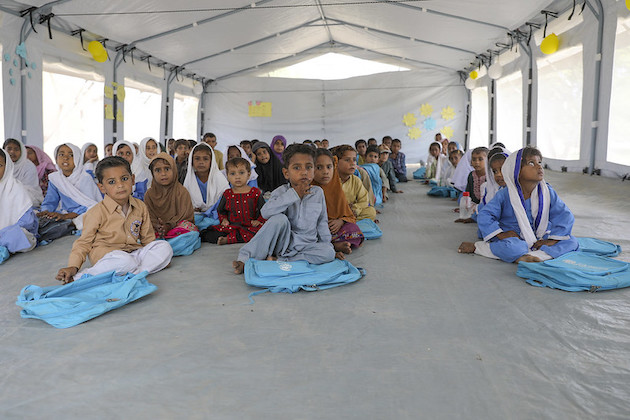
Young girls and boys after receiving UNICEF bags, books, and copies attending their first-class in a UNICEF-supported temporary learning centre next to the flood water in village Allah Dina Channa, district Lasbela, Baluchistan province, Pakistan. The primary school was badly damaged during a heavy monsoon rain in 2022. Credit: UNICEF

Young girls and boys, after receiving UNICEF bags and books, attended their first class in a UNICEF-supported temporary learning centre in Allah Dina Channa village, district Lasbela, Baluchistan province, Pakistan. The primary school was badly damaged during a heavy monsoon rain in 2022. Credit: UNICEF

The 224 million school-aged children globally effected by crises need diverse forms of educational support. Of these, 31 million children are in countries ill-prepared to handle the impacts of severe climate-related crises. Droughts, closely followed by floods, are the most frequently encountered climate-related shocks, which often intertwine and exacerbate one another.

“Education is an essential component in delivering on the promises and commitments outlined in the Paris Agreement, the Sendai Framework for Disaster Risk Reduction, and the Sustainable Development Goals. As all eyes turn toward this year’s Climate Talks (COP28) and the Global Refugee Forum, world leaders must connect climate action with education action,” Sherif emphasizes.

The number of disasters driven, in part, by climate change has increased fivefold in the past 50 years. By 2050, climate impacts could cost the world economy USD 7.9 trillion and could force up to 216 million people to move within their own countries, according to the World Bank. This poses a real and present threat to global security, economic prosperity, and efforts to address the life-threatening impacts of the climate crisis.

Unmitigated, the study shows that the future of millions of children is at risk. Children who are already at risk of dropping out face an even higher risk when exposed to crises worsened by climate change and environmental degradation. In Sub-Saharan Africa, where climate-related crises are prevalent, internally displaced children are 1.7 times more likely to be out of primary school compared to their non-displaced peers.

The study emphasizes that climate change impacts are not gender-neutral. Women and girls are disproportionally affected due to preexisting gender norms. Climate change exacerbates the risks of gender-based violence, school dropouts, food insecurity, and child marriage.

The new appeal outlines a strategic value proposition that connects donors, the private sector, governments, and other key stakeholders to create a coordinated approach to scaling up education funding in response to the climate crisis. The new funding aims to ensure learning continuity by providing mental health and psychosocial support, school rehabilitation and resilience, child protection, gender-based violence prevention and risk mitigation, water, sanitation, and hygiene (WASH), disaster risk reduction, and anticipatory and early action measures.

ECW has championed the right to education for children affected by the global climate crisis. In the aftermath of devasting floods, Libya, Mozambique and Pakistan and spikes in hunger, forced displacement, and violence across the Horn of Africa and the Sahel, the ECW has issued emergency grants to get children and adolescents back to the safety and opportunity that quality education provides.

Within existing programmes in crisis-impacted countries like Bangladesh, Chad, Nigeria, South Sudan and Syria, ECW investments are supporting climate-resilient infrastructure, disaster risk reduction, and school meals, offering hope and opportunity in the most challenging circumstances.

IPS UN Bureau Report

  Source

Africa Will Not Cope with Climate Change Without a Just, Inclusive Energy Transition

Africa, Civil Society, Climate Action, Climate Change, Climate Change Finance, COP28, Editors’ Choice, Energy, Environment, Featured, Headlines, Human Rights, Humanitarian Emergencies, Sustainable Development Goals, TerraViva United Nations

COP28

Climate change impact on Africa has been devastating as this photo taken in the aftermath of Cyclone Idai in Mozambique shows. A just transition is needed. Credit: Denis Onyodi / IFRC/DRK

Climate change impact on Africa has been devastating as this photo taken in the aftermath of Cyclone Idai in Mozambique shows. Credit: Denis Onyodi / IFRC/DRK

NAIROBI, Nov 24 2023 (IPS) – A just transition should be viewed as an opportunity to rectify some of the wrongs where women are not prioritised in the energy mix, yet their experience of the impact of climate change is massive, says Thandile Chinyavanhu, a young South African-based climate and energy campaigner with Greenpeace Africa.


Recent UN scientific research on the state of the climate change crisis and ongoing climate action reveals that the window to reach climate goals is rapidly closing. The world is not on track to reach the goals set out in the Paris Agreement, which commits all countries to pursue efforts to limit the global temperature increase to 1.5°C above pre-industrial levels.

To achieve this goal, emissions must decrease by 45% by 2030 and reach net zero by 2050. Ahead of COP28 in Dubai, United Arab Emirates (UAE), expectations are high that a clear roadmap to net zero progress will be reached, bringing issues of energy, a global energy transition, and energy security into sharp focus.

The energy sector has a significant impact on climate as it accounts for an estimated two-thirds of all harmful greenhouse gas emissions. The burning of fossil fuels is the primary cause of the ongoing global climate change crisis, significantly altering planet Earth. The issue of energy and climate is of particular concern to African countries, especially the Sub-Saharan Africa region, as they also relate to increased vulnerabilities for women, especially rural women. The intersection between energy security and economic growth, poverty reduction, and the empowerment of women and girls is not in doubt.

Still, despite access to reliable, affordable, and sustainable energy for all being articulated under the UN’s SDG 7, one in eight people around the world has no access to electricity. In sub-Saharan Africa alone, nearly 600 million people, or an estimated 53 percent of the region’s population, have no access to electricity. Currently, less than a fifth of African countries have targets to reach universal electricity access by 2030. For some, the silver bullet is to dump fossil fuels and go green; for others, it is an urgent, just, and equitable transition to renewables.

IPS spoke to Chinyavanhu about her role as a social justice and climate activist. She says she wants to contribute to climate change mitigation, ensuring that people and cities are prepared for climate change and can adapt to what is coming.

Thandile Chinyavanhu

Thandile Chinyavanhu

Here are excerpts from the interview.

IPS: Why are current energy systems untenable, considering the ongoing climate change crisis?

Chinyavanhu: On going green and dumping fossil fuels, there are several issues at play, and they vary from country to country. Fossil fuels—coal, oil, and gas—are by far the largest contributors to global climate change, as they account for more than 75 percent of global greenhouse gas emissions and nearly 90 percent of all carbon dioxide emissions. South Africa, for instance, has a big coal mining industry and is one of the top five coal-exporting countries globally. The country relies heavily on coal for about 70 percent of its total electricity production. We need to move away from energy consumption models that are exacerbating the climate crisis, but we must also ensure that we are centred on a just transition.

IPS: What should a ‘just energy transition’ look like for Africa and other developing nations?

Chinyavanhu: Overall, we are looking at issues of socio-economic development models that leave no one behind. To achieve this, renewable energy is the pathway that provides us with energy security and accelerated development. We have serious energy-related challenges due to a lack of preparation and planning around the energy crisis. The challenge is that Africa needs energy and, at the same time, accelerates its development in a manner that leaves no one behind, be it women or any other vulnerable group that is usually left behind in policy responses.

There is a need to address challenges regarding access to energy for all so that, in transitioning to clean energy, we do not have any groups of people being left behind, as has been the case. This is not so much a problem or challenge as an opportunity for countries to address gaps in access to energy and ensure that it is accessible to all, especially women, bearing in mind the many roles they play in society, including nurturing the continent’s future workforce. A just energy transition is people-centred.

We must recognise and take stock of the economic impact that moving from fossil fuels to clean energy could have on people and their livelihoods, such as those in the mining sector. It is crucial that people are brought along in the process of transition, giving them the tools and resources needed for them to be absorbed into new clean energy models. There is a very deep socio-economic aspect to it because people must be given the skills and capacities to engage in emerging green systems and industries.

IPS: As a young woman activist, what do you think the roles of women in an energy transition are?

Chinyavanhu: Women are generally not prioritised, and so they do not have the same opportunities as men, even in matters of climate change adaptation and mitigation, and this is true for sectors such as agriculture and mining. Women have great economic potential and have a very big role to play towards a just energy transition as key drivers of socio-economic progress.

In the green energy space, economic opportunities are opening up. Men are quickly taking over the renewable energy industry, but there are plenty of opportunities for women to succeed if given the right resources. We are at a point in time when we have the opportunity to leave behind polluting technologies and, at the same time, address some of the key socio-economic challenges that have plagued societies for a long time.

This transition should be viewed as an opportunity to rectify some of those wrongs in a way that is people-centred and inclusive. No one should be left behind. It is really about building harmony with nature while also addressing many of the socio-economic issues that plague us today. This is more of an opportunity than a hurdle. It is about understanding and rectifying systems’ thinking that contributes to women being left behind. It is important that we see the bigger picture—identify and acknowledge that different groups—not just women, but any identifier that places people at a point of vulnerability—have been left furthest behind. The energy transition process has presented an opportunity to make it right.
IPS UN Bureau Report

  Source

Bunker Hill’s One Book Program celebrates one of its own

The college’s One Book Program began in 2007 and provides a means for students, faculty, and staff to share the experience of reading and discussing a common text. Expanding on the decades-old concept of the national “One City, One Book” movement, in which public libraries choose a work to promote community-wide discussion, Bunker Hill’s program encourages professors to incorporate the book into their curriculum. Programming throughout the school year includes author talks, book signings, and discussion groups.

Past selections have included “White Space: Essays on Culture, Race, and Writing” by Jennifer De Leon; “The Other Wes Moore” by Maryland Governor Wes Moore; and “The Immortal Life of Henrietta Lacks” by Rebecca Skloot.

Advertisement


Author Caroline Kautsire signs a book for a student at Bunker Hill Community College. Bunker Hill Community College

“This year marks the 50th anniversary of Bunker Hill Community College,” said English professor Naoko Akai-Dennis, coordinator of the One Book Program. “It was a good year to choose someone local and related to community colleges. Students find Caroline approachable and engaging.”

“What Kind of Girl?” by Caroline Kautsire. Austin Macauley Publishers

Kautsire, who earned her bachelor’s degree at UMass Boston, then completed a master’s degree in English at Brown and a master’s of fine arts in creative writing at Emerson, was 17 when she emigrated from Malawi to Boston. Her first memoir, “What Kind of Girl?,” depicts her childhood in Africa; the second book picks up with her arrival in the United States and explores not only culture shock but issues of gender, race, class, sexuality, and the complications of navigating the immigration system.

Advertisement


The idea that her experiences as an immigrant might be worthy of a memoir began to take shape when Kautsire started teaching at Bunker Hill as an adjunct English instructor more than a decade ago.

“I was teaching contemporary African-American literature, so I found myself talking a lot about race and identity,” she said. “And then I had to ask myself, if I’m teaching students how to understand narratives of Black women in literature, where is my story?”

Bunker Hill student John Massaquoi found numerous commonalities between the feelings Kautsire depicted in her memoir and those he has had since he emigrated from Sierra Leone in early 2022.

“As immigrants, we are out of our comfort zone much of the time,” Massaquoi reflected. “We may be self-conscious or feel insecure.” During a recent class discussion about Kautsire’s memoir, Massaquoi found it comforting to learn that many of his classmates felt the same way.

Author Caroline Kautsire discusses her memoir with a Bunker Hill Community College audience. Bunker Hill Community College

Bunker Hill’s main campus is in Charlestown, with a satellite campus in Chelsea and several learning centers throughout Greater Boston. At Massachusetts’ largest community college, 65 percent of students are people of color and more than half are women, according to statistics provided by the school. There are nearly 600 international students who come from 94 countries and speak more than 75 languages.

“My story is meant to be an invitation,” Kautsire said. “This is a conversation, not a monologue. I want to hear my students’ stories; I want people to hear each other. I hope that what I share can help make immigrants feel more confident about navigating American culture.”

Advertisement


Ilsi Hernandez, a student in one of Kautsire’s writing classes, said “I felt a connection to Caroline from the very first chapter, where she talks about arriving in this beautiful country. I came here from Guatemala three years ago. The students in my class come from a range of different countries. We all had some kind of experience like what she describes when we first arrived, anxious to learn English, afraid we would not be understood.”

Kautsire hopes that nonimmigrants will draw insights from her story as well. In the talks she has given on campus so far, she has emphasized that Americans play their own role in this story.

“What does it mean to be an American living in a community with so many people from other countries?” she asked. “We need to hear their stories also, and understand how they feel about their identities as they interact with people who have left their home countries. What do you lose when you leave your home country, what do you gain when you live here, and what can an American learn from the experience of an immigrant?”

Moreover, she pointed out, themes such as financial insecurity and tensions between conformity and nonconformity feel relevant to nearly every college student, regardless of background.

Advertisement


As she takes part in discussions across campus and in the wider community, Kautsire is gaining new insights from what her readers see in her work.

“Knowing Bunker Hill chose my book to discuss is a sign that stories like mine are needed in communities that really want to bring about social and cultural change,” she said. “Not only does it validate the hard work I put into creating positive impact through my art, but it is also confirmation that my voice as a Malawian is relevant in America.

“I always tell my students that one of the responsibilities of a writer is to provide insight that helps us to cure ignorance. The One Book Program allows us to open a space for conversations that will enable us to connect, that will help us to realize that we are one.”

Nancy Shohet West can be reached at nancyswest@gmail.com.

Source