Mexico on the Rights Path

Civil Society, Featured, Gender, Headlines, Health, Human Rights, Latin America & the Caribbean, TerraViva United Nations, Women’s Health

Opinion

Crerdit: Silvana Flores/AFP via Getty Images

MONTEVIDEO, Uruguay, Oct 10 2023 (IPS) – Mexico’s Supreme Court recently declared abortion bans unconstitutional, effectively decriminalising abortion throughout the vast federal country, so far characterised by a legislative patchwork.

The ruling came in response to a lawsuit filed by a civil society organisation, Information Group on Reproductive Choice. It forces the Federal Congress to repeal the Federal Penal Code articles that criminalise abortion. Effective immediately, those seeking abortions and those providing them can no longer be punished for doing so. The ruling also enshrines the right to access abortion procedures in all institutions of the federal health system network, even in states where the crime of abortion remains on the books.


Global trends

Mexico is part of a global, long-term trend of progress in sexual and reproductive rights. According to the Center for Reproductive Rights, the vast majority of countries that have changed their national abortion laws over the past couple of decades have made them less restrictive. Only four countries have gone the other way: El Salvador, Nicaragua, Poland and the USA.

Several Latin American countries have been swept by the ‘green tide’ that originated in Argentina, increasingly liberalising abortion laws. Before the 2010s, abortion was legal in only one Latin American country, Cuba. It was legalised in Uruguay in 2012, and eight years later in Argentina. Colombia decriminalised abortion in February 2022, and other countries, such as Chile and Ecuador, have since made it legal on limited grounds, notably when pregnancy is a result of rape – which women’s rights organisations see as a milestone on the road to full legalisation.

Globally, abortion is currently legal on request in 75 countries, often until 12 weeks into pregnancy. Around a dozen more allow it for broad socio-economic reasons. Many more permit it for specific reasons such as health grounds or to save a pregnant person’s life.

But abortion remains banned under any circumstances in 24 countries, and overall 40 per cent of women of reproductive age live under restrictive abortion laws. These restrictions have a significant impact on women: it’s estimated that unsafe abortions costs the lives of 39,000 women and girls every year.

A legislative patchwork

The trend towards decriminalisation in Mexico kicked off in 2007 in Mexico City, and it took 12 years for another state, Oaxaca, to follow its lead. Change accelerated in recent years, with Hidalgo and Veracruz legalising abortion in 2021.

In September 2021, the federal Supreme Court issued its first-ever decision on abortion rights, unanimously recognising a constitutional right to safe, legal and free abortion services within a ‘short period’ early in pregnancy, and on specific grounds later. The ruling came in response to a lawsuit against the state of Coahuila, which imposed prison terms of up to three years for voluntary abortion.

Although this ruling only applied to Coahuila, it had a wider impact: judges in other states were no longer able to sentence anyone for the crime of voluntary abortion in the early stages of pregnancy.

Two days after this judgment, the Supreme Court addressed another lawsuit concerning the state of Sinaloa, issuing a ruling that declared it unconstitutional for state laws to redefine the legal concept of personhood by protecting ‘human life from conception’. And soon after, it declared invalid the principle of conscientious objection for medical practitioners in the General Health Law. A couple of months earlier it had ruled unconstitutional the time limits set by some states for abortions in cases of rape.

By the time of the Coahuila ruling, only four federal entities allowed abortion on demand up to 12 weeks. But several have changed their laws since, and by the time of the latest Supreme Court ruling, abortion on demand was already legal in 12 of Mexico’s 32 states. All states also allowed abortions for pregnancies resulting from rape, most allowed abortion when necessary to save a pregnant person’s life, and several allowed it in cases of risks to a pregnant person’s health or severe congenital foetal abnormalities.

Regional experience however suggests that making abortion conditional on exceptional grounds that must be proven tends to result in denial of access. Additionally, in Mexico, access by particularly vulnerable women has often been restricted through resistance in bureaucracies and medical institutions, even in states where abortion is legal.

Now Congress has until the end of its current session, which runs until 15 December, to amend the Penal Code clauses that criminalise abortion. But even after this, abortion will continue to be a state-level crime in 20 states. This means that abortion complaints will continue to be filed in those states. In most cases judges will ultimately have to dismiss the charges – but women will continue to be subjected to unnecessary barriers and uncertainty. For this reason, the women’s rights movement is pushing locally for decriminalisation in every Mexican state.

Effective access the next struggle

Mexican women’s rights groups are getting ready for what promises to be a long battle for effective access. They feel confident, for now, that thanks to decades of hard work public opinion is on their side. But they know that, while there may be less up-front resistance than before, there are still powerful forces against change. Resistance manifests in the imposition of barriers to prevent effective access to what is now recognised as a right, particularly for people from the most excluded groups in society.

Denial of access can take many forms: long waiting times, the need for multiple doctors’ appointments and parental or marital consent, disinformation and the extension of conscientious objection from individual health personnel to entire institutions.

Sexual and reproductive health, including abortion procedures, is basic healthcare and should be easily accessible to all. Mexican feminists know this, and will continue fighting to change both policy and minds so nobody is denied access to their rights.

Inés M. Pousadela is CIVICUS Senior Research Specialist, co-director and writer for CIVICUS Lens and co-author of the State of Civil Society Report.

  Source

Bahrain’s Political Prisoners: Resistance Against the Odds

Civil Society, Crime & Justice, Democracy, Featured, Headlines, Human Rights, Middle East & North Africa, TerraViva United Nations

Opinion

Credit: Mohammed al-Shaikh/AFP via Getty Images

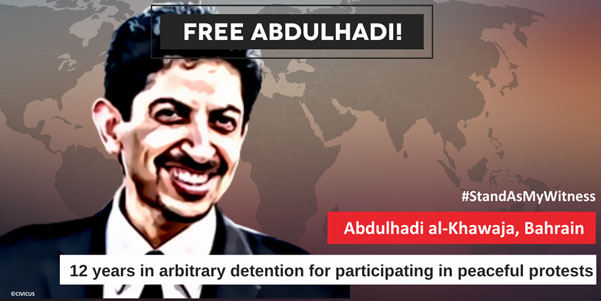
MONTEVIDEO, Uruguay, Sep 26 2023 (IPS) – Maryam al-Khawaja’s journey home ended before it had begun: British Airways staff stopped her boarding her flight at the request of Bahraini immigration authorities. Maryam was no regular passenger: her father is veteran human rights activist Abdulhadi al-Khawaja, in jail in Bahrain for 12 years and counting.


Abdulhadi was sentenced to life in prison on bogus terrorism charges for his role in 2011 democracy protests, part of the ‘Arab Spring’ regional wave of mobilisations. His health, weakened due to denial of medical care, has further declined as he joined other political prisoners in a hunger strike demanding improvements in prison conditions.

Emerging from the unlikeliest place – a prison designed to break wills and destroy the desire for freedom – this hunger strike has become the biggest organised protest Bahrain has seen in years.

Maryam has four judicial cases pending in Bahrain but was ready to spend years in prison if this was what it took to save her father’s life. This is far from Abdulhadi’s first hunger strike, but his family warns that his fragile health means it could be his last. In denying Maryam the chance to see her father, the Bahraini regime has reacted as those who rule by fear often do: in fear of those who aren’t afraid of them.

A prison state

The Bahraini cracked down severely on the 2011 protests, unleashing murderous security force violence to clear protest sites, arresting scores of protesters, activists and opposition leaders, subjecting them to mass trials and stripping hundreds of citizenship. It sentenced 51 people to death and has executed six, while 26 wait on death row having exhausted their appeals. Most were convicted on the basis of confessions obtained through torture.

Many of those arrested in the 2011 protests and subsequent crackdown remain behind bars. According to estimates from the Bahrain Center for Human Rights, over the past decade the government has arrested almost 15,000 people for their political views, and between 1,200 and 1,400 are still jailed, mostly in Jau prison in Manama, the capital. Abdulhadi is one of many.

On 7 August, Jau’s political prisoners went on hunger strike. Their demands include an end to solitary confinement, more time outside cells – currently they’re only allowed out for an hour a day, permission to hold prayers in congregation, amended visitation rules and access to adequate medical care and education. Over the following weeks the numbers taking part grew to more than 800. Their families took to the streets to demand their release.

On 31 August, the political prisoners extended their protest after rejecting the government’s offer of only minor improvements.

On 11 September, a two-week suspension of the strike was announced to allow the government to fulfil promises to improve conditions, including ending isolation for some prisoners. It seemed clear the government had shifted position to avoid embarrassment as Bahrain’s Crown Prince and Prime Minister Salman bin Hamad Al-Khalifa prepared to meet US President Joe Biden.

Abdulhadi, however, soon resumed his hunger strike after being denied access to a scheduled medical appointment, only to suspend it a few days later when he was promised improvements in conditions, including a cardiologist appointment. But the next day it became apparent that these were all lies, and he resumed his hunger strike. It felt, as Maryam put it, ‘like psychological warfare and an attempt to kill solidarity’.

International solidarity urgently needed

In her attempt to return to Bahrain, Maryam received strong international support. Several Bahraini, regional and international civil society groups backed a joint letter urging European Union authorities to call for the immediate and unconditional release of all Bahrain’s political prisoners. A similar letter was sent to the UK government.

In late 2022, backlash from human rights organisations forced Bahrain to withdraw its candidacy for a UN Human Rights Council seat. And earlier this year, during the Inter-Parliamentary Union’s global assembly in Bahrain, which the regime sought to use for whitewashing purposes, parliamentarians called on Bahrain to release Abdulhadi and send him to Denmark for medical treatment.

But while Bahrain’s political prisoners have many allies, some powerful voices aren’t among them.

Bahrain’s foreign allies include not only repressive autocracies such as Saudi Arabia and the United Arab Emirates but also democratic states, notably the UK and the USA, which clearly value stability and security far more highly than democracy and human rights.

Following Bahrain’s independence in 1971, the UK has continued to back the institutions it established – and has pretended to see progress towards democratic reform. In July, Bahrain’s Crown Prince made an official visit to the UK, where he met Prime Minister Rishi Sunak and signed a ‘Strategic Investment and Collaboration Partnership’ between the two countries. This included a US$1 billion investment deal in the UK. Barely a month before the start of the hunger strike, Sunak welcomed ‘progress on domestic reforms in Bahrain, particularly in relation to the judiciary and legal process’.

For the USA, Bahrain has been a ‘major non-NATO ally‘ since 2002 and a ‘major security partner’ since 2021. Bahrain was the first state in the region to be accorded major non-NATO ally status, the first to host a major US military base and the first, in 2006, to sign a free trade agreement with the USA. The US Navy’s Fifth Fleet, one of seven around the world, is stationed there, and the country hosts the headquarters of the US Naval Forces Central Command.

On 13 September, the Crown Prince visited Washington DC and signed a ‘Comprehensive Security Integration and Prosperity Agreement’ meant to scale up military and economic cooperation with the USA.

Only in the last paragraph of its pages-long announcement, meticulously detailed in every other respect, did the White House briefly acknowledge that human rights were an item of discussion. Nothing was said about the content or outcome of those alleged conversations.

The USA has been repeatedly chastised for a ‘selective defence of democracy‘. President Biden promised a foreign policy centred around human rights, but that rings hollow in Bahrain. It’s high time the USA, the UK and other democratic states use the many levers at their disposal to urge the Bahraini government to free its thousands of political prisoners and move towards real democratic reform.

Inés M. Pousadela is CIVICUS Senior Research Specialist, co-director and writer for CIVICUS Lens and co-author of the State of Civil Society Report.
  Source

Iran: One Year on, What’s Changed?

Active Citizens, Civil Society, Crime & Justice, Democracy, Economy & Trade, Featured, Gender, Headlines, Human Rights, Middle East & North Africa, TerraViva United Nations, Youth

Opinion

Credit: Dan Kitwood/Getty Images

MONTEVIDEO, Uruguay, Sep 19 2023 (IPS) – It’s a year since a photo of 22-year-old Mahsa Amini – bruised and in a coma she would never recover from after being arrested by the morality police for her supposedly improperly worn hijab – went viral, sending people onto the streets.


The protests became the fiercest challenge ever faced by Iran’s theocratic regime. The unprecedented scale of the protests was matched by the unparalleled brutality of the crackdown, which clearly revealed the regime’s fear for its own survival.

Led by women and young people, mobilisations under the ‘Woman, Life, Freedom’ banner articulated broader demands for social and political change. They spread like wildfire – to streets across Iran, to universities, even to cemeteries where growing numbers of the regime’s victims were being buried. They were echoed and amplified by the Iranian diaspora around the world. The Iranian people made it abundantly clear they wanted the Islamic Republic gone.

A year on, the theocratic regime still stands, but that doesn’t mean nothing has changed. By sheer force, the authorities have regained control – at least for now. But subtle changes in daily life reveal the presence of active undercurrents that could once again spark mass protests. The regime knows this, hence the fear with which it has awaited this date and its redoubled repression as it neared.

A glimpse of change

Last December, as protests raged and the authorities were busy trying to stop them, women could be seen on Iranian streets without their hijabs for the first time in decades. After the protests were quelled, many simply refused to resubmit to the old rules. A tactical shift followed, with mass street mobilisation turning into more elusive civil disobedience.

Women, particularly Gen Z women just like Mahsa, continue to protest on a daily basis, simply by not abiding by hijab rules. Young people express their defiance by dancing or showing affection in public. Cities wake up to acts of civil disobedience emblazoned on their walls. Anti-regime slogans are heard coming from seemingly nowhere. In parts of the country where many people from excluded ethnic minorities live, protest follows Friday prayers. It may take little for the embers of rebellion to reignite.

Preventative repression

Ahead of the anniversary, family members of those killed during the 2022 protests were pressured not to hold memorial services for their loved ones. The lawyer representing Mahsa Amini’s family was charged with ‘propaganda against the state’ due to interviews with foreign media. University professors suspected to be critical of the regime were dismissed, suspended, forced to retire, or didn’t have their contracts renewed. Students were subjected to disciplinary measures in retaliation for their activism.

Artists who expressed support for the protest movement faced reprisals, including arrests and prosecution under ridiculous charges such as ‘releasing an illegal song’. Some were kept in detention on more serious charges and subjected to physical and psychological torture, including solitary confinement and beatings.

Two months ago, the regime put the morality police back on the streets. Initial attempts to arrest women found in violation of hijab regulations, however, were met with resistance, leading to clashes between sympathetic bystanders and police. Women, including celebrities, have been prosecuted for appearing in public without their hijab. Car drivers carrying passengers not wearing hijab have been issued with traffic citations and private businesses have been closed for noncompliance with hijab laws.

The most conservative elements of the regime have doubled down, proposing a new ‘hijab and chastity’ law that seeks to impose harsher penalties, including lashes, heavy fines and prison sentences of up to 10 years for those appearing without the hijab. The bill is now being reviewed by Iran’s Guardian Council, a 12-member, all-male body led by a 97-year-old cleric.

[embedded content]

If not now, then anytime

In the run-up to 16 September, security force street presence consistently increased, with snap checkpoints set up and internet access disrupted. The government clearly feared something big might happen.

As the anniversary passes, the hardline ruling elite remains united and the military and security forces are on its side, while the protest movement has no leadership and has taken a bad hit. Some argue that what made it spread so fast – the role of young people, and young women in particular – also limited its appeal among wider Iranian society, and particularly among low-income people concerned above all with economic strife, rising inflation and increasing poverty.

There are ideological differences among the Iranian diaspora, which formed through successive waves of exiles and includes left and right-wing groups, monarchists and ethnic separatists. While most share the goal of replacing the authoritarian theocracy with a secular democracy, they’re divided over strategy and tactics, and particularly on whether sanctions are the best way to deal with the regime.

Ever since the protests took off last year, thousands of people around the world have shown their support and called on their governments to act. And some have, starting with the USA, which early on imposed sanctions on the morality police and senior police and security officials. New sanctions affecting 29 additional people and entities, including 18 members of the Islamic Revolutionary Guard Corps and security forces, were imposed on the eve of the anniversary of the protests, 15 September, International Day of Democracy. That day, US President Joe Biden made a statement about Mahsa Amini’s inspiration of a ‘historic movement’ for democracy and human dignity.

The continuing outpouring of international solidarity shows that the world still cares and is watching. A new regime isn’t around the corner in Iran, but neither is it game over in the quest for democracy. For those living under a murderous regime, every day of the year is the anniversary of a death, an indignity or a violation of rights. Each day will therefore bring along a new opportunity to resurrect rebellion.

Inés M. Pousadela is CIVICUS Senior Research Specialist, co-director and writer for CIVICUS Lens and co-author of the State of Civil Society Report.

  Source

The UN’s Own Relevance Is at Stake at This Year’s General Assembly

Armed Conflicts, Civil Society, Climate Change, Crime & Justice, Development & Aid, Featured, Global, Headlines, Health, Human Rights, Inequality, Peace, Sustainable Development Goals, TerraViva United Nations

Opinion

United Nations Secretary General Antonio Guterres addresses the 22nd session of the Permanent Forum on Indigenous Issues at the General Assembly Hall of the United Nations headquarters in New York City on 17 April 17 2023. Credit: Ed Jones/AFP via Getty Images

NEW YORK, Sep 7 2023 (IPS) – This September, world leaders and public policy advocates from around the world will descend on New York for the UN General Assembly. Alongside conversations on peace and security, global development and climate change, progress – or the lack of it – on the Sustainable Development Goals (SDGs) is expected to take centre-stage. A major SDG Summit will be held on 18 and 19 September. The UN hopes that it will serve as a ‘rallying cry to recharge momentum for world leaders to come together to reflect on where we stand and resolve to do more’. But are the world’s leaders in a mood to uphold the UN’s purpose, and can the UN’s leadership rise to the occasion by resolutely addressing destructive behaviours?


Sadly, the world is facing an acute crisis of leadership. In far too many countries authoritarian leaders have seized power through a combination of populist political discourse, outright repression and military coups. Our findings on the CIVICUS Monitor – a participatory research platform that measures civic freedoms in every country – show that 85% of the world’s population live in places where serious attacks on basic fundamental freedoms to organise, speak out and protest are taking place. Respect for these freedoms is essential so that people and civil society organisations can have a say in inclusive decision making.

UN undermined

The UN Charter begins with the words, ‘We the Peoples’ and a resolve to save future generations from the scourge of war. Its ideals, such as respect for human rights and the dignity of every person, are being eroded by powerful states that have introduced slippery concepts such as ‘cultural relativism’ and ‘development with national characteristics’. The consensus to seek solutions to global challenges through the UN appears to be at breaking point. As we speak hostilities are raging in Ukraine, Sudan, the Occupied Palestinian Territories and the Sahel region even as millions of people reel from the negative consequences of protracted conflicts and oppression in Afghanistan, Ethiopia, Myanmar, Syria and Yemen, to name a few.

Article 1 of the UN Charter underscores the UN’s role in harmonising the actions of nations towards the attainment of common ends, including in relation to solving international problems of an economic, social, cultural or humanitarian character, and to promote respect for human rights and fundamental freedoms for all. But in a time of eye-watering inequality within and between countries, big economic decisions affecting people and the planet are not being made collectively at the UN but by the G20 group of the world’s biggest economies, whose leaders are meeting prior to the UN General Assembly to make economic decisions with ramifications for all countries.

Economic and development cooperation policies for a large chunk of the globe are also determined through the Organisation for Economic Cooperation and Development (OECD). Established in 1961, the OECD comprises 38 countries with a stated commitment to democratic values and market-based economics. Civil society has worked hard to get the OECD to take action on issues such as fair taxation, social protection and civic space.

More recently, the BRICS – Brazil, Russia, India, China and South Africa – grouping of countries that together account for 40 per cent of the world’s population and a quarter of the globe’s GDP are seeking to emerge as a counterweight to the OECD. However, concerns remain about the values that bind this alliance. At its recent summit in South Africa six new members were admitted, four of which – Egypt, Iran, Saudi Arabia and the United Arab Emirates – are ruled by totalitarian governments with a history of repressing civil society voices. This comes on top of concerns that China and Russia are driving the BRICS agenda despite credible allegations that their governments have committed crimes against humanity.

The challenge before the UN’s leadership this September is to find ways to bring coherence and harmony to decisions being taken at the G20, OECD, BRICS and elsewhere to serve the best interests of excluded people around the globe. A focus on the SDGs by emphasising their universality and indivisibility can provide some hope.

SDGs off-track

The adoption of the SDGs in 2015 was a groundbreaking moment. The 17 ambitious SDGs and their 169 targets have been called the greatest ever human endeavour to create peaceful, just, equal and sustainable societies. The SDGs include promises to tackle inequality and corruption, promote women’s equality and empowerment, support inclusive and participatory governance, ensure sustainable consumption and production, usher in rule of law and catalyse effective partnerships for development.

But seven years on the SDGs are seriously off-track. The UN Secretary-General’s SDG progress report released this July laments that the promise to ‘leave no one behind’ is in peril. As many as 30 per cent of the targets are reported to have seen no progress or worse to have regressed below their 2015 baseline. The climate crisis, war in Ukraine, a weak global economy and the COVID-19 pandemic are cited as some of the reasons why progress is lacking.

UN Secretary-General Antonio Guterres is pushing for an SDG stimulus plan to scale up financing to the tune of US$500 billion. It remains to be seen how successful this would be given the self-interest being pursued by major powers that have the financial resources to contribute. Moreover, without civic participation and guarantees for enabled civil societies, there is a high probability that SDG stimulus funds could be misused by authoritarian governments to reinforce networks of patronage and to shore up repressive state apparatuses.

Also up for discussion at the UN General Assembly will be plans for a major Summit for the Future in 2024 to deliver the UN Secretary-General’s Our Common Agenda report, released in 2021. This proposes among other things the appointment of a UN Envoy for Future Generations, an upgrade of key UN institutions, digital cooperation across the board and boosting partnerships to drive access and inclusion at the UN. But with multilateralism stymied by hostility and divisions among big powers on the implementation of internationally agreed norms, achieving progress on this agenda implies a huge responsibility on the UN’s leadership to forge consensus while speaking truth to power and challenging damaging behaviours by states and their leaders.

The UN’s leadership have found its voice on the issue of climate change. Secretary-General Guterres has been remarkably candid about the negative impacts of the fossil fuel industry and its supporters. This July, he warned that ‘The era of global warming has ended; the era of global boiling has arrived’. Similar candour is required to call out the twin plagues of authoritarianism and populism which are causing immense suffering to people around the world while exacerbating conflict, inequality and climate change.

The formation of the UN as the conscience of the world in 1945 was an exercise in optimism and altruism. This September that spirit will be needed more than ever to start creating a better world for all, and to prove the UN’s value.

Mandeep S. Tiwana is chief officer for evidence and engagement + representative to the UN headquarters at CIVICUS, the global civil society alliance.

  Source

Guatemala: Change Within Reach

Civil Society, Crime & Justice, Democracy, Featured, Headlines, Latin America & the Caribbean, Press Freedom, TerraViva United Nations

Opinion

Credit: Luis Acosta/AFP via Getty Images

MONTEVIDEO, Uruguay, Aug 29 2023 (IPS) – On 20 August, Guatemala witnessed a rare event: despite numerous attempts to stop it, the will of the majority prevailed. Democracy was at a dramatic crossroads, but voters got their say, and said it clearly: the country needs dramatic change and needs it now.


Bernardo Arévalo, leader of the progressive Movimiento Semilla (Seed Movement), born out of 2015 anti-corruption protests, is now Guatemala’s president-elect. All-night street celebrations erupted as early results were announced. It was a once-in-a-lifetime occurrence: politics bringing joy rather than disappointment to Guatemalans.

But renewed attempts to prevent change can be expected. What Guatemalans expect from Arévalo is a morally competent government that will bring about genuine democracy – a government looking out for the public rather than self-serving elites. The unprecedented seriousness of Arévalo’s promise is reflected in the fear his rise has fuelled among the beneficiaries of the current authoritarian kleptocracy.

A blatant manipulation of judicial institutions after the first round of voting on 25 June failed to prevent Arévalo competing in the runoff – but now the attempt is to stop his inauguration. Following the runoff, the Public Prosecutor made yet another attempt to have Semilla suspended.

The stakes are so high that an attempt to stop change by force can’t ruled out. An assassination plot involving state and non-state forces came to light days before the runoff.

For security reasons, Arévalo couldn’t address the crowds celebrating on election night. On 24 August, the Inter-American Commission on Human Rights granted precautionary measures to Arévalo and vice-president-elect Karin Herrera, giving the state 15 days to report back on the adoption of additional measures – both already have state-issued security – to protect their physical integrity.

Guatemalans are counting the days to the inauguration of their new government, scheduled for 14 January 2024. But their hope is mingled with uncertainty and fear.

An election surprise and its aftermath

The collective mood on 20 August couldn’t have been more different from that on 25 June, when first place in the first round went to invalid votes.

The run-up to the June vote had been marked by further deterioration of civic space and the restriction of the choice on offer through the disqualification of several contenders, including the candidate first in the polls, conservative business leader Carlos Pineda Soa. But Arévalo wasn’t on the radar of opinion polls and no one saw him coming. In a very fragmented vote, his 12 per cent put him in the runoff. The frontrunner, with 16 per cent, was a political insider, former first lady Sandra Torres of the National Unity of Hope (UNE).

The establishment rightfully feared Arévalo because he didn’t seem the kind they could easily bring into the fold. A progressive academic and a member of Congress since 2020, he promised to bring back the numerous justice officials in exile and resume the fight against corruption ended by his predecessors.

The fact that he could become Guatemala’s next president made the 25 June election results an instant object of contention. Nine parties, including UNE, submitted complaints about supposed ‘irregularities’ that had gone undetected by all international observers. Their supporters converged outside the Supreme Electoral Tribunal (TSE).

In what was denounced as an attempted ‘electoral coup’, the Constitutional Court ordered a recount and instructed the TSE to suspend certification of results. The TSE eventually endorsed the results two weeks later, on 12 July.

But in the meantime, the Attorney General, an official under US corruption sanctions, spearheaded an onslaught of judicial harassment against Arévalo. She launched an investigation of Semilla for alleged registration irregularities and had its offices raided. She twice ordered raids on TSE offices too. And just as the TSE announced Torres and Arévalo as the runoff competitors, she ordered Semilla’s suspension. The Constitutional Court however blocked this order.

Citizens defend democracy

The European Union and the Organization of American States, both of which had observation missions, took a strong stance. Domestic condemnation of the attempt to twist the results was also voiced by groups ranging from leading business associations to Indigenous authorities. But the starring role was played by citizens who spent weeks on the alert to ensure that Arévalo wasn’t kicked out of the runoff.

Large-scale peaceful demonstrations were repeatedly held in Guatemala City and departmental capitals, overwhelmingly led by young people. They were vocally nonpartisan, making clear that they were marching not for Arévalo or Semilla, but for the future of democracy.

On election day, this translated into a clear victory for the change candidate: Arévalo took 58 per cent of the vote, compared to Torres’s 37.2 per cent. The election saw strong participation by young, educated, urban voters, many voting for the first time.

An uncertain future

Once he takes office Arévalo will face a tough time fulfilling his promises, not least because the June election produced a highly fragmented Congress in which Semilla will have only 23 of 160 seats.

But the urgent question now is what lengths deeply entrenched elites will go to to try and stop Arévalo taking office. Torres hasn’t conceded defeat. Instead, she’s cried foul and accused the five TSE magistrates of ‘breach of duties and abuse of authority’.

Meanwhile the Attorney General and her right-hand man, a prosecutor who has made a career of protecting the powerful and persecuting the press, continue the ‘investigation’ through which they seek to shut Semilla down. People have responded by continuing to demonstrate outside the Attorney General’s office demanding her resignation.

Guatemala is living a unique moment, an opportunity that many didn’t think they’d ever see. But it’s also an uncertain time. Guatemala must walk carefully into the future, one step at a time, resisting the onslaught, judicial or otherwise, to get the president-elect to Inauguration Day.

People have made it clear they’re ready to take to the streets in numbers to defend what they’ve achieved. And they’ll need to both support and hold to account the new government for the mission it’s been entrusted with: that of restoring the substance of democracy.

Inés M. Pousadela is CIVICUS Senior Research Specialist, co-director and writer for CIVICUS Lens and co-author of the State of Civil Society Report.

  Source

Senegal: Democracy in the Balance?

Africa, Civil Society, Crime & Justice, Economy & Trade, Featured, Gender, Headlines, Human Rights, Labour, Press Freedom, TerraViva United Nations

Opinion

Credit: Zohra Bensemra/Reuters via Gallo Images

LONDON, Aug 18 2023 (IPS) – Civic space is deteriorating in Senegal ahead of next February’s presidential election. Recent protests have been met with lethal violence and internet and social media restrictions. Senegal’s democracy will soon face a key test, and whether it passes will depend largely on whether civic space is respected.


Political conflict

Recent protests have revolved around the populist opposition politician Ousmane Sonko. Sonko came third in the 2019 presidential election and has grown to be the biggest thorn in President Macky Sall’s side. He’s won support from many young people who see the political elite as corrupt, out of touch and unwilling to tackle major social and economic problems such as the country’s high youth unemployment. He’s also been the subject of a recent criminal conviction that his supporters insist is politically motivated.

On 1 June, Sonko was sentenced to two years in jail for ‘corrupting youth’. This resulted from his arrest on rape charges in March 2021. Although he was cleared of the most serious charges – something women’s rights advocates have expressed concern about – his conviction likely makes him ineligible to stand in the next presidential election.

Sonko’s arrest in March 2021 triggered protests in which 14 people died. His conviction set off a second wave of protests. Sonko was arrested again on 28 July on protest-related charges, including insurrection. A few days later, the government dissolved his party, Pastef. It’s the first such ban since Senegal achieved independence in 1960.

All of this gave fresh impetus to Sonko’s supporters, who accuse the government of instrumentalising the judiciary and criminal justice system to stop a credible political threat.

Repressive reaction

The latest wave of protests saw instances of violence, including stone-throwing, tyre burning and looting. The state responded with lethal force. According to civil society estimates, since March 2021 over 30 people have been killed, more than 600 injured and over 700 detained.

In response to the recent protests, the army was deployed in the capital, Dakar. Live ammunition was used and armed people dressed in civilian clothes, evidently embedded with security forces, violently attacked protesters.

Journalists were harassed and arrested while covering protests. Recent years have seen a rise in verbal and physical attacks on journalists, along with legal action to try to silence them. Several journalists were arrested in relation to their reporting on Sonko’s prosecution. Investigative journalist Pape Alé Niang has been jailed three times in less than one year.

The government also limited internet access and TV coverage. TV station Walf TV was suspended over its protest coverage. On 1 June, social media access was restricted and on 4 June mobile internet was shut down for several days. In August, TikTok access was blocked. Restrictions harmed both freedom of expression and livelihoods, since many small traders rely on mobile data for transactions.

Third-term tussle

A major driver of protests and Sonko’s campaign was speculation that Sall might be tempted to seek a third presidential term. The constitution appeared to be clear on the two-term limit, but Sall’s supporters claimed constitutional amendments in 2016 had reset the count. Thousands mobilised in Dakar on 12 May, organised by a coalition of over 170 civil society groups and opposition parties, to demand that Sall respect the two-term limit.

On 3 July, Sall finally announced that he wasn’t running again. But it hasn’t ended suspicion that the ruling Alliance for the Republic (APR) party will go to any lengths stay in power, including using the state’s levers to weaken the opposition.

There’s precedent here: ahead of the Sall’s re-election in 2019, two prominent opposition politicians who might have presented a serious challenge were excluded. In both cases, barely weeks before the election the Constitutional Council ruled them ineligible due to prior convictions on corruption charges that were widely believed to have been politically motivated.

That Sonko and Pastef might have stood a chance in 2024 was suggested by the results of votes in 2022. In local elections, the APR lost control of Dakar and Sonko was elected mayor of Ziguinchor city. And then in parliamentary elections, the APR lost 43 of its 125 seats and Pastef finished second, claiming 56 seats, leaving no party with a majority.

Reputation on the line

Senegal long enjoyed an international reputation for being a relatively stable and democratic country in a region that’s experienced numerous democratic setbacks. With West African countries such as Burkina Faso, Guinea, Mali and now Niger under military control, and others like Togo holding deeply flawed elections, Senegal stood out. It’s held several free elections with changes of power.

The country’s active and youthful civil society and relatively free media have played a huge part in sustaining democracy. When President Abdoulaye Wade sought an unconstitutional third term in 2012, social movements mobilised. The Y’en a marre (‘I’m fed up’) movement got out the youth vote to oust Wade in favour of Sall. Wade himself rode a similar youth wave in 2000. So Sall and his party are surely aware of the power of social movements and the youth vote.

A small step forward was taken recently when parliament voted to allow the two opposition candidates who’d been blocked in 2019 to stand in 2024. But the government needs to do much more to show its commitment to democratic rules.

Upholding protest rights would be a good start. The repeated use of violence and detention of protesters points to a systemic problem. No one has been held to account for killings and other rights violations. It’s high time for accountability.

Media freedoms need to be respected and people detained for exercising their civic freedoms must be released. For Senegal to live up to its reputation, Sall should strive to enter history as the president who kept democracy alive – not the one who buried it.

Andrew Firmin is CIVICUS Editor-in-Chief, co-director and writer for CIVICUS Lens and co-author of the State of Civil Society Report.

  Source



