Iran, Back to the Grim Normal

Civil Society, Crime & Justice, Featured, Gender, Gender Violence, Headlines, Human Rights, Middle East & North Africa, Press Freedom, Religion, TerraViva United Nations

Opinion

Credit: Mike Segar/Reuters via Gallo Images

MONTEVIDEO, Uruguay, Jan 16 2024 (IPS) – Iran’s time of public rebellion has ended. The protesters marching, chanting, and dancing under the ‘Woman, Life, Freedom’ banner have long stopped. And shifting regional dynamics may play to the regime’s favour.


Protest wave repressed

The wave of protest against the theocratic regime started on 16 September 2022 and lasted far longer than anyone could have predicted. But by the one-year mark it had all but died down, its unprecedented scale and reach superseded by the unparalleled brutality of the crackdown.

The regime murdered hundreds of protesters, injured thousands and arrested tens of thousands. It subjected many to torture, sexual abuse and denial of medical treatment while in detention.

It weaponised the criminal justice system, holding express trials behind closed doors in ‘revolutionary courts’ presided over by clerics, with zero procedural guarantees. It sentenced hundreds – including journalists – to years in jail and handed out several death sentences. According to the UN Special Rapporteur on Iran, some of the human rights violations committed by the regime could constitute crimes against humanity.

Shortly after the first anniversary of the protests, on 6 October, it was announced that the 2023 Nobel Peace Prize had been awarded to Narges Mohammadi, an imprisoned Iranian woman activist with 20 years of struggle for democracy, human rights and women’s rights under her belt. Over the years, she’d been arrested 13 times, sentenced to 31 years in prison and 154 lashes, and been in prison three times. She received the news behind bars.

Ahead of the anniversary, afraid of protests returning, the theocratic regime put back on the streets the morality police whose intervention had resulted in Mahsa Amini’s death. Conservatives proposed a new ‘hijab and chastity’ law that would impose a stricter dress code and harsher penalties for violations.

The reinforcement of morality rules soon claimed its next victim. On 1 October, high school student Armita Garawand was left unconscious, reportedly assaulted by a hijab enforcer for not wearing a headscarf. She remained in a coma for several weeks before dying on 28 October. At her funeral mourners were assaulted and dozens were arrested, including well-known human rights lawyer Nasrin Sotoudeh.

Succession

Battered but unbeaten, the Iranian regime views upcoming legislative elections as part of its road to recovery. On 1 March, people will be called on to vote for all 290 members of the Islamic Consultative Assembly. The key battle will be over turnout, which was already down to 42 per cent in 2020 – the lowest since the 1979 revolution. That record could be shattered, as opposition and reformists call for abstention or boycott.

Along with parliamentary elections, in March Iran will hold elections for the Council of Experts, the body of clerics that appoints Iran’s Supreme Leader. The Council has recently faced criticism for its lax oversight of 84-year-old Supreme Leader Ayatollah Ali Khamenei’s performance, and might have to step in relatively soon.

In power since 1989, Khamenei is in a race against the clock. Bent on ensuring that the theocracy he largely built stands strong after he’s gone, he’s preparing his 54-year-old second son to succeed him. But the ongoing economic crisis may conspire against his plans. The cumulative impacts of international sanctions, fluctuating oil prices, mismanagement and rampant corruption have fuelled inflation and unemployment, and discontent runs high.

To prevent accumulated grievances from translating into mass protest, the regime will likely try to tread a fine line between displaying indestructible power and offering minor concessions.

Regional balance shifts

When the protests erupted international support poured in. People around the world showed solidarity with Iranian women and called on their governments to act. Early on, the USA imposed sanctions on the morality police and several senior leaders of the force and other security agencies. New sanctions by the European Union, UK and USA were announced on the eve of the anniversary of the protests.

On International Women’s Day in 2023, a group of Afghan and Iranian women launched the End Gender Apartheid campaign, which seeks recognition and condemnation of the two regimes as based on gender apartheid. They want the 1973 UN Convention on the Suppression and Punishment of the Crime of Apartheid, which so far applies only to racial hierarchies, extended to gender. The campaign wants this specific and extreme form of exclusion to be codified as a crime under international law so those responsible can be prosecuted and punished.

There was hope that such moves would foster action to hold those responsible to account. Civil society called for the creation of a dedicated accountability mechanism to work alongside the UN Special Rapporteur on Iran.

But on 7 October, as Armita lay in a coma, the paramilitary wings of Hamas launched their attacks into Israeli territory, and global attention shifted to this outrage and Israel’s murderous campaign of revenge. As a key source of support for Hamas, Iran was far from out of the spotlight – but condemnation of theocracy and gender apartheid now took a back seat to geopolitical considerations.

Khamenei publicly stated that Iran wasn’t involved in the 7 October attacks, and although he reiterated Iran’s political and moral support for Hamas, he reportedly told Hamas leader Ismail Haniyeh that Iran wouldn’t directly intervene unless it was attacked by Israel or the USA. But Iran’s leadership of the anti-Israeli and anti-western ‘Axis of Resistance’ and the key role it can play in either expanding or limiting the scope of the conflict means it will be included in any attempt to redefine the regional order, and could well emerge stronger.
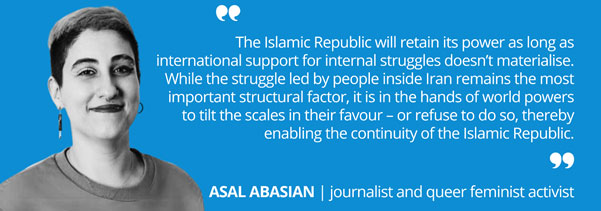
Amid the chaos and in the search for security, the international community might be increasingly willing to look the other way. Iran’s search for international respectability saw a milestone in November, when it took advantage of other states’ lack of interest to claim the chair of the UN Human Rights Council’s Social Forum. The result was a largely empty room – but it remains the case that Iran succeeded in occupying institutional space to whitewash its blood-soaked image.

This mustn’t be allowed to happen. Iranian women mustn’t be left to their own devices. Iranian pro-democracy and human rights activists, both inside and outside Iran, need the support of the international community if they’re to have any chance.

Inés M. Pousadela is CIVICUS Senior Research Specialist, co-director and writer for CIVICUS Lens and co-author of the State of Civil Society Report.

  Source

Latvia: A Vital First Step Towards Marriage Equality

Civil Society, Europe, Featured, Gender, Gender Identity, Headlines, Human Rights, LGBTQ, TerraViva United Nations

Opinion

Credit: Ilmars Znotins/AFP via Getty Images

MONTEVIDEO, Uruguay, Dec 12 2023 (IPS) – Last month the Saeima, Latvia’s parliament, passed a package of eight laws recognising same-sex civil unions and associated rights. The new legislation came in response to a 2020 Constitutional Court ruling that established that same-sex couples have a constitutional right to the benefits and legal protections afforded to married opposite-sex couples.


Equal marriage rights are still a long way away, and civil unions are only a first step in the right direction. But in one of Europe’s most restrictive countries for LGBTQI+ rights, activists view it as a significant shift, achieved after numerous attempts over more than two decades. Anti-rights forces agree, and they’re not going to let it happen quietly. They’ve already responded with an attempt to stop the new law being adopted by campaigning for a referendum.

The breakthrough

The first registered partnership bill was submitted by the National Human Rights Office in 1999 but rejected by parliament’s Human Rights and Public Affairs Committee and never debated. Initiatives accelerated in the mid-2010s but were all rejected – the latest attempts coming in 2020 and 2022.

On 29 October 2020, a popular initiative calling for the passage of a civil union law that had gathered more than 10,000 signatures was voted down by parliament. Campaigners immediately started a new initiative for the ‘legal protection of all families’, which attracted over 23,000 signatures – but that too was rejected by parliament in December 2022.

Following the 2020 parliamentary vote, however, two court rulings catalysed change. In November 2020, the Constitutional Court found the labour law in violation of the constitution because it didn’t provide for parental leave to the non-biological parent in a same-sex relationship.

As the result of a 2006 anti-rights initiative to ban same-sex marriage, the Latvian Constitution defines marriage as a union between a man and a woman. The concept of family, however, isn’t explicitly defined in reference to marriage, and the court understood it more broadly as a stable relationship based on understanding and respect. It concluded that the constitution demanded protection for same-sex partners and gave parliament a deadline of 1 June 2022 to amend the law to provide a way for same-sex couples to register their relationship.

A year later, in December 2021, the Supreme Court ruled that if the deadline was missed, same-sex couples would be allowed to resort to the courts to have their relationship recognised.

Anti-rights backlash

The anti-rights reaction was quick in coming. Two months after the Constitutional Court ruling, parliament introduced a constitutional amendment that went further than ratifying the definition of marriage as being between a man and a woman, defining family as based on marriage.

To comply with the Constitutional Court’s ultimatum, in February 2022 the Ministry of Justice submitted a civil union bill and two months later, despite an attempted boycott to deny a quorum, parliament approved its first reading.

When it became apparent that the court’s deadline would be missed, same-sex couples started petitioning the courts for recognition as family units. The first of dozens of positive rulings was issued on 31 May 2022.

That same day a tight parliamentary vote resulted in the appointment of Latvia’s first out gay president. Momentum was building, and parliament finally passed a law to allow same-sex civil unions on 9 November 2023.

But conservative politicians managed to put the new law on hold as they seek to gather the signatures required to force a referendum that they hope will prevent its entry into force.

A long way to go

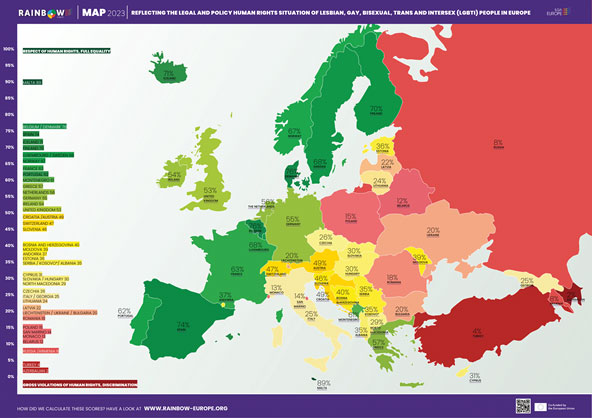
Even if it survives the challenge, the new law is no panacea. Ultimately, access to marriage is the only way to ensure LGBTQI+ couples have the same legal rights as heterosexual couples. Recognition of same-sex relationships is a step forward, but still leaves Latvia behind neighbouring Estonia, which legalised same-sex marriage in June.

If upheld, the new legislation will give registered same-sex couples some but not all the rights associated with marriage – they’ll have hospital visitation rights and tax and social security benefits, but not inheritance rights or the right to adopt children.

Beyond the legal sphere, the biggest challenge will come in influencing public attitudes, as signalled by Latvia’s scores on Equaldex’s Equality Index. This ranking combines a legal index that assesses key laws and a public opinion index that measures attitudes towards LGBTQI+ people. Latvia scores far lower for public opinion than for its laws. A 2019 Special Eurobarometer poll found that only 49 per cent of Latvians thought that LGBTQI+ people should have the same rights as heterosexuals.

The message is clear: changing laws and policies won’t be enough – and any legal victories will remain in peril unless social attitudes change.

Latvian LGBTQI+ organisations are fully aware of this, which is why they’ve worked on both fronts for many years. A centrepiece of their work to challenge prejudice is the annual Pride event, which Latvia pioneered for the Baltic region in 2005. As recounted by its organisers, Latvia’s Pride grew from 70 participants who faced 3,000 protesters in 2005 to 5,000 participants at EuroPride 2015, held in Latvia’s capital Riga, and 8,000 in the 2018 Baltic Pride, also held in Riga. Pride was repeatedly banned by Riga City Council, and it invariably faced hostile counter-protesters – but fewer each time, while the number of Pride participants has grown, boosting people’s self-confidence.

Global trends show progress towards the recognition of LGBTQI+ rights to be much stronger than regression. Latvian LGBTQI+ advocates will continue to push forward on both the policy and awareness-raising fronts. They’ll continue working to secure what they’ve already achieved while striving for more. They’re on the right course.

Inés M. Pousadela is CIVICUS Senior Research Specialist, co-director and writer for CIVICUS Lens and co-author of the State of Civil Society Report.
  Source

COP28: Climate Summit in Closed Civic Space

Civil Society, Climate Action, Climate Change, Crime & Justice, Energy, Environment, Featured, Global, Headlines, Human Rights, Press Freedom, TerraViva United Nations

Opinion

Credit: Bryan Bedder/Getty Images for Bloomberg Philanthropies

LONDON, Nov 17 2023 (IPS) – The need to act on the climate crisis has never been clearer. In 2023, heat records have been shattered around the world. Seemingly every day brings news of extreme weather, imperilling lives. In July, UN Secretary-General António Guterres grimly announced that ‘the era of global boiling has arrived’.


In short, there’s a lot at stake as the world heads into its next climate summit.

But there’s a big problem: COP28, the latest in the annual series of conferences of parties (COP) to the UN Framework Convention on Climate Change, will be held in the United Arab Emirates (UAE). This is a country with closed civic space, where dissent is criminalised and activists are routinely detained. It’s also a fossil fuel power bent on continuing extraction.

At multilateral summits where climate change decisions are made, it’s vital that civil society is able to mobilise to demand greater ambition, hold states and fossil fuel companies and financiers to account and ensure the views of people most affected by climate change are heard. But that can’t happen in conditions of closed civic space.

Concerning signs

In September, the UAE was added to the CIVICUS Monitor Watchlist, which highlights countries experiencing significant declines in respect for civic freedoms. Civic space in the UAE has long been closed: no dissent against the government or advocacy for human rights is allowed, and those who try to speak out risk criminalisation. In 2022, a Cybercrime Law introduced even stronger restrictions on online expression.

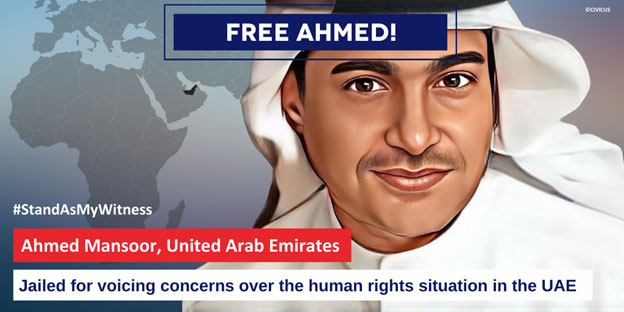
There’s widespread torture in jails and detention centres and at least 58 prisoners of conscience have been held in prison despite having completed their sentences. Many of them were part of a group known as the UAE 94, jailed for the crime of calling for democracy. Among the ranks of those incarcerated is Ahmed Mansoor, sentenced to 10 years in jail in 2018 for his work documenting the human rights situation, and held in solitary confinement for over five years and counting.

Ahead of COP28, civil society has worked to highlight the absurdity of holding such a vital summit in closed civic space conditions. Domestic civil society is unable to influence COP28 and its preparatory process, and it’s hard to see how civil society, both domestic and international, will be able to express itself freely during the summit.

Civil society is demanding that the UAE government demonstrate that it’s prepared to respect human rights, including by releasing political prisoners – something it’s so far failed to budge on.

An ominous sign came when the UAE hosted a climate and health summit in April. Participants were reportedly instructed not to criticise the government, corporations, individuals or Islam, and not to protest while in the UAE.

Civic space restrictions aren’t the only indication the UAE isn’t taking COP28 seriously. The president of the summit, Sultan Ahmed Al Jaber, also happens to be head of the state’s fossil fuel corporation ADNOC, the world’s 11th-biggest oil and gas producer. It’s like putting an arms manufacturer in charge of peace talks. Multiple other ADNOC staff members have roles in the summit. ADNOC is currently talking up its investments in renewable energies, all while planning one of the biggest expansions of oil and gas extraction of any fossil fuel corporation.

Instead of real action, all the signs are that the regime is instrumentalising its hosting of COP28 to try to launder its reputation, as indicated by its hiring of expensive international lobbying firms. An array of fake social media accounts were created to praise the UAE as host and defend it from criticism. A leaked list of key COP28 talking points prepared by the host made no mention of fossil fuels.

A summit that should be about tackling the climate crisis – and quickly – is instead being used to greenwash the image of the host government – something easiest achieved if civil society is kept at arm’s length.

Fossil fuel lobby to the fore

With civil society excluded, the voices of those actively standing in the way of climate action will continue to dominate negotiations. That’s what happened at COP27, also held in the closed civic space of Egypt, where 636 fossil fuel lobbyists took part – and left happy. Like every summit before it, its final statement made no commitment to reduce oil and gas use.

The only way to change this is to open the doors to civil society. Civil society has consistently sounded the alarm and raised public awareness of the need for climate action. It’s the source of practical solutions to cut emissions and adapt to climate impacts. It urges more ambitious commitments and more funding, including for the loss and damage caused by climate change. It defends communities against environmentally destructive impacts, resists extraction and promotes sustainability. It pressures states and the private sector to stop approving and financing further extraction and to transition more urgently to more renewable energies and more sustainable practices. These are the voices that must be heard if the cycle of runaway climate change is to be stopped.

COPs should be held in countries that offer an enabling civic space that allows strong domestic mobilisation, and summit hosts should be expected to abide by high standards when it comes to domestic and international access and participation. That should be part of the deal hosts make in return for the global prestige that comes with hosting high-level events. Civil society’s exclusion mustn’t be allowed to happen again.

Andrew Firmin is CIVICUS Editor-in-Chief, co-director and writer for CIVICUS Lens and co-author of the State of Civil Society Report.

  Source

Argentina: Unpalatable Choices in Election Plagued with Uncertainty

Civil Society, Economy & Trade, Featured, Financial Crisis, Gender, Gender Identity, Headlines, Latin America & the Caribbean, TerraViva United Nations

Opinion

Credit: Tomás Cuesta/Getty Images

MONTEVIDEO, Uruguay, Nov 3 2023 (IPS) – For many of Argentina’s voters the choice in the 19 November presidential runoff is between the lesser of two evils: Sergio Massa, economy minister of a government that’s presiding over a once-in-a-generation economic meltdown with a whopping 140-per cent inflation rate, or Javier Milei, a far-right libertarian who admires Donald Trump, wants to shut down the Central Bank and wields a chainsaw in public as a symbol of his willingness to slash the state. Many will rue that it ever came to this.


A peculiar outsider

A post-modern media celebrity, Milei’s performance style is a perfect fit for social media. He’s easily angered, reacts violently and insults copiously. He’s unapologetically sexist and mocks identity politics.

Milei bangs the drum for ‘anarcho-capitalism’, an ultra-individualistic ideology in which the market has absolute pre-eminence: earlier this year, he described the sale of human organs as ‘just another market’.

To expand his appeal beyond this extreme economic niche he forged an alliance with the culturally conservative right. His running mate, Victoria Villarruel, represents the backlash against abortion – legalised after decades of civil society campaigning in 2020 – and sexual diversity and gender equality policies, along with reappraisal of the murderous military dictatorship that ruled Argentina between 1976 and 1983.

In the run-up to primary elections in August, the two mainstream coalitions – the centre-left incumbent Union for the Homeland (UP) and the centre-right opposition Together for Change (JxC) – displayed a notable lack of leadership and indulged in internal squabbles that showed very little empathy for people’s daily struggles. All they had to offer in the face of widespread concerns about inflation and insecurity were the candidacies of the current minister of the economy and a former minister of security. They made it easy for Milei to hold them responsible for decades of corruption, ineffectiveness and failure.

In Milei’s discourse, the hardworking, productive majority is being bled dry by taxation to maintain the privileges of a parasitic and corrupt political ‘caste’. His proposal is deceptively simple: shrink the state to a minimum to destroy the caste that lives off it, clearing their way for individual progress.

Milei gained traction among young voters, particularly young men, via TikTok. He found fertile ground among a generation that no longer expect to be better off than their parents. While many of his followers concede that his ideas may be a little crazy, they appear to be willing to take the risk of embracing the unknown on the basis that the really crazy plan would be to allow those long in control to retain their power and expect things to turn out differently. Milei has capitalised on the despair, hopelessness and accumulated anger so many rightfully feel.

Surprise after surprise

The first surprise came on 13 August, when Milei won the most votes of any candidate in the primaries.

Milei only entered politics in 2021, when the 17 per cent vote he amassed in the capital, Buenos Aires, sent him and two other libertarians to the National Congress. In the 2023 primaries he went much further, winning 30 per cent of the vote. He placed ahead of JxC, whose two candidates received a joint 28 per cent, and UP, the current incarnation of the Peronist Party, which took 27 per cent. The bulk of the UP vote, 21 per cent, went to Massa. That Peronism, once the dominant force, came third was a historic first.

The second surprise came on 22 October. Following the primaries, all talk was of Milei winning the presidency. He trumpeted his intent to win the first round outright. Measured against these expectations, his second place looks like an underperformance. But the fact that a candidate who wasn’t on the radar before the primaries has made the runoff shows how quickly the political landscape can shift.

In the October vote Milei took almost the exact share he’d received in the primaries. Massa finished above him with almost 37 per cent, displacing JxC, which lost four points on its second-place performance in the primaries.

The fact that the economy minister was able to distance himself from the government he’s part of – one often described as the worst in 40 years – to come first was viewed as a notable victory, even though his share was just about the lowest Peronism has ever received.

One explanation for Massa’s improved performance was turnout, which increased by eight points to almost 78 per cent – still low for a country with compulsory voting, but enough to make a difference. Much of the increase could be credited to the political machinery that mobilised voters on election day, aided by the minister-candidate pulling as many levers as he could to improve his chances. This included putting lots of instant cash into voters’ pockets, including through tax breaks benefiting targeted groups of workers and consumers.

An unpalatable decision

There’s still much uncertainty ahead. Economic failure is Milei’s best propaganda, so much will depend on how the economy behaves over the next couple of weeks. Milei and the destruction he represents can’t be written off.

Neither those currently in power nor those in the mainstream opposition recognise the obvious: Milei is their fault. They’ve held power for the best part of the past 40 years without effectively tackling any of the issues that concern people the most.

Many voters now feel they face an unpalatable choice between a corrupt and failing government and a dangerous disruptor. They fear that if they choose to keep Milei out, their votes may be misinterpreted as a show of active support for a continuity they also reject. What’s at stake here is more than one election. If Milei is kept at bay, the political dynamics leading to the current economic dysfunction will still need to be addressed – or the far-right threat to democracy won’t end with Milei.

Inés M. Pousadela is CIVICUS Senior Research Specialist, co-director and writer for CIVICUS Lens and co-author of the State of Civil Society Report.

  Source

Brazil: A Step Forward for Indigenous Peoples’ Rights

Civil Society, Climate Change, Environment, Featured, Headlines, Human Rights, Indigenous Rights, Latin America & the Caribbean, TerraViva United Nations

Opinion

Credit: Evaristo Sa/AFP via Getty Images

MONTEVIDEO, Uruguay, Oct 24 2023 (IPS) – Brazil’s Supreme Court has delivered a long-awaited ruling upholding Brazilian Indigenous peoples’ claims to their traditional land. It did so by rejecting the ‘Temporal Framework’ principle, which only allowed for the demarcation and titling of lands physically occupied by the Indigenous groups who claimed them by 5 October 1988, when the current constitution was adopted. This excluded the numerous Indigenous communities who’d been violently expelled from their ancestral lands before then, including under military dictatorship between 1964 and 1985.


The case was brought in relation to a land dispute in the state of Santa Catarina, but the ruling applies to hundreds of similar situations throughout Brazil.

This was also good news for the climate. Brazil is home to 60 per cent of the Amazon rainforest, a key climate stabiliser due to the enormous amount of carbon it stores and the water it releases into the atmosphere. Most of Brazil’s roughly 800 Indigenous territories – over 300 of which are yet to be officially demarcated – are in the Amazon. And there are no better guardians of the rainforest than Indigenous peoples: when they fend off deforestation, they protect their livelihoods and ways of life. The best-preserved areas of the Amazon are those legally recognised and protected as Indigenous lands.

But there’s been a sting in the tale: politicians backed by the powerful agribusiness lobby have passed legislation to enshrine the Temporal Framework, blatantly ignoring the court ruling.

A tug of war

The Supreme Court victory came after a long struggle. Hundreds of Indigenous mobilisations over several years called for the rejection of the Temporal Framework.

Powerful agribusiness interests presented the Temporal Framework as the proper way of regulating article 231 of the constitution in a way that provides the legal security rural producers need to continue to operate. Indigenous rights groups denounced it as a clear attempt to make theft of Indigenous lands legal. Regional and international human rights mechanisms sided with them: the Inter-American Commission on Human Rights and the United Nations (UN) Special Rapporteur on the rights of Indigenous Peoples warned that the framework contradicted universal and Inter-American human rights standards.

In their 21 September decision, nine of the Supreme Court’s 11 members ruled the Temporal Framework to be unconstitutional. With a track record of agribusiness-friendly rulings, the two judges who backed it had been appointed by former far-right president Jair Bolsonaro, and one of them had also been Bolsonaro’s justice minister.

As the Supreme Court held its hearings and deliberations, political change took hold. Bolsonaro had vowed ‘not to cede one centimetre more of land’ to Indigenous peoples, and the process of land demarcation had remained stalled for years. But in April 2023, President Lula da Silva, in power since January, signed decrees recognising six new Indigenous territories and promised to approve all pending cases before the end of his term in 2026, a promise consistent with the commitment to achieve zero deforestation by 2030. The recognition of two additional reserves in September came alongside news that deforestation in the Brazilian Amazon had fallen by 66 per cent in August compared to the same month in 2022.

Agribusiness fights back

But the agribusiness lobby didn’t simply accept its fate. The powerful ruralist congressional caucus introduced a bill to enshrine the Temporal Framework principle into law, which the Chamber of Deputies quickly passed on 30 May. The vote was accompanied by protests, with Indigenous groups blocking a major highway. They faced the police with their ceremonial bows and arrows and were dispersed with water cannon and teargas.

The Temporal Framework bill continued its course through Congress even after the Supreme Court’s decision. On 27 September, with 43 votes for and 21 against, the Senate approved it as a matter of ‘urgency’, rejecting the substance of the Supreme Court ruling and claiming that in issuing it the court had ‘usurped’ legislative powers.

The Articulation of Indigenous Peoples of Brazil’s (APIB) assessment was that, as well as upholding the Temporal Framework, the bill sought to open the door to commodity production and infrastructure construction in Indigenous lands, among other serious violations of Indigenous rights. For these reasons, Indigenous groups called this the ‘Indigenous Genocide Bill’.

The struggle goes on

As the 20 October deadline for President Lula to either sign or veto the bill approached, a campaign led by Indigenous congresswoman Célia Xakriabá collected almost a million signatures backing her call for a total veto. Along with other civil society groups, APIB sent an urgent appeal to the UN requesting support to urge Lula to veto the bill.

On 19 October the Federal Public Prosecutor’s Office said Lula should veto the bill on the basis that it’s unconstitutional. On the same day, however, senior government sources informed that there wouldn’t be a total veto, but a ‘very large’ partial one. And indeed, the next day it was announced that Lula had partially vetoed the bill. According to a government spokesperson, all the clauses that constituted attacks on Indigenous rights and went against the Constitution were vetoed, while the ones that remained would serve to improve the land demarcation process, making it more transparent.

Even if the part of the bill that wasn’t vetoed doesn’t undermine the Supreme Court ruling, the issue is far from settled. The veto now needs to be analysed at a congressional session on a date yet to be determined. And the agribusiness lobby won’t back down easily. Many politicians own land overlapping Indigenous territories, and many more received campaigns funding from farmers who occupy Indigenous lands.

While further moves by the right-leaning Congress can’t be ruled out, the Supreme Court ruling also has some problems. The most blatant concerns the acknowledgment that there must be ‘fair compensation’ for non-Indigenous people occupying Indigenous lands they acquired ‘in good faith’ before the state considered them to be Indigenous territory. Indigenous groups contend that, while there might be a very small number of such cases, in a context of increasing violence against Indigenous communities, the compensation proposal would reward and further incentivise illegal invasions.

But beneath the surface of political squabbles, deeper changes are taking place that point to a movement that is growing stronger and better equipped to defend Indigenous peoples’ rights.

The 2022 census showed a 90-per-cent increase, from 896,917 to 1.69 million, in the number of Brazilians identifying as Indigenous compared to the census 12 years before. There was no demographic boom behind these numbers – just longstanding work by the Indigenous movement to increase visibility and respect for Indigenous identities. People who’d long ignored and denied their heritage to protect themselves from racism are now reclaiming their Indigenous identities. Not even the violent anti-Indigenous stance of the Bolsonaro administration could reverse this.

Today the Brazilian Indigenous movement is stronger than ever. President Lula owes his election to positioning himself as an alternative to his anti-rights, climate-denying predecessor. He now has the opportunity to reaffirm his commitment to respecting Indigenous peoples’ rights while tackling the climate crisis.

Inés M. Pousadela is CIVICUS Senior Research Specialist, co-director and writer for CIVICUS Lens and co-author of the State of Civil Society Report.

  Source

Maldives Election: What Now for Civil Society?

Asia-Pacific, Civil Society, Crime & Justice, Featured, Gender, Headlines, Human Rights, LGBTQ, Press Freedom, TerraViva United Nations

Opinion

Credit: Mohamed Afrah/AFP via Getty Images

LONDON, Oct 12 2023 (IPS) – Ahead of the presidential election, Solih faced accusations of irregularities in his party’s primary vote, in which he defeated former president Mohamed Nasheed. The Electoral Commission was accused of making it harder for rival parties to stand, including the Democrats, a breakaway party Naheed formed after the primary vote. The ruling party also appeared to be instrumentalising public media and state resources in its favour. Solih’s political alliances with conservative religious parties were in the spotlight, including with the Adhaalath Party, which has taken an increasingly intolerant stance on women’s and LGBTQI+ rights.


Big beasts battle for influence

If the two candidates seemed similar in their attitudes towards civil society, they stood on opposite sides of a geopolitical divide. In recent years Maldives, a chain of small Indian Ocean islands with a population of around half a million, has become a major site of contestation in the battle for supremacy between China and India. The location is seen as strategic, not least for control of shipping routes, vital for the transport of oil from the Gulf to China.

Civic space under pressure

Solih quickly conceded defeat and thanked voters for playing their part in a democratic and peaceful process. It’s far from rare for incumbents to lose in Maldives: there’s been a change at every election since the first multiparty vote in 2008. But there are concerns that Muizzu will follow the same course as former president Abdulla Yameen, leader of his party, the People’s National Congress.

Yameen, in office from 2013 to 2018, wanted to run again, but the Supreme Court barred him because he’s serving an 11-year jail sentence for corruption and money-laundering. Critics question the extent to which Muizzu will be his own person or a proxy for Yameen. Perhaps there’s a clue in the fact that Yameen has already been moved from jail to house arrest on Muizzu’s request.

The question matters because the human rights situation sharply deteriorated under Yameen’s presidency. The 2018 election was preceded by the declaration of a state of emergency enabling a crackdown on civil society, the media, the judiciary and the political opposition. Judges and politicians were jailed. Protests were routinely banned and violently dispersed. Independent media websites were blocked and journalists subjected to physical attacks.

Ultimately, Yameen was roundly defeated by a united opposition who capitalised on widespread alarm at the state of human rights. Some positive developments followed, including repeal of a criminal defamation law. But many challenges for civil society remained and hopes of significant progress were largely disappointed.

A restrictive protest law stayed in effect and parliament rejected changing it in 2020. Police violence towards protesters continued, as did impunity. Civil society groups were still smeared and vilified if they criticised the government. Activists have been subjected to smears, harassment, threats and violence from hardline conservative religious groups. Women’s rights activists have been particularly targeted.

In 2019, a prominent civil society organisation, the Maldivian Democracy Group, was deregistered and had its funds seized following pressure from religious groups after it published a report on violent extremism. It now operates from exile.

Ahead of the presidential election, Solih faced accusations of irregularities in his party’s primary vote, in which he defeated former president Mohamed Nasheed. The Electoral Commission was accused of making it harder for rival parties to stand, including the Democrats, a breakaway party Naheed formed after the primary vote. The ruling party also appeared to be instrumentalising public media and state resources in its favour. Solih’s political alliances with conservative religious parties were in the spotlight, including with the Adhaalath Party, which has taken an increasingly intolerant stance on women’s and LGBTQI+ rights.

Big beasts battle for influence

If the two candidates seemed similar in their attitudes towards civil society, they stood on opposite sides of a geopolitical divide. In recent years Maldives, a chain of small Indian Ocean islands with a population of around half a million, has become a major site of contestation in the battle for supremacy between China and India. The location is seen as strategic, not least for control of shipping routes, vital for the transport of oil from the Gulf to China.

India has historically had close connections with Maldives, something strongly supported by Solih. But Muizzu, like his predecessor Yameen, seems firmly in the China camp. Under Yameen, Maldives was a recipient of Chinese support to develop infrastructure under its Belt and Road Initiative, epitomised in the 1.4 km China-Maldives Friendship Bridge.

India has come to be a big issue in Maldivian politics. Under Solih, India established a small military presence in Maldives, mostly involved in providing air support for medical evacuations from isolated islands. But the development of a new India-funded harbour prompted accusations that the government was secretly planning to give India’s military a permanent base.

This sparked opposition protests calling for the Indian military to be expelled. Protests faced heavy restriction, with many protesters arrested. In 2022, Solih issued a decree deeming the protests a threat to national security and ordering them to stop. This high-handed move only further legitimised protesters’ grievances.

Muizzu’s campaign sought to centre the debate on foreign interference and Maldives’ sovereignty. He used his victory rally to reiterate his promise that foreign soldiers will be expelled.

In practice, the new administration is likely to mean a change of emphasis rather than an absolute switch. Maldives will still need to trade with both much bigger economies and likely look to play them off against each other, while India will seek to maintain relations, hoping that the political pendulum will swing its way again.

Time to break with the past

International relations were far from the only issue. Economic strife and the high cost of living – a common issue in recent elections around the world – was a major concern. And some people likely switched votes out of unhappiness with Solih’s failure to fulfil his 2018 promises to challenge impunity for killings by extremists and make inroads on corruption, and to open up civic space.

Neither India, where civic freedoms are deteriorating, nor China, which stamps down on all forms of dissent, will have any interest in whether the Maldives government respects the space for civil society. But there’s surely an opportunity here for Muizzu to prove he’ll stand on his own feet by breaking with both the dismal human rights approach of Yameen and the increasingly compromised positions of Solih. He can carve out his own direction by committing to respecting and working with civil society, including by letting it scrutinise and give feedback on the big development decisions he may soon be taking in concert with China.

Andrew Firmin is CIVICUS Editor-in-Chief, co-director and writer for CIVICUS Lens and co-author of the State of Civil Society Report.
  Source



