Belarus: A Sham Election That Fools No One

Civil Society, Crime & Justice, Europe, Featured, Headlines, Human Rights, Nuclear Energy – Nuclear Weapons, Press Freedom, TerraViva United Nations

Opinion

Credit: Sergei Gapon/AFP via Getty Images

LONDON, Feb 7 2025 (IPS) – Alexander Lukashenko will soon begin his seventh term as president of Belarus. The official result of the 26 January election gave him 86.8 per cent of the vote, following an election held in a climate of fear. Only token opposition candidates were allowed, most of who came out in support of Lukashenko. Anyone who might have offered a credible challenge is in jail or in exile.


No repeat of 2020

In office since 1994 as the so far only president of independent Belarus, Lukashenko is by far Europe’s longest-serving head of state. The 1994 vote that brought the former Soviet official to power was the country’s only legitimate election. Each since has been designed to favour Lukashenko.

He only faced a serious threat in 2020, when an outsider candidate, Sviatlana Tsikhanouskaya, was able to run a campaign that captured the popular imagination. Lukashenko’s response was to arrest opponents, repress protests, restrict the internet, deny access for electoral observers and then blatantly steal the election.

When people took to the street in mass protests against electoral fraud, Belarus seemed on the brink of a democratic revolution. But Lukashenko’s government launched a brutal defence, using security forces to violently attack protesters and arresting over a thousand people. It dissolved opposition political parties and raided and shut down civil society organisations: over a thousand have been forcibly liquidated since 2020.

Lukashenko’s regime has gone after those in exile, kidnapping and allegedly killing Belarusians abroad. Belarus is among the 10 states most engaged in transnational repression. They authorities have also deprived the estimated 300,000 people who’ve fled since 2020 of their ability to vote.

By embracing repression, Lukashenko made a choice to abandon his policy of balancing between the European Union (EU) and Russia. When the EU imposed sanctions in response to the 2020 election fraud, Russia offered a package of loans. In 2022, when Russia launched its full-scale assault on Ukraine, some of its forces entered Ukraine from Belarus.

Shortly after Russia began its full-scale invasion, a constitutional referendum held in Belarus, marked by the same lack of democracy as its elections, formally ended the country’s neutrality and non-nuclear status. In December 2024, the two states signed a security treaty allowing the use of Russian nuclear weapons in the event of aggression against Belarus, and Lukashenko confirmed that the country hosts dozens of Russian nuclear warheads.

Belarus has also been accused of instrumentalising migrants to try to destabilise neighbouring countries. In 2021, it relaxed its visa rules for people from Middle Eastern and North African countries and encouraged flights to Belarus. Thousands were taken to the borders with Lithuania and Poland and left to try to cross them in desperate conditions, freezing and without essentials, subjected to security force violence on both sides. Migrants were unwitting pawns in Lukashenko’s game to strike back at his neighbours. Attempted crossings and human rights violations have continued since.

Renewed crackdown

Just to be on the safe side, Lukashenko launched another crackdown in the months leading up to the election. The intent was clearly to ensure there’d be no repeat of the expression of opposition and protests of 2020.

Starting in July 2024, Lukashenko pardoned around 250 political prisoners, releasing them from jail. His likely aim was to soften international criticism in the run-up to the vote. But these weren’t the high-profile prisoners serving long sentences, such as Nobel Peace Prize winner Ales Bialiatski, a founder of the Viasna Human Rights Centre, who received a 10-year sentence in 2023, or protest leader Maria Kolesnikova, sentenced to 11 years in 2021. Those pardoned had to publicly acknowledge their guilt and repent.

The freed jail spaces were quickly filled, with over a hundred friends and relatives of political prisoners detained. In February 2024, authorities detained at least 12 lawyers who’d defended political prisoners. In December, they arrested seven independent journalists. Belarus has the world’s fourth highest number of jailed journalists.

People have been jailed merely for following Telegram channels deemed ‘extremist’ or making social media comments. Over 1,700 people reportedly faced charges for political activities in 2024. Prison conditions are harsh. People may be forced to do hard labour, kept in solitary confinement, sent to freezing punishment cells, denied access to their families and have medical care withheld.

On election day, Lukashenko’s dictatorial style was on full display. He held a press conference where he promised to ‘deal with’ opposition activists in exile and said they were endangering their families in Belarus, adding that some opponents ‘chose’ to go to prison. He also didn’t rule out the prospect of running for an eighth term in 2030.

Time for change

Lukashenko promises more of the same: continuing autocracy and closed civic space. For generations of Belarusians who’ve known nothing but his rule, and with opposition voices so ruthlessly suppressed, it may be hard to imagine anything else. The possibilities opened up in 2020 have been ruthlessly shut down.

But the wheels of history will keep turning, and the 70-year-old dictator won’t last forever. Some kind of cessation of hostilities in Ukraine may well come this year, forcing Lukashenko to make friends beyond Vladimir Putin. If Russia winds down its booming war economy, the ensuing economic shock in Belarus, which largely depends on Russia, could trigger public anger.

Meanwhile, potentially increased scrutiny could come from the International Criminal Court: in September 2024, the government of Lithuania requested an investigation into crimes against humanity allegedly committed by Belarusian authorities. If this move gains momentum, Lukashenko could find himself in an uncomfortable spotlight. States could also intensify sanctions: Canada and the UK have done so following the election.

If Belarus attempts to reengage with them, democratic states should insist that no thaw in relations is possible without tangible human rights progress . This should start with the release of all political prisoners, guarantees for the safety of exiled activists and a reversal of attacks on civic space.

Andrew Firmin is CIVICUS Editor-in-Chief, co-director and writer for CIVICUS Lens and co-author of the State of Civil Society Report.

For interviews or more information, please contact research@civicus.org.

  Source

U.S. White House Executive Order Raises Concerns for Its Support to the UN

Aid, Armed Conflicts, Civil Society, Development & Aid, Editors’ Choice, Featured, Headlines, Human Rights, Humanitarian Emergencies, IPS UN: Inside the Glasshouse, Sustainable Development Goals, TerraViva United Nations

Humanitarian Emergencies

Coly Seck (at microphone), Chair of the Committee on the Exercise of the Inalienable Rights of the Palestinian People and Permanent Representative of the Republic of Senegal to the United Nations, briefs reporters with Members of the newly-elected Committee on the Exercise of the Inalienable Rights of the Palestinian People (CEIRPP Bureau). At fourth from right is Riyad Mansour, Permanent Observer of the State of Palestine to the United Nations. Credit: UN Photo: Manuel Elías

Coly Seck (at microphone), Chair of the Committee on the Exercise of the Inalienable Rights of the Palestinian People and Permanent Representative of the Republic of Senegal to the United Nations, briefs reporters with Members of the newly-elected Committee on the Exercise of the Inalienable Rights of the Palestinian People (CEIRPP Bureau). At fourth from right is Riyad Mansour, Permanent Observer of the State of Palestine to the United Nations. Credit: UN Photo: Manuel Elías

UNITED NATIONS, Feb 6 2025 (IPS) – A new executive order from the United States White House calls for withdrawing support from major UN entities and a review of all international intergovernmental organizations which the United States is a member of. The U.S.’s orders against the UN Palestine Refugee Agency also do not bode well for ongoing ceasefire negotiations in Gaza.


President Donald Trumps comments that the “US will take over the Gaza Strip and we will do a job with it, too. We’ll own it,” have also been widely criticized.

On Tuesday, the White House issued an executive order, where they announced that they will pull out from the UN Human Rights Council (UNHRC) effective immediately and called for a review of its membership in UN and other intergovernmental organizations. The executive order singles out other UN entities that needed “further scrutiny”—the UN Relief and Works Agency for Palestine Refugees in the Near East (UNRWA); and the UN Educational, Scientific, and Cultural Organization (UNESCO). The executive order suspended all funding to these organizations.

The executive order also cites that UNESCO has failed to address “mounting arrears” and reform, also noting that it has demonstrated anti-Israeli sentiments over the last decade. A review of the U.S.’s membership in UNESCO would assess whether it supports the country’s interests, and would include an analysis of anti-Semitic and anti-Israeli sentiment within the organization.

The United States announced that no funds or grants would go towards the UN Relief and Works Agency for Palestine Refugees in the Near East (UNRWA), citing corruption within the organization and the infiltration of terrorist groups such as Hamas.

UN Secretary-General Spokesperson Stéphane Dujarric told reporters on Tuesday that in light of the United States’ decision, this would not change the UN’s “commitment to supporting UNRWA in its work”, or the HRC’s importance as a part of the “overall human rights architecture within the United Nations”.

“It has been clear for us that U.S. support for the United Nations has saved countless lives and global security,” said Dujarric. “The Secretary-General is looking forward to speaking with President (Donald) Trump, he looks forward to continuing what was a very, I think, frank and productive relationship during the first term. He looks to strengthening the relationship in the turbulent times that we live in.”

On Wednesday the newly-elected chair of the Committee on the Exercise of the Inalienable Rights of the Palestinian People, Ambassador Coly Seck, Permanent Representative of Senegal, told a told a press conference that it condemned the ban by Israel on UNWRA .

“We strongly condemn Israel’s ban UNWRA which obstructs vital humanitarian cooperation in direct violation of the UN mandate and General Assembly resolutions in stabilizing the ceasefire and supporting Gaza’s recovery. This ban imposed immediately after the ceasefire, deal will deepen Gaza suffering.”

The suspension of aid funding from the United States is already impacting humanitarian operations across different agencies. Dujarric said that the U.S. had committed 15 million USD to the trust fund, of which 1.7 million has already been spent. This leaves 13.3 million frozen and unusable at this time.

Pio Smith, Regional Director for Asia and the Pacific, United Nations Population Fund (UNFPA) told reporters in Geneva that they had to suspend the programs funded by US grants, which included funds that were already committed to the agency. Smith warned that the lack of funding would impact programs in places such as Afghanistan, Pakistan and Bangladesh. Worldwide, more than half of UNFPA’s facilities, 596 out of 982, would be impacted by this funding pause.

Vivian van de Perre, the Deputy Head of its UN Mission to the Democratic Republic of the Congo, told reporters in New York on Wednesday that the recent pause in funding from the U.S. Agency for International Development (USAID) has forced humanitarian partners on the ground to suspend their work. “…Many of the partners, including IOM (the International Organization for Migration), which is a key partner for us, need to stop their work due to the USAID stop-work order,” she said.

The executive order, along with Trump’s announcement that the U.S. would move into and claim Gaza cast a shadow of doubt over ongoing ceasefire negotiations.

UN Human Rights Commissioner Volker Türk said that the priority now must be to move to the next phase of the ceasefire, which calls for the release of all hostages and arbitrarily detained prisoners, an end to the war, and the reconstruction of Gaza.

“The suffering of people in the [occupied Palestinian territories] and Israel has been unbearable. Palestinians and Israelis need peace and security, on the basis of full dignity and equality,” Türk said in a statement. “International law is very clear. The right to self-determination is a fundamental principle of international law and must be protected by all States, as the International Court of Justice recently underlined afresh. Any forcible transfer in or deportation of people from occupied territory is strictly prohibited.”

The forcible removal of 2.2 million Palestinians from Gaza that Trump is calling for has been decried and been called a violation of international humanitarian law.

“Any forced displacement of people is tantamount to ethnic cleansing,” said Dujarric when asked about Trump’s remarks. “…In our search for solutions, we must not make the problem worse. Whatever solutions we find need to be rooted in the bedrock of international law.”

Riyad Mansour, Permanent Observer of the State of Palestine to the United Nations, briefing reporters after the opening session of the Committee on the Exercise of the Inalienable Rights of the Palestinian People, added his condemnation of Trump’s plan.

Mansour said with regard to the idea of “kicking the Palestinian people out from the Gaza Strip, I just want to tell you that during the last 24 hours, statements from heads of states, of Egypt, of Jordan, of the State of Palestine, of Saudi Arabia and many countries, including countries who spoke in the debate in the room behind us during the meeting of the committee, condemn these efforts.”

He said Trump’s plan has been met with a “global consensus on not allowing forced transfer to take place, ethnic cleansing to take place. We Palestinians love every part of the State of Palestine. We love the Gaza Strip. It is part of our DNA.”

The march of Palestinians from the south to the north of the Gaza Strip following the ceasefire was proof of the people’s committment to rebuild their own homes, Mansour said.

“More than 400,000 of them to go to the rubbles in the northern Gaza in order to start cleaning around their destroyed homes.”

At the White House, Trump’s aids attempted a row back on his comments. Secretary of State Marco Rubio reportedly told journalists that it Trump was proposing to rebuil Gaza, and his press secretary Karoline Leavitt, said “the president has not committed to putting boots on the ground in Gaza.”

IPS UN Bureau Report

  Source

Pakistan: Freedom of Expression at Stake With New Cybercrime Law

Asia-Pacific, Civil Society, Democracy, Editors’ Choice, Featured, Freedom of Expression, Headlines, Human Rights, Sustainable Development Goals, TerraViva United Nations

Freedom of Expression

Pakistani journalists speak out about cybercrimes law from left to right Hamid Mir, Munazza Siddiqui and Umar Cheema. Credits: Jang News, and TikTok

Pakistani journalists speak out about cybercrimes law from left to right Hamid Mir, Munazza Siddiqui and Umar Cheema. Credits: Jang News, and TikTok

KARACHI, Feb 5 2025 (IPS) – “I may not be able to continue hosting my show because the content I put up will most certainly land me in prison,” said senior correspondent Azaz Syed who works for a private TV channel, but who also has his own private online digital channel. He was referring to the recent amendment in the already existing cybercrime law, terming it a “wild” law which has been instituted to grapple with fake news among other online harms.


The new version—Prevention of Electronic Crimes (Amendment) Act, 2025—passed hurriedly, within a week, in both the houses without debate, and signed into a law by President Asif Ali Zardari on January 29, has triggered nationwide protests by the country’s media personnel.

“They have taken away my right to freedom of expression,” Syed told IPS.

“I fail to understand the uproar among journalists working in electronic media. They already have PEMRA, [the Pakistan Electronic Media Regulatory Authority] which is responsible for facilitating and regulating private electronic media,” said Minister for Information and Broadcasting Atta­ullah Tarar. “This law is to regulate the social media and countries across the world have some codes or standards under which social media operate; but there was none in our country.”

He said the existing authority, which is the Federal Investigation Authority, that looked into cybercrimes seemed ill-equipped to handle the expanding nature of online crimes taking place—harassment, pornography, national security threats, spreading economic uncertainty; just look at the conviction rate, which is dismal,” he defended the amendment.

Tarar’s reference to the “uproar” stems from TV journalists, like Syed, who have gigs on online platforms and fear the restrictions on content imposed by PECA.

For the past two years, Syed has been hosting a popular show on YouTube called Talk Shock, focusing on sensitive topics like the Pakistan army, intelligence agencies, blasphemy laws, persecution of Ahmadis, and forced conversions of Hindu girls. He described it as a passion project addressing issues close to his heart, despite potential disapproval from authorities. His show has gained over eight million viewers and 174,000 followers, also providing him with extra income.

Hamid Mir, host of Capital Talk, one of the oldest and highest-rated political talk shows, launched his digital TV channel on YouTube after being banned from TV in 2021 (he had already been banned twice, in 2007 by military dictator Pervez Musharraf  and in 2008 by the ruling Pakistan People’s Party) for  speaking against the country’s powerful military for persecuting journalists. “I share my opinions there when I am unable to on the channel that I’m employed in. Having your own platform is liberating,” he told IPS. He has 263,000 viewers.

Azaz Syed, who has his digital TV programme on YouTube called Talk Shock. Credit: Azaz Syed

Azaz Syed, who has his digital TV programme on YouTube called Talk Shock. Credit: Azaz Syed

Mir’s greater worry though is the possibility of losing his voice on X, where he connects with over eight million followers. “If I can’t speak my mind, it will have a profound impact on me,” he said.

But even those journalists who otherwise feel social media is being misused find the law distasteful.

“I have zero tolerance for fake news, and am all for regulating the beast that social media has become, but not this way, certainly” said senior investigative journalist, Umar Cheema, terming it a “third class” law.

The law was originally passed in 2016, by the same ruling party that has brought the current amendments – the Pakistan Muslim League-N. It had been met with much criticism even then.

“The reason for the need for the law given back in 2016 was to counter hate speech, terrorist content and harassment of women—this time the ruse is fake news,” said Farieha Aziz’s co-founder of Bolo Bhi, an advocacy forum for digital rights. The suspicion and criticism against the law now and then is the same—the government is using this law to “stifle political dissent and rein in freedom of expression” she said.

The amendment to the law, criminalises fake news and its dissemination with a prison term of up to three years and a fine of up to Rs 2 million (about USD 7,200).

But, pointed out Aziz, the concern went beyond just the penalties associated with the amendment to the law—it is the “potential for misuse” in the process of determining what constitutes fake news. “People will be reluctant to share or even discuss information out of fear that it might be deemed false or harmful, leading to criminal charges,” she explained, adding the definition of fake news was vague and broad. “They have created a vagueness through the use of language taken from the anti-terrorism act, around the offence,” she pointed out.

“The government operates in grey areas and likes to keep people in a state of confusion,” agreed Cheema.

Moreover, pointed out, Munazza Siddiqui, senior producer on a private TV channel: “The law is unconstitutional as it violates the fundamental right to freedom, a core principle enshrined in our Constitution.” She uses TikTok, a platform predominantly used for putting up entertaining content, for disseminating news and opinions. “It’s popular with young people but works superbly for me as they are my audience. The millennials and Gen Z want to stay informed about the world around them, but they lack the patience to sit through long articles or watch lengthy news segments on TV. I provide them with both in just a minute or so!”

However, Siddiqui acknowledged that her vlogging might be impacted. With the sword of Damocles hanging over her, in the form of the newly revised cyber law, she said, “We already navigate a space of self-censorship, and now there’s an added layer of fear.”

The law establishes four bodies—the Social Media Protection and Regulatory Authority, the Social Media Complaints Council, the Social Media Protection Tribunal, and the National Cyber Crime Investigation Agency—concentrating significant power. Aziz warned that these bodies, appointed by the federal government, could lack independence, creating potential conflicts of interest and undermining fairness and accountability.

“And the window of appeal has also been closed as I can only go to the Supreme Court of Pakistan,” said Azaz, which was an expensive route to prove your innocence.

Although the 2016 cybercrime law was already considered draconian by experts, the reason to tweak it further, explained Cheema, was that “the nature and use of social media has changed and become more sophisticated since then, adding that the media needed to share the blame for the recent shape the law has taken.

Cheema said the media did not establish a code of conduct for responsible social media use which led the government to step in, using the fake news excuse to silence dissenting voices. He emphasized that while media can express opinions, facts must be solid, and journalists should hold each other accountable. “Yet, we don’t even call out our colleagues for lying.”

Finding the nationwide protest hypocritical, he questioned, “The bill wasn’t a surprise—everyone knew it was being revised. Why didn’t anyone speak up then? Where were the protests and revisions when it was in the National Assembly and Senate? There was silence, and now, after it’s law, they’re out on the streets.”

“The law is in place,” Tarrar said with finality. However, he added: “The rules are still being worked out, and we’re open to media input to refine them.”

“Recalling the law may be tough,” agreed Cheema, but if the media is concerned, “They can come up with their own system; no one is stopping them; but that’s the real test for our community.”

IPS UN Bureau Report

  Source

Venezuela: The Democratic Transition That Wasn’t

Civil Society, Crime & Justice, Democracy, Economy & Trade, Featured, Headlines, Latin America & the Caribbean, Migration & Refugees, TerraViva United Nations

Opinion

Credit: Juan Barreto/AFP via Getty Images

MONTEVIDEO, Uruguay, Feb 3 2025 (IPS) – Venezuela stands at a critical juncture as Nicolás Maduro begins a controversial third term as president. His 10 January inauguration, following a post-election period marked by widespread protests against election fraud and heightened repression, represents a significant setback for democratic aspirations in a country devastated by years of economic collapse and political oppression. Maduro’s confirmation at the helm is the latest chapter in a decades-long process that has transformed Venezuela from a beacon of leftist democratic aspirations into a full-blown authoritarian regime, where the last shred of legitimacy – popular election – has now vanished.


The implications of Venezuela’s crisis extend far beyond its borders, triggering the largest refugee exodus in the Americas and creating significant challenges for neighbouring countries. Almost eight million Venezuelans live abroad, with projections suggesting another two or three million might leave in the coming years.

This crisis comes at a moment when, unlike in the past, two key factors potentially leading to a democratic transition are present: unprecedented opposition unity capable of sustaining a protest movement and growing international support, with progressive Latin American governments increasingly distancing themselves from Maduro. However, Maduro’s willingness to use violent repression and his ability to maintain military loyalty suggest a difficult path ahead for democratic restoration.

Election fraud and post-election repression

The 2024 presidential election initially sparked hopes for democratic change. These hopes were crushed when Maduro declared himself the winner despite clear evidence that opposition candidate Edmundo González Urrutia had secured a significant victory.

The election campaign unfolded against a backdrop of intensifying civic space restrictions and was far from free and fair. The government disqualified popular opposition leader María Corina Machado and blocked her proposed replacement, forcing the opposition to field González Urrutia. Additional irregularities included systematic persecution of opposition leaders, abuse of public resources, media manipulation and voter suppression tactics, particularly targeting the estimated four million Venezuelan voters abroad.

Despite these challenges, the opposition demonstrated unprecedented unity and organisation. Through its Plan 600K initiative, it mobilised around 600,000 volunteers to monitor polling stations, collect the tallies produced by voting machines and independently calculate results. Their parallel count revealed that González won around 67 per cent of votes compared to Maduro’s 29 per cent, figures supported by independent exit polls. However, the National Electoral Council stopped publishing results after counting 40 per cent of votes, eventually declaring an implausible Maduro victory without providing any supporting data.

Fraud sparked widespread unrest, with 915 spontaneous protests erupting across Venezuelan cities in the two days following the election. The regime’s response was swift and severe. It labelled protests a ‘fascist outbreak’ and charged many protesters with terrorism and incitement to hatred. Security forces used deadly force, resulting in at least 25 deaths, while pro-government paramilitaries engaged in intimidation and violence.

The crackdown extended beyond protesters to target opposition and civil society leaders. Several prominent figures were forced into hiding or exile, while others faced arbitrary detention. Repression intensified in the lead-up to Maduro’s inauguration, with 75 new political detentions in the first 11 days of January alone.

Inauguration day

Maduro’s inauguration reflected both the regime’s isolation and its increasingly authoritarian character. Only two presidents – from Cuba and Nicaragua – attended the ceremony, while other governments sent lower-level representatives. The swearing-in ceremony took place 90 minutes earlier than scheduled, out of fear that the opposition’s president-elect, in exile in Spain, could somehow materialise its declared intention to enter Venezuela and hold a parallel counter-inauguration.

The government implemented extraordinary security measures to make sure this wouldn’t happen, closing land borders with Brazil and Colombia, shutting down Venezuelan airspace and deploying an unprecedented number of security forces throughout Caracas. The militarisation extended to the closure of opposition-controlled neighbourhoods and the pre-emptive detention of dozens of opposition figures.

Maduro’s inaugural address and subsequent appearances were particularly confrontational. He announced plans for constitutional changes to further consolidate power and declared the beginning of a new phase of governance based on a strong alliance between civilian authorities, military forces, the police and the intelligence apparatus. He openly discussed Venezuela’s readiness to take up arms against intervention alongside Cuba and Nicaragua, framing political opposition as a threat to national sovereignty.

International responses and regional implications

In the Americas, only Bolivia, Cuba, Honduras and Nicaragua recognise Maduro as the legitimately elected president, with only an additional handful worldwide, including China, Iran and Russia, maintaining their support.

The USA responded to Maduro’s inauguration by increasing the reward it offers for information leading to Maduro’s arrest to US$25 million, while also targeting his inner circle with new sanctions. The European Union also imposed new sanctions. The G7’s foreign ministers and the High Representative of the European Union issued a joint statement condemning Maduro’s ‘lack of democratic legitimacy’ and the ongoing repression of civil society and the political opposition.

Most significantly, the positions of Latin American states appear to be slowly shifting, with some left-wing leaders, notably those of Brazil and Colombia, not automatically siding with the Maduro regime for the first time. However, Colombia’s pragmatic approach reveals the complexities faced by Venezuela’s neighbours: while not accepting the official election results at face value, Colombia has stopped short of condemnation and has been careful to maintain its diplomatic relations, citing the need to manage border issues and the refugee situation.

Prospects for democratic change

The path to democratic transition faces significant obstacles, with military support remaining crucial to Maduro’s hold on power. The regime has secured military loyalty through a combination of institutional integration, coercion and economic privilege, with high-ranking military officers reaping generous rewards. The regime has found additional layers of protection in security structures including the National Bolivarian Guard, special police units and pro-government militias, and the Bolivarian National Intelligence Service, strongly backed by G2, Cuba’s secret service.

But the authoritarian regime has vulnerabilities. Growing international isolation, combined with continued economic deterioration, may eventually strain the system of patronage that maintains elite loyalty, including among the military. The opposition’s commitment to peaceful resistance, while seemingly ineffective in the short term, continues to earn it moral authority and international support.

While the combination of peaceful resistance, international pressure and potential internal divisions within the regime may eventually create conditions for change, the immediate future suggests a continuing struggle between an entrenched authoritarian system and a resilient democratic movement. The outcome will have profound implications for Venezuela and for all of Latin America.

Inés M. Pousadela is CIVICUS Senior Research Specialist, co-director and writer for CIVICUS Lens and co-author of the State of Civil Society Report.

For interviews or more information, please contact research@civicus.org.

  Source

Hidden Danger: How War Remnants Threaten Syrian Lives

Armed Conflicts, Civil Society, Development & Aid, Editors’ Choice, Featured, Headlines, Human Rights, Humanitarian Emergencies, Middle East & North Africa, Sustainable Development Goals, TerraViva United Nations

Armed Conflicts

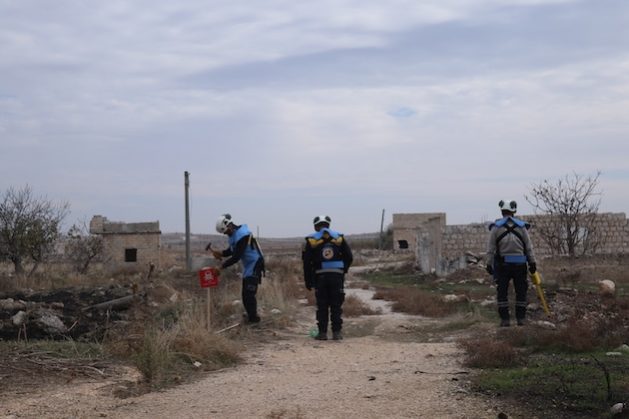
Syrian Civil Defense prepares to remove unexploded munitions of all shapes and types, including landmines. Credit: Sonya Alali/IPS

Syrian Civil Defense prepares to remove unexploded munitions of all shapes and types, including landmines. Credit: Sonia Alali/IPS

IDLIB, Syria, Feb 3 2025 (IPS) – When 42-year-old Amina al-Hassan’s family returned home after the fall of the Bashar al-Assad regime, her son stood on a landmine.

Hassan, from Kafranbel in southern Idlib countryside, sits beside her son’s bed in the hospital after his leg was amputated following the explosion on agricultural land near their home.


“After the fall of the Bashar al-Assad regime and the expulsion of its elements from our city, we went to check on our house, while my son went to inspect the agricultural land near the house. He did not notice a landmine planted among the weeds and plants, and it exploded, amputating his leg,” she told IPS.

Explosive remnants of war and landmines are scattered haphazardly across Syria, endangering the lives of civilians, hindering the return of displaced persons to their cities and villages, and obstructing their agricultural work. The frequency of explosions caused by unexploded ordnance and abandoned explosive ordnance has significantly increased following the collapse of the Bashar al-Assad regime and the fading of the frontlines between the regime and the opposition, where mines and unexploded ordnance are widely dispersed.

“When I heard the explosion, I ran as fast as lightning towards the source of the sound. When I reached the explosion site, I tried to take out my son myself, but the people present at the scene prevented me from doing so. One of the engineering team specialists took charge of removing the mines around him and took him out, then we rushed him to the nearest hospital in the city,” she said, her voice tinged with sorrow.

The United Nations Children’s Fund (UNICEF) confirmed on January 14 that the deadly legacy of landmines and other explosives left behind by years of conflict in Syria had killed more than 100 children in December alone, urging the international community to urgently support mine clearance projects across the country.

According to the Syria Response Coordinators team, the war remnants left by the former Syrian regime continue to claim the lives of Syrians. Since December 8, 2024, explosions of mines and cluster munitions in more than 108 locations in Syria have killed 109 people, including 9 children and 6 women. More than 121 others were injured, including 48 children and one woman.

Rowan al-Kamal (46), from the western Aleppo countryside, visited her home after Syria was liberated from the Assad regime. Unlike many others, she was fortunate, not because her house was intact, but because she noticed an unexploded shell near the house. She recounts, “I moved my children away and called the Syrian Civil Defense, who worked to dismantle it. We were saved from death or injury.”

Kamal adds, “I don’t know how I spotted it amidst the rubble. When I saw it, I was rushing to check what remained of the house. I think my eyes have become accustomed to recognizing shells, as we lived with them throughout the long years of war.”

She reveals that she won’t be able to return to her home due to the presence of landmines and unexploded ordnance, despite living in a makeshift camp with her family of seven and facing extremely harsh conditions, especially with the significant drop in temperatures and the inability of humanitarian organizations to provide the displaced with necessary supplies such as food and heating.

While Kamal and her family survived injury or death, Wael al-Ahmad (22), from Has town in southern Idlib, lost his life after his city was liberated. His mother, Fatima al-Ahmad, recounts, “My son was tending to the sheep on the outskirts of the town and stepped on a landmine without noticing it, causing him severe injuries. He passed away hours later due to his injuries.”

Ahmad calls for intensified efforts to remove these remnants to prevent further casualties and ensure the safe return of the displaced. “The war remnants planted by the Syrian regime and its allies represent a delayed death for Syrians, as they threaten lives and prevent civilians from returning to their homes and farms,” she says tearfully.

Mohammed al-Saeed (32), who works on a war remnants removal team at the Syrian Civil Defense, explains, “War remnants are unexploded munitions of all shapes and types that remain in an area after the end of a war.”

He adds, “War remnants pose a real threat to Syrians in various parts of the country. They are divided into unexploded ordnance such as bombs, rockets, and shells, in addition to landmines.”

Al-Saeed clarifies that the first type is easier to remove and avoid because it can be seen and is usually found above ground. However, the biggest challenge lies in landmines that people cannot see.

Saeed further explained that Syrian government forces planted hundreds of thousands of mines in various regions of Syria, particularly in agricultural lands, military barracks, and frontline areas between the regime and the opposition. He warned that anyone returning to their town, home, or land should be aware that there may be unexploded ordnance present.

According to Saeed, Syrian Civil Defense teams conducted 822 operations to dispose of unexploded ordnance in northwestern Syria between November 27, 2024, and January 3, 2025.

He urged residents to be cautious of strange objects, to avoid touching or moving them, and to report them immediately. Meanwhile, Civil Defense engineering teams continue to conduct daily technical surveys of land contaminated with war remnants and work to dispose of munitions.

Saeed emphasized the need for the international community to work with the new Syrian government and coordinate with it to remove mines by providing funding to expand the Civil Defense’s capacity, hire more personnel, purchase more equipment, and operate in wider areas.

‘The former Syrian regime and its allied militias deliberately planted mines in vital areas, aiming to inflict the maximum number of civilian casualties. This long-term crime represents another facet of their brutal practices,” says Saeed.

IPS UN Bureau Report

  Source

‘The Closure of Meta’s US Fact-Checking Programme Is a Major Setback in the Fight Against Disinformation’

Artificial Intelligence, Civil Society, Education, Featured, Global, Headlines, Press Freedom, TerraViva United Nations

Jan 24 2025 (IPS) –  
CIVICUS speaks with Olivia Sohr about the challenges of disinformation and the consequences of the closure of Meta’s fact-checking programme in the USA. Olivia is the Director of Impact and New Initiatives at Chequeado, an Argentine civil society organisation working since 2010 to improve the quality of public debate through fact-checking, combating disinformation, promoting access to information and open data.


Olivia Sohr

In January 2025, Meta, the company that owns Facebook, Instagram and WhatsApp, announced the suspension of its US data verification programme. Instead, the company will implement a system where users can report misleading content. The decision came as Meta prepared for the start of the new Trump presidency. Explaining the change, Meta CEO Mark Zuckerberg said the company was trying to align itself with its core value of free speech. Meta also plans to move some of its content moderation operations from California to Texas, which it says is in response to concerns about potential regional bias.

What led to Meta’s decision to end its fact-checking programme?

While the exact details of the process that led to this decision are unknown, in his announcement Zuckerberg alluded to a ‘cultural shift’ that he said was cemented in the recent US election. He also expressed concern that the fact-checking system had contributed to what he saw as an environment of ‘excessive censorship’. As an alternative, Zuckerberg is proposing a community rating system to identify fake content.

This decision is a setback for information integrity around the world. Worryingly, Meta justifies its position by equating fact-checking journalism with censorship. Fact-checking is not censorship; it’s a tool that provides data and context to enable people to make informed decisions in an environment where disinformation is rife. Decisions like this increase opacity and hamper the work of those focused on combatting disinformation.

The role of fact-checkers in Meta is to investigate and label content that is found to be false or misleading. However, decisions about the visibility or reach of such content will be made solely by the platform, which has assured that it will only reduce exposure and add context, not remove or censor content.

How the community grading system will work has not yet been specified, but the prospects are not promising. Experience from other platforms suggests that these models tend to increase disinformation and the spread of other harmful content.

What are the challenges of fact-checking journalism?

Fact-checking is extremely challenging. While those pushing disinformation can quickly create and spread completely false content designed to manipulate emotions, fact-checkers must follow a rigorous and transparent process that is time-consuming. They must constantly adapt to new and increasingly sophisticated disinformation strategies and techniques, which are proliferating through the use of artificial intelligence.

Meta’s decision to end its US verification programme makes our task even more difficult. One of the key benefits of this programme is that it has allowed us to reach out directly to those who spread disinformation, alerting them with verified information and stopping the spread at the source. Losing this tool would be a major setback in the fight against disinformation.

What are the potential consequences of this change?

Meta’s policy change could significantly weaken the information ecosystem, making it easier for disinformation and other harmful content to reach a wider audience. For Chequeado, this means we will have to step up our efforts to counter disinformation, within the platform and in other spaces.

In this scenario, verification journalism is essential, but it will be necessary to complement this work with media literacy initiatives, the promotion of critical thinking, the implementation of technological tools to streamline the work and research to identify patterns of disinformation and the vulnerability of different groups to fake news.

GET IN TOUCH
Website
Instagram
Twitter

SEE ALSO
BRAZIL: ‘The focus should be on holding social media companies accountable, not punishing individual users’ CIVICUS Lens | Interview with Iná Jost 01.Oct.2024

‘It’s easier and cheaper than ever to spread disinformation on a massive scale’ CIVICUS Lens | Interview with Imran Ahmed 21.Sep.2024

UK: ‘Social media platforms have become breeding grounds for far-right ideologies’ CIVICUS Lens | Interview with Kulvinder Nagre 19.Aug.2024

  Source