NEW YORK, Feb 3 2026 (IPS) – In the month of February 2025, one year ago, United Nations Secretary-General Antonio Guterres commenced his briefing of the media by announcing that “I want to start by expressing my deep concern about information received in the last 48 hours by UN agencies — as well as many humanitarian and development NGOs — regarding severe cuts in funding by the United States.” He went on to warn that ““The consequences will be especially devastating for vulnerable people around the world.”
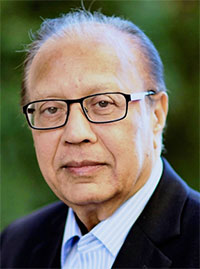
Anwarul K. Chowdhury
UN80 Initiative – Reform or Pressure?
That budgetary crisis was attempted to be put off by launching the anniversary-rationaled and liquidity-crunch-panic-driven, window-dressing reform agenda – the so-called UN80 Initiative. These long overdue structural and programmatic reforms of the UN system have been on the agenda of at least for the last four Secretaries-General but without having much significant impact, except acronym-changing, mandate-creeping and structure-tweaking, and now these days, staff-relocating.
An Alarm Bell for Financial Collapse
End of this January again the Secretary-General said in a letter to all UN Member States that cash for its regular operating budget could run out by July, which could dramatically affect its operations. He also called on the to fundamentally overhaul the UN’s financial rules to prevent an “imminent financial collapse”.
Why now ask the member states to do something concrete? Why not in February 2025 when he sounded the alarm himself?
It reminds me of the somewhat similar Aesop’s fable about boy who cried wolf.
Lamenting Limited Power – No Power, No Money
In the past, Secretary-General Guterres lamented to the media asserting that “… it is absolutely true that the Secretary-General of the United Nations has very limited power, and it’s also absolutely true that he has very little capacity to mobilize financial resources. So, no power and no money.”
That is the reality which every Secretary-General faces and has been aware of. That is also known generally to the people who follow the United Nations regularly and thoroughly understand the functional complexity of the world’s largest multilateral apparatus.
Why then does this reality surfaces and brought to public attention only when the UN leadership fails to carry out the mandated responsibilities?
I believe strongly that this “very limited power”, as worded by SG Guterres, should be highlighted as often as possible to avoid unnecessary and undue expectations of the global community about the UN and its top leadership. No Secretary-General has pointed out these limitations as he campaigned for the post and on assuming the office, as far as I know.
Current SG Guterres is no exception. He would have been realistic and factual if he had pointed out the limitations – better termed as obstacles – to his leadership as he took office in 2017, and not in 2026 after being in office for nearly nine years. This built-in operational weakness and inability of the world’s most important diplomat have always been there.
Controlling Or Quitting?
Some people speculate that the US is using its financial clout and pressure to threaten the collapse of the UN.
The US has always been using its huge power of veto and almost one-fourth of the budgetary contributions to the operations of the UN system. That is a reality which should be kept in mind by the leadership of the UN and its Member States, unless the Charter of the UN is changed to create a more democratic organization in the true sense.
For a long time, the US has used the part payment arrangements for its legally due contributions, with full understanding and acceptance of the Secretary-General, so that it can avoid losing its voting power and get its own pound of flesh each time such instalment payments are made.
I believe the US wants to use the world body in its own way by controlling, not quitting.
A Woman at the Helm for The UN
In this context, let me reiterate that after eight decades of its existence and choosing nine men successively to be the world’s topmost diplomat, it is incumbent on the United Nations to have the sanity and sagacity of electing a woman as the next Secretary-General in 2026 when the incumbent’s successor would be chosen.
There is a need for creative, non-bureaucratic and pro-active leadership initiative for a real change to ensure avoidance of “crying wolf” syndrome disrupting the work and activities of the most universal multilateral body with the mandate for working in the best interest of humanity.
Ambassador Anwarul K. Chowdhury is a former UN Under-Secretary-General, one-time Permanent Representative of Bangladesh to the United Nations, Chairman of the UN General Assembly’s Administrative and Budgetary Committee (1997-1998), former Senior Special Adviser to UN General Assembly President (2011-2012) and President of the UN Security Council (2000 and 2001) and a two-term Vice Chairman of the all-powerful UN Committee on Programme and Coordination (1984-85).
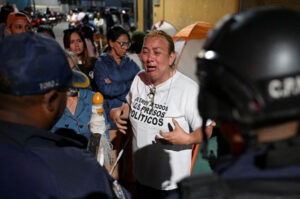
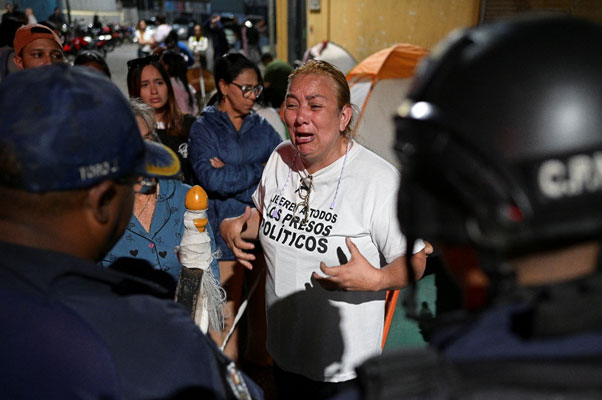
Evelis Cano, mother of political prisoner Jack Tantak Cano, pleads with the police for her son’s release outside a detention centre in Caracas, Venezuela, 20 January 2026. Credit: Gaby Oraa/Reuters via Gallo Images
MONTEVIDEO, Uruguay, Feb 2 2026 (IPS) – When US special forces seized Nicolás Maduro and his wife from the presidential residence in Caracas on 3 January, killing at least 24 Venezuelan security officers and 32 Cuban intelligence operatives in the process, many in the Venezuelan opposition briefly dared hope. They speculated that intervention might finally bring the democratic transition thwarted when Maduro entrenched himself in power after losing the July 2024 election. But within hours, those hopes were crushed. Trump announced the USA would now ‘run’ Venezuela and Vice-President Delcy Rodríguez was sworn in to replace Maduro. Venezuela’s sovereignty had been violated twice: first by an authoritarian regime that usurped the popular will, and then by an external power that deliberately violated international law.
A cynical intervention
Under Trump, the USA has abandoned any pretence of promoting democracy. Trump wrapped the intervention in the rhetoric of anti-narcotics operations while openly salivating over Venezuela’s oil reserves, rare earth deposits and investment opportunities. He repeatedly made clear that US regional hegemony is the number one priority. His contempt for Venezuelans’ right to self-determination was explicit: when asked about opposition leader María Corina Machado, Trump dismissed her as lacking ‘respect’ and ‘capacity to lead’. The message to Venezuela’s democratic movement was clear: your struggle doesn’t matter, only our interests do.
Ironically, the US intervention achieved what years of Maduro’s propaganda failed to do, giving anti-imperialist rhetoric a shot in the arm. For decades, Latin American authoritarian regimes have justified repression by pointing to the threat of US intervention, even though this was a largely historical grievance. Not anymore: Trump has handed every Latin American dictator the perfect justification for continuing authoritarian rule.
The global response has been equally revealing. The loudest defenders of national sovereignty are authoritarian powers such as China, Iran and Russia: states that routinely violate their citizens’ rights expressed their ‘solidarity with the people of Venezuela’ and positioned themselves as champions of international law. By blatantly violating a foundational principle of the post-1945 international order, Trump made the leaders of some of the world’s most repressive regimes look like the adults in the room. And across Latin America, the political conversation has now shifted dramatically: the question is no longer how to restore democracy in Venezuela, but how to prevent the next US military adventure in Latin America.
Authoritarianism continues
Meanwhile, Venezuela’s authoritarian regime remains intact. Maduro may be in a New York courtroom, but the structures that kept him in power – the corrupt military, embedded Cuban intelligence, patronage networks and the repressive apparatus – continue unchanged. Rodríguez will likely try to run down the clock, claiming Maduro could return at any moment to avoid calling elections while quietly negotiating oil deals with US companies and reasserting authoritarian control. For both Rodríguez and Trump, democracy seems like an inconvenient obstacle to resource extraction.
For Venezuelan civil society, this creates real dilemmas. As she was sworn in, Rodríguez denounced the operation that put her in charge and vowed that Venezuela would ‘never again be a colony of any empire’. She has wrapped herself in the flag, framing regime continuity as a patriotic stand against western imperialism, and can now easily paint opposition activists who have long demanded international pressure for democracy as treasonous collaborators with foreign powers. This is despite being an insider of a regime that welcomed Cuban intelligence, Iranian oil traders and Russian military advisers, and is now negotiating oil deals with the USA and crossing its own red line by promising legal changes to enable private investment.
A Venezuelan solution for Venezuela
But there may be some cracks in the regime. With Maduro gone, frictions inside the ruling party have become apparent. For instance, there have been obvious disagreements on how to handle the pressure to free Venezuela’s over 800 political prisoners. These may yield opportunities the democracy movement can exploit.
This is the time for the democratic opposition to reclaim the narrative. In the immediate aftermath of the intervention, families of political prisoners mounted vigils outside detention centres, demanding releases the government has only partially delivered. Civil society must amplify these voices, making clear that any transitional arrangement requires the dismantling of the repressive apparatus, not merely a change of faces at the top.
A broad coalition of civil society organisations has issued 10 demands that chart a path to democratic transition. They call for the immediate and unconditional release of political prisoners, the dismantling of irregular armed groups, unfettered access for human rights monitors and humanitarian aid and, crucially, a free and fair presidential election with international observers. These demands deserve international backing, not as conditions for oil contracts, but as non-negotiable requirements for any government that can claim to represent Venezuela.
Venezuela’s democratic forces can either accept marginalisation as Trump and Rodríguez carve up their country’s resources, or use this chaotic moment to advance a genuinely Venezuelan democratic agenda. That means rejecting both Maduro’s authoritarianism and Trump’s intervention, and insisting that any legitimacy Rodríguez’s government claims must come from Venezuelan voters, not US armed forces or oil contracts. Any window of opportunity may however be closing fast. The question is whether Venezuela’s democratic movement can seize it to build the country they have strived for, or whether they will remain spectators while others decide their fate.
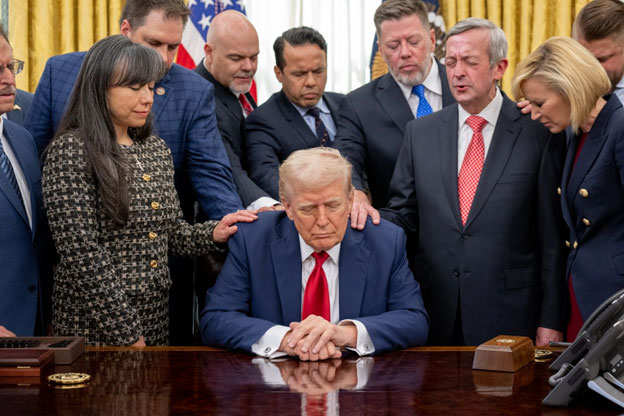
President Donald Trump Joins Faith Leaders in Prayer – Credit: The White House
According to the UN, Sunday marked the start of World Interfaith Harmony Week, a time to emphasize that mutual understanding and interreligious dialogue are essential to building a culture of peace. The week was established to promote harmony among all people, regardless of their faith.
NEW YORK, Feb 2 2026 (IPS) – Several events, meetings, consultations, initiatives, etc. taking place among faith-inspired, ‘faith-based’ and a variety of other similar efforts, over the past year, in the United States especially, concern me.
Coming from a background of human rights, international development, and humanitarian service, I have witnessed the arc of ‘none’ to increasing interest by Western governments in ‘religion’ – religious engagement, religion and development, religion and foreign policy, religious freedom, religious peacebuilding, or religion and peace, and more, including even religion and agriculture. Basically, religion and everything.
Non-Western governments within Africa and Asia, including areas overlapping with what we call (variably) “the Middle East”, have long been interested, and indeed actively engaging religious leaders and religious institutions.
As many scholars, observers, and foreign policy pundits have noted, the interest of such governments has often transcended any genuine fascination with faith, towards rather obvious instrumentalization of religious leaders, religious organisations and religious groups, in support of specific political agendas (e.g., making peace with Israel, legitimacy of corrupt – and violent – politically repressive leaders and regimes, etc.).
In fact, the marriage between select religious leaders/institutions/groups and some political actors goes back to the empires we have inherited pre-Westphalian states).
I recall some stories from my time serving as a staff member at the United Nations, and in other international fora. The first story revolves around one Arab and one Indian diplomat speaking with a European counterpart, during one of several UN Strategic Learning Exchanges on Religion, Development and Diplomacy, which I coordinated and facilitated, this one in 2014.
The discussion concerned how best to “benefit” from working with religious leaders to affirm a message of certain political parties, especially, albeit not only, around elections. The Arab patted the European on the back and said, with a smile and a wink: “you are finally catching up on how to use these religious leaders – congratulations my friend”. The Indian one, looking bemused, added “Yes. And be careful”.
Another story concerns another meeting I organised – in one of the basement meeting rooms of the UN – between UN officials and a diverse array of religious actors, around peace and mediation efforts, in select African and Asian conflict settings, early 2015.
A European Christian religious leader of a renowned multi-religious organisation made an intervention to address the concerns about “instrumentalization” of religious actors, which some faith-based NGO leaders were articulating.
While some faith representatives cautioned against religious actors being used to “rubber stamp decisions already made by governments and some intergovernmental organisations” (in the room were both UN and EU officials), this particular Western Christian religious leader spoke up and said, “I am not worried about that at all, in fact, I would like to say to my secular colleagues in this room, please use us… we can certainly benefit you… we are not common civil society actors, our mission makes us exceptional”.
My last story, is from my time serving as the secretary general of an international multireligious organisation which convenes religious leaders from diverse religious institutions around “deeply held and widely shared values”.
As soon as I became a member of the UN Secretary-General’s High Level Advisory Board on Effective Multilateralism, I arranged a meeting between some of my multi-religious Board members (religious leaders), and some members of this high Level UN SG’s Advisory Board.
The idea was to nurture a quiet but candid dialogue between pollical and religious leaders, around why and how multilateralism can be significantly strengthened by multireligious engagement.
I hasten to note that multireligious engagement, if served well, can be – as I have written and persistently argued – resistant to instrumentalization of select religious actors to serve any one particular governmental agenda. The latter is a feature I warn against, and small wonder, given developments from India to the United States, from Russia to Israel, and beyond.
Once again, I heard a religious leader invite the members of the SG’s Board to “use” their (religious) wisdom because of their “exceptional” mission (presumably the godly one). This time, later reflection among members of the UN SG Board led to noting that such multireligious engagement would be inadvisable, due to a concern about “Muslims” involved in such multireligious spaces.
Fast forward to 2026, one year after an increasingly belligerent US Presidential Administration’s record, which includes relatively ‘minor’ policy decisions such as transforming the name of the Ministry of Defence to the “Ministry of War”. And not so minor human rights abuses of citizens and immigrants, and some pointing to manipulation and outright disregard of the rule of law, both at home and abroad (I hope this is polite enough wording). Of course one dares not mention support to certain genocidal regimes killing thousands in the name of self-protection.
In this environment, I listen to conversations among some of the United States’ most esteemed faith-based organisations, all with a remarkable track record of serving humanity in all corners of the world. Who, apparently, are seeking to engage this Administration “constructively”, with some praising the “unprecedented” outreach of members of this Administration in engaging, largely (some would say exclusively), with certain Christian NGOs, certain Christian religious leaders, and certain Christian faith protagonists – no doubt to further noble objectives. Apparently, this is a form of strategic engagement of/with religion.
Even though there were likely some who felt uncomfortable with aspects of this rhetoric, the studiously diplomatic silences – including my own – about challenging anything said, was noteworthy. The bottom line is, “we need access to the White House… we need more resources to do our (good) work”.
Why was I silent? Because I am the quintessential ‘other’ whose outspokenness has already earned me the loss of a sense of ‘home’ and security, many times over. This is neither excuse nor justification, rather, an acknowledgement of cowardice.
Into this Kafkaesque reality, let me ask a few questions I am battling with: what will it take to speak truth to power publicly – the way Minnesotans and Palestinians are having to do with their own regimes? Is it strategic to be silent, or such consummate diplomats, especially when we work in the name of the ‘godly’ – being such “exceptional” actors?
Conversely, is this Administration which we endeavour to be so tactful with, being silent about it’s “divine mission”? Is being “nice and essentially a kind person with their heart in the right place”, and doing godly work, a good reason to work with those who are serving regimes which ignore the rule of law in their own nation and abroad? Does faith-based diplomacy mean we either collude, remain silent, or take the struggle to the streets?
If so, what difference is faith-based diplomacy and engagement actually making to civic engagement, to honoring human rights and the rule of law, or to serving principled leadership? Or do these simply not matter since it is the self-interests of the ruling and rich few, are what matters to determine the integrity of life, planet and leadership?
Perhaps we should ponder the advice of the Indian Diplomat, given to his Western counterpart 22 years ago: how can we “be careful”?
Professor Azza Karam serves as President of Lead Integrity; and Director of the Kahane UN Program, for Occidental College’s Diplomacy and World Affairs.
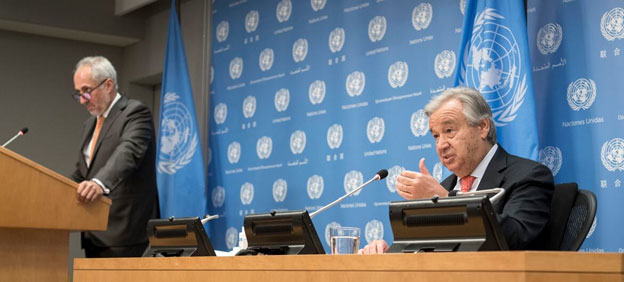
UN Secretary-General António Guterres (seated at right) speaks to reporters at a press conference at UN Headquarters, in New York. UN Photo/Mark Garten
UNITED NATIONS, Jan 30 2026 (IPS) – UN Secretary-General Antonio Guterres was dead on target when he told the Security Council last week that the rule of law worldwide is being replaced by the law of the jungle.
“We see flagrant violations of international law and brazen disregard for the UN Charter. From Gaza to Ukraine, and around the world, the rule of law is being treated as an à la carte menu,” he pointed out, as mass killings continue.
“The New York Times on January 28 quoted a recent study pointing out the four-year war between Russia and Ukraine has resulted in over “two million killed, wounded or missing”. The study published last week by the Center for Strategic and International Studies in Washington says nearly 1.2 million Russian troops and close to 600,000 Ukrainian troops have been killed, wounded or are missing.
In the war in Gaza, over 70,000 Palestinians, mostly civilians, including women and children, have been killed since October 7, 2023, with figures reaching over 73,600 by early January 2026, according to various reports from the Gaza Health Ministry and human rights organizations.
These killings have also triggered charges of war crimes, genocide and violations of the UN charter, as in the US invasion of Venezuela and the takeover threats against Greenland.
Guterres said in an era crowded with initiatives, the Security Council stands alone in its Charter-mandated authority to act on behalf of all 193 Member States on questions of peace and security. The Security Council alone adopts decisions binding on all.
No other body or ad hoc coalition can legally require all Member States to comply with decisions on peace and security. Only the Security Council can authorize the use of force under international law, as set out in the Charter. Its responsibility is singular. Its obligation is universal, declared Guterres.
Dr Ramzy Baroud, Editor of Palestine Chronicle and former Managing Editor of the London-based Middle East Eye, told IPS the statement by the Secretary-General is long overdue.
Too often, he said, UN officials resort to cautious, euphemistic language when describing egregious violations of international law—especially when those responsible are UN Security Council veto holders, states that have ostensibly sworn to uphold the UN Charter and the core mission of the international system.
Unfortunately, the UN itself has become a reflection of a rapidly shifting world order—one in which those with overwhelming military power sit at the top of the hierarchy, abusing their dominance while steadily hollowing out the very institutions meant to restrain them, he pointed out.
“We must be honest with ourselves and acknowledge that this crisis did not begin with the increasingly authoritarian misuse of law by the Trump administration, nor is it limited to Israel’s absolute disregard for the international community during its two-year-long genocide in Gaza.”
The problem is structural. It is rooted in the way Western powers have long identified—and exploited—loopholes within the international legal system, selectively weaponizing international law to discipline adversaries while shielding allies and advancing their own strategic agendas, he declared.
Responding to a question at the annual press briefing on January 29, Guterres told reporters it is obvious that members of the Security Council are themselves violators of international law –and it doesn’t make life easy for the UN in its efforts.
Unfortunately, he said, there is one thing that we miss. “It’s leverage. It’s the power that others eventually have, to force countries and to force leaders to abide by international law. But not having the power, we have the determination, and we’ll do everything possible with our persuasion, with our good offices, and building alliances to try to create conditions for some of these horrible tragedies we are witnessing. And from Ukraine to Sudan, not to mention what has happened in Gaza, we will be doing everything we can for these tragedies to stop”.
Dr Jim Jennings, President of Conscience International, told IPS the global humanitarian situation described by the Secretary-General is grim but very real. The climate crisis, natural disasters, numerous ongoing and expanding conflicts, and the impact of new technologies, all add to today’s global economic instability and affect every person on earth.
While President Trump continues bombing countries and strutting the world stage with his adolescent dream of US territorial expansion, a major readjustment of the global power balance among China, the US, Europe, and the BRICS nations is underway, he noted.
Stripping life-giving aid away from the poorest countries on earth to benefit those already rich, as his policies guarantee, is a recipe for even more global suffering and violence.
“Clearly one of the most blatant and harmful reasons for the present disastrous situation worldwide is the reduction of funding for UN agencies by the United States, which has traditionally paid a high percentage of their costs”.
With the further curtailment of The Department of State-USAID’s enormous support for people in critical need in almost every country in the world, the Trump administration’s one-two punch has already threatened to make a challenging set of problems unmanageable.
What is to be done? People and governments everywhere must stand up, speak out, and act against the colossal forces now arrayed against some of the world’s most vulnerable populations. How to do that has never been easy, Dr Jennings argued.
Put in the simplest terms, Secretary-General Guterres was merely pointing out the glaring fact of the true global situation and appealing for the critical need UN agencies have for support if their mission is not to fail. The answer is straightforward— more private funding.
Why not raise the level of our individual, corporate, and foundation donations to the UN Agencies and other aid organizations while continuing to advocate for responsible government backing for the irreplaceable United Nations agencies? he asked.
Dr Palitha Kohona, a former Chief of the UN Treaty Section, told IPS international relations, for a very long time, were dependent on the whims of powerful states and empires. Might was right and disputes were settled by using force. Land inhabited for centuries was annexed to empires and native populations were dispossessed or even exterminated.
From such fractured beginnings, an orderly world governed by agreed rules began to emerge gradually, although most of the rules were established by the powerful.
Thousands of treaties were concluded, customary rules were respected and a rudimentary judicial structure began to be established. The world rejoiced in the establishment of the United Nations.
Though lacking in proper enforcement mechanisms and largely dependent on voluntary mutually beneficial compliance, a rule based international order was beginning to emerge.
“Many, including the present writer, wrote enthusiastically about the consolidation of a rules-based international order. The violence that was commonplace in international dispute resolution prior to the Second World War appeared to be limited to distant parts of the world.”
But like a cozy dream being shattered in mid-sleep, he said, the USA has rudely disrupted the illusion of a new international rules-based world order of which it was once a champion. The trade rules, so painfully developed, have been ditched. Mutual deal making has resurfaced, he said.
“Now it would seem that the powerful would determine the rules, based on self-interest. Rules relating to sovereignty, territorial integrity and rights of people would now seem to depend on the whims of the powerful. The weak will draw their own conclusions. Acquire counterattack capabilities that would make an aggressor think twice”.
“Unless the medium powers and powerless band together and resolve to maintain the international rule of law, we may be entering an era of extreme uncertainty in international relations”, declared Dr Kohona, a former Permanent Representative of Sri Lanka to the UN and Ambassador to China.
Dr Baroud also pointed out that the 2003 US-British invasion of Iraq stands as a textbook example, but the same pattern has repeated itself in Libya, Syria, and across large parts of the Middle East and beyond. In each case, international law was either manipulated, ignored, or retroactively justified to accommodate power rather than principle.
Israel’s genocide in Gaza, the war in Ukraine, and the ongoing atrocities in Sudan and elsewhere are not aberrations. They represent the culmination of decades of legal erosion, selective enforcement, and the systematic degradation of the international legal order.
While I agree—and even sympathize—with Canadian Prime Minister Mark Carney’s comments at the World Economic Forum in Davos, in which he expressed criticism of the new power dynamics that have rendered the international political system increasingly defunct, one cannot help but ask why neither he nor other Western leaders are willing to confront their own governments’ historical role in creating this reality.
Without such reckoning, calls to defend international law risk sounding less like principled commitments and more like selective outrage in a system long stripped of credibility.
European powers that are critical of Trump have not raised their voice with the same intensity and vigor against Netanyahu for doing a lot worse than anything that Trump has done or threatened to do.
This also begets the same question about the latest comments by the UN Secretary-General. He should offer more specifics than generalized decrying the collapse of international morality.
“Moreover, we expect a roadmap that will guide us in the process of re-establishing some kind of a sane global system in the face of the growing authoritarianism, dictatorship, and criminality all around”, declared Dr Baroud.
Jan 28 2026 (IPS) – CIVICUS speaks to the Business and Human Rights Centre (BHRC) about labour rights abuses in Myanmar’s garment industry since the 2021 military coup.
Myanmar’s garment sector, which employs hundreds of thousands of workers, is in deep crisis. Since the coup, labour protections have collapsed, independent unions have been dismantled and workers who try to organise face intimidation, dismissal and arrest. Inside factories, reports show multiple cases of child labour, forced overtime, harassment, poverty wages and unsafe conditions. At the same time, rising living costs and US tariffs are pushing many workers further into insecurity as factories close and layoffs become more common. Garment workers, most of them women, are trapped between exploitation, repression and a rapidly shrinking industry.
How have conditions inside Myanmar’s garment factories changed since the coup?
Our monitoring between February 2021 and October 2024 shows a sharp rise in both the number and severity of pre-existing labour rights abuses. Since the coup, factory employers have increasingly worked with the military to restrict organising and silence workers. This collaboration has led to threats, arrests and violent attacks against workers. In one case, security forces carried out joint military and police raids on the homes of workers who demanded unpaid wages and limits on overtime.
Factories have also expanded surveillance. Workers report invasive searches, phone confiscation and installation of CCTV inside factories, including near toilets. Employers also force workers to lie during audits. These practices aim to hide abuses and have exacerbated the abuses workers already faced.
What abuses do garment workers suffer in the workplace?
Factories force workers to meet extreme production targets through excessive and often unpaid overtime. Many workers must stay overnight until dawn, often without enough food, water or ventilation, leading to exhaustion and health problems. Managers threaten and abuse workers who refuse to work overtime or fail to meet targets. We have documented a case where supervisors denied workers food and water as punishment for not meeting targets.
What happen to workers who try to speak out or organise?
Workers who dare speak out face brutal reprisals. After the military declared 16 labour unions and labour rights organisations illegal, arrests, home raids and surveillance increased, particularly against union leaders and activists linked to the Civil Disobedience Movement. The movement began after the coup and brings together workers who refuse to cooperate with military rule through strikes and other forms of non-violent resistance.
Inside factories, employers threaten and dismiss union leaders on false grounds. In one case, a factory reopened and refused to reinstate union members and publicly humiliated them. Employers have also created Workplace Coordination Committees to replace independent unions, denying workers the right to choose their representatives and silencing their complaints. Prominent union leaders such as Myo Myo Aye have been arrested multiple times simply for continuing to organise.
What should international brands be doing in this context?
Under the United Nations Guiding Principles on Business and Human Rights, brands operating in conflict settings must carry out heightened, conflict-sensitive due diligence and demonstrate, with independent and verifiable evidence, that it works. In Myanmar’s current context, where surveillance and violent repression run through all the supply chain, this standard is exceptionally hard to meet.
Any brand that stays must deliver clear and demonstrable improvements in working conditions. Brands that can’t meet this threshold must carry out a responsible exit, working with workers and their representatives and taking steps to reduce harm, rather than adding to the instability garment workers already face under military rule.
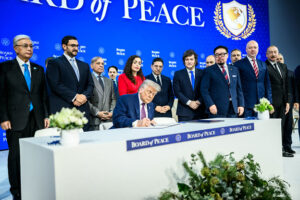
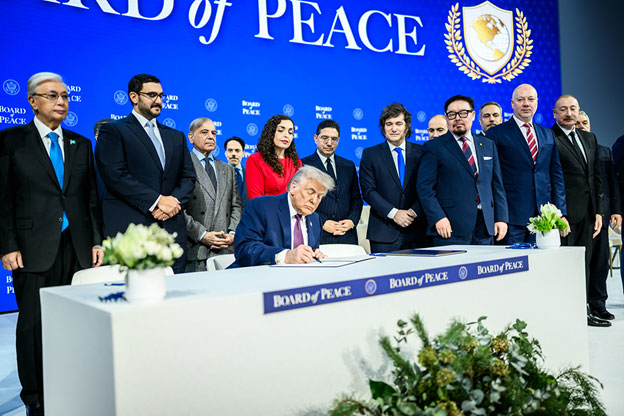
Trump’s proposed “Board of Peace” built around heads of state, including Russia, is structurally ill-suited to end the Israel–Hamas war and to govern postwar Gaza in any sustainable way.
NEW YORK, Jan 26 2026 (IPS) – At a press conference at the World Economic Forum in Davos last week, Trump unveiled his newly formed Board of Peace to end the Israel-Hamas war. During a press conference in the White House, he explained that he created the board because “The UN should have settled every one of the wars that I settled. I never went to them. I never even thought to go to them.”
He claimed that the Board of Peace will be dealing with ending the Israel-Hamas war in Gaza. He invited many heads of state to join the Board and threatened to impose heavy tariffs on the countries of those who refused. Paradoxically, he also invited Russian President Putin to join the pack.
Even a cursory review of the Board’s structure—its executive make-up, role, and responsibilities—makes it glaringly clear that he placed himself at the forefront of everything, from operations to ultimate decision-making. He basically codified US dominance, as long as he ran it.
He granted himself the authority to veto any decision he did not like, to invite or remove any board member, to approve the agenda, to designate his successor, and even dissolve the board entirely. Furthermore, he reserved a central role for himself even after leaving the presidency.
Shortcomings of the Board and its Structure
In more than one way, the creation of this board dissolves the American-built post-war international system and builds a new one with himself at the center. And while Trump is striving to consolidate authoritarian power domestically, he now wants to project himself on the international stage as if he were an Emperor, presiding over a board composed largely of heads of state. Although board members can have their say, they are nevertheless structurally subordinated to him.
No Seat for the Primary Stakeholders
The Board of Peace and the parallel Gaza Executive Board are designed to sit above a technocratic Palestinian committee, with no Palestinian political representative given a seat at the top table, despite their being primary stakeholders. Hamas is required to disarm, without specifying how, and to withdraw from administrative governance.
The Palestinian Authority is relegated to an “apolitical” managerial role, which in effect reproduces the long-standing problem of trying to impose solutions over Palestinians instead of negotiating with them. This has repeatedly undermined past peace frameworks and offers no pathway towards sustainable regional or world peace.
Conflict of Interests
The board is chaired by Trump himself, with membership effectively bought via a $1 billion “permanent seat” fee, creating apparent conflicts between profit, prestige, and peacemaking. Russia, Israel, Gulf monarchies, and others who have direct stakes in arms sales, regional influence, and energy routes, are not neutral guarantors but interested parties likely to instrumentalize Gaza for their own strategic agendas.
Colonial-Style Trusteeship
The architecture explicitly envisions international figures and heads of state supervising Gaza’s reconstruction, security, and governance, effectively turning Gaza into a protectorate administered by external powers.
Human rights advocates and regional observers are already criticizing this as a colonial-style trusteeship that denies genuine sovereignty, which is already generating local resistance, delegitimizing the arrangement, and providing ideological fuel for militant spoilers.
Israeli and Regional Objections
Israel’s leadership has publicly objected to the composition and design of the Gaza bodies. It is enraged over the role of Turkey and Qatar, forcing Netanyahu to distance himself from aspects of the plan even while joining the board under pressure from Trump.
Nevertheless, the Israeli government views key members of the Board and mechanisms as hostile or at odds with its security principles. Israel will either hinder implementation or hollow it out in practice, turning the board into an arena for intra-allied conflict rather than conflict resolution.
Great Power Rivalry Inside the Board
Ironically, the board anticipates concurrent participation by rivals such as Russia, the EU, and US-aligned states, while at the same time, Moscow is resisting US-backed peace terms in Ukraine and leveraging Middle East crises to weaken Western influence. This arrangement invites the board to become another theater of great power competition, where Russia, Hungary, Belarus, and others can obstruct or dilute measures that do not serve their broader geopolitical interests.
This is not to speak, of course, about the widespread concerns and suspicions among European leaders about Putin’s adversarial relations at the table, which is a recipe for discord and prevents concrete action.
Unclear Legal Basis
Another big hole in Trump’s Board is its framing as an alternative to, and possible replacement for, the United Nations, without any legal foundation, universal membership, or binding authority under international law.
A self-selected club by Trump of mostly invited heads of state, tied to a particular US administration and anchored in significant financial contributions, lacks the procedural legitimacy to impose security arrangements, adjudicate disputes, or credibly guarantee Palestinian rights over the long term, to which Trump pays no heed at all.
Overambitious, Under-Specified Mandate
The board’s responsibilities have already expanded from supervising a Gaza ceasefire to a broad charter “promoting stability” and “resolving global conflict,” which is ostentatious and will never come to fruition, while indicating mission creep before it even begins.
Such a variable mandate, with multiple overlapping structures (Board of Peace, Gaza Executive Board, Founding Executive Board), is almost guaranteed to generate bureaucratic turf wars, paralysis, and incoherence—particularly once crises beyond Gaza compete for attention and resources.
To be sure, this is just another of Trump’s stunts, always pretending that he is the only one who can come up with out-of-the-box ideas. Like many of his initiatives, this so-called Board of Peace one falls into the same category—transactional and reversible.
It is a grandiose idea that cannot be sustained structurally, has no enforcement capability, and relies on a contradictory algorithm to allow it to fulfill its mission, which, in any case, remains open-ended and unrealistic.
Dr. Alon Ben-Meir is a retired professor of international relations, most recently at the Center for Global Affairs at NYU. He taught courses on international negotiation and Middle Eastern studies.



 Myanmar’s garment sector, which employs hundreds of thousands of workers, is in deep crisis. Since the coup, labour protections have collapsed, independent unions have been dismantled and workers who try to organise face intimidation, dismissal and arrest. Inside factories, reports show multiple cases of child labour, forced overtime, harassment, poverty wages and unsafe conditions. At the same time, rising living costs and US tariffs are pushing many workers further into insecurity as factories close and layoffs become more common. Garment workers, most of them women, are trapped between exploitation, repression and a rapidly shrinking industry.