Beyond Buzzwords: COP30’s Opportunity to Deliver on Sustainable Food Systems

Climate Action, Climate Change, Conferences, COP30, Economy & Trade, Environment, Food and Agriculture, Food Security and Nutrition, Food Sustainability, Food Systems, Global, Green Economy, Headlines, Natural Resources, Sustainability, Sustainable Development Goals, TerraViva United Nations
Opinion


In the midst of the COP30 climate talks, consensus will depend on recognizing that climate action and protecting livelihoods must advance together.

Delegates met at the Global Climate-Smart Agriculture Conference in Brasília before the COP30 climate talks. Credit: 2025Clim-Eat/Flickr

BELÉM, Brazil, Nov 20 2025 (IPS) – The language of agricultural sustainability changes like the seasons—from “climate-smart” to “regenerative,” “agroecological,” and “nature-positive.” Each term reflects good intentions, but the growing list risks duplication, confusion and delays.


The recent CSA Conference in Brasília gathered leaders from policy, science and finance ahead of COP30 to focus not on buzzwords but on the shared foundations of sustainable food systems, which is all the more important in the Grave New World. For all the various theories of change, many share the same principles of soil health, crop innovation, inclusive finance and resilient livestock production.

In the midst of the COP30 climate talks, consensus will depend on recognizing that climate action and protecting livelihoods must advance together. Leaders must challenge themselves to measure success not only in emissions reduced, but also in the quality of life sustained by a thriving and resilient rural economy. With Brazil’s COP presidency determined to accelerate agreements into action, the challenge now is to accept and advance context-specific approaches in pursuit of a shared goal.

At present, fragmentation continues to divide institutions, donors, NGOs and producers, with competing ideologies slowing progress toward sustainability at the speed and scale required. For example, while a vast number of organizations are currently backing the concept of regenerative agriculture, others tread the paths of sustainable intensification or climate-smart agriculture. But some of the practices, such as agroforestry, could fall under each of these concepts.

And the Koronivia Joint Work on Agriculture (KJWA), established prior to COP26, has been succeeded by Sharm el-Sheikh Joint Work on the Implementation of Climate Action on Agriculture and Food Security and yet farmers are still waiting for clear national strategies to emerge from years of workshops and working papers. While the principles underpinning these joint work programs are sound, they have not generated action at the speed needed.

On the other hand, the six CSA Conference themes—from soil health and crop innovation to finance and policy—offer a fundamental framework around which there is already much agreement and can deliver results under whichever buzzword it is categorized. The themes also reflect the priorities of Brazil’s Action Agenda and ABC+ Plan, highlighting practical areas of consensus.

Brazil’s experience offers tangible examples of how shared priorities can move from discussion to delivery. The ABC+ Plan (2020–2030) forms the backbone of the country’s low-carbon agriculture strategy, integrating sustainable practices like no-till farming, pasture recovery and biological nitrogen fixation into a coherent national framework. It represents a direct contribution to the COP30’s Action Agenda’s agricultural pillar, transforming abstract goals on soil health and productivity into measurable outcomes.

Building on this, Brazil’s RENOVAGRO is the financing arm that enables the implementation of the ABC+ Plan, demonstrating how public policy can activate private investment to move all Action Agenda ambitions forward together. By tying credit eligibility to verified adoption of low-carbon practices, the program allows farmers to commit to transitions that would otherwise be out of reach. This realizes the ABC+ Plan’s policy objectives and shows that progress depends not necessarily on new ideas, but on acting decisively on the systems that already work.

At COP30, the challenge is not to settle on the right language but to sustain the right actions—whatever this might look like according to local circumstances and resources. Progress depends on scaling what we already agree on: sound policies, accessible finance that doesn’t exclude vulnerable populations and resilient food systems that keep production within environmental limits. The next phase must prioritize implementation over invention.

Leaders have an opportunity to move from promises to performance. The task ahead is to scale what already works—not to define new concepts, but to deliver proven solutions faster.

Brazil’s example shows that integration works better than focusing on the continued search for a universal solution. There is no single path forward, only a combination of context-specific approaches bound by diplomatic agreement and sustainable financing.

By focusing on fundamentals, we can avoid the paralysis of competing definitions and begin to act collectively by applying the policies and practices we know work in ways that fit local realities.

Ana Maria Loboguerrero, Director, Adaptive and Equitable Food Systems at Gates Foundation
Dhanush Dinesh, Chief Climate Catalyst at Clim-Eat

IPS UN Bureau

 

Zambia’s Hichilema UPND cadres abduct, harass former justice Minister Lubinda

LUSAKA-(MaraviPost)-The Zambian governing United Party for National Development (UPND) cadres on Wednesday reportedly abducted former Justice Minister Given Lubinda, subjecting him to harassment before police officers intervened to rescue him.

UPND is a major political party in Zambia, currently in power, with Hakainde Hichilema as the current President of Zambia and the party leader.

The incident escalated quickly as the group confronted Lubinda in what appeared to be a politically motivated attack.

Eyewitnesses say the cadres surrounded him, shouting threats and insults while attempting to force him into a vehicle against his will.

The situation grew tense as the harassment intensified, drawing the attention of bystanders who feared the confrontation might turn deadly.

According to witnesses, the cadres accused Lubinda of undermining the ruling party and vowed to “teach him a lesson,” signalling a troubling rise in political intolerance.

Police officers who were alerted to the incident arrived promptly at the scene and managed to disperse the attackers before safely extracting Lubinda from their hold.

Law enforcement authorities confirmed the rescue, noting that the cadres had acted unlawfully and would be pursued for criminal conduct.

In their statement, police condemned the attack and warned that political violence would not be tolerated under any circumstances.

The rescue operation brought temporary relief, but it also sparked wider national concern about the growing pattern of political thuggery.

Several political commentators have criticized the incident, describing it as a dangerous reminder of how partisan violence threatens democratic stability.

Opposition figures have also condemned the attack, calling it a deliberate attempt to silence dissenting voices through intimidation.

Citizens across social media expressed outrage, urging authorities to take decisive action against perpetrators regardless of political affiliation.

Many observers have emphasized that political competition must never justify lawlessness, stressing the need for stronger protection of public figures.

Lubinda, though visibly shaken, was safely escorted to an undisclosed location where he is receiving support from colleagues and family members.

The incident has revived debate about Zambia’s political environment, with many calling for urgent reforms to curb cadre violence.

Analysts warn that the normalization of such attacks risks eroding public trust in law enforcement and institutional governance.

Others argue that unless perpetrators face real consequences, political violence will continue to grow and spread unchecked.

As investigations proceed, the public is demanding transparency, accountability, and meaningful action from both the police and the political leadership.

The attack on Lubinda serves as a stark reminder that democracy cannot thrive in an environment where fear replaces dialogue.

It also underscores the urgent need for political leaders to denounce cadre behaviour and promote a culture of peaceful engagement.

Zambia now watches closely as authorities take the next steps, hoping this incident marks a turning point in the fight against politically motivated violence.


Discover more from The Maravi Post

Subscribe to get the latest posts sent to your email.

The Maravi Post

Tigers beat Kamuzu Barracks in TNM Super League

BLANTYRE-(MaraviPost)-Mighty Tigers on Wednesday afternoon braved a heavily waterlogged Mpira Stadium in Chiwembe to claim a hard-fought 1–0 victory over Kamuzu Barracks in a TNM Super League match marked by persistent rains.

Earlier in the day, the state of the pitch had raised concerns as officials were seen pushing away water from the drenched surface while match organisers installed commercial boards under rainfall.

Players from both teams were forced to delay warm-ups and remained in the dressing rooms as the situation gradually stabilised.

Despite the soggy conditions, the match kicked off as scheduled, with Tigers showing early intent.

By the 2nd minute, they had already won their first corner, and moments later Bakali Osman fired a powerful free-kick over the bar from just outside the penalty area but Kamuzu Barracks survived those early scares.

The visitors responded with their own corner in the 12th minute as rains continued pouring, though they struggled to capitalise.

Tigers eventually found the breakthrough in the 16th minute when Greyson Msowoya connected beautifully to a delivery from Masambiro Kalua, sliding the ball past goalkeeper Hastings Banda to make it 1–0.

From then, the match became a battle of determination.

Zeliet Nkhoma was a constant threat for KB, pushing relentlessly for an equaliser but the Tigers’ defence remained composed.

A dramatic moment came in the 43rd minute when KB’s goalkeeper handled the ball outside the box, giving Tigers a free-kick, while bench player Peter Mughogho received a yellow card for confronting the assistant referee.

In the second half, Tigers nearly doubled the lead in the 48th minute when Msowoya set up substitute Precious Kwalenga but KB keeper Hastings Banda reacted brilliantly to deny the effort.

KB made several substitutions to bolster their attacking power, but Tigers continued to look dangerous on the break while defending with discipline.

Both teams endured more stoppages as the soaked pitch made play difficult.

Tigers earned multiple corners but failed to convert, while KB’s hopes remained pinned on lone marksman Zeliet Nkhoma, whose efforts were repeatedly kept at bay by goalkeeper Lucky Tizoola and a resolute Tigers backline.

As the clock ticked towards full-time, both sides continued making tactical changes.

Tigers’ coach Trevor Kajawo introduced fresh legs to preserve the narrow lead, while KB sought one last push for an equaliser. After three added minutes, the referee blew the final whistle, confirming Tigers’ 1–0 triumph.

Speaking after the match, Tigers’ coach Trevor Kajawo expressed satisfaction, saying his players understood the importance of the fixture as they continue fighting to move away from the relegation zone.

On the other hand, Kamuzu Barracks’ coach Nicholas Mhango accepted defeat, saying one critical mistake cost them the match.

However, Mhango remained optimistic about their ambition to finish in the top eight.

Kamuzu Barracks remain 7th on the log with 35 points from 25 matches, while Mighty Tigers move to 26 points from the same number of games on position 12.


Discover more from The Maravi Post

Subscribe to get the latest posts sent to your email.

The Maravi Post

Cold or Heat, A Disputed Roadmap to Leave Fossil Fuels Behind in COP30

Biodiversity, Civil Society, Climate Action, Climate Change, Conferences, COP30, Editors’ Choice, Environment, Headlines, Integration and Development Brazilian-style, Latin America & the Caribbean, Natural Resources, Sustainability, Sustainable Development Goals, TerraViva United Nations

Climate Change

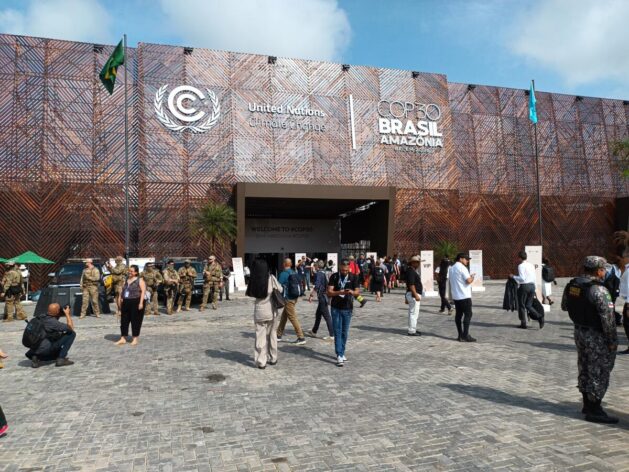
Entrance to the Hangar Convention Center of the Amazonia in the northeastern Brazilian city of Belém. The climate summit, which began on November 10 and is due to conclude on Friday the 21st, is debating issues such as the phase-out of fossil fuels and adaptation goals. Credit: Emilio Godoy / IPS

Entrance to the Hangar Convention Center of the Amazonia in the northeastern Brazilian city of Belém. The climate summit, which began on November 10 and is due to conclude on Friday the 21st, is debating issues such as the phase-out of fossil fuels and adaptation goals. Credit: Emilio Godoy / IPS

BELÉM, Brazil, Nov 20 2025 (IPS) – The heat in the Hangar Convention Center of the Amazonia, in the northeastern Brazilian city of Belém, has reached the negotiation rooms of the climate summit. Over the past 72 hours, one of the most delicate and significant discussions of this climate meeting has been taking place: the path to progressively abandon the production and use of coal, gas, and oil.


In recent hours, a global coalition of rich and developing countries, led by Colombia, has doubled down on pushing for a fossil fuel phase-out roadmap, while major producer countries resist it.

“The plan must have differentiated commitments, the elimination of fossil fuel subsidies, and the reform of the international financial system, because foreign debt payments are punishing us,” Colombian Environment Minister Irene Vélez explained to IPS.

For the official, the 30th United Nations Conference of the Parties (COP30) on climate change must result in a roadmap. “People are mobilizing, demanding climate action; we have to start now,” she urged.

In Belém, the gateway to the planet’s largest rainforest, it is no longer just about reducing emissions but about transforming the foundation of the energy system, thus acquiring a moral, political, and scientific urgency. What was initially meant to be the “Amazon COP” has mutated into the “end-of-the-fossil-era-COP,” but the roadmap to achieve it is a toss-up.

“The plan must have differentiated commitments, the elimination of fossil fuel subsidies, and the reform of the international financial system, because external debt payments are punishing us” –Irene Vélez.

Two years after the world agreed at COP28, held in 2023 in Dubai, to move away from fossil fuels, Belém is the moment of truth, upon which the effort to keep global warming below the 1.5° Celsius limit largely depends—a goal considered vital to avoid devastating and inevitable effects on ecosystems and human life.

Thus, the discussion among the 197 parties to the United Nations climate convention has shifted from the “what” to the “how,” and especially to the “when,” questions that have turned potential coordinates into a geopolitical labyrinth.

In that vein, a coalition of over 80 countries emerged on Tuesday the 18th to push the roadmap, including Colombia, Chile, Guatemala, and Panama among the Latin American countries.

One challenge for the roadmap advocates is that the issue is not explicitly part of the main agenda, a resource that the Brazilian presidency of COP30 could use to shirk responsibility on the matter.

The issue appears on the thematic menu of COP30, which started on the 10th and is scheduled to conclude on the 21st, and whose official objectives include approving the Global Goal on Adaptation to climate change and securing sufficient funds for that adaptation.

Approximately 40,000 people are attending this climate summit, including government representatives, multilateral agencies, academia, and civil society organizations.

An unprecedented indigenous presence is also in attendance, with about 900 delegates from native peoples, drawn by the ancestral call of the Amazon, a symbol of the menu of solutions to the climate catastrophe and simultaneously a victim of its causes.

Also present and very active in Belém are about 1,600 lobbyists from the hydrocarbon industry, 12% more than at the 2024 COP, according to the international coalition Kick Big Polluters Out.

The clamor from civil society demands an institutional structure with governance, clear criteria, measurable objectives, and justice mechanisms.

“The roadmap has become a difficult issue to ignore; it is already at the center of these negotiations, and no country can ignore it. The breadth of support is surprising, with rich and poor countries, producers and non-producers, indicating that an agreement is about to fall,” Antonio Hill, Just Transitions advisor for the non-governmental and international Natural Resource Governance Institute, told IPS.

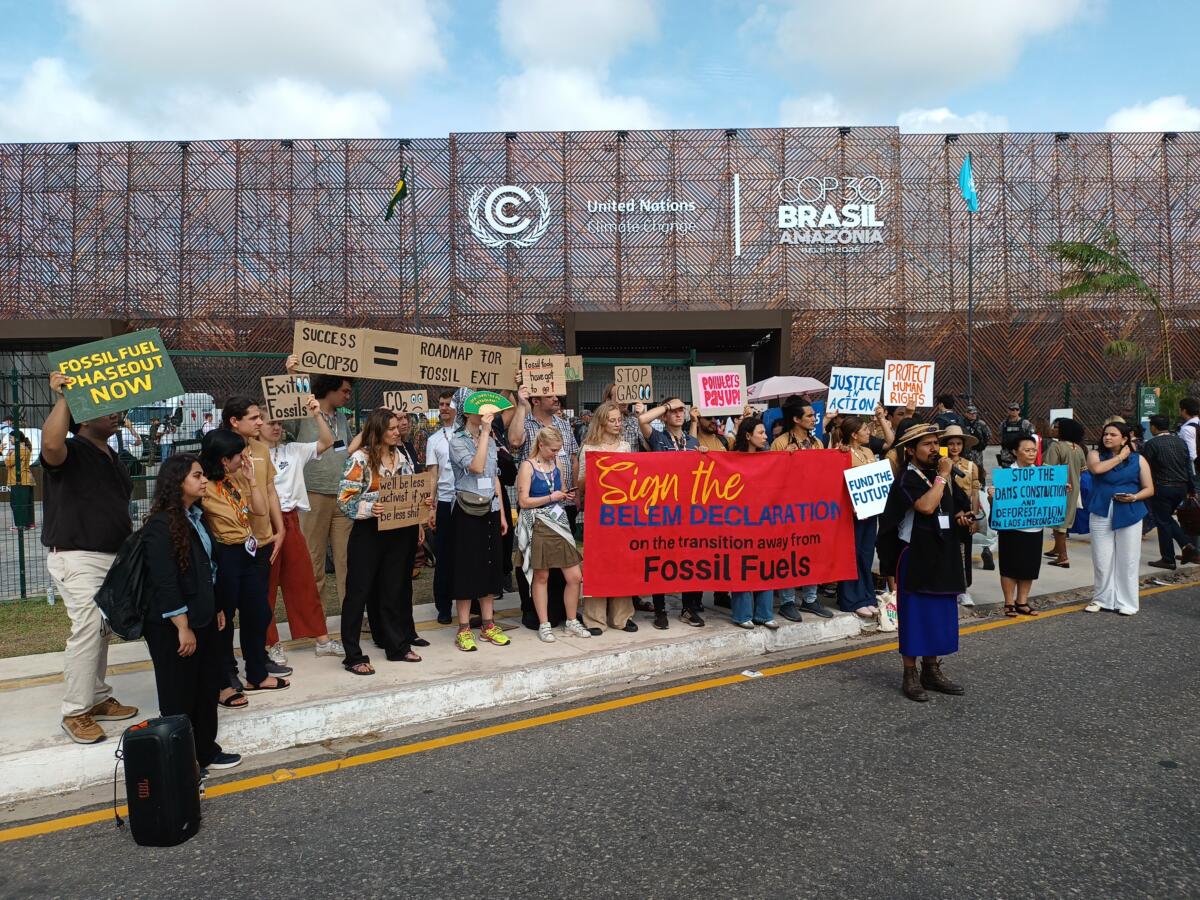
Activists protest on Wednesday the 19th against fossil fuel exploitation at the entrance to the venue of the Belém climate summit, in the Amazonian northeast of Brazil. Credit: Emilio Godoy / IPS

Activists protest on Wednesday the 19th against fossil fuel exploitation at the entrance to the venue of the Belém climate summit, in the Amazonian northeast of Brazil. Credit: Emilio Godoy / IPS

Poisoned

The push for the roadmap comes from the Fossil Fuel Non-Proliferation Treaty, promoted by civil society organizations, strongly adopted by Colombia, and which so far has the support of 18 nations, but no hydrocarbon-producing Latin American country, such as Argentina, Brazil, Ecuador, Mexico, or Venezuela.

Colombia, despite also being a producer and exporter of fossil fuels, has presented its Roadmap for a Just Energy Transition, with which it seeks to replace income from coal and oil with investments in tourism and renewable energy.

Colombia’s 2022-2052 National Energy Plan projects long-term reductions in fossil fuel production. The country announced US$14.5 billion for the energy transition to less polluting forms of energy production.

But for the rest of the region, the duality between maintaining fossil fuels and promoting renewable energies persists.

A prime example of this duality is the COP30 host country itself, Brazil. While the host President, Luiz Inácio Lula da Silva, and his Minister of Environment and Climate Change, Marina Silva, have insisted on the need to abandon fossil fuels, the government is promoting expansive oil and gas extraction plans.

In fact, just weeks before the opening of COP30, the state-owned oil group Petrobras received a permit for oil exploration in the Atlantic, just kilometers from the mouth of the Amazon River.

But Lula and his team committed that this summit in the heart of the Amazon would be “the COP of truth” and “the COP of implementation,” and the issue of fossil fuels has become central to the negotiations, which Lula joined on Wednesday the 19th to give a push to the talks and the outcomes.

In their Nationally Determined Contributions (NDCs)—the set of mitigation and adaptation policies countries must present to comply with the Paris Agreement on climate change signed in 2015 at COP21—Argentina, Brazil, Mexico, or Chile avoid mentioning a managed phase-out of fossil fuels.

Simply put, they argue they cannot let go of the old vine before grasping the new one. This stance also involves a delicate aspect, as nations like Ecuador depend on revenues from hydrocarbon exploitation.

Therefore, the Global South has insisted on its demand for funding from rich nations, due to their contribution to the climate disaster through fossil fuel exploitation since the 17th century.

The result of the presented policies is alarming: although many countries have increased their emission reduction targets on paper, they lack details on phasing out production. The only existing roadmap is the growing extractive one.

In fact, the Global Stocktake of the Paris Agreement process, originating from COP28, demanded that countries take measures to move towards a fossil-free era.

The argument is unequivocal: various estimates indicate that fossil fuels contribute 86% of greenhouse gas emissions, the cause of global warming.

But a key point is where to start. For Uitoto indigenous leader Fanny Kuiru Castro, the new general coordinator of the Coordinator of Indigenous Organizations of the Amazon Basin –which  brings together the more than 350 native peoples of the eight countries sharing the biome–, the starting point must precisely be at-risk regions like the Amazon.

“It is a priority. If there isn’t a clear signal that we must proceed gradually, it means the summit has failed and does not want to adopt that commitment. We will have another 30 years of speeches,” she told IPS, alluding to that number of summits without substantial results.

In the Amazon, oil blocks threaten 31 million hectares or 12% of the total area, mining threatens 9.8 million, and timber concessions threaten 2.4 million.

And in that direction, a major obstacle arises: how to finance the phase-out. The roadmap has a direct link to the financial goals aimed at the Global South, with a demand for US$1.2 trillion in funding for climate action starting in 2035.

“Can the COP deliver the financial backing that countries need to reinvent their economies in time to guarantee just and inclusive development?” Hill questioned.

The atmosphere in Belém is of a different urgency compared to Dubai or Baku, where COP29 was held a year ago. The roadmap to a world free of fossil fuel smoke remains a blurry map, drawn freehand on ground that is heating up far too quickly.

In Belém, humanity is deciding whether to brake gradually or to accelerate, with the air conditioning on and a full tank.