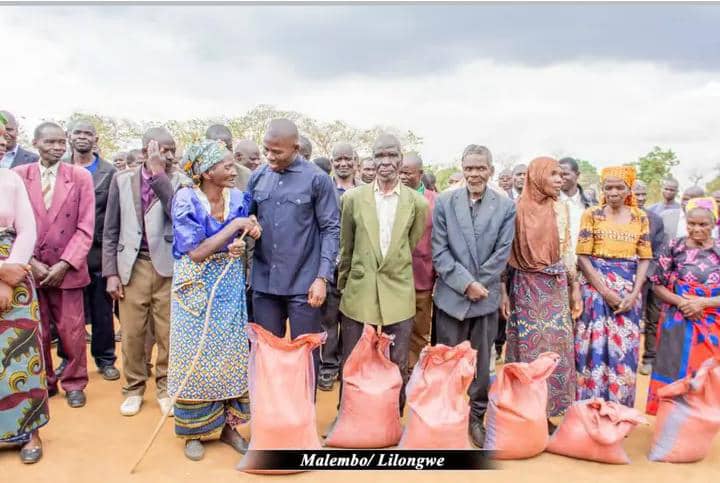
LILONGWE-(MaraviPost)-Salvation for All Ministries International has extended a lifeline to over 4,000 people in Traditional Authority Chiwaura (T.A), Lilongwe District, through the donation of 6,000 bags of maize, as part of its ongoing mission to empower vulnerable communities across Malawi.
The food donation was made during a spirit-filled crusade held at Chiwaura CDSS, led by Apostle Clifford Kawinga, the founder of the ministry.
The outreach comes barely a month after the ministry distributed irrigation farming equipment to farmers in Malawi’s Southern Region, reaffirming its commitment to combining spiritual nourishment with practical humanitarian support.
Speaking during the event in Malembo, Apostle Kawinga emphasized that addressing hunger is essential to effective ministry.
“This is one area that has been affected by hunger due to the dry spells. We thought it wise to come here and spread the good news while donating food because we can’t preach to people who are hungry,” Kawinga said.
He further called on other stakeholders and faith-based organizations to complement government efforts in assisting those affected by the ongoing food crisis. It is not the responsibility of the government alone. We can all join hands to help families affected by hunger,” he added.
Kawinga also expressed concern that hunger has forced some families to cross into Mozambique and Zambia in search of food, describing the situation as alarming.
Representing TA Chiwaura and all Sub-T/As, Bleston Caleb commended the ministry for the timely support.
“Our area has been hit hard by hunger. We are grateful to Apostle Kawinga and his ministry for this generous gesture,” Caleb said.
One of the beneficiaries, Lucia Chipozi, shared her gratitude, revealing that her family had been going to bed on empty stomachs.
“This maize will surely bail us out. We had nothing to eat for days,” Chipozi said.
Beyond his ministry work, Apostle Kawinga is also a successful entrepreneur and philanthropist the proprietor of Creck Hardware and General Suppliers, CK Storage, Creck Sporting Club, and several other enterprises that contribute to community development and economic empowerment.
Through such initiatives, Salvation for All Ministries International continues to demonstrate that faith in action can bring hope and transformation to struggling communities across Malawi.
Share this:
Like this:
LikeLoading…
Discover more from The Maravi Post
Subscribe to get the latest posts sent to your email.
A new report, ‘Indigenous Territories and Local Communities on the Frontlines,’ calls for secure land rights, free and informed consent, direct financing to communities, protection of life, and recognition of traditional knowledge.
Brazil’s Minister of Indigenous Peoples, Sonia Guajajara, attends a meeting during the UN Climate Change Conference COP 30. Credit: Hermes Caruzo/COP30
SRINAGAR, India & BELÉM, Brazil, Nov 8 2025 (IPS) – A report by the Global Alliance of Territorial Communities (GATC) and Earth Insight paints a stark picture of how extractive industries, deforestation, and climate change are converging to endanger the world’s last intact tropical forests and the Indigenous Peoples who protect them.
The report, ‘Indigenous Territories and Local Communities on the Frontlines,’ combines geospatial analysis and community data to show that nearly one billion hectares of forests are under Indigenous stewardship, yet face growing industrial threats that could upend global climate and biodiversity goals.
Despite representing less than five percent of the world’s population, Indigenous Peoples and local communities (IPs and LCs) safeguard more than half of all remaining intact forests and 43 percent of global biodiversity hotspots.
These territories store vast amounts of carbon, regulate ecosystems, and preserve cultures and languages that have sustained humanity’s relationship with nature for millennia. But the report warns that governments and corporations are undermining this stewardship through unrestrained extraction of resources in the name of economic growth or even “green transition.”
One of the main report authors, Florencia Librizzi, who is also a Deputy Director at Earth Insight, told IPS that the perspectives and stories from each region are grounded in the lived realities of Indigenous Peoples and local communities and come directly from the organizations from each of the regions that the report focuses on in Mesoamerica, Amazonia, the Congo Basin, and Indonesia.
Across four critical regions—the Amazon, Congo Basin, Indonesia, and Mesoamerica—extractive industries overlap with millions of hectares of ancestral land. In the Amazon, oil and gas blocks cover 31 million hectares of Indigenous territories, while mining concessions sprawl across another 9.8 million.
In the Congo Basin, 38 percent of community forests are under oil and gas threat, endangering peatlands that store immense quantities of carbon. Indonesia’s Indigenous territories face 18 percent overlap with timber concessions, while in Mesoamerica, 19 million hectares—17 percent of Indigenous land—are claimed for mining, alongside rampant narcotrafficking and colonization.
These intrusions have turned Indigenous territories into sacrifice zones. From nickel extraction in Indonesia to oil drilling in Ecuador and illegal logging in the Democratic Republic of Congo, corporate incursions threaten lives, livelihoods, and ecosystems. Between 2012 and 2024, 1,692 environmental defenders were killed or disappeared across GATC countries, with 208 deaths linked to extractive industries and 131 to logging. The report calls this violence “the paradox of protection”—the act of defending nature now puts those defenders at deadly risk.
Yet the report also documents extraordinary resilience. In Guatemala’s Maya Biosphere Reserve, Indigenous forest communities have achieved near-zero deforestation—only 1.5 percent forest loss between 2014 and 2024, compared to 11 percent in adjacent areas. In Colombia, Indigenous Territorial Entities maintain over 99 percent of their forests intact.
The O’Hongana Manyawa of Indonesia continue to defend their lands against nickel mining, while the Guna people of Panama manage autonomous governance systems that integrate culture, tourism, and ecology.
In the Congo, the 2022 “Pygmy Law” has begun recognizing community rights to forest governance, a historic step toward justice.
The report’s findings were released ahead of the 30th UN Climate Conference (COP30), emphasizing the urgency of aligning international climate and biodiversity frameworks with Indigenous rights.
The 2025 Brazzaville Declaration, adopted at the First Global Congress of Indigenous Peoples and Local Communities from the Forest Basins, provides a roadmap for such alignment.
Signed by leaders from 24 countries representing 35 million people, it calls for five key commitments: secure land rights, free and informed consent, direct financing to communities, protection of life, and recognition of traditional knowledge.
These “Five Demands” are the cornerstone of what the GATC calls a shift “from extraction to regeneration.”
They demand an end to the violence and criminalization of Indigenous leaders and insist that global climate finance reach local hands.
The report notes that, despite the 2021 COP26 pledge of 1.7 billion dollars for forest protection, only 7.6 percent of that money reached Indigenous communities directly.
“Without financing that strengthens territorial governance, all global commitments will remain symbolic,” said the GATC in a joint statement.
Reacting to the announcement of the The Tropical Forest Forever Facility (TFFF) announced on the first day of the COP Leaders’ Summit and touted as a “new and innovative financing mechanism” that would see forest countries paid every single year in perpetuity for keeping forests standing, Juan Carlos Jintiach, Executive Secretary of the Global Alliance of Territorial Communities (GATC) said, “Even if the TFFF does not reach all its fundraising goals, the message it conveys is already powerful: climate and forest finance cannot happen without us Indigenous Peoples and local leadership at its core.
“This COP offers a crucial opportunity to amplify that message, especially as it takes place in the heart of the Amazon. We hope the focus remains on the communities who live there, those of us who have protected the forests for generations. What we need most from this COP is political will to guarantee our rights, to be recognized as partners rather than beneficiaries, to ensure transparency and justice in climate finance, and to channel resources directly to those defending the land, despite growing risks and violence.”
Deforestation in Acre State, Brazil. Credit: Victor Moriyama / Climate Visuals
Jintiach, who is also the report’s author, told IPS the Global Alliance has proposed establishing clear mechanisms to ensure that climate finance reaches Indigenous Peoples’ and local communities’ initiatives directly, not through layers of external actors.
“That’s why we have established our Shandia Platform, a global Indigenous-led mechanism designed to channel direct, predictable, and effective climate finance to our territories. Through the Shandia Funds Network, we ensure that funding is managed according to our priorities, governance systems, and traditional knowledge. The platform also includes a transparent system to track and monitor funding flows, with a specific indicator for direct finance to Indigenous Peoples and local communities,” he said.
The report also warns that global conservation goals such as the “30×30” biodiversity target—protecting 30 percent of Earth’s land and sea by 2030—cannot succeed without Indigenous participation. Policies under the Kunming-Montreal Global Biodiversity Framework and the Paris Agreement must, it says, embed Indigenous governance and knowledge at their core. Otherwise, climate strategies risk reinforcing historical injustices by excluding those who have sustained these ecosystems for centuries.
Jintiach said that based on his experience at GATC, Indigenous Peoples’ and local communities’-led conservation models are not only vital but also deeply effective.
“In our territories, it is our peoples and communities who are conserving both nature and culture, protecting the forests, waters, and biodiversity that sustain all of us,” he said.
He added, “Multiple studies confirm what we already know from experience: Indigenous and local community lands have lower rates of deforestation and higher biodiversity than those managed under state or private models. Our success is rooted in ancestral knowledge, collective governance, and a deep spiritual connection to the land, principles that ensure true, lasting conservation.”
According to Jintiach, the GATC 5 demands and the Brazzaville Declaration are critical global reference points and we are encouraged by the level of interest and engagement displayed by political leaders in the lead-up to COP 30.
Map highlighting extractive threats faced by Indigenous Peoples and Local Communities across the Amazon basin. Credit: GATC
“We are hopeful that these principles will be uplifted and championed at COP 30, the UN Permanent Forum on Indigenous Issues, CBD COP 17 and on the long road ahead,” he said.
When asked about the rising violence against environmental defenders, Jintiach said that the Brazzaville Declaration calls for a global convention to protect Environmental Human Rights Defenders, including Indigenous Peoples and local community leaders.
According to him, the governments must urgently tackle the corruption and impunity fueling threats and violence while supporting collective protection and preventing rollback of rights.
“This also means upholding and strengthening the Escazú Agreement and UNDRIP, and ensuring long-term protection through Indigenous Peoples and local communities-led governance, secure land tenure, and accountability for human rights violations.”
Earth Insight’s Executive Director Tyson Miller described the collaboration as a call to action rather than another policy document. “Without urgent recognition of territorial rights, respect for consent, and protection of ecosystems, global climate and biodiversity goals cannot be achieved,” he said. “This report is both a warning and an invitation—to act with courage and stand in solidarity.”
The case studies highlight how Indigenous governance models already offer proven solutions to the climate crisis. In the Brazilian Amazon, Indigenous organizations have proposed a self-determined Nationally Determined Contribution (NDC) to reduce emissions through territorial protection. Their slogan, “Demarcation is Mitigation,” underlines how securing Indigenous land rights directly supports the Paris Agreement’s goals. Similarly, in Central Africa, communities have pioneered decolonized conservation approaches that integrate Indigenous leadership into national park management, reversing exclusionary models imposed since colonial times.
In Mesoamerica, the Muskitia region—known as “Little Amazon”—illustrates both crisis and hope. It faces deforestation from drug trafficking and illegal logging, yet community-based reforestation and forest monitoring are restoring ecosystems and livelihoods. Women and youth play leading roles in governance, showing how inclusive leadership strengthens resilience.
The report’s conclusion is unequivocal: where Indigenous rights are recognized, ecosystems thrive; where they are ignored, destruction follows. It argues that the fight for land is inseparable from the fight against climate change. Indigenous territories are not just sources of raw materials; they are “living systems of governance, culture, and biodiversity” essential to humanity’s survival.
The Brazzaville Declaration urges governments to ratify international human rights conventions, end deforestation by 2030, and integrate Indigenous territories into national biodiversity and climate plans. It also calls for a global convention to protect environmental human rights defenders, whose safety is central to planetary stability.
For GATC’s leaders, the message is deeply personal. “Our traditional knowledge is the language of Mother Earth,” said Joseph Itongwa, GATC Co-Chair from the Congo Basin. “We cannot protect the planet if our territories, our identity, and our livelihoods remain under threat.”
This feature is published with the support of Open Society Foundations.
LILONGWE-(MaraviPost)-High Court Judge Redson Kapindu has sustained the case involving Joseph Manguluti against Malawi Electoral Commission (MEC) declaring Simplex Chithyola Banda as a winner for Kasungu South Constituency during the September 16 General Elections.
Judge Kapindu therefore has ordered the continual of the case for further hearing.
Chithyola who won the ticket as Malawi Congress Party (MCP) and MEC are the first and second respondent respectively in the case.
Sikwese is the lawyer representing Manguluti while Wapona Kita leads Chithyola legal team.
This means the case will go into full trial after the court found that reasons for dismissal were not enough.
Chithyola is now opposition leader in Parliament.
Share this:
Like this:
LikeLoading…
Discover more from The Maravi Post
Subscribe to get the latest posts sent to your email.
BLANTYRE-(MaraviPost)-Southern Africa is celebrating a landmark moment as Malawi’s Temwa Chawinga and Zambia’s Barbra Banda have both been nominated for the FIFA Best Attacker Award solidifying their positions among the world’s elite forwards.
Temwa’s nomination carries even greater weight.
She has become the only African woman nominated for the FIFA Best Women’s Player of the Year, a rare and remarkable achievement that cements her status as one of the most influential players on the global stage.
Temwa making Malawians proud
Her dominance in the USA Women’s Super League, where she finished as top scorer and delivered match-winning performances, has earned her respect from coaches, analysts and fans worldwide.
Barbra Banda’s nomination reflects her unstoppable rise in world football.
Her power, athleticism, leadership and consistent ability to deliver in big moments for both club and country have made her one of the most feared attackers in the women’s game.
From Olympic heroics to club brilliance, Banda has continued to put Zambia on the global football map.
The dual nominations of Temwa and Banda represent a significant victory for African women’s football. For years, African female players have had limited representation at the highest level of FIFA awards.
This moment signals a shift one where the world can no longer overlook African excellence.
As the spotlight shines on women’s football, global football giants are also making headlines on the men’s side.
In stunning fashion, Cristiano Ronaldo and Lionel Messi have both been nominated for the 2025 FIFA The Best Men’s World XI.
Even in the twilight of their legendary careers, the two icons widely regarded as the GOATs of modern football continue to command respect with their unmatched class and longevity.
The inclusion of Ronaldo and Messi once again in a world XI shortlist underscores their enduring influence in the game.
Despite rising stars across Europe and beyond, the two superstars remain at the top of world football conversations.
Their presence in this year’s nominations adds an extra layer of excitement to the awards season, combining the emergence of new African stars with the sustained brilliance of football’s greatest legends.
Share this:
Like this:
LikeLoading…
Discover more from The Maravi Post
Subscribe to get the latest posts sent to your email.
LUSAKA-(MaraviPost)-Legal and economic experts are urging the Malawi government to pursue an out-of-court settlement in the controversial helicopter deal with Zambia’s AYA Technologies, warning that dragging the matter through international arbitration could cost taxpayers billions more in damages, interest, and legal fees.
The Malawi government has been advised to consider an out-of-court settlement in the ongoing $9.2 million helicopter dispute with Zambian firm AYA Technologies Ltd, amid fears that continued litigation before the International Court of Arbitration (ICC) in Paris could lead to escalating financial losses for the country.
The dispute stems from the government’s July 2024 decision to cancel a deal for two Bell 412 helicopters, which were later condemned as unfit to fly. The government had already paid $500,000 (about K867 million) as a deposit to AYA Technologies before pulling out of the contract.
The company has since sued for $4.6 million (about K8 billion), arguing that Malawi breached the agreement.
While Malawi’s former Attorney General (AG) Thabo Nyirenda, insists the contract was invalid and wants the advance payment refunded, some analysts warn that the government’s position could be legally and financially untenable.
“We’ve already admitted liability by paying,” says lawyer Blantyre-based commercial lawyer Chifundo Soko said Malawi’s initial deposit is legally significant because it shows that the government had acknowledged and entered into a binding contract with AYA Technologies.
“Once the government paid that $500,000, it created a contractual relationship. Whether or not the helicopters were airworthy, that payment demonstrates consent and intent to transact. Unilaterally cancelling now exposes the state to litigation risk,” Soko said.
“In arbitration, the ICC will not only look at the technical side of the aircraft but also at the conduct of the parties. Malawi could easily be found in breach and ordered to pay both damages and interest,” he added.
Soko said an out-of-court mediation settlement could be a less expensive and reputationally safer option, especially given that international arbitration often involves high legal costs and currency penalties.
Economists warn of ballooning costs Economic governance analyst Michael Cipo said the government’s refusal to engage in mediation could see costs spiral far beyond the K8 billion currently being demanded.
“International arbitration is extremely expensive. By the time the case concludes, Malawi could be paying upwards of K12 or even K15 billion, once you add interest, lawyer fees, and arbitration costs in Paris,” Chipo warned.
“It is in the country’s best financial interest to negotiate a settlement—perhaps by compensating AYA for its expenses and withdrawing cleanly—rather than waiting for a costly judgment.”
He added that a protracted legal fight could also affect Malawi’s credit reputation and relations with regional partners, especially given AYA’s Zambian origin.
Middlemen at the centre of the storm Public procurement specialist Dr. Anthony Kamwana argued that the deal’s problems partly stemmed from the use of middlemen in defence procurement, a recurring issue in Malawi’s military acquisitions.
“If the government already made a deposit, that means the intermediary was engaged and fulfilled certain contractual conditions. Those intermediaries need to be properly compensated to avoid more penalties,” Kamwana said.
“Government should settle with AYA, clean up the process, and move on. Otherwise, this will become another long-running legal mess like the cement and fertilizer procurement cases that drained millions.”
Lessons from previous arbitration cases Malawi has a poor record in managing international contract disputes.
In 2020, the government lost $8 million in a similar arbitration case involving a European supplier over a cancelled procurement deal.
Legal experts warn that history could repeat itself if Lilongwe insists on defending the AYA case through full arbitration.
Former Solicitor General Janet Banda, now an international law consultant, said Malawi’s defence—based on claims of the helicopters being “unfit to fly”—may not be strong enough to avoid liability.
“Arbitration tribunals often prioritize procedural fairness over technical assessments. If Malawi did not follow proper termination procedures or failed to give adequate notice, the tribunal may rule in AYA’s favour regardless of the aircraft condition,” Banda said. “A negotiated settlement is the most practical and least damaging option right now.”
The case for settlement Experts agree that Malawi can still limit its exposure by engaging in structured mediation, paying off the Zambian supplier a portion of the claimed amount, and formally ending the contract to avoid ongoing penalties “If government pays even half of the K8 billion claim as a negotiated settlement, that’s far cheaper than the billions more it might lose after arbitration,” Chipo emphasized.
The Attorney General’s office maintains it will defend the case vigorously, but insiders within the Ministry of Finance admit privately that arbitration in Paris could “cripple the budget.”
As one Treasury official who asked not to be named put it: “The truth is, we paid something. That payment binds us legally. Unless we resolve this quickly, it will cost the taxpayer far more than anyone is admitting.”
In summary
Malawi’s attempt to walk away from the controversial helicopter deal could soon backfire.
With AYA Technologies pursuing damages before an international tribunal, experts say the government should swallow its pride, negotiate a settlement, and spare the nation a costly and humiliating legal defeat.
Share this:
Like this:
LikeLoading…
Discover more from The Maravi Post
Subscribe to get the latest posts sent to your email.
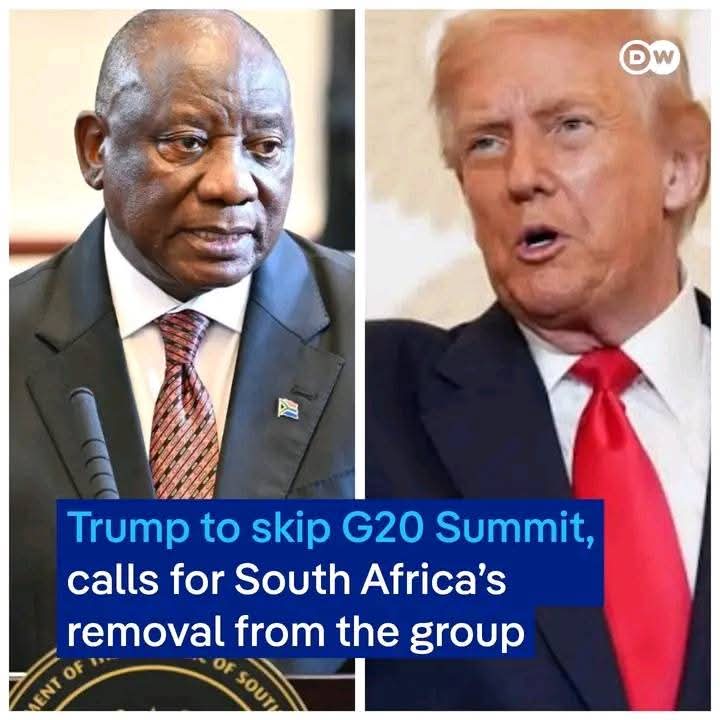
WASHINGTON-(MaraviPost)-US President Donald Trump has said he will not attend the upcoming G20 summit in Johannesburg, arguing that South Africa “no longer deserves a place” among the world’s major economies.
Speaking at the American Business Forum in Miami, Trump said, “South Africa shouldn’t even be in the G’s anymore, because what’s happened there is bad.”
Vice President J.D. Vance will represent the United States at the meeting, set for November 22–23.
Trump, a longtime critic of South Africa’s land reform policies, has accused the government of targeting white farmers and committing “massive human rights violations”—claims Pretoria has dismissed as “factually incorrect” and based on a distorted view of its policies.
Source: DW Africa
Share this:
Like this:
LikeLoading…
Discover more from The Maravi Post
Subscribe to get the latest posts sent to your email.