Overwhelmed Healthcare Systems in Gaza Struggle Through Evacuation Orders

Aid, Armed Conflicts, Civil Society, Development & Aid, Editors’ Choice, Featured, Headlines, Health, Human Rights, Humanitarian Emergencies, Middle East & North Africa, Migration & Refugees, Sustainable Development Goals, TerraViva United Nations

Humanitarian Emergencies

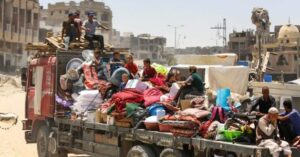
Displaced families in Gaza are on the move after the latest Israeli evacuation orders. Around nine in 10 Gazans have been displaced at least once since the war began. Photo: UNRWA

Displaced families in Gaza are on the move after the latest Israeli evacuation orders. Around nine in 10 Gazans have been displaced at least once since the war began. Photo: UNRWA

UNITED NATIONS, Jul 12 2024 (IPS) – For nine months, over 2 million people in the Gaza Strip have been forcibly displaced in the wake of the armed conflict between Israel and Hamas. The ongoing fighting and displacement have put significant strain on humanitarian organizations on the ground to address even basic health needs.

The United Nations and other humanitarian organizations have stressed that the healthcare system in Gaza has collapsed or has suffered undue pressure as a result of the fighting. Out of 36 hospitals in the area, 13 remain open, operating with partial functionality.


This includes Nasser Hospital, which now stands as the last hospital providing comprehensive healthcare services. It has been overwhelmed with patients in the wake of evacuation orders issued on July 1 by Israeli authorities for the east and south of Khan Younis. Patients and medical personnel working in the Gaza European Hospital, located in Khan Younis, evacuated ahead of time.

Although an official from the Israeli defense force stated that patients and medical personnel were exempt from the evacuation order, this was not conveyed to the humanitarian groups on the ground. 

Andrea de Domenico, UN-OCHA’s Head of Office in the Occupied Palestinian Territory, told reporters in a virtual press briefing on July 3 that OCHA was not informed. He stated that it was likely that those who evacuated acted based on past experiences where hospitals were specifically targeted for raids or military bombardment, and so they took preemptive measures to evacuate before the Israeli military moved in on Khan Younis.

Evacuation orders have devastating implications for the fragile health infrastructure by disrupting the functionality of health facilities within and adjacent to evacuation zones, as one spokesperson from the World Health Organization (WHO) told IPS. They impede access for both healthcare providers and patients, and they compromise the efficacy and security of humanitarian operations. In addition, this only increases the burden on other hospitals that are now charged with receiving patients from evacuated areas.

As one of the remaining hospitals providing comprehensive care, Nasser Hospital has been operating beyond capacity with limited supplies, amidst destruction in the surrounding area, which WHO staff on the ground have said is ‘indescribable’. The area surrounding the hospital is laden with heavy layers of debris, destroyed buildings, and no stretch of an intact road. Its pediatric ward has now hosted more than 120 patients since July 5, despite its 56-bed capacity.

OCHA and the World Health at Nasser Medical Complex in Gaza earlier this year. UN and other humanitarian agencies have been struggling to ensure health care continues. Credit: OCHA

OCHA and the World Health at Nasser Medical Complex in Gaza earlier this year. UN and other humanitarian agencies have been struggling to ensure health care continues. Credit: OCHA

It is also operating with dwindling medical supplies and holds responsibility for sterilizing equipment for the surrounding field hospitals, according to Doctors Without Borders (DWB). Despite the critical need for supplies, DWB trucks and convoys carrying these supplies have been unable to enter Gaza since April. As recently as July 3, trucks were denied entry due to ongoing fighting in the South.

“Overall, it’s a comprehensive issue—from shortages of beds and supplies to the lack of surgeons. With yet another hospital closed, patients’ lives are even more at risk,” said medical team leader Javid Abdelmoneim, working in Nasser Hospital.

The issue of life-saving aid being restricted from entering Gaza has continued to persist and impact operations for humanitarian organizations on the ground, including the UN. As the WHO spokesperson told IPS, their trucks were unable to pass through last week as the Karem Shalom crossing remains closed.

Fuel has been identified as critical to the functionality of health facilities and aid operations, and yet shortages are rampant. A WHO spokesperson stated that hospitals have been forced to work with limited supplies of fuel, electricity and solar systems, and this has only hindered groups from properly functioning.

Power blackouts in newborn/ICU and kidney dialysis units place their patients at critical risk. The lack of fuel also impacts the water and sanitation sectors, which require at least seventy-thousand liters of fuel a day, and yet in the last few weeks, they have only received less than ten percent of what is needed.

Only 500,000 liters of fuel have been brought in during the first week of July, and 2 million liters were brought in in the month of June, which humanitarian organizations note is a fraction of the fuel needed to sustain humanitarian, medical, and WASH operations—at least 400,000 liters per day.

Trash and sewage buildup and a lack of clean water, among other factors, have all led to the spread of water-borne diseases and upper respiratory infections. According to the WHO, since mid-October 2023, they have reported cases of diarrhea, lice and scabies, skin rashes, impetigo and chicken pox.

“While a healthy body can more easily fight off diseases, a wasted and weakened body will struggle and become more susceptible,” one WHO spokesperson told IPS.

Meanwhile, acute food insecurity has ravaged Gaza. Since the start of the war, food insecurity has been a major concern for humanitarian actors in the region and globally.

The Integrated Phase Classification (IPC)’s special brief acute food insecurity projected that 96 percent of Gaza’s population, or 2.15 million people, would be experiencing extreme levels of food insecurity between June 16 and September 30, which includes over 495,000 people who face catastrophic food insecurity. More than half of the households reported that often, they did not have any food in the household, and more than 20 percent go full days and nights without eating. The violence and repeated displacement have challenged people’s ability to cope or to access humanitarian assistance.

This is further exacerbated when humanitarian workers are also forced to relocate for their own safety and move their operations. Domenico stated that the constant movement also means that warehouses containing fuel and supplies are abandoned as a result. In the case of UN agencies such as OCHA and its partners, humanitarian operations may be considered a parameter of activity that is (or should be) protected from military activity. Their presence is likely to signal to people that it may be safe to be there or that their basic needs will be met.

So far, 34 people have died from malnutrition and dehydration, according to the Ministry of Health. Of those deaths, WHO notes that 28 of them are children. A group of independent experts has warned that famine has spread throughout the Gaza Strip, noting recent cases of children who have died due to hunger and malnutrition, one of whom was as young as six months old.

“With the death of these children from starvation despite medical treatment in central Gaza, there is no doubt that famine has spread from northern Gaza into central and southern Gaza,” the experts said in a shared statement.

The IPC special brief notes that only a cessation of the armed conflict and sustained, uninterrupted humanitarian intervention could reduce the risk of famine. Humanitarian organizations have struggled to maintain their operations while hostilities have persisted in the Gaza Strip, endangering and displacing more than a million civilians multiple times over, along with humanitarian workers who have risked their lives to continue providing what little life-saving aid can cross the border. Military violence has continued despite international condemnation and repeated demands for a ceasefire.

Organizations such as WHO and Doctors Without Borders have coordinated with health partners and agencies on the ground, namely UNRWA, to provide primary care, support vaccination campaigns, and deploy emergency medical teams. As the WHO notes, however, these efforts can only support the health system; they cannot replace it.

IPS UN Bureau Report

Note: This feature was published with the support of the Riana Group.

  Source

Book Nook: ‘Mission to Malawi – Memoir of an African American Peace Corps Volunteer, 1967-1969’ by John E. Fleming

John E. Fleming grew up wanting to become a missionary. That dream got derailed and as a young man fresh out of college his parents expected him to go out and get a job that paid him a decent salary. He decided instead to obtain a low paying position as a Peace Corps volunteer in the African nation of Malawi. Fleming was the only African-American recruit in his group.

In this memoir he shares his observations on that adventurous period of his life. And when he actually met some missionaries in Malawi he was
not very impressed. He realized at that point that perhaps his missionary dreams would not have turned out as he had hoped. This is a lovely meditation on a world that no longer exists.

Source

UAE Complicit in Sudan Slaughter

Armed Conflicts, Civil Society, Crime & Justice, Featured, Food and Agriculture, Headlines, Human Rights, Middle East & North Africa, Migration & Refugees, TerraViva United Nations

Opinion

Credit: Mark Kerrison/In Pictures via Getty Images

LONDON, Jul 11 2024 (IPS) – Sudan is the scene of unimaginable suffering. As war between army and militia continues, civilians are paying the highest price. Both sides are killing non-combatants and committing gross human rights crimes.


The country stands on the brink of famine. It’s experiencing its worst recorded levels of food insecurity and over 750,000 are at risk of starvation.

Around 11 million people have been forced to flee their homes, armed forces have stolen and destroyed food supplies, crops and livestock, and many people are no longer able to earn a living or farm. UN human rights experts accuse both sides of using denial of food as a weapon, including by blocking humanitarian deliveries and looting depots.

Many of the worst-affected areas are in Darfur, where the Rapid Support Forces (RSF) militia has gained territory and is currently besieging El Fasher. The RSF grew out of the militias that committed genocide in Darfur two decades ago, and they’re again accused of genocide, carrying out ethnically motivated mass killings. Meanwhile, the army it’s fighting, the Sudanese Armed Forces (SAF), has blocked the main humanitarian access point on the border with Chad.

Proxy war

The conflict broke out in April 2023, sparked by a power struggle between two men: Abdel Fattah al-Burhan, SAF commander-in-chief and leader of the ruling junta, and Mohamed Hamdan Dagalo, known as Hemeti, RSF head. The two worked together in the 2021 coup that ousted a civilian government. A plan to incorporate the RSF into the SAF was the flashpoint of their battle for leadership and, crucially, control of resources.

But beyond the two warring egos, bigger forces are at play. Several other states are taking sides in the conflict, enabling it to continue. Much of the foreign involvement is opaque and subject to official denials. Egypt and Iran are among states providing military support to the SAF. Meanwhile, forces from the eastern part of divided Libya have allegedly helped supply the RSF, and the Chadian government is accused of cooperating with it.

Another distant war is echoing in Sudan. Russia, which has extensive goldmining interests in the country, initially seemed to be siding with the RSF, particularly through its mercenary fighters. In response, Ukrainian troops reportedly carried out attacks on Russian mercenaries and RSF forces. More recently, however, Russia may be tilting towards the SAF, possibly eyeing the development of a Red Sea naval base. Russia recently abstained on a UN Security Council resolution calling on the RSF to end its siege of El Fasher, which it could have vetoed.

But the biggest player is the United Arab Emirates (UAE), the Gulf petrostate that’s increasingly asserting itself in many African countries. In countries undergoing conflict, it takes sides. In Ethiopia, when federal troops fought separatist groups from Tigray, the UAE supported the government. In Libya, it’s backed the eastern forces fighting those in the west.

In Sudan, it’s firmly on the RSF’s side. It’s supplying weapons to the RSF, including reportedly through shipments disguised as humanitarian aid and supplies routed through other African counties where it has a presence. Key RSF backroom operations are being run from UAE locations. Wounded RSF fighters are reportedly being treated in Abu Dhabi. Without the UAE’s support, it’s highly unlikely the RSF would be able to sustain its war effort on its current scale. The UAE denies it all, but a UN expert panel found the allegations credible.

The UAE has extensive economic interests at stake. It receives more Sudanese gold than any other country, some of which makes its way to Russia. It has large agricultural investments and a major Red Sea port plan.

There are political interests too. The UAE doesn’t want countries it has a stake in to democratise. It supports several anti-democratic African governments, including in Algeria, Egypt and Tunisia. It likely sees backing the RSF as the best way to ensure the democratic transition once promised by the 2019 revolution remains thwarted.

A Middle East power struggle is playing out in Sudan. The UAE has long taken a similar stance to Saudi Arabia’s, but increasingly shows an appetite to contest Saudi supremacy. The two ended up diverging over their involvement in the conflict in Yemen. Its Sudan policy is another way the UAE can demonstrate its independence.

The UAE’s role also accounts for Iran’s pro-SAF position, while Saudi Arabia is trying to distinguish itself from both by brokering peace talks, known as the Jeddah process, which so far have come to little.

The UAE also has powerful friends in the west, not least the UK and the USA, and it’s using them to limit international scrutiny. The British government, which currently leads on Sudan at the UN Security Council, was reported to have pressured African states not to criticise the UAE over its support for the RSF.

Time for action

The people of Sudan deserve better than to be pawns in a proxy war waged by distant states.

But people in the UAE have no way to pressure their government if they’re upset about the blood on its hands. Civic space in the UAE is closed and those who speak out are routinely criminalised.

This means it falls on others to mobilise. States helping perpetuate the conflict should come under greater pressure from other states, the international community and international civil society.

The first and most urgent demand must be for unfettered humanitarian access. Even then, an immediate ceasefire is needed. There must the follow a process of genuine dialogue to build peace and plan for transition, which must involve Sudanese civil society in its diverse forms.

The international community must step up its efforts. The UN’s fact-finding mission, established last October following civil society advocacy, has been severely hampered by funding shortfalls, as has the humanitarian response plan. States must adequately resource the UN response.

States, the international community and civil society must also throw the spotlight on the UAE. There must be consequences. When the RSF eventually faces justice, those who enabled it must also be held to account – and the UAE’s rulers should be first in line.

Andrew Firmin is CIVICUS Editor-in-Chief, co-director and writer for CIVICUS Lens and co-author of the State of Civil Society Report.

  Source

AFGHANISTAN: ‘The Doha Meeting Has Raised Concerns the UN Is Indirectly Legitimising the Taliban’

Asia-Pacific, Civil Society, Education, Featured, Gender, Headlines, Human Rights, Labour, Religion, TerraViva United Nations

Jul 10 2024 (IPS) –  
CIVICUS discusses the exclusion of women from international talks on Afghanistan currently being held in Qatar with Sima Samar, former chairperson of the Afghan Independent Human Rights Commission (AIHRC). The AIHRC is the Afghan national institution devoted to the promotion, protection and monitoring of human rights. Its status is now a matter of contention: on returning to power, the Taliban decreed its dissolution, but the AIHRC refuses to abide by the decision due to the illegitimate nature of the Taliban regime.


Sima Samar

The meeting between the Taliban, envoys from up to 25 countries and other stakeholders being hosted by the United Nations (UN) in Doha, Qatar, has sparked an international outcry because Afghan women haven’t been invited. This is the third such meeting but the first to include the Taliban, who aren’t internationally recognised as Afghanistan’s rulers. Rights activists have criticised the UN’s approach, saying it gives legitimacy to the Taliban and betrays its commitment to women’s rights. They are calling for gender apartheid to be recognised as an international crime and for sanctions to be imposed on those responsible.

What’s the purpose and relevance of the third Doha meeting on Afghanistan?

The third Doha meeting was convened following a UN Security Council resolution that mandated an independent assessment of the situation in Afghanistan, with the aim of facilitating Afghanistan’s reintegration into the international community and the UN. The appointed independent expert, a former Turkish diplomat, conducted a comprehensive assessment. While it acknowledged the Taliban’s human rights violations, particularly against women, it did not sufficiently address issues such as the persecution of minorities and the erosion of democratic processes.

The UN sees these meetings as part of a plan for a peaceful Afghanistan that respects human rights, particularly for women and girls, and is integrated into the global community. But the decision to exclude women from these critical discussions is deeply contradictory. By accepting the Taliban’s conditions for participation in the talks, the UN is undermining its commitment to promoting inclusivity and gender equality.

Why are rights groups criticising the meeting and what are their demands?

Rights groups have been highly critical of the UN’s approach to the meeting for a number of reasons. First, they have condemned the exclusion of women from the main discussions. This exclusion directly contradicted the UN’s commitment to gender mainstreaming and its resolutions advocating women’s participation in peace processes. Second, there was a significant lack of transparency about the agenda and proceedings of the meetings, particularly the separate women’s session that followed the main discussions. This opacity fuelled concerns about the effectiveness and sincerity of the engagement.

Critics say the meeting focused mainly on economic issues, ignoring important discussions on human rights and women’s rights. This has raised concerns the UN is indirectly legitimising the Taliban’s harsh policies. Rights groups want future meetings to be inclusive and transparent and ensure women’s voices are heard. They want the UN to stick to its rules and not agree to demands that violate human rights.

What’s the situation of Afghan women under the Taliban?

Since the Taliban came back to power, the situation for women in Afghanistan has deteriorated dramatically. Women have been almost completely removed from public life, allowed to work only in very limited fields such as health and primary education, and then only under strict conditions.

Afghanistan is the only country in the world that prohibits girls beyond 11 to 12 years old from receiving education. Even below that level, there are severe restrictions, including the imposition of the hijab on young girls and a curriculum increasingly focused on religious instruction, which threatens to radicalise the next generation.

Women working in any capacity face severe economic discrimination. Their salaries are capped at unsustainable levels, making it impossible for them to live independently. When female health workers went on strike over these unfair conditions, the Ministry of Public Health refused to engage in dialogue.

The Taliban’s systematic discrimination places women in an inferior position in all aspects of life, from education to employment, perpetuating a cycle of oppression and marginalisation. There is an obvious gap between the goals of the Doha meeting, which aim to achieve a peaceful Afghanistan with human rights for women and girls, and the harsh realities faced by Afghan women under Taliban rule.

What should the international community do to support Afghan women?

To support women’s rights in Afghanistan, the international community must take a firm stand against the Taliban’s policies.

First, the Taliban should not be recognised as a legitimate government until they comply with international human rights standards, including those relating to women’s rights. Second, existing sanctions against the Taliban should be strengthened to pressure them to comply with human rights norms. Third, the international community should hold the Taliban accountable for their crimes, including rights violations against women, through legal mechanisms and continuous advocacy.

The plight of Afghan women is not just a national issue, but a global one that affects the stability and peace of the entire region. Ignoring women’s suffering will only perpetuate conflict and undermine efforts to achieve sustainable peace and development. The international community has a moral obligation to ensure the protection of Afghan women’s rights and uphold the principles of justice and equality in any engagement with the Taliban.

What should be done to ensure women are included in future talks on Afghanistan?

To ensure the inclusion of women in future international talks, it is essential that their participation is mandated at every stage of the dialogue process. Women must be at the table for all discussions, as their exclusion fundamentally undermines the legitimacy and effectiveness of the talks.

The international community should strongly reject any conditions set by the Taliban that violate human rights principles, particularly those that exclude women. Transparency is also crucial. Agendas and outcomes of meetings should be openly shared to ensure inclusiveness and accountability.

Civic space in Afghanistan is rated ‘closed’ by the CIVICUS Monitor.

Get in touch with the Afghan Independent Human Rights Commission through its website or Facebook page, and follow @AfghanistanIHRC and @DrSimasamar on Twitter.

  Source

The Winds of War

Armed Conflicts, Civil Society, Democracy, Global, Global Governance, Headlines, Human Rights, TerraViva United Nations

Opinion

The aftermath of a missile strike on the center of Kyiv. July 2024. Credit: UNICEF Ukraine

ATLANTA, Georgia, Jul 10 2024 (IPS) – Herman Wouk’s 1971 novel The Winds of War traced the romance, bravery, fear, and faith required for American youths to join the military, deploy to the war zones, and confront the mighty Axis threat in the lead-up to WW II. It later became a dramatic TV series.


Today multitudes around the world are increasingly affected by ongoing conflicts, or are living in societies so disordered that they might even welcome war as a solution to their problems.

The news on just one day in June 2024 was not reassuring: The US and NATO agreed to unleash Ukraine to attack Russia; Israel thumbed its nose at American demands to end its genocidal war in Gaza; Hezbollah bombarded northern Israel for the umpteenth time and Israel reciprocated.

Yemen exchanged missile attacks with US warships in the Red Sea; while Israel and Iran engaged in slinging hundreds of Intercontinental ballistic missiles at each other.

Meanwhile, China announced that any attempt to award sovereignty to Taiwan would receive a strong military response. Only a few days later on July 4 at Astana in Kazakhstan, Russia and China convened a bloc of their Eurasian allies for the Shanghai Cooperation Organization to stake out a policy of resistance to Euro-American control of the world economy.

Equally sobering, Japan and the Philippines have just initiated a defense alliance that echoes Japan’s security zone posture in WW II. All these moves signify that the great powers are indeed readying for war.

Elsewhere major regional wars in Sudan and Congo are ongoing; Haiti is in bloody chaos, and the same is true of several countries in West Africa, namely Mali, Niger, and Burkina Faso, which recently formed the Alliance of Sahel States to oppose the Economic Community of West African States (ECOWAS).

Political destabilization within nations is in the balance everywhere, from Myanmar and Bangladesh to Europe and Latin America, with an astounding political division in the United States as well. What could possibly go wrong?

The real problem in America and the West is one of cultural fatigue, with a lack of clear focus on what course to follow, as we had in both World Wars and the Cold War. A “War to End Wars,” like the WW I rallying cry, would not fly today.

Neither would “Make the World Safe for Democracy” as both world wars aimed to do; or “Better Dead than Red,” the slogan of the Cold War. Instead, it’s “Ho-hum, another war.” Not very inspiring.

The Ostrich is famous for sticking its head in the sand when danger approaches. With wars simmering all around, Americans may be practicing that same tactic. There was a disquieting moment at the June 6 D-Day ceremony in Normandy commemorating the 80th anniversary of the allied assault on the Nazi defenses during WW II.

In her prayer, US Army Chaplain Karen Meeker gave thanks for those who sacrificed their lives and blessed the surviving heroes at the ceremony, but also used an ominous phrase: “As war clouds gather….”

Does she know something the rest of us don’t? Probably so, and it is disquieting. War clouds are indeed gathering. All we need to do is pay attention to the news, listen to the statements of key leaders of many of the great powers, and read the headlines. It is hard to miss the central theme: that the world is becoming more and more ungovernable.

At a conference in Tallinn, Estonia during May, Yale Historian Timothy Snyder suggested that the present time reminds him of Europe in 1938, just before the start of WW II. That should frighten everybody. His warning means that unless something extraordinary prevents it, an expanding, generalized conflict may lie ahead.

Among today’s most urgent problems are the ongoing genocidal war in Gaza, the bloody and seemingly endless Russia-Ukraine War, and regional wars in Sudan, Congo, and Myanmar.

The growing East-West economic divide and the North-South poverty gap appear intractable. If these conflicts expand, global civilization is facing a world of hurt.

Maybe that’s why a tough guy image like that cultivated by our more pugnacious presidents like Andrew Jackson and Teddy Roosevelt remains so appealing today, along with a larger than life “John Wayne” type of fictional character. However, it’s never that simple, and there is always a price to be paid.

Roosevelt’s son Quentin died in the very war his father advocated so fiercely. The Greek historian Herodotus recorded the sage but painful observation that, “In times of peace, sons bury their fathers; in times of war, fathers bury their sons.”

What then is to be done? Perhaps the US could start by ending support for the blood-lust killing of so many defenseless civilians in Gaza. All it would take is for President Biden to have the guts to say no to an ally and mean it. On Taiwan vs. China and Iran vs. Israel and the US, why not sit and talk with our adversaries?

That simple tactic has worked before. Why not at least start a meaningful peace process in Sudan and Congo? It may take a long time, but peace is always better than war.

At the US Academics for Peace conferences we convened in Iraq, Iran, Syria, and Sudan over the decades before and after the US invasion of Iraq, we advocated the principle that dialogue is essential or conflict is inevitable.

Why not try? It might work.

James E. Jennings, PhD is President of Conscience International and Executive Director of US Academics for Peace.

IPS UN Bureau

  Source

Commemorating 60 years of Malawi’s independence from British rule July 5, 2024

By Janet Karim

When Israel was in Egypt’s land, let my people go! … Go down, Moses, way down in Egypt’s land, tell old Pharaoh to let my people go…” – part of an African American spiritual

Sixty years ago on July 6, 1964, the former protectorate of Nyasaland became independent from British rule, and changed its name to Malawi. Two years later in 1966 on the same date Malawi became a Republic with the then Prime Minister, Dr. H. Kamuzu Banda becoming President. Happy 60th anniversary to all Malawians. It has been a long and sometimes hard and bitter journey; I trust we are all proud to be Malawians. I am proud of my Malawi roots.

Today I came to tell you that I was in the room and as sad, upsetting and infuriating as recent events have been, there have been others in one party rule as well as multi party rule. More light will be shared on this.

Kamuzu BandaKamuzu Banda
Kamuzu Banda

1.      Kamuzu – black man to fight white leaders – From 1958 to 1964, a man called Dr. Hastings Kamuzu Banda landed in Malawi (on July 6, 1958), fighting the white colonial rulers. Many rallies were held; for some reason my mum and dad were very connected with this fearless person. My Dad was Kamuzu’s first interpreter; my Mom the hostess to the many political officials and friends that gathered for the rallies that were fighting the British. They formed a political party called the Nyasaland African Congress (NAF). I was in the Room of History here.

2.      In 1959, Kamuzu had caused so much trouble, the British government declared a State of emergency and Kamuzu was imprisoned. While he was still at the Chichiri Central Prisons, my dad and some members of the NAC surrendered themselves, declaring that they too were part of the trouble Kamuzu was causing that led him to be imprisoned. No problem here. The group was put in jail. The two groups were taken to Rhodesia but separated between Gwero and Khami. I was in the Room of History here.

3.      They were released in 1960; the British governors negotiated with the Home office to engage in talks with Banda. Being the eloquent talker, filled with knowledge of ancient, biblical and modern history, Banda convinced the colonial office to free Malawi from them. Malawi followed a group of other independent negotiators at Lancaster House: among these were Ghana, Kenya, Somalia, Nigeria, Sierra Leone, Tanganyika (united with Zanzibar to become Tanzania), Uganda, The Gambia, Botswana, Zambia, and Rhodesia (Ruled by Ian smith and later became Zimbabwe with Robert Mugabe as leader).

4.      After his release from prison and his successful negotiations that won Nyasalance freedom from the British, women, led by Mrs. Rose Chibambo, arranged women in Blantyre to perform traditional dances to celebrate Kamuzu. I was in the Room of History here. As a student of Blantyre’s leading girl’s school (also known as Blantyre Girls’ School), we went and danced for Kamuzu. I remember so many girls introducing great traditional songs they dance in their villages. These were turned into praise songs by the women. As a thank you to the women and girls, Kamuzu ordered a pair of Pata-Pata shoes for all the dancers. My very first pair and I wore them with pride. This was in 1963.

5.      I rewind to 1962 when the first two of so many other suspicious accidents took place in a spate of six months. The first was of Lewis Somanje Makata, a very jovial Ndirande icon. In March, the car he was driving collided with another car on the Mchinji Road as he was travelling on a mission Kamuzu had sent him. Six months later in September, Dunduzu Chisiza Sr.’s car was found with his mangled body under the Thondwe Bridge as he was coming to Blantyre. Even though I was a young girl, the talk by adults about these two deaths angers me to this day. As with many of such incidents, the people’s anger reaches fire-hot intensity because I, like many Malawians, never know to whom to direct the anger. I was in the Room of History here.

6.      In 1963 my dad, along with Bridger Katenga, Tim Mangwazu, Vincent Gondwe and David Rubadhri were sent to London School of Economics for training. While there, these became Malawi’s first ambassadors and high commissioners to various countries (Great Britain – later became the United Kingdom, US, UN, Kenya, Ethiopia, and Ghana). Their postings started in 1963 and families joined their fathers/husbands the following year. The first independence celebrations I spent was in the UK where dad was the High Commissioner. The biggest cultural shock was to see my mom and dad sitting next to the leaders (prime ministers and even the Queen and Duke of Edinburgh). As children we feared white people; their children called us monkeys and spat at us while riding on their horses in Ndirande. In faraway England, we were friends with the white people.

7.      My biggest moment in my three and half year stay in the UK was meeting Kamuzu, at close range for the first time. I was sickly and had swollen legs, joint pains; so I could not give the kugwada (courtesy) bit when greeting the Prime Minister. He asked if he could examine me (Dr. H. Kamuzu Banda was a medical doctor before he came into politics), and my mom and dad agreed. Within minutes. He diagnosed my ailment as Rheumatic fever; they were advised to take me to Dr. Sam Bhima, a Malawian doctor practicing in the UK.

8.      In 1965, Malawi had its first upheaval when a major part of Banda’s cabinet in misunderstandings, among them the introduction of a small charge for medical treatment, led to ministers regretting having called Dr. Banda from Ghana to help them in the fight for freedom. The first exodus of the truckload of ministers and many others known as the 1965 Cabinet Crisis shook the country. The Prime Minister recalled his ambassadors for consultations. Of the first five first ambassadors, three chose to remain in service Katenga, Mangwazu, and Mbekeani). This choice, as was for the other ministers that chose to remain in Malawi, did so on the understanding that they were to work with Kamuzu and make delivery on his vision for the country. While the cabinet ministers and others labeled the remaining officials as “stooges,” the massive development work both in Malawi and on the international platform, led to the transformation Malawi was privileged to be witness to. I was in the Room of History here.

9.      The years of 1966 to 1971 were the growth years whereby Kamuzu introduced and reiterated his Gwero dreams. There were three: The capital moved from Zomba to Lilongwe, University moved from Blantyre to Zomba, and the Lake Shore Road linking the south, centre and northern regions. Malawi also witnessed an agricultural revolution of sorts: the spreading of ADMARC in all the regions and districts, to buy farmers’ produce; establishment of feeder corporations such as cloth manufacturing industries (cotton farming, cotton ginnery, tailoring), rice farming. While some were managed under the Press Corporation, others were by Lonrho (London-Rhodesia – the giant corporation owned by Kamuzu’s friend Tiny Lowland). Kamuzu encouraged his ministers to buy and operate farms. On another level, the country, with help from Israel and Taiwan (known as the Republic of China until 1971).

10.  Many of the visions Kamuzu had were realized by establishing friendships with countries that were shunned by other African countries. Countries such as Apartheid South Africa – they helped in the move of the capital to Lilongwe; the Taiwanese helped in Malawi Young Pioneer training of youth and establishing irrigation schemes in the rural areas, and Israel (whom Malawi supported in the Israeli Egypt Six Day War). And the North Atlantic Treaty Organization (NATO) – countries such as the US, UK, France, Germany, Italy, and others; these poured in millions of dollars in development aid, leading to the massive 30-year mushrooming of labor-intensive establishment of companies in Malawi. I was in the Room of History here. One main ingredient that is seldom mentioned: Banda hated communism and often ridiculed the notion of working hard in your field and what you gain from selling your produce, you give to the state to redistribute the others.  This anti-communism position won Banda the hearts of many capitalist countries. All he had to do was cough, and streams of monies came pouring in; much, much money sometimes fighting each other. This joyride existed until 1991; the year and others to follow were the years of a rude awakening and bitter separation.

Source