By Inés M. Pousadela MONTEVIDEO, Uruguay, May 19 2023 (IPS)
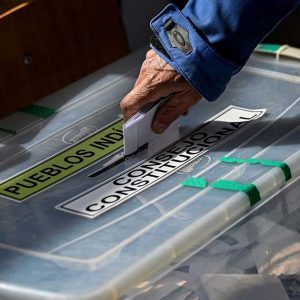
On 7 May, Chileans went to the polls to choose a Constitutional Council that will produce a new constitution to replace the one bequeathed by the Pinochet dictatorship – and handed control to a far-right party that never wanted a constitution-making process in the first place.
This is the second attempt at constitutional change in two years. The first process was the most open and inclusive in Chile’s history. The resulting constitutional text, ambitious and progressive, was widely rejected in a referendum. It’s now far from certain that this latest, far less inclusive process will result in a new constitution that is accepted and adopted – and there’s a possibility that any new constitution could be worse than the one it replaces.
A long and winding road
Chile’s constitution-making process was born out of mass protests that erupted in October 2019, under the neoliberal administration of Sebastián Piñera. Protests only subsided when the leaders of major parties agreed to hold a referendum to ask people whether they wanted a new constitution and, if so, how it should be drafted.
In the vote in October 2020, almost 80 per cent of voters backed constitutional change, with a new constitution to be drafted by a directly elected Constitutional Assembly. In May 2021, the Constitutional Assembly was elected, with an innovative mechanism to ensure gender parity and reserved seats for Indigenous peoples. Amid great expectations, the plural and diverse body started a one-year journey towards a new constitution.
Pushed by the same winds of change, in December 2021 Chile elected its youngest and most unconventional president ever: former student protester Gabriel Boric. But things soon turned sideways, and support for the Constitutional Assembly – often criticised as made up of unskilled amateurs – declined steadily along with support for the new government.
In September 2022, a referendum resulted in an overwhelming rejection of the draft constitution. Although very progressive in its focus on gender and Indigenous rights, a common criticism was that the proposed constitution failed to offer much to advance basic social rights in a country characterised by heavy economic inequality and poor public services. Disinformation was also rife during the campaign.
The second attempt kicked off in January 2023, with Congress passing a law laying out a new process with a much more traditional format. Instead of the large number of independent representatives involved before, this handed control back to political parties. The timeframe was shortened, the assembly made smaller and the previous blank slate replaced by a series of agreed principles. The task of producing the first draft is in the hands of a Commission of Experts, with a technical body, the Technical Admissibility Committee, guarding compliance with a series of agreed principles. One of the few things that remained from the previous process was gender parity.
Starting in March, the Commission of Experts was given three months to produce a new draft, to be submitted to the Constitutional Council for debate and approval. A referendum will be held in December to either ratify or reject the new constitution.
Rise of the far right
Compared with the 2021 election for the Constitutional Convention, the election for the Constitutional Council was characterised by low levels of public engagement. A survey published in mid-April found that 48 per cent of respondents had little or no interest in the election and 62 per cent had little or no confidence in the constitution-making process. Polls also showed increasing dissatisfaction with the government: in late 2022, approval rates had plummeted to 27 per cent. This made an anti-government protest vote likely.
While the 2021 campaign focused on inequality, this time the focus was on rising crime, economic hardship and irregular migration, pivoting to security issues. The party that most strongly reflected and instrumentalised these concerns came out the winner.
The far-right Republican Party, led by defeated presidential candidate José Antonio Kast, received 35.4 per cent of the votes, winning 23 seats on the 50-member council. The government-backed Unity for Chile came second, with 28.6 per cent and 16 seats. The traditional right-wing alliance Safe Chile took 21 per cent of the vote and got 11 seats. No seats were won by the populist People’s Party and the centrist All for Chile alliance, led by the Christian Democratic Party. The political centre has vanished, with polarisation on the rise.
What to expect
The Expert Commission will deliver its draft proposal on 6 June and the Constitutional Council will then have five months to work on it, approving decisions with the votes of three-fifths of its members – meaning 31 votes will be needed to make decisions, and 21 will be enough to block them. This gives veto power to the Republican Party – and if it manages to work with the traditional right wing, they will be able to define the new constitution’s contents.
The chances of the new draft constitution being better than the old one are slim. In the best-case scenario, only cosmetic changes will be introduced. In the worst, an even more regressive text will result.
People will have the final say on 17 December. If they ratify the proposed text, Chile will adopt a constitution that is, at best, not much different from the existing one. If they reject it, Chileans will be stuck with the old constitution that many rose up against in 2019. Either way, a once-in-a-generation opportunity to expand the recognition of rights will have been lost, and it will fall on civil society to keep pushing for the recognition and protection of human rights.
Jennifer Frances Namuli Kizza was feeling tired after work one evening in March 2021. And yet she still kept a scheduled first phone call with Donald Mayfield Brown, whom she had met through a dating app.
Ms. Kizza, 28, from Gainesville, Fla., had previously given up on finding a serious relationship. But now, as a medical student at Harvard, she wanted to make the time. “It was really challenging for me to find people where I felt like we both had the same goals for our relationship and for what romance looked like,” she said.
Mr. Brown, 31, who goes by Field, was living in Starkville, Miss., at the time, teaching in the English and African American studies department at Mississippi State University and finishing his dissertation research. He changed his location on the dating app Hinge to Boston with the hope of pursuing a relationship while finishing his doctoral degree at Harvard.
Ms. Kizza expected their first phone call to be brief, but it lasted for nearly an hour. The two bonded over a shared Southern upbringing, their families and similar poundcake recipes they were fond of. Mr. Brown’s came from his mother.
On their first virtual date in April, they watched an episode of “Waffles + Mochi,” a Netflix series about healthy food hosted by Michelle Obama.
“Growing up in the conservative Black Belt South, I didn’t want to watch a show with a lot of explicit stuff on my first date,” Mr. Brown said. “I didn’t want to lead that way with the person I wanted to be with.”
They eventually moved on to the Starz drama series “Power” over several more virtual dates.
Before matching on Hinge, the two had nearly crossed paths several years earlier.
Mr. Brown was attending Oxford University as a Rhodes scholar, working toward a master’s degree in history. He left by July 2016 to return to Harvard to start a Ph.D. program, three months before Ms. Kizza arrived at Oxford to pursue a master’s in global health science. That spring, she had graduated from Harvard with a bachelor’s degree in neurobiology and global health and health policy.
In September 2017, she became a Fulbright research fellow in Uganda alongside her father, who received his grant to teach and research the impact of soil pollution. Ms. Kizza, who began medical school at Harvard in 2018, will be doing her residency at Massachusetts General Hospital this summer.
Mr. Brown graduated from Mississippi State University in 2014with a bachelor’s in philosophy and English. He earned a doctoral degree in English literature at Harvard last year and is currently a post-doctorate fellow at Brown.
Their first in-person date, at a Thai restaurant, wasn’t until July 2021, when Mr. Brown returned to Boston. He recalled their laughter and cheerful banter from that first meeting. “I never really had a date like that,” he said, adding that he was so wrapped up in their conversation that he left his credit card at the restaurant.
Mr. Brown would find more reasons to see Ms. Kizza again. When she needed to get to work for her medical rotations at Brigham and Women’s Hospital, he would wake up at 5 a.m. to drive her so she wouldn’t have to ride her bike.
Ms. Kizza invited him to attend her cousin’s wedding in Orlando, Fla., in February 2022. It was the first time he met Ms. Kizza’s family. Her mother is from Malawi and her father from Uganda; they live in Gainesville. It was a big step, and she knew her family would take it as a sign that the relationship was serious.
In the summer of 2022, Ms. Kizza met Mr. Brown’s parents in Vicksburg, Miss. At the time, she was dealing with her father’s cancer diagnosis and felt even more appreciative of the warm welcome she received.
“It was just the hardest times for my family and for me,” she said. “It just felt like a miracle to just have this beautiful extension of people to support me.”
Mr. Brown proposed last August. He planned a surprise outing to distract Ms. Kizza as he awaited the arrival of a photographer, her friends and her cousin at the Public Garden in Boston. First, they stopped at the cafe L.A. Burdick Handmade Chocolates to pick up her favorite pastry, and then they strolled around the Newbury Street shopping district. When they arrived at the garden, Mr. Brown got down on one knee.
The couple celebrated their upcoming nuptials with a kwanjula, a Ugandan engagement ceremony, in November in Gainesville. During an evening of costume changes, dancing and gifts presented to Ms. Kizza’s family, Mr. Brown asked to marry her, again, in front of 150 guests.
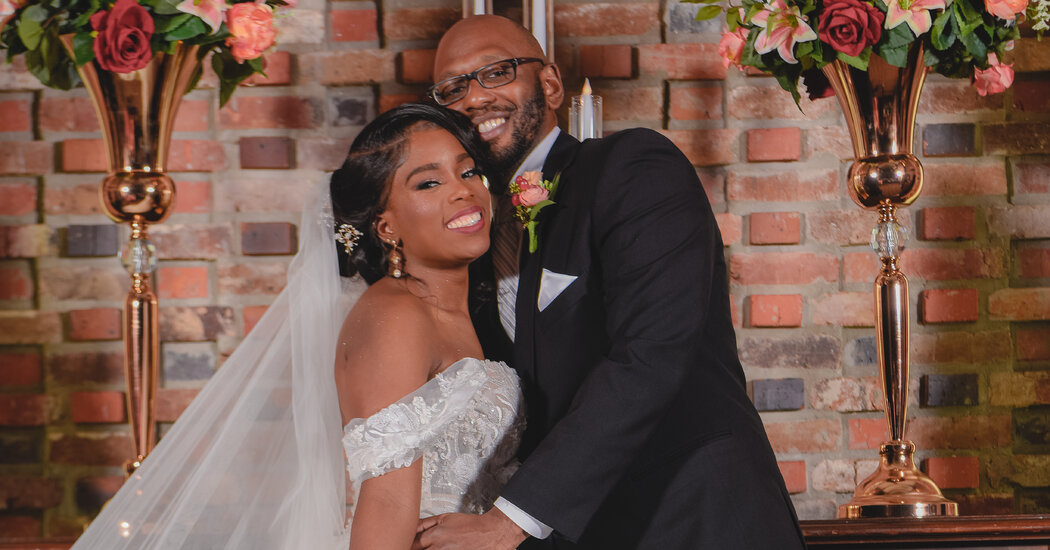
They wed on April 29 at the Chapel of Memories on Mississippi State University’s campus, a nod to Mr. Brown’s Southern roots and time as an undergraduate. The wedding was officiated by Reginald L. Walker, a pastor at the Word of Faith Christian Center in Vicksburg. The couple asked that the 100 guests be vaccinated to attend.
In her vows, Ms. Kizza recalled their first phone call. “I knew that day, romantic or not, Field was going to be in my life for the rest of my life,” she said.
Treatment response of P. falciparum malaria is influenced by many factors. Such factors include drug quality, pharmacokinetic characteristics of individual drugs, parasite sensitivity, host genetics,1 drug–drug interactions and food–drug interactions. Inter-individual variability with respect to extent and rate of absorption, metabolism, distribution, plasma protein binding and elimination has been shown to influence the plasma concentration of drugs, hence affecting treatment outcomes in return.2 The inter-individual variability is common in Africa due to genetic diversity and heterogenicity.3 The complex patterns of population expansion, migration, contraction and admixture during evolutionary history explain the diversity observed in African populations.4 Sub-Saharan Africa (SSA) uniquely bears the highest global disease burden of infectious diseases, particularly malaria and HIV (90% and 69%, respectively). Unfortunately, only about 3% of patients with African or SSA genetic background take part in clinical trials globally.5 This implies that drugs employed in clinical practice lack information on safety and efficacy in African populations, thus the information employed in SSA relies mainly on post-marketing surveillance. Employing information from clinical trials which do not involve African populations creates uncertainty regarding the impact of genetic diversity during treatment. Thus, characterization of different ethnic groups in SSA is pivotal for implementation of pharmacogenomics or implementation of treatment based on the major drug metabolizer genotypes in the region.
The role of heritable genetic variations on treatment outcomes in malaria has gained much attention over recent years. However, such studies began in the 1950s with a remarkable finding on higher occurrence of hemolytic anaemia among black American soldiers than their white counterparts when primaquine was administered.6
The pattern of genetic variants affecting efficacy and safety of commonly used drugs in clinical practice has been of major interest in pharmacogenetic studies in SSA. Though not all populations have been studied, there has been progress as various genome initiatives, such as malariaGEN, African pharmacogenomic consortium (APC), H3Africa and African Genome variation Project have been established.7 Globally, significant advances have been achieved whereby individualized therapy is recommended for anticoagulants (warfarin-CYP2C9*2&*3), antiplatelet agents (clopidogrel- CYP2C19*2), antipsychotics (amitriptyline-CYP2D6&citalopram-CYP2C19)8 and anticancer treatments (tacrolimus-CYP3A5).9 With regard to P. falciparum malaria, CYP450 genotype-based treatment has not been introduced. However, G6PD deficiency testing prior to primaquine treatment for P. vivax malaria patients is now common practice in some South East Asian countries.10
Genetic variability in cytochrome P450 (CYP450) enzyme family has been shown to determine pharmacokinetic profiles of many drugs, including the antimalarials.11 The CYP3A4 gene, which is located on chromosome 7q21.3-q22.1 consisting of 13 exons,12 contributes to metabolism of about 50% of drugs used in clinical practice.13–15 In the liver microsomes, CYP3A4 mediates its reactions through the nicotinamide adenine dinucleotide phosphate-dependent electron pathway.12 The major contributor in drug metabolism in the CYP3A4 family is CYP3A4*1B (rs2740574),16 which is a result of A to G transition at nucleotide 392 in the promoter sequence of the gene.17 This single nucleotide polymorphism (SNP) results in poor metabolism of artemether and lumefantrine.11,18
CYP3A5 isoenzyme is regarded as the second contributor to drug metabolism after CYP3A4.19,20 CYP3A5*3 (rs776746) SNP occurs at highest abundance and plays a major role in drug metabolism within the CYP3A5 gene. This SNP is a result of the replacement of a nucleotide A by nucleotide G at locus 6986 within intron 3, producing an mRNA splice defect and consequently producing a premature stop codon.19,20 The CYP3A5*3 plays a significant role in the metabolism of artemether, lumefantrine, mefloquine, primaquine and chloroquine.4
The expression of both CYP3A4 and CYP3A5 is inducible by drugs. The increased enzyme activity is a result of increased expression via nuclear receptors pregnane X receptor (PXR), glucocorticoid receptor (GR), constitutive androstane receptor-β (CAR), vitamin D receptor (VDR) and hepatocyte nuclear factor-4 (HNF4α).21,22 These nuclear receptors increase transcription and expression of CYP3A4/5 after binding to DNA segments present in the CYP3A promoter (for CYP3A4) region, mainly PXR responsive element (prPXRE), xenobiotics responsive enhancer module (XREM) and constitutive liver enhancer module (CLEM4).
CYP2C8*2 SNP exists at higher frequencies among African than Asian and Caucasian populations. Unlike CYP2C8*2, the CYP2C8*3 SNP is common in Caucasians and Asians, but very rare in Africans.23 Both CYP2C8*2 and CYP2C8*3 are associated with a significant reduction in amodiaquine (AQ) in vitro metabolism. AQ adverse events are rare (1:2000) but very serious. These adverse drug reactions (ADRs) include neutropenia effects and severe liver failure. Studies associate these ADRs with a highly reactive and short-lived quinine-imine (QI) species which are products of AQ and DEAQ (metabolite of AQ) metabolism.24 CYP1A1 and CYP1B1 enzymes have been shown to play a great role in the formation of QI from in vitro biotransformation of AQ and DEAQ,25 since CYP1A1 and CYP1B1 are extra-hepatic localized, this could explain the occurrence of neutropenia effects observed with amodiaquine since the biotransformation of AQ and DEAQ to QI occurs in blood and not in the liver.24 There is a high possibility that CYP1A1 and CYP1B1 fast metabolizers are likely to suffer from AQ therapy side effects.24
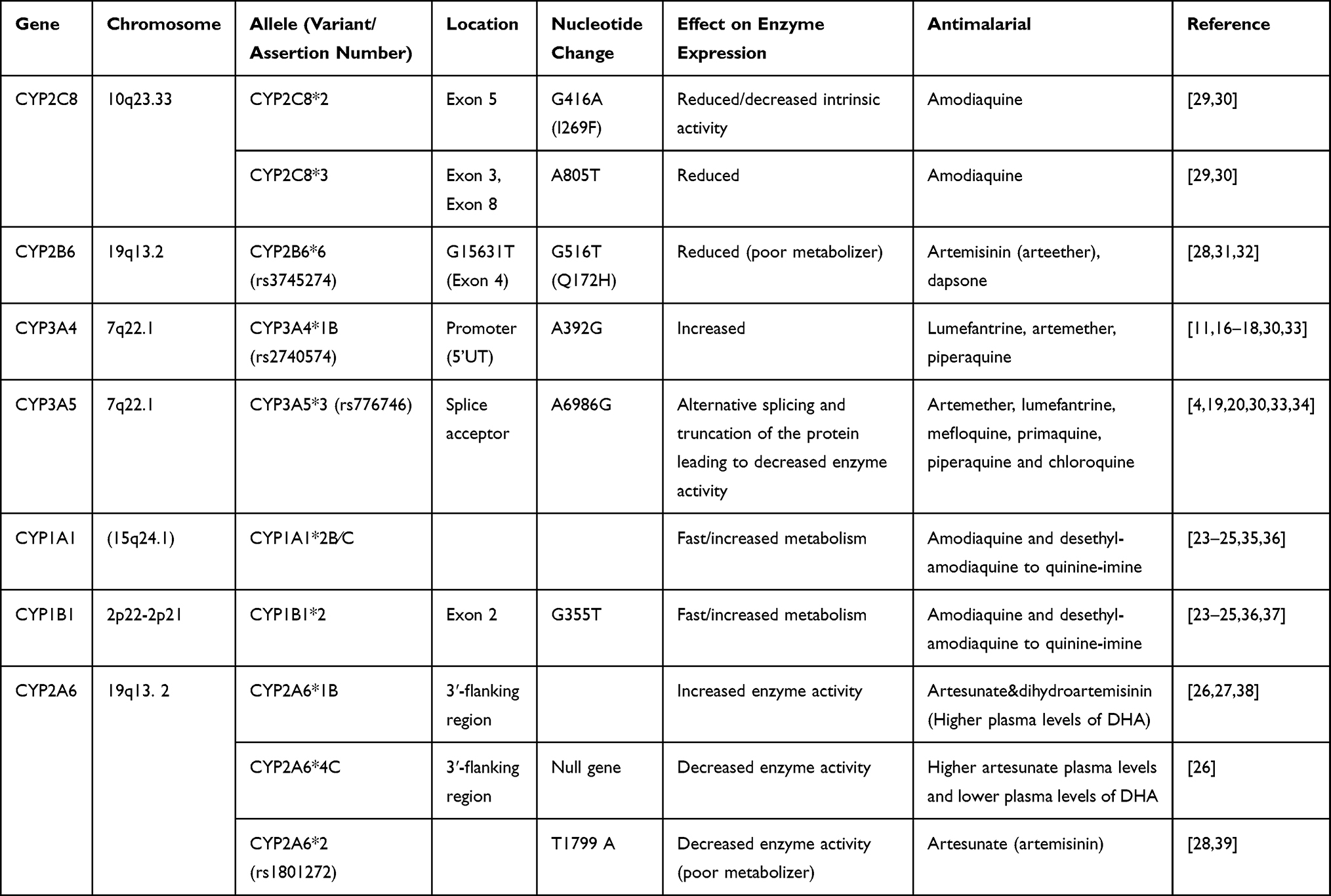
CYP2A6 and CYP2B6 play a minor role in the biotransformation of artemisinin derivatives to form dihydroartemisinin, which is an active metabolite.26 The low activity of CYP2A6*1B and CYP2B6*6 is suggested to predict low plasma concentrations of dihydroartemisinin.26,27 The elimination of dihydroartemisinin depends on its conversion of inactive glucuronide conjugates, which is mediated by the highly polymorphic uridine diphosphate glucuronosyltransferase (UGT1A6 &UGT2B7) enzymes.28 A summary of the human genetic variants important for antimalarial drug metabolism is shown in Table 1.
Table 1 CYP450 Single Nucleotide Polymorphisms Involved in Antimalarial Drugs Metabolism
We have previously reported the frequencies of cytochrome P450 polymorphisms responsible for metabolism of antimalarial drugs in Africa.40 Other researchers have also extensively assessed these frequencies in the region.22,41,42 In general, the most frequently recorded SNPs are CYP2C8*2 (15–22%), CYP2B6*6 (30–50%), CYP3A4*1B (50–80%) and CYP3A5*3 (15–80%). However, the information on the influence of these polymorphisms on metabolism of antimalarial drugs used in clinical settings in SSA is scanty, thus evidence on the impact of these SNPs on pharmacokinetic profiles, efficacy and safety is not established. In this review, we explore and synthesize available evidence on the influence of cytochrome P450 polymorphisms on pharmacokinetic profiles and treatment outcomes of ACTs and other antimalarial drugs employed in SSA.
Methods
Literature Search
Literature search for published studies assessing the influence of CYP450 enzymes on PK profiles (plasma concentrations), efficacy and safety of antimalarial drugs in SSA was done through the Cochrane Central Register of Controlled Trials (CENTRAL), Google Scholar, EMBASE, SCOPUS, PubMed, Medline and LILACS online databases.
The search terms used were: ((“amodiaquine” and “CYP2C8*2”) AND (“efficacy”)) OR ((“amodiaquine” and “CYP2C8*2”) AND (“efficacy”) AND (“Africa”)) OR ((“amodiaquine” and “CYP2C8*2”) AND (“safety”) AND (“Africa”)) OR ((“amodiaquine” and “CYP2C8*2”) AND (“Pharmacokinetics”) AND (“Africa”)) OR ((“amodiaquine” and “CYP2C8*2”) AND (“Plasma concentration”) AND (“Africa”)). For lumefantrine, the search terms used were “CYP3A4*1B”) AND (“efficacy”)) OR ((“lumefantrine” and “CYP3A4*1B”) AND (“efficacy”) AND (“Africa”)) OR ((“lumefantrine” and “CYP3A4*1B”) AND (“safety”) AND (“Africa”)) OR ((“lumefantrine” and “CYP3A4*1B”) AND (“Pharmacokinetics”) AND (“Africa”)) OR ((“lumefantrine” and “CYP3A4*1B”) AND (“Plasma concentration”) AND (“Africa”)). The same approach was used for other drugs by replacing the name of the drug and the CYP450 SNP involved in metabolism of the drug. We used the Preferred Reporting Items for Systematic review and Meta-Analysis Protocols (PRISMA-P) 2015 checklist43 to identify studies to be included in our review.
Inclusion Criteria
Publications assessing the impact of CYP450 polymorphisms on PK profiles, safety and efficacy of antimalarials used for treatment of uncomplicated P. falciparum malaria in SSA were included. These studies were not time bound.
Exclusion Criteria
We excluded, for numerous reasons, studies assessing the influence of CYP450 SNPs on other drugs apart from antimalarials, studies assessing the influence of CYP450 on interaction between antiretroviral drugs (ART) and antimalarials excepting those with data for controls who are not on ART, studies assessing the impact of Phase II metabolizing enzymes on safety, efficacy and pharmacokinetic profiles, studies assessing the influence of drug transporters on pharmacokinetic profiles and treatment outcomes and studies assessing the influence of CYP450 polymorphisms on antimalarial treatment outcomes and PK profiles in regions other than SSA. Meeting communications and findings published based on animal models were not regarded as sufficient evidence and thus were also excluded. Studies assessing the influence of CYP450s on primaquine among P. vivax patients and volunteers were also excluded.
Methodological and Data Quality Assessment
Methodological quality assessment was done using the national institute of health (NIH) study quality assessment tools for controlled intervention, observational cohort and cross-sectional studies.44 The score ranged from 0 to 14, with a score of one point each that was then converted to percentages. The score range of 0–60% was regarded as low quality, 61–80% good quality and 81–100% excellent quality. Any difference in opinion with regard to extracted data and methodological quality assessment was resolved by consensus between the two independent reviewers. All included studies were of good to excellent quality as per the NIH scale.
Data Extraction
Two independent reviewers participated in the data extraction and screening of the results of the literature search and selected studies as per the inclusion criteria. Differences in opinion between reviewers on inclusion of studies were resolved through discussion. The basic information extracted included the author names, country in which the study was carried out, study population, sample size, SNPs, study endpoints, influence on pharmacokinetic profiles, influence on efficacy and influence on safety. Data was entered into extraction sheets.
Results
Study Characteristics
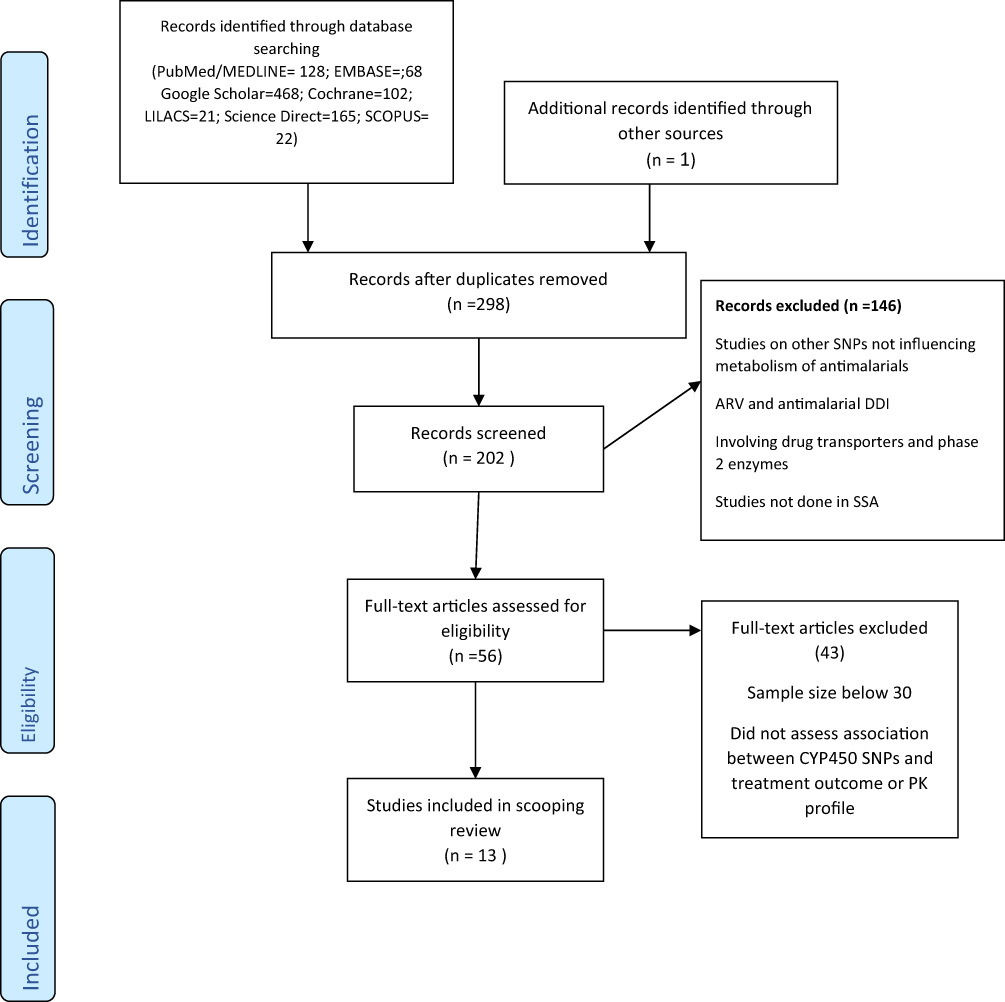
Fifty-six articles were included for full-text review from the 298 records (after removal of duplications) which were identified through the electronic database. Thirteen studies were finally included in data extraction after meeting the inclusion criteria. Details of the study search are shown in Figure 1. These studies originated from eight different countries within SSA.
Figure 1 PRISMA flow diagram for article searches and screening.
Note: Adapted from Moher D, Liberati A, Tetzlaff J, Altman DG, PRISMA Group* T. Preferred reporting items for systematic reviews and meta-analyses: the PRISMA statement. Annals of internal medicine.2009 Aug 18;151(4):264-9.43
Treatment Outcome
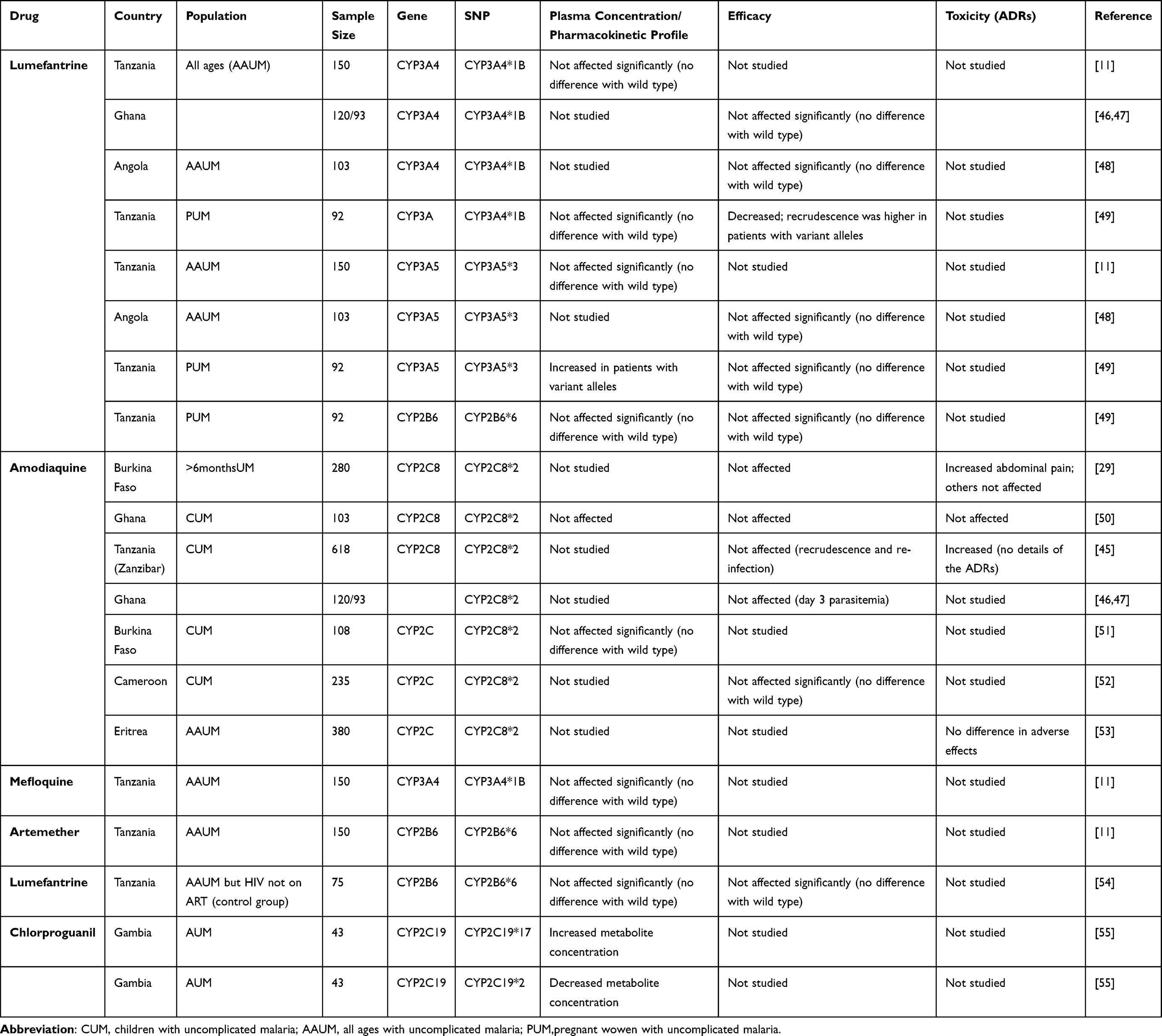
Pernaute-Lau et al45 carried out a study to assess the influence of CYP2C8*2 (805A>T) and CYP2C8*3 (416A>G) on treatment outcomes and tolerability among P. falciparum malaria patients treated with artesunate amodiaquine (ASAQ) in a Zanzibar population, Tanzania. This study reported presence of CYP2C8*3, which is rare in African populations but common among whites and Caucasians. The study end points were adverse events, ACPR, recrudescence and re-infection among malaria patients after 28- and 42-day follow up. There was no significant difference in recrudescence between subjects carrying CYP2C8*2 mutant alleles and wild type alleles. Carrying CYP2C8*2 or CYP2C8*3 did not predict for ACPR and re-infection among malaria patients. However, carrying CYP2C8*2 or CYP2C8*3 was associated with occurrence of non-serious adverse events compared to those with wild type alleles (Table 2).
Table 2 Influence of CYP450 SNPs on Plasma Concentration and Treatment Outcomes
Habtemikael et al53 carried out a cross-sectional study among malaria patients on artesunate amodiaquine in Eritrea. This study reported lack of association between CYP2C8*2 (805A>T) or CYP2C8*3 (416A>G) and extra pyramidal effects among Eritreans.
Mutagonda et al49 did a prospective cohort study in Tanzanian pregnant women to assess the influence of pharmacogenetics on day 7 plasma concentration and treatment outcomes. This study did not report association between CYP2B6*6 (516G>T), CYP3A5*3 (6986A>G) and day 28 ACPR. Unexpectedly, the study reported association between CYP3A4*1B (392A>G) with day 28 ACPR but not day 7 lumefantrine plasma concentration. This finding may have happened by chance since it is the day 7 plasma concentration of the drug which is suggested to determine treatment outcomes in malaria patients (Table 2).
Adjei et al50 assessed the influence of CYP450 polymorphisms on treatment outcomes and adverse events among Ghanaian children with uncomplicated malaria receiving ASAQ or AQ. No difference in efficacy and adverse events was observed between patients with CYP2C8*2 mutant allele and those with wild type allele (Table 2).
The assessment on the impact of CYP2C19*2 among Gambian adults with uncomplicated receiving chlorproguanil by Janha et al55 reported lack of significance in area under the curve (AUC) and maximum plasma concentration (Cmax) between those with loss of function allele and those without. Full pharmacokinetic sampling was done after three daily doses and plasma concentrations were used to determine AUC and Cmax (Table 2).
Another study in Burkina Faso, by Parikh et al,29 assessed the influence of CYP2C8 genotypes on efficacy and adverse events among malaria patients with uncomplicated malaria receiving ASAQ after 28 days of follow up. In this study, treatment outcomes in terms of ACPR, recrudescence and re-infection did not vary between patients with CYP2C8*2 (805A>T) and wild alleles (Table 2).
The influence of CYP2B6 genotypes on treatment outcomes among HIV-positive patients in the absence of antiretroviral therapy (ART) co-treatment (control group) was studied in Tanzania by Maganda et al.54 This group included only HIV-infected patients on artemether lumefantrine but who had not started taking ART, thus the drug–drug interactions between lumefantrine and efavirenz which could affect the plasma concentrations of either drug were not observed. The major finding was lack of association between CYP2B6*6 genotypes with incidence of recurrent parasitaemia (Table 2).
Mballa et al52 evaluated the influence of CYP2C8*2 variant allele on treatment outcomes among children with uncomplicated P. falciparum malaria in Cameroon. This study also reported lack of influence on treatment outcomes associated with CYP2C8 genotypes.
Lumefantrine and Amodiaquine Plasma Concentrations
Some et al51 did a cross-sectional survey on the influence of CYP2C8*2 (805A>T) SNPs on amodiaquine metabolism in Burkina Faso. There was no difference in day 7 DEAQ plasma concentrations between those with homozygous wild type allele and those with mutant allele. CYP2C8 genotypes did not contribute to differences in DEAQ concentration between subjects with mutant alleles and those with wild type alleles in Ghanaian children receiving ASAQ and AQ50 (Table 2).
Mutagonda et al49 also reported lack of association between CYP2B6*6 (516G>T) and day 7 lumefantrine concentration among pregnant women with uncomplicated P. falciparum malaria. Similar findings are reported for CYP3A4*1B (392A>G). However, patients with CYP3A5*3 (6986A>G) genotype had slightly higher day 7 lumefantrine concentration than their counterparts (CYP3A5*1/1*) but treatment outcomes were not affected (Table 2).
Adjei et al50 assessed the influence of CYP450 polymorphisms on pharmacokinetics among Ghanaian children with uncomplicated malaria receiving ASAQ or AQ. CYP2C8 genotypes did not contribute to the difference in the mean day 3 DEAQ concentrations between subjects with mutant and wild type allele.
Another study in Burkina Faso, by Parikh et al,29 evaluated the influence of CYP2C8 genotypes on efficacy and pharmacokinetic profiles of ASAQ among malaria patients with uncomplicated malaria. In this study, the intrinsic clearance of AQ for CYP2C8*2(805A>T) was six-fold lower than that of wild type allele (Table 2).
A population pharmacokinetics study was done in Tanzania by Hodel et al.11 The study population was 150 Tanzanian patients with uncomplicated malaria treated with ALU. Cambodian patients assessed for ASAQ were not discussed in this review. Neither CYP3A4*1B nor CYP3A5*3 affected lumefantrine plasma concentrations significantly. Similar findings were observed for artemether, whereby patients with CYP3A4*1B and CYP3A5*3 did not have different plasma concentration values compared to their counterparts (patients with wild alleles).
The influence of CYP2B6, CYP3A4 and CYP3A5 genotypes on day 7 lumefantrine plasma concentrations among HIV-positive patients in the absence of ART co-treatment (control group) was also studied in Tanzania, by Maganda et al.54 This group included only HIV-infected patients on artemether lumefantrine who had not started taking ART, thus the drug–drug interactions between lumefantrine and efavirenz, which could affect the plasma concentrations of either drug, were not observed. CYP2B6*6, CYP3A4*1B and CYP3A5*3 genotypes did not influence day 7 lumefantrine concentrations significantly among this group of malaria patients (Table 2).
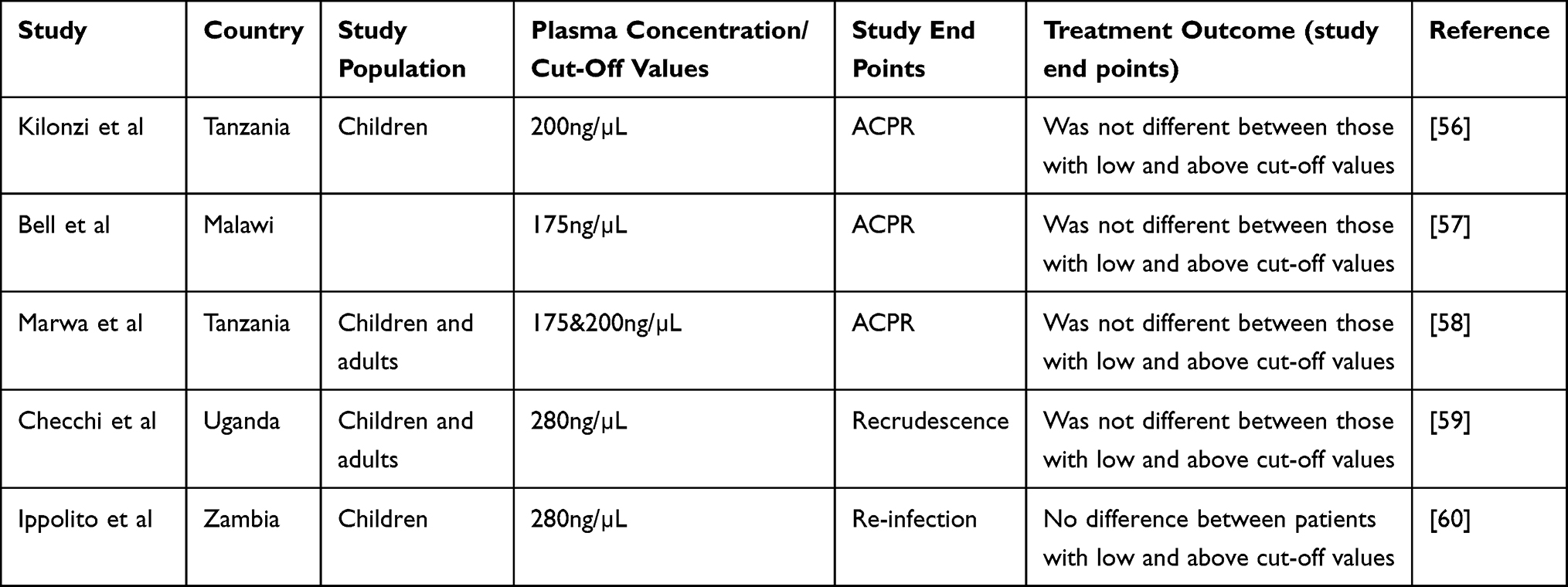
There are studies which report association between drug levels and treatment outcomes but did not assess CYP 450 polymorphisms. Since CYP450 polymorphisms affect treatment outcomes through influencing plasma concentrations, it is worth considering these studies (Table 3). The above studies report lack of correlation between day 7 lumefantrine concentration cut-off values and treatment outcomes in SSA.
Table 3 Influence of Lumefantrine Plasma Concentration Below Cut-off Values on Treatment Outcome in SSA Populations
Discussion
The major focus in studying CYP450 polymorphisms has been attainment of personalized medicine among patients. However, most studies only describe frequencies of CYP 450 variant alleles in different populations without assessing the effect of these polymorphisms on pharmacokinetics, efficacy and safety within populations. This review highlights evidence on the influence of CYP450 enzyme polymorphisms on antimalarial drug plasma concentrations and treatment outcomes among P. falciparum malaria patients in SSA.
The major CYP450 enzyme SNPs suggested to influence plasma concentrations and treatment outcomes (CYP3A4*1B, CYP3A5*5, CYP2B6*6 and CYP2C8*2) donot affect antimalarial drug plasma concentrations significantly in SSA, as shown in Table 2. In general, there was no difference in PK profiles between uncomplicated P. falciparum malaria patients with the mentioned CYP450 mutant alleles and those with wild type alleles in the region (Table 2). A similar finding was observed with antimalarial drug efficacy. These SNPs did not predict for low or high efficacy among patients with uncomplicated P. falciparum malaria. Findings from our review also suggest that a difference in ADRs between uncomplicated P. falciparum malaria patients with the CYP3A5*3, CYP3A4*1B and CYP2B6*6 SNPs and those with wild type alleles does not exist, with the exception of the CYP2C8*2 variant allele whereby a difference in minor adverse effects was observed in two studies. No difference was observed in terms of serious ADRs between subjects with CYP2C8*2 and those with wild type allele.
Lack of the influence of CYP450 polymorphisms on plasma concentrations, efficacy and serious adverse events suggests that dose optimization may not be necessary among P. falciparum malaria patients with CYP450 allelic variants in the region. Hodel et al also had a similar opinion to ours about ten years ago after employing genetic-based population pharmacokinetic modelling.11 Then, there were few studies on frequencies of genetic variants affecting the metabolism of antimalarial drugs in SSA. There has been advancement in terms of evidence on the presence of genetic variants in the region since Hodel et al suggested such findings. Our review provides a broader picture on the influence of CYP450 polymorphisms in treatment outcomes of P. falciparum malaria patients in various countries in SSA.
The suggestion that CYP450 genotyping-based treatment (tailored therapy) for uncomplicated P. falciparum malaria patients may not be of substantial worth is further supported by the recent findings in some SSA populations whereby lumefantrine plasma levels below cut-off values (<175ng/µL, 200ng/µL and 280ng/µL), which are suggested to predict treatment outcomes, did not affect treatment outcomes in these populations (Table 3). Drug plasma levels depend on enzyme metabolism as one of the key determinants, which in turn determines treatment response. Therefore, genotyping for variant alleles and their correlation with plasma levels may not be of great importance in these populations due to lack of an association between drug plasma levels and treatment outcomes. We observed similar findings in our recent study on association between day 3 and 7 lumefantrine plasma concentrations and treatment outcomes among P. falciparum malaria patients in Tanzania.58 Although studies included in this review have shown a lack of association between day 3 and 7 lumefantrine plasma concentrations and treatment outcomes, the influence of metabolites such as desbutyl-lumefantrine (usually not measured) on treatment outcomes in SSA needs to be assessed.
The lack of predictive effect of CYP450 polymorphisms and day 7 lumefantrine concentration on treatment outcomes in SSA may be attributed to high parasite sensitivity existing in the SSA region despite a growing threat of spread of resistant parasite strains from GMS regions. The acquired immunity among malaria patients in SSA populations, where most areas are malaria endemic thus individuals are exposed to multiple infections, may also account for the insignificant effect of CYP450 polymorphisms and plasma concentrations below cut-off values on treatment outcomes in the region. Although, the observation that lumefantrine plasma concentrations below cut-off values do not affect treatment outcomes in the region is encouraging, the impact of sub-optimal concentrations exposure to parasites should be worrying as far as selection of resistant parasites is concerned.
Our review focuses on SSA where most malaria patients are immune. Therefore, reviews of other regions of the world (where patients are non-immune) on the influence of CYP450 polymorphisms on antimalarial drug plasma concentrations, safety and efficacy among patients with uncomplicated P. falciparum malaria are warranted.
Like any other study, our review is not devoid of limitations. First, we understand there could be other unpublished data which we could not assess during our online search. Second, the lack of a sufficient number of studies (only a few countries are represented) assessing the influence of CYP450 polymorphisms on pharmacokinetic parameters, efficacy and safety in SSA limits the power of our review and did not allow us to carry out a meta-analysis.
There could be other factors, such as polymorphism in Phase II SNP genes encoding N-Acetyl Transferase 2, drug transporters (such as ABCB1 [MDR1], ABCC2 [MRP2]) and drug targets, which may also influence antimalarial drug plasma concentrations, safety and cure rates among malaria patients, thus limiting the findings reported in this study. However, since we only considered CYP450s, these factors are regarded as constant and thus their influence may not vary. We understand polypharmacy is common in SSA, thus drug–drug interactions are common and could influence CYP450 expression and treatment outcomes among malaria patients. To minimize this, only studies which followed the WHO protocol for assessment of the efficacy of antimalarials were included and studies assessing drug–drug interactions among malaria patients were excluded. Despite these limitations, this review is unique because it is the first review to assess the influence of CYP450 polymorphisms on antimalarial drug plasma concentrations, safety and efficacy among P. falciparum malaria patients in SSA.
Conclusion
This review reports lack of influence of CYP3A5*3, CYP3A4*1B, CYP2C8*3 and CYP2B6*6 SNPs on plasma concentrations, efficacy and safety among P. falciparum malaria patients in the region. This suggests that CYP450 genotyping-based dose optimization (personalized medicine) may not be important in malaria patients with the variant alleles in SSA.
No grant was received. However, authors have been receiving salaries by their respective universities during the literature search and manuscript writing.
Disclosure
The authors declare that they have no competing interests in this work.
References
1. Obua C, Hellgren U, Ntale M, et al. Population pharmacokinetics of chloroquine and sulfadoxine and treatment response in children with malaria: suggestions for an improved dose regimen. Br J Clin Pharmacol. 2008;65(4):493–501. doi:10.1111/j.1365-2125.2007.03050.x
2. Pang KS. Modeling of intestinal drug absorption: roles of transporters and metabolic enzymes (for the Gillette Review Series). Drug Metabol Disposit. 2003;31(12):1507–1519. doi:10.1124/dmd.31.12.1507
3. Campbell MC, Tishkoff SA. African genetic diversity: implications for human demographic history, modern human origins, and complex disease mapping. Annu Rev Genomics Hum Genet. 2008;9:403–433. doi:10.1146/annurev.genom.9.081307.164258
4. Dandara C, Swart M, Mpeta B, Wonkam A, Masimirembwa C. Cytochrome P450 pharmacogenetics in African populations: implications for public health. Expert Opin Drug Metab Toxicol. 2014;10(6):769–785. doi:10.1517/17425255.2014.894020
5. Mpye K, Matimba A, Dzobo K, Chirikure S, Wonkam A, Dandara C. Disease burden and the role of pharmacogenomics in African populations. Global Health Epidemiol Genom. 2017;2. doi:10.1017/gheg.2016.21
6. Motulsky AG. Drug reactions, enzymes, and biochemical genetics. J Am Med Assoc. 1957;165(7):835–837. doi:10.1001/jama.1957.72980250010016
7. Dandara C, Masimirembwa C, Haffani YZ, et al. African Pharmacogenomics Consortium: consolidating pharmacogenomics knowledge, capacity development and translation in Africa: consolidating pharmacogenomics knowledge, capacity development and translation in Africa. AAS Open Res. 2019;2:19. doi:10.12688/aasopenres.12965.1
8. Dandara C, Matimba A. A Glimpse into Pharmacogenomics in Africa. Cambridge, UK: Cambridge University Press; 2019.
9. Tata BE, Ambele M, Pepper M. Barriers to implementing clinical pharmacogenetics testing in Sub-Saharan Africa. A critical review. Pharmaceutics. 2020;12(9):809. doi:10.3390/pharmaceutics12090809
10. Ley B, Luter N, Espino FE, et al. The challenges of introducing routine G6PD testing into radical cure: a workshop report. BioMed Central. 2015. doi:10.1186/s12936-015-0896-8
11. Staehli Hodel EM, Csajka C, Ariey F, et al. Effect of single nucleotide polymorphisms in cytochrome P450 isoenzyme and N-acetyltransferase 2 genes on the metabolism of artemisinin-based combination therapies in malaria patients from Cambodia and Tanzania. Antimicrob Agents Chemother. 2013;57(2):950–958. doi:10.1128/AAC.01700-12
12. Keshava C, McCanlies EC, Weston A. CYP3A4 polymorphisms—potential risk factors for breast and prostate cancer: a HuGE review. Am J Epidemiol. 2004;160(9):825–841. doi:10.1093/aje/kwh294
13. Seripa D, Pilotto A, Panza F, Matera MG, Pilotto A. Pharmacogenetics of cytochrome P450 (CYP) in the elderly. Ageing Res Rev. 2010;9(4):457–474. doi:10.1016/j.arr.2010.06.001
14. Thummel KE, Wilkinson GR. In vitro and in vivo drug interactions involving human CYP3A. Annu Rev Pharmacol Toxicol. 1998;38:389–430. doi:10.1146/annurev.pharmtox.38.1.389
15. Feltrin C, Farias IV, Sandjo LP, Reginatto FH, Simões C. Effects of standardized medicinal plant extracts on drug metabolism mediated by CYP3A4 and CYP2D6 enzymes. Chem Res Toxicol. 2020;33(9):2408–2419. doi:10.1021/acs.chemrestox.0c00182
16. Alessandrini M, Asfaha S, Dodgen TM, Warnich L, Pepper MS. Cytochrome P450 pharmacogenetics in African populations. Drug Metab Rev. 2013;45(2):253–275. doi:10.3109/03602532.2013.783062
17. El-Shair S, Al Shhab M, Zayed K, Alsmady M, Zihlif M. Association between CYP3A4 and CYP3A5 genotypes and cyclosporine’s blood levels and doses among Jordanian kidney transplanted patients. Curr Drug Metab. 2019;20(8):682–694. doi:10.2174/1389200220666190806141825
18. Piedade R, Gil JP. The pharmacogenetics of antimalaria artemisinin combination therapy. Expert Opin Drug Metab Toxicol. 2011;7(10):1185–1200. doi:10.1517/17425255.2011.608660
19. Eng H-S, Mohamed Z, Calne R, et al. The influence of CYP3A gene polymorphisms on cyclosporine dose requirement in renal allograft recipients. Kidney Int. 2006;69(10):1858–1864. doi:10.1038/sj.ki.5000325
20. Tang H-L, Ma -L-L, Xie H-G, Zhang T, Hu Y-F. Effects of the CYP3A5* 3 variant on cyclosporine exposure and acute rejection rate in renal transplant patients: a meta-analysis. Pharmacogenet Genomics. 2010;20(9):525–531. doi:10.1097/FPC.0b013e32833ccd56
21. Daly AK. Significance of the minor cytochrome P450 3A isoforms. Clin Pharmacokinet. 2006;45(1):13–31. doi:10.2165/00003088-200645010-00002
22. Saiz-Rodríguez M, Almenara S, Navares-Gómez M, et al. Effect of the most relevant CYP3A4 and CYP3A5 polymorphisms on the pharmacokinetic parameters of 10 CYP3A substrates. Biomedicines. 2020;8(4):94. doi:10.3390/biomedicines8040094
23. Daily EB, Aquilante CL. Cytochrome P450 2C8 pharmacogenetics: a review of clinical studies. Pharmacogenomics. 2009;10(9):1489–1510. doi:10.2217/pgs.09.82
24. Cavaco I, Piedade R, Msellem MI, Bjorkman A, Gil JP. Cytochrome 1A1 and 1B1 gene diversity in the Zanzibar islands. Trop Med Int Health. 2012;17(7):854–857.
25. Johansson T, Jurva U, Gronberg G, Weidolf L, Masimirembwa C. Novel metabolites of amodiaquine formed by CYP1A1 and CYP1B1: structure elucidation using electrochemistry, mass spectrometry, and NMR. Drug Metab Dispos. 2009;37(3):571–579. doi:10.1124/dmd.108.025171
26. Phompradit P, Muhamad P, Cheoymang A, Na-Bangchang K. Preliminary investigation of the contribution of CYP2A6, CYP2B6, and UGT1A9 polymorphisms on artesunate-mefloquine treatment response in Burmese patients with Plasmodium falciparum malaria. Am J Trop Med Hyg. 2014;91(2):361. doi:10.4269/ajtmh.13-0531
27. Yusof W, Hua GS. Gene, ethnic and gender influences predisposition of adverse drug reactions to artesunate among Malaysians. Toxicol Mech Methods. 2012;22(3):184–192. doi:10.3109/15376516.2011.623331
28. Kerb R, Fux R, Mörike K, et al. Pharmacogenetics of antimalarial drugs: effect on metabolism and transport. Lancet Infect Dis. 2009;9(12):760–774. doi:10.1016/S1473-3099(09)70320-2
29. Parikh S, Ouedraogo JB, Goldstein J, Rosenthal P, Kroetz D. Amodiaquine metabolism is impaired by common polymorphisms in CYP2C8: implications for malaria treatment in Africa. Clin Pharmacol Ther. 2007;82(2):197–203. doi:10.1038/sj.clpt.6100122
30. Tornio A, Backman JT. Cytochrome P450 in pharmacogenetics: an update. Adv Pharmacol. 2018;83:3–32.
31. Hoffman SMG, Nelson DR, Keeney DS. Organization, structure and evolution of the CYP2 gene cluster on human chromosome 19. Pharmacogenet Genomics. 2001;11(8):687–698. doi:10.1097/00008571-200111000-00007
32. Zanger UM, Klein K, Saussele T, Blievernicht J, Hofmann M, Schwab M. Polymorphic CYP2B6: molecular mechanisms and emerging clinical significance. Pharmacogenomics. 2007;8(7):743–759. doi:10.2217/14622416.8.7.743
33. Liu H, Xie Y, Cai T, Xing J. No effect of PXR (8055C> T) polymorphism on the pharmacokinetic profiles of piperaquine in healthy Chinese subjects. Curr Drug Metab. 2021;23(2):164–170.
34. Gim J-A, Kwon Y, Lee HA, et al. A machine learning-based identification of genes affecting the pharmacokinetics of tacrolimus using the DMETTM plus platform. Int J Mol Sci. 2020;21(7):2517. doi:10.3390/ijms21072517
35. Cavaco IdCL. Molecular determinants of the response to malaria therapeutics; 2007.
36. Gil JP. The pharmacogenetics of the antimalarial amodiaquine: citeseer; 2012.
37. Jin J, Lin F, Liao S, Bao Q, Ni L, Wei Q-Y. Effects of SNPs (CYP1B1* 2 G355T, CYP1B1* 3 C4326G, and CYP2E1* 5 G-1293C), smoking, and drinking on susceptibility to laryngeal cancer among Han Chinese. PLoS One. 2014;9(10):e106580. doi:10.1371/journal.pone.0106580
38. Mwenifumbo JC, Lessov‐Schlaggar CN, Zhou Q, et al. Identification of novel CYP2A6* 1B variants: the CYP2A6* 1B allele is associated with faster in vivo nicotine metabolism. Clin Pharmacol Ther. 2008;83(1):115–121. doi:10.1038/sj.clpt.6100246
39. Ezzeldin N, El-Lebedy D, Darwish A, et al. Association of genetic polymorphisms CYP2A6* 2 rs1801272 and CYP2A6* 9 rs28399433 with tobacco-induced lung Cancer: case-control study in an Egyptian population. BMC Cancer. 2018;18(1):1–9. doi:10.1186/s12885-018-4342-5
40. Marwa KJ, Schmidt T, Sjögren M, Minzi OM, Kamugisha E, Swedberg G. Cytochrome P450 single nucleotide polymorphisms in an indigenous Tanzanian population: a concern about the metabolism of artemisinin-based combinations. Malar J. 2014;13(1):1–7. doi:10.1186/1475-2875-13-420
41. Ferreira PE, Veiga MI, Cavaco I, et al. Polymorphism of antimalaria drug metabolizing, nuclear receptor, and drug transport genes among malaria patients in Zanzibar, East Africa. Ther Drug Monit. 2008;30(1):10–15. doi:10.1097/FTD.0b013e31815e93c6
42. Roederer MW, McLeod H, Juliano JJ. Can pharmacogenomics improve malaria drug policy? Bull World Health Organ. 2011;89:838–845. doi:10.2471/BLT.11.087320
43. Moher D, Shamseer L, Clarke M, et al. Preferred reporting items for systematic review and meta-analysis protocols (PRISMA-P) 2015 statement. Syst Rev. 2015;4(1):1. doi:10.1186/2046-4053-4-1
44. Health NIo. National Heart Lung, and Blood Institute. Study Quality Assessment Tools. Bethesda, MD, USA: National Institutes of Health; 2018.
45. Pernaute-Lau L, Morris U, Msellem M, Mårtensson A, Björkman A, Gil JP. Influence of cytochrome P450 (CYP) 2C8 polymorphisms on the efficacy and tolerability of artesunate‐amodiaquine treatment of uncomplicated Plasmodium falciparum malaria in Zanzibar. Malar J. 2021;20(1):1–7. doi:10.1186/s12936-021-03620-6
46. Hodoameda P. Determination of Plasmodium Falciparum and Host Genetic Factors That Affect the Efficacy of the Artemisinin-Based Combination Partner Drugs Used in Ghana. University Of Ghana; 2019.
47. Hodoameda P, Duah-Quashie NO, Hagan CO, et al. Plasmodium falciparum genetic factors rather than host factors are likely to drive resistance to ACT in Ghana. Malar J. 2020;19(1):1–8. doi:10.1186/s12936-020-03320-7
48. Kiaco K, Rodrigues AS, Do Rosário V, Gil JP, Lopes D. The drug transporter ABCB1 c. 3435C> T SNP influences artemether–lumefantrine treatment outcome. Malar J. 2017;16(1):1–6. doi:10.1186/s12936-017-2006-6
49. Mutagonda RF, Kamuhabwa AA, Minzi O, et al. Effect of pharmacogenetics on plasma lumefantrine pharmacokinetics and malaria treatment outcome in pregnant women. Malar J. 2017;16(1):1–10. doi:10.1186/s12936-017-1914-9
50. Adjei GO, Kristensen K, Goka BQ, et al. Effect of concomitant artesunate administration and cytochrome P4502C8 polymorphisms on the pharmacokinetics of amodiaquine in Ghanaian children with uncomplicated malaria. Antimicrob Agents Chemother. 2008;52(12):4400–4406. doi:10.1128/AAC.00673-07
51. Somé FA, Bazié T, Ehrlich HY, et al. Investigating selected host and parasite factors potentially impacting upon seasonal malaria chemoprevention in Bama, Burkina Faso. Malar J. 2020;19(1):1–8. doi:10.1186/s12936-020-03311-8
52. Mballa R, Chedjou J, Ngwafor R. Single nucleotide polymorphisms in the cyp2C8 and nat2 genes and treatment outcomes in patients suffering from uncomplicated malaria in Garoua, Northern Region of Cameroon. Pharm Pharmacol Int J. 2019;7(4):147–153.
53. Habtemikael L, Russom M, Bahta I, et al. Prevalence of CYP2C8* 2 and* 3 among Eritreans and its potential impact on artesunate/amodiaquine treatment. Pharmgenomics Pers Med. 2020;13:571. doi:10.2147/PGPM.S276215
54. Maganda B, Minzi O, Ngaimisi E, Kamuhabwa A, Aklillu E. CYP2B6* 6 genotype and high efavirenz plasma concentration but not nevirapine are associated with low lumefantrine plasma exposure and poor treatment response in HIV-malaria-coinfected patients. Pharmacogenomics J. 2016;16(1):88–95. doi:10.1038/tpj.2015.37
55. Janha RE, Sisay-Joof F, Hamid-Adiamoh M, et al. Effects of genetic variation at the CYP2C19/CYP2C9 locus on pharmacokinetics of chlorcycloguanil in adult Gambians. Pharmacogenomics. 2009;10(9):1423–1431. doi:10.2217/pgs.09.72
56. Kilonzi M, Minzi O, Mutagonda R, et al. Usefulness of day 7 lumefantrine plasma concentration as a predictor of malaria treatment outcome in under-fives children treated with artemether-lumefantrine in Tanzania. Malar J. 2020;19(1):1–8. doi:10.1186/s12936-020-3150-y
57. Bell DJ, Wootton D, Mukaka M, et al. Measurement of adherence, drug concentrations and the effectiveness of artemether-lumefantrine, chlorproguanil-dapsone or sulphadoxine-pyrimethamine in the treatment of uncomplicated malaria in Malawi. Malar J. 2009;8(1):1–11. doi:10.1186/1475-2875-8-204
58. Marwa KJ, Liwa AC, Konje ET, Mwita S, Kamugisha E, Swedberg G. Lumefantrine plasma concentrations in uncontrolled conditions among patients treated with artemether-lumefantrine for uncomplicated plasmodium falciparum malaria in Mwanza, Tanzania. Int J Infect Dis. 2022;123:192–199. doi:10.1016/j.ijid.2022.08.020
59. Checchi F, Piola P, Fogg C, et al. Supervised versus unsupervised antimalarial treatment with six-dose artemether-lumefantrine: pharmacokinetic and dosage-related findings from a clinical trial in Uganda. Malar J. 2006;5(1):1–8. doi:10.1186/1475-2875-5-59
60. Ippolito MM, Pringle JC, Siame M, et al. Therapeutic Efficacy of artemether–lumefantrine for uncomplicated falciparum malaria in Northern Zambia. Am J Trop Med Hyg. 2020;103(6):2224. doi:10.4269/ajtmh.20-0852
Few know the names Michelle Saahene or Melissa DePino. But millions have heard the beginning of their story.
They were witnesses at a Philadelphia Starbucks five years ago when two Black businessmen asked to use the restroom and a white barista called police, who led the men away in handcuffs.
“They didn’t do anything!” Saahene shouted as another customer recorded the confrontation.
Saahene and DePino didn’t know each other. But in their shock and anger, the two women started talking, and after DePino got a copy of the video, she conferred with Saahene before tweeting it out.
A showcase for compelling storytelling from the Los Angeles Times.
It also launched lucrative new careers for both women, who teamed up to promote awareness about racism and started a nonprofit that provided sensitivity talks to corporations just as the diversity, equity and inclusion industry was about to take off.
What they could not anticipate was how their joint venture would go awry — or how they themselves would become a potent illustration of the racial animosity and misunderstanding they had set out to combat.
“This is what happens when white women insert themselves into what should be Black-led organizations,” Saahene, who is Black and 36, said recently. “White supremacy and emotional abuse get masked under kindness.”
“This is what it looks like to be canceled,” said DePino, who is whiteand 55. “I’m not really sure what I did wrong.”
Advertisement
‘Racism on display’
Within days of the April 12, 2018, arrest, the video had been played 8 million times. In interviews with CNN and other outlets, DePino accused Starbucks of racism.
By April 14, the company’s CEO issued a public apology to the men, who were never charged with a crime. Two days later, the corporation vowed toclose every company-owned U.S. store for an afternoon of racial bias training. Now many coffee shops, including Starbucks, let anyone use their restrooms with no questions asked.
The controversy ushered in a new genre of viral videos on race — clips showing people of color having cops called on them for shopping, barbecuing, swimming and other everyday activities.
In the aftermath, DePino tracked down Saahene, hoping to process what happened, gain insight from a Black woman and make a friend.
The two met over drinks, planting the seeds of a passion project they named From Privilege to Progress. It had a stated aim of creating “a national movement to desegregate the public conversation about race.” In reality, it was a few social media accounts attempting to go viral, with the women unsure of whether they were making a dent.
Adjoa Michelle Saahene’s anti-racist activism began in 2018 when she witnessed the unnecessary arrest of two Black men at a Philadelphia Starbucks and shouted at police to try to stop it.
(Luis Sinco / Los Angeles Times)
“I witnessed something wrong and spoke up about it and shared it in my social network, which happens to be mostly white,” DePino said at the time in an interview with The Times. “That brought attention to this issue that really happens all the time.”
Saahene put it more succinctly: “If it was me posting that video, it would be my Black friends seeing it and it would not be news to them.”
They slowly gained followers, mostly white liberals, on Facebook, Instagram, Twitter and YouTube. They posted about Eric Garner, the Black man choked to death by police in Staten Island, N.Y., in 2014, whose last words — “I can’t breathe” — became a protest cry. They released guides on “racism interrupters,” phrases that witnesses to racist acts can use to interject. They launched a website that sold one-on-one anti-racism coaching and $20 T-shirts with the logo “#ShowUp.”
And they pitched corporations to pay them to share their stories.
DePino, a marketingprofessional and liberal mother of two, told audiences of becoming an activist after “seeing racism on display right in front of my eyes” and of educating herself by reading Ta-Nehisi Coates, James Baldwin and Frederick Douglass.
Melissa DePino, an anti-racist activist who co-founded From Privilege to Progress with Saahene, sits in her rental house’s living room in Lewes, Del., one of many places she has lived over the last year while traveling across the U.S.
(Kent Nishimura / Los Angeles Times)
Advertisement
She talked about growing up in a white, mostly Catholic suburb between Trenton, N.J., and Philadelphia. She admitted to not having Black friends until after college. She told audiences she’d always thought of herself “as not racist — one of the good ones” — but it wasn’t until that day in Starbucks that “it just hit me” that racism “never happens to me.”
Saahene, who studied health policy in college, spoke of entering corporate healthcare and becoming dismayed at the idea of profiting from helping people — before realizing her purpose was to push white people tospeak out against injustice. The daughter of Ghanaian immigrants, she used lessons she’d learned from an online diversity, equity and inclusion certificate course to talk about race.
She spoke of being one of the few Black children in her small town outside Hershey, Pa., and of never feeling “Black enough.” Black Americansoften told her she was instead “African,” and she felt more at home with Ghanaian culture than with Black American culture. She recounted painful memories of racism, including when the mother of a white boyfriend called her the N-word after they broke up.
Both DePino and Saahene believed fate led them to Starbucks that day to inspire others to do right.
They started to get noticed, landing occasional corporate gigs or appearances on university campuses. They went on “Red Table Talk,” the online show hosted by the actor Jada Pinkett-Smith, appeared on MSNBC and spoke at the Women’s March in Philadelphia.
Their effort could have stayed relatively small at a time when so many people wanted to make a dime off viral fame, when activism increasingly was happening from keyboards instead of on the streets.
Advertisement
Then came May 25, 2020.
American soul-searching
The world watched as a police officer pressed his knee into a Black man’s neck for 9½ minutes on a Minneapolis street corner. Protests raged in response to George Floyd’s murder. America began soul-searching.
On Slack and in boardrooms, institutions grappled with the inequality within. Companies hired diversity specialists, created equity departments and held seminars on race.
Diversity initiatives had been around since the 1960s, when Congress passed laws outlawing racial and gender discrimination. As immigration grew and more women entered the workforce, many companies and schools tried to at least appear to be more welcoming. In the 1990s and 2000s, historic settlements in discrimination lawsuits against major banks pushed CEOs to pay more attention to diversity.
But this latest boom was unprecedented. Corporations pledged tens of billions of dollars to further racial equality. In California and New York, governments launched DEI initiatives. Schools, nonprofits and businesses across the U.S. hosted diversity summits. Many outsourced training to people like Saahene and DePino.
From Privilege to Progress — the project the women called P2P — took off.
Advertisement
The number of followers on their Instagram account shot up from around 20,000 to roughly half a million. By late 2020, the women had monthly, sometimes weekly, paid engagements at Google, Spectrum, Ikea, Yale, MIT, Tufts and the United Nations.
“White people are tired of hearing this story,” Saahene told audiences. “We’re tired of living it, too. If you want to see racism dismantled, you have to show up to the conversation.”
“The word ‘privilege’ is triggering for white people,” DePino chimed in, telling audiences that Saahene “doesn’t dislike you for your privilege, she just wants it too.”
The two had become close. Saahene house-sat for DePino and had the code to her marijuana safe. They met each other’s families. It was a friendship and a business commingled with a sense of purpose and profit.
They launched an Instagram Live series and snagged interviews with Hollywood actors including Ilana Glazer, Jameela Jamil and Sophia Bush. They hosted “Unscripted,” a weekly video program in which they answered questions on the do’s and don’ts of being anti-racist.
Advertisement
The duo nearly doubled their jointspeakers rate to $10,000total per appearance. In 2021, each netted more than $100,000.
Saahene did much of the work remotely. She was living for months at a time in Accra, Ghana, reconnecting with family members and disconnecting from news on police violence, racism and divisive politics in the U.S. Still, she talked to corporate audiences about it all on Zoom.
She left her healthcare job and was working life-coaching gigs on top of P2P. When not in Ghana, she lived with a boyfriend in Dallas.
“White people are tired of hearing this story,” Saahene used to tell audiences in talks she gave for From Privilege to Progress. “We’re tired of living it, too. If you want to see racism dismantled, you have to show up to the conversation.”
(Dania Maxwell / Los Angeles Times)
DePino, who was dating after a divorce, grew close with a new boyfriend, an artist and professor who is Black; he teaches in Delaware and has long collected videos of early 20th century Black family life. She adopted a mini sheepadoodle and her college-aged sons left Philadelphia to settle in Los Angeles. Though she still had her day job in the marketing firm she co-founded, DePino thought the cash flow from P2P was becoming enough for her to be a full-time activist.
The two women dreamed of a national tour and documentary series — and it felt within reach.
Advertisement
‘I was the draw: my skin, my story’
Then the demand for talk and training on race slowly started to subside.
Part of the reason was national fatigue. The coast-to-coast movement spurred by Floyd’s murder led to a backlash, a belief among a segment of America that the course correction on race had gone too far. Activists accused institutions of papering over inequality with one-off DEI events.
Another part was politics. President Trump, whose words and policies provoked a constant stream of outrage that united activists and corporations on the left, was out of office. Now President Biden was promising to right racist wrongs.
And part was practical. Research has suggested that one-shot seminars, speeches and sensitivity exercises do little to curb unconscious biases. One study published in the Harvard Business Review looked at more than 800 major U.S. companies and found no correlation between mandatory diversity training and improvement in representation of women and racial minorities in management.
DePino and her boyfriend, Billy Colbert, at their former rental house in Lewes, Del.
(Kent Nishimura / Los Angeles Times)
Advertisement
Corporations began to pull back from their big promises.
In 2021, the Washington Post asked the 50 most valuable U.S. companies, which had promised a total of $49.5 billion to diversity programs since 2020, how much they actually spent. It received responses from 37 confirming less than 4% of that amount— $1.7 billion.
The workforce research group Revelio Labs crunched data on 17 million layoff notices since 2020 and found that by the fall of 2021, diversity-related jobs were being cut at double the rate of non-DEI jobs.
Saahene and DePino experienced the trends in a simpler way: They were getting less traction on social media, one of the primary ways clients found them.
“We were used to putting speaking dates on the calendar months ahead of time,” Saahene said. “Then it began to go dry.”
Saahene grew introspective. Living in Ghana for long stretches had made her feel empowered in her Black skin. She began to question her role as a Black woman who spoke to white audiences about racism.
“I started to realize that I was the draw: my skin, my story,” Saahene said.
Advertisement
She began to think back to disagreements she’d had with DePino — differences that had seemed minor at the time but in a new light felt more troubling.
One such conflict involved Saahene’s growing discomfort about capitalizing on the corporate interest in social justice that followed Floyd’s murder.
“I was growing faster and thinking about this all at a deeper, more complex level,” Saahene said. “I told her the pain I was feeling about how we were making money off of this. Her responses were cold.”
DePino said she saw it differently: “She was setting boundaries. I respected them. I never told her to do anything more than what she wanted.”
Saahene, center, co-hosts a recent fundraiser in Los Angeles for Kusewera, a charity that works with children in Malawi.
(Luis Sinco / Los Angeles Times)
Then there was the question of how to divide the profits from their business. The two women had always split them evenly, but in 2019 Saahene had suggested that she deserved a greater share. It seemed clear that the venture would have gotten little traction without a Black woman on board, and in her view, speaking about racism required more “emotional labor” on her part. She said DePino disagreed, contending that she did more background work: nonprofit filings, managing money and posting to social media accounts.
Advertisement
Saahene had quickly backed down. But now she wished she had not let it pass so easily.
“I was reading and learning about equity models in businesses,” she said.
DePino said that she remembers brief disagreements that she believed the pair had moved beyond, but that she did not recall talk of a new pay model.
“If she wanted an equity model for pay, I would have been open to discussing that,” DePino said. “She was also the president. I was vice president. So she could have instituted one on her own.”
“I didn’t know she felt so wronged,” said DePino.
In her view, their venture was more a calling than a full-fledged business. DePino was also consumed by other worries. A close aunt was slowly dying of cancer.
Often unable to sleep, DePino was rethinking her priorities, and Saahene no longer felt like somebody she could lean on. Casual emails and texts became curt, professional exchanges.
Advertisement
It felt to DePino like they were becoming strangers again.
A friendship and business fray
As she befriended African activists, Saahene heard stories of Black women who felt the sting of racism while working with white women. One was a group called No White Saviors, led by a Ugandan and a white American, that challenged the tradition of white-led charities in Africa but crumbled amid a bitter fight among its founders.
Saahene saw parallels.
In late November 2021, shetexted DePino: “I’m exploiting my trauma. … Someone said this to me yesterday, ‘No one asks a sexual assault survivor to retell their story, so why are Black people expected to tell theirs?’”
“You have to do what feels right by you,” DePino replied. “I support you completely.”
They continued to talk, to try to sort out differences. Saahene texted, saying she felt unheard and pointing out past moments she now considered “microaggressions.”
One involved a suggestion by DePino that they visit a lynching memorial in Alabama together. “As if we haven’t had numerous conversations about how traumatizing it is for me to witness violence against Black bodies,” Saahene wrote.
She called DePino “manipulative” and cited “the challenges of working with white women in racial justice,” arguing that “Black people shouldn’t always have to be in therapist or coach mode.”
Advertisement
DePino replied: “I thought our personal relationship was so much deeper… this text sounds like we are strangers.”
Saahene emailed to say she was done sharing stages. Since returning from Ghana, Saahene wrote, she was on a “transformation of healing and decolonizing.” She accused DePino of “defensiveness and other manifestations of whiteness.”
DePino was overwhelmed. She was two weeks from leaving her marketing job of 17 years and about to move out of her Philadelphia row house. She was often at the hospital, tending to her aunt in her final weeks, and she was hurt to not be asked more about her own life’s transitions. Itall felt sudden.
“I thought we were working things out. I thought we were best friends,” DePino said in an interview. “Instead, I learned that we were not friends anymore. … The organization had a mission and she no longer supported it.”
They plotted how to publicly end their story. There was so much to untangle: social media, a website, a bank account, corporate contacts and a network of activists that knew them as a pair.
DePino emailed Saahene in March 2022: “I always planned on making the organization independent of the two of us and dedicating my time to fully developing it.”
Advertisement
Saahene replied that she wanted the project “dissolved.” She objected that DePino kept posting on P2P’s Instagram because it was “misleading the public” into believing the partnership was alive.
On April 22, 2022, Saahene took over the platform. In a written statement to nearly 500,000 followers, she said DePino was “not honest” and had no “commitment to ending colonialism.” She plugged her personal Instagram.
“A staple of anti-racism is ‘listen to Black women.’ In this org that is not happening,” Saahene wrote.
DePino deleted the posts and dashed off an email: “You cannot legally slander me… I will send a cease-and-desist ASAP.”
Saahene shot back: “My life experiences and statements are truth.”
For weeks, the two tussled over the Instagram account. One posted. The other deleted. By the end of September, the website and social media accounts were permanently wiped offline.
Advertisement
Saahene and DePino stopped communicating, except through lawyers.
Separate work, separate lives
The former partners were moving on — and so was much of the country.
DEI roles were among the first to go last year when Meta, Lyft and Netflix laid off thousands of workers. At Princeton, the University of South Florida and other colleges, relatively new DEI staffers quit in frustration, claiming they received little support and were set up to fail. Just this week, Florida Gov. Ron DeSantis signed a bill into law that blocks all publicly funded diversity programs at state colleges.
“It’s like people just stopped caring, even though the problem — racism — never went away,” Saahene said. “How real was the commitment everyone in the country had made?”
Seeking a new beginning with a community of Black activists, actors and social media creators, Saahene moved to Los Angeles. On her website, she described herself as a “speaker, activist, model, and global inclusion strategist.” She also hopes to start an African luxury imports business.
In the last several months, she has spoken at the University of Pittsburgh at Greensburg about racism, healing and self-care, visited Malawi to join the board of a nonprofit for children and co-hosted a fundraiser for the group in Los Angeles.
Advertisement
Her next big project is organizing a six-day retreat for “changemakers” at a Black-owned luxury hotel in Morocco. She expects most attendees will be Black.
“I spent so much time talking to white people about a white problem: racism,” Saahene said. “It’s draining. I want to make Black people my audience.”
Recently, she reclaimed her Ghanaian name, asking new friends to call her Adjoa, the Asante word for women born on a Monday.
DePino, for her part, is still grieving for her aunt and recovering from an onslaught of online abuse, nearly all from white former followers. They called her a racist, a “Karen,” a manipulator, a fake.
DePino assists Colbert, her boyfriend, on a project in which he is digitizing and cataloging home videos of Black family life from the Jim Crow era.
(Kent Nishimura / Los Angeles Times)
The experience forced her to reassess her place in the world as a white woman who still wants to fight inequality. She often pages through “The Autobiography of Malcolm X,” pondering the phrase “white devil.”
Advertisement
She pores over old essays by white abolitionists. “Those are the revolutionary white people throughout history that did not drop that ball,” DePino said recently. “But people didn’t always like them, either.”
She is helping her boyfriend digitize and catalog his video archive of Jim Crow-era Black family life, hoping it can be part of a permanent museum exhibit or public digital collection.
DePino finds comfort in moving from place to place: to Delaware to see her boyfriend, to New Mexico to see family, to New Orleans to hear jazz, to Los Angeles to be with her kids.
Last month, she relaunched her blog, where she sometimes signs posts with the moniker “That White Lady.” She is also working on a book, which she has titled “Uncomfortable.” It starts with that moment five years ago at Starbucks, but she’s not sure how she will address the demise of P2P or her friendship with Saahene.
On Instagram, Saahene has 38,000 followers and DePino 21,000, but neither posts about racial injustice as frequently as they did when they worked together. They haven’t spoken in months.
“I’m over it,” Saahene said recently about their relationship. “I’ve moved on. It’s a new chapter. A new me.”
Advertisement
“I don’t really know where she is or what she’s doing,” DePino said. “But I wish her the best.”
The world’s news media — both under authoritarian regimes and democratic governments– continue to come under relentless attacks and political harassment.
“Freedom of the press is the foundation of democracy and justice. It gives all of us the facts we need to shape opinions and speak truth to power. But in every corner of the world, freedom of the press is under attack,” UN Secretary-General Antonio Guterres said on World Press Freedom Day May 3.
Journalists and media workers, he said, are directly targeted on and offline as they carry out their vital work. They are routinely harassed, intimidated, detained and imprisoned.
At least 67 media workers were killed in 2022 — a 50 per cent increase over the previous year. Nearly three quarters of women journalists have experienced violence online, and one in four have been threatened physically, according to the UN.
But there is also an increase in non-physical attacks, including defamation lawsuits against media organizations challenging their legitimate right to free expression.
The Washington-based US Agency for International Development (USAID) last week launched Reporters Shield, a new membership program that protects journalists around the world– who report in the public interest– from defamation lawsuits and legal threats.
Established as a U.S.-based nonprofit organization by the Organized Crime and Corruption Reporting Project (OCCRP) and the Cyrus R. Vance Center for International Justice, Reporters Shield has been described as “a first-of-its-kind global program that defends investigative reporting around the world from legal threats meant to silence critical voices”.
USAID, which has a long history of fostering the growth of independent media across the world, plans to work with Congress to contribute up to $9 million in seed funding for this groundbreaking new program to support media outside the United States, according to a May 2 press release.
In a statement released last week, USAID said investigative journalists and civil society organizations reporting in the public interest are increasingly facing lawsuits that aim to harass and silence them by burdening them with the cost and time of a legal defense until they abandon their stories or go out of business entirely.
Reporters Shield will help to reduce these risks through training and pre-publication review, as well as funding legal representation to fight lawsuits and other legal actions meant to intimidate and financially burden reporters.
In order to keep the program sustainable, member organizations participating in Reporters Shield will pay reasonable annual fees that are based on a variation of factors, including location of the outlet and how many stories they produce a year.
“To be considered for membership in Reporters Shield, an organization must be legally registered and focus primarily in news, public interest, and/or investigative reporting; publish reporting in print and/or online; have non-profit status or transparent ownership; be independent from political, commercial, or other undue influence or interference; and have editorial independence and adhere to professional editorial standards”.
Reporters Shield is accepting applications worldwide and will be reviewing them in a phased approach, with some regions receiving benefits in the coming months, and others added later this year and in 2024.
Interested organizations can find more information and apply for membership by visiting reporters-shield.org.
The development of Reporters Shield has been supported by the generous pro bono legal support of the law firms of Proskauer, Primmer Piper Eggleston & Cramer PC, and Weil, Gotshal & Manges LLP.
Mandeep S. Tiwana, Chief Programmes Officer at CIVICUS, a global alliance of civil society organizations (CSOs), told IPS “these are hard times for media freedoms due to disinformation and attacks on civic space spurred by deepening authoritarianism, denigration of democracy through populism and consolidation of wealth by oligarchs”.
Uncovering serious human rights violations and high-level corruption, he pointed out, is becoming increasingly dangerous and costly for investigative journalists and civil society activists.
When few companies are ready to sign the Anti- Strategic Lawsuits Against Public Participation (SLAPP) pledge and crafty politicians are busy undermining the independence of judiciaries, this initiative comes at a critical time,” he declared.
According to the Anti-SLAPP pledge by Global Citizen, an international education and advocacy organization, strategic lawsuits against public participation, or SLAPPs, are not a legitimate business strategy for companies.
“The private sector thrives in functioning democratic societies, where the right to freedom of expression is a respected bedrock principle and where everyone can express their views without fear of intimidation or reprisal”.
“Lawsuits and legal tactics meant to silence civil organizations and human rights defenders aren’t just bad for societies, they’re also damaging to companies. When companies stifle free expression, they limit their ability to manage risk related to their operations and global supply chains.”
As companies that are committed to operating in societies where people are able to exercise fundamental rights, said Global Citizen, “we pledge to: define Strategic lawsuits against public participation, or SLAPPs, as both lawsuits and legal tactics that are designed to silence critics and abridge citizens’ ability to exercise fundamental rights.”
— Refrain from engaging in SLAPPs against human rights and environmental defenders and civil society organizations that support affected rights-holders.
— Recognize the critical role that civil society organizations and human rights defenders play in creating a profitable enabling environment for the private sector.
— Encourage partners and suppliers within our value chain to refrain from engaging in SLAPPs to silence legitimate activism.
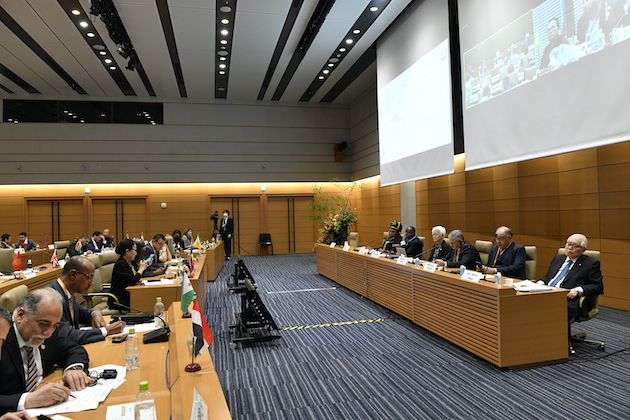
Parliamentarians attending the Global Conference of Parliamentarians on Population and Development Toward the 2023 G7 Hiroshima Summit. Credit: APDA
By Cecilia Russell JOHANNESBURG, May 9 2023 (IPS)
Parliamentarians from more than 30 countries agreed to send a strong message to the G7 Hiroshima Summit in Japan later this year, focusing on human security and support of vulnerable communities, including women, girls, youth, aging people, migrants, and indigenous people, among others.
The wide-ranging declaration also called on governments to support active political and economic participation for women and girls, enhancing and implementing legislation that addresses gender-based violence (GBV) and eradicating harmful practices like child, early, and forced marriages. During discussions and in the declaration, a clear message emerged that budgetary requirements for Universal Health Care (UHC) should be prioritized and the exceptional work done by health workers during the pandemic be recognized.
In his keynote address, Japan’s Prime Minister Kishida Fumio reminded delegates that Covid-19 had exposed the “fragility of the global health architecture and underscored the need for UHC.”
Kishida said that the central vision of the G7 Hiroshima Summit was to emphasize the importance of addressing human security – through building global health architecture, including the “governance for prevention, preparedness, and response to public health crises, including finance. We believe it is important for the G7 to actively and constructively contribute to efforts to improve international governance, secure sustainable financing and strengthen international norms.”
Apart from contributing to resilient, equitable, and sustainable UHC, health innovation was needed to promote a “more effective global ecosystem to enable rapid research and development and equitable access to infectious disease crisis medicines … and to support aging society,” Kishida said.
Former Prime Minister of Japan Fukuda Yasuo, Chair of APDA, and Honorary Chair of JPFP said this conference and its declaration would follow in a tradition of delivering strong messages to the G7 that improving reproductive health was crucial to the development and the future of a planet which now had 8 million people living on it.
“International Community is becoming increasingly confrontational and divided, and there is the emergence of a national leader who is threatening the use of nuclear weapons. No nuclear weapons have been used in the nearly 80 years since Hiroshima and Nagasaki. We must work together to prevent the use of nuclear weapons, which can take many precious lives and people’s daily lives. In this instance, I would like you to search for the path toward appeasement and not division. We must keep all channels of dialogue open so as to ease tension,” Fukuda asked of the conference.
While calling on parliamentarians to work together to address challenges, Fukuda also expressed concern about the widening inequities caused by Covid-19 and climate change and noted: “This network of parliamentarians on population and development has been a vital resource for parliamentarians who share the same concern for not only their own countries but for the entire planet and future generations.”
Kamikawa Yoko, MP Japan, Chair of JPFP, said that with a world population of 8 billion, it was essential to “realize a society where no one is left behind … and Japan would share its experiences of being on the frontlines of an aging society with declining birth rates. “We are living in an aging society … and given these challenges in Japan, we will try to share with you our experience and lessons through our diplomacy while trying to deepen our discussions and exchanges to seek solutions.”
Japan’s Foreign Affairs Minister Hayashi Yoshimasa said it was essential for all to cooperate during the “Anthropocene era, when human activities have promised to have a major impact on the global environment, global issues that transcend national borders, such as climate change, and the spread of infectious diseases, including Covid-19 are becoming more and more prevalent.”
He reminded the delegates that at the center of Japan’s economic growth post World War II was mainly through health promotion and employment policies.
Delegates of the Global Conference of Parliamentarians on Population and Development Toward the 2023 G7 Hiroshima Summit agreed to send a strong message on human security to the Summit. Credit: APDA
Director of the Division for Communications and Strategic Partnerships of UNFPA, Ian McFarlane, said it was not about the “numbers of people but the rights of the people that matter. It’s not about whether we are too many or too few, but whether women and girls can decide if, when, and how many children to have.”
A recent UNFPA report indicated that nearly half of the women across the globe could not exercise their rights and choices, their bodily autonomy, and expressed hope that policies in the future continue to focus on humanity and universal human rights.
Despite being close to the 30th anniversary of the International Conference on Population and Development (ICPD), the conference heard that much still needed to be done regarding women’s rights.
New Zealand MP and co-chair of AFPPD Standing Committee on Gender Equality and Women Empowerment, Angela Warren-Clark, reminded the audience that women still only held 26 percent of parliamentarian seats globally. While women make up 70 percent of the workforce in the health sector, only 25 percent have senior leadership positions.
“It is women in this pandemic who bore the increased burden of unpaid work at home as schools were closed, and it is girls and the poorest families who were taken out of school and forced into early marriages … We believe that if women had an equal say in decision-making during the pandemic, some of these mistakes would have been avoided.”
Baroness Elizabeth Barker, MP from the United Kingdom, told parliamentarians their role was to ensure that “no person on earth, from the head of G7 country to a poor person in a village, can say that they do not know what gender equality is. And they do not know what gender violence is.”
Barker suggested they use international standards, like the Istanbul Convention on Violence Against Women, to compare countries. “And you know that if your country doesn’t come out very well, they really don’t like it.”
She pointed to two successes in the UK, including stopping virginity testing and tackling the practice of forced marriages. She also warned the delegates that there was a right-wing campaign aimed at destroying human rights gained, and they chose different battlegrounds. The overturning of abortion rights in the United States in the Roe vs. Wade case was an example, as was the anti-LGBTQ legislation in Uganda.
Hassan Omar, MP from Djibouti, gave a host of achievements in his country, including ensuring that women occupy 25 percent roles in politics and the state administration and the growing literacy of women numbers in his country.
Risa Hontiveros, MP Philippines, painted a bleak picture of the impact of Covid in her country.
Hontiveros said GBV increased during Covid and extended to the digital space.
“The Internet has become a breeding ground for predators and cyber criminals to prey on children, especially young women, and girls. The online sexual abuse and exploitation of children … has become so prevalent in the Philippines that we have been tagged as the global hotspot.”
In a desperate attempt to provide for their families, even parents produced “exploitative material of their own children and sold them online to pedophiles abroad.”
To address these, she filed a gender-responsive and inclusive Emergency Management Act bill, which seeks to address the gender-differentiated needs of women and girls, because they were “disproportionately affected in times of emergencies.”
Former MP from Afghanistan Khadija Elham’s testimony united many in the conference and even resulted in proposals from the floor to include a condemnation of the Taliban’s women’s policies.
Elham said GBV had increased since the Taliban took over – women were forced to wear a burqa in public, they were not allowed to work, and those who wish to “learn science or (get an) education are forced to continue their studies and hidden places like basements.”
If their secret schools are exposed, they face torture and imprisonment. During the last two months, 260 people, including 50 women, were publicly whipped – a clear violation of their human rights. Women’s representation in political life has been banned, and women are no longer allowed to work in NGOs – and it has been “550 days since women could attend high schools and universities.”
She called on the international community, the United Nations, to pressure the Taliban to restore women’s work and education rights.
Nakayama Maho, Director of the Peacebuilding Program at the Sasakawa Peace Foundation, announced new research on factors contributing to men’s propensity to GBV. The research found that the higher a man’s educational attainment, the lower the level of violence. There were also lower levels of violence with “positive” masculinity – such as a man being employed, married, and capable of protecting his family. Men who experienced violence during times of conflict tended to support violence to instill discipline, or protect women and communities.
Dr Roopa Dhatt, Executive Director of Women in Global Health, summed up this critical session by saying, “Equal leadership for women in all fields is a game changer, particularly in politics and health.”
Japan’s Health, Labour and Welfare Minister, Kato Katsunobu, noted during his closing address that the G7 countries “share the recognition that investment in people is not an expense, but an investment… and as you invest in people you can create a virtuous cycle between workers well-being and social and economic activities.”
He said Japan had a lot to offer concerning aging populations.
“Japan has been promoting the establishment of a comprehensive community-based care system so that people can continue to live in their own way in their own neighborhood until the end of their lives and is in the position to provide knowledge to the G7 countries and other countries who will be facing (an aging population) in the future.”
Dr Alvaro Bermejo, Director-General of IPPF, commended the conference and said he was “thankful” that the conference declaration would tell G7 governments to set an example. “Marginalized and excluded populations are at the heart of human security and can only be achieved in solidarity, and that message from this conference is clear.”
Professor Takemi Keizo, MP Japan, Chair of AFPPD, summed up the proceeding by saying that parliamentarians as representatives of the electorate were vital to creating a “positive momentum in this global community and overcoming so many difficult issues.”
Takemi elaborated on some issues facing the world now, including climate change and military conflicts, but as parliamentarians, there was the opportunity to “build up the new basis of the global governance, which can be very beneficial.”
NOTE: Global Conference of Parliamentarians on Population and Development Toward the 2023 G7 Hiroshima Summit was organized by the Asian Population and Development Association (APDA), the Asian Forum of Parliamentarians on Population and Development (AFPPD), and the Japan Parliamentarians Federation for Population (JPFP).
It was supported by the Ministry of Foreign Affairs of Japan (MOFA), United Nations Population Fund (UNFPA), Japan Trust Fund (JTF), and Keidanren-Japan Business Federation in cooperation with the International Planned Parenthood Federation (IPPF).