Multi-Faith Team Urges Repeal of Blasphemy Laws– in the Name of Religious Freedom

Civil Society, Crime & Justice, Featured, Global, Headlines, IPS UN: Inside the Glasshouse, TerraViva United Nations

Opinion

Independent UN human rights experts condemned the death sentence of a university lecturer charged with blasphemy in Pakistan, calling the ruling “a travesty of justice”. December 2019. Credit: UNICEF/Josh Estey

NEW YORK, Sep 12 2022 (IPS) – In nations lacking certain religious freedoms, the bold multi-faith membership of the International Religious Freedom Roundtable’s Campaign to Eliminate Apostasy and Blasphemy Laws, would be forbidden.


This archaic, and at times, violent fact is driving a biblical justice authority, an international activist and a team of culturally and religiously diverse advocates to raise their voices with member states, just before world leaders arrive for the high-level segment of the 77th UN General Assembly session which commences in New York City September 20.

The trip will highlight the twelve nations currently imposing the death penalty for apostasy and blasphemy charges, calling for its immediate repeal.

Freedom of religion or belief is universally regarded as fundamental human right and is protected by international covenants and national constitutions alike.

However, courts continue to mete out unjustifiably long prison sentences and even death sentences to individuals for non-violent, victimless conduct such as committing blasphemy or apostasy.

Recently, Nigerian humanist Mubarak Bala was sentenced to an unimaginable 24 years’ imprisonment for an allegedly blasphemous Facebook post he made expressing his disbelief in an afterlife.

Though the death penalty is not actually imposed upon a convicted individual in a vast majority of cases, the sentence itself relegates convicts to years and decades of prolonged imprisonment on death row, denial of medical care while in prison, withholding of legal counsel, and endless interrogation.
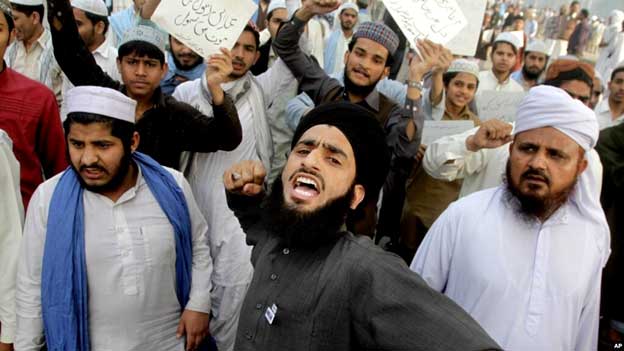
Pakistanis rally in support of Mumtaz Qadri who was convicted and executed for a blasphemy-motivated killing of a former governor, in Lahore, Pakistan, Feb. 2016. Credit: Voice of America

Previously, Asia Bibi, a Pakistani woman, languished on death row for eight years on charges of blasphemy simply for drinking water from a canteen while picking berries with a group of Muslim women.

After her release and acquittal in 2019, Asia was forced to flee her home country in fear of reprisal attacks by radical Islamists.

In 2014, a pregnant Sudanese woman Mariam Ibrahim – who was imprisoned on apostasy charges for her marriage to a Christian man, and as a woman born to a Muslim father – was forced to give birth to her second child while her legs remained shackled to the cell floor.

As a Christ follower, I am reminded of times when God revealed his heart for justice through stories like that of Esther, whom was strengthened to boldly intercede for an oppressed group of religious minorities.

The time is now for United Nations Member States to do the same, through their set own of convictions, in an effort to create communities of human flourishing and safety for those who are persecuted for freedom of religion or belief.

Speaking on Islam’s position on blasphemy, there is much evidence that Prophet Muhammad pardoned his worst critics. Blasphemy laws and inhumane punishments for blasphemy have no legitimacy in the Quran.

The Quran does not command Muslims to kill blasphemers.
Surah (verse) 4:140 of the Quran states – “If you hear people denying and ridiculing God’s revelation, do not sit with them unless they start to talk of other things…”

There is no reference to killing and or issuing fatwas.

Even where moratoriums on the death penalty exist, faith minorities and individuals who express views and perspectives deviating from those prescribed by the majority religion can be in tremendous danger.

Mauritania, which has upheld a moratorium on the death sentence since 1987, convicted blogger Mohamed Cheikh Ould Mkhaitir of apostasy and sentenced him to death as recently as 2014 for an article he wrote criticizing the use of Islam to justify the caste system in his country. Fortunately, Mkhaitir was released from prison in 2019.

In Pakistan, where the death sentence is often issued to perceived blasphemers – most often Christian and Ahmadi Muslim minorities – but not carried out– laws criminalizing apostasy and blasphemy embolden state and non-state actors alike to commit acts of violence against innocent civilians.

In July 2021, a police constable slashed and killed a man named Muhammad Waqas who had been previously acquitted of blasphemy charges; the perpetrator explicitly stated perceived blasphemy as the crimes’ impetus.

A few months later, in December 2021, a Sri Lankan national Priyantha Kumara was lynched by a mob and had his body burned by an angry mob in the Pakistani city of Sialkot.

Kumara was a garment factory manager who had been accused of committing blasphemy after removing an Islamic poster from the factory’s walls to prepare for a renovation project.

These non-state actors, fortified by lackluster laws, pose a serious obstacle to human rights, free speech and dignity, creating a system where sometimes even state supported religious leaders call for the death penalty and other inhumane punishments.

A more recent and equally horrific incident occurred in Sokoto Nigeria, when young Christian college student Deborah Samuel Yakubu was stoned to death and set on fire by her very own Muslim classmates.

Days prior, Yakubu had angered the perpetrators by questioning why her school course’s WhatsApp chat was being used to discuss contentious religious affairs rather than focusing on academic issues.

Currently, twelve nations that maintain the death penalty for apostasy, blasphemy, or both; these include Afghanistan, Brunei, Iran, Maldives, Mauritania, Nigeria, Pakistan, Qatar, Saudi Arabia, Somalia, United Arab Emirates, and Yemen. * [New Penal Code implemented in 2022 in UAE removes hudud punishments – including apostasy from the penal code]

Additionally, approximately 40% of UN Member States – some of them holding seats in the Human Rights Council – criminalize apostasy and blasphemy, despite their lack of the death sentence for such ‘crimes’.

However, it is not without criticism and attention by human rights and religious freedom activists and even representatives of the United Nations who have emphasized the inhumanity of apostasy and blasphemy laws and called for their repeal.

This includes the UN General Assembly, the UN Secretary-General, the UN High Commissioner for Human Rights, the Human Rights Council, and the Special Rapporteurs on freedom of religion or belief, and on extrajudicial killings, respectively.

Now, civil society is taking matters into its own hands.

Efforts to work toward the abolition of the death penalty for apostasy and blasphemy have been a bottom-up grassroots approach. Next week, a delegation of human rights and religious freedom advocates will travel to the United Nations to meet with representatives from the missions of numerous UN Member States, including Luxembourg, Canada, Nigeria, Sri Lanka, Niger, and Australia.

Their goal is to increase support among UN Member States for the insertion of language in the UNGA Resolution on Extrajudicial, summary or arbitrary executions stating that “the death penalty should never be imposed as a sanction for apostasy, blasphemy, or other perceived religious offense.

As a capstone to the multifaith, multicultural and multidisciplinary United Nations advocacy fly-in, the group will host an issue briefing pointing to the critical proposed resolution language, calling for the immediate repeal of the death penalty for apostasy and blasphemy charges.

The briefing, which is open to the press, will spotlight survivors in their own voice. The development of pluralistic resilient communities which uphold basic human rights and allow for human flourishing amongst inevitable interdependent globalized societies depend on the undaunted actions those in power.

We call upon all Member States to join us in this fight toward international religious freedom by supporting the IRF Campaign’s resolution language today.” More info here.

Dr. Christine M. Sequenzia, MDiv. is Co-Chair, International Religious Freedom Roundtable Campaign to Eliminate Blasphemy and Apostasy Laws

Soraya Marikar Deen, is a Lawyer, Community Organizer, International Activist; HumanRights & Gender Equity Advocate. She is also Co-chair Women’s Working Group @ Int. Religious Freedom Roundtable and Founder MuslimWomenSpeakers

IPS UN Bureau

  Source

The uncomfortable lessons of the new Fourth Plinth statues Arts feature

The Revd John Chilembwe – whose statue will adorn Trafalgar Square from next Wednesday – is notorious for the church service he conducted beneath the severed head of William Jervis Livingstone, a Scottish plantation manager with a reputation for mistreating his workers. The night before, Chilembwe’s followers had broken into his house and chased him from room to room as he tried to fend them off with an unloaded rifle. Eventually, they pinned him down and decapitated him in front of his wife and children. It was the most significant action in the 1915 Chilembwe rebellion, a small, short-lived affair in an obscure corner of the British Empire today known as Malawi.

It says a lot about our times that a figure with Chilembwe’s record should be vaunted with a public statue. The Fourth Plinth Commission announced the decision in July last year, when dispute about statues was intense. The summer before, Black Lives Matter riots had erupted in Britain. Edward Colston was torn down, Gandhi and Churchill were daubed with graffiti. The Chilembwe statue was chosen to shine ‘a spotlight on important issues that our society continues to face’, said Sadiq Khan. In other words, it was a deliberate salvo in the already heated culture wars. But Chilembwe’s real story is an ambiguous one, and I wonder if the Fourth Plinth Commission has got more than it bargained for with this particular contribution to the vexed debate about our past.

The installation is actually a pair of statues: the second figure is John Chorley, an otherwise unremarkable English missionary who was Chilembwe’s friend. An iconic photograph exists of the two men standing together, and it is on this that the statues are based. The artist, Samson Kambalu – a Malawian professor of fine art at Oxford – has cast Chorley much smaller, to diminish him and exalt Chilembwe. Nevertheless, what is astonishing is that Chorley should be there at all: a white missionary to Africa is hardly a common subject for public statuary in the age of identity politics.

‘We have to start putting detail to the black experience… to the African experience, to the post-colonial experience,’ Kambalu has rightly said. And to that end, the story of Malawi is especially useful because it encapsulates so much of Britain’s imperial record in Africa. But it comes with a trigger warning: this is not a straightforward tale of black and white, good and evil. The detail is complicated, and sometimes uncomfortable.

Why is Chorley on the plinth with Chilembwe? Ultimately because British missionaries were essential in the formation of modern Malawi. Before their arrival, it was the land that fed the vast Indian Ocean slave trade, whose largest market was in Zanzibar. For centuries, the Arabs and their indigenous, Islamised accomplices had been capturing and trading slaves in incalculable numbers. David Livingstone called it ‘the open sore of the world’. The issue obsessed him and, in response, he stirred up one of the greatest moral crusades of modern times.

From the 1850s onwards, thousands of young men answered Livingstone’s call, and volunteered for missionary service in Central Africa. In the early years, they died in droves, mostly of disease, their graves scattered throughout the region, and still venerated today. But their sacrifice was matched by their achievement. The societies they encountered were near disintegration thanks to slave raids, war and the ensuing disorder and famine. When the missionaries proposed peace and goodwill to all men, their message was widely welcomed.

Of course the slavers resisted, and an early attempt at armed confrontation ended in disaster. Thereafter, the missionaries operated mainly just through a heroic appeal to better nature. Only a handful of slaver strongholds were subdued by force after the British government had reluctantly established a protectorate in 1891. Otherwise, it is striking how peacefully slavery was extirpated from Malawi. The missionaries then established schools and colleges of towering academic ambition, which quickly produced the first crop of campaigners for independence.

The flip side to missionary endeavour was the colonisation that quickly followed. White settlers and entrepreneurs never came in large numbers as in Kenya or Rhodesia, but the society they created was nonetheless like those that existed throughout the Empire: capable of cruel exploitation, and always permeated with racial injustice. It was against this that Chilembwe reacted with violence.

Born in the 1870s, his mother seems to have been a slave, his father her captor. As a young man, Chilembwe became the servant of an unsuccessful, itinerant English missionary called Joseph Booth, who was to prove the major influence of his life. Booth was a born-again Christian, a socialist, and a fervent critic of colonialism. He was also an enthusiast of an evangelical American cult that believed Christ had returned to Earth a few years earlier and was biding his time until the Battle of Armageddon, scheduled for 1915.

In 1897, Booth took Chilembwe to the United States on a fund-raising tour. The pair were fêted by black American churches, and Chilembwe was sponsored to enrol at a Baptist seminary in Virginia. Two years later, he returned to Malawi as a pastor and founded his own mission. At first he prospered, but his radicalism – acquired from Booth and from America – put him at odds with colonial society, which regarded him with suspicion and disdain. He quarrelled with his white neighbours and denounced them and the government in his sermons. This was grudgingly tolerated until the Germans invaded the colony in 1914, and Chilembwe wrote to a local newspaper objecting to Africans fighting in a war that did not concern them. In response, the authorities decided to deport him. His health and business ventures had been deteriorating for some time. It was also 1915: the year appointed for apocalypse. In what seems to have been a knowingly reckless decision, Chilembwe incited his congregation to rebellion.

Besides the infamous decapitation, the rebels attacked another plantation manager and a business in the town of Blantyre. But far from rising in support, the local population responded with bewilderment and, later, even hostility. A further attack was attempted on a nearby mission station, with whose leaders Chilembwe had long feuded. But the rebels found the place already evacuated, apart from one sick child too unwell to leave, and a missionary who had stayed behind to look after her. The rebels tried to stab him to death, though he later recovered from his wounds.

Everything then petered out as government forces ruthlessly took control of the situation. In the aftermath, 36 of the rebels were sentenced to death, 300 imprisoned. Chilembwe fled into the forest where he was hunted down and shot dead by askaris. His final act had been to write to the Germans seeking alliance. Though the message failed to reach them in time, it was an unedifying gesture. Just a few years before, Germany had suppressed a rebellion in its immense colony to the north by massacring up to 300,000 people.

So why should Chilembwe be celebrated at all? It would, from one angle, be easy to condemn him as a murderous lunatic of little real consequence. And yet there is a poignancy to his example. ‘We will all die by the heavy blow of the whiteman’s army,’ he is reported to have said on the eve of the uprising. ‘The whitemen will think, after we are dead, that the treatment they are treating our people is bad, and they might change to the better for our people.’ In these words, there is dignity of purpose as well as real foresight by which it is difficult not to be moved. Chilembwe bequeathed an example of defiance, courage and sacrifice. The next generation took inspiration from this, though they chose mostly peaceful means in their pursuit of independence. When this was granted in 1964, one of Chilembwe’s own children was still alive to see it.

When you examine the detail, you can ignore neither the injustice nor the beneficence of Empire: both are essential to the story of Malawi. If we celebrate Chilembwe as a hero, there are many others we should also acknowledge, especially the British missionaries: ‘Men good and brave who, to advance knowledge, set free the slave, and hasten Christ’s kingdom in Africa, loved not their lives even unto death’ – to quote the plaque that commemorates them in Zanzibar’s Anglican cathedral.

It is these contradictions that Kambalu captures so admirably, and without rancour, in his pair of statues. Our sententious age needs urgently to be reminded that history is complicated, and the figures who have shaped it are seldom unproblematic. In atonement for his faults, perhaps Chilembwe can now teach us to learn from statues, rather than topple them. Let the Fourth Plinth be his cenotaph, and a place for us all to make peace with our past.

Samson Kambalu’s Fourth Plinth commission, ‘Antelope’, will be unveiled on 14 September. Alexander Chula’s book, Goodbye, Dr Banda, on Malawi and the West, will be published by Polygon in March 2023.

Source

The 101 Best Movies on Netflix Right Now

To help you make your next streaming selection at home, we’ve rounded up the best movies on Netflix.

For this list, all feature films are fair game. Here there are classic dramas and comedies; powerful small-budget fare you’ve probably never heard of; kids’ movies; lots of scary horror, pulse-pounding action flicks and thrillers; illuminating documentaries—there’s a lot of sexy stuff, guilty pleasures, some foreign-language offerings, and so much more. We’ve included Netflix original films, and the movies they’ve acquired.

Recommended for you

Rookie Spencer Strider pitched eight scoreless innings and set a franchise record for a nine-inning game with 16 strikeouts as the Atlanta Braves beat the visiting Colorado Rockies 3-0 on Thursday. Click for more.

Source

Racism Hurts People and Democracy in Peru

Civil Society, Democracy, Editors’ Choice, Featured, Headlines, Human Rights, Indigenous Rights, TerraViva United Nations

Human Rights

A family from Sachac, a Quechua farming community in the Andes highlands region of Cuzco in southeastern Peru, where Quechua is still the predominant language and where ancestral customs are preserved. When members of these native families move to the cities, they face different forms of racism, despite the fact that 60 percent of the Peruvian population identifies as ‘mestizo’ or mixed-race and 25 percent as a member of an indigenous people. CREDIT: Mariela Jara/IPS

A family from Sachac, a Quechua farming community in the Andes highlands region of Cuzco in southeastern Peru, where Quechua is still the predominant language and where ancestral customs are preserved. When members of these native families move to the cities, they face different forms of racism, despite the fact that 60 percent of the Peruvian population identifies as ‘mestizo’ or mixed-race and 25 percent as a member of an indigenous people. CREDIT: Mariela Jara/IPS

LIMA, Sep 1 2022 (IPS) – Banning the use of the same bathroom, insults and calling people animals are just a few of the daily forms of racism experienced by people in Peru, a multicultural, multiethnic and multilingual country where various forms of discrimination are intertwined.


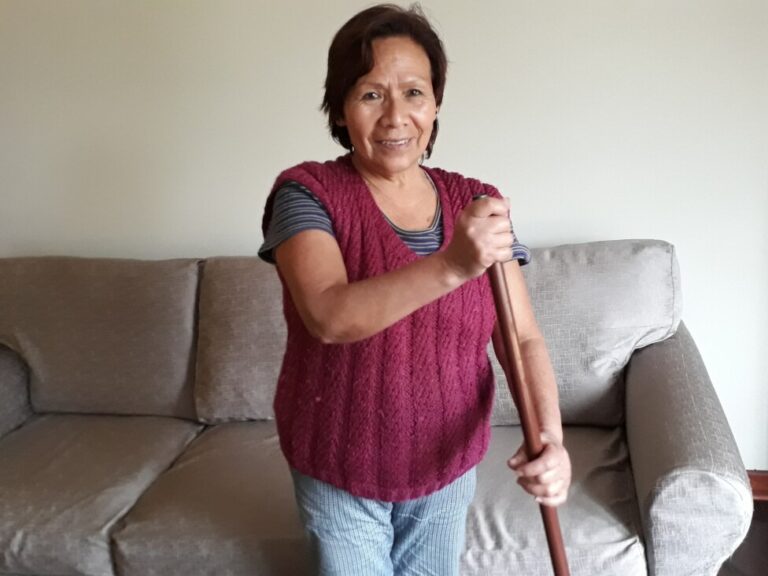
“In the houses where I have worked, they have always told me: ‘Teresa, this is the service bathroom, the one you have to use,’ as if they were disgusted that I might use their toilets,” Teresa Mestanza, 56, who has worked as a domestic in Lima since she was a teenager, told IPS.

She was born in a coastal town in the northern department of Lambayeque, where her parents moved from the impoverished neighboring region of Cajamarca, the homeland of current President Pedro Castillo, a rural teacher and trade unionist with indigenous features.

With Quechua indigenous roots, she considers herself to be “mestiza” or mixed-race and believes that her employers treat her differently, making her feel inferior because of the color of her skin.

Sixty percent of the population of this South American country of 33 million people describe themselves as “mestizo”, according to the 2017 National Census, the last one carried out in Peru.

For the first time, the census included questions on ethnic self-identification to provide official data on the indigenous and Afro-Peruvian population in order to develop public policies aimed at closing the inequality gap that affects their rights.

A study by the Economic Commission for Latin America and the Caribbean (ECLAC) ranks Peru as the country with the third largest indigenous population in the region, after Bolivia and Guatemala.

Teresa Mestanza has experienced discriminatory, if not outright humiliating, treatment because of the color of her skin, as a domestic worker in Lima since she arrived as a teenager from a Quechua community in northern coastal Peru. She defines herself as ‘mestiza’ or mixed-race and believes that this is the reason why some of her employers try to "make me feel less of a person." CREDIT: Mariela Jara/IPS

Teresa Mestanza has experienced discriminatory, if not outright humiliating, treatment because of the color of her skin, as a domestic worker in Lima since she arrived as a teenager from a Quechua community in northern coastal Peru. She defines herself as ‘mestiza’ or mixed-race and believes that this is the reason why some of her employers try to “make me feel less of a person.” CREDIT: Mariela Jara/IPS

Before the invasion by the Spaniards, several native peoples lived in what is now Peru, where the Tahuantinsuyo, the great Inca empire, emerged. At present, there are officially 55 different indigenous peoples, 51 from the Amazon rainforest region and four from the Andes highlands, which preserve their own languages, identities, customs and forms of social organization.

According to the census, a quarter of the population self-identified as indigenous: 22 percent Quechua, two percent Aymara and one percent Amazonian indigenous, while four percent self-identified as Afro-descendant or black.

During the Spanish colonial period, slaves were brought from Africa to do hard labor or work in domestic service. It was not until three decades after independence was declared that the country abolished slavery, in 1854.

Indigenous and Afro-Peruvian populations are historically discriminated against in Peru, in a country with traditionally highly segmented classes. Their needs and demands have not been met by the State despite legal frameworks that seek to guarantee equality and non-discrimination and specific rights for indigenous peoples.

This situation is reflected on a daily level in routine racism, a problem recognized by more than half of the population (52 percent) but assumed as such by only eight percent, according to a national survey conducted by the Ministry of Culture in 2018.

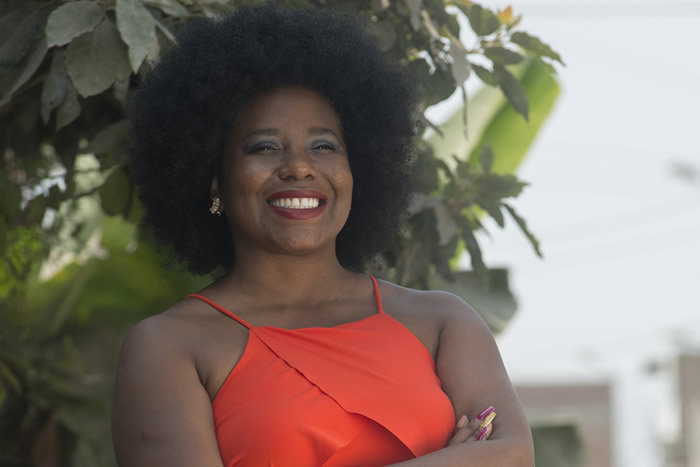
Sofia Carrillo is a journalist, activist and anti-racist feminist and Afro-Peruvian proud of her roots, who has faced racism since childhood and despite this made Forbes Peru's list of the most influential women in the country this year. CREDIT: Amnesty International

Sofia Carrillo is a journalist, activist and anti-racist feminist and Afro-Peruvian proud of her roots, who has faced racism since childhood and despite this made Forbes Peru’s list of the most influential women in the country this year. CREDIT: Amnesty International

“Racism is hushed up because it hurts less”

A journalist, activist, and radio and television host who was chosen by Forbes Peru magazine as one of the 50 most powerful women in the country this year, Sofia Carrillo is an Afro-Peruvian proud of her roots who has faced many obstacles and “no’s” since childhood.

“It was not seen as possible, for example, for me to be a studious girl because I was of African descent, and black people were not seen as intelligent. And that was represented on television and generated a great sense of rebellion in me,” she told IPS in Lima.

Faced with these messages she had only two options. “Either you believe it or you confront the situation and use it as a possibility to show that it is not true. I shouldn’t have to prove myself more than other people, but in a country as racist and as sexist as this one, that was the challenge I took on and what motivated me throughout all the stages of my life,” she said.

In her home racism was not a taboo subject, and was discussed. But this was not the case in the extended family of cousins and aunts and uncles “because it’s better not to be aware of the situation, so it hurts less; it’s a way to protect yourself,” Carrillo said.

“It is not uncommon for people of African descent to even say that they do not feel affected by racism or discrimination, because we have also been taught this in our families: that it will affect you if you identify it, but if you pretend it does not happen, then it is much easier to deal with,” she said.

Her experience as a black woman has included receiving insults since she was a child and sexual harassment in public spaces, in transportation, on the street, “to be looked at as a sexual object, to be dehumanized,” she said.

She has also had to deal with prejudices about her abilities in the workplace. And although she has never stopped raising her voice in protest, it has affected her.

“Now I can admit that it affected my mental health, it led to periods of deep depression. I did not understand why, what the reasons were, because you also try to hide it, you try to bury it deep inside. But I understood that one way to heal was to talk about my own experiences,” Carrillo said.

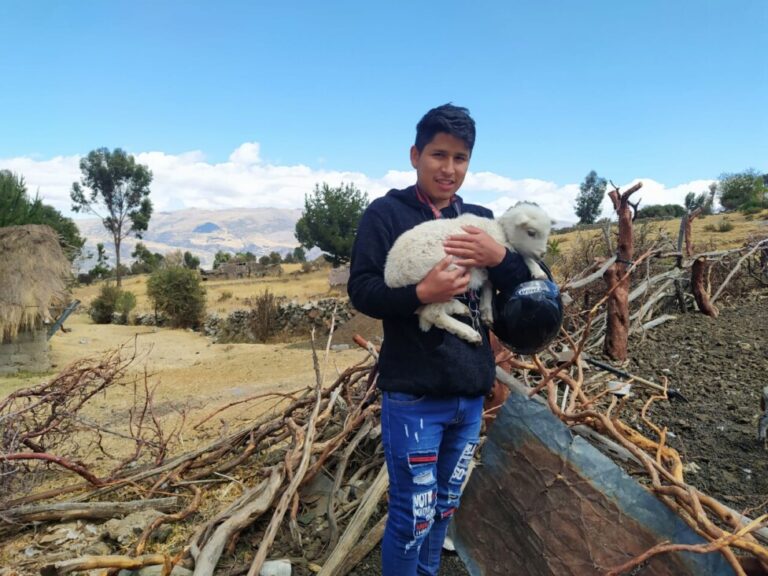
Enrique Anpay is 24 years old and finished his university studies in Lima last year, where he experienced episodes of racism that still hurt him to remember. In the picture he is seen carrying one of his grandmother's lambs in the Quechua farming community of Pomacocha, where he is from, in the central Andean region of Peru. CREDIT: Courtesy of Enrique Anpay

Enrique Anpay is 24 years old and finished his university studies in Lima last year, where he experienced episodes of racism that still hurt him to remember. In the picture he is seen carrying one of his grandmother’s lambs in the Quechua farming community of Pomacocha, where he is from, in the central Andean region of Peru. CREDIT: Courtesy of Enrique Anpay

Racism to the point of calling people animals

Enrique Anpay Laupa, 24, studied psychology at a university in Lima, thanks to the government scholarship program Beca 18, which helps high-achieving students living in poverty or extreme poverty.

Originally from the rural community of Pomacocha, made up of some 90 native Quechua families in the central Andes highlands region of Apurimac, he still finds it difficult to talk about the racism he endured during his time in Lima, until he graduated last year.

He spoke to IPS from the town of Andahuaylas, in Apurímac, where he now lives and practices as a psychologist. “In 2017 we were 200 scholarship holders entering the university, more than other years, and we noticed discomfort among the students from Lima,” he said.

“They said that since we arrived the bathrooms were dirtier, things were getting lost, like laptops…I was quite shocked, it was a question of skin color,” he said.

During a group project, a student from the capital even told him “shut up, llama” when he made a comment. (The llama is a domesticated South American camelid native to the Andes region of Peru.)

“I kept silent and no one else said anything either,” Anpay said. Although he preferred not to go into more details, the experience of what he went through kept him from encouraging his younger brother to apply for Beca 18 and to push him to study instead at the public university in Andahuaylas.

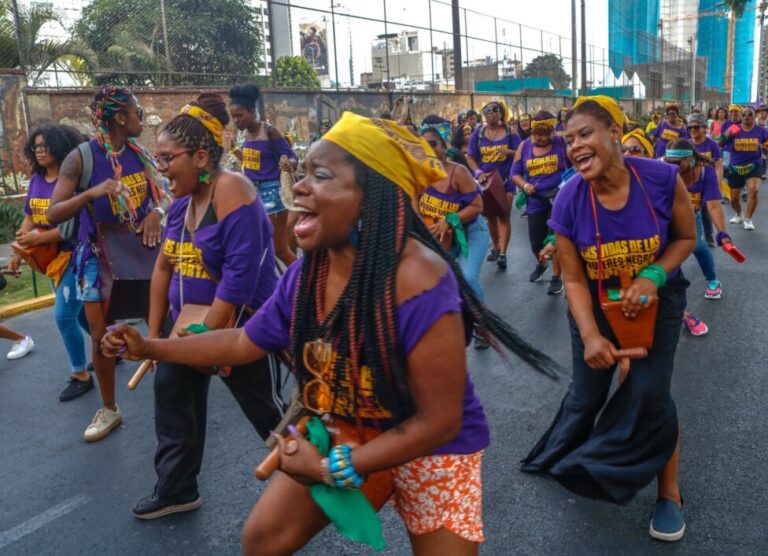
Afro-Peruvian women participate in a festive demonstration demanding respect for their rights, on the streets of Lima on International Women's Day, March 8, 2022. CREDIT: Courtesy of Lupita Sanchez

Afro-Peruvian women participate in a festive demonstration demanding respect for their rights, on the streets of Lima on International Women’s Day, March 8, 2022. CREDIT: Courtesy of Lupita Sanchez

Racism affects the whole country

Racism is felt as a personal experience but affects whole communities and the entire country.

Carrillo said: “We can see this in the levels of impoverishment: the last census, from 2017, indicates that 16 percent of people who self-identify as ‘white’ and ‘mestizo’ live in poverty as opposed to the Afro-Peruvian population, where poverty stands at around 30 percent, the Amazonian indigenous population (40 percent) and the Andean indigenous population (30 percent).”

A study by the National Institute of Statistics and Informatics on the evolution of poverty between 2010 and 2021 showed that it affected to the greatest extent the population who spoke a native mother tongue, i.e. indigenous people.

The percentage of this segment of the population living in poverty and extreme poverty was 32 percent – eight percentage points higher than the 24 percent recorded for the population whose mother tongue is Spanish.

Carrillo considered it essential to recognize the existence of institutional racism, to understand it as a public problem that affects individuals and peoples who have been historically discriminated against and excluded, who have the right to share all spaces and to fully realize themselves, based on the principles of equality and non-discrimination.

She criticized the authorities for thinking about racism only in terms of punitive actions instead of considering a comprehensive policy based on prevention to stop it from being reproduced and handed down from generation to generation, which would include an anti-racist education that values the contribution made by each of the different peoples in the construction of Peru.

  Source

Monster Monsoon: “Pakistan and Its People Are Paying the Costs of What They Are Not Responsible For.”

Aid, Asia-Pacific, Civil Society, Climate Action, Climate Change, Development & Aid, Economy & Trade, Environment, Headlines, Inequality, TerraViva United Nations

Opinion

Credit: Pakistan Development Alliance

ISLAMABAD, Pakistan, Sep 1 2022 (IPS) – Pakistan has been going through the worst time of its recent history due to unprecedented colossal monsoon rains and devastating floods. The current floods would have been expected less than once a century, but climate experts claim that what we are seeing today is just a trailer of what’s in store for us if we don’t pay heed to climate change. More than 112 districts are currently afffected and around 30 million people; their property and land are totally devastated. Across the country, where hundreds of thousands of cattle died due to the Lumpy Skin Disease, now more than 727,000 have perished due to floods and rains. The number is increasing rapidly.


We were in the countryside conducting a study on the rights of women farm workers, when the Monster monsoon hit the country. We had to cut our field mission short and we are now relatively “safe” here in Islamabad, busy organising emergency relief and rescue operations.

Pakistan and its people are paying the costs of what they are not responsible for. For the past 20 years, Pakistan has consistently ranked among the top 10 most vulnerable countries on the Climate Risk Index. We are facing such climate change aggression and devastation while contributing only 0.8% of greenhouse carbon emissions to global warming. We are squeezed, geographically situtated between titans China and India, who are the top two emitters of greenhouse gases. This impacts the glaciers of the Himalaya. In Pakistan, our 7253 glaciers – more glaciers than almost anywhere on Earth – are melting faster than ice-cream in the sun due to climate change. Since the whole country is situated in the downstream of the Hamalaya, heavy floods have become the norm. To this scenario, you need to add flawed developement interventions, absence of rule of law and the lack of policy priorities towards the management of “everyday” disasters. This results in risks being left undone instead of being treated as full-fledged national security emergencies.

Today, the horrific scale of the floods are not in doubt, but the catastrophe is still unfolding. Rehabilitation and reconstruction activities need to be initiated immediately. Pakistan is already facing food insecurity due to this manmade disaster. In the long run, this crisis will increase poverty, inequality and economic instability in the country if we – supported by the world at large – fail to respond quickly.

Being part of a civil society network I see with my own eyes how civil society is vehementally engaged in rescue, relief and emergency activities through local resources and philanthropic initiatives. The international community and INGOs have not yet initiated their field operations. Although the government has officially appealed for the support of the international community and has levereged restrictions, the intensive regulatory frameworks are still working against rights based NGOs.

I have a message for the international community. Please support flood affected communities as early as possible. Local civil society needs to be strengthened and financed as well, as they are on the frontlines, they are the first reaching affected communities. In the future, there needs to be serious investments on addressing the impacts of climate change, particularly in vulnerable countries such as Pakistan, where climate change adaptation mechanism and infrastructure support should be mainstreamed. Now they are at the periphery, and it shows.

IPS UN Bureau

  Source

Governance systems can aid seamless leadership transitions

KENYA-AFRICA

Moments of leadership transition reveal much about the governance systems and processes in an organisation. The more robust the institutional arrangements are, the more seamless the transition. Since leadership is custodial and not permanent, effective transitions also entail learning from those you are replacing and sharing insights when you are replaced.

Leaving an institution and a place where one has spent several years is always bittersweet. Whatever challenges one faces, one develops the beguiling comforts of familiarity. In my case, as I shared in the previous reflection, I also experienced the complex joys of leadership that left me with a certain wistfulness as I prepared for departure from the United States International University Africa (USIU-Africa) back to the US.

The ambiguous comforts of home

During my vice-chancellorship my wife and I simultaneously felt both at home and away from home, suspended in an ambiguous existential space that was mutually empowering and discordant.

We represented two faces of the African diaspora. As an African American, it was the first time my wife’s Blackness was valorised. As a member of the new diaspora, I relished the inconsequentiality of my Blackness. Both of us felt temporarily liberated from the persistent assaults of racism in the US. But we were always reminded of our foreignness, respectfully for her and grudgingly for me.

One of the things we missed most was the social conviviality with friends and work colleagues that we had previously enjoyed abundantly in all the cities we lived prior to moving to Nairobi.

Of course, in my official capacity as vice-chancellor (VC) I interacted with hundreds of people – state officials, corporate executives, higher education personnel, and ordinary people on campus, at their premises, and other venues. In the first few years, we eagerly hosted social events at our home or at restaurants, as we were used to, but they were rarely reciprocated.

Over the six years there, we never visited the homes of any of our university colleagues. Only one member each of the Board of Trustees and University Council and the chancellor invited us to their homes. Among fellow university leaders, we went for dinner once to the house of another vice-chancellor who was himself a foreigner.

Talking to other African expatriates, we realised this was their experience as well. So, we mostly spent our free time by ourselves. Every opportunity we had we scoured Kenya’s legendary tourist sites from the beautiful resorts in Naivasha and Mombasa to the breathtaking national game parks of Maasai Mara, Tsavo, and Nairobi itself. We savoured going for dinners and weekend brunches at the city’s fine restaurants.

Occasionally, before the pandemic, we would be accompanied by periodic visitors from Southern Africa, North America, Europe, and Asia. A glaring absence was our daughter, Natasha Thandile, who never visited.

The beauty of being in Nairobi is its accessibility as a regional hub. We took full advantage and jetted, whenever an opportunity arose, to Kampala in Uganda, Kigali in Rwanda, and Zanzibar and Dar es Salaam in Tanzania, and even more frequently to my native homeland, Malawi, as well as Botswana and South Africa, where I also have family and many friends.

We spent the Christmas holidays in the US, except in 2019 when we went to Malawi. It was magical, largely because my son, Mwai, got engaged to a wonderful woman, Sylvia. That was the last time I saw my son.

The Annus Horribilis of 2021

Besides the pressures of managing the pandemic with my colleagues, 2021 was personally a difficult year. In mid-January we lost Mwai to the pandemic. It was one of the most devastating events of my life.

The pain was indescribable, worsened by the fact that due to COVID-19 protocols in Malawi at the time, where he died while on vacation from his job in Mozambique, burial of COVID-19 fatalities had to be conducted within 24 hours and there was no way my wife and I could attend the funeral. We watched it on video, in the cruellest send-off to the unfathomable beyond.

Natasha, isolated in Atlanta, was distraught beyond words at losing her big brother. We tried our best to comfort her, commiserate with her, and be there for her.

We couldn’t wait to re-join and live closer to Natasha and my wife’s family. A decision we had made six years earlier to serve one term suddenly acquired an uncanny prescience. The eager anticipation of reuniting with family and old friends gave us a semblance of solace in the suffocating cloistered life of the pandemic.

After a week’s bereavement leave, my work as vice-chancellor resumed at its unrelenting pace. As management we primarily focused on handling the grim ramifications of the pandemic. As I noted in a previous reflection, except for a few recalcitrants who sought to use the crisis for their own pre-existing sectarian and selfish ends, the university community rallied together – faculty taught, students attended classes, and staff discharged their administrative duties.

The management continued to work well as a team, drawing on the university’s existing business continuity plan and iterative crisis management strategies developed during the pandemic, derived from exhaustive internal analyses and external benchmarking with universities in Kenya, across Africa, in the United States, and elsewhere.

Such are the infinite mysteries of life that even in excruciating times, there are currents of personal and professional uplift. For me, these included the launch of my book, Africa and the Disruptions of the Twenty-First Century, on 25 March 2021, mostly written in 2020 during the pandemic.

Most gratifying was teaching my last class in the 2021 spring semester, which made me appreciate what faculty and students were going through during the pandemic. A particularly joyous occasion was the ceremony marking the donation of my personal library and archives to the university.

In addition, my family planned to set up an endowed scholarship fund in memory of my son. I asked the relevant manager to give me an estimate for 12 scholarships. We intended to fund two students from each of Africa’s five internal regions and the sixth diaspora region. I never got the estimates despite repeated requests.

It was a disappointing reminder of the underdevelopment of fundraising in African higher education that I discussed in an earlier reflection, which I worked hard to change at USIU-Africa.

For more than two years after our director of advancement left, we failed to hire a replacement because of the dearth of university development talent in the local market and lack of resources to recruit internationally. So overwhelming was the success in securing the unprecedentedly large scholarship and e-learning grants from the Mastercard Foundation, which I actively cultivated, that other opportunities were not pursued.

Still, there were more slices of professional joy. One was completing the strategic plan for 2020-25, which was approved, in fall 2021. Another was overseeing the completion of a new building for the School of the Humanities and Social Sciences, the largest construction project in the university’s history. I was also delighted to sign an MOU with a private property developer securing 1200 beds for student accommodation.

Preparing for departure

On my last day before taking my long-delayed leave pending the end of my contract in December 2021, I conducted an interview with the Sunday Standard. The journalist wrote: “When he walks you through the campus, one gets the sense of great achievement from a man proud of what he has done. But still, one gets a sense of a man who still has a lot of ideas for the institution.

Given the chance, would he stay on longer?

‘No. When I took the job my wife and I agreed that I will only do one term as the vice-chancellor, so I would like to keep my word,’ he says.

‘Plus, I think I have done all I could do. I do not want to overstay in this position of authority like so many of our presidents and corporate bosses. Sometimes you have to pass on the baton to the future generations.’”

I concluded that I had a life before I became a VC, and I would have a life afterwards. I didn’t believe in leadership that lasts decades depriving institutions of the oxygen of periodic renewal.

Besides, it’s good to leave when you still have the energy and inclination to do something else, to reinvent yourself. Thus, I looked forward to the next phase of my personal and professional life.

Neither in that interview nor in conversations with university colleagues did I let on that I had already informed the chairs of the board and council and the chancellor of my decision to leave at the end of my contract.

I wrote them on 1 November 2020, 14 months ahead of time. Although the contract did not require such a long advance notice, I thought it essential to give the university enough time to recruit my successor.

In the letter I reassured them that I would dedicate my last year meeting institutional priorities and navigating the ramifications of the COVID-19 pandemic.

I would always cherish my experiences at the university, the opportunity to return to Kenya and the continent after spending 25 years in Canada and the UE. I shared with them how I found the energies, vibrancy, demands, and aspirations of the youth, who comprise much of the population across Africa, so uplifting.

I also noted I had come to understand more keenly the continent’s huge educational and developmental challenges, and the need to get our institutions right, our politics right, and our economics right for inclusive, innovative, integrated, and sustainable democratic development.

This invaluable experience had broadened, deepened, and would enrich my future research on higher education, as I now better understood the institutional, intellectual, and ideological contexts and constraints, perils and possibilities of African universities.

Specifically, working at USIU-Africa had been immensely gratifying because I met some wonderful people among students, staff, faculty and colleagues in the various governance bodies.

However, I had also been struck, I said, by a mindset of exceptionalism and entitlement, which could propel us towards excellence and continuous improvement in being the best of ourselves. But it also bred a troubling blindness to the realities around us, opposition to change, risk averseness, a culture of low expectations, of satisfaction with so little.

Overall, I stressed that my experiences as VC had been among the most rewarding of my personal and professional life. I had certainly given the position my all and learned much about the challenges and opportunities of university leadership.

Under my tenure the university had continued to make significant strides in its remarkable journey that began more than 50 years ago as Kenya’s first private, secular, and international university. I concluded that I was committed to working with the board and council for a smooth transition to serve the university’s best interests.

Moments of leadership transition reveal the strengths and weaknesses of governance systems and processes in a country or an organisation. The more mature and robust the institutional organs and arrangements are, the more seamless the transition.

There was no response to my letter, which I had sent before the annual November leadership retreat of the board, council, and management. I expected it would be discussed during the executive session. That didn’t happen.

The matter was also not discussed in the meetings of the council and board in February and March 2021. To no avail, I kept asking the council chair why there was no response to my letter and an announcement made to the university community, or the search process for my successor commenced.

The news of my impending departure came out of the bag, inadvertently, in late March when the vice chair of the council wrote the university secretary and another member of management asking them about university procedures for appointing a new vice-chancellor. That forced me to share the notification with my management colleagues.

I wanted the council to make an announcement and start the search. I was told the inaction was because of sensitivity to my grief. I found it deeply offensive since I had returned to work after the permissible five days bereavement leave, and besides my notice had been sent two and half months before my son passed away.

Several weeks later I broke the news to the university senate to avoid rumours. Only then did the council finally make an announcement to the university community. More than six months had passed since I served notice of my departure. Living in a culture where leaders cling to office past their sell-by date, I wondered if people were shocked that I would leave after one term.

If the council had acted with due diligence, a new VC would have been in place by the time I went on leave, and I would have spent time with him – or her – for a smooth transition.

In my administrative life I have always valued effective transitions, learning from those I’m replacing and sharing my insights with those who are replacing me. Because in the end leadership positions are custodial, they’re not permanent.

A couple of weeks before I left, it was announced that my predecessor, who had previously served for 21 years, would be returning as acting VC for nine months as the search for a new VC proceeded. There was no time for a proper in-person transition, and when I wrote to her immediately after I had resettled in the US, she didn’t respond. I did receive a WhatsApp in which she asked me to stop writing these reflections.

Individuals, organisations, and nations that are not confident enough to engage in vigorous self-critique are doomed to wallow in complacent, unredeemable mediocrity.

Excavating and exposing the complex and contradictory lived realities behind the facade of institutional branding is quite challenging, and even unwelcome to some.

However, critical assessment is essential for continuous growth and improvement.

As an historian, I believe more African leaders, whatever their sector, should write about their experiences as part of the historical record that might be informative and instructive to aspiring and future leaders.

In mid-July 2022, the appointment of my successor, another American, was finally announced. The new VC was scheduled to start on 1 September 2022, almost two years after I had sent my notification letter.

I left Nairobi on a lovely Friday night in late August, on my first flight since the beginning of the pandemic. More than 24 hours later I arrived back in my diaspora home in the US.

I looked forward to living in a new city and state, and what seemed like a new country transformed during the six years I lived abroad on my beloved continent.

I was eager for a fresh phase in my professional life without the all-consuming demands of executive leadership in a remarkable, ascendant, if resource-challenged university, which taught me, and to which I gave, so much.

Paul Tiyambe Zeleza is currently the North Star distinguished professor and associate provost at Case Western Reserve University, a private institution in Cleveland, Ohio, in the United States. This commentary is the ninth of a series of reflections on various aspects of his experiences over six years as the vice-chancellor of the United States International University Africa and reflects his personal opinions. The original article has been edited and shortened.

Source