To Achieve Gender Equality Within, the UN Must Do More to Tackle Sexual Harassment

Civil Society, Development & Aid, Editors’ Choice, Featured, Gender, Global, Global Governance, Headlines, IPS UN: Inside the Glasshouse, TerraViva United Nations

Opinion

Antonia Kirkland is Global Lead on Legal Equality & Access to Justice at Equality Now*
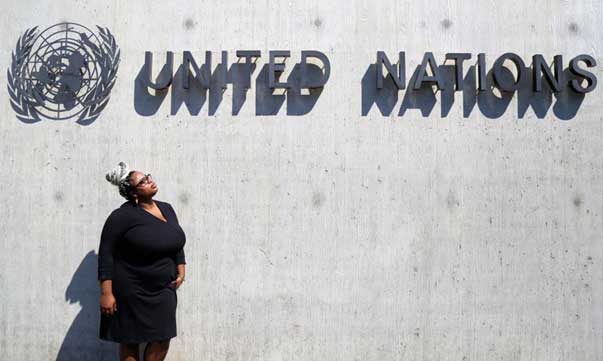
Credit: Equality Now, Tara Carey

NEW YORK, Sep 30 2020 (IPS) – In September 2017, Secretary-General António Guterres launched the “System-wide strategy on gender parity”, which set the goal of reaching gender parity within the United Nations by 2028 and outlined a strategy on how to achieve this, including the introduction of special measures, senior appointments, targets and accountability, amongst other things.


Three years have passed and it is heartening to hear that the UN has made significant progress towards this goal by achieving gender parity within its senior management. We look forward to the organization hopefully achieving this at all levels by 2028, or preferably sooner.

The principle of equal rights for women and men is one of the pillars upon which the UN was founded. It is rooted in the recognition that gender equality is a fundamental human right and that empowering all women is essential for a peaceful, prosperous, and sustainable world.

The blueprint to achieving this was outlined by the UN in 2015 with the 2030 Agenda for Sustainable Development, which enshrines the ambition in Sustainable Development Goal 5 to “achieve gender equality and empower all women and girls”.

As an agenda-setting organisation that plays an influential role on the world stage, the UN has a responsibility to lead by example in advocating for gender equality from the inside out. This entails ensuring that women from a variety of backgrounds are equally represented at all levels of the UN system, and is necessary for both its credibility and effectiveness in applying a gender lens to its policies and programs.

An inclusive, gender-balanced and culturally diverse workforce, operating within a system that support’s women’s equal access to decision-making, will enable the UN to carry out its mandate more successfully.

Although gender parity is an important component of achieving gender equality within the UN, what is also needed is a frank examination and enhancement of the organizational culture and ways of working. The UN has spoken of the need to “create a working environment that embraces equality, eradicates bias, and is inclusive of all staff.”

Whilst it is encouraging to see the progress being made at the UN, there are still areas where commitments must be translated into effective action, and this pertains particularly to the handling of sexual abuse and harassment within the work environment, even as the workplace itself is evolving in response to the COVID-19 pandemic.

In 2018, UN Women appointed an Executive Coordinator and Spokesperson on Sexual Harassment and Discrimination. This office was tasked with “supporting States, government administrations and the private sector to ensure actions are taken to respond to women’s experiences of sexual harassment.”

It contributed to the adoption of the UN System Model Policy on Sexual Harassment by the Chief Executives Board, as well as promoting much-needed awareness raising and open discussion of the issue at the highest levels of the UN itself.

Unfortunately, this office has just been closed permanently, undermining the Secretary-General’s “zero-tolerance” policy on sexual harassment and putting into question the UN’s commitment to priortizing this as in important issue in need of addressing.

Greater attention and improvement are required regarding the handling of sexual harassment and abuse cases involving UN staff, including those in senior management. A staff survey investigating sexual harassment within the organization was carried out in 2018.

Only 17.1 percent of staff responded but of those who did, a third reported they had experienced harassment, with junior and temporary staff being particularly targeted. 12 percent of the perpetrators were in senior leadership positions and incidents were cited in which offenders were not punished or condemned, despite numerous charges being levied against them.

This type of failure was clearly illustrated when the UN’s own internal Dispute Tribunal called the “accountability gap deplorable” in a recent case involving compensation for sexual harassment committed by a previous chair of the International Civil Service Commission against a UN staff member who worked under him.

Although the chair was a UN official elected by the UN General Assembly, he was deemed to be outside the jurisdiction of the UN Secretary-General and as such, no action was taken by the Tribunal. This demonstrates a systemic failure in dealing with cases of this kind.

Sexual harassment and abuse thrive where there is a culture that fosters a lack of accountability that enables perpetrators to act with impunity. Tackling it requires clear and effective leadership to ensure the implementation of adequate safeguarding measures.

Senior management must enact changes to embed transparency across the board, tackle the continuing problem of under-reporting, and provide better support to victims and whistle-blowers who disclose allegations. Only then, will the UN truly be on course to achieve gender equality within its own ranks and stand as a role model for others.

For media enquiries and interview requests please contact Tara Carey at tcarey@equalitynow.org; +44 (0)20 7304 6902; +44 (0)7971 556 340.

*Equality Now is an international human rights organisation that works to protect and promote the rights of women and girls around the world by combining grassroots activism with international, regional and national legal advocacy. It’s international network of lawyers, activists, and supporters achieve legal and systemic change by holding governments responsible for enacting and enforcing laws and policies that end legal inequality, sex trafficking, sexual violence, and harmful practices such as female genital mutilation and child marriage.

For details of current campaigns, go to www.equalitynow.org, Facebook @equalitynoworg, and Twitter @equalitynow.
  Source

After 75 Years, UN Claims 50:50 Gender Parity, But Falls Short of its Ultimate Goals

Civil Society, Development & Aid, Editors’ Choice, Featured, Gender, Global, Global Governance, Headlines, IPS UN: Inside the Glasshouse, TerraViva United Nations

While women have come a long way since the adoption of the Beijing Platform for Action nearly 25 years ago, they still lag behind on virtually every Sustainable Development Goal (SDG). Credit: UN Women, India

UNITED NATIONS, Sep 18 2020 (IPS) – When the United Nations was dominated by men, holding some of the highest positions in the staff hierarchy, women staffers were overwhelmingly administrative secretaries seen pounding on their Remington typewriters seated outside their bosses’ enclosed offices.


A legendary story circulating in the 1960s recounts the plight of a woman candidate being interviewed for a job. She had superlative credentials, including work experience as a political analyst, and was armed with a post-graduate degree from a prestigious university in the US.

The male UN director from human resources, however, had one final question at the end of the interview: “But can you type?”

Mercifully, that was a bygone era. But since then, the UN has made significant progress trying to conform to an age-old General Assembly resolution calling for gender parity system-wide.

As Secretary-General Antonio Guterres tweeted last week: “The #COVID19 pandemic is demonstrating what we all know: millennia of patriarchy have resulted in a male-dominated world with a male-dominated culture which damages everyone – women, men, girls & boys.”

As the UN commemorates its 75th anniversary, the world body claims it has achieved 50:50 gender parity in the higher ranks of its administrative hierarchy.

But it still falls short of reaching “full parity at all levels” of the Organization —even as two recent staff surveys in New York and Geneva raised several lingering questions, including the largely system-wide absence of women of color, widespread racism in the Organization and the lack of equitable geographical representation of staffers from the developing world.

In a letter to staffers on September 2, Guterres singles out the efforts made shortly after he took office: ”Nearly four years into this effort, I can report that we have come a long way”.

In 2019, for the first time in United Nations history, he said; “we reached parity in the Senior Management Group and among Resident Coordinators. On 1 January 2020, and well ahead of schedule, we attained this milestone by reaching parity among all full-time senior leaders, comprising 90 women and 90 men at the level of Assistant and Under-Secretaries-General.”

“In addition to the commitment to reach parity and diversify in our senior leadership by 2021, I have committed to achieving parity at all levels of the Organization by 2028”.

“We are on track to meet this target, but progress is uneven and inconsistent. Our greatest challenge is in field missions, where the gap is the largest and the rate of change is slowest”, he added.

Prisca Chaoui, Executive Secretary of the 3,500-strong Staff Coordinating Council of the UN Office in Geneva (UNOG), told IPS that in the past, despite the existence of competent women in the UN, it has largely been the reality that when women do achieve career progression, it tends to be mostly women belonging to certain geographical groups or regions.

“There are concerns that implementation of the UN’s Gender Parity Strategy may follow a similar pattern. It is crucial that this important initiative ensures a diverse gender parity that includes women from the global South, women of colour, and women from developing and underrepresented countries,” she noted.

The Organization can do better at bringing the valuable and creative talents of diverse women together to help bridge the gender gap. This can only help the UN better deliver on its mandate – especially in these challenging times.

“Gender and geographic diversity should not be mutually exclusive. We can implement the Gender Parity Strategy while ensuring improved geographical representation and diversity,” Chaoui declared.

Meanwhile, the lack of geographical diversity is reflected in the absence of staffers from some 21 member states, according to the latest December 2017 figures released in a report to the UN’s Administrative and Budgetary Committee.

The 21 “unrepresented” countries among staffers, mostly in the developing world, include Afghanistan, Lao People’s Democratic Republic Saint Lucia, Andorra, Liechtenstein, Saint Vincent and the Grenadines., Angola, Marshall Islands, Sao Tome and Principe, Belize, Monaco, Timor-Leste, Equatorial Guinea, Nauru, Tuvalu, Kiribati, Palau United Arab Emirates, Kuwait, Qatar and Vanuatu.

Ian Richards, former President of the Coordinating Committee of International Staff Unions and Associations, and an economist at the Geneva-based UN Conference on Trade and Development (UNCTAD), told IPS that last year Guterres asked the UN’s member states at the General Assembly to let him change the staff regulations to allow the quotas and promotion and recruitment bans based on gender that he had been seeking for a while. But they refused his request.

“It seems they felt it went against Article 8 of the UN Charter on non-discrimination and Article 101 on merit”.

However, this year, while the pandemic and Covid-19 recovery efforts drew attention elsewhere, it seems he made the changes anyway, albeit through a type of executive order called an “administrative instruction”, complained Richards.

Firstly, is the executive order legal if it contradicts the staff regulations? he asked. Lawyers have apparently been looking at this. And, secondly, is it wise to provoke our member states by disregarding their instructions at a time when some are trying to cut our funding? There seems to be some disquiet.

“We all want to advance gender balance and we are all impatient. But I hope our efforts to do so doesn’t backfire because of this”.

A further question is why aren’t the General Service staff included?. They are staff like everyone else and form the backbone of our organization,” asked Richards.

Currently, the UN has a global staff of about 34,170, according to the latest figures from the Chief Executives Board for Coordination.

While the Secretariat staff in New York is estimated at over 3,000, the five largest UN agencies worldwide include the UN children’s agency UNICEF (12,806 staffers), the Office of the UN High Commissioner for Refugees (9,740), the World Health Organization (8,049), the UN Development Programme (7,177) and the World Food Programme (6,091).

Purnima Mane, a former UN Assistant Secretary-General and Deputy Executive Director of the UN Population Fund (UNFPA), told IPS it is indeed heartening to hear that the UN has reached gender parity among its senior leadership.

The Secretary-General further promises that steps will be taken to ensure parity at all levels of the organization by 2028 which is most welcome, she said.

“It is also heartening to note that there is attention to the reality that it is not just about numbers but also about a shift in organizational culture. There obviously needs to be transparency on what this shift implies in terms of its goals, how they will be achieved, and how success will be measured.”

While equitable recruitment is one way to measure gender parity, number of male and female staff obviously cannot be the sole measure of success in achieving gender equality, she argued.

“Parity in numbers is one, critical part of ensuring gender equality in the UN but it needs to be matched with efforts that address the quality of work life. Recognizing the demands on the lives of women and men today and building flexibility in work life policies is a key part of ensuring this quality and equality,” she added.

Attention will have to be paid to other critical areas of work life, such as parity in retention, rate of promotion, salary, benefit package including adequate and flexible work arrangements especially those related to maternity (and paternity) leave, and support and mentoring of women, Mane said.

Targets will not only need to be set for each of these areas but also reported on to ensure transparency and accountability that gender parity is successful in a comprehensive and meaningful way, in the long run, she declared.

Ben Phillips, author of ‘How to Fight Inequality’ and former Campaigns Director for Oxfam and for ActionAid, told IPS there is a growing unity amongst grassroots groups across the world fighting intersecting inequalities.

That is what ‘we the peoples‘ really means. It is that united push that is driving a long-overdue reckoning across institutions of every kind, said Phillips who co-founded the Fight Inequality Alliance.

  Source

UN Women Calls for Accelerating its Unfinished Business

Civil Society, Featured, Gender, Global, Headlines, IPS UN: Inside the Glasshouse, Poverty & SDGs, TerraViva United Nations, Women’s Health

Opinion

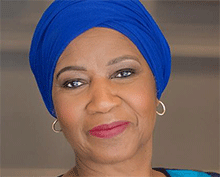
Phumzile Mlambo-Ngcuka is UN Under-Secretary-General and Executive Director, UN Women

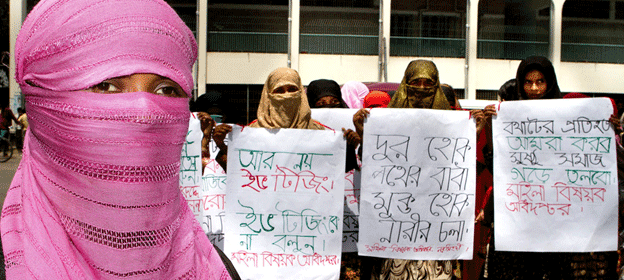
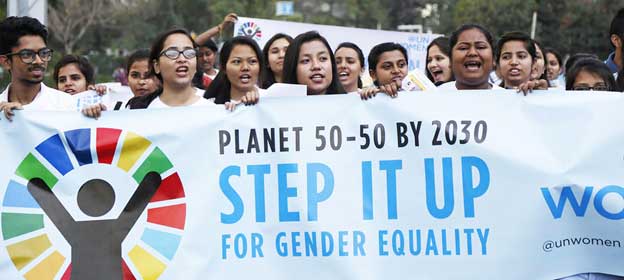
Women in Bangladesh stand up for gender equality. Credit: UNICEF/Jannatul Mawa

NEW YORK, Sep 7 2020 (IPS) – Twenty-five years ago, the Fourth World Conference on Women in Beijing set a path-breaking agenda for women’s rights. As a result of the two-week gathering with more than 30,000 activists, representatives from 189 nations unanimously adopted the Beijing Declaration and Platform for Action.


This historic blueprint articulated a vision of equal rights, freedom and opportunities for women – everywhere, no matter what their circumstances are – that continues to shape gender equality and women’s movements worldwide.

A quarter century on, the UN Secretary-General, Antonio Guterres, calls for urgent action: “With nations around the world searching for solutions to the complex challenges of our age, the leading way for all of us to rebuild more equal, inclusive, and resilient societies, is to accelerate the implementation of women’s rights – the Beijing Platform for Action. That vision has been only partly realized. We still live in a male-dominated world with a male-dominated culture, and this simply has to change”.

The Beijing Platform for Action imagined a world where every woman and girl can exercise her freedoms and choices, and realize her rights, such as to live free from violence, to go to school, to participate in decisions and to earn equal pay for work of equal value. As a defining framework for change, the Platform for Action made comprehensive commitments under 12 critical areas of concern.

Twenty-five years later, no country has fully delivered on the commitments of the Beijing Platform for Action, nor is close to it. A major stock-taking UN Women report published earlier this year showed that progress towards gender equality is faltering and hard-won advances are being reversed.

Women currently hold just one quarter of the seats at the tables of power across the board. Men are still 75 per cent of parliamentarians, hold 73 per cent of managerial positions, are 70 per cent of climate negotiators and almost all of the peacemakers.

Phumzile Mlambo-Ngcuka

The anniversary is a wake-up call and comes at a time when the impact of the gender equality gaps is undeniable. Research shows the COVID-19 pandemic is exacerbating pre-existing inequalities and threatening to halt or reverse the gains of decades of collective effort – with just released new data revealing that the pandemic will push 47 million more women and girls below the poverty line.

We are also witnessing increased reports on violence against women throughout the world due to the lockdowns, and women losing their livelihoods faster because they are more exposed to hard-hit economic sectors.

While much works remains on fulfilling the promises of the Beijing Platform for Action, it continues to be a global framework and a powerful source of mobilization, civil society activism, guidance and inspiration 25 years later.

It was at the Fourth World Conference on Women, specifically at the Women & Health Security Colloquium, where Hillary Clinton coined the phrase, “Women’s rights are human rights, and human rights are women’s rights”.

In a recent article in The Atlantic, she recalled her participation at the Conference as the Honorary Chairperson of the US delegation, and the significance of the Beijing Declaration: “A 270-page document might not lend itself to bumper stickers or coffee mugs, but it laid the groundwork for sweeping, necessary changes.”

Underlining the urgency for implementation, she added: “As the changes laid out in the Platform for Action have been implemented, what’s become clear is that simply embracing the concept of women’s rights, let alone enshrining those rights in laws and constitutions, is not the same as achieving full equality. Rights are important, but they are nothing without the power to claim them.”

Years after, global activists continue the hard work and those who participated at the 1995 Beijing Conference remain touched by this historic meeting. Zeliha Ünaldi, a long-standing gender advocate from Turkey, said it was a life-changing experience: “When I recall those days, mingling around the tents with thousands of women committing to a better world, two words immediately come to my mind: sisterhood and peace. The Beijing Declaration and Platform for Action and the subsequent five years helped me understand the power in us and of us as the global women’s movement.”

The upcoming UN General Assembly later this month will be a key opportunity to bring to the forefront the relevance of the Beijing Declaration and move the needle on implementation, with a High-Level Meeting attended by global leaders on “Accelerating the Realization of Gender Equality and the Empowerment of all Women and Girls” on 1 October.

The event will showcase how building equal and inclusive societies is more urgent than ever, as the COVID-19 pandemic ravages lives and livelihoods.

Calling on world leaders to use their political power to accelerate robust action and resources for gender equality and the empowerment of all women and girls: “This is a re-set moment. On this important anniversary, let us reaffirm the promises the world made to women in 1995. Let us draw on the activist spirit of the Beijing Conference and commit to forging new alliances across generations and sectors to ensure we seize this opportunity for deep, systemic change for women and for the world.”

The anniversary will be further commemorated in the context of the Generation Equality Forum, a civil society–centred, global gathering for gender equality, convened by UN Women and co-hosted by the governments of France and Mexico, foreseen to take place in the first half of 2021.

Exactly 25 years after the opening of the Fourth World Conference on Women in Beijing, China, its significance is undimmed. In that quarter century we have seen the strength and impact of collective activism grow and have been reminded of the importance of multilateralism and partnership to find common solutions to shared problems.

Back in 1995, the deliberations of the Conference resulted in the framing of the Beijing Declaration and Platform for Action: a bold agenda for the change needed to realize the human rights of women and girls, articulated across 12 critical areas of concern.

The Platform for Action provided a blueprint for the advancement of gender equality and the empowerment of women and girls, adopted by 189 UN Member States and universally referenced.

The continued relevance of the Beijing Declaration and Platform for Action cannot be overstated today. The far-reaching social and economic impacts of the COVID-19 pandemic, including the significant increases in violence against women, threaten to reverse many of the hard-won advances made in the last 25 years to empower women and girls.

At the same time, the outstanding value of women’s leadership through the COVID-19 pandemic is in plain sight, along with the recognition of just how much women’s work and women’s movements have sustained the world, from domestic life, the fight for human rights, to national economies.

We also know that by next year, 435 million women and girls are likely to have been reduced to extreme poverty. Governments, local administrations, businesses and enterprises of all sorts must not let this happen.

To tackle persistent systemic barriers to equality, we need transformative approaches and new alliances that engage the private sector alongside governments and civil society. This is a re-set moment. The economic and policy lifeboats for our struggling world must put women and children first.

The political will of leaders can make the difference. World leaders convening at this year’s United Nations General Assembly have the opportunity to use their power in action to accelerate the realization of gender equality and the empowerment of all women and girls, and to support the role of civil society organizations and youth.

Our humanitarian responses to COVID-19, our economic stimulus packages, our reinventions of working life and our efforts to create solidarity across social and physical distance – these are all chances to build back better for women and girls.

For success, we need to work together on these transformative actions. In 2019, we launched a global campaign called Generation Equality: Realizing Women’s Rights for an Equal Future, with a call for renewed commitment by governments in partnership with civil society, academia and the private sector.

It included clear timelines, responsibilities and resources towards realizing the 2030 Agenda for Sustainable Development, an ambitious long-term framework that included goals to achieve universal gender equality.

On October 1, 2020, when a High-Level Meeting on the 25th anniversary of the Beijing Platform for Action is convened by the President of the General Assembly, Member States can put into action their commitment toward a more gender-equal world.

On this important anniversary, let us reaffirm the promises the world made to women and girls in 1995. Let us draw on the activist spirit of the Beijing Conference and commit to forging new alliances across generations and sectors to ensure we seize this opportunity for deep, systemic change for women and for the world.

  Source

Energy Cooperatives Swim Against the Tide in Mexico

Civil Society, Development & Aid, Economy & Trade, Editors’ Choice, Energy, Environment, Featured, Green Economy, Headlines, Integration and Development Brazilian-style, Latin America & the Caribbean, Projects, Regional Categories, TerraViva United Nations

Energy

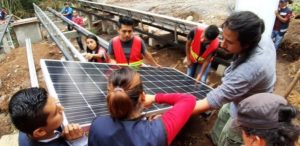
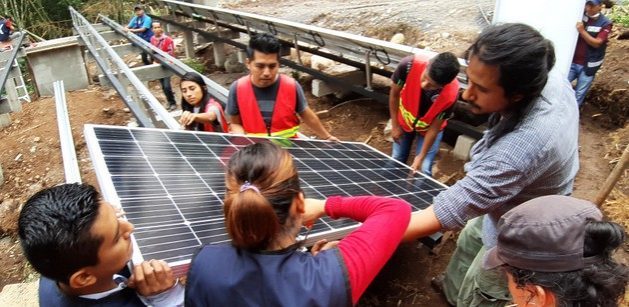
Onergia, one of the two energy cooperatives operating in Mexico today, installs photovoltaic systems, such as this one at the Tosepan Titataniske Union of Cooperatives in the municipality of Cuetzalan, in the southern state of Puebla. CREDIT: Courtesy of Onergia

Onergia, one of the two energy cooperatives operating in Mexico today, installs photovoltaic systems, such as this one at the Tosepan Titataniske Union of Cooperatives in the municipality of Cuetzalan, in the southern state of Puebla. CREDIT: Courtesy of Onergia

MEXICO CITY, Aug 31 2020 (IPS) – A Mexican solar energy cooperative, Onergia, seeks to promote decent employment, apply technological knowledge and promote alternatives that are less polluting than fossil fuels, in one of the alternative initiatives with which Mexico is seeking to move towards an energy transition.


“We organised ourselves in a cooperative for an energy transition that will rethink the forms of production, distribution and consumption to build a healthier and fairer world,” Onergia founding partner and project director Antonio Castillo told IPS. “In this sector, it has been more difficult; we have to invest in training and go against the logic of the market.”

The eight-member cooperative, created in 2017, has so far installed some 50 photovoltaic systems, mainly in the south-central state of Puebla.

“A public policy is needed that would allow us to move towards the transition. Getting people to adopt alternatives depends on public policy. It is fundamental for people to have the freedom to choose how to consume. It is our job to organise as consumers.” —
Antonio Castillo

Castillo explained by phone that the cooperative works with middle- and upper-class households that can finance the cost of the installation as well as with local communities keen on reducing their energy bill, offering more services and expanding access to energy.

In the case of local communities, the provision of solar energy is part of broader social projects in which the beneficiary organisations’ savings and loan cooperatives design the financial structure to carry out the work. A basic household system can cost more than 2,200 dollars and a larger one, over 22,000.

“The communities are motivated to adopt renewable energy as a strategy to defend the land against threats from mining or hydroelectric companies,” said Castillo. “They don’t need to be large-scale energy generators, because they already have the local supply covered. The objective is to provide the communities with alternatives.”

Onergia, a non-profit organisation, promotes distributed or decentralised generation.

In Mexico, energy cooperatives are a rarity. In fact, there are only two, due to legal, technical and financial barriers, even though the laws governing cooperatives recognise their potential role in energy among other diverse sectors. The other, Cooperativa LF del Centro, provides services in several states but is not a generator of electricity.

The Electricity Industry Law, in effect since 2014, allows the deployment of local projects smaller than one megawatt, but practically excludes them from the electricity auctions that the government had been organising since 2016 and that the administration of leftwing President Andrés Manuel López Obrador put a stop to after he took office in December 2018.

Since then, López Obrador has opted to fortify the state monopolies of the Federal Electricity Commission (CFE) and the Petróleos Mexicanos (Pemex) oil giant, which translates into favouring fossil fuels over renewable sources.

The National Electric System Development Programme 2018-2032 projects that fossil fuels will represent 67 percent of the energy mix in 2022; wind energy, 10 percent; hydroelectric, nine percent; solar, four percent; nuclear, three percent, and geothermal and bioenergy, four percent.

In 2032, the energy outlook will not vary much, as fossil fuels will account for 60 percent; wind, nuclear and geothermal energy will rise to 13, eight and three percent, respectively; hydroelectric power will drop to eight percent; while solar and bioenergy will remain the same.

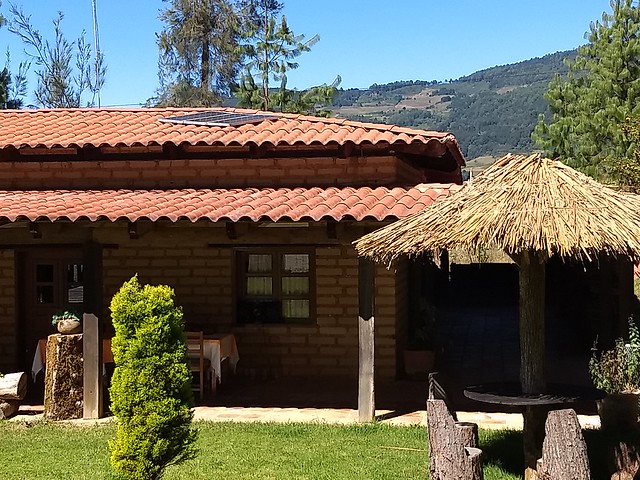
In Mexico, rural communities are guaranteeing their electricity supply by using clean sources, thus furthering the energy transition to micro and mini-scale generation. The photo shows the "Laatzi-Duu" ecotourism site (the name means "standing plain" in the Zapotec indigenous language) which is self-sufficient thanks to a solar panel installed on its roof, in the municipality of San Juan Evangelista Analco in the southern state of Oaxaca. CREDIT: Emilio Godoy/IPS

In Mexico, rural communities are guaranteeing their electricity supply by using clean sources, thus furthering the energy transition to micro and mini-scale generation. The photo shows the “Laatzi-Duu” ecotourism site (the name means “standing plain” in the Zapotec indigenous language) which is self-sufficient thanks to a solar panel installed on its roof, in the municipality of San Juan Evangelista Analco in the southern state of Oaxaca. CREDIT: Emilio Godoy/IPS

The government cancelled the call for long-term electric auctions that allowed private companies to build wind and solar plants and sell the energy to CFE. But these tenders privileged private Mexican and foreign capital and large-scale generation.

In a dialogue with IPS, independent researcher Carlos Tornel questioned the predominant energy design promoted by the 2013 reform that opened up the hydrocarbon and electricity markets to private capital, and the form of energy production based on passive consumers.

“We don’t have an effective legal framework to promote that kind of energy transition,” said the expert via WhatsApp from the northeast English city of Durham. “A free market model was pursued, which allowed the entry of megaprojects through auctions and allowed access to those who could offer a very low cost of generation, which could only be obtained on a large scale.”

With that strategy, he added, “small projects were left out. And the government did not put in place economic incentives to foment cooperative schemes.”

“We need a more active model focused on the collective good,” added Tornel, who is earning a PhD in Human Geography at Durham University in the UK.

Mexico, the second largest economy in Latin America with a population of 129 million, depends heavily on hydrocarbons and will continue to do so in the medium term if it does not accelerate the energy transition.

In the first quarter of 2019, gross generation totaled 80,225 gigawatt hours (Gwh), up from 78,167 in the same period last year. Gas-fired combined cycle plants (with two consecutive cycles, conventional turbine and steam) contributed 40,094, conventional thermoelectric 9,306, and coal-fired 6,265.

Hydroelectric power plants contributed 5,137 Gwh; wind fields 4,285; nuclear power plants 2,382; and solar stations 1,037.

The Energy Transition Law of 2015 stipulates that clean energy must meet 30 percent of demand by 2021 and 35 percent by 2024. By including hydropower and nuclear energy, the country will have no problem reaching these goals.

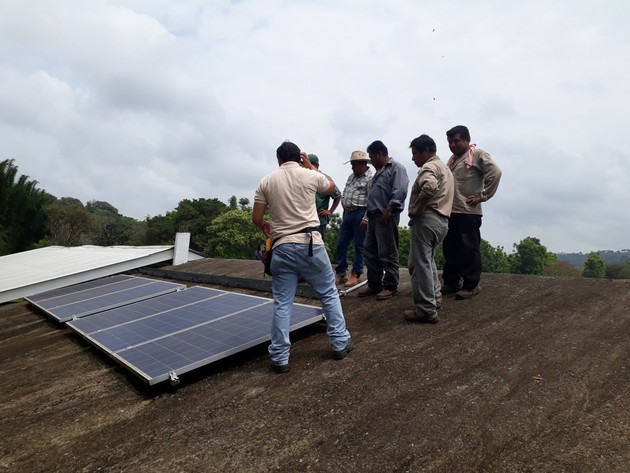
Residents of the small rural community of Amatlán, in the municipality of Zoquiapan in the state of Puebla, oversee the operation of photovoltaic panels installed by the Mexican cooperative Onergia. This type of cooperative can help rural communities in Mexico access clean energy, particularly solar power. CREDIT: Courtesy of Onergia

Residents of the small rural community of Amatlán, in the municipality of Zoquiapan in the state of Puebla, oversee the operation of photovoltaic panels installed by the Mexican cooperative Onergia. This type of cooperative can help rural communities in Mexico access clean energy, particularly solar power. CREDIT: Courtesy of Onergia

By early August, the government’s Energy Regulatory Commission (CRE) had granted 310 permits for solar generation, small-scale production and self-supply, totaling almost 22,000 Mw.

The 2017 report Renewable Energy Auctions and Participatory Citizen Projects, produced by the international non-governmental Renewable Energy Policy Network for the 21st Century (REN21), cites, with respect to Mexico, the obligation for investors to form self-sufficient companies, which complicates attempts to develop local ventures.

Onergia’s Castillo stressed the need for a clear and stable regulatory framework.

“A public policy is needed that would allow us to move towards the transition,” he said. “Getting people to adopt alternatives depends on public policy. It is fundamental for people to have the freedom to choose how to consume. It is our job to organise as consumers.”

Affected by the coronavirus pandemic, Onergia is reviewing the way it works and its financial needs to generate its own power supply. It also works with the Renewable Energies Institute of the National Autonomous University of Mexico in the design and installation of solar power systems.

In March, the government’s National Council for Science and Technology launched a strategic national programme on energy transition that will promote sustainable rural energy projects and community solar energy, to be implemented starting in 2021.

In addition, the energy ministry is set to announce the Special Energy Transition Programme 2019-2024.

But to protect the CFE, the CRE is blocking approval of the development of collective distributed generation schemes, which would allow citizens to sell surplus energy to other consumers, and the installation of storage systems in solar parks.

Tornel criticised the lack of real promotion of renewable sources.

“The Mexican government has been inconsistent in its handling of this issue,” he maintained. “They talk about guaranteeing energy security through hydrocarbons. There is no plan for an energy transition based on renewables or on supporting community projects. We have no indication that they support renewable, and that’s very worrying.”

The REN21 report recommends reserving a quota for participatory citizen projects and facilitating access to energy purchase agreements, which ensures the efficiency of tenders and the effectiveness of guaranteed tariffs for these undertakings.

In addition, it proposes the establishment of an authority for citizen projects, capacity building, promotion of community energy and specific national energy targets for these initiatives.

  Source

It is Time for a Democratic Global Revolution

Civil Society, Climate Change, Democracy, Editors’ Choice, Featured, Global, Global Governance, Headlines, Human Rights, IPS UN: Inside the Glasshouse, TerraViva United Nations

Opinion

Daniel Jositsch is a Member of the Swiss Senate and President, Democracy Without Borders-Switzerland, and Andreas Bummel is Executive Director, Democracy Without Borders. Twitter: @democracywb

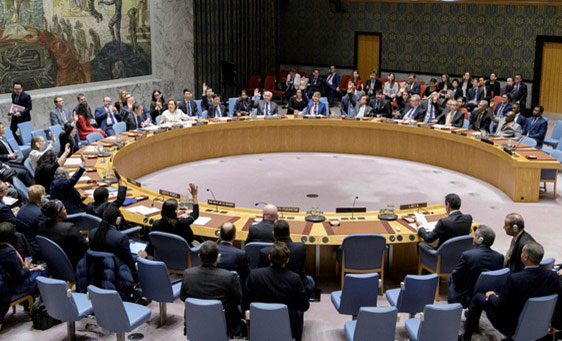
The UN’s Security Council, in particular, is suffering from a dysfunctional decision-making method that grants the five victors of the Second World War and official nuclear powers not only a permanent seat but also a veto right. Credit: United Nations

BERLIN / BERNE, Aug 28 2020 (IPS) – The people of the world need to seize the moment and bring about a democratic global revolution. It is time for a global parliament and real representation.

More than 21 million people got infected with the novel coronavirus and over 770,000 have died. Never before did the world witness similar collective lockdowns of social and economic activity that had to be enforced to contain the pandemic.


For many, the corona-related global crisis exacerbates a situation that was already critical before the outbreak of the virus.

The climate crisis is unfolding with record temperatures in Siberia, Greenland, the Antarctic and other places like the Middle East. The new climate apartheid is characterized by whether you can afford to shield yourself from such heat or not. Most cannot.

135 million people are facing crisis levels of hunger. There are currently more than 70 million displaced people who have fled war, persecution and conflict. It’s the worst humanitarian and refugee crisis in seventy years.

There is a global inequality crisis. Productivity gains and globalization disproportionately benefit the affluent. Financial assets in the trillions are hidden in offshore accounts from tax authorities. The world’s 26 richest billionaires own as much as the poorest 3.8 billion people on the planet.

While global surveys confirm that people across all world regions strongly believe in democracy, there is in fact a democratic retreat. Confidence in the actual performance of democratic governments is waning. Populist nationalism and authoritarianism has been advancing, aided and abetted by social media platforms and the internet. Major arms control treaties are crumbling, geopolitical tensions are rising and multilateralism is under attack.

Civil society and citizens across the world are fighting back, though. Pro-democracy movements are at an all-time high as widespread protests in dozens of countries now and in recent times demonstrate. Freedom and justice have lost no appeal. At the same time, millions of citizens joined climate protests around the world and called for quick and effective action in this critical field.

The present issues are symptoms of a crisis of global governance. There is a scale mismatch between a political world order that is based on 200 states and territories and issues that demand decisive global action.

As the UN celebrates its 75th anniversary this year, the organization continues to lose significance and impact. The UN is only as strong and effective as its member states allow it to be. The same applies to all intergovernmental organizations and forums, including the World Health Organization that had to launch an investigation into its handling of the Covid-19 pandemic.

The UN’s Security Council, in particular, is suffering from a dysfunctional decision-making method that grants the five victors of the Second World War and official nuclear powers not only a permanent seat but also a veto right.

If long-lasting solutions are to be achieved, this scale mismatch must be tackled. It is not enough to call on individual governments to change their policies. The way how the world is governed must be changed. What is needed is a new vision of a democratic world order that is based on shared sovereignty on global issues, a clear commitment to human rights, the principle of subsidiarity and complete disarmament.

When the UN was founded it was recognized that this should only be a beginning and that changes would be required. Article 109 of the Charter provides that a conference to review the Charter should be held by 1955. The UN’s member states did not deliver on that promise. Now is the time to hold them to account.

The world’s people need an actual say in global affairs that is not intermediated by national governments and their diplomats. The key ingredient of a new UN should be a democratically elected world parliament that complements intergovernmental bodies such as the UN General Assembly.

The creation of a new democratic world organization that has actual powers seems to be a gigantic project that raises numerous questions. How is a global democracy to be created while major states themselves are not democratically organised? Can decisions of a world parliament be enforced against the will of individual states? How is it possible that states will agree to the creation of a superior political unit?

These questions show the way forward: The people of the world themselves need to embrace and call for global democracy. Eventually, they are the sovereigns not only in their individual states but on the planet as a whole, too.

A global democratic revolution needs to push for a legitimate, inclusive and representative global body that will deal with these questions in a serious way. The creation of a UN Parliamentary Assembly could be an important stepping stone to launch a global constitutional process and a transformation of global governance.

This global democratic revolution will be peaceful because it is not about destroying structures or conquering territories, but about opening up a political level that is lying idle. Supranational integration cannot be imposed by force. It will happen because the people want it.

If existing movements in the fields of climate, environment, peace, disarmament, democracy, social justice and others join forces, the global democratic revolution will become very real.

This may sound visionary. But the big issues troubling this planet and its people will remain, and worsen, unless the root cause is addressed. A democratic global government is not a mind game in some ivory tower. It is the most important question on the agenda of humanity today.

  Source

Semiarid Regions of Latin America Cooperate to Adapt to Climate

Civil Society, Combating Desertification and Drought, Development & Aid, Economy & Trade, Editors’ Choice, Environment, Featured, Food & Agriculture, Green Economy, Headlines, Integration and Development Brazilian-style, Latin America & the Caribbean, Projects, Regional Categories, South-South, TerraViva United Nations, Water & Sanitation

Combating Desertification and Drought

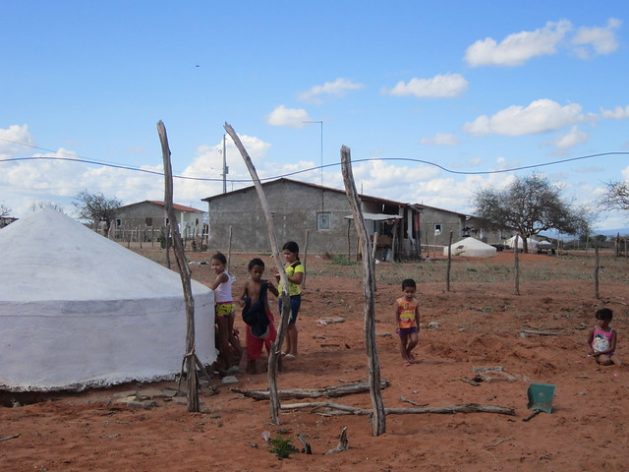
A rural settlement in the state of Pernambuco, in Brazil's semiarid ecoregion. Tanks that collect rainwater from rooftops for drinking water and household usage have changed life in this parched land, where 1.1 million 16,000-litre tanks have been installed so far. CREDIT: Mario Osava/IPS

A rural settlement in the state of Pernambuco, in Brazil’s semiarid ecoregion. Tanks that collect rainwater from rooftops for drinking water and household usage have changed life in this parched land, where 1.1 million 16,000-litre tanks have been installed so far. CREDIT: Mario Osava/IPS

RIO DE JANEIRO, Aug 27 2020 (IPS) – After centuries of poverty, marginalisation from national development policies and a lack of support for positive local practices and projects, the semiarid regions of Latin America are preparing to forge their own agricultural paths by sharing knowledge, in a new and unprecedented initiative.


In Brazil’s semiarid Northeast, the Gran Chaco Americano, which is shared by Argentina, Bolivia and Paraguay, and the Central American Dry Corridor (CADC), successful local practices will be identified, evaluated and documented to support the design of policies that promote climate change-resilient agriculture in the three ecoregions.

This is the objective of DAKI-Semiárido Vivo, an initiative financed by the United Nations International Fund for Agricultural Development (IFAD) and implemented by the Brazilian Semiarid Articulation (ASA), the Argentinean Foundation for Development in Justice and Peace (Fundapaz) and the National Development Foundation (Funde) of El Salvador.

DAKI stands for Dryland Adaptation Knowledge Initiative.

The project, launched on Aug. 18 in a special webinar where some of its creators were speakers, will last four years and involve 2,000 people, including public officials, rural extension agents, researchers and small farmers. Indirectly, 6,000 people will benefit from the training.

“The aim is to incorporate public officials from this field with the intention to influence the government’s actions,” said Antonio Barbosa, coordinator of DAKI-Semiárido Vivo and one of the leaders of the Brazilian organisation ASA.

The idea is to promote programmes that could benefit the three semiarid regions, which are home to at least 37 million people – more than the total populations of Chile, Ecuador and Peru combined.

The residents of semiarid regions, especially those who live in rural areas, face water scarcity aggravated by climate change, which affects their food security and quality of life.

Zulema Burneo, International Land Coalition coordinator for Latin America and the Caribbean and moderator of the webinar that launched the project, stressed that the initiative was aimed at “amplifying and strengthening” isolated efforts and a few longstanding collectives working on practices to improve life in semiarid areas.

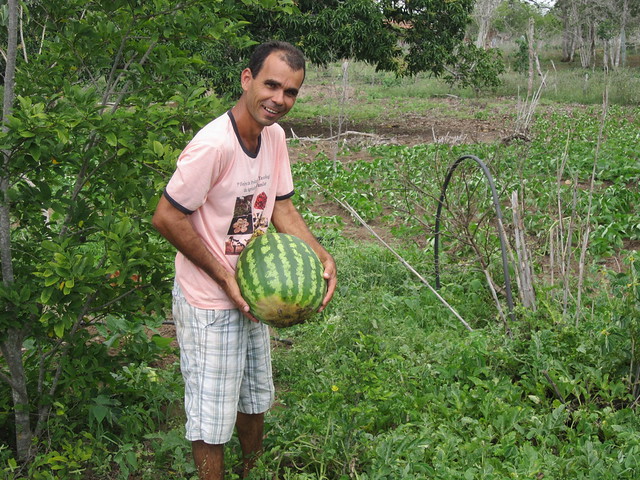
Abel Manto, an inventor of technologies that he uses on his small farm in the state of Bahia, in Brazil's semiarid ecoregion, holds up a watermelon while standing among the bean crop he is growing on top of an underground dam. The soil is on a waterproof plastic tarp that keeps near the surface the water that is retained by an underground dam. CREDIT: Mario Osava/IPS

Abel Manto, an inventor of technologies that he uses on his small farm in the state of Bahia, in Brazil’s semiarid ecoregion, holds up a watermelon while standing among the bean crop he is growing on top of an underground dam. The soil is on a waterproof plastic tarp that keeps near the surface the water that is retained by an underground dam. CREDIT: Mario Osava/IPS

The practices that represent the best knowledge of living in the drylands will be selected not so much for their technical aspects, but for the results achieved in terms of economic, ecological and social development, Barbosa explained to IPS in a telephone interview from the northeastern Brazilian city of Recife, where the headquarters of ASA are located.

After the process of systematisation of the best practices in each region is completed, harnessing traditional knowledge through exchanges between technicians and farmers, the next step will be “to build a methodology and the pedagogical content to be used in the training,” he said.

One result will be a platform for distance learning. The Federal Rural University of Pernambuco, also in Recife, will help with this.

Decentralised family or community water supply infrastructure, developed and disseminated by ASA, a network of 3,000 social organisations scattered throughout the Brazilian Northeast, is a key experience in this process.

In the 1.03 million square kilometres of drylands where 22 million Brazilians live, 38 percent in rural areas according to the 2010 census, 1.1 million rainwater harvesting tanks have been built so far for human consumption.

An estimated 350,000 more are needed to bring water to the entire rural population in the semiarid Northeast, said Barbosa.

But the most important aspect for agricultural development involves eight “technologies” for obtaining and storing water for crops and livestock. ASA, created in 1999, has helped install this infrastructure on 205,000 farms for this purpose and estimates that another 800 peasant families still need it.

There are farms that are too small to install the infrastructure, or that have other limitations, said Barbosa, who coordinates ASA’s One Land and Two Waters and native seed programmes.

The “calçadão” technique, where water runs down a sloping concrete terrace or even a road into a tank that has a capacity to hold 52,000 litres, is the most widely used system for irrigating vegetables.

A group of peasant farmers from El Salvador stand in front of one of the two rainwater tanks built in their village, La Colmena, in the municipality of Candelaria de la Frontera. The pond is part of a climate change adaptation project in the Central American Dry Corridor. Central American farmers like these and others from Brazil's semiarid Northeast have exchanged experiences on solutions for living with lengthy droughts. CREDIT: Edgardo Ayala/IPS

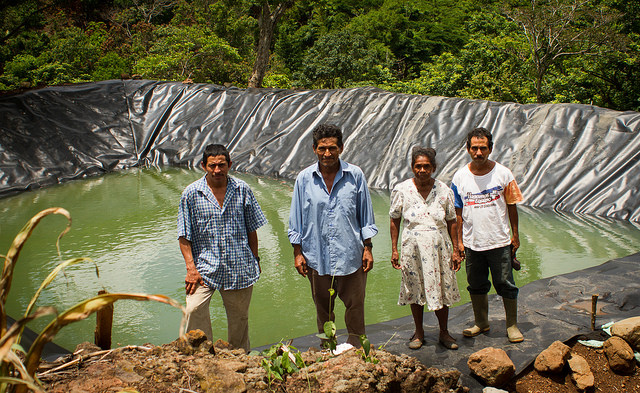
A group of peasant farmers from El Salvador stand in front of one of the two rainwater tanks built in their village, La Colmena, in the municipality of Candelaria de la Frontera. The pond is part of a climate change adaptation project in the Central American Dry Corridor. Central American farmers like these and others from Brazil’s semiarid Northeast have exchanged experiences on solutions for living with lengthy droughts. CREDIT: Edgardo Ayala/IPS

And in Argentina’s Chaco region, 16,000-litre drinking water tanks are mushrooming.

But tanks for intensive and small farming irrigation are not suitable for the dry Chaco, where livestock is raised on large estates of hundreds of hectares, said Gabriel Seghezzo, executive director of Fundapaz, in an interview by phone with IPS from the city of Salta, capital of the province of the same name, one of those that make up Argentina’s Gran Chaco region.

“Here we need dams in the natural shallows and very deep wells; we have a serious water problem,” he said. “The groundwater is generally of poor quality, very salty or very deep.”

First, peasants and indigenous people face the problem of formalising ownership of their land, due to the lack of land titles. Then comes the challenge of access to water, both for household consumption and agricultural production.

“In some cases there is the possibility of diverting rivers. The Bermejo River overflows up to 60 km from its bed,” he said.

Currently there is an intense local drought, which seems to indicate a deterioration of the climate, urgently requiring adaptation and mitigation responses.

Reforestation and silvopastoral systems are good alternatives, in an area where deforestation is “the main conflict, due to the pressure of the advance of soy and corn monoculture and corporate cattle farming,” he said.

Mariano Barraza of the Wichí indigenous community (L) and Enzo Romero, a technician from the Fundapaz organisation, stand next to the tank built to store rainwater in an indigenous community in the province of Salta, in the Chaco ecoregion of northern Argentina, where there are six months of drought every year. CREDIT: Daniel Gutman/IPS

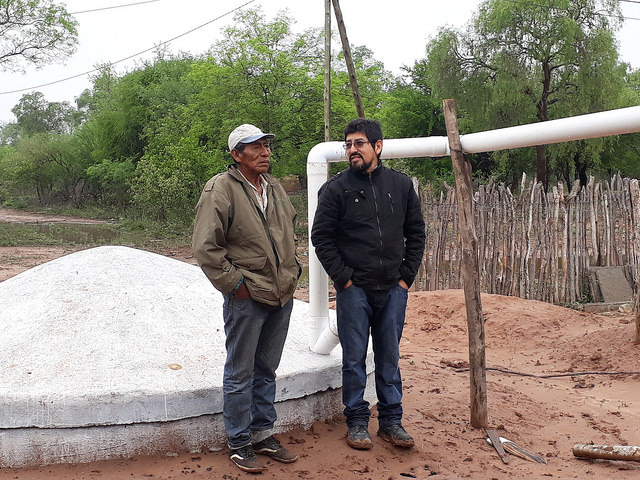
Mariano Barraza of the Wichí indigenous community (L) and Enzo Romero, a technician from the Fundapaz organisation, stand next to the tank built to store rainwater in an indigenous community in the province of Salta, in the Chaco ecoregion of northern Argentina, where there are six months of drought every year. CREDIT: Daniel Gutman/IPS

More forests would be beneficial for the water, reducing evaporation that is intense due to the heat and hot wind, he added.

Of the “technologies” developed in Brazil, one of the most useful for other semiarid regions is the “underground dam,” Claus Reiner, manager of IFAD programmes in Brazil, told IPS by phone from Brasilia.

The underground dam keeps the surrounding soil moist. It requires a certain amount of work to dig a long, deep trench along the drainage route of rainwater, where a plastic tarp is placed vertically, causing the water to pool during rainy periods. A location is chosen where the natural layer makes the dam impermeable from below.

This principle is important for the Central American Dry Corridor, where “the great challenge is how to infiltrate rainwater into the soil, in addition to collecting it for irrigation and human consumption,” said Ismael Merlos of El Salvador, founder of Funde and director of its Territorial Development Area.

The CADC, which cuts north to south through Guatemala, Honduras and El Salvador, is defined not as semiarid, but as a sub-humid region, because it rains slightly more there, although in an increasingly irregular manner.

Some solutions are not viable because “75 percent of the farming areas in the Corridor are sloping land, unprotected by organic material, which makes the water run off more quickly into the rivers,” Merlos told IPS by phone from San Salvador.

“In addition, the large irrigation systems that we’re familiar with are not accessible for the poor because of their high cost and the expensive energy for the extraction and pumping of water, from declining sources,” he said.

The most viable alternative, he added, is making better use of rainwater, by building tanks, or through techniques to retain moisture in the soil, such as reforestation and leaving straw and other harvest waste on the ground rather than burning it as peasant farmers continue to do.

“Harmful weather events, which four decades ago occurred one to three times a year, now happen 10 or more times a year, and their effects are more severe in the Dry Zone,” Merlos pointed out.

Funde is a Salvadoran centre for development research and policy formulation that together with Fundapaz, four Brazilian organisations forming part of the ASA network and seven other Latin American groups had been cooperating since 2013, when they created the Latin American Semiarid Platform.

The Platform paved the way for the DAKI-Semiárido Vivo which, using 78 percent of its two million dollar budget, opened up new horizons for synergy among Latin America’s semiarid ecoregions. To this end, said Burneo, it should create a virtuous alliance of “good practices and public policies.”

  Source