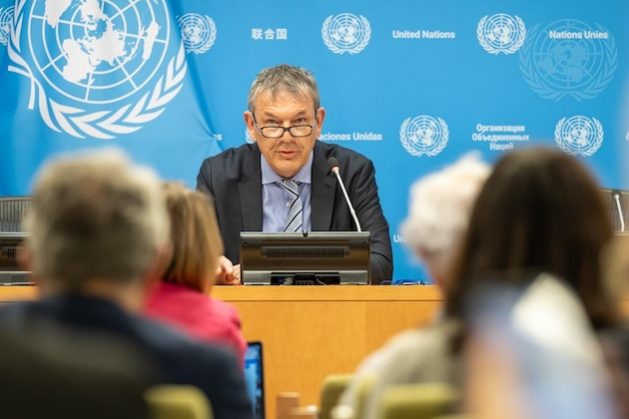
Philippe Lazzarini, Commissioner-General of the United Nations Relief and Works Agency for Palestine Refugees in the Near East (UNRWA), briefs reporters at UN Headquarters.
UNITED NATIONS, Mar 6 2024 (IPS) – UNRWA Commissioner-General Philippe Lazzarini asked the UN General Assembly to urge member states to support the organization’s mandate during this period of unprecedented crisis for the region and the agency. He also called for member states to facilitate a “long-overdue political process” for the two-state solution for Israel and Palestine. Only then, in this context, should UNRWA be allowed to transition.
He was speaking at an informal session of the General Assembly on the United Nations Relief and Works Agency for Palestinian Refugees in the Near East (UNRWA). This was convened to discuss the ongoing situation with UNRWA’s capacity as a humanitarian and human development agency in Gaza.
Despite its existence for 75 years, UNRWA’s presence was always intended to be temporary. “It is a stain on our collective conscience that for 75 years, UNRWA has had to fill a vacuum left by the lack of a political solution and genuine peace,” said Lazzarini.
The ongoing hostilities in the Gaza Strip and the resulting destruction of UNRWA facilities, which have disrupted humanitarian services in the region, have led to calls to seek alternatives that can deliver on the scale of the agency or to raise concern about whether other agencies can deliver the necessary humanitarian aid.
“UNRWA is facing a deliberate and concerted campaign to undermine its operations and ultimately end them,” said Lazzarini.
Lazzarini argued that dismantling UNRWA during the current crisis would be shortsighted, given that the agency was designed to provide public services such as education and primary healthcare in a region without state authority. “The notion that the Agency can be dismantled without violating a host of human rights and jeopardizing international peace and security is naïve at best,” he said.
Speaking at a press briefing that same day, Lazzarini told reporters, “We can only feel that the worst is yet to come.” He remarked that since January, aid delivery to Gaza has decreased by 50 percent. Since then, famine has become all but inevitable.
Remarking on the dual investigations into UNRWA’s operations, Lazzarini stated that the investigations were necessary as an accountability measure. These investigations were announced after it was revealed that he had terminated the contracts of 12 staff members who were allegedly involved in the October 7 attacks. Lazzarini added that the “swift decision” to terminate the contracts, as well as the investigations, would likely reflect the agency’s ability to follow through on recommendations from a risk management review.
Lazzarini admitted, however, that he had not anticipated the swift action that 16 donor countries took to suspend their funding in the wake of the allegations, which he revealed were conveyed to him in an oral manner. “I have no regret,” he said, referring to his response to the allegations, “but to be honest, I did not expect that… over the weekend, 16 countries would take that decision.”
The UNRWA chief also indicated that most donor countries would consider resuming their support. For those donor countries, the pressure to pull support came from domestic or public opinion that seems divided over UNRWA rather than foreign policy considerations.
There is some promise that UNRWA will continue to deliver on its mandate with the help of donor states, as was seen with the European Commission’s decision to continue funding the agency, starting with a pledge of 50 million euros. However, this will only go partway into filling the gap of 450 million USD left by the 16 donor countries. Lazzarini warned that without additional funding, the agency would be in “uncharted territory” and would have “serious implications for global peace and security.”
The atrocities that were committed on and since October 7 have only resulted in increasing devastation and tragedy. The international community, as embodied by the General Assembly on Monday, seems largely united in their calls for a humanitarian ceasefire in Gaza and for the safe release of all hostages.
Yet the ongoing hostilities in the region have prevented the UN and its agencies from fulfilling their mandate to safely provide critical emergency aid. Five months on, there is a seeming lack of forward momentum within the Security Council to deliver a ceasefire resolution. UNRWA has been contending with compounding existential questions about its survival as an agency from hostile forces in the Gaza Strip and beyond who call for its dissolution.
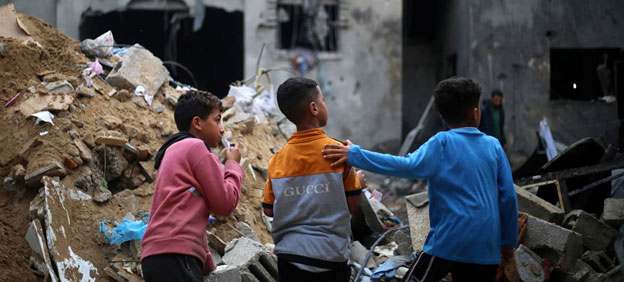
Children look at their destroyed homes in Rafah city, in the southern Gaza Strip. Credit: UNICEF/Eyad El Baba
GAZA STRIP, Feb 29 2024 (IPS) – Nothing could prepare me for my recently concluded mission into the Gaza Strip, where children face catastrophic conditions.
In my twenty years with UNICEF, traveling from one humanitarian crisis to the next – from famines to floods and war zones to refugee camps – I’ve simply never seen such devastation and despair as is happening in Gaza.
The intensity of the attacks, the massive number of child casualties, the desperation and panic of the people on the move – people who already have nothing – is palpable. It is humanitarian disaster on top of humanitarian disaster.
Near the start of the recent brief pause in fighting, we set out early in the morning at Rafah on the border with Egypt. Our convoy of trucks carrying vital humanitarian aid made its way slowly in a punishing journey north to Gaza City, which hadn’t seen aid in weeks.
The two cities are just 35 kilometres apart, but travelling through a war zone always makes distances seem more daunting. Along the way, I saw apartment building after apartment building, home after home, flattened by the bombings, a dystopian scene that stretched for miles.
In Gaza City I got out to look more closely at a building that had been reduced to rubble. Inside, I noticed bloodstains, but it’s impossible to know whether the people who were pulled out of this mass of concrete survived.
I will never forget how a man in his 60s walked out from the ruins of a recently bombed apartment building. At first, I thought he was indicating the number 10, as in 10 people had been killed. But he corrected this, using a stick to write in the dirt: 30. It wasn’t the number of people killed. It was the number of his extended family members killed in the blast.
This man had lost everyone, his whole extended family, everyone he loved. At the start of this war, UNICEF said Gaza was a “graveyard for children and a living hell for everyone else.” It has only gotten worse as the bombing and fighting have continued.
There was a hope that the devastation seen before the pause would not be repeated should the fighting resume. But after hearing hundreds and hundreds of rounds of artillery and more explosions, I could tell that it’s happening.
Within hours, the humanitarian pause felt too long ago.
I walked across the wreckage of what I was told was once a tight-knit community that is now broken glass, rubble and steel crunching under my feet. Homes sliced open, their contents exposed like doll houses, the inside of lives laid bare.
Against the grey rubble, eerie remnants of normalcy cropped up, like a sofa on a third-floor apartment with no walls, or a painting on the only wall left standing after a blast.
I looked at what was once a child’s bedroom, with pink blankets, a cupboard, shelves full of books, fluffy stuffed toys. It looked like the room of any 12-year-old girl, from any middle-class family, anywhere in the world. It was largely untouched. The little girl would have been safe if she wasn’t in another room with her family when the home was struck.
Driving through Gaza there’s never much time for reflection. The aid convoy needs to keep moving.
Along the route we saw the same theme repeated in neighborhood after neighborhood: basic needs are not being met. People need water and nourishment. Hospitals need medicine. This convoy has all those things. But despite our efforts and those of our UN colleagues, I know it’s not enough. It’s not nearly enough.
As one of my UNICEF colleagues noted just a couple of weeks into the war, the killing and maiming of children, abduction of children, attacks on hospitals and schools, and the denial of humanitarian access are a stain on our collective conscience. It was true then, it remains true now.
From Gaza City we pushed further north, to Jabaliya. The first thing I noticed were the piles of rotting garbage outside hospitals, offices and schools. Sanitation and rubbish collection services have broken down completely, of course, as trucks have no fuel to collect it and the conflict has displaced most of the workers who do these jobs anyway.
One hospital we visited, Al-Ahli Arab Hospital, was utterly chaotic. It was overcrowded, loud, intense. Our trucks were delivering medical supplies while wounded people were being rushed in bleeding.
We eventually made it back to the south of Gaza, to what we call the Joint Operation Centre. That’s where dozens of UN workers meet to discuss the next mission. The mood was sombre. We all know what Palestinian families need: they need more of everything, especially medicines, water, fuel, food.
But genuine safety for Gaza’s children depends on parties to the conflict ensuring that humanitarians have unimpeded access to civilians wherever they are… on our ability to bring water, essential food, nutrition supplements, fuel and other humanitarian supplies into the territory… and on parties implementing an immediate humanitarian ceasefire.
Unless those conditions are met, children in Gaza are now in danger from the sky, disease on the ground, and death from hunger and thirst. Nowhere is safe.
The children of Gaza have suffered enough. We need a humanitarian ceasefire, and peace, now.
James Elder is UNICEF’s spokesperson. Follow him @1james_elder
Protesting against Israel’s attacks on Gaza, at the opening day march of the World Social Forum in Kathmandu. Credit: Marty Logan/IPS
KATHMANDU, Feb 17 2024 (IPS) – Romi Ghimire has a busy life running a non-profit organization dedicated to Nepal’s rural people, but she also feels driven to do something about Gaza. “There are a lot of issues happening in the world, but right now the genocide in Gaza is the most urgent one,” she said inside the Palestine tent at the World Social Forum (WSF) in Kathmandu on Saturday.
“We’re watching it live…. we’re seeing it on a daily basis: every morning and evening I’m consuming it and I just can’t stop thinking about it. I can’t pretend that it isn’t happening,” Ghimire told IPS. “We have to raise awareness about it around the world because we are all the (Palestinians) have. They don’t have any arms or ammunition, any military — it’s just people like us that they have.”
“People like us” include the roughly 30,000 activists expected to attend the WSF, the annual global gathering of social activists, happening this year in Nepal’s capital Kathmandu until Monday. This block of the city centre is bustling with activists, rushing to reach a scheduled workshop or bumping shoulders with peers from 90+ countries amid white tents set up as temporary classrooms in a fairground.
Israel’s ongoing assault on Gaza, in response to an attack on Israel by Hamas on Oct. 7, 2023, is one of the most discussed issues.
“Israel has refined the art of colonization through what I call the best business practice of colonialism, which invites multinational actors and corporations to invest in their colonial project. And that provides an economic incentive to ensure that political positions are supportive of Israel”
On Friday, Dr Varsen Aghabekian spoke to 30 activists from Nepal, South Asia and beyond. The former Commissioner General for the Palestinian Independent Commission for Human Rights, Aghabekian detailed the history that has culminated in Israel’s occupation of Palestine, stressing the deep roots of the current assaults.
Historical “annexation” includes takeover of public and private property. In 1947, 90% of such property was owned by Palestinians; by 2023 they had been relegated to 22% of historic Palestine.
Israeli laws and policies “institutionalize the superiority and privilege the status of Jews,” added Aghabekian. They reserve the right of self-determination in Israel exclusively for the Jewish people, and declare Hebrew as the official state language, demoting Arabic, which had been the country’s official second language.
“We rightfully call (the situation) apartheid but when we do that many western countries frown and say: ‘It can’t be!’… Israel is trying to project that an occupier state is a victim of our resistance and our violence (but) we have the right to resist as an occupied people who want to be liberated.”
Eventually Israel must make peace with the Palestinians, added Aghabekian. “If they are prospering and we are in pain there will not be peace. The Gaza genocide, despite its disasters, is an opportunity… even the US said seriously ‘maybe we should think about the two-state solution’. I think we’re moving toward that.”
Not only is Israel misrepresenting its occupation and current attack on Gaza, the situation has revealed the hypocrisy of western legal, religious and cultural tradition, argued Mitri Raheb, the first president of Dar-al-Kalima University in Bethlehem, who spoke after Aghabekian.
Israel’s response to the Hamas attack has revealed the “warrior God,” not the God of peace, said Raheb, citing a personal example. A German bishop he met counselled Palestinians to remain non-violent. But just weeks later Raheb, who also served as the pastor of the Christmas Lutheran Church in Bethlehem from 1987 until 2017, saw the bishop on TV calling for western countries to provide Ukraine with tanks to counter Russia’s invasion.
Palestinians, he added, used to “believe in and fight for human rights because we thought they were international, they were for everyone. But I’m starting to question that. I think that human rights were meant for white Europeans, so they won’t kill each other any more, but it’s OK if the rest of the world is killed by the empire.”
“Business of colonialism”
Legal expert Wasem Ahmad dissected the economic structure that props up Israel’s occupation. “Israel has refined the art of colonization through what I call the best business practice of colonialism, which invites multinational actors and corporations to invest in their colonial project. And that provides an economic incentive to ensure that political positions are supportive of Israel.”
A human rights scholar, Ahmad told IPS he recognizes the limitations of the human rights system. “The more you do this work the more cynical you become of the system as it’s proposed. (Human rights) look very nice on paper but when you try to put them into practice you realize that there are a lot of political obstacles to that realization and it has to do with the broader imperial interests at play.”
“Our role,” he continued, “is to push that system and engage it, and force the wheels of justice to turn. Either it works in our benefit or we expose it and over time that system will change, even if it requires a breakdown to rebuild.”
But opposing Israel’s colonization through the legal system is only one approach, added Ahmad. “The idea that I’m only going to rely on the legal mechanisms, ignoring that the law is a social construct connected to economic, political and cultural interests and beliefs in society ignores that reality.”
Despite his critique of the West’s legal and cultural traditions, Raheb said he was invigorated by the throngs of people worldwide, and at the WSF, protesting Israel’s attacks. “Gaza was the wake-up call for all of us. And I think in the future this will just get stronger and stronger… Gaza galvanized the global South because it was the magnifying glass: suddenly we could see clearly. That was the turning point.”
Sa’ada, Yemen. Aftermath of a Saudi airstrikes. Credit: Ghaith Abdul-Ahad
KABUL, Afghanistan, Feb 2 2024 (IPS) – Two months ago, an opinion piece I wrote, “The Cries of Gaza Reach Afghanistan,” was published with the hope of reminding American and other Western leaders of how quickly wars ON terror descend into wars OF terror because of their disproportionate impact on civilians and the unpredictability once unleashed.
The United States and its Western alliance of ‘forever wars’ since 9/11 were all entered under the pretext of defeating terrorism. Instead, they strengthened the political and military standing of those they aimed to destroy while simultaneously causing unimaginable suffering for millions of civilians, including their own citizens.
According to Brown University’s Cost of War Project and various other independent research groups, a catastrophic 4.5 million direct and indirect deaths are attributed to Western efforts to “defeat terrorism” since 9/11.
If Afghanistan, Iraq, Yemen, Syria, and Libya have taught us anything, it should be this. Today, the Taliban once again rules Afghanistan, and Iraq, after years of sectarian violence resulting from the U.S. invasion has moved closer to the political influence of Iran. In Syria, Bashar al-Assad’s autocratic rule remains firmly in place. The U.S./European NATO-led air war to rid Libya of Muammar Qaddafi and usher in democracy in 2011 was so naively executed that no consideration was paid to how such a reckless, violent endeavor would ultimately trigger a civil war, terrorism, and mass migration. In Yemen, U.S. support for Saudi Arabia’s war against Houthi rebels has led to the deaths of more than 200,000 Yemenis and strengthened the Houthis to the point where, for the “first time in history, a naval blockade is being successfully enacted” by a non-state actor with “no navy and cheap, low-grade technology.”
The same hubris that has blinded the West’s addiction to answering terrorism with war since 9/11 is the same hubris and hypocrisy that fuels its unconditional support for Israel’s war against Hamas today. To be clear, the attacks of Hamas on October 7, like the attacks of Al Qaeda on 9/11, deserve the harshest global condemnation and a proportional, strategic response that respects international law. It does not justify the unconditional support and shielding of Israel’s punitive war on Gaza’s unarmed civilian population, its civilian infrastructure, and its cultural and religious heritage while further risking the lives of the remaining Israeli hostages held by Hamas. Moreover, this war serves no military objective for Israel and offers no strategic benefit for those aiding and abetting Israel’s war from Washington, London, and various EU capitals.
In seeking to wipe out Hamas, all that Israel and its supporters led by the United States are doing is wiping out Gaza. In 100 days, Israel has succeeded in decimating 4 percent of Gaza’s population. Ninety thousand men, women, and children in the Gaza Strip have been killed, seriously injured, or disappeared. 75% of those killed are women and children (Source: Euro-Med Monitor), not Hamas fighters.
If Gaza was called an open-air prison before this war, now it’s an open-air graveyard. A closer look at the 4 percent shows an even bigger tragedy unfolding by the minute. Unchallenged by those who are supplying it with arms and political cover, Israel is targetting Palestinian healthcare workers, humanitarian relief specialists, journalists, artists, poets, civil society activists, and educators, along with their families. As if the killing of Gaza’s children and its brightest wasn’t enough, Israel, through the collaboration of its Western allies, is also obliterating Gaza’s residential and public service infrastructure.
According to a Wall Street Journal satellite imagery survey, “Israel has bombarded and destroyed 70 percent of homes in Gaza.” According to the W.H.O., “none of Gaza’s 36 hospitals are functioning,” and universities, including its primary medical teaching college, have been blown up by the I.D.F. Even places of worship, mosques, and churches, historically places of refuge during times of war, haven’t been spared the wrath of the Israeli-Western assault on Gaza.
Investigations conducted by The Washington Post and Truthout state, “Israel has deployed over 22,000 U.S. produced bombs on Gaza including 2,000-pound ‘bunker bombs’ which experts warn are not meant for densely populated areas as well as white phosphorus produced by munitions manufacturer, the Pine Bluff Arsenal, in the U.S. state of Arkansas (source: Arkansas Times) and supplied to Israel by the U.S. government over the years. Despite massive protests in major U.S. cities calling for a cease-fire, President Biden has bypassed Congress on two occasions to get even more weapons to Israel. The U.K. and Europe, for their part, have also continued to supply key weapons to Israel since the start of the war (Stockholm International Peace Research Institute) despite loud calls from their citizens for an immediate cease-fire.
When asked about these atrocities, the only reply from Israeli, American, British, and European officials is, “Do you condemn Hamas?” The answer should always be yes, but Hamas’s crimes against Israeli citizens on October 7 are not a license for Israel and the West to kill, maim, and displace the entire unarmed civilian population of Gaza. Furthermore, Israel’s reasoning that Hamas is using the civilians of Gaza as human shields and, therefore, justified in deploying any form of military action it deems necessary is not war but a crime against humanity. It’s also a disingenuous argument meant to create a fog of war repeated with criminal negligence by countless U.S., U.K., and European leaders and government officials.
It’s hard to imagine today, but the suffering being inflicted upon two million Palestinians and the remaining 132 Israeli hostages in Gaza, fatefully connected by history, geography, and the tragic events of October 7, will eventually come to an end. Perhaps the historic ruling by the International Criminal Court of Justice (I.C.J.) will prevail, but this could take months. In the meantime, the atrocities being committed on Gazans will intensify, and the plight of the Israeli hostages will enter an even darker, more desperate stage.
The recent ruling of the world’s highest court, while legally binding, doesn’t have the power of enforcement. Furthermore, the court’s order to Israel to “take measures which prevent further harm on Palestinians” without actually ordering a cease-fire fails to take into consideration the entrenched and sick appetite for war that exists between the world’s political elites are not only providing unconditional support for Israel’s war on the civilian population of Gaza, but participating and profiting from it.
According to EuroMed Monitoring, “Since the I.C.J.’s ruling, Israel has maintained its rate of killing in Gaza” with either no or muted reactions from Western leaders. The fury but also the inertia of powerful states, regardless of political governance and persuasion, is virtually impossible to stop once their war machines are set in motion. It’s no different for Israel.
It took the United States twenty years to end its war in Afghanistan and almost ten years in Iraq. It still maintains counter-terrorism operations with Saudi Arabia in Yemen despite the deadly impact on Yemeni civilians. Europe continues its unwavering support for continued war in Ukraine for no reason other than political arrogance. Russia, for its part, despite its upper hand in Ukraine, continues to fight with devastating consequences for both Russians and Ukrainians. So, why should Netanyahu and his war cabinet be counted on to rein in their war in Gaza? Like their militarily powerful peers, Israel’s warmongering has no bounds.
The entire population of Northern Gaza is now internally displaced, forced by Israel to move south towards Rafah on the Egyptian border. Despite the I.C.J.’s ruling, Israel has intensified its ground operation towards Rafah, where hundreds of thousands from the North of Gaza are already taking refuge on the outskirts of the city, living for weeks in a harsh desert landscape. If Israel continues its violent push into Rafah as it has warned Egypt it plans to do, the entire population of Gaza will be trapped in a tiny corner of the desert with no protection and no safe passage out.
Those who survive the daily air strikes are now dying of hunger, disease, and injuries left untreated because of the destruction of Gaza’s health care system. Two million people are now also forced to endure the extreme traumas of trying to survive without any viable shelter, food, clean water and sanitation, electricity, and safe passage while surrounded by constant air and ground bombardment, snipers, drone attacks, the cold and rain of winter and perhaps worse of all the inaction of world leaders who have it in their power to end Israel’s genocidal campaign in Gaza and, now it’s frightening assault on the civilian population of the West Bank, where Hamas isn’t even in power.
Only the United States, specifically President Biden, is uniquely positioned to pressure Israel to respect each of the I.C.J’s rulings. Perhaps, given its reliance on war as an answer to every foreign policy challenge since 9/11, the United States has forgotten it also has something called soft power- something it has sorely neglected the past twenty years.
The easiest way for President Biden to prove that he and the United States are still committed to international law is by announcing his personal support for an immediate cease-fire and showing proof that he’s pressuring Israel to do the same. He will also need to push for a robust and independent humanitarian assistance effort without any interference from Israel at either border crossing into Gaza.
Of course, all of this assumes that President Biden is willing to stop listening to the impenetrable wall of aides and advisors he’s created around himself and start seeing with his own eyes the scale of the suffering and the dire risks of a wider, regional war that is already endangering American lives.
According to a confidential source with extensive U.S. foreign policy experience, the deadly attack on U.S. troops on the border between Jordan and Syria this past week “exhibits how even the projection of U.S. military power serves to fuel conflict rather than mitigate it.” For totally preventable reasons, now the families of these American soldiers can join all the Palestinian and Israeli lives torn apart by the sheer insanity of this preventable war and unfolding humanitarian disaster.
Above all, President Biden needs to start hearing the calls of his fellow citizens, including the many thousands of Jewish Americans, who are demanding that their taxes and their nation not be used to wage yet another senseless war in their names. A failure to do so will have unimaginable consequences not just for Israelis and Palestinians but for the world.
MONTEVIDEO, Uruguay, Jan 16 2024 (IPS) – Iran’s time of public rebellion has ended. The protesters marching, chanting, and dancing under the ‘Woman, Life, Freedom’ banner have long stopped. And shifting regional dynamics may play to the regime’s favour.
Protest wave repressed
The wave of protest against the theocratic regime started on 16 September 2022 and lasted far longer than anyone could have predicted. But by the one-year mark it had all but died down, its unprecedented scale and reach superseded by the unparalleled brutality of the crackdown.
The regime murdered hundreds of protesters, injured thousands and arrested tens of thousands. It subjected many to torture, sexual abuse and denial of medical treatment while in detention.
It weaponised the criminal justice system, holding express trials behind closed doors in ‘revolutionary courts’ presided over by clerics, with zero procedural guarantees. It sentenced hundreds – including journalists – to years in jail and handed out several death sentences. According to the UN Special Rapporteur on Iran, some of the human rights violations committed by the regime could constitute crimes against humanity.
Shortly after the first anniversary of the protests, on 6 October, it was announced that the 2023 Nobel Peace Prize had been awarded to Narges Mohammadi, an imprisoned Iranian woman activist with 20 years of struggle for democracy, human rights and women’s rights under her belt. Over the years, she’d been arrested 13 times, sentenced to 31 years in prison and 154 lashes, and been in prison three times. She received the news behind bars.
Ahead of the anniversary, afraid of protests returning, the theocratic regime put back on the streets the morality police whose intervention had resulted in Mahsa Amini’s death. Conservatives proposed a new ‘hijab and chastity’ law that would impose a stricter dress code and harsher penalties for violations.
The reinforcement of morality rules soon claimed its next victim. On 1 October, high school student Armita Garawand was left unconscious, reportedly assaulted by a hijab enforcer for not wearing a headscarf. She remained in a coma for several weeks before dying on 28 October. At her funeral mourners were assaulted and dozens were arrested, including well-known human rights lawyer Nasrin Sotoudeh.
Succession
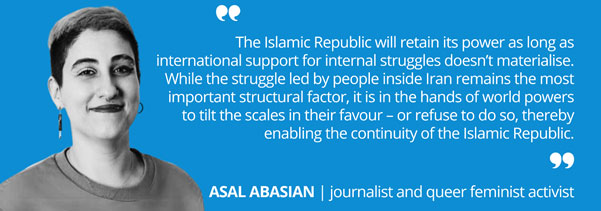
Battered but unbeaten, the Iranian regime views upcoming legislative elections as part of its road to recovery. On 1 March, people will be called on to vote for all 290 members of the Islamic Consultative Assembly. The key battle will be over turnout, which was already down to 42 per cent in 2020 – the lowest since the 1979 revolution. That record could be shattered, as opposition and reformists call for abstention or boycott.
Along with parliamentary elections, in March Iran will hold elections for the Council of Experts, the body of clerics that appoints Iran’s Supreme Leader. The Council has recently faced criticism for its lax oversight of 84-year-old Supreme Leader Ayatollah Ali Khamenei’s performance, and might have to step in relatively soon.
In power since 1989, Khamenei is in a race against the clock. Bent on ensuring that the theocracy he largely built stands strong after he’s gone, he’s preparing his 54-year-old second son to succeed him. But the ongoing economic crisis may conspire against his plans. The cumulative impacts of international sanctions, fluctuating oil prices, mismanagement and rampant corruption have fuelled inflation and unemployment, and discontent runs high.
To prevent accumulated grievances from translating into mass protest, the regime will likely try to tread a fine line between displaying indestructible power and offering minor concessions.
Regional balance shifts
When the protests erupted international support poured in. People around the world showed solidarity with Iranian women and called on their governments to act. Early on, the USA imposed sanctions on the morality police and several senior leaders of the force and other security agencies. New sanctions by the European Union, UK and USA were announced on the eve of the anniversary of the protests.
On International Women’s Day in 2023, a group of Afghan and Iranian women launched the End Gender Apartheid campaign, which seeks recognition and condemnation of the two regimes as based on gender apartheid. They want the 1973 UN Convention on the Suppression and Punishment of the Crime of Apartheid, which so far applies only to racial hierarchies, extended to gender. The campaign wants this specific and extreme form of exclusion to be codified as a crime under international law so those responsible can be prosecuted and punished.
There was hope that such moves would foster action to hold those responsible to account. Civil society called for the creation of a dedicated accountability mechanism to work alongside the UN Special Rapporteur on Iran.
But on 7 October, as Armita lay in a coma, the paramilitary wings of Hamas launched their attacks into Israeli territory, and global attention shifted to this outrage and Israel’s murderous campaign of revenge. As a key source of support for Hamas, Iran was far from out of the spotlight – but condemnation of theocracy and gender apartheid now took a back seat to geopolitical considerations.
Khamenei publicly stated that Iran wasn’t involved in the 7 October attacks, and although he reiterated Iran’s political and moral support for Hamas, he reportedly told Hamas leader Ismail Haniyeh that Iran wouldn’t directly intervene unless it was attacked by Israel or the USA. But Iran’s leadership of the anti-Israeli and anti-western ‘Axis of Resistance’ and the key role it can play in either expanding or limiting the scope of the conflict means it will be included in any attempt to redefine the regional order, and could well emerge stronger.
Amid the chaos and in the search for security, the international community might be increasingly willing to look the other way. Iran’s search for international respectability saw a milestone in November, when it took advantage of other states’ lack of interest to claim the chair of the UN Human Rights Council’s Social Forum. The result was a largely empty room – but it remains the case that Iran succeeded in occupying institutional space to whitewash its blood-soaked image.
This mustn’t be allowed to happen. Iranian women mustn’t be left to their own devices. Iranian pro-democracy and human rights activists, both inside and outside Iran, need the support of the international community if they’re to have any chance.
Workers, some from regions impacted by climate change, joined queues for accreditation outside Expo 2020 in Dubai, where COP28 is being held. Credit: Stella Paul/IPS
DUBAI, Dec 7 2023 (IPS) – With COP23 underway, researchers and activists are pointing at the plight of climate migrants.
On November 30, a few hours before the COP23 was officially inaugurated, long, serpentine queues could be seen outside Expo 2020, the venue of the COP23. Standing under the blazing sun, besides delegates and media personnel, were hundreds of migrant workers, a majority of whom were from Nepal and the Philippines.
The workers, who would later be working in different service hubs such as food kiosks and cleaning units throughout the COP, were there to get registered and get a badge that would allow them entry inside the blue zone, the high-security area within the COP. Almost all of these workers are unskilled and employed by various contractors. Despite the long hours of standing in the scorching sun, none of them was complaining—some because they have worked in much worse conditions, while others didn’t want to earn their employers’ wrath by expressing any displeasure.
“The company decides where and when we will work, as well as how long. What is there to complain about? Please understand, it’s risky,” whispered Chandra, a worker from Nepal who requested not to reveal his last name. Chandra also wouldn’t reveal his exact address except that he is “from the upper Mustang,” a district in Nepal that has seen large-scale migration of locals following massive water scarcity caused by the drying of natural springs and groundwater sources.
Chandra’s whispered sentences nearly summarize the environment in which thousands of migrants work: exposure to harsh climate conditions, inadequate pay packages, and oftentimes abuse, say human rights advocates who have documented migrants across the Middle East.
Human Rights Watch, the US-based global human rights defender, recently published a study conducted in three climate-vulnerable countries—Nepal, Bangladesh, and Pakistan—that found that migrant workers faced a strong set of labor abuses that included paying high recruitment fees, low and irregular wages, and high exposure to extreme heat. Although the research did not specifically focus on climate migrants, most of the respondents were from places that have witnessed strong climate change impacts, including extreme weather events.
Ironically, their search for a secure livelihood and a better life also made them vulnerable to working in environments that leave them exposed to similar harsh climatic conditions. For example, during the construction of Expo City, the very venue of COP28, migrant workers were seen working in scorching heat that could lead to a plethora of health challenges, including heat stroke and extreme dehydration leading to chronic kidney failure. In fact, HRW’s study found that several migrants had had kidney failure and were on dialysis, which not only cost them their jobs but also pushed them into a financial crisis as they needed to take out loans for medical treatment.
“Our study interviewed 73 current and former UAE-based workers and 42 families of current migrant workers between May and September 2023 from Pakistan, Bangladesh, and Nepal. Ninety-four of these interviewees live in or are from areas already facing the devastating consequences of the climate crisis, with scientific studies linking extreme weather events like floods, cyclones, and the salinization of agricultural lands to climate change. In addition, former and current outdoor workers interviewed were working in jobs like construction, cleaning, agriculture, animal herding, and security and were often exposed to the UAE’s extreme heat, which is also increasing due to climate change,” says Michael Page, Deputy Director in the Middle East and North Africa division at Human Rights Watch.
Climate Migration: A global snapshot
According to the International Organization of Migration (IOM), the implications of the climate crisis on migration are profound and are ever-increasing. IOM cites data produced by the Internal Displacement Monitoring Center that shows in 2022 a total of 31.8 million internal displacements due to weather-related hazards.
The World Bank Groundwell Report also shows that in South Asia, 12.5 million people were displaced by climate disasters in 2022, while the numbers are 7.5 million in Sub-Saharan Africa and 305,000 in the Middle East and North Africa region. The report projects that without immediate and concerted climate and development action, the number could go up to over 216 million by 2050.
According to the Nepal government’s own assessment, the UAE, along with Qatar, remain the most popular work destinations among young Nepalis. Data collected by the country’s Department of Foreign Employment (DoFE), 37,492 young people arrived in the UAE for work between mid-July and mid-October of the current fiscal year alone. This group includes 7,015 women and 30,477 men.
A moment of global recognition
On Friday, Nepal, one of the biggest source countries of unskilled and climate migrants, found a special mention in the speech of UN Secretary General Antonio Guterres at the inaugural ceremony of COP28. “Just days ago, I was on the melting ice of Antarctica. Not long before, I was among the melting glaciers of Nepal. These two spots are far in distance, but united in crisis. Polar ice and glaciers are vanishing before our eyes, causing havoc the world over, from landslides and floods to rising seas,” Guterres said, addressing the global leaders at the opening ceremony.
Soon after, addressing the media, Nepal Prime Minister Pushpa Kamal Dahal said that his country was preparing to establish Nepal’s rights to receive compensation for loss and damage. According to him, Guterres’s speech had drawn the world’s attention to the climate crisis in Nepal, and his government would now push for the much-deserved compensation under the newly operationalized Loss and Damage mechanism.
Maheshwar Dhakal, Joint Secretary, Ministry of Forests and Environment, who is at the COP, says that Nepal has plans to address climate-induced displacement and migrations at their root, but it needs external support and resources.
“Due to climate change and loss of livelihood, our youths are migrating rapidly to other countries. This is also destabilizing the family value system and causing social disorder as youths are separated from their family elders. This is under discussion at the political level. But at the same time, unless and until equal education, opportunities, and a level of salary (available in other countries) are made available, we cannot stop this migration. We have assessed that the total cost to implement our National Action Program (that can address climate displacement) will be USD 50 billion, of which we can only raise USD 2 billion; we need the rest from external sources such as the various funds.”
However, experts believe that host countries, particularly the COP presidency UAE, where migrant workers make up 88% of the labor force, can take immediate steps while negotiators develop their respective arguments and strategies to claim compensation for climate refugees and displaced people under the climate finance mechanisms.
One of these is adopting a risk-based labor protection policy.
Currently, the Ministry of Human Resources and Emiratisation (MoHRE) is implementing the ‘Midday Break’ initiative, which broadly means workers should not work outside from 12 to 3 p.m. Violations of the ban can lead to a fine of Dh5,000 for each worker from non-compliant employers. The maximum fine amount is Dh50,000 when multiple workers are made to work during the banned hours.
However, the policy also allows employers to continue working through midday in areas where it is deemed unfeasible to postpone work until it is completed. These works typically include roofing, manning traffic, containing hazards or repairing damages such as interruptions to water supply or electricity, etc.
These provisions provide escape routes for employers who continue to push migrant workers into unsustainable and risky work conditions. The same ‘loopholes’ also make the labor policies inadequate for protecting migrant workers from harsh weather conditions, says Page of HRW, who thinks adopting a public health risk-based policy would be the right way to ensure migrant workers’ rights.
A risk-based approach would mean that countries, competent authorities, and employers would identify, assess, and understand the public health risks to which the workers are exposed and take the appropriate mitigation measures in accordance with the level of risk. One of these strategies would be to use the wet bulb globe temperature (WBGT) index, which is already in use in nations like Canada.
The wet bulb globe temperature (WBGT) unit considers a number of environmental factors, such as air temperature, humidity, and air movement, which contribute to the perception of hotness by people.
Page thinks that the adoption of the wet bulb globe temperature (WBGT) would be a great way to assess the risks for migrant workers in a place like the UAE because it can cover more risk factors that are usually ignored by employers but are regularly faced by the workers. For example, in some workplace situations, solar load (heat from radiant sources) is also considered in determining the WBGT as the basis of the risk assessment.
“If the UAE really cares about the protection of its migrant workforce, then they should also care about adopting a risk assessment method that is more reflective of local conditions; that will also ensure climate justice for the workers,” Page says.