Bahrain’s Political Prisoners: Resistance Against the Odds

Civil Society, Crime & Justice, Democracy, Featured, Headlines, Human Rights, Middle East & North Africa, TerraViva United Nations

Opinion

Credit: Mohammed al-Shaikh/AFP via Getty Images

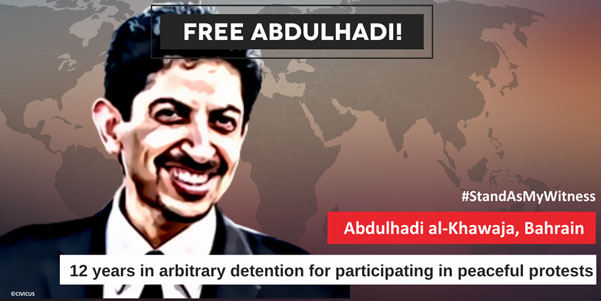
MONTEVIDEO, Uruguay, Sep 26 2023 (IPS) – Maryam al-Khawaja’s journey home ended before it had begun: British Airways staff stopped her boarding her flight at the request of Bahraini immigration authorities. Maryam was no regular passenger: her father is veteran human rights activist Abdulhadi al-Khawaja, in jail in Bahrain for 12 years and counting.


Abdulhadi was sentenced to life in prison on bogus terrorism charges for his role in 2011 democracy protests, part of the ‘Arab Spring’ regional wave of mobilisations. His health, weakened due to denial of medical care, has further declined as he joined other political prisoners in a hunger strike demanding improvements in prison conditions.

Emerging from the unlikeliest place – a prison designed to break wills and destroy the desire for freedom – this hunger strike has become the biggest organised protest Bahrain has seen in years.

Maryam has four judicial cases pending in Bahrain but was ready to spend years in prison if this was what it took to save her father’s life. This is far from Abdulhadi’s first hunger strike, but his family warns that his fragile health means it could be his last. In denying Maryam the chance to see her father, the Bahraini regime has reacted as those who rule by fear often do: in fear of those who aren’t afraid of them.

A prison state

The Bahraini cracked down severely on the 2011 protests, unleashing murderous security force violence to clear protest sites, arresting scores of protesters, activists and opposition leaders, subjecting them to mass trials and stripping hundreds of citizenship. It sentenced 51 people to death and has executed six, while 26 wait on death row having exhausted their appeals. Most were convicted on the basis of confessions obtained through torture.

Many of those arrested in the 2011 protests and subsequent crackdown remain behind bars. According to estimates from the Bahrain Center for Human Rights, over the past decade the government has arrested almost 15,000 people for their political views, and between 1,200 and 1,400 are still jailed, mostly in Jau prison in Manama, the capital. Abdulhadi is one of many.
On 7 August, Jau’s political prisoners went on hunger strike. Their demands include an end to solitary confinement, more time outside cells – currently they’re only allowed out for an hour a day, permission to hold prayers in congregation, amended visitation rules and access to adequate medical care and education. Over the following weeks the numbers taking part grew to more than 800. Their families took to the streets to demand their release.

On 31 August, the political prisoners extended their protest after rejecting the government’s offer of only minor improvements.

On 11 September, a two-week suspension of the strike was announced to allow the government to fulfil promises to improve conditions, including ending isolation for some prisoners. It seemed clear the government had shifted position to avoid embarrassment as Bahrain’s Crown Prince and Prime Minister Salman bin Hamad Al-Khalifa prepared to meet US President Joe Biden.

Abdulhadi, however, soon resumed his hunger strike after being denied access to a scheduled medical appointment, only to suspend it a few days later when he was promised improvements in conditions, including a cardiologist appointment. But the next day it became apparent that these were all lies, and he resumed his hunger strike. It felt, as Maryam put it, ‘like psychological warfare and an attempt to kill solidarity’.

International solidarity urgently needed

In her attempt to return to Bahrain, Maryam received strong international support. Several Bahraini, regional and international civil society groups backed a joint letter urging European Union authorities to call for the immediate and unconditional release of all Bahrain’s political prisoners. A similar letter was sent to the UK government.

In late 2022, backlash from human rights organisations forced Bahrain to withdraw its candidacy for a UN Human Rights Council seat. And earlier this year, during the Inter-Parliamentary Union’s global assembly in Bahrain, which the regime sought to use for whitewashing purposes, parliamentarians called on Bahrain to release Abdulhadi and send him to Denmark for medical treatment.

But while Bahrain’s political prisoners have many allies, some powerful voices aren’t among them.

Bahrain’s foreign allies include not only repressive autocracies such as Saudi Arabia and the United Arab Emirates but also democratic states, notably the UK and the USA, which clearly value stability and security far more highly than democracy and human rights.

Following Bahrain’s independence in 1971, the UK has continued to back the institutions it established – and has pretended to see progress towards democratic reform. In July, Bahrain’s Crown Prince made an official visit to the UK, where he met Prime Minister Rishi Sunak and signed a ‘Strategic Investment and Collaboration Partnership’ between the two countries. This included a US$1 billion investment deal in the UK. Barely a month before the start of the hunger strike, Sunak welcomed ‘progress on domestic reforms in Bahrain, particularly in relation to the judiciary and legal process’.

For the USA, Bahrain has been a ‘major non-NATO ally‘ since 2002 and a ‘major security partner’ since 2021. Bahrain was the first state in the region to be accorded major non-NATO ally status, the first to host a major US military base and the first, in 2006, to sign a free trade agreement with the USA. The US Navy’s Fifth Fleet, one of seven around the world, is stationed there, and the country hosts the headquarters of the US Naval Forces Central Command.

On 13 September, the Crown Prince visited Washington DC and signed a ‘Comprehensive Security Integration and Prosperity Agreement’ meant to scale up military and economic cooperation with the USA.

Only in the last paragraph of its pages-long announcement, meticulously detailed in every other respect, did the White House briefly acknowledge that human rights were an item of discussion. Nothing was said about the content or outcome of those alleged conversations.

The USA has been repeatedly chastised for a ‘selective defence of democracy‘. President Biden promised a foreign policy centred around human rights, but that rings hollow in Bahrain. It’s high time the USA, the UK and other democratic states use the many levers at their disposal to urge the Bahraini government to free its thousands of political prisoners and move towards real democratic reform.

Inés M. Pousadela is CIVICUS Senior Research Specialist, co-director and writer for CIVICUS Lens and co-author of the State of Civil Society Report.

  Source

Iran: One Year on, What’s Changed?

Active Citizens, Civil Society, Crime & Justice, Democracy, Economy & Trade, Featured, Gender, Headlines, Human Rights, Middle East & North Africa, TerraViva United Nations, Youth

Opinion

Credit: Dan Kitwood/Getty Images

MONTEVIDEO, Uruguay, Sep 19 2023 (IPS) – It’s a year since a photo of 22-year-old Mahsa Amini – bruised and in a coma she would never recover from after being arrested by the morality police for her supposedly improperly worn hijab – went viral, sending people onto the streets.


The protests became the fiercest challenge ever faced by Iran’s theocratic regime. The unprecedented scale of the protests was matched by the unparalleled brutality of the crackdown, which clearly revealed the regime’s fear for its own survival.

Led by women and young people, mobilisations under the ‘Woman, Life, Freedom’ banner articulated broader demands for social and political change. They spread like wildfire – to streets across Iran, to universities, even to cemeteries where growing numbers of the regime’s victims were being buried. They were echoed and amplified by the Iranian diaspora around the world. The Iranian people made it abundantly clear they wanted the Islamic Republic gone.

A year on, the theocratic regime still stands, but that doesn’t mean nothing has changed. By sheer force, the authorities have regained control – at least for now. But subtle changes in daily life reveal the presence of active undercurrents that could once again spark mass protests. The regime knows this, hence the fear with which it has awaited this date and its redoubled repression as it neared.

A glimpse of change

Last December, as protests raged and the authorities were busy trying to stop them, women could be seen on Iranian streets without their hijabs for the first time in decades. After the protests were quelled, many simply refused to resubmit to the old rules. A tactical shift followed, with mass street mobilisation turning into more elusive civil disobedience.

Women, particularly Gen Z women just like Mahsa, continue to protest on a daily basis, simply by not abiding by hijab rules. Young people express their defiance by dancing or showing affection in public. Cities wake up to acts of civil disobedience emblazoned on their walls. Anti-regime slogans are heard coming from seemingly nowhere. In parts of the country where many people from excluded ethnic minorities live, protest follows Friday prayers. It may take little for the embers of rebellion to reignite.

Preventative repression

Ahead of the anniversary, family members of those killed during the 2022 protests were pressured not to hold memorial services for their loved ones. The lawyer representing Mahsa Amini’s family was charged with ‘propaganda against the state’ due to interviews with foreign media. University professors suspected to be critical of the regime were dismissed, suspended, forced to retire, or didn’t have their contracts renewed. Students were subjected to disciplinary measures in retaliation for their activism.

Artists who expressed support for the protest movement faced reprisals, including arrests and prosecution under ridiculous charges such as ‘releasing an illegal song’. Some were kept in detention on more serious charges and subjected to physical and psychological torture, including solitary confinement and beatings.

Two months ago, the regime put the morality police back on the streets. Initial attempts to arrest women found in violation of hijab regulations, however, were met with resistance, leading to clashes between sympathetic bystanders and police. Women, including celebrities, have been prosecuted for appearing in public without their hijab. Car drivers carrying passengers not wearing hijab have been issued with traffic citations and private businesses have been closed for noncompliance with hijab laws.

The most conservative elements of the regime have doubled down, proposing a new ‘hijab and chastity’ law that seeks to impose harsher penalties, including lashes, heavy fines and prison sentences of up to 10 years for those appearing without the hijab. The bill is now being reviewed by Iran’s Guardian Council, a 12-member, all-male body led by a 97-year-old cleric.

[embedded content]

If not now, then anytime

In the run-up to 16 September, security force street presence consistently increased, with snap checkpoints set up and internet access disrupted. The government clearly feared something big might happen.

As the anniversary passes, the hardline ruling elite remains united and the military and security forces are on its side, while the protest movement has no leadership and has taken a bad hit. Some argue that what made it spread so fast – the role of young people, and young women in particular – also limited its appeal among wider Iranian society, and particularly among low-income people concerned above all with economic strife, rising inflation and increasing poverty.

There are ideological differences among the Iranian diaspora, which formed through successive waves of exiles and includes left and right-wing groups, monarchists and ethnic separatists. While most share the goal of replacing the authoritarian theocracy with a secular democracy, they’re divided over strategy and tactics, and particularly on whether sanctions are the best way to deal with the regime.

Ever since the protests took off last year, thousands of people around the world have shown their support and called on their governments to act. And some have, starting with the USA, which early on imposed sanctions on the morality police and senior police and security officials. New sanctions affecting 29 additional people and entities, including 18 members of the Islamic Revolutionary Guard Corps and security forces, were imposed on the eve of the anniversary of the protests, 15 September, International Day of Democracy. That day, US President Joe Biden made a statement about Mahsa Amini’s inspiration of a ‘historic movement’ for democracy and human dignity.

The continuing outpouring of international solidarity shows that the world still cares and is watching. A new regime isn’t around the corner in Iran, but neither is it game over in the quest for democracy. For those living under a murderous regime, every day of the year is the anniversary of a death, an indignity or a violation of rights. Each day will therefore bring along a new opportunity to resurrect rebellion.

Inés M. Pousadela is CIVICUS Senior Research Specialist, co-director and writer for CIVICUS Lens and co-author of the State of Civil Society Report.

  Source

The Privilege of Making a Choice

By Yasmine Sherif
NEW YORK, May 8 2023 (IPS)

A civilian student named Saber was caught in the crossfire in Khartoum. He had two choices: either flee and lose everything; or die. But within a moment his option to choose was violently denied: he died.


As a result of the brutal internal armed conflict in Sudan right now, UNHCR projects that 860,000 people will flee across the borders as refugees and returnees into the Central African Republic, Chad, Egypt, Ethiopia, Eritrea and South Sudan. About 50% will be children and adolescents below 18.

Will they arrive alive? They can’t choose. They can only hope.

Making it worse, none of the neighboring countries has the financial and structural capacity to manage such influx, and yet they too, have no choice.

Indeed, an enormous international response will be required to support the Refugee Response Plan developed by 134 partners, including UN agencies, national and international NGOs and civil society groups, and launched on 4 May 2023.

Fleeing children and adolescents will need immediate psycho-social support and mental health care to cope with the stress and trauma of the conflict and perilous escape. They will need school meals. They will need water and sanitation. They will need protection. In the deep despair of their young lives, they will need a sense of normalcy and hope for their future. They need it now and a rapid response to establishing education can meet these needs.

Or to paraphrase ECW’s new Global Champion, the world-renowned journalist, Folly Bah Thibault – who reaffirms the need for speed and quality: the humanitarian-development nexus in action – in her high-level interview in this month’s ECW Newsletter, “We need to deliver with humanitarian speed and development depth.”

The choice is ours.

ECW is now traveling to the region to support host-governments, UN and civil society colleagues who jointly produced the Refugee Response Plan and who are on the ground working day and night in difficult circumstances. ECW will provide support both through an initial First Emergency Response investment and through our global advocacy.

We all have a choice to act now. Our choice is not between losing everything or die. Our choice is between action or inaction. Between humanity and indifference.

Prior to the breakout of the internal armed conflict in Sudan, Samiya*, a 17-year-old refugee student, wrote in her recent Postcard From the Edge: “Education is our future dream. Education is one of the most important factors to progress in life. Through education, people can thrive in their lives; they can also develop their skills and improve their life quality.”

We can help make Samya’s dream come true at the hardest, darkest moment of her life. Samiya does not have that choice. Only, we have that choice. Let us recognize it for what it is: as a privilege or blessing of choosing responsibility and humanity.

Yasmine Sherif is Director of Education Cannot Wait.

IPS UN Bureau


!function(d,s,id){var js,fjs=d.getElementsByTagName(s)[0],p=/^http:/.test(d.location)?’http’:’https’;if(!d.getElementById(id)){js=d.createElement(s);js.id=id;js.src=p+’://platform.twitter.com/widgets.js’;fjs.parentNode.insertBefore(js,fjs);}}(document, ‘script’, ‘twitter-wjs’);  

Source

As a Humanitarian Crisis Engulfs Afghanistan, Education Cannot Wait Makes Urgent Appeal for Access to Quality Learning for All Children

Civil Society, Development & Aid, Editors’ Choice, Education, Education Cannot Wait. Future of Education is here, Featured, Headlines, Human Rights, Humanitarian Emergencies, Inequity, Middle East & North Africa, TerraViva United Nations

Education Cannot Wait. Future of Education is here

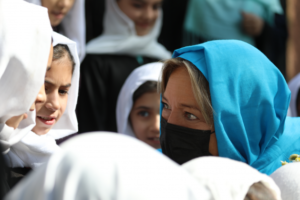
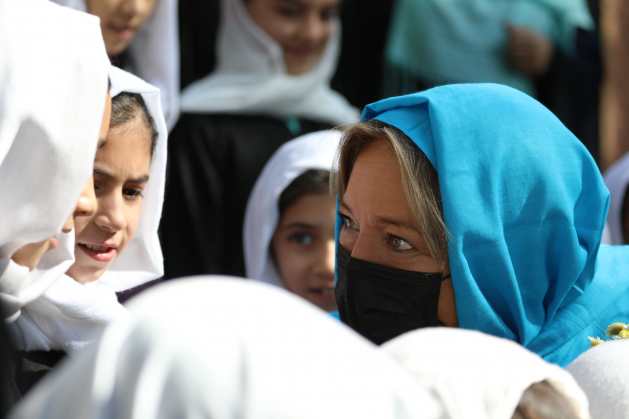
Yasmine Sherif, Director of Education Cannot Wait, is welcomed by teachers and students at a girls’ primary school in Kabul, Afghanistan.
Credit: Omid Fazel/ECW

New York, Nov 5 2021 (IPS) – After leading a landmark, first-ever all-women mission to Afghanistan last week, Yasmine Sherif, Director of Education Cannot Wait, the United Nations global fund for education in emergencies and protracted crises, says that schools must reopen for all children and that girls, in particular, must be able to return to secondary school classrooms.


Sherif visited a girls’ school in Kabul and spoke to students, female teachers, and administrators as part of her Afghan mission. She also met with the de facto education authorities at the Ministry of Education to advocate the right of all children to quality education. The ECW mission comes less than a month after ECW launched a US$4 million First Emergency Response grant to provide ‘quality, flexible learning and psychosocial support for children and adolescents caught in the escalating crisis.

“We need to act fast. When you are in the midst of a humanitarian emergency like Afghanistan, where there is no money in circulation, starvation is a very real fact and poverty is extreme,” Sherif told IPS. “Schools need to continue to reopen and education must be sustained. Not only at primary school levels but through secondary schools – and girls have to go back to secondary schools.”

Sherif, a human rights lawyer, worked in Afghanistan in the early 1990s. She was part of a mission to the country after the first Taliban takeover in 1999 and has visited the country periodically over the last 20 years. She spoke to IPS about her observations from this ground-breaking mission to Kabul a few days ago – the first of its kind since the Taliban take-over in August.

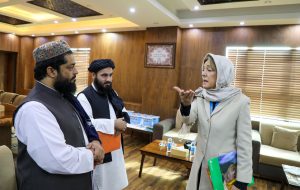
Yasmine Sherif, Director of Education Cannot Wait, meets with de facto education authorities in Afghanistan.
Credit: Omid Fazel/ECW

“There are more women on the streets of Kabul today. I even saw women demonstrating for health care. I visited a girls’ primary school whose teachers and administration were all women,” Sherif said.

“The school’s headmaster is a woman, the school’s doctor is a woman, administrators and teachers are women. There are educated, strong women who are working, but they do not get salaries, because there are no salaries for basic services as a result of the funding freeze to Afghanistan.”

The World Bank, the International Monetary Fund, and the European Union are just a few of the international bodies that have cut off Afghanistan’s access to financing. According to the World Bank, the country relies on grant funding for more than 75 percent of public spending, with expenditure of US$411 billion and government revenue of US$2.5 billion.

With that grant funding frozen, the country is on the brink of economic collapse.

Sherif is appealing for direct funding through UN agencies like ECW and UNICEF, which has the proven mechanisms in place to ensure that funds are used to support teachers and students.

“Teachers are not being paid. UNICEF has a very strong process on the ground. If money were to be given today or tomorrow to pay all teacher salaries, UNICEF has capacities in place to deliver on that funding, even if this would typically have been done through the World Bank or other development actors, but now we are in humanitarian crisis so you cannot use regular development aid approaches,” Sherif told IPS.

“The same goes for all UN agencies like the World Food Programme and UNHCR, the UN Refugees agency. Funding can be channeled through them directly to implement aid programmes. Nothing needs to, nor will go through, the de facto authorities.”

The ECW Director is cautiously optimistic following her meeting with the de facto education authorities, to whom she appealed for a return to secondary school for girls.

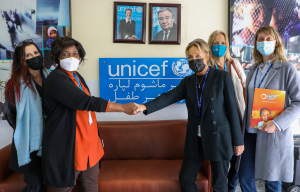
UNICEF Deputy Representative Alice Akunha and Chief of Education Jeannette Vogelaar greet the Education Cannot Wait all-women delegation to Afghanistan, led by Director Yasmine Sherif and her colleagues, Michelle May and Anouk Desgroseilliers.
Credit: Omid Fazel/ECW

“Primary schools have opened for girls’ education and for girls’ secondary education, the de facto authorities told us that they are developing a plan. I stressed that the girls have no time to lose and that the benefits of educating girls are crucial to the future of the country,” she said.

The ECW Director has commended international and national civil society organizations that now work with religious scholars as they negotiate the resumption of secondary school education at the grassroots level. “By bringing an Islamic scholar with them, these NGOs have actually managed to build trust. So secondary schools have opened in some provinces, a few in the north and a few in the south. It is important to stand firm on human rights and girls’ rights, but you must also have the ability to build trust as well,” she said.

ECW is already prepared to swiftly scale up its support and adapt its programming in Afghanistan. New challenges and more children in need of help demand pivoting and quick response. Sherif says ECW was created for crises like these.

“As the UN’s global fund for education in emergencies and protracted crises, we are agile, quick, and flexible. We use decades of lessons learned across the UN system to respond to crises. Traditional development aid modalities that are not crisis-sensitive are not going to work; not in this situation,” she said.

Sherif says that an estimated $1 billion is urgently required for United Nations agencies and international and local NGOs to meet the pressing education needs across the country.

“It’s about how can we save the Afghan population from a humanitarian catastrophe. How can we ensure that every Afghan girl and boy in the country can go to primary and secondary school? It’s about how we can ensure that teachers receive their salaries, so they are able to continue to teach. It is about providing teaching and learning materials and safe learning environments. It is about ensuring that the rights of adolescent girls to access education are fulfilled. That is why it was important for us to do an all-women mission to Afghanistan and to make clear where we stand on girls’ education.”

Sherif is hoping that the visit can give the world an open window view into life in Afghanistan and provide concrete recommendations for international aid to be immediately scaled up and invested to support quality education for both girls and boys.

“Afghanistan cannot wait. The girls of Afghanistan cannot wait. Education cannot wait.”

  Source

Bringing Quality Education to Syria’s Most Vulnerable, Crisis-Impacted Children – Their Education Cannot Wait

Armed Conflicts, Civil Society, Development & Aid, Education, Education Cannot Wait. Future of Education is here, Featured, Headlines, Human Rights, Humanitarian Emergencies, Inequity, Middle East & North Africa, Poverty & SDGs, TerraViva United Nations

Education Cannot Wait. Future of Education is here

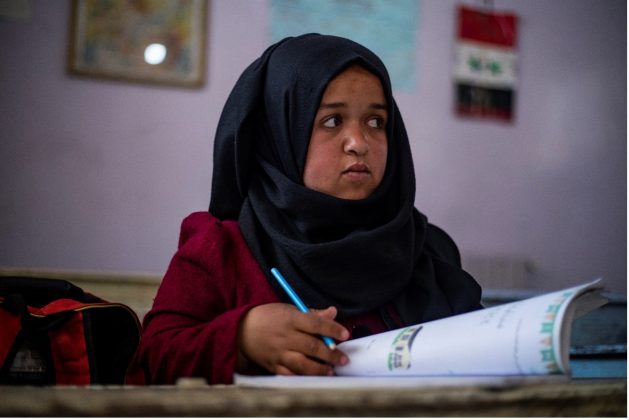
Kawthar, 13, takes notes while attending Grade 3 at a UNICEF-supported self-learning centre in Al-Hasakeh, northeast Syria. She says she always wanted to be like other children and grab her bag and go to school like other children. With Education Cannot Wait assisted schooling, this dream has become a reality. Credit: UNICEF/ Syria 2020/ Delil Souleiman

DOMINICA, Oct 21 2021 (IPS) – In war-torn Syria, the support of Education Cannot Wait (ECW) – the United Nations global fund for education in emergencies and protracted crises – is bringing positive, life-changing educational opportunities tailored to children like 11-year-old Ali.


Ali, who lives in Raqqa with his two siblings and parents, has to work to help support his family. He and his brother did not attend school. Ali heard about registration for ECW-supported educational activities near the industrial area in which he works. They are part of courses being offered in three centres in the city – alongside psychosocial support for children who have experienced war for most of their lives.

Ali initially registered his siblings in the ECW-supported programme but held out himself for fear of losing his job. The centre proposed a flexible learning schedule – one that would allow the brothers to work and attend classes. Programme officials had to convince his family and employers at the industrial centre that school is essential for children’s development. Now he is part of a class of 16 children from the area who attend classes from 7:30 am to 10:00 am. After class, they go to work.

Ali’s story is one of the many stories of vulnerable children and adolescents embroiled in Syria’s protracted conflict that ECW’s investments are helping bring back to school in partnership with education partners on the ground. ECW’s multi-year response in Syria was initiated in 2017 through an initial investment which was further expanded into a Multi-Year Resilience Programme which will continue until 2023 with a cumulative budget of US$45 million.

Yasmine Sherif, the Director of Education Cannot Wait, says too many children and adolescents in Syria have only seen the brutal reality of war, forced displacement, and the hardship of living in areas affected by armed conflict in their short lives.  Credit: Education Cannot Wait (ECW)

“Too many children and adolescents in Syria have only seen the brutal reality of war, forced displacement, and the hardship of living in areas affected by armed conflict in their short lives. For them, education is a beacon of hope. It is an opportunity to thrive and become positive changemakers to rebuild their communities and ensure a more peaceful and prosperous future for all,” said Yasmine Sherif, the Director of Education Cannot Wait. “Working together with our partners on the ground, ECW is dedicated to fulfilling the right to a quality education for the most vulnerable girls and boys in Syria.”

Save the Children has key actor status in the education sector in Syria and has been involved since the inception of ECW’s multi-year response, providing sector-specific technical expertise and guiding in the development of a programme framework that is responsive to the extensive education needs of children in Syria,” Sara Dabash, Awards Officer for the ECW programme in Syria, told IPS.

Children and adolescents already suffering from the impacts of a decade-long war are also bearing the brunt of the COVID-19 pandemic, particularly due to school closures and movement restrictions.

“The disruption of access to quality education for children has dramatically impacted learning and child well-being. In addition, lack of access to safe learning environments and continued isolation exposes children to higher risks of child labour, early marriage, and other negative coping mechanisms. The limited social interactions also compromise access to psychosocial support and other protection services,” Dabash said.

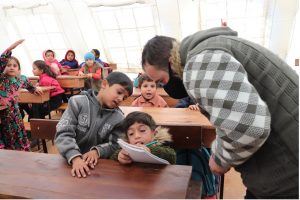
Emad, 9, who lives with a disability, shows his writing to his teacher to check if he is doing right in the class of Arabic subject in the ECW supported temporary learning space in Idleb, northwest Syria. Credit: UNICEF/ Syria 2020

According to Dabash, blended learning options have been introduced, using devices such as mobile phones for remote learning. This option has its downsides as many children have limited to no access to phones or internet connections.

Figures provided by Save the Children put almost 7 million people in need of humanitarian education assistance. Children make up 97 percent of that number. Dabash says, however, that in the “determined locations of implementation within the ECW Programme in northeast Syria, Save the Children, with the support of its partners, has identified around 15,000 children as the most vulnerable and in need of education assistance.”

Since 2017, ECW is also partnering with UNICEF to provide quality education services for the most vulnerable children in the country.

“With funding from ECW, UNICEF provides children across Syria with opportunities to continue their learning through a holistic package of activities tailored to the needs of the children. To support learning, the package of activities generally includes providing learning supplies and psychosocial support through recreational activities. Where classrooms do not exist or continue to be unsafe or overcrowded, we establish new classrooms and rehabilitate existing ones,” Karen Bryner, Education Specialist and ECW Programme Manager in Syria, told IPS.

Bryner says the partnership provides training, teaching supplies and stipend payments to teachers.

The goal is to get as many girls and boys as possible enrolled and attending school regularly. According to UNICEF, ‘children have experienced psychological distress due to violence and instability. Many have missed years of education, with over 2.4 million currently out of school.’

The COVID-19 pandemic has challenged that goal with intermittent school closures. However, Bryner says when face-to-face instruction was not an option, the ECW-supported students transitioned to electronic and paper-based distance education.

“Various modalities were used over the last year, including WhatsApp groups by teachers to deliver daily instruction where connectivity allowed; blended learning with face-to-face instruction two days a week and home-based learning (worksheets and assignments) for the other days, conducting lessons in smaller groups closer to children’s homes, and home delivery of biweekly learning packs and retrieval of students’ work by teachers,” she told IPS.

Kawthar, 13, hangs out with her cousin Juhaina outside her house in Ghwairan neighbourhood, Al-Hasakeh. Since 2019, she has benefitted from the self-learning programme, helping her catch up on the education she had missed due to displacement, her disability, and the financial challenges her family had. Credit: UNICEF/ Syria 2020/ Delil Souleiman

The story of 13-year-old Kawthar is a testament to the positive impact of ECW’s support for the most marginalised children Displaced five times and suffering from growth-related issues due to stunting, she could not walk to school, and her family could not afford transportation. Two years ago, Kawthar, originally from Al-Hasakeh City, enrolled in the ECW-supported self-learning programme implemented by UNICEF– a course that gives out-of-school children the tools to catch up to their peers. She also receives transportation to classes.

“I always wanted to be like all other children; to grab my bag and head to school; to read, write and learn,” says Kawthar. “I wish for all children to be able to go to school. And I certainly hope that nobody gets displaced anymore and that we all remain safe.”

According to UNICEF, with ECW funding, since November 2020, the self-learning programme has been able to reach 2,600 out-of-school children in Al-Hasakeh. Despite this progress, challenges remain to fulfil the right to inclusive, quality education for every child in Syria.

UNICEF states that there has been a 20 percent increase in the number of children in need of humanitarian assistance, and agencies will need scaled-up support as they continue to bring hope to Syria’s children.

  Source

Biden’s Opportunity To End Israeli-Palestinian Conflict

Armed Conflicts, Civil Society, Featured, Global Geopolitics, Headlines, IPS UN: Inside the Glasshouse, Middle East & North Africa, Peace, TerraViva United Nations

Opinion

Dr. Alon Ben-Meir is a professor of international relations at the Center for Global Affairs at New York University (NYU) and teaches courses on international negotiation and Middle Eastern studies

Time is running out fast. Thousands of jobs could be lost if the financial situation of the United Nations Relief and Works Agency for Palestine Refugees in the Near East (UNRWA) doesn’t improve promptly, says Philippe Lazzarini, the organization’s commissioner-general. Credit: United Nations

NEW YORK, Dec 7 2020 (IPS) – Recently I had an opportunity to brief a group of European diplomats and journalists on a variety of conflicts, with a focus on the Middle East. During the Q&A I was asked which of the region’s conflicts Biden should tackle first.


Without much hesitation I said the Israeli-Palestinian conflict, not only because it is over seven decades old, but because it is an increasingly intractable, explosive, and destabilizing situation, which reverberates throughout the Mideast, and several regional powers are exploiting it to serve their own national interests, which sadly contributes to its endurance.

It is expected that Biden will support a two-state solution given his past position on the Israeli-Palestinian conflict, albeit a growing number of Israelis and Palestinians no longer believe that such an outcome remains viable.

I disagree with this belief: the Palestinians will never give up their right to establish an independent state of their own, and the one-state solution, which is being floated as an alternative, will never be accepted by the Israelis, because that would compromise the Jewish national identity of the state and undercut its democratic nature.

Due to the inter-dispersement of the Israeli and Palestinian populations, the two independent states, however, will have to fully collaborate in many areas, especially on security and economic development. This will lead to the establishment of the framework for a confederation, which will be the final outcome after several years of peace and reconciliation.

For Biden to succeed where his predecessors failed, he must repair the severe damage that Trump has inflicted on the entire peace process and restore the Palestinians’ confidence in a new negotiation that could, in fact, lead to a permanent solution.

To that end, he must take specific measures before the start of the talks and establish rules of engagements to which both sides must fully subscribe to demonstrate their commitment to reaching an agreement.

Preliminary Measures

Reestablish the PLO mission in DC: Biden should allow the Palestinian Authority (PA) to reestablish its mission in DC. This would immediately open a channel of communication which is central to the development of a dialogue between the US and the PA and to clear some of the initial hurdles before resuming the negotiations.

Resuming financial aid: It is essential that Biden restore the financial aid that the Palestinians had been receiving from the US. The Palestinian Authority is financially strapped and is in desperate need of assistance. The aid given should be monitored to ensure that the money is spent on specific program and projects.

Prohibiting territorial annexation: The Biden administration should inform the Israeli government that it will object to any further annexation of Palestinian territories. It will, however, keep the American embassy in Jerusalem and continue recognizing Jerusalem as its capital, leaving its final status to be negotiated.

Freezing settlement expansion: Given the intense controversy about the settlements and their adverse psychological and practical effect on the Palestinians, Biden should insist that Israel impose a temporary freeze on the expansion of settlements. This issue should top the negotiating agenda to allow for a later expansion of specific settlements in the context of land swaps.

Invite Hamas to participate: The Biden administration should invite Hamas to participate in the negotiations jointly with the PA or separately, provided they renounce violence and recognize Israel’s right to exist. If they refuse, they should be left to their own devices and continue to bear the burden of the blockade.

Appoint professional and unbiased mediators: Unlike Trump’s envoys who openly supported the settlements and paid little or no heed to the Palestinians’ aspirations, Biden’s envoys should be known for their integrity, professionalism, and understanding of the intricacies of the conflict, and be committed to a two-state solution.

Invite Arab and European observers: The Arab states and the EU are extremely vested in a solution to the Israeli-Palestinian conflict. Saudi and German officials will be ideal observers who can render significant help in their unique capacity as leading Arab and European powers.

Rules of engagement

Establishing the end game: No negotiations succeed unless the parties involved agree on the nature of their desired outcome. For the Palestinians it is establishing an independent Palestinian state, and for Israelis it is maintaining the security and independence of a democratic Jewish state. Before embarking on new negotiations, the Biden administration should insist that both sides unequivocally commit to a two-state outcome.

Acknowledging historical and psychological impediments: Both sides have paid little heed in the past to the need to understand each other’s historic experiences—the Holocaust for the Israelis and the Nakba (catastrophe) for the Palestinians—which they subconsciously use as protective shields. Acknowledging each other’s respective traumatic experiences would help mitigate the psychological impediments which continue to feed into the mutual distrust and hatred.

Ending public acrimony: No negotiations can be conducted in good faith in an atmosphere of mutual public acrimony, as had been the case in all prior peace talks. An integral part of any negotiating process is to build trust, which cannot be nurtured while denouncing each other publicly. Leaders on both sides must end acrimonious statements, as their respective publics will have no faith in negotiations under such an atmosphere.

Renouncing and preventing violence: Both sides must commit not only to renouncing violence but to doing everything in their power to prevent acts of violence against one another. To be sure, nothing is more disruptive to the negotiations than a wanton act of violence.

To that end, both sides need to fully collaborate on all security matters and send a clear massage, especially to extremists on both sides, that violence will not be tolerated and perpetrators will suffer severe consequences.

Delinking and “banking” agreed-upon issues: What will be necessary in future talks is to commit to “bank” any agreement reached on a specific issue, delink it from all others, and not subject it to renegotiations should the talks stall or collapse. This would prevent the resumption of negotiations from ground zero and allow for the building blocks that could eventually lead to an agreement.

In that regard, five critical issues—the settlements, Jerusalem, the Palestinian refugees, national security, and borders—have been hashed and rehashed ad nauseum in past negotiations. The Biden team should identify any common denominator on these issues to prevent renegotiating certain elements over which both sides have already agreed.

Establishing a process of reconciliation: The negotiating process must simultaneously be accompanied by a process of reconciliation. Both sides must initiate widespread people-to-people interactions to gradually mitigate the deep animosity and distrust between them which cannot simply be negotiated away.

Israelis and Palestinians should engage in many activities, including sports, performing arts, tourism, development projects, and student interactions, to foster trust and confidence that peaceful coexistence is possible.

Keeping the public informed: Given that both sides will be required to make significant concessions, it will be imperative to keep their respective publics informed about the progress being made in the negotiations to engender support.

Keeping the public in the dark, as was the practice in past, prevented the public from developing any vested interest in the negotiating process and its successful outcome.

The failure of both sides to agree in the past to establish and be governed by the above rules of engagement clearly suggests that neither side negotiated in good faith. The Biden administration must insist that Israelis and Palestinians accept the above rules if they want to resume the negotiations in earnest. Otherwise, the new talks will be nothing but an exercise in futility.

Sadly though, the current leaders in Israel and Palestine are not in a position to enter into serious negotiations, and must leave the political scene before Biden resumes new talks. Prime Minister Netanyahu is on record opposing the establishment of a Palestinian state; he is also facing three criminal charges of corruption, and in spite of his impressive accomplishments, he may well have outlived his usefulness.

President Abbas too has taken a hard position in connection with the settlements, Jerusalem, and the refugees, and it will be nearly impossible for him to make any significant concession and survive politically.

He is also “too comfortable” in his position and does not want to leave the political scene accused of having sold the Palestinian cause. In the interim, Biden should reiterate the US commitment to Israel’s national security and his support for the establishment of a Palestinian state, giving a clear signal that only moderation will win the day.

The US remains the indispensable power that can bring both sides to an enduring peace, because no other power can exert the kind of influence needed to reach a breakthrough.

For the Biden administration to bring this about, it must play an active role by advancing its own ideas and put its foot down when necessary because neither the Israelis nor the Palestinians can have it only their way, and certainly not without direct US involvement.

As president, Biden has a momentous opportunity to end the Israeli-Palestinian conflict, and both sides will do well to grasp the moment.

  Source