WFP in Gaza: ‘We Need a Long Ceasefire That Leads to Peace so We Can Operate’

Armed Conflicts, Civil Society, Global Governance, Headlines, Human Rights, Humanitarian Emergencies, IPS UN: Inside the Glasshouse, Middle East & North Africa, TerraViva United Nations

Opinion

Credit: WFP/Ali Jadallah/2024

ROME, Aug 15 2024 (IPS) – Corinne Fleischer, WFP’s regional director for the Middle East, North Africa and Eastern Europe, describes Gaza as “a terrible situation getting worse.” Over the past two weeks, 21 United Nations World Food Programme (WFP) food distribution points have been closed under evacuation orders.


“UNRWA says that 86% of the Strip is under an evacuation order,” she says on a video call from her office in Cairo. Fleischer visited the enclave in July.“ 2 million people are crammed into 14% of the territory.”

Despite Immense Challenges, WFP Continues to Assist Gazans

With continuous evacuation orders forcing WFP to uproot food distribution sites, precise targeting of the most vulnerable groups becomes challenging. We provide ready-to-eat food, hot meals and nutrition support to breastfeeding women and small children.

Mohammed was severely injured in the conflict but all efforts to evacuate him for medical treatment failed. His family fully depends on food from WFP to survive.

“We support partners in almost 80 kitchens, where they cook meals, pack and distribute them to people in camps,” Fleischer explains. She previously visited Gaza last December. “Then, it was really about how do we bring food in – that’s still very much the case,” she says. “Now, at least we have a dedicated WFP operation on the ground.” Our main accomplishment? “We have helped prevent full-scale famine from happening,” she says.

There are currently nearly 500,000 people at IPC5/Catastrophe, the highest grade of food insecurity on the global standard for measuring food insecurity – down from 1.1 million people earlier this year.

Fleischer is keen to highlight the positive impacts of humanitarian supplies making it through.“Right now, we don’t bring enough food into Gaza,” she says. “We don’t bring in what we plan for the month because we don’t have enough crossing points open. We need all the crossings open and at full capacity.”

“Operations are super complicated,” Fleischer says. “We work in a war zone. Roads are destroyed. We are waiting hours at checkpoints for green lights to move.”

WFP, she stresses, also works to support the wider humanitarian community. “We are leading the Logistics Cluster (the interagency coordination mechanism) and supporting partners to bring in their goods through the Jordan corridor. We are receiving their goods in the north at the Zikim crossing point. We’re helping them in Kerem Shalom. So, of course, we’re helping with fuel supplies too.”

Nowhere Is Safe in Gaza

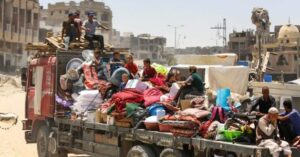
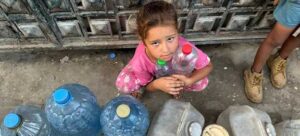
“Gazans cannot get out, and they’re asking to get out,” Fleischer says. “They’re beyond exhausted. There is no space – one makeshift tent after the other up to the sea. Streets are teeming with people.” Meanwhile, the breakdown of sewage systems, lack of water and waste management means diseases, such as Hepatitis A which is spreading among children, are allowed to fester.

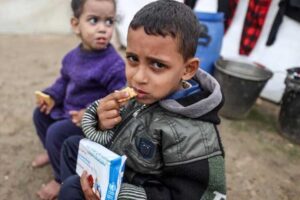
Children eat fortified biscuits from WFP at a makeshift camp in southern Gaza.

“We are lucky that nothing has happened to our amazing staff – more than 200 UNRWA staff have been killed,” she says. “That is not acceptable.” She adds: “We have amazing security officers who advise management on which risks to avoid, so that we can stay and do our work safely and families can access our assistance safely. But the risks are high. Very high. We have bullets close to our convoys. We’re there repairing roads. We’re there moving with our trucks. We’re there reaching people. And it’s very dangerous.”

On the path to recovery, the private sector has a role to play, says Fleischer – take the reopening of shops. “If you think of a lifeline, of hope, or a sense of normalcy, it’s surely when the staple bread is back in the market,” she says of bakeries that have reopened with WFP support. “Bakeries need wheat flour, they need yeast, and diesel too – and that’s where we come in.”

High Prices Keep Basic Foods Out of Reach for Most Gazans

In the south of Gaza, “basic food items are slowly re-emerging in food markets. You can actually find vegetables, fruits in the markets but because prices are high, they remain out of reach for most,” she says “And in any case, people don’t have cash. There are no jobs. Even our own staff tell us, ‘We have a salary, but we can’t access cash’.”

Fleischer is keen for humanitarian efforts to reach a stage where people “stop eating things they have been eating for the past nine months” – to diversify diets heavily dependent on canned food (provided by WFP) and whatever people can get their hands on.

“This level of destruction I’ve never seen.”

Fleischer’s biggest fear for Gaza is “that there is no end to this [war]. That we continue with ever less space for the people who already have nowhere to go back to. Even if they moved back to the north, where could they go?”

“Everything is flattened. There are no homes, it’s all destroyed. We need a long ceasefire that leads to peace so we can operate.”

After the Rafah incursion, many people returned to Khan Younis but there’s no means of living in the area. There are no homes left. Credit: WFP

Fleischer, who has served with WFP in Syria and Sudan’s Darfur Region, adds: “This level of destruction I’ve never seen. Hospitals and clinics are destroyed, food processing plants are destroyed. Everything is destroyed.”

Yet, “There is this never-give-up attitude from the people, from the families we serve,“ she says. “I can’t believe children still run to you and laugh with you. They probably see in us hope that there will be an end to all this – a sign they are not forgotten.”

This story originally appeared on WFP’s Stories on August 8, 2024 and was written by the WFP Editorial Team.

IPS UN Bureau

  Source

Killings of Palestinian Journalists Continue –Aided by Uninterrupted Flow of US Arms

Armed Conflicts, Civil Society, Featured, Global Governance, Headlines, Human Rights, IPS UN: Inside the Glasshouse, Middle East & North Africa, Press Freedom, TerraViva United Nations

The journalists gather in front of Al-Aqsa Martyrs Hospital to commemorate their friends, Al Jazeera reporter Ismail al-Ghoul and cameraman Rami al-Rifi, who lost their lives in Israeli army attack on a moving vehicle in the Al-Shati refugee camp, in Deir al-Balah, Gaza on July 31, 2024. Source: Middle East Monitor. Credit: Ashraf Amra, Anadolu Agency

UNITED NATIONS, Aug 12 2024 (IPS) – The growing number of killings of Palestinian journalists in Gaza has triggered a demand for a cut-off in US arms supplies to Israel.

Sarah Leah Whitson, Executive Director, Democracy for the Arab World Now (DAWN), told IPS despite pleas of the international community to suspend arms to Israel in the face of its unprecedented atrocities against Palestinians in Gaza, including the killing of over 165 Palestinian journalists, it beggars the imagination that Biden is now seeking to sell Israel new weaponry to facilitate even more slaughter.


On August 9, the U.S. State Department officially notified Congress of its intent to proceed with a new authorization for weapons to Israel, including 6,500 Joint Direct Attack Munitions (JDAMs) guidance kits to Israel, despite extensive evidence documenting the Israel Defense Force’s (IDF) use of U.S. weapons to carry out war crimes and crimes against humanity, said DAWN, in a press release Friday.

This “is a slap in the face of humanity and all the values we hold dear,” Whitson said.

According to Cable News Network (CNN) last June, two key congressional Democrats have given their approval to allow the Biden administration to proceed with what is believed to be the biggest ever weapons package for Israel, expected to be worth more than $18 billion and include some 50 F-15 fighter jets.

Blinken also announced his decision not to sanction the IDF’s notorious Netzah Yehuda battalion, despite credible evidence of its systematic and gross human rights violations in the occupied West Bank, in violation of strict U.S. laws requiring the imposition of such sanctions.

“It is mind-boggling that despite the overwhelming evidence of the IDF’s unprecedented crimes in Gaza that has shocked the conscience of the entire world, the Biden administration is greenlighting the transfer of additional lethal weapons to Israel,” said Whitson.

“It is hard to comprehend how the Biden administration can justify rewarding Israel with new weapons, despite Israel’s persistent defiance of every single plea the Biden administration has made urging a modicum of restraint, and despite the very apparent fact that such sales violate black letter U.S. laws prohibiting weapons to gross abusers like Israel,” she pointed out.

Meanwhile, as of August 9, 2024, preliminary investigations by the Committee to Protect Journalists (CPJ) showed at least 113 journalists and media workers were among the more than 40,000 killed since the war began, making it the deadliest period for journalists since CPJ began gathering data in 1992.

Journalists in Gaza face particularly high risks as they try to cover the conflict during the Israeli ground assault, including devastating Israeli airstrikes, disrupted communications, supply shortages, and extensive power outages, CPJ said.

This has meant that it is becoming increasingly hard to document the situation, and CPJ is investigating almost 350 additional cases of potential killings, arrests and injuries.

Dr Ramzy Baroud, a journalist and the Editor of The Palestine Chronicle, told IPS Israel has killed, as of last week, 168 Palestinian journalists, the same way it has killed over 200 aid workers, hundreds of doctors, medics and people from every category and background. None of this is coincidental.

A simple proof that Israel deliberately targets journalists is the fact that it habitually produces and promotes stories that justify their murder, often accusing them of terrorism. Israel is yet to provide a single set of credible evidence against any of the killed journalists, he said.

On October 11, Israeli President Yitzhak Herzog had said “there are no innocent civilians in Gaza”. This disturbing Israeli logic applies to all Palestinians in the Strip, including journalists.

“Israel must be held accountable to its ongoing murder of journalists. But a huge responsibility falls on the shoulders of journalists and media organizations around the world, who often ignore the very murder of their colleagues in Gaza, let alone circulate Israeli’s unfounded accusations often without questioning its credibility or merit,” he said.

The fact that Gazans continue to report on their own genocide by Israel is heroic beyond words. But they must not be disowned, and must not continue to report and die alone without a true international solidarity that could hold their murderers to account, said Dr. Baroud, who is also a Non-resident Senior Research Fellow at the Center for Islam and Global Affairs (CIGA).

Dr. James Jennings, President, Conscience International, told IPS the heroic martyrs of the free press in Gaza deserve to be honored by all humanity, at the very least with the Nobel Peace Prize. Standing under the bombs, reporting the truth, then paying with your life is a superhuman act of courage.

The job of journalists is simply to journal–to shine a light on the truth by writing down or telling what they see on the battlefield. Killing the messengers is a sign that the perpetrators fear them and their influence, he pointed out.

Deception and lies are major part of war. How else could people slaughter myriads of others and do it with impunity?, he asked.

But truth has two sides–sending and receiving. Refusing to credit honest reporters means that we really don’t want to hear what they are saying anyway. Choosing to believe lies because we want them to be true is what enables wars to continue.

“Even worse than lying to the enemy is lying to yourself. Attempting to cover the plain truth by denying facts or looking the other way is tantamount to insanity. When will Americans stop lying to themselves and start believing their own ideals?”, asked Dr Jennings.

Ibrahim Hooper, National Communication Director at the Washington-based Council on American-Islamic Relations (CAIR), the nation’s largest Muslim civil rights and advocacy organization, said: “The only thing that can explain the shocking silence of American and international media professionals about the mass killing of their Palestinian colleagues is the decades-long and systematic dehumanization of the Palestinian people, in which the lives of Palestinians have lesser or no value. Journalists worldwide must begin to speak out about these killings and about the Israeli genocide in Gaza.”

In a press release last week, the UN Educational, Scientific and Cultural Organization (UNESCO) said it is monitoring attacks and threats against journalists.

The agency noted that in recent months, multiple journalists covering protests in different parts of the world have been subjected to various forms of attacks, including killings, injuries, arbitrary detentions, and confiscation of their equipment, while exercising their rightful duties as journalists.

UNESCO recalls “that all authorities concerned have the duty and responsibility to ensure the safety of journalists covering protests around the world, in accordance with international norms and human rights obligations”.

In a joint statement, five UN special rapporteurs declared: “We have received disturbing reports that, despite being clearly identifiable in jackets and helmets marked “press” or traveling in well-marked press vehicles, journalists have come under attack, which would seem to indicate that the killings, injury, and detention are a deliberate strategy by Israeli forces to obstruct the media and silence critical reporting.”

Meanwhile, under international law, the intentional targeting of journalists is considered a war crime. While all governments are bound by international law protecting reporters, U.S. domestic law also prohibits the State Department from providing assistance to units of foreign security forces credibly accused of gross violations of human rights. Israel’s well-documented pattern of extrajudicial executions of journalists is a gross violation of human rights.

IPS UN Bureau Report

  Source

Biden Administration Faces Rebellion Within its Own Ranks over Gaza War

Armed Conflicts, Civil Society, Featured, Global Governance, Headlines, Human Rights, IPS UN: Inside the Glasshouse, Middle East & North Africa, TerraViva United Nations

Opinion

Schools-turned-shelters run by the UN agency for Palestine refugees, UNRWA, have suffered serious damage in strikes in the last week. July 2024. Credit: United Nations

UNITED NATIONS, Jul 19 2024 (IPS) – The Biden administration, which has come under heavy fire for its unyielding pro-Israeli stand on the nine-month-old war in Gaza, is facing a rebellion within its own bureaucratic ranks—12 and counting.

The 12 government officials, who recently resigned, have accused the US of providing diplomatic cover for the continuous flow of arms to Israel ensuring “our undeniable complicity in the killings and forced starvation of a besieged Palestinian population in Gaza.”


This is not only morally reprehensible and in clear violation of international humanitarian law and US laws, but it has also put a target on America’s back,” they continue, arguing that it has put the lives of service members and diplomats at risk.

Dr. Alon Ben-Meir, a retired professor of international relations, most recently at the Center for Global Affairs at New York University (NYU), and who taught courses on international negotiation and Middle Eastern studies, told IPS: “I share the overall view of the 12 US government officials who have resigned in protest against the Biden administration’s policy in connection with the Israel-Hamas war”.

They wrote in their joint statement, titled Service in Dissent, that “America’s diplomatic cover for, and continuous flow of arms to Israel has ensured our undeniable complicity in the killings and forced starvation of a besieged Palestinian population in Gaza. This is not only morally reprehensible and in clear violation of international humanitarian law and US laws, but it has also put a target on America’s back.”

https://jointstatement.tiiny.site/

“I have supported Israel’s right to defend itself as well as the Biden administration’s support of Israel’s war efforts, standing by the US’s iron-clad commitment to Israel’s security by providing it with all necessary military aid and political cover.

“I have stated time and again that Hamas’s unprecedented October 7, 2023 attack and Israel’s unparalleled retaliation have reinforced my own view, which I share with many others, that there will be no resolution to the 76-year-old Israeli-Palestinian conflict short of a two-state solution.

I still hold to the position that it will be impossible to return to the status quo that prevailed before October 7, as a new paradigm was created that offered the inimitable opportunity to recommence the peace negotiations that could lead to a two-state solution,” said Dr Ben-Meir.

Meanwhile there have also been negative reactions in European capitals. Last February, the New York Times ran a story headlined “US and European officials release a Letter Protesting Israeli Policies.”

According to the Times report, more than 500 officials in the US, Britain and the European Union (EU) released a “public letter of dissent” against their (respective) government’s support of Israel in its war in Gaza.”

In an oped piece published on the IPS wire July 18, Mouin Rabbani, Co-Editor of Jadaliyya and Non-Resident Fellow with the Center for Conflict and Humanitarian Studies (CHS), says the Letter of Dissent makes indisputably clear that US policy towards the present crisis has been an absolute failure at virtually every level.

https://www.ipsnews.net/2024/07/us-policy-towards-gaza-crisis-absolute-failure-virtually-every-level/

Not only has it failed to achieve any of its objectives and further consolidate Western hegemony in the Middle East, but it has made the US government directly and actively complicit in the genocide currently before the International Court of Justice in The Hague, he said.

As the signatories note, the US is “wilfully” violating not only international laws that are binding upon Washington, but is similarly and knowingly violating US domestic law in its fanatic determination to see Israel’s mass atrocities through to the bitter end, said Rabbani, who is also a Non-Resident Fellow at Democracy for the Arab World Now (DAWN).

“Tellingly, and quite accurately, they also point out that the Biden administration’s determination to stand shoulder-to-shoulder with Israeli Prime Minister Netanyahu and his ultra-rightist, annexationist government has led to the suppression of basic constitutional freedoms within the United States,” he declared.

Meanwhile, in an address to the UN Security Council on July 17, Secretary-General Antonio Guterres warned that recent developments are driving a stake through the heart of any prospect for a two-State solution.

“The geography of the occupied West Bank is steadily being altered through Israeli administrative and legal steps. The seizure of large land parcels in strategic areas and changes to planning, land management and governance are expected to significantly accelerate settlement expansion”.

These changes, he pointed out, include the issuance of two military orders at the end of May. These orders transferred powers to, and appointed, a civilian deputy in Israel’s Civil Administration, which is alarming.

This move is another significant advance in the ongoing transfer of authority over many aspects of daily life in the occupied West Bank, and a further step towards extending Israeli sovereignty over this occupied territory.

If left unaddressed, these measures risk causing irreparable damage, he said.

“We must change course. All settlement activity must cease immediately. Israeli settlements are a flagrant violation of international law and a key obstacle to peace. The violence must end, and the perpetrators of the violence must be swiftly brought to justice.

Israel must ensure the safety and security of the Palestinian population, Guterres declared.

Elaborating further Dr Ben-Meir said: “Personally, I was in favor of crippling Hamas militarily. Still, I have also repeatedly stated that while Israel may be able to crush Hamas militarily, it will be unable to destroy it as a political movement that holds a specific ideology that calls for Israel’s destruction.

“However, I have never subscribed to the notion that Hamas will ever be in a position to extinguish Israel for many reasons, including the fact that Hamas leaders know only too well that Israel is a formidable military power whose existence is irrevocable. The war has made it clear that challenging Israel’s right to exist is tantamount to suicide”.

President Biden was the first global leader to affirm that, given the new developing circumstances, a two-state solution is a prerequisite to end this endemic conflict.

As the war continued to grind on and as the Palestinians’ death toll and destruction were mounting, and Prime Minister Netanyahu categorically refused to even mention any solution along the lines of an independent state, the whole idea of a two-state solution was dropped from Biden’s lexicon. But the flow of weapons to Israel, if anything, was increasing without any preconditions.

Moreover, the US vetoed two UNSC resolutions that called for a ceasefire while food, water, fuel, and medical supplies were dwindling, and the displacement of Palestinians by the hundreds of thousands continued unabated.

Meanwhile, Israel’s relentless bombing using American-made bombs, which were killing thousands in densely populated areas, made the US complicit in the horrific carnage. By now, more than 37,000 Palestinians have been killed, and more than half of Gaza lies in ruin, Dr Ben-Meir said.

IPS UN Bureau Report

  Source

Overwhelmed Healthcare Systems in Gaza Struggle Through Evacuation Orders

Aid, Armed Conflicts, Civil Society, Development & Aid, Editors’ Choice, Featured, Headlines, Health, Human Rights, Humanitarian Emergencies, Middle East & North Africa, Migration & Refugees, Sustainable Development Goals, TerraViva United Nations

Humanitarian Emergencies

Displaced families in Gaza are on the move after the latest Israeli evacuation orders. Around nine in 10 Gazans have been displaced at least once since the war began. Photo: UNRWA

Displaced families in Gaza are on the move after the latest Israeli evacuation orders. Around nine in 10 Gazans have been displaced at least once since the war began. Photo: UNRWA

UNITED NATIONS, Jul 12 2024 (IPS) – For nine months, over 2 million people in the Gaza Strip have been forcibly displaced in the wake of the armed conflict between Israel and Hamas. The ongoing fighting and displacement have put significant strain on humanitarian organizations on the ground to address even basic health needs.

The United Nations and other humanitarian organizations have stressed that the healthcare system in Gaza has collapsed or has suffered undue pressure as a result of the fighting. Out of 36 hospitals in the area, 13 remain open, operating with partial functionality.


This includes Nasser Hospital, which now stands as the last hospital providing comprehensive healthcare services. It has been overwhelmed with patients in the wake of evacuation orders issued on July 1 by Israeli authorities for the east and south of Khan Younis. Patients and medical personnel working in the Gaza European Hospital, located in Khan Younis, evacuated ahead of time.

Although an official from the Israeli defense force stated that patients and medical personnel were exempt from the evacuation order, this was not conveyed to the humanitarian groups on the ground. 

Andrea de Domenico, UN-OCHA’s Head of Office in the Occupied Palestinian Territory, told reporters in a virtual press briefing on July 3 that OCHA was not informed. He stated that it was likely that those who evacuated acted based on past experiences where hospitals were specifically targeted for raids or military bombardment, and so they took preemptive measures to evacuate before the Israeli military moved in on Khan Younis.

Evacuation orders have devastating implications for the fragile health infrastructure by disrupting the functionality of health facilities within and adjacent to evacuation zones, as one spokesperson from the World Health Organization (WHO) told IPS. They impede access for both healthcare providers and patients, and they compromise the efficacy and security of humanitarian operations. In addition, this only increases the burden on other hospitals that are now charged with receiving patients from evacuated areas.

As one of the remaining hospitals providing comprehensive care, Nasser Hospital has been operating beyond capacity with limited supplies, amidst destruction in the surrounding area, which WHO staff on the ground have said is ‘indescribable’. The area surrounding the hospital is laden with heavy layers of debris, destroyed buildings, and no stretch of an intact road. Its pediatric ward has now hosted more than 120 patients since July 5, despite its 56-bed capacity.

OCHA and the World Health at Nasser Medical Complex in Gaza earlier this year. UN and other humanitarian agencies have been struggling to ensure health care continues. Credit: OCHA

OCHA and the World Health at Nasser Medical Complex in Gaza earlier this year. UN and other humanitarian agencies have been struggling to ensure health care continues. Credit: OCHA

It is also operating with dwindling medical supplies and holds responsibility for sterilizing equipment for the surrounding field hospitals, according to Doctors Without Borders (DWB). Despite the critical need for supplies, DWB trucks and convoys carrying these supplies have been unable to enter Gaza since April. As recently as July 3, trucks were denied entry due to ongoing fighting in the South.

“Overall, it’s a comprehensive issue—from shortages of beds and supplies to the lack of surgeons. With yet another hospital closed, patients’ lives are even more at risk,” said medical team leader Javid Abdelmoneim, working in Nasser Hospital.

The issue of life-saving aid being restricted from entering Gaza has continued to persist and impact operations for humanitarian organizations on the ground, including the UN. As the WHO spokesperson told IPS, their trucks were unable to pass through last week as the Karem Shalom crossing remains closed.

Fuel has been identified as critical to the functionality of health facilities and aid operations, and yet shortages are rampant. A WHO spokesperson stated that hospitals have been forced to work with limited supplies of fuel, electricity and solar systems, and this has only hindered groups from properly functioning.

Power blackouts in newborn/ICU and kidney dialysis units place their patients at critical risk. The lack of fuel also impacts the water and sanitation sectors, which require at least seventy-thousand liters of fuel a day, and yet in the last few weeks, they have only received less than ten percent of what is needed.

Only 500,000 liters of fuel have been brought in during the first week of July, and 2 million liters were brought in in the month of June, which humanitarian organizations note is a fraction of the fuel needed to sustain humanitarian, medical, and WASH operations—at least 400,000 liters per day.

Trash and sewage buildup and a lack of clean water, among other factors, have all led to the spread of water-borne diseases and upper respiratory infections. According to the WHO, since mid-October 2023, they have reported cases of diarrhea, lice and scabies, skin rashes, impetigo and chicken pox.

“While a healthy body can more easily fight off diseases, a wasted and weakened body will struggle and become more susceptible,” one WHO spokesperson told IPS.

Meanwhile, acute food insecurity has ravaged Gaza. Since the start of the war, food insecurity has been a major concern for humanitarian actors in the region and globally.

The Integrated Phase Classification (IPC)’s special brief acute food insecurity projected that 96 percent of Gaza’s population, or 2.15 million people, would be experiencing extreme levels of food insecurity between June 16 and September 30, which includes over 495,000 people who face catastrophic food insecurity. More than half of the households reported that often, they did not have any food in the household, and more than 20 percent go full days and nights without eating. The violence and repeated displacement have challenged people’s ability to cope or to access humanitarian assistance.

This is further exacerbated when humanitarian workers are also forced to relocate for their own safety and move their operations. Domenico stated that the constant movement also means that warehouses containing fuel and supplies are abandoned as a result. In the case of UN agencies such as OCHA and its partners, humanitarian operations may be considered a parameter of activity that is (or should be) protected from military activity. Their presence is likely to signal to people that it may be safe to be there or that their basic needs will be met.

So far, 34 people have died from malnutrition and dehydration, according to the Ministry of Health. Of those deaths, WHO notes that 28 of them are children. A group of independent experts has warned that famine has spread throughout the Gaza Strip, noting recent cases of children who have died due to hunger and malnutrition, one of whom was as young as six months old.

“With the death of these children from starvation despite medical treatment in central Gaza, there is no doubt that famine has spread from northern Gaza into central and southern Gaza,” the experts said in a shared statement.

The IPC special brief notes that only a cessation of the armed conflict and sustained, uninterrupted humanitarian intervention could reduce the risk of famine. Humanitarian organizations have struggled to maintain their operations while hostilities have persisted in the Gaza Strip, endangering and displacing more than a million civilians multiple times over, along with humanitarian workers who have risked their lives to continue providing what little life-saving aid can cross the border. Military violence has continued despite international condemnation and repeated demands for a ceasefire.

Organizations such as WHO and Doctors Without Borders have coordinated with health partners and agencies on the ground, namely UNRWA, to provide primary care, support vaccination campaigns, and deploy emergency medical teams. As the WHO notes, however, these efforts can only support the health system; they cannot replace it.

IPS UN Bureau Report

Note: This feature was published with the support of the Riana Group.

  Source

UAE Complicit in Sudan Slaughter

Armed Conflicts, Civil Society, Crime & Justice, Featured, Food and Agriculture, Headlines, Human Rights, Middle East & North Africa, Migration & Refugees, TerraViva United Nations

Opinion

Credit: Mark Kerrison/In Pictures via Getty Images

LONDON, Jul 11 2024 (IPS) – Sudan is the scene of unimaginable suffering. As war between army and militia continues, civilians are paying the highest price. Both sides are killing non-combatants and committing gross human rights crimes.


The country stands on the brink of famine. It’s experiencing its worst recorded levels of food insecurity and over 750,000 are at risk of starvation.

Around 11 million people have been forced to flee their homes, armed forces have stolen and destroyed food supplies, crops and livestock, and many people are no longer able to earn a living or farm. UN human rights experts accuse both sides of using denial of food as a weapon, including by blocking humanitarian deliveries and looting depots.

Many of the worst-affected areas are in Darfur, where the Rapid Support Forces (RSF) militia has gained territory and is currently besieging El Fasher. The RSF grew out of the militias that committed genocide in Darfur two decades ago, and they’re again accused of genocide, carrying out ethnically motivated mass killings. Meanwhile, the army it’s fighting, the Sudanese Armed Forces (SAF), has blocked the main humanitarian access point on the border with Chad.

Proxy war

The conflict broke out in April 2023, sparked by a power struggle between two men: Abdel Fattah al-Burhan, SAF commander-in-chief and leader of the ruling junta, and Mohamed Hamdan Dagalo, known as Hemeti, RSF head. The two worked together in the 2021 coup that ousted a civilian government. A plan to incorporate the RSF into the SAF was the flashpoint of their battle for leadership and, crucially, control of resources.

But beyond the two warring egos, bigger forces are at play. Several other states are taking sides in the conflict, enabling it to continue. Much of the foreign involvement is opaque and subject to official denials. Egypt and Iran are among states providing military support to the SAF. Meanwhile, forces from the eastern part of divided Libya have allegedly helped supply the RSF, and the Chadian government is accused of cooperating with it.

Another distant war is echoing in Sudan. Russia, which has extensive goldmining interests in the country, initially seemed to be siding with the RSF, particularly through its mercenary fighters. In response, Ukrainian troops reportedly carried out attacks on Russian mercenaries and RSF forces. More recently, however, Russia may be tilting towards the SAF, possibly eyeing the development of a Red Sea naval base. Russia recently abstained on a UN Security Council resolution calling on the RSF to end its siege of El Fasher, which it could have vetoed.

But the biggest player is the United Arab Emirates (UAE), the Gulf petrostate that’s increasingly asserting itself in many African countries. In countries undergoing conflict, it takes sides. In Ethiopia, when federal troops fought separatist groups from Tigray, the UAE supported the government. In Libya, it’s backed the eastern forces fighting those in the west.

In Sudan, it’s firmly on the RSF’s side. It’s supplying weapons to the RSF, including reportedly through shipments disguised as humanitarian aid and supplies routed through other African counties where it has a presence. Key RSF backroom operations are being run from UAE locations. Wounded RSF fighters are reportedly being treated in Abu Dhabi. Without the UAE’s support, it’s highly unlikely the RSF would be able to sustain its war effort on its current scale. The UAE denies it all, but a UN expert panel found the allegations credible.

The UAE has extensive economic interests at stake. It receives more Sudanese gold than any other country, some of which makes its way to Russia. It has large agricultural investments and a major Red Sea port plan.

There are political interests too. The UAE doesn’t want countries it has a stake in to democratise. It supports several anti-democratic African governments, including in Algeria, Egypt and Tunisia. It likely sees backing the RSF as the best way to ensure the democratic transition once promised by the 2019 revolution remains thwarted.

A Middle East power struggle is playing out in Sudan. The UAE has long taken a similar stance to Saudi Arabia’s, but increasingly shows an appetite to contest Saudi supremacy. The two ended up diverging over their involvement in the conflict in Yemen. Its Sudan policy is another way the UAE can demonstrate its independence.

The UAE’s role also accounts for Iran’s pro-SAF position, while Saudi Arabia is trying to distinguish itself from both by brokering peace talks, known as the Jeddah process, which so far have come to little.

The UAE also has powerful friends in the west, not least the UK and the USA, and it’s using them to limit international scrutiny. The British government, which currently leads on Sudan at the UN Security Council, was reported to have pressured African states not to criticise the UAE over its support for the RSF.

Time for action

The people of Sudan deserve better than to be pawns in a proxy war waged by distant states.

But people in the UAE have no way to pressure their government if they’re upset about the blood on its hands. Civic space in the UAE is closed and those who speak out are routinely criminalised.

This means it falls on others to mobilise. States helping perpetuate the conflict should come under greater pressure from other states, the international community and international civil society.

The first and most urgent demand must be for unfettered humanitarian access. Even then, an immediate ceasefire is needed. There must the follow a process of genuine dialogue to build peace and plan for transition, which must involve Sudanese civil society in its diverse forms.

The international community must step up its efforts. The UN’s fact-finding mission, established last October following civil society advocacy, has been severely hampered by funding shortfalls, as has the humanitarian response plan. States must adequately resource the UN response.

States, the international community and civil society must also throw the spotlight on the UAE. There must be consequences. When the RSF eventually faces justice, those who enabled it must also be held to account – and the UAE’s rulers should be first in line.

Andrew Firmin is CIVICUS Editor-in-Chief, co-director and writer for CIVICUS Lens and co-author of the State of Civil Society Report.

  Source

Zionism is Broken

Armed Conflicts, Civil Society, Global Governance, Headlines, Human Rights, IPS UN: Inside the Glasshouse, Middle East & North Africa, TerraViva United Nations

Opinion

A child waits to fill water containers in Gaza. Credit: UNRWA

 
In its latest update last week. the UN agency for Palestinian refugees, UNRWA, reported “especially intense” airstrikes in central Gaza in recent days, particularly in Bureij, Maghazi and Nuseirat refugee camps and eastern Deir Al-Balah.

 
Meanwhile, the Israeli military’s ground offensive “continues to expand”, UNRWA noted, particularly in the southern regions of Gaza City and eastern Rafah, causing further suffering and further “destabilising” humanitarian aid flows.

ATLANTA, Georgia, Jul 3 2024 (IPS) – Zionism is broken. It is finished as a political philosophy and cannot long survive. Having earned the visceral opposition of multitudes of people and countries around the world for engaging in vast overkill in Gaza, that historical reality will likely become clear to the Israeli people over time.


Still, how could the most powerful state in the Middle East, the most flourishing economically, with the strongest superpower backing, become defunct? It cannot—unless somehow its chief raison d’etrê, its founding philosophy, collapses. That has already happened.

In the wake of the October 7 attack by Hamas, the visceral racist core of Zionism has become evident in the indiscriminate slaughter of tens of thousands of innocent Palestinian civilians, including many thousands of children.

No reason of state can ever excuse that. Israel’s righteous anger against HAMAS for its obscene October 7 attack transitioned quickly into racial hatred, ending in, if not genocide, then certainly war crimes and crimes against humanity. Netanyahu and his Likud allies have not hidden their racism for decades. Now it is explicit in full view of the world.

The Zionism of Netanyahu and his supporters must be repudiated by the Israelis themselves. Israel’s leaders from Menachem Begin to today have long endorsed statements lauding Israel uber alles.

Zionism can only be rehabilitated if it separates its reason for existing from the current triumphalist military identity that is determined to kill, kill, and kill again until the utter destruction and suppression of all every tangible and ideological enemy.

In a recent CNN interview, former Shin Beth Director Ami Ayalon, was very explicit: he said “The toxic leadership of Prime Minister Netanyahu” [in pursuing an endless war] will “lead to the end of Zionism.” In that case, he said, “We cannot be secure and we shall lose our identity.”

Ayalon was preceded by a number of courageous Israeli thinkers and writers who warned of the same outcome—Israel was founded in 1948 but in their opinion, Zionism had already failed ideologically by the mid-1960s. They included Hebrew University professor Israel Shahak (1933-2001), who wrote, “It is my considered opinion that the State of Israel is a racist state in the full meaning of the term.”

He insisted that, “You cannot have humane Zionism. It (too) is a contradiction in terms.” Uri Avnery (1923-2018), a decorated Israeli soldier and later a publisher and politician, published a book in 1968 titled Israel without Zionists.

Many of the original Jewish colonists had utopian dreams, but their leaders would probably not recognize the grim, revengeful militarism of today’s Israel. A few tiny orthodox religious parties in Israel have never bought into the military machine that is the Likud Party’s pride and joy.

Some have steadfastly refused even to serve in the Israeli army because they don’t believe in the Israeli state. Now even they are being conscripted.

The original dream of Zionism from Theodore Herzl to Chaim Weizmann to David Ben Gurion, although containing seeds of a today’s hob-booted military identity, nevertheless also expressed a grandiosely humane, even a universal, goal—to become a “light to the nations.” In that, Israel has signally failed.

Like HAMAS and most Palestinians, Israel’s people—and Israel as a country—has become increasingly and deeply racist. Now racism—hatred of others for their differences—has become racial-ism, which is even worse, a doctrine of race superiority, which was the Nazi credo.

The Israel of Benjamin Netanyahu and his thuggish coalition has succumbed to such race hatred that Zionists from pre-1948 Palestine would not recognize it. A Jan. 6, 2024 opinion article in the Jerusalem Post urges Israel to reform its politics along better Zionist lines and take power away from the extremists now in charge. Commendable, but not nearly enough.

What if Abraham Lincoln had countenanced America’s original sin of slavery by merely taking half steps? We might still have “slavery lite.” No, Israel’s race-based philosophy must change to the democratic ideal: a single state in Israel and the occupied territories for Muslims, Christians, and Jews. One person, one vote.

When Palestinians are treated as human beings—as real people instead of enemies to be eradicated en masse—people everywhere would soon see how quickly peace would come to the Middle East.

James E. Jennings, PhD, is President, Conscience International
www.conscienceinternational.org
conscience@earthlink.net

IPS UN Bureau

  Source