Make Health Top of Climate Negotiations Agenda—Global Climate & Health Alliance

Climate Action, Climate Change Finance, Climate Change Justice, Conferences, COP29, Editors’ Choice, Featured, Global, Headlines, Health, Human Rights, Humanitarian Emergencies, Sustainable Development Goals, TerraViva United Nations

COP29

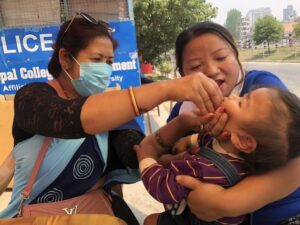
Community health worker in Nepal helping giving polio vaccine to a child. Climate change-induced events are affecting basic health facilities directly. Photo: Tanka Dhakal/IPS

Community health worker in Nepal helping giving polio vaccine to a child. Climate change-induced events are affecting basic health facilities directly. Photo: Tanka Dhakal/IPS

BAKU, Nov 14 2024 (IPS) – Climate change and its impact on public health hasn’t made the top of the agenda even at a forum like the UN Climate Conference, but is should, say the health community.


Understanding the gap, more than 100 organizations from across the international health and climate community came together as the Global Climate and Health Alliance and have called wealthy countries to protect people’s health by committing to provide climate finance in the order of a trillion dollars annually, in addition to global action with leadership from the highest emitting countries to end the fossil fuel era.

Alliance endorsed nine recommendations for the summit through a policy brief—‘A COP29 for People and Planet’ which includes financing to community engagement.

In an interview with Dr. Jeni Miller, Executive Director of the Global Climate and Health Alliance IPS asked about the recommendations and why they were necessary.

Dr. Jeni Miller, Executive Director of the Global Climate and Health Alliance.

Dr. Jeni Miller, Executive Director of the Global Climate and Health Alliance.

IPS: How and why the international health and climate community came together—why was it necessary, right before COP29?

Miller: For many years, the UN climate negotiations have been going on. For many years, health was not a part of the conversation. And in fact, the Global Climate and Health Alliance was established because a handful of health organizations felt like this is an important health issue, and we need to get health into that conversation, and we’re not seeing it there. Over the years, more and more health organizations have really begun to understand the threat that climate change poses to people’s health. I think a big contributing factor as well is that we are now seeing those impacts of climate change in real time in communities all over the world—every country, every region, is seeing some combination of extreme weather events.

This is directly impacting the communities that we serve, and we have to raise the alarm bell and make sure that we’re pushing for those solutions that are going to protect people’s health. The report, specifically the policy recommendations, is really an attempt to take what we’re seeing from the health perspective, the concerns that we have. About the threat that this poses for people’s health and the reality of the impacts on people’s health, and somewhat translate that into terms that make sense for negotiators to pick that up, understand it, and use it in the context of those actual decision-making processes in the climate talks.

IPS: Wealth is concentrated on one side of the world or one section of the community, but burden—especially public health burden—is on marginalized communities who don’t have access to basic resources. Is there any way that gap will be narrowed in the near future?

Miller: This is such a critically important issue. And unfortunately, we’re seeing some real extremes of wealth disparity—ironically, in countries that have huge wealth disparity within the country, everyone is less healthy than they would be if there was less health disparity. If people were more equal, that would be healthier for everyone. But the reality is, many people, as you say, don’t have the resources to access the basic necessities of life. Healthy food, clean water, electricity of any kind, but particularly clean energy, even access to education, access to basic health care—all of those things are really vital to growing up healthy and to living a healthy life. And the thing that is so clear is that access to those basic necessities early in life makes a tremendous difference in being able to grow up healthy, resilient, and productive.

It’s a huge impact on the individual that’s growing up without those resources—it’s also an impact on society. So, a society that has people that grow up with enough resources to be resilient, healthy, and well educated is a healthier society. And I would argue that that extends not only within a community or even a country but also internationally. So, if we have huge disparities internationally, that’s also kind of a drain on the world, a challenge for the world as a whole. It leads to conflict, it leads to friction, and it leads to difficulty making decisions to tackle climate change together. I would argue that it’s really in the best interest of wealthy countries to make those investments to help the lowest-income, vulnerable countries have the resource they need to address those basic necessities. I think it’s fundamental. It’s the right thing to do.

I think for so many reasons, it’s important that the wealthy countries do step up and provide this kind of resources.

IPS: While talking about the resources, wealthy countries are already far behind on their climate finance commitment. Do you think they will consider financing to protect people’s health?

Miller: This is a major focus of this year’s climate negotiations. In fact, on the table is a major discussion about a new pot of financing for climate change, and I don’t think we know the answer yet as to how that’s going to come out.

It often gets talked about as we can’t economically afford to put in that money. I think a key question is, what is the cost of inaction? If we fail to act, we’re already seeing. The cost of failing to act on climate change is immense. The cost of failing to enable countries to be better, prepared to be better, to have their systems, their water and sanitation systems be stronger, their hospitals be more prepared, etc. The costs are just staggering. So, when we’re talking about, can we afford to put the money into climate action, I think we also need to ask the question, can we afford not to? I think the answer is no. And then the last thing that I’ll say about this is, and this is also important, we are currently subsidizing fossil fuels more than a trillion a year in direct public subsidies. So that’s public money going into supporting the production and use of fossil fuels, and fossil fuels are the primary driver of climate change.

So again, when we’re talking about, can we afford to or are we prepared to invest in climate action and put money into a Climate Fund? We need to ask ourselves the question. What is the cost of not doing so? And then where else is public money going that could be going into moving us in the right direction, towards clean energy, towards climate resilience?

IPS: You talked about the extreme weather events. In recent years, extreme events contributed by climate change are causing destruction en masse; often its monetary losses will be counted but its public health impact is still to be discussed. How do you see climate and health discussion moving forward especially regarding financing?

Miller: I don’t think it happens by itself. In my own country, the US, we are seeing climate-exacerbated disaster, and yet people not accepting the role of climate change in that and not accepting that the health impacts, the dislocation, and the trauma that they’re experiencing were caused by climate change.

It’s not necessarily going to happen just by itself, in in other countries as well. People may be feeling the impacts, but not connecting the dots, and not because of disinformation, not recognizing.

I do think that it’s important for those who know about those connections—the scientists, the advocates, the health professionals who are looking at these issues, the academic departments—to talk about it and articulate what those connections are.

But then I do think that each time one of those extreme weather events does create the opportunity for that conversation to happen, and we need to step up to those opportunities.

And I think that can make a really big difference in changing the nature of the conversation and opening-up possibility for a deeper conversation about what we need to do about this.

IPS: Let’s talk about the report. It talks about healthy climate action for most affected communities. Can you explain it for our audience and what would be the role of the community?

Miller: It’s so often the case that decisions get made without consulting communities affected by those decisions. There can be very good will that is, and good intentions behind that, and yet the results are not going to be as good if you’re not working with the people affected by the issue. The thing that community members know that nobody else knows in the way that they know it is their lived experience of what’s going on in their community, their resources in terms of their own knowledge, their own community relationships, their own resilience, their own techniques. There may be techniques that they know for growing food and their ecosystem.

There may be knowledge you know for forced communities, knowledge that they have of the force that they live in. There is very deep knowledge that communities have about their circumstances, their context, and their needs and what they can bring in terms of solutions, so effectively working with communities means really involving them in the conversation from the get-go when designing programs and projects and all of that sort of thing. And I think when it comes even to financing, thinking about how finance for Climate Solutions reaches that community level.

I think another thing that’s really important to recognize is that climate change puts a huge strain on all of us. It’s a huge psychological strain just to live in the climate era. Enabling communities to come together and be a part of the solution helps to heal that burden.

IPS: You touched on mental health. The report also talks about mental health and wellbeing outcomes—we are seeing people struggling with climate-related post- and pre-event psychological burden in different forms. How do you see this dimension moving forward?

Miller: That is one area where I’ve definitely seen significant progress in the last several years. I think I’ve seen significant progress in increasingly recognizing the health impacts of climate change and the health threat that climate change poses, and then within that, significant progress in beginning to recognize and acknowledge and understand the mental health dimensions of this. There’s a long way to go, but it is a part of the conversation, and it’s an important one.

There are mental health impacts before or after an extreme weather event, and that can show up as kind of anxiety and stress, a variety of things. People who go through major extreme weather events, like the post-traumatic stress of having experienced that and having gone through it, not knowing if it might happen again or when it might happen again.

There’s also the sense of losing one’s world, losing the world that one grew up in, losing the environment that one, the world that one grew up in and seeing those things kind of slip away—this sort of a cultural, ecological and cultural dimension to that. And if you know, failing to acknowledge that mental health dimension both leaves people suffering and also leaves people sort of disempowered.

I think community is important in response to those kinds of mental health challenges—the kind of recognition that there are actions that one can take and ways that one can come together. And some of those actions may be kind of the direct actions of sustainability, working to live a more sustainable lifestyle. I think even, maybe even more important than that, are actions of coming together with the community to influence the kinds of decisions that get made, to call for the kinds of policies that will turn the needle on climate change, to have a voice in the larger conversation. I think that can be even more powerful.

IPS: Do you have anything to add that we may have missed or you wanted to add?

Miller: I think the one thing that I would add is that, right now, every government that’s part of the Paris Agreement is in the process of drafting new national climate commitments.

It’s an important opportunity, not just at the international level, and as at these big international climate talks, but at home, in every single country, for people to call on their governments to make commitments that are aligned with protecting their health from climate change.

Also, I think it’s important to continue to focus on what we can do. The headwinds can feel pretty strong. Addressing climate change will be something that we’re doing for the rest of our lives, not just for the rest of my life—anybody alive today will be dealing with this issue for the rest of our lives. So, we need to maintain our stamina around it and know that this is a long-term commitment and know that it’s worth it.

IPS UN Bureau Report


UNDP’s Sustainable Energy Director Calls For Innovative Financial Solutions for Adaptation, Mitigation

Climate Action, Climate Change, Climate Change Finance, Climate Change Justice, Conferences, COP28, COP29, Editors’ Choice, Environment, Featured, Global, Headlines, Humanitarian Emergencies, Sustainable Development Goals, TerraViva United Nations

COP29

Financial solutions for the global South are under the spotlight during COP29. Credit: UN Climate Change/ Habib Samadov

Financial solutions for the global South are under the spotlight during COP29. Credit: UN Climate Change/ Habib Samadov

BAKU, Nov 13 2024 (IPS) – Riad Meddeb, Director of the Sustainable Energy Hub at the United Nations Development Programme (UNDP), stressed the urgency of finding innovative financial solutions during COP29.


Meddeb was speaking to IPS in an exclusive interview at the conference. He said the negotiations were expected to focus heavily on finance—a core issue that has historically hampered climate action in developing and least-developed nations.

The Finance COP Expectations

Meddeb highlighted the historical challenge of meeting the USD 100 billion annual target for climate finance, which has been a central but elusive goal in previous COPs. He noted that Azerbaijan’s COP 29 presidency aims to overcome this by ensuring the necessary funds are available, especially for countries most vulnerable to climate impacts. 

“This year’s COP is considered the ‘Finance COP’ because it’s crucial we not only set targets but also mobilize the resources to help countries adapt and mitigate climate impacts,” he explained.

A key focus will be developing sustainable financing mechanisms for countries that struggle with debt. Many nations in the global South face significant financial burdens, and accelerating their energy transitions requires resources that may be challenging to secure within their existing economic constraints. Meddeb also stressed the need for concrete financial schemes that can attract private sector investments to supplement international climate funding.

Riad Meddeb, Director of the Sustainable Energy Hub at the United Nations Development Programme (UNDP)

Riad Meddeb, Director of the Sustainable Energy Hub at the United Nations Development Programme (UNDP).

Progress at COP 28 and Hopes for COP 29

Reflecting on COP 28, Meddeb noted key successes, including establishing the Loss and Damage Fund and reaching consensus on a targeted increase in renewable energy capacity.

“The agreement to triple renewable energy and double energy efficiency by 2030 was a significant breakthrough at COP28,” he said. “Now, COP29 must translate that ambition into action by securing the financial support needed to achieve these goals.”

Making sure that the commitments made at COP28 are more than just empty words is one of the main challenges going forward, according to Meddeb.

“By COP30, we want a global commitment on the pathway to adaptation and mitigation,” he added.

UNDP’s Role in the Climate Action Landscape

UNDP plays a critical role in translating international climate targets into real, on-the-ground actions. Through initiatives like the UN’s “Climate Promise,” UNDP supports countries in implementing Nationally Determined Contributions (NDCs) and operationalizing climate goals. Meddeb explained that UNDP is uniquely positioned to facilitate these efforts due to its extensive network of country offices in 170 nations. This network enables UNDP to address climate issues from a development perspective, integrating energy solutions into broader sectors such as health, education, and poverty alleviation.

“UNDP’s approach is not just about energy,” he said. “It’s about sustainable energy for development. We link energy needs with development needs, connecting climate action to real improvements in health, education, and economic opportunities. This is the difference UNDP makes.”

Addressing the Debt Issue in Climate Finance

A significant portion of the interview focused on the complex financial situations faced by many global South nations, where debt often limits capacity to implement ambitious climate plans. Meddeb pointed out that addressing these financial constraints is essential for equitable progress toward climate goals. He suggested that international financial institutions should provide debt relief or restructuring options to allow these countries to invest more readily in clean energy and climate adaptation.

“Pushing countries with heavy debt burdens to accelerate their energy transition requires a nuanced approach,” Meddeb said. “We need financial structures that acknowledge their debt situations while still allowing them to contribute meaningfully to global climate targets.”

Implementation of the Paris Agreement: From Words to Action

Meddeb stressed the importance of shifting the Paris Agreement’s commitments from paper to practice, especially regarding emission reductions by developed nations. He believes that developed countries have a moral obligation to reduce their carbon footprints, given their historical contribution to climate change and their financial capacity.

“The plan is clear, and it’s agreed upon by all parties in the Paris Agreement. Now it’s just about accelerating implementation,” he asserted. “We don’t need to reinvent the wheel—we need to get it moving.”

When asked whether the current pace of implementation is sufficient, Meddeb offered a candid view: “The Secretary General was very clear—it’s now or never. We need optimism and ambition but also an unyielding focus on practical solutions. There are obstacles, yes, but there are solutions too. Together, we can save our planet.”

The Responsibility of Developed Nations Toward Vulnerable Countries

As climate impacts disproportionately affect poorer nations, Meddeb urged developed countries to support those bearing the brunt of climate change. He pointed to the Loss and Damage Fund as a critical mechanism for this purpose. Set up at COP28, the fund has already garnered around USD 700 million, and Meddeb hopes COP29 will build on this initial success by accelerating funding mobilization.

After all, as the UN secretary general António Guterres noted this week, while the Loss and Damage Fund was a victory, the initial capitalization of USD 700 million doesn’t come close to righting the wrong inflicted on the vulnerable.  “USD 700 million is roughly the annual earnings of the world’s ten best-paid footballers,” Guterres said.

Meddeb agrees. “Mobilizing funds for loss and damage is a positive first step. But we must continue pushing to ensure that the support reaches the most affected communities quickly and effectively.”

A Call to Action

For Meddeb, the stakes could not be higher, and the time for incremental progress is over. He said that COP 29 must not only focus on setting ambitious goals but also make real progress on securing the necessary financing to turn aspirations into achievements.

“Now is the moment to turn pledges into action,” he said. “We’ve reached a point where the world cannot afford to wait any longer. This is the COP for finance, and we need to ensure the resources are in place for meaningful climate action.”

IPS UN Bureau Report


Middle East: Ceasefires are the Only Answer

Armed Conflicts, Civil Society, Global Governance, Headlines, Human Rights, IPS UN: Inside the Glasshouse, Middle East & North Africa, TerraViva United Nations

Opinion

A family collecting hygiene kits from Maliha, in Eastern Ghouta, Rural Damascus, Syria. The distribution provided essential items to mostly Syrian and Lebanese families who had fled from the south of Lebanon. Credit: Norwegian Refugee Council

OSLO, Norway, Nov 13 2024 (IPS) – “The shockwaves from Israel’s ongoing and indiscriminate warfare on Gaza and Lebanon are reverberating across this entire region. Neither the horrific assault on Israeli civilians on 7 October 2023, nor the indiscriminate missiles launched by militant groups from Lebanon, can justify the degree of destruction on civilian lives and infrastructure in the region that I have witnessed in recent days.


We cannot wait another day for an end to this senseless violence. For the sake of children across the entire region, diplomacy must result in a sustainable ceasefire.

The people I have met in recent days–from those in Gaza City, to the displaced in eastern Lebanon, to those crossing into Syria–longed for peace so they could return home. Children spoke of how much they missed school and their friends, and parents wished for an end to the precarity and suffering that displacement has brought. The suffering of millions cannot begin to end until those in power push for peace and take action to end the violence.

What I witnessed in Gaza was a society shattered by advanced weaponry, with ongoing military strikes relentlessly impacting the civilian population. War has rules, and it is clear that the Israeli campaign has been conducted with utter disregard for international humanitarian law.

As Gaza has been reduced to rubble, Western leaders have largely stood by unwilling to apply the necessary pressure on the stronger party, Israel, to stop starving the population that they are besieging and bombarding.

In Lebanon, I met people who in just a couple of weeks have lost their homes, jobs and everything in between. They are now staying in almost bare shelters that offer neither protection nor privacy, in fear that the worst is yet to come. The temperature has dropped substantially. People are ill-prepared for what promises to be the coldest winter season for the hundreds of thousands displaced.

Travelling into Syria from Lebanon via the Masnaa border crossing, I saw the huge challenges facing those fleeing violence in Lebanon, exacerbated by vast craters in the road caused by Israeli strikes. Displaced people must be provided with safe passage, shelter, and services.

Those fleeing into Syria arrive in a country with deep, pre-existing economic and humanitarian crises. NRC is providing support to those arriving in Syria, people who took the impossible decision to leave their homes while facing bombardment, and left with only what they could carry.

The aid we and others are currently able to provide is totally insufficient for the needs our staff are seeing. We must be given the right to independently monitor how those who flee from Lebanon to Syria are treated. There must be robust international support to meet people forced to flee, and there must be a genuine, re-energised diplomatic effort from all sides, to halt violence against civilians.

My visit started in Gaza, continued in Lebanon, and finished in Syria, tracing the fallout of this now regional conflict. At each point, the people I met said they wished for only one thing: peace.

Jan Egeland is Secretary General of the Norwegian Refugee Council (NRC). This article follows his visit to Gaza, Lebanon, and Syria.

NRC teams are operating across Gaza, Lebanon and Syria providing essential services to displaced people. This includes items such as mattresses, blankets and hygiene kits as well as cash. We are also providing clean water and sanitation facilities as well as education to children.

IPS UN Bureau

  Source

Scorched Earth Colonizing of Gaza is a Horrible Idea

Armed Conflicts, Civil Society, Democracy, Global Governance, Headlines, Human Rights, IPS UN: Inside the Glasshouse, Middle East & North Africa, TerraViva United Nations

Opinion

Credit: UNRWA

ATLANTA, USA, Nov 11 2024 (IPS) – For religious, humanitarian, and scientific reasons, Israel’s increasingly apparent plan for the de facto colonization of the Northern Gaza Strip is a bad idea. When that program was rejected recently by Israel’s own Defense Minister Yoav Galant, he was summarily fired by Prime Minister Netanyahu.


However, the founding document of the worldwide Jewish community, the Torah, and especially the Decalogue, states plainly, “Thou shalt not covet thy neighbor’s wife…or anything that is thy neighbors.” If religion still means anything to people in the modern nation of Israel, it should be clear that whatever belongs to others should be left alone and neither coveted nor stolen.

For obvious humanitarian reasons the one-sided bombing of Gaza must stop. After more than a year of an ongoing holocaust in Gaza, Israel’s relentless bombing has produced casualties totaling nearly 150,000 dead and wounded people, mostly civilians.

Now with UN sources reporting that starvation is setting in, people everywhere must demand that this racist, inhumane bloodshed stop immediately. Otherwise, international law has no force and the word “humane” has no meaning.

In scientific terms, the contamination of the water, soil, and air in northern Gaza from explosive dust, including Depleted Uranium, will clearly persist for decades, if not generations. That is neither good for the inhabitants if they manage to return to their homes, nor for the Jewish colonists if they should return to their previous colonies in the strip.

US bombing of Iraq two decades ago, especially in and around Basra, as much scientific and eyewitness testimony—including my own on the scene report—proves, has produced a plethora of birth defects.

The idea of some capitalists that Gaza will become a future Dubai—a wealthy trade zone that will be a veritable Las Vegas on the Mediterranean shore—is actually a good one. Geographically and commercially, Gaza is a potential Hong Kong.

The only thing wrong with the plan is the question of who will control this mighty future entrepot, the Palestinians, investors from the Gulf States and the West, or Israel? Answering that will take another century of bloodletting.

Far better that the United States, NATO, the United Nations, the International Court of Justice in the Hague or somebody other than HAMAS or the extreme right wing and increasingly bloodthirsty Likud government now in power in Jerusalem should deal with that issue and guarantee justice.

The ICJ/International Court of Justice, responsible governments everywhere, and especially the campus protesters and those on the streets of cities around the world, must keep chanting, “NO JUSTICE, NO PEACE!” “NO JUSTICE, NO PEACE!”

James E. Jennings, PhD is President of Conscience International and Executive Director of US Academics for Peace

IPS UN Bureau

  Source

When the Truth Becomes a Lie: What Trump’s Election Means for the World as we Know it

Civil Society, Democracy, Global, Global Governance, Headlines, Human Rights, IPS UN: Inside the Glasshouse, TerraViva United Nations

Opinion

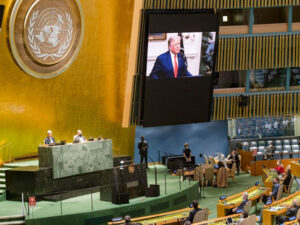
Donald J. Trump, President of the United States of America, addresses the General Debate of the General Assembly’s 75th session September 2020. Credit: UN Photo/Rick Bajornas

NEW YORK, Nov 8 2024 (IPS) – On the day following the US election, UN Secretary General, Antonio Guterres issued a brief statement commending the people of the United States for their active participation in the democratic process. He wisely omitted to mention that the election of Donald J. Trump – who attempted to overturn the people’s mandate by inciting an insurrection in 2020 – is a major setback for the UN’s worldwide quest to advance human rights and the rule of law.


Trump is a self-avowed admirer of authoritarian strongmen like Russia’s Vladimir Putin and Hungary’s Viktor Orban who disdain international norms that the UN seeks to uphold. Unsurprisingly, questions posed to the UN Secretary General’s spokesperson, Stéphane Dujarric, in a press conference on November 6, ranged from what will be Trump’s response to the war in Ukraine to potential funding cuts that might come with the new US administration to whether the UN has contingency plans ready for when Trump takes office.

The US plays an outsized role in global affairs. Therefore, any changes in policy in Washington impact the whole world. As someone who bears responsibility for stewarding a global civil society alliance, it worries me what a second Trump presidency will unleash.

Even without Trump in power we are living in a world where wars are being conducted with complete disregard for the rules; corrupt billionaires are dictating public policy for their benefit; and greed induced environmental degradation is putting us on a path to climate catastrophe. Hard fought gains on gender justice are in danger of being rolled back.

The first Trump administration showed disdain for the UN Human Rights Council and pulled the US out of vital global commitments such as the Paris Agreement to combat climate change. It restricted support for civil society groups around the world and targeted those that sought to promote sexual and reproductive rights of women. Promotion of democracy and human rights are key pillars of US foreign policy.

It’s deeply concerning that when disinformation and misinformation have assumed pandemic level proportions, the majority of the US electorate have cast their vote in favour of a candidate who ran his campaign on divisive dog whistles, half-truths and outright lies. These tactics have deepened fissures in an already polarized United States.

Families countrywide were left devastated by Trump’s negligence and COVID denialism as president which resulted in tens of thousands of Americans dying of avoidable infections. His administration’s immigration detention and deportation policies instilled fear in minority communities. This time Trump has vowed to deport millions of people.

Trump’s stances on abortion rights have caused women immeasurable suffering in several US states that have introduced laws to ban the procedure. He has promised to accelerate harmful fossil fuel extraction and undoubtedly views gender justice advocates, environmental defenders and migrant rights activists as a threat his power.

Given the stated predilections of Trump and his advisors, opposition politicians, activists and journalists exposing corruption and rights violations are likely to be at risk of enhanced surveillance, intimidation and persecution by the new administration.

At the international level, Trump’s election casts a pall over efforts to ensure accountability for war crimes, crimes against humanity and genocidal actions in the Occupied Palestinian Territories, Sudan and Ukraine due to his tacit support for authoritarian leaders in Israel, Russia and the United Arab Emirates, all of whom are fueling conflicts and causing havoc abroad. A future Trump administration could try to starve the UN of funding to erode the rules based international order, emboldening autocrats.

Even if things appear bleak today, it’s important to remember that there are hundreds and thousands of civil society activists and organisations around the world who remain steadfast in their resolve to celebrate diversity and promote justice and equality. To imagine the future we sometimes have to take heart from the past.

India’s freedom struggle, South Africa’s struggle against apartheid and the civil rights movement in the United States wasn’t won by authoritarian leaders but by brave and determined individuals united in solidarity and determined to resist oppression for as long as it takes.

There is a lesson here for civil society in the US that higher American ideals are worth standing up for and will outlive any sitting president.

Mandeep S. Tiwana is Interim Co-Secretary General of CIVICUS, the global civil society alliance. He also serves as CIVICUS representative to the United Nations.

IPS UN Bureau

  Source

UN Arms Embargo on Israel: Dead on Arrival

Armed Conflicts, Civil Society, Featured, Global Governance, Headlines, Human Rights, IPS UN: Inside the Glasshouse, Middle East & North Africa, TerraViva United Nations

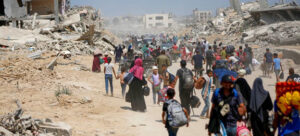
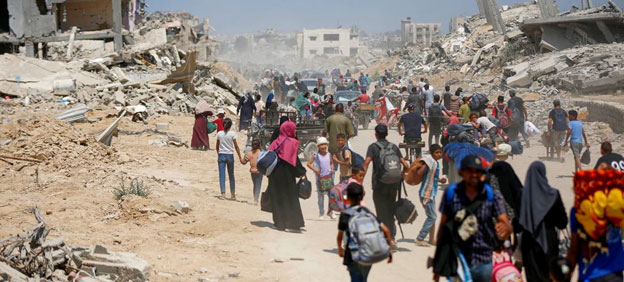
In Khan Younis, thousands of people are fleeing for their lives again. Credit: UNRWA

UNITED NATIONS, Nov 8 2024 (IPS) – When the United Nations imposes sanctions or penalizes a member state – be it the General Assembly or the Human Rights Council – the resolutions are “non-binding” and often remain unimplemented.

But the Security Council resolutions are “binding” – and still openly violated by countries such as North Korea—because all these UN bodies have no means of implementing these resolutions, nor a standing army to forcibly enforce them. But they only carry moral weight.


The Council can also impose its own sanctions, mostly in economic, financial and trade sectors, against violators of its decisions.

And last week there was a move to impose arms sanctions against Israel – and rightly so, judging by the 43,000 plus, mostly Palestinian civilians, killed in Gaza largely with US-supplied weapons since October last year.

But how effective will this be since the strongest opposition will come from the US, an unyielding supporter of Israel, which will unhesitatingly use its veto power if the resolution comes before the Security Council?

Ambassador Anwarul K. Chowdhury, a former UN Under-Secretary-General and one-time Permanent Representative of Bangladesh to the United Nations, told IPS anything short of a real, permanent ceasefire would not create a pathway to end the perpetration of the ongoing genocidal aggression by Israel.

In this context, he said, the joint letter calling on all countries to stop the sale of arms and ammunition to Israel, signed by 52 countries and two UN-recognized multilateral organizations, is meaningfully forward-looking, and contains a purposeful objective of contributing to that “pathway”.

In fact, the Foreign Minister of Turkiye, whose country initiated the letter, asserted that “We must repeat at every opportunity that selling arms to Israel means participating in its genocide.”

“It would be argued rightfully that the United Nations and its apex body, the General Assembly have no powers to enforce such an arms embargo. The Security Council, the sole UN entity which can authorize an arms embargo and obligate the arms suppliers desist from sending arms to the areas of conflict, also becomes powerless if one of the P-5 uses the notorious veto”.

“However, I strongly believe that a General Assembly resolution following the call for the arms embargo to Israel would have a moral value which has its own merit. Despite the politics and power-play which is destroying the UN’s credibility and marginalizing its operational capacity to resolve conflicts, the arms embargo would highlight the principled position taken by the UN,” said Ambassador Chowdhury.

In a way, he pointed out, that would strengthen the Secretary-General’s efforts to promote the much-needed ceasefire.

In the aftermath of Israel’s declaration of the Secretary General as persona non-grata (PNG) and its extension of the attacks on UNIFIL in Lebanon, the General Assembly needs to show that its moral and normative role as envisaged in the UN Charter has not been cowed down by the politics of the frequently-used threat of veto, he declared.

Stephen Zunes, Professor of Politics and International Studies at the University of San Francisco, who has written extensively on the politics of the Security Council, told IPS: “This initiative reflects the view of the vast majority of the world’s governments and peoples and is consistent with imperatives of international humanitarian law, but given that the major arms supplier of Israel is a veto-wielding permanent member of the Security Council, it is unlikely to have much of an impact.”

Also problematic, he pointed out, is that some of the countries sponsoring the initiative, such as Russia and Saudi Arabia, have been guilty not only of similarly providing weapons to those engaging in war crimes but engaging in war crimes themselves.

Turkiye’s foreign minister Hakan Fidan said last week his country had submitted a letter to the United Nations, signed by 52 countries and two inter-governmental organizations, calling for a halt in arms deliveries to Israel.

“We have written a joint letter calling on all countries to stop the sale of arms and ammunition to Israel. We delivered this letter, which has 54 signatories, to the UN on November 1,” said Fidan, according to the Times of Israel.

“We must repeat at every opportunity that selling arms to Israel means participating in its genocide,” said Fidan, adding that the letter is “an initiative launched by Turkiye.”

Among the signatories were Saudi Arabia, Brazil, Algeria, China, Iran and Russia, plus the Arab League and the Organization of Islamic Cooperation (OIC),

Elaborating further, Ambassador Chowdhury said the UN should not forget that the UN’s International Court of Justice which determined that Israel’s occupation of the Gaza Strip and West Bank is illegal under international law. The judgment was followed by a General Assembly resolution last September, demanding Israel leave the occupied territories within a year.

“I am encouraged by the UN’s own 45 Human Rights Experts and Special Rapporteurs, who, driven by their conscience, forcefully called for a ‘permanent ceasefire, … an ‘arms embargo on all warring parties,’ and ‘the deployment of an international protective presence in the occupied Palestinian territory under the supervision of the UN.’ All these well-thought-out measures would only promote dialogue and diplomacy over death and destruction”.

The UN Secretary-General needs to endorse and welcome this call by his in-house experts and recommend to the General Assembly to do the same without any delay, he declared.

Back in April 2024, in a resolution adopted by 28 votes in favour, six against and 13 abstentions, the 47-member Human Rights Council backed a call “to cease the sale, transfer and diversion of arms, munitions and other military equipment to Israel, the occupying Power…to prevent further violations of international humanitarian law and violations and abuses of human rights”.

Presented by Pakistan on behalf of the Organization of Islamic Cooperation, delegates heard that the resolution had also been motivated by the need to stop “egregious” human rights violations in the Occupied Palestinian Territory.

Co-sponsors of the text included Bolivia, Cuba and the State of Palestine, ahead of the vote which saw support from more than two dozen countries including Brazil, China, Luxembourg, Malaysia and South Africa, according to UN News.

Unlike the UN Security Council, Human Rights Council resolutions are not legally binding on States but carry significant moral weight, and in this instance is intended to increase diplomatic pressure on Israel as well as potentially influence national policy decisions.

Israel’s two largest arms sources, the United States and Germany, have resisted calls for an embargo on Israel, though each has been accused of withholding certain arms during the war.

In an October 2024 report, the Stockholm International Peace Institute (SIPRI) said in the past decade, Israel has greatly increased its imports of arms. SIPRI estimates that in the five-year period 2019–23, Israel was the world’s 15th largest importer of major arms, accounting for 2.1 per cent of global arms imports in the period. In 2009–13 it ranked only 47th.

Although only three countries supplied major arms to Israel in 2019–23, the United States, Germany and Italy, many others supplied military components, ammunition or services. The three other global major arms exporters among the top 10: the United Kingdom, France and Spain.

IPS UN Bureau Report

  Source