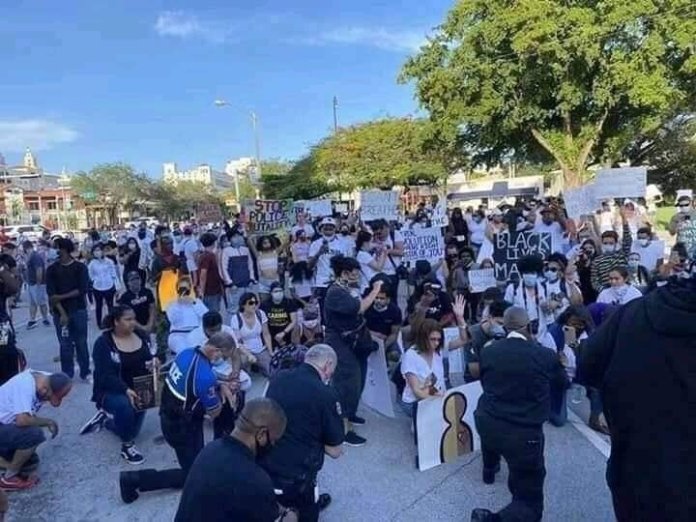
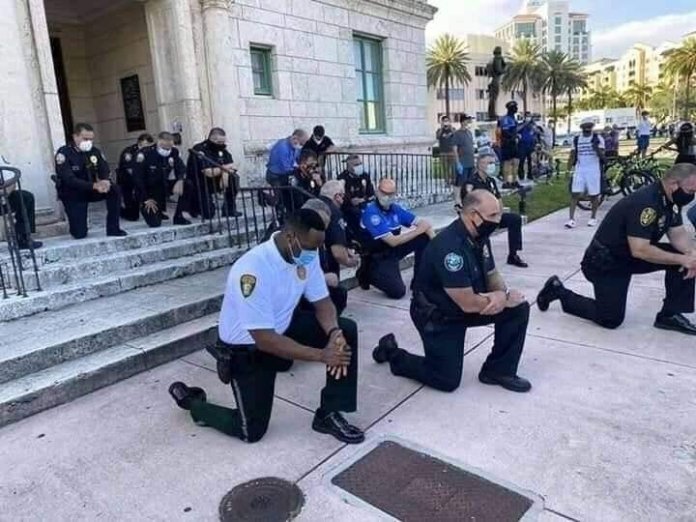
USA Miami Police met Crowds protesting the death of George Floyd and the scourge of racism in America.
When Protesters came to attack them due to George Floyd Murder; The Black American who was killed by Minnesota Police These Miami Police Officers all went on their knees; asked for forgiveness on behalf of their evil colleagues while crying.
The Rioters were forced to join them… something which melted so many heart
As the black community in America battles abusive acts of racists coupled with cops shooting them in their homes and even on the streets, the fate of fellow blacks in Brazil is no better.
Even as enraged protesters and police faceoff on the streets of Minneapolis in the wake of the murder of 46-year-old African-American George Floyd on suspicion of committing fraud, 14-year-old boy João Pedro Matos Pinto was on Monday, May 18 shot dead.
He was playing with a cousin in his uncle’s house in São Gonçalo, in the metropolitan region of Rio de Janeiro, when Civil and Military police supposedly on the heels of drug dealers shot him dead in the stomach.
Curiously enough, the boy was airlifted by the security agents in a Civil Police helicopter and taken to the Firefighter aerial operations, south of Rio, about 18km away without informing any family member of the boy. According to the Fire Department, Pinto was already dead upon arrival per a doctor’s assessment.
With Pinto’s parents and relatives unaware of his demise, the family started a search all night in hospitals and police stations and created a campaign on social media networks with the #procurasejoaopedro hash tag.
It will be on Tuesday morning, May 19, a whole 17 hours later that Pinto’s lifeless body was found at the IML (Legal Medical Institute) of the city. The Civil Police of Rio de Janeiro (PCRJ) claimed it has initiated an investigation to look into the death of the teenager killed during the police operation.
While PCRJ noted that the operation aimed to carry out two search and seizure warrants against leaders of a criminal faction, it added “during the action, drug dealers’ security guards tried to escape by jumping over the wall of a house. They fired at the police and threw grenades at the agents.”
Pinto’s cousin Daniel Blaz, who witnessed the invasion and was with him gave a different version of events. Blaz stated aside using firearms, agents of the Federal and Civil police threw grenades at Pinto’s home, adding the security agents invaded the residence and threw a grenade at the door.
“Closest to the door were me and João. There was a buzz. Then they took a lot of shots at the window, and we came out running to the room. We ran to the room, João and Duda were in the pantry, lying down,” the young man continued. “The police came in, told us to lie on the floor and everyone to shut up,” he detailed.
Pinto’s father Neilton Matos said officers forged a version of the police action that killed his teenage son, adding the walls of the property have at least 72 marks of gunshots.
He also denied criminals had invaded the residence, as stated in the police version stressing “there were no bandits. They entered the house and threw two grenades, besides the shots. There were only teenagers of the family.”
“João was not on the street in confrontation. He was inside a house, a home. Nobody has the right to enter someone’s home and take the life of a 14-year-old,” he lamented.
“If justice is not done here, God’s will be, but we hope it will be fulfilled here. My son had dreams, he already knew what he wanted. He wanted to be a lawyer and he was able to do that. A son with good grades, a boy 100%”, he recalled.
Scores of Brazilians have called for the death penalty for the security agents responsible for the teenager’s death while other state authorities have demanded a full report from the police hierarchy in days to ascertain the way forward.
What’s clear in the US and Brazil is that the police would not enter a mostly white middle-class neighborhood and riddle a house with more than 70 shots.
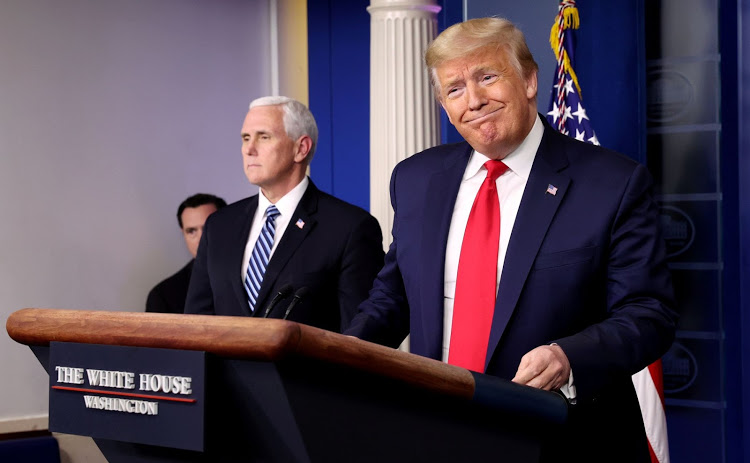
United States President Donald Trump on Thursday called those involved in the protests against the death of an African American man in police custody “thugs”. George Floyd died after a white Minneapolis police officer knelt on his neck as he lay on the ground during an arrest on Monday.
Videos captured by the bystanders at the scene showed Floyd shouting “I cannot breathe” and “don’t kill me”. Floyd, a 46-year-old restaurant worker, was seen gasping for breath after the police officer detained him for allegedly using a counterfeit $20 bill in a purchase.
Demonstrators across the country continued their protests for the third night on Thursday. Outside Minneapolis police precinct station, protestors clashed repeatedly with the police in riot gear, AP reported. They also set the police station on fire. A police spokesperson said the staff had evacuated the station “in the interest of the safety of our personnel” shortly after 10 pm. The third precinct covers the area of south Minneapolis where Floyd was arrested. A car and at least two other buildings in the vicinity were also set ablaze during the demonstrations.
Late Thursday, Trump castigated the “total lack of leadership” in Minneapolis. “Either the very weak radical left Mayor, Jacob Frey, get his act together and bring the city under control, or I will send in the National Guard and get the job done right,” he tweeted. “These thugs are dishonoring the memory of George Floyd, and I won’t let that happen. Just spoke to Governor Tim Walz and told him that the military is with him all the way. Any difficulty and we will assume control but, when the looting starts, the shooting starts.”
Minnesota Governor Tim Walz earlier in the day activated the National Guard at the Minneapolis mayor’s request. The Guard tweeted minutes after the station burned that it had activated more than 500 soldiers across the metro area. “Our mission is to protect life, preserve property and the right to peacefully demonstrate,” it added. “A key objective is to ensure fire departments are able to respond to calls.”
However, it is not clear when and where the Guard was being deployed. The angry protestors also reportedly carried mannequins from a looted Target store and threw them onto a burning car. In Los Angeles and Denver, hundreds of demonstrators blocked traffic in both cities. Elsewhere in Minneapolis, thousands marched through the streets calling for justice after Floyd’s death.
Four city police officers involved in the incident, including the one pressing his knee into Floyd’s neck, were fired from their jobs on Tuesday. Meanwhile, officials overseeing investigations from the US Justice Department, Federal Bureau of Investigation, Minnesota Bureau of Criminal Apprehension and prosecutors appealed for calm at a press conference. “Give us the time to do this right, and we will bring you justice,” County Attorney Mike Freeman told reporters. He also accepted the police officers conduct in the video was “horrible”, adding that his job his, however, to prove that he violated a criminal statute.
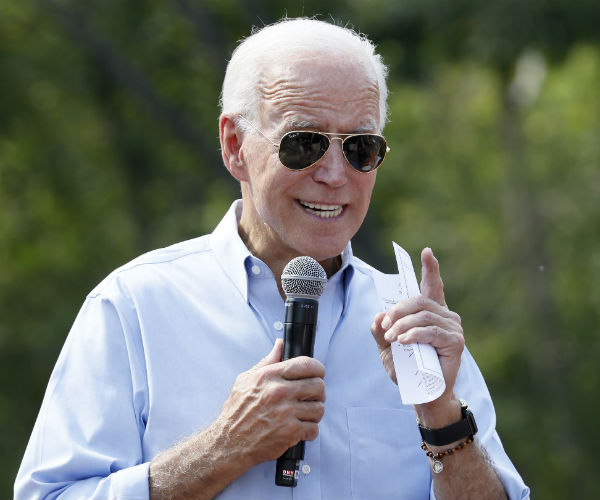
It’s hard to keep your eyes closed when you get slapped in the face. While appearing on “The Breakfast Club,” presidential candidate Joe Biden told co-host Lenard McKelvey, known professionally as “Charlamagne tha God,” that if black voters can’t decide whether to vote for Biden or Trump, then they “ain’t black.”
Initially I was a bit shocked, but I soon realized that we actually created this Monster. When I say WE, I mean the millions of my fellow Black Democratic Obama/Biden voters. The fact of the matter is that we never held VP Joe Biden accountable for his history of oppressive policies toward Black America. So to be honest, I can understand why he feels so confident about his clout in the Black community. Biden was in fact the VP for the first African American man in the White House and no one ever called him out for mass incarcerating millions of black men, or promoting segregating policies his entire political career.
No matter what political party you are in, we should all sympathize for the hundreds of thousands of black families that have been negatively effected by Joe Biden’s policies. This may be a political game to Democrats, but it’s not a game to the thousands of fathers sitting in the prisons that I teach in across America.
We should all remember that Joe Biden finds confidence from his many influential Black colleagues in the Congressional Black Caucus. An even harsher reality is that Black Democratic-led communities remain some of the worst in America while the majority of them enrich themselves and their campaigns by raising money promoting welfare programs, anti-Christian policies and race-baiting whenever they can identify issues that trigger the emotions of their black constituencies.
Let’s not forget these same Democrats continue to vote against school choice simply because they can’t raise money from it, even though most fundamentally agree with the concept. The Black Democratic elite have become slaves to the teachers unions while some poor black kids continue to read and write at levels you only find in Third World countries. In eight years, Biden and Obama did nothing substantial to address these injustices.
To make matters worst, Black America has to now deal with the fact that Joe Biden literally negotiated more money from the Ukrainians and Chinese for his family’s interest, than he did for the Historically Black Colleges and Universities in America thorough his eight years as vice president.
I called Donald J. Trump the first black president for a reason, and you can rest assured that I will not call Joe Biden the second. Hopefully, his latest comments will finally awakened Black America.
Jack Brewer possesses a unique combination of expertise in the fields of global economic development, sports, and finance through his roles as a successful entrepreneur, executive producer, news contributor, and humanitarian. Currently serving as the CEO and Portfolio Manager of The Brewer Group, Inc. as well as the Founder and Executive Director of The Jack Brewer Foundation (JBF Worldwide), active Shriner and Ambassador and National Spokesperson for the National Association of Police Athletic/Activities Leagues, Inc. Other key roles include regular contributor to CNBC, Fox Business, and The American City Business Journals, Ambassador for Peace and Sport for the International Federation for Peace and Sustainable Development at the United Nations, Senior Advisor to former H.E. President Joyce Banda of the Republic of Malawi, and three-time National Football League (NFL) Team Captain for the Minnesota Vikings, Philadelphia Eagles and New York Giants. Read Jack Brewer’s Reports —More Here.
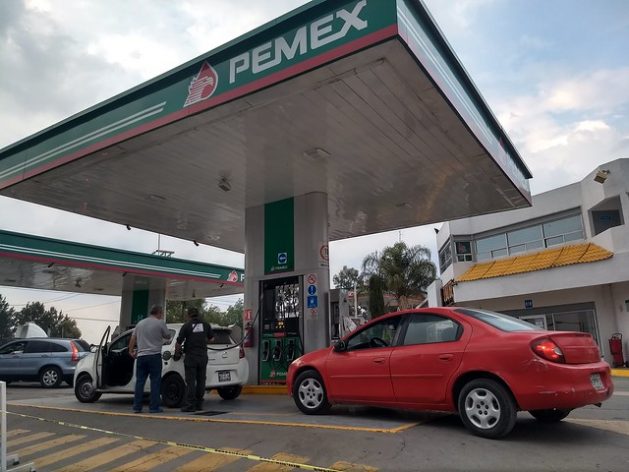
Mexico’s state-run oil giant Pemex faces a difficult outlook due to the fall in international oil prices and the crisis resulting from the coronavirus pandemic, which threatens its production and finances, in a situation analysed during the 29th La Jolla Energy Conference, organised online by the Institute of the Americas. CREDIT: Emilio Godoy/IPS
MEXICO CITY, May 22 2020 (IPS) – While it attempts to cushion the effects of the coronavirus pandemic, the Latin American and Caribbean region also faces concerns about the future of the energy transition and state-owned oil companies.
These questions were discussed at the 29th La Jolla Energy Conference, organised by the Institute of the Americas. It was held online May 18-22, rather than bringing together more than 50 speakers at the institute’s headquarters in the coastal district of San Diego, in the U.S. state of California, in the midst of the COVID-19 pandemic.
Alfonso Blanco of Uruguay, executive secretary of the Latin American Energy Organisation (OLADE), said during a session on global trends and the regional energy industry that the changes seen during the pandemic will spread after the crisis and will be long-lasting.
“There will be structural transformations and we are convinced that most consumer behaviors will change after the pandemic. Demand will vary due to changes in the main areas of transportation and other energy areas. The effects on fossil fuel consumption will be strong and there will be a greater impact on renewable energies,” he said.
OLADE, a 27-member regional intergovernmental organisation for energy coordination, estimates that electricity demand has fallen by 29 percent in Bolivia compared to 2019, as a result of the severe acute respiratory syndrome coronavirus 2 (SARS-CoV-2), which causes COVID-19, and by 26 percent in Argentina, 22 percent in Brazil and 11 percent in Chile.
“There will be structural transformations and we are convinced that most consumer behaviors will change after the pandemic. Demand will vary due to changes in the main areas of transportation and other energy areas. The effects on fossil fuel consumption will be strong and there will be a greater impact on renewable energies.” — Alfonso Blanco
Likewise, final energy demand plummeted 14 percent in Brazil compared to 2019, 11 percent in both the Andean and Southern Cone regions, nine percent in Mexico, seven percent in Central America and five percent in the Caribbean.
As countries went into lockdown to curb the spread of COVID-19, electricity consumption by businesses and factories declined, due to the suspension of activities.
Leonardo Sempertegui, legal advisor to the Organisation of Petroleum Exporting Countries (OPEC), said the pandemic may be a wake-up call for countries lagging behind in the energy transition.
“This may be the new normal. The structure and governance of the energy architecture to cope with the next phase are changing dramatically. Energy poverty and the energy transition cannot be solved regardless of who controls a resource; these challenges cannot wait,” he said in the same session.
In Latin America, nations like Argentina, Bolivia, the Dominican Republic, Ecuador, Honduras and Uruguay have made progress in the energy transition since 2015, while Brazil has slid backwards and countries like Mexico are stuck in the same place, according to the World Economic Forum’s Energy Transition Index, released May 13.
As the region heads into the fourth month of the pandemic, countries are assessing their electricity markets, which have been shaken by the crisis.
Nations like Argentina, Chile, Colombia and Peru have resorted to long-term electricity auctions, which have generated low prices for renewables, while Mexico suspended such schemes in 2019.
In Argentina, as Andrés Chambouleyron, a non-resident fellow at the Institute of the Americas, explained, industrial consumption fell by 50 percent and electricity distributors have not been able to obtain sufficient revenues to cover fixed costs or electricity purchases.
The government has thus provided financing to Cammesa – the electricity wholesale market administration company – to pay the generators, since it is bound by contracts to buy the energy.
“There will be a permanent change in electricity consumption in Argentina. We have cheaper gas than before; the models say that you have to use more gas because it is cheaper than other sources. We won’t see much change in Argentina’s energy mix, and that could extend to all of Latin America,” said Chambouleyron, who warned of breach of and renegotiation of contracts for energy purchases.
Low oil prices threaten to slow down the energy transition in Latin America, although renewable energies already compete with the costs of fossil fuels, agreed experts at the 29th La Jolla Energy Conference, organised online by the Institute of the Americas. The photo shows solar panels on a house in Ajijic, in the western Mexican state of Jalisco. CREDIT: Emilio Godoy/IPS
While renewables are already competing in price with conventional sources, low oil and gas prices undermine their expansion, a predicament that alternative energy sources have been facing in recent years.
In addition, the rise in the cost of international credit and the fluctuations of the dollar against local currencies may make generation more expensive.
In another session on the outlook for state-owned oil companies, Marta Jara, former president of Uruguay’s public oil company ANCAP, said the current crisis could accelerate the transition, but called it a “major challenge”.
“The temptation is to be opportunistic and forget the roadmap of the energy transition. We must invest in sustainable energy systems, decarbonise transport. It is important to secure funding and create jobs. I hope the crisis opens the door to be more innovative,” she said.
Viable or not?
The plunge in fossil fuel prices is damaging the finances of the region’s oil producing countries, such as Argentina, Bolivia, Brazil, Colombia, Ecuador, Mexico, Peru and Venezuela, and state companies in the sector are facing problems with regard to planning and operations.
But it benefits net importers, like the countries of Central America or Chile, whose oil bills have shrunk, while for consumers in both oil producing and importing countries the cost of electricity could go down.
“The most competitive will be the countries with lower oil extraction costs. Some projects will not be economically viable. We will see greater economic problems than in 2019,” predicted Lisa Viscidi, director of the Energy, Climate Change and Extractive Industries Programme at the non-governmental Inter-American Dialogue, during a panel on the situation in several Caribbean nations.
The pandemic and a rise in Saudi production announced on Mar. 10 led to a collapse in oil prices and the consequent risk of bankruptcies in the industry. State-owned oil companies have fared better than others so far in the crisis.
In another session on the outlook for state-owned oil companies, John Padilla, managing director of the private consulting firm IPD Latin America, stated that “it will take time to get out of this situation, with effects for the region, and the need for great efficiency.
“Most nations have been exporters, efficiency will be the key. What has not been done is to cultivate domestic and regional markets, state enterprises are not going to play the same role as they always have,” he said.
Public companies such as Brazil’s Petrobras and Colombia’s Ecopetrol entered the crisis in a better position than Mexico’s Pemex, Venezuela’s PDVSA and Argentina’s YPF, according to experts.
“These are difficult times, even for the best prepared. We can hope that if the country and its company are in trouble, if governments need money, they can get more out of the companies,” said Francisco Monaldi, interim director of the Baker Institute for Public Policy’s Latin America Initiative at the private Rice University in the U.S. state of Texas.
In his view, “Mexico is in better fiscal conditions, it should not be a problem. But Pemex can drag Mexico down. If the government doesn’t change direction, it could become a serious problem,” he said as an example.
Although Pemex will increase its investment in 2020, the oil company reported losses of 20 billion dollars in the first quarter of this year. Due to the crisis, Petrobras limited its investment to 3.5 billion dollars and its daily production to 200,000 barrels, and postponed the sale of eight refineries.
For Lucas Aristizábal, a senior director in Fitch Ratings’ Latin American corporates group, some state-owned oil companies are viable and others are not.
“In 2021, the financial contribution of oil will be lower for governments. If they want the companies to play a key role, they will put more pressure on their financial structure. The current situation illustrates the economics of these corporations,” he said during the forum.
Pemex and YPF were already losing money per barrel in 2019, while Petrobras has more balanced production costs.
On the oil horizon, and in the midst of the COVID-19 crisis, Guyana has become the rising star, although there is still political uncertainty, as the result of the Mar. 2 presidential elections is still unclear.
“It’s hard to predict what will happen. There is a risk of U.S. sanctions that would not affect investment in the sector, but would pose a political risk to the country,” said Thomas Singh, in the Department of Economics at the public University of Guyana.
The country expects to extract 600,000 barrels per day by 2024 and take in revenues of five billion dollars, with reserves exceeding five billion barrels.
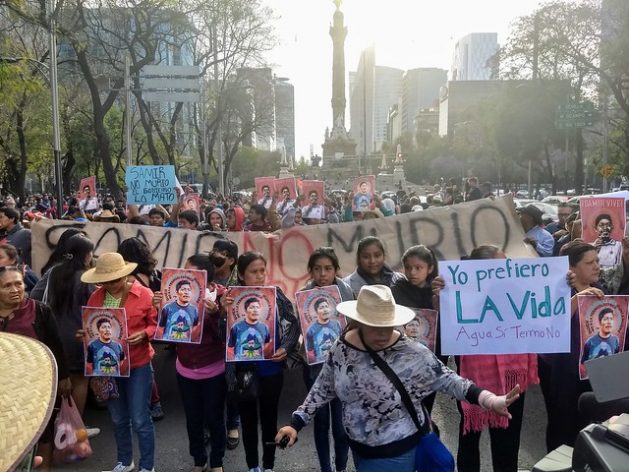
Demonstrators demand clarification of the murder of land rights activist Samir Flores and the shutdown of a thermoelectric plant in the state of Morelos, in central Mexico, in a February 2019 protest on Mexico City’s emblematic Paseo Reforma. CREDIT: Emilio Godoy/IPS
MEXICO CITY, May 20 2020 (IPS) – Since 2012, Teresa Castellanos has fought the construction of a gas-fired power plant in Huexca, in the central Mexican state of Morelos, adjacent to the country’s capital.
“We don’t want the power plant to operate, because it will cause irreparable damage, polluting the water and air. This project was imposed on us; we have to defend the water and the land. This is not an industrial zone,” the activist, coordinator of the Huexca Resistance Committee, told IPS.
During the tests, the constant noise of the turbines also altered the life of this small community of just over 1,000 people, mostly farmers, near the Cuautla River, within the rural municipality of Yecapixtla.
“Development banks must have safeguards and principles for sustainable investment. National regulations are needed, which define climate finance and green finance, what principles govern them, what are the climate risks. The trend should be to increasingly finance green projects and less and less hydrocarbons.” — Liliana Estrada
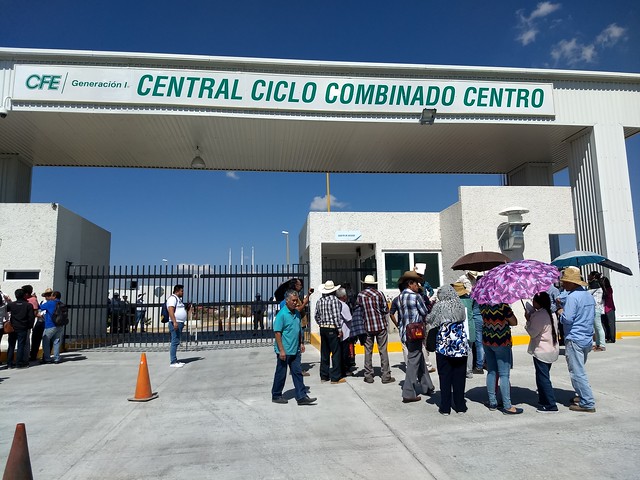
The Central Combined Cycle Plant, located in Huexca and with a capacity of 620 megawatts based on gas and steam, is part of the Morelos Integral Project (PIM), developed by the state Federal Electricity Commission (CFE). It also consists of an aqueduct and a gas pipeline that crosses the states of Morelos, Puebla and Tlaxcala.
The People’s Front in Defence of Land and Water of Morelos, Puebla and Tlaxcala and its ally, the Permanent Assembly of the People of Morelos, have managed to get several court orders that have blocked the operation of the plant, the 12-km aqueduct and the 171-km gas pipeline since 2015.
Castellanos, who has won an international and a national award for her activism, has been involved in the battle against the plant from the very start, which has earned her persecution and threats.
The opposition to the power plant by local communities that depend on planting corn, beans, squash and tomatoes and raising cattle and pigs, focuses on the lack of consultation, the threat to their agricultural activity, due to the extraction of water from the rivers, and the discharge of liquid waste.
In February 2019, a public consultation that did not meet international standards supported the completion of the project.
A few days earlier, activist Samir Flores had been murdered, a crime that remains unsolved – just one more instance of violence against environmentalists in Mexico. Despite Flores’ murder, the government of leftist President Andrés Manuel López Obrador went ahead with the referendum and upheld the result.
As in the case of other projects, development banks have become a financial pillar for the oil industry in Latin America’s second-largest nation, population 130 million.
The National Bank of Foreign Trade (Bancomext), Banobras and Nacional Financiera (Nafin) have funneled millions of dollars into building pipelines and oil and gas facilities in recent years, even though the climate change crisis makes it necessary to abandon such investments.
They have also financed renewable energy projects, but in much smaller amounts than fossil fuels.
The construction and operation of the Central Combined Cycle Plant, of the state Federal Electricity Commission, financed with public funds, unleashed a conflict with residents of Huexca, a small community in the central Mexican state of Morelos, which has brought the operation of the thermoelectric plant to a halt. CREDIT: Emilio Godoy/IPS
Energy reform pillar
The energy reform that then conservative president Enrique Peña Nieto (2012-2018) enacted in 2013 opened the sector to private capital, broke the monopoly of the state-owned Petroleos Mexicanos (Pemex) oil giant and CFE, and made Mexico an attractive market for international investment in the sector.
To support this transformation, the state development banks also opened their coffers.´
Since 2012, Banobras, which finances infrastructure and public works and services, has lent at least 721 million dollars for the construction of gas pipelines, 10.2 billion dollars for oil and gas projects, 251 million dollars for electrical cogeneration, from steam generated in hydrocarbon plants, and eight million dollars for the construction of a thermoelectric plant that will burn fuel oil in the northwestern state of Baja California Sur.
Bancomext, which provides financing to exporters, importers and nine strategic sectors, has delivered some 500,000 dollars to oil companies in the eastern state of Tamaulipas and another 446 million dollars in Mexico City. It has also provided 65.4 million dollars to gas initiatives in the northern state of Nuevo Leon and 626.7 million dollars in Mexico City.
In addition, it has contributed 1.5 billion dollars for the supply of gas through pipelines to the final consumer; 324 million dollars for the extraction of oil and gas; 216 million dollars for the construction of public works for oil and gas; 126 million dollars for the manufacture of products derived from oil and coal; nearly seven million dollars for oil refining; 0.65 million dollars for the commercialisation of fuels; 0.25 million dollars for the drilling and maintenance of hydrocarbon wells; as well as 0.25 million dollars for oil platform maintenance and services.
In February, Bancomext granted a loan of 7.1 million dollars to Grupo Diarqco, in what it presented as the first credit to a private Mexican company in the industry, to exploit an oil field in the southeastern state of Tabasco.
Nafin, which grants credits and guarantees to public and private projects, created in 2014 the Energy Impulse Programme for these initiatives, endowed with more than a billion dollars.
As in the case of the Morelos Integral Project, the gas pipelines have been a source of conflict with local communities, arising from the lack of socio-environmental safeguards and standards to guarantee that a project and its financing will respect the human rights of potentially affected communities.
Nafin and Banobras lack such safeguards, while Bacomext has had an “Environmental and Social Risk Management System Guide” since 2017, with no evidence of whether and how it has been applied to energy projects financed since then.
Since 2003, three platforms of international standards have emerged, to which Mexico’s development banks have not adhered, on human rights; social and environmental assessments and impacts; the application of safeguards; stakeholder participation; complaint resolution; and transparency.
The planet needs 80 percent of the global hydrocarbon reserves to stay underground in order for the temperature increase to remain at 1.5 degrees Celsius, as set out in the Paris Agreement on climate change.
The treaty, signed by 196 countries and territories in 2015, will enter into force at year-end and is considered indispensable to avoid irreversible climate disasters and human catastrophes.
Liliana Estrada, a researcher with the Climate Finance Group of Latin America and the Caribbean, told IPS that most investment in energy still goes to fossil fuels.
“After the reform, they have to enter into strategic projects and follow the guidelines of the government; they cannot go against these strategic lines. The gas and gas pipelines became strategic,” with the boost to the megaprojects of the López Obrador administration, said the representative of this coalition of non-governmental organisations and academics.
These credits are part of the fossil fuel subsidies that Mexico has pledged, to several international bodies, to eliminate.
The Mexican energy industry has also attracted international private banks, which have lent 55.95 billion dollars to 12 corporations, according to “Banking on Climate Change: Fossil Fuel Finance Report 2020”, released in March by six international environmental organisations.
The CFE received some 5.4 billion dollars from 12 banks between 2016 and 2019, and Pemex received 48.3 billion dollars from 20 foreign banks.
Based on Huexca’s experience, Castellanos demanded that these investments be stopped.
“If it’s our company, as the government says, then we can close it down. We have to defend the space in which we live, because we only have one planet and it belongs to all of us, it belongs to every living being, and it is our obligation to contribute something to this planet, because we are only here for a short while, we are guests of the earth”, she said.
Estrada called for sustainable financing regulations and questioned the lack of government leadership in this regard.
“Development banks must have safeguards and principles for sustainable investment,” she said. “National regulations are needed, which define climate finance and green finance, what principles govern them, what are the climate risks. The trend should be to increasingly finance green projects and less and less hydrocarbons.”