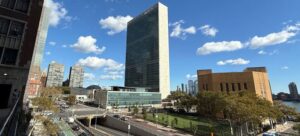
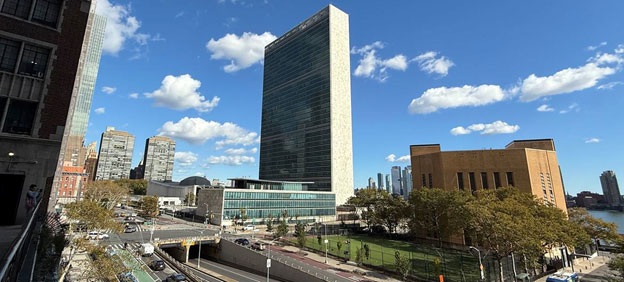
The United Nations Headquarters as seen from First Avenue in New York City. Credit: UN News/Vibhu Mishra
KATHMANDU, Nepal, Dec 10 2025 (IPS) – The election of the next Secretary-General of the United Nations comes at a highly inopportune moment in 2026, when the UN is being bypassed, and multilateralism—with the UN at its core—is under increasing challenge from some of the world’s most powerful states and leaders.
The new Secretary-General, taking office in 2027, will inherit an unprecedented financial crisis and a pressing need for major institutional reorganization simply to keep the UN afloat. At first glance, this hardly seems like the right moment for a new SG to advance a bold vision—one capable of winning over powerful leaders who appear lukewarm toward strengthening genuine multilateralism and instead prefer a multipolar order where each can guard its own sphere of influence.
Yet history reminds us that some of the boldest ideas have emerged during periods of great upheaval—wars, revolutions, and global crises. It is therefore conceivable that a visionary new UN leader could break new ground, introduce innovative ideas, and help plant the seeds for a rejuvenated, rules-based world order.
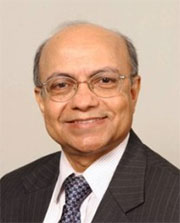
Kul Gautam
While many of today’s most powerful leaders may be ambivalent about multilateralism, the world’s general public—especially the digitally savvy younger generation—has a strong sense of global interdependence.
They increasingly identify as global citizens, eager to thrive in a borderless world, and are more likely to embrace visionary proposals for UN reform that meet the realities of the 21st century.
A promising starting point would be the election of the first-ever female Secretary-General of the UN. Another essential reform would be restructuring the UN’s financing system to make it more broad-based and less dependent on the whims of a few wealthy, powerful states.
Some consolidation of the UN’s sprawling architecture—much of it underfunded—is already underway through the current SG’s UN80 Initiative. A new SG could accelerate this effort, earning the support of both critics and cynics.
Still, even a dynamic and visionary new SG will require the backing of Member States. At present, leaders of the most powerful states, particularly the veto-wielding P5, seem disinclined to empower the world’s top diplomat as a true global leader.
While many enlightened global citizens—especially Gen Z—hope for a bold, inspiring figure at the helm, the major powers may prefer a more compliant “Secretary” rather than a strong, strategic “General.”
With the rise of the Global South and groupings such as BRICS+ and the G20, the balance of power—especially soft power—is shifting away from the states that founded the UN 80 years ago.
One hopes this evolving landscape will help strengthen the UN and reinvigorate multilateralism, which remains the only viable way to confront such transcendental issues as climate change, war and peace, pandemics, widening inequalities, and the profound opportunities and risks of the AI revolution.
The world urgently needs a more effective UN to address these pressing global challenges—none of which any nation, however rich or powerful, can tackle alone. It is to be hoped that world leaders, attuned to their peoples’ aspirations, will choose a highly capable new Secretary-General and empower her to help build a more peaceful and prosperous world for present and future generations.
Kul Gautam is a former UN Assistant Secretary-General, Deputy Executive Director of UNICEF and author of Global Citizen from Gulmi: My Journey from the Hills of Nepal to the Halls of the United Nations.
Influencer Jeri Wirtz has tragically died at 74 … following a long battle with breast cancer. The news was confirmed on the joint IG account she shared with her husband, Mike — “Jeri & Mike” — where it was revealed she passed away on Dec.…
Share this:
Like this:
LikeLoading…
Discover more from The Maravi Post
Subscribe to get the latest posts sent to your email.
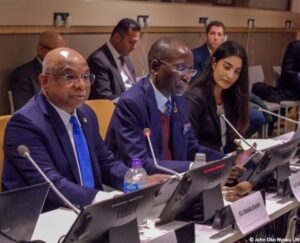
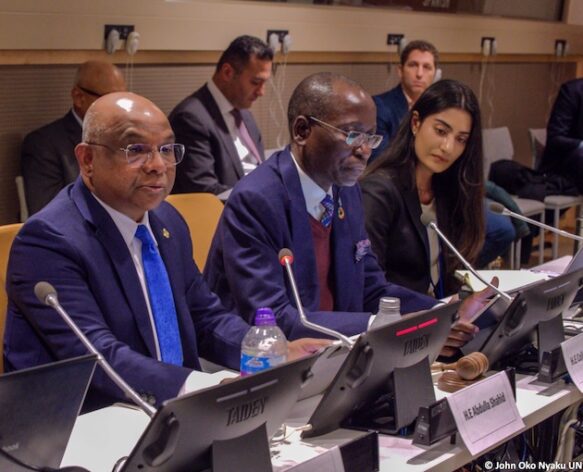
H.E. Abdulla Shahid (left), former President of the UN General Assembly, and Collen Kelapile (center), former UN ambassador to Botswana and former vice-president of the UN Economic and Social Council, speak as panelists at the launch event of ICO’s flagship report. Credit: John Okyo Nyaku/UN
UNITED NATIONS, Dec 9 2025 (IPS) – More than one year since its adoption, the UN Pact for the Future is held up as a critical framework for countries to address today’s issues through global cooperation. Its agenda for global governance and sustainable development is ambitious, and it is for this reason the Pact poses implementation challenges when it comes to the direct impact on local communities. It will require the joint efforts of governments, civil society and international organizations to achieve the goals laid out in the Pact.
The efforts of the International Communities Organisation (ICO), a UK-based international NGO, demonstrate what implementing the Pact would look like. Since 2016, ICO has worked to empower minority communities in conflict-affected areas through education and capacity-building opportunities. ICO focuses on directly supporting efforts to build up underrepresented groups’ involvement in community initiatives and diplomatic dialogue and address systemic, societal inequalities.
On December 3, ICO launched its flagship report, For Our Future: Best Practice for the Implementation of the UN Pact for the Future, at the UN Headquarters in New York, presenting a practical framework to support UN member states in advancing the objectives outlined in the Pact for the Future. Several Permanent Missions to the UN, including Bahrain, Guyana, Hungary, Kuwait, Samoa, Singapore, Tajikistan, Tonga, and Uganda, co-sponsored the event.
The UN Pact for the Future represents a shared set of global commitments to sustainable development, peace and security, and redefining global governance for member states. While its adoption marks a decisive moment of global consensus, there remains the challenge of translating the Pact’s guiding principles into meaningful action at the national and regional levels. Through its ‘Best Practices’ blueprint, the ICO report distills their findings into an adaptable methodology designed to equip policymakers with the tools they need to implement the Pact’s goals effectively.
James Holmes, ICO founder and Secretary General, said, “The Pact reminds us that the strength of nations is measured not only by the power of their armies or the size of their economies, but also by the inclusiveness of their societies and the recognition of all who live within.” “How we treat minority peoples, those who are few in number, vulnerable, or historically marginal, is the true test of our progress and the true test of whether the fact for the future is being successful.”
H.E. Abdulla Shahid, ICO International Ambassador and former President of the 76th United Nations General Assembly, said it was crucial for the world to unite.
“The UN Pact for the Future calls for renewed unity in tackling humanity’s greatest challenges. This report demonstrates that lasting peace is built not only at negotiation tables but also through empowering communities themselves, ensuring that no group is left behind.”
“As UN Secretary-General António Guterres noted at the opening of the ‘Summit of the Future’ in September 2024, ‘21st-century challenges require 21st-century solutions: frameworks that are networked and inclusive and that draw on the expertise of all humanity.’
He added that the ICO’s report embodies this principle, showing how global aspirations can intersect with local action.
Prominent UN diplomats and civil society members were present at the launch event, demonstrating and remarking on their commitment to the Pact for the Future, and specifically to ICO’s work on the ground. Current and former high-ranking UN officials were also in attendance.
“One year after the adoption of the Pact, this discussion is timely,” said Themba Kalua, the UN Director, Pact for the Future Implementation Kalua remarked during the event. “While the world has grown more complex since the adoption of the Pact for the Future, the Pact continues to be central in realizing multilateralism, navigating the current geopolitical complexities and shaping our collective action on the global agenda.”
Kalua noted the efforts made by the UN system towards the Pact, including global panels on the governance of artificial intelligence (AI) and the political declarations that emerged from UN conferences on social development in Qatar and financing for development in Spain. He expressed that the Pact was a “strategic priority” for the UN and its Secretary-General, António Guterres.
“From our side in the UN system and the Secretariat, we are committed to doing our part in supporting the implementation of the Pact,” Kalua told IPS.
Presenting the report, ICO’s UN Programme Manager Mia Sawjani broke down its findings and recommendations. She emphasized that countries would need to empower and promote the agency of local actors. This includes building up their capacity and skills to enact positive change in their communities. Countries must recognize adaptability in assessing situations on the ground, particularly in conflict settings that transform institutions and structures.
“The implementation of the Pact can be tangibly realized for all, but particularly to serve marginalized communities. It’s a transformative opportunity and it is our collective responsibility to follow through,” said Sawjani.
After the event, Holmes was heartened by the outpouring of support for ICO’s work, noting that many more countries had agreed to partner with them for future projects. By maintaining their focus on working with minority communities, ICO can “play a major global role” in implementing the Pact for Future.
“I have a big vision, and I have a lot of ambition for ICO,” Holmes told IPS. “We already have a global team, and I see that growing, and I see us having a bigger and bigger role in helping to implement the Pact.”
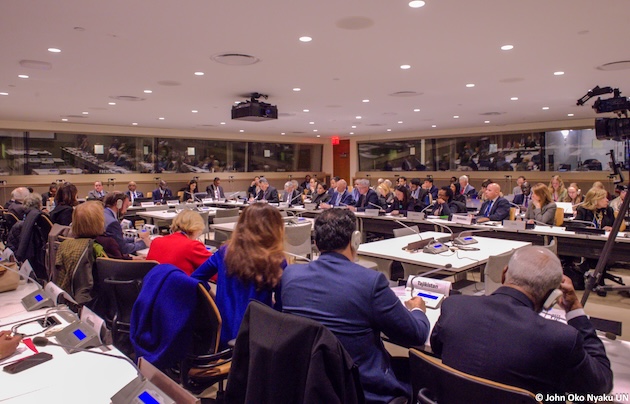
The launch event of ICO’s flagship report on the UN Pact for the Future at UNHQ in New York. The event was attended by high-ranking UN diplomats. Credit: John Okyo Nyaku/UN
Local actors and stakeholders, namely governments, academia, the private sector and civil society, would play a key role in implementing the Pact’s agenda. Organizations like ICO could serve as a bridge to translate the issues to the national context.
“The more we are able to bridge communities, the more successful it will be for states to deal with Track I diplomacy,” Shahid said to IPS, referencing the formal channel of diplomacy between governments on international issues.
Implementing the Pact for the Future must also mean recognizing the specific needs and challenges that these countries face. Island states like Samoa and Tonga, for example, are uniquely impacted by climate change, energy, and the global financial structures that need to better serve developing countries.
“For us in the Pacific, progress is measured not by rhetoric, but by real improvements that are felt in our villages, outer islands and vulnerable communities,” said Viliami Va’inga Tōnē, the Permanent Representative of Tonga.
Accountability and transparency will also be crucial to ensure countries follow through on the promises of the Pact. This must be present at all levels. Participants at the event emphasized the need for monitoring mechanisms that would measure progress.
The timing of the report coincides with the ongoing reform negotiations under the UN80 Initiative introduced this year. Discussions around the Pact went hand in hand with recognizing the critical step toward reforming the UN system that will optimize its ability to live up to its founding principles and the Pact’s promises.
If the Pact represents ‘what’ the UN and member states need to achieve in the global agenda, then UN80 represents ‘how’ the UN can implement the agenda.
“The UN80 initiative is really part of the UN response to how it can deliver on the ground,” said Fatumanava-o-Upolu III Dr. Pa’olelei Luteru, the Permanent Representative of Samoa. He said to IPS, “When you look at all the individual actions that need to be taken, these are at the global level, the UN [level], regional level, and national level. They’re all important, because we can’t continue to work in silence. Everything is interconnected now. So we need to make those connections and work together, and you don’t want duplication.”
While New York hosts reform discussions around the UN and its mandates, the organization’s impact will ultimately be felt by local communities across the world.
Dr. Agnes Mary Chimbiri-Molande, Permanent Representative of Malawi, told IPS that the people who serve in multilateral systems like the UN need to “renew or even rebuild trust” with local communities. At a time when people are questioning the UN’s relevance, she said, these discussions must be held and all perspectives need to be respected.
“We need to hear the voices of the local people. Because here we are working for them. We are not working for ourselves,” Chimbiri-Molande said. “So in fact, to be hearing the voices of those peoples, it’s very, very important to inform our work here, whether we are making an impact or we are making differences in the lives of the people in the community.”
Shahid reiterated that the decisions made in the halls of UN Headquarters will affect local communities, adding that the UN’s success is also contingent on its partnerships with civil society and how important it is for civil society to recognize the UN’s relevance.
During his time as President of the General Assembly from 2021-2022, the world was in the midst of the COVID-19 pandemic. His ‘presidency of hope’ championed the progress made by the international system despite the challenges brought on by the pandemic. He also made efforts to promote inclusivity by opening the General Assembly to more participants, including civil society groups.
Shahid invited young diplomats from underrepresented member states to the President’s office to witness international diplomacy firsthand.
Even after his presidency ended, he told IPS, he wanted to continue to deliver on the ideals that defined his tenure.
“I thought that there’s no need to end the presidency of hope after one year. Let us keep delivering the message of hope through other platforms. And ICO provides me the platform, because it is a platform through which I can actually reach out to communities at [the] household level and inspire them not to give up. Keep working, keep aiming to change the status.”
H.E. Abdulla Shahid (left), former President of the UN General Assembly, and Collen Kelapile (center), former UN ambassador to Botswana and former vice-president of the UN Economic and Social Council, speak as panelists at the launch event of ICO’s flagship report. Credit: John Okyo Nyaku/UN
UNITED NATIONS, Dec 9 2025 (IPS) – More than one year since its adoption, the UN Pact for the Future is held up as a critical framework for countries to address today’s issues through global cooperation. Its agenda for global governance and sustainable development is ambitious, and it is for this reason the Pact poses implementation challenges when it comes to the direct impact on local communities. It will require the joint efforts of governments, civil society and international organizations to achieve the goals laid out in the Pact.
The efforts of the International Communities Organisation (ICO), a UK-based international NGO, demonstrate what implementing the Pact would look like. Since 2016, ICO has worked to empower minority communities in conflict-affected areas through education and capacity-building opportunities. ICO focuses on directly supporting efforts to build up underrepresented groups’ involvement in community initiatives and diplomatic dialogue and address systemic, societal inequalities.
On December 3, ICO launched its flagship report, For Our Future: Best Practice for the Implementation of the UN Pact for the Future, at the UN Headquarters in New York, presenting a practical framework to support UN member states in advancing the objectives outlined in the Pact for the Future. Several Permanent Missions to the UN, including Bahrain, Guyana, Hungary, Kuwait, Samoa, Singapore, Tajikistan, Tonga, and Uganda, co-sponsored the event.
The UN Pact for the Future represents a shared set of global commitments to sustainable development, peace and security, and redefining global governance for member states. While its adoption marks a decisive moment of global consensus, there remains the challenge of translating the Pact’s guiding principles into meaningful action at the national and regional levels. Through its ‘Best Practices’ blueprint, the ICO report distills their findings into an adaptable methodology designed to equip policymakers with the tools they need to implement the Pact’s goals effectively.
James Holmes, ICO founder and Secretary General, said, “The Pact reminds us that the strength of nations is measured not only by the power of their armies or the size of their economies, but also by the inclusiveness of their societies and the recognition of all who live within.” “How we treat minority peoples, those who are few in number, vulnerable, or historically marginal, is the true test of our progress and the true test of whether the fact for the future is being successful.”
H.E. Abdulla Shahid, ICO International Ambassador and former President of the 76th United Nations General Assembly, said it was crucial for the world to unite.
“The UN Pact for the Future calls for renewed unity in tackling humanity’s greatest challenges. This report demonstrates that lasting peace is built not only at negotiation tables but also through empowering communities themselves, ensuring that no group is left behind.”
“As UN Secretary-General António Guterres noted at the opening of the ‘Summit of the Future’ in September 2024, ‘21st-century challenges require 21st-century solutions: frameworks that are networked and inclusive and that draw on the expertise of all humanity.’
He added that the ICO’s report embodies this principle, showing how global aspirations can intersect with local action.
Prominent UN diplomats and civil society members were present at the launch event, demonstrating and remarking on their commitment to the Pact for the Future, and specifically to ICO’s work on the ground. Current and former high-ranking UN officials were also in attendance.
“One year after the adoption of the Pact, this discussion is timely,” said Themba Kalua, the UN Director, Pact for the Future Implementation Kalua remarked during the event. “While the world has grown more complex since the adoption of the Pact for the Future, the Pact continues to be central in realizing multilateralism, navigating the current geopolitical complexities and shaping our collective action on the global agenda.”
Kalua noted the efforts made by the UN system towards the Pact, including global panels on the governance of artificial intelligence (AI) and the political declarations that emerged from UN conferences on social development in Qatar and financing for development in Spain. He expressed that the Pact was a “strategic priority” for the UN and its Secretary-General, António Guterres.
“From our side in the UN system and the Secretariat, we are committed to doing our part in supporting the implementation of the Pact,” Kalua told IPS.
Presenting the report, ICO’s UN Programme Manager Mia Sawjani broke down its findings and recommendations. She emphasized that countries would need to empower and promote the agency of local actors. This includes building up their capacity and skills to enact positive change in their communities. Countries must recognize adaptability in assessing situations on the ground, particularly in conflict settings that transform institutions and structures.
“The implementation of the Pact can be tangibly realized for all, but particularly to serve marginalized communities. It’s a transformative opportunity and it is our collective responsibility to follow through,” said Sawjani.
After the event, Holmes was heartened by the outpouring of support for ICO’s work, noting that many more countries had agreed to partner with them for future projects. By maintaining their focus on working with minority communities, ICO can “play a major global role” in implementing the Pact for Future.
“I have a big vision, and I have a lot of ambition for ICO,” Holmes told IPS. “We already have a global team, and I see that growing, and I see us having a bigger and bigger role in helping to implement the Pact.”
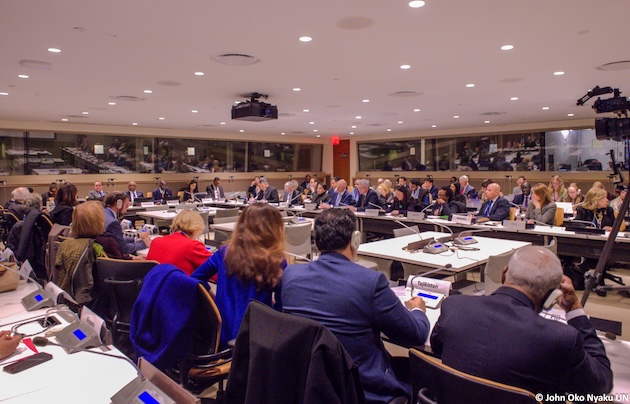
The launch event of ICO’s flagship report on the UN Pact for the Future at UNHQ in New York. The event was attended by high-ranking UN diplomats. Credit: John Okyo Nyaku/UN
Local actors and stakeholders, namely governments, academia, the private sector and civil society, would play a key role in implementing the Pact’s agenda. Organizations like ICO could serve as a bridge to translate the issues to the national context.
“The more we are able to bridge communities, the more successful it will be for states to deal with Track I diplomacy,” Shahid said to IPS, referencing the formal channel of diplomacy between governments on international issues.
Implementing the Pact for the Future must also mean recognizing the specific needs and challenges that these countries face. Island states like Samoa and Tonga, for example, are uniquely impacted by climate change, energy, and the global financial structures that need to better serve developing countries.
“For us in the Pacific, progress is measured not by rhetoric, but by real improvements that are felt in our villages, outer islands and vulnerable communities,” said Viliami Va’inga Tōnē, the Permanent Representative of Tonga.
Accountability and transparency will also be crucial to ensure countries follow through on the promises of the Pact. This must be present at all levels. Participants at the event emphasized the need for monitoring mechanisms that would measure progress.
The timing of the report coincides with the ongoing reform negotiations under the UN80 Initiative introduced this year. Discussions around the Pact went hand in hand with recognizing the critical step toward reforming the UN system that will optimize its ability to live up to its founding principles and the Pact’s promises.
If the Pact represents ‘what’ the UN and member states need to achieve in the global agenda, then UN80 represents ‘how’ the UN can implement the agenda.
“The UN80 initiative is really part of the UN response to how it can deliver on the ground,” said Fatumanava-o-Upolu III Dr. Pa’olelei Luteru, the Permanent Representative of Samoa. He said to IPS, “When you look at all the individual actions that need to be taken, these are at the global level, the UN [level], regional level, and national level. They’re all important, because we can’t continue to work in silence. Everything is interconnected now. So we need to make those connections and work together, and you don’t want duplication.”
While New York hosts reform discussions around the UN and its mandates, the organization’s impact will ultimately be felt by local communities across the world.
Dr. Agnes Mary Chimbiri-Molande, Permanent Representative of Malawi, told IPS that the people who serve in multilateral systems like the UN need to “renew or even rebuild trust” with local communities. At a time when people are questioning the UN’s relevance, she said, these discussions must be held and all perspectives need to be respected.
“We need to hear the voices of the local people. Because here we are working for them. We are not working for ourselves,” Chimbiri-Molande said. “So in fact, to be hearing the voices of those peoples, it’s very, very important to inform our work here, whether we are making an impact or we are making differences in the lives of the people in the community.”
Shahid reiterated that the decisions made in the halls of UN Headquarters will affect local communities, adding that the UN’s success is also contingent on its partnerships with civil society and how important it is for civil society to recognize the UN’s relevance.
During his time as President of the General Assembly from 2021-2022, the world was in the midst of the COVID-19 pandemic. His ‘presidency of hope’ championed the progress made by the international system despite the challenges brought on by the pandemic. He also made efforts to promote inclusivity by opening the General Assembly to more participants, including civil society groups.
Shahid invited young diplomats from underrepresented member states to the President’s office to witness international diplomacy firsthand.
Even after his presidency ended, he told IPS, he wanted to continue to deliver on the ideals that defined his tenure.
“I thought that there’s no need to end the presidency of hope after one year. Let us keep delivering the message of hope through other platforms. And ICO provides me the platform, because it is a platform through which I can actually reach out to communities at [the] household level and inspire them not to give up. Keep working, keep aiming to change the status.”
Two years ago, a Karam tree branch brought from another district was being planted in the SAMS office premises along the Shyamnagar-Munshiganj road, but it didn’t survive. Credit: Rafiqul Islam Montu/IPS
SATKHIRA, Bangladesh, Dec 9 2025 (IPS) – A dried karam tree branch stands on the bank of a pond in a field in Datinakhali village adjacent to the Sundarbans. Despite many efforts, the tree could not be saved.
For two years, the Munda community in Bangladesh’s Sundarbans had been fighting to save the Karam tree so that they could bring back their traditional Karam festival—once the biggest festival in their community. Many trees are unable to survive due to the effects of salinity—this list includes the Karam tree, which is the main ingredient in celebrating the festival.
Bhakta Sardar, a priest from the Munda community, says the festival of the indigenous Munda community would be incomplete without the branches of the Karam tree
“We believe that our prosperity and well-being are hidden in the branches of the Karam tree. We pray to God to achieve our prosperity around this festival. But frequent cyclones and salinity have killed the Karam trees.”
“Now we celebrate this festival in its name only for the prosperity of the community. We cannot leave the festival for the next generation,” added Bhakta Sardar, referring to a smaller festival where the community uses fig tree branches as an alternative.
While the debate about how to integrate non-economic losses and damages due to the impact of climate change continued during the 30th Conference of the Parties to the UNFCCC (COP30) in Belém, Brazil, the Munda community is looking for ways to revive the Karam festival, a symbol of their prosperity. A recent study emphasized that these non-economic losses and damages included the loss of religious and cultural practices.
The study says that climate risks are increasing on the coast of Bangladesh. The risk is even higher in the southwest. If this situation continues in the future, small communities like the indigenous Munda community will be in even greater crisis. The study called for policy and financial reform to assist communities like this to adapt to the impacts of climate change.
In Search of the Karam Tree
The scientific name of the Karam tree is Mitragyna parvifolia. This tree in the Asian region is also known as Kelikadam. It mainly blooms before the monsoon. As the Karam tree has disappeared, the indigenous Munda community of Bangladesh now celebrates a similar festival on a smaller scale, with branches of a fig tree. The scientific name of this tree is Ficus religiosa.
There were once many Karam trees in the villages of southwestern Bangladesh. Datinakhali, adjacent to the Sundarbans in the Shyamnagar upazila (subdistrict) of Satkhira district, is one such village. This village celebrated the Karam festival with a grand event, with people from the Munda community from different areas joining in.
In addition to their time-honored religious tradition, the community in this village on the banks of the Chuna River faces economic difficulties.
The indigenous Munda community lives in several villages adjacent to the Sundarbans in Koyra upazila (sub-district) of Khulna district in southwestern Bangladesh.
Shukkuri Rani Munda used to attend the Karam festival organized in the courtyard of Fulsingh Munda’s house in Uttar Haztakhali village.
“To everyone now, the festival feels like a myth. A storm has swept away the entire festival. The next generation will forget the name of the Karam festival,” she says.
Munda Young Balai Krishna Sardar (38), president of the Sundarban Adivasi Unnayan Sangstha of that village, cannot recall attending the festival. Rangalal Munda’s 60-year-old father, Fulsingh Munda, witnessed a small-scale celebration five years ago. After Fulsingh’s death a year ago, no one in the village now knows how to initiate the Karam festival.
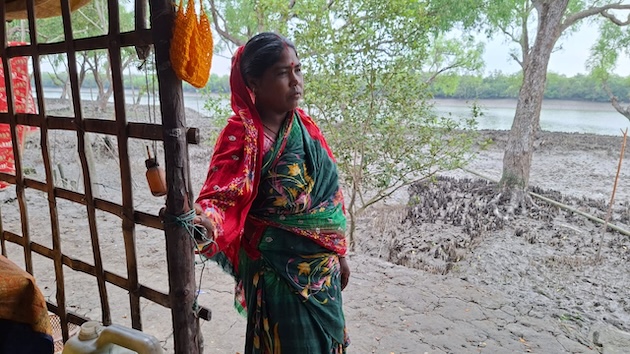
Geeta Rani Munda, 42, lives precariously in Datinakhali village, adjacent to the Sundarbans. She wants the Karam festival to return for her prosperity. Credit: Rafiqul Islam Montu/IPS
‘A Symbol of Our Faith’
The Munda community holds the belief that the branches of this tree conceal prosperity and well-being. They believe that the Karam festival ensures their good health and the well-being of future generations. Various tribal communities in Jharkhand, West Bengal, and Bihar, India, celebrate this festival with the same beliefs. Indigenous communities like Munda, Mahato, Kurmi, Matato, Santal, Orao, Baraik, Singh, Pahan, Mahali, Bhumij, etc., all celebrate the Karam festival.
“The Karam festival is our faith. Perhaps our economic condition is gradually deteriorating because we cannot follow our religious instructions,” said Anandini Rani Munda of Datinakhali village, articulating the belief that religious and economic wellbeing are intrinsically interlinked.
Nilkant Pahan, a priest of Burigoalini village in Shyamnagar upazila (sub-district), had been conducting the puja (religious ceremony) of the Munda community for eight years. He has organized the Karam festival several times following the ancestral tradition. But they were small events.
“Celebrating the Karam festival is our religious tradition. Our ancestors observed this tradition. We are trying to maintain its continuity. We are facing a much greater socio-economic and cultural crisis than before. We do not know what this crisis is because we cannot observe religious traditions,” Pahan says.
Impact of salinity
During Cyclone Aila in 2009, the entire area was submerged in the wave of salt water that broke the dam. The land was submerged in salt water for a long time, and the Karam trees could no longer survive. Many elderly Munda citizens believe that not only Aila but also other cyclones, especially a strong cyclone that hit the region in 1988, helped reduce the number of Karam trees.
GM Mostafizur Rahman, Chief Scientific Officer of Khulna Soil Resources Institute, said, “Both the intensity and extent of salinity in soil and water are increasing due to climate change; 81 percent of land in Shyamnagar is affected by varying degrees of salinity.”
Professor Saleh Ahmed Khan, Department of Botany, Jahangirnagar University, said, “The tree that the Munda community calls the ‘Karam’ tree is ‘Kelikadam.’ We did not find it among the 528 species under our research. The tree may not have survived due to the spread of salinity.”
Fight To Bring Back the Karam Festival
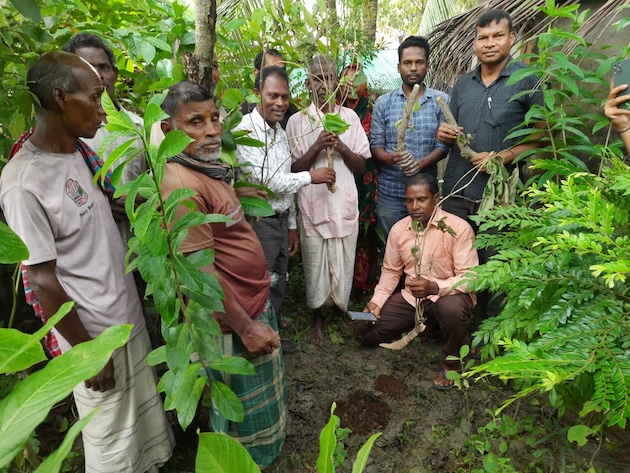
The Sundarbans Adivasi Munda Sangstha (SAMS) and leading members of the Munda community are working to bring back the Karam tree. They are trying to bring back the Karam festival by bringing branches of the Karam tree from other districts.
Two years ago, a branch of the Karam tree was planted in the SAMS office premises on the Shyamnagar-Munshiganj road, and another branch was planted in the Munda-dominated Datinakhali village. But it was not possible to save the tree. They will try again next year.
“We celebrate the Karam festival for our prosperity. We are trying to save the Karam trees for the festival. But due to salinity in the soil, the Karam trees cannot be saved. As an alternative, we use the branches of the fig (Ficus religiosa) tree,” said Geeta Rani Munda of Datinakhali village.
Krishnapada Sardar, Executive Director of SAMS, said it wasn’t enough that this festival only survives in the stories of elders.
“It was a major event in the rural culture of this community, which is proud of its identity. Climate change has changed the food habits of the Munda community, and the opportunities for livelihood have narrowed. The families of the community are facing an extreme economic crisis.
“Our lost festivals can be brought back by restoring the Karam tree. We want to return to our lost traditions. We want to return to our roots.”
President Trump heads to Pennsylvania to defend his record on affordability as polls show voters increasingly blame his policies for high prices. The Supreme Court appears poised to grant presidents far greater power over independent agencies, signaling a major shift in how the federal government operates. And Indiana lawmakers move toward a congressional map that could eliminate the state’s last two Democratic seats, intensifying a nationwide battle over mid-cycle redistricting.
Want more comprehensive analysis of the most important news of the day, plus a little fun? Subscribe to the Up First newsletter.
<
p class=”readrate”>Today’s episode of Up First was edited by Rebekah Metzler, Krishnadev Calamur, Kelsey Snell, Mohamad ElBardicy and Alice Woelfle.
<
p class=”readrate”>
<
p class=”readrate”>It was produced by Kaity Kline, Nia Dumas and Christopher Thomas.
<
p class=”readrate”>
<
p class=”readrate”>We get engineering support from Stacey Abbott. And our technical director is Carleigh Strange.
<
p class=”readrate”>
<
p class=”readrate”>And Our Senior Supervising Producer is Vince Pearson.