World’s Largest Religious Gathering Becomes Trans-Inclusive Despite Controversies

Arts, Asia-Pacific, Civil Society, Editors’ Choice, Featured, Gender, Gender Identity, Headlines, Human Rights, LGBTQ, Religion, TerraViva United Nations

Religion

Pavitra Nandagiri—one of the highest-ranking transgender spiritual leaders at Maha Kumbh, the largest religious gathering on earth in Prayagraj, India. Credit: Stella Paul/IPS

Pavitra Nandagiri—one of the highest-ranking transgender spiritual leaders at Maha Kumbh, the largest religious gathering on earth in Prayagraj, India. Credit: Stella Paul/IPS

PRAYAGRAJ, India, Feb 18 2025 (IPS) – Despite a blazing sun and growing heat, Pavitra Nandagiri sits on a cot smiling. Clad in a saffron robe and headgear with her forehead painted with turmeric and vermillion, Nandagiri is a Mahamandaleshwar—one of the highest-ranking monks of the Kinnar Akhada (Transgender Arena) at the Maha Kumbh, the world’s largest religious gathering currently underway in northern India.


As a steady stream of visitors pours in to touch her feet, Nandagiri raises her right hand and touches their heads in a gesture of accepting their respect and blesses them.

Just a few hours ago, she had taken part in the special, ceremonial snan (bathing) in the Sangam—a place with mythological significance where three holy rivers—Ganga, Jamuna and Saraswati—are believed to have met. Taking a dip in the confluence of these rivers is considered by Hindus as the most sacred act of one’s lifetime.

The ceremonial bathing is led by the most important of the living Hindu saints and godmen who follow a strict order of hierarchy. On Wednesday morning (February 12), the fourth ceremonial bathing of the 45-day Maha Kumbh was held. Fifteen transgender spiritual leaders, including Nandagiri, marched along with the Naga Sadhus and Aghoris—the legendary saints with ash-covered bodies, matted hair, and minimalistic clothing. Together, they bathed in the river with the holy chant of “Har har Mahadev” (Hail Shiva) while saints of other sects waited for their turn.

A devotee prays at the Maha Kumbh Sangam, where three rivers are believed to have converged. While two of the rivers—Ganges and Yamuna—are visible, the third river, Saraswati, is said to be hidden underneath. Credit: Stella Paul/IPS

A devotee prays at the Maha Kumbh Sangam, where three rivers are believed to have converged. While two of the rivers—Ganges and Yamuna—are visible, the third river, Saraswati, is said to be hidden underneath. Credit: Stella Paul/IPS

Later, inside the Kinnar Akhada, trans gurus receive visitors while some are seen performing some rituals and meditating along with Aghori ascetics. Asked how the partnership between the third highest order of the religious saints and the trans leaders came to be, Nandagiri says that it had been in the making since 2015 and culminated in a functioning collaboration during this year’s Maha Kumbh, which happens once every 12 years. She, however, does not share other details except that perhaps what brought together the two sects is their shared denouncement of worldly pleasure and embracing of a life free from its wealth and other complexities.

Transgender-Inclusive Kumbh: Conditions Apply

At the Kumbh, Akharas are organized into various sects, primarily categorized based on their philosophical orientation and the deity they worship. The two main sects are Shaiva Akharas, dedicated to Lord Shiva, and Vaishnava Akharas, devoted to Lord Vishnu. Each Akhara operates under a hierarchical structure, typically led by a Mahant (chief) or Acharya (spiritual leader) who oversees the spiritual and administrative functions.

The inclusion of the transgender Acharyas in the Kumbh, especially as a part of the highly revered Juna Akhada of the group of the Naga Sadhus, however, has not been completely free of controversies. Some have disputed their claim of embracing a minimalistic life and accused them of indulging in a game of power and authority considered unbefitting for true sainthood.

On January 24, the community ushered in a former film actress called Mamta Kulkarni as one of its top leaders, which led to protests by many both from within the trans community and leaders of other Hindu sects, who described it as a public relations stunt. Baba Ramdev—a well-known yoga guru—called it a violation of the Hindu religious ethos. Some gurus went as far as threatening to boycott the next Kumbh—to be held in 2037—if the Kinnar Akhada is not excluded from the ritual bathing.

Kalyani Nandagiri—another top-ranking trans guru who opposed the actress’s inclusion—was physically attacked by unidentified assailants on February 12.

A monk at the Transgender Arena within the Maha Kumbh. Credit: Stella Paul/IPS

A monk at the Transgender Arena within the Maha Kumbh. Credit: Stella Paul/IPS

Despite these deep divisions and acts of violence, Pavitra Nanndgiri remains hopeful of the community’s future.

“People say a lot of things; some wrongs also happen. But such small issues should not be highlighted much. We are here today, and we will be here then (in the next Kumbh),” she says, sounding more like a peace advocate.

A Different Picture

While inside the Kinnar Akhada, trans gurus are busy receiving and blessing visitors; outside, on the street, a small crowd of men is seen surrounding a young trans man dancing to the fast beats of music.

“This is Launda Naach,” says Ajeet Bahadur—a local theater artist. “It’s a common form of rural entertainment here, performed typically by cross-dressing trans men.”

The audience of Launda Naach is typically male. It is said to have started at a time when women were not allowed to dance in public because of orthodox social norms. However, today the moves of a Launda Naach performer are often sleazy and according to Ajeet Bahadur, the dancers are often sexually exploited, and their performance is rarely seen as art.

“Their lives are unbelievably miserable; there is little respect for their art, all eyes are on their bodies and exploitation and poverty are a constant part of their lives,” says Bahadur, who has studied the lives of Launda Naach performers for some time.

Aside from Launda Naach performers, thousands of other trans men and women in India struggle to earn a living. They are usually seen begging on the street and inside public transport, while many are also often accused of extorting money from small businesses such as shopkeepers in local markets. Not surprisingly, the presence of a trans person in India usually evokes a mix of fear and contempt instead of the deep respect that is on display in the Kinnar Akhada of the Kumbh. Will the elevated status of the gurus here lead to any change in the social status of the common trans people?

Priyanka Nandagiri, a transgender monk, says that it cannot be guaranteed. “Broadly, the transgender community in India is divided into two groups: the Sanatani and the Deredaar. We are the members of the Sanatani group who have always been immersed in religious activities, while the Deredaar are the ones who have chosen a different lifestyle, such as performing dances on the street and at social events like weddings, etc. So, we have always been following separate paths,” she explains.

Dwita Acharya and Mohini Acharya—two other trans monks—nod in agreement: “It will depend on what life they choose,” they say in unison.

”If they want to follow our path (the Sanatani), they will get that recognition but if they want to continue with their usual Deredaar lifestyle, then people will continue to view them accordingly.”

[embedded content]

IPS UN Bureau Report

  Source

Erratic Sales and Government Apathy Hurt Telangana Weavers

Arts, Asia-Pacific, Civil Society, Development & Aid, Editors’ Choice, Featured, Headlines, Labour, Sustainable Development Goals, TerraViva United Nations, Trade & Investment

Arts

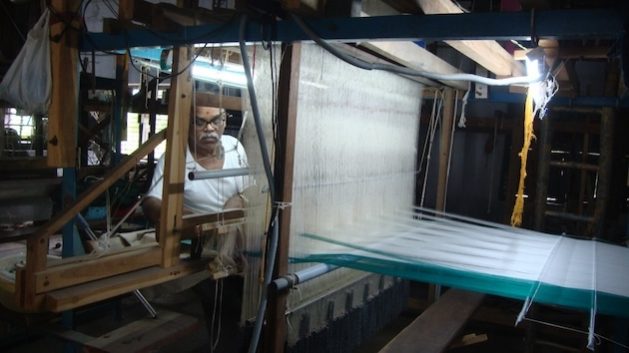
Siddipet cotton fabric being woven. Credit: Rina Mukherji/IPS

Siddipet cotton fabric being woven. Credit: Rina Mukherji/IPS

SIDDIPET, POCHAMPALLY & KOYALAGUDDEM, India, Jan 8 2025 (IPS) – The southern Indian state of Telangana has always been home to exquisite cotton and silk weaves. But in recent years, lack of market access, expensive inputs, and government apathy have taken their toll on the weaving community. As a result, the younger generation is refraining from pursuing this traditional occupation and opting for more lucrative pursuits.


This is evident when one visits the weaving towns of the state. Take Siddipet, which is about 100 km from the metropolitan city of Hyderabad. Siddipet has always been known for its exquisite cotton saris and stoles. But today, only about a hundred wizened individuals, spread over seven handloom cooperatives, still weave.

Srivikailasam is a renowned middle-aged weaver who was honoured by the Chief Minister with the Konda Laxman Bapuji Award. His saris, dupattas and stoles are prized items in the export market. Yet none of his children—a son and two daughters—want to inherit his craft.

Another weaver, known as Ilaiyah, has been weaving for the past 60 years, since he turned 15. Yet his children have turned their backs to weaving.

Yadagiri has also been weaving for the past 60 years, like his fellow weavers. But neither his son nor daughter are interested in learning to weave.

Master weaver Mallikarjun Siddi, who also owns a marketing outlet in Siddipet, followed his father, renowned weaver Buchaiah Siddi, into the profession. But his children have opted out of this traditional occupation.

However, Siddi defends the youngsters.

“Why would youngsters want to adopt a profession that pays so little? A weaver earns Rs 1000 (USD 11.82) a day here, and it takes three full days to weave a sari. A job in the IT hub of HiTech City in Hyderabad fetches a lot more.”

Worse, the Telangana government does not subsidize electricity; this has resulted in the Siddipet weavers continuing to use handlooms instead of switching to powerlooms, making their work even more tedious and hard. Electricity is Rs 10 (USD 0.12) a unit. If subsidized, the cost comes down to Rs 1 (US$ 0.012) per unit. Power loom machinery is expensive, ranging from Rs 1.5 lakh to 6 lakh (USD 1773.5 to USD 7101). With electricity subsidy, a weaver can bear the burden. Otherwise, it is not possible. Hence, even today, you see only handlooms here,” explains Siddi.

Master weaver Laxman Tadaka prepares his materials. Credit: Rina Mukherji/IPS

Master weaver Laxman Tadaka prepares his materials. Credit: Rina Mukherji/IPS

Marketing the product is also tough. The government buys the product at higher rates but does so lackadaisically. “Their representatives come only once a year, and although the payment is higher, it is not immediate. Private parties come regularly, and often, pay immediately,” say weavers.

The story is hardly any different in Pochampally, world-renowned for its ikat silk weaves. Ikat here can be either single ikat or double ikat, with the second being even more expensive. The yarn has to be initially soaked and then dyed before weaving. Since ikat weaves require every thread of the yarn to be dyed separately, a power loom can never be used. Thus, ikat weaves, whether cotton or silk, must be woven on a handloom, as master weaver Laxman Tadaka points out. The silk yarn comes from Bengaluru and is priced at Rs 4500 (USD 53.20) per kilogram. A weaver needs an average of 6 kg of yarn to weave seven saris a month. To bear the cost of inputs and the effort, a weaver must make enough sales. “The 15 percent subsidy extended by the government can hardly suffice,” Tadaka points out.

Rudra Anjanelu, manager of the Pochampally Handloom Weavers Cooperative Society, says they are dependent on subsidies.

“Our silk saris are expensive. But we cannot afford to give discounts unless the government supports us. A major problem is the 5 percent Goods and Services Tax (GST) that has now been imposed by the central government. It makes saris and other silk products even more expensive.”

In the past, the state government used to render marketing support through its outlets, offering the products to customers at discounted prices, especially during the festive season, while subsidizing weavers. This is not forthcoming anymore, making it tough for weavers.

Most weavers have to rely on the Telangana State Handloom Weavers Cooperative Society Limited (TSCO), their apex cooperative, to sell their product.

“We had suggested a method to jack up our sales. The Telangana government has a Kalyanalakshmi scheme, wherein parents of girls are given Rs 1 lakh (USD 1182.32) for their daughter’s wedding. Along with the money, the government could easily provide a sari worth Rs 10,000 (USD 118.23) for the bride. This will help us weavers too, while helping the parents with the bridal trousseau,” Anjanelu says.

Besides, most weavers are not happy with the quality of the subsidized yarn provided by the government through the National Handloom Development Corporation.

Muralikrishnan, a weaver from Koyalaguddem, a village renowned for its cotton ikat, laments, “The yarn provided by the government is of inferior quality and this, in turn, can affect the quality of our end product. It is unlike what we get from private traders.”

Moreover, as Anjanelu points out, “Yarn has to be paid for. When sales are down, how can weavers buy any yarn?”

A big challenge for handloom weavers remains the flooding of markets by printed duplicates, which sell at a fraction of the price of handloom fabric.

On hindsight, though, it is not as if nothing was done for weavers by the Telangana government. However, if weavers have not experienced long-term benefits, could this be attributed to the outcome of the ballot?

The previous Chandrashekhar Reddy (state) government, for instance, introduced a 36-month savings-cum-insurance scheme for weavers termed the Thrift Scheme, wherein the government contributed an amount matching the investment made by an individual.

In Pochampally, land was also sanctioned for a handloom institute, and a handloom park was set up on the outskirts of the town. However, with a new Chief Minister getting elected, the plans came to naught. The Handloom Park too suffered from bad planning. Weavers who had set up shop at the park now have to market their products from their homes.

It is ironical that the weavers of Pochampally, Koyalaguddem and Siddipet find it tough to sell their exquisite weaves, despite being located in the vicinity of metropolitan Hyderabad, which boasts of an upwardly mobile population with high disposable income.

Notwithstanding the problems faced, there are a few who have found a solution. Dudyala Shankar and Muralikrishnan of Koyalaguddem have diversified their range of products to include ikat fabric and bedsheets, alongside traditional saris, dupattas, and stoles. Muralikrishnan has been accessing markets all over India through the internet, from his dusty little village.

“It is the only way out,” he tells me.

Indeed, the World Wide Web can certainly fill in where humans cannot. Product diversification and market access translating into sales may ultimately wean back the younger generation to keep the weaving tradition alive in Telangana and prevent it from dying out.

IPS UN Bureau Report

  Source

Dazzling Wildlife Portraits at COP29: A Conversation with Photographer Brad Wilson

Arts, Biodiversity, Civil Society, Climate Action, Climate Change, COP29, COP29 Blog, Editors’ Choice, Environment, Featured, Global, Headlines, Sustainable Development Goals, TerraViva United Nations

COP29 Blog

Brad Wilson is an American photographer specializing in classical portraits of animals. Credit: Umar Manzoor Shah/IPS

Brad Wilson is an American photographer specializing in classical portraits of animals. Credit: Umar Manzoor Shah/IPS

As delegates at COP29 stroll through the venue in Baku, Azerbaijan, many pause to marvel at the stunning portraits of animals and birds adorning the pavilion walls. These 16 captivating images, showcasing Azerbaijan’s rich biodiversity, are more than just art—they’re a call to action.

Visitors, from diplomats to environmental activists, can often be seen snapping selfies with these majestic portraits, drawn to their lifelike intensity. Behind this collection is Brad Wilson, an American photographer whose mission is to “bridge the gap between humans and the natural world.” 

Wilson spoke to the IPS on his artistic journey and the philosophy underpinning his work.

“My name is Brad Wilson,” he begins. “I’m an American photographer specializing in classical portraits of animals.”

Classical portraits—usually a domain of human subjects—take on a unique depth when applied to animals.

“I aim to elevate animals to a higher level, presenting them as equals to humans—different but equal. Looking into their eyes through these photographs should invoke a sense of responsibility for their lives because we all share the same planet.”

For Wilson, animals represent a poignant connection to the natural world. “They are our closest relatives living in the wild,” he says. “They serve as a bridge, reminding us of our roots in nature.”

Brad Wilson photographic portraits were commissioned for the Haydar Aliyev Centre in Baku and are on display at the COP29 venue. Credit: Umar Manzoor Shah/IPS

Brad Wilson photographic portraits were commissioned for the Haydar Aliyev Centre in Baku and are on display at the COP29 venue. Credit: Umar Manzoor Shah/IPS

Process: A Dance of Patience and Precision

Creating these portraits is no simple task. Wilson describes the meticulous setup required for his work.

“All the portraits are done in a studio. I set up the studio close to where the animals live—often in sanctuaries or ranches. Then we bring them in for two or three hours,” he says. But those hours yield just fleeting moments of magic.

“I’m lucky if I get two or three good seconds with each animal. But that’s all I need—a single moment of connection that resonates.”

“My photo shoots are like meditations amidst organized chaos,” he says. Amid bustling activity, Wilson remains quiet and still, waiting for the animal to relax. “What I aim to capture is something uncommon—a glimpse of the animal’s soul, if you will. That’s what I hope viewers experience—a moment of connection.”

“I want people to understand that we are part of this planet’s biodiversity. We’re not separate from these creatures. It’s only been about 12,000 years—since the advent of farming and permanent settlements—that we began seeing ourselves as separate from the natural world. That’s a mistake. These animals remind us of our place in the web of life.”

“When we talk about climate action, it’s not just about saving the earth—it’s about saving humanity and the animals that share this planet with us. The earth will endure, but we might not.”

Behind the Scenes at COP29

Wilson’s collection at COP29 was commissioned by the Haydar Aliyev Centre in Baku.

“They brought me here in August to photograph animals in Baku and Shamaki,” he says. The project celebrates Azerbaijan’s biodiversity, showcasing species native to the region while promoting conservation awareness.

The portraits have been a hit among COP29 attendees, sparking conversations about the intersection of art, biodiversity, and climate action. Wilson hopes the images inspire policymakers and the public alike to take meaningful action.

“Climate change is already a massive problem, and it’s only going to worsen. We need to get serious about tackling it.”

Advice for Aspiring Photographers

For those inspired to follow in Wilson’s footsteps, he offers this advice: “Start with humans. I spent 15 years photographing people in New York City before transitioning to animals. That experience taught me about connection and emotion—skills that translate well to wildlife photography.”

IPS UN Bureau Report

  Source

Rejuvenating Tradition To Help Save Ancient Engineering Marvel—Dhamapur Lake

Arts, Asia-Pacific, Civil Society, Conservation, Environment, Featured, Food and Agriculture, Food Security and Nutrition, Headlines, Natural Resources, Religion, Sustainable Development Goals, TerraViva United Nations

Environment

The Vijayanagar rulers constructed an earth-fill dam in 1530 AD to create Dhamapur Lake. There is now a campaign to save it. Credit: Rina Mukherji/IPS

The Vijayanagar rulers constructed an earth-fill dam in 1530 AD to create Dhamapur Lake. There is now a campaign to save it. Credit: Rina Mukherji/IPS

PUNE, India, Oct 2 2024 (IPS) – Dhamapur is a small village in Malvan taluka of west Sindhudurg district, housing the famous Dhamapur Lake. The Vijayanagar kings constructed an earthfill dam in 1530 A.D., creating a man-made lake surrounded by hills on three sides. Canals connect it to the Karli river, irrigating lush paddies and farms that grow the red Sorti and Walay rice varieties typical to the region.


A Bhagwati temple constructed in the typical Konkan style stands on its banks. Small shrines to anthills flank this temple, which is devoted to Goddess Bhagwati. This is because all over the Konkan region, anthills are considered manifestations of the Earth Goddess and worshipped as Goddess Sateri. These are monuments to biodiversity and well-being; white ants or termites that build anthills are known to aerate the soil, help seed dispersal, and improve soil fertility. The worship of anthills is an old Vedic practice that continues to survive in and around the Konkan region of Maharashtra, Goa, and its neighborhood to this day.

The construction of the earthfill dam on Dhamapur Lake too spells of local ingenuity. Made up of porous laterite stone that is locally found here, every layer of stone is alternated with a layer of biomass made of twigs and branches.

This freshwater reservoir, used for irrigation and drinking water purposes, is one of Maharashtra’s oldest engineering marvels. Its waters and the Kalse-Dhamapur forests that flank it nurture a wide variety of unique floral and faunal species, making it a popular tourist destination.

But beauty apart, this man-made lake, which is geographically on higher ground as compared to the surrounding countryside, plays an important role in recharging the groundwater, acting as a sponge during the monsoons.  Apart from serving as an important source of drinking water and irrigation, Dhamapur Lake nurtures an entire ecosystem. Its waters and surrounding forests harbour a wide variety of flora and fauna, some of which are endangered species. Its significance can be gauged from the fact that it was given the Word Heritage Irrigation Structure (WHIS) Award by the International Commission of Irrigation and Drainage (ICID) in 2020.

But in recent times, several encroachments have affected this extensive waterbody. Guest houses, wells, and walkways built in its floodplains to boost tourism have been eating into its extensive area, in scant regard to the flora and fauna that thrive in its pristine waters.

Fighting for Dhamapur Lake

In recent years, though, Dhamapur Lake has found a savior in Sachin Desai and his organisation, Syamantak Trust. Incidentally, Sachin Desai and his wife, Meenal, have an interesting background that illustrates their love for the natural world and India’s time-honored traditions.

Believers in home schooling, the Desais fought out with the authorities to home-school their daughter. Abandoning high-paying corporate jobs, these two professionals set up the University of Life on their ancestral property to familiarize youngsters with traditional bricklaying, carpentry and farming skills in 2007. To stem the migration from the region, they sought to inculcate love and respect for traditional practices, foods, and cuisine among youngsters. This was how the Syamantak Trust came into being.

In the years that followed, learners and youngsters who spent time at the University of Life went to use the knowledge they acquired to specialize in respective fields or venture into entrepreneurship, selling local products to tourists frequenting Dhamapur. Rohit Ajgaonkar, once a student at the University of Life, has become an active volunteer with Syamantak and runs a small eco-café in Dhamapur.  Remarkable in its use of local materials, the eco-café has an array of local delicacies such as kashayam and jackfruit, wood apple, and mango ice creams.

Rohit and his mother, Rupali Ajgaonkar, also run a shop adjoining their eco-café, wherein they sell hand-pounded local masalas, mango and jackfruit toffee, local pickles, cashew butter, kokum syrups and kokum butter.  Prathamesh Kalsekar, another student of the University of Life who is the son of a local farmer, is now doing his B.Sc. (Agriculture) at the Konkan Krishi Vidyapeeth. He has raised a private forest on his family land in Dhamapur, and now grows many local fruit and vegetable trees, bushes, and plants, particularly focusing on nutrient-rich wild varieties. He has also set up a nursery of saplings for distribution among local farmers.

A temple on the outskirts of Dhamapur Lake. Credit: Rina Mukherji/IPS

The Bhagwati temple is on the banks of Dhamapur Lake. The temple is built in the typical Konkan style, wherein the deity is placed at one end in the sanctum sanctorum. The main section of the temple is reserved for the assembly of elders who meet and discuss matters related to the village. The temple is reminiscent of a bygone era when a place of worship also served as a place for the community to assemble and parley. Credit: Rina Mukherji/IPS

The Ongoing Battle to Save Dhamapur

These skills and respect for nature came in handy when Syamantak embarked on its mission to save Dhamapur and other waterbodies in Sindhudurg district through a community-led movement, following the construction of a skywalk undertaken by the authorities in 2014, and the running of diesel-run boats for tourists by the panchayat (village self-governing body). But this was easier said than done, notwithstanding the public zeal.

Desai and his volunteers realized that “Sindhudurg district has several wetlands and waterbodies. However, the authorities haven’t notified or demarcated any of them. This permits encroachments, a lot of them by government bodies.” In the case of Dhamapur Lake, the high flood line was ignored, and private parties encroached upon the peripheral areas of the lake. Even the state government’s Department of Agriculture had built a nursery and sunk a well on the floodplains of the lake.

Making use of the National Wetland Atlas prepared by the Space Applications Centre of the Indian Space Research Organization (ISRO) and the Maharashtra Remote Sensing Applications Centre in 2010, during the tenure of Minister of Environment & Forests Jairam Ramesh, Syamantak Trust approached the Western Zonal bench of the National Green Tribunal. Some residents of Sindhudurg district also filed an Environment Interest Litigation (EIL) to save the lake. At that time, the phytoplankton population had already decreased due to the construction of 35 pillars and the 500-meter-long cement concrete skywalk.

An Interim Order in 2018 by the Tribunal not only halted all further construction but saw every bit of concrete broken down and removed from the precincts of the lake. It also stopped the use of diesel boats on the lake . Furthermore, the state Public Works Department (PWD) was ordered to shell out Rs 1.5 crore for mitigation measures to be undertaken to reverse the damages caused by the construction of the 2.5 km skywalk and the use of diesel boats.

Meanwhile, following the formation of a 32-member Wetland Brief Documentation Committee as per an Order by the District Collector, the Syamantak Trust organized the local citizenry to document the flora and fauna of Dhamapur lake. They were soon joined by students from the local college of architecture, academicians, botanists, zoologists, and geographers from Mumbai and other parts of India, besides Dr Balkrishna Gavade and Dr Yogesh Koli, who lent their expertise for the study.  Mapping Dhamapur helped the volunteers learn about the kind of biodiversity hotspot the Western Ghats region is, especially in the forested tracts around Dhamapur Lake.

Five months spent documenting the various wetland flora and fauna showed 35 species of birds belonging to 18 families to frequent the lake, such as the Eurasian Marsh Harrier, Indian Pond Heron, Lapwing, Kingfisher,  and Small Bee-Eater. The lake was found to be particularly lush with phytoplankton and zooplankton species, which are the building blocks of a wetland ecosystem. The volunteers would also learn about how the Wax Dart butterfly was reported for the first time in Maharashtra, on the banks of Dhamapur lake.

Once Dhamapur was mapped, the volunteers went on to document a total of 57 wetlands and waterbodies in Sindhudurg district, including those as yet unlisted by the authorities. These included Vimleshwar in Devgad, Pat Lake in Kudal, and Jedgyachikond in Chaukul, among others.

The Uphill Struggle to Save Dhamapur Lake

The mapping and summary of violations were to come in handy when fighting to conserve Dhamapur Lake at the NGT.  However, the community’s fight to have Dhamapur Lake recognized as a wetland has not borne fruit so far. “Our case was dismissed by the NGT in 2023 on the grounds that the lake does not qualify to be a wetland in keeping with the Wetlands (Conservation and Management) Rules 2017, since it was constructed for drinking water and agricultural purposes,” Desai tells IPS.

However, the Trust and its community volunteers have not given up yet. They have now approached the Supreme Court to demand

1) Demarcation of the Lake’s buffer zone and high flood line; and

2) Notification of the Lake by the state government in its gazette.

Once notified, the Lake, they feel, would be protected against further encroachment from public and private bodies alike.

Meanwhile, Syamantak Trust, along with members of the local community, continue to familiarize visiting students and persons from other parts of India with this unique water-body and its flora and fauna through eco-trails. As of this year, Syamantak Trust has begun hosting classical music concerts with the theme “Connect to Nature,” allowing music lovers to explore the vast repertoire of Hindustani classical music and its connection to the seasons and nature’s clock.

Currently, the Desais and their volunteers in the local community sincerely hope that once people in Dhamapur and beyond learn to appreciate and love nature, it will help them connect better with the lake and its entire ecosystem. This can be the best and only bulwark against the destructive march of climate change.

IPS UN Bureau Report

  Source

At Paris Olympics, Art Runs in Tandem with Sports

Arts, Civil Society, Europe, Headlines, Inequality, TerraViva United Nations

Human Rights

Cover of the Cultural Olympiad programme

PARIS, Jul 31 2024 (IPS) – As cheers from beach-volleyball fans fill the air at the Eiffel Tower Stadium on a steamy, sunny day, pedestrians just down the road are enjoying another kind of show: an outdoor exhibition of huge photographs gleaming on the metal railings of UNESCO headquarters.


Titled Cultures at the Games, the exhibition is among hundreds of artistic and cultural events taking place across France during the 2024 Olympic Games (hosted by the French capital July 26 to Aug. 11), and they’re being staged alongside the numerous athletic contests.

The events even have an umbrella name – the Cultural Olympiad – and include photography, painting, sculpture, fashion, and a host of attractions linking art and sport. Most are scheduled to run beyond the closing ceremony of the Games.

UNESCO (the United Nations Educational, Scientific and Cultural Organization) is a “partner” in the Cultural Olympiad, arranging not only the usual meetings where bureaucrats give lofty speeches, but also showcasing a series of works to highlight diversity and inclusion.

Cultures at the Games, for instance, comprises some 140 photographs portraying memorable aspects of the opening and closing ceremonies of the Olympics since 1924 and is presented in association with the Olympic Museum of Lausanne.

Images show how national delegations have transmitted their culture during these extravaganzas, and the pictures depict athletes such as Jamaica’s Usain Bolt, whose “lightning bolt” pose has become part of the Games’ folklore even as he has helped to make the green, gold and black colours of his country’s flag more recognizable.

Inside UNESCO’s Y-shaped building, meanwhile, a collection of panels focuses on how sport can “Change the Game”, a theme running across all of the organization’s “Olympiad” events. (At the “World Ministerial Meeting” that UNESCO hosted on July 24, just ahead of the Olympics, officials discussed gender equality, inclusion of people with disabilities, and protection of athletes, for example.)

A notable section of the indoor exhibition features historic photographs that pay tribute to athletes who sparked change through their achievements or activism. Here, one can view an iconic picture of American athlete Jesse Owens, the “spanner in the works that completely disrupted the Nazi propaganda machine set up during the 1936 Berlin Olympics,” according to the curators.

Owens won four medals at the Games, but “received no immediate (official) recognition from his own country” despite being welcomed as a hero by the public, as the exhibition notes. The racism in the United States meant that President Franklyn D. Roosevelt refused to congratulate him “for fear of losing votes in the Southern states.” The photo shows him standing on the podium in Berlin, while behind him another competitor gives a “Hitler salute”.

Jesse Owens at the Berlin Olympics, in Athletes who changed the world at UNESCO;

Athletes who changed the world equally features boxer Mohammad Ali, who in 1967 refused to fight in Vietnam and was stripped of his world championship title and banned from the ring for three years.

Perhaps the most famous image, however, is that of athletes Tommie Smith and John Carlos at the 1968 games in Mexico City. They “removed their shoes and walked forward in socks to protest against the extreme poverty faced by African Americans,” as the caption reminds viewers. “With solemn faces, Smith and Carlos bowed their heads and raised their gloved black fists, aiming to raise global awareness about racial segregation in their country.”

A photo of Tommie Smith, in Athletes who changed the world at UNESCO

The exhibition outlines the long battles faced by women athletes as well, and it highlights the work of Alice Milliat who, as president of the French Women’s Sports Federation, “campaigned for women’s inclusion in Olympic sports”. She organized the first Women’s Olympic Games in Paris in 1922, bringing together five countries and 77 athletes.

Although Milliat “died in obscurity” in 1957, her “legacy endures today, with the Paris 2024 Games highlighting gender equality in sports, largely thanks to her visionary efforts,” says the photo caption.

Similarly, the exhibition spotlights the contributions of disabled athletes such as Ryadh Sallem, who was born without arms or legs, a victim of the Thalidomide medication that was prescribed to pregnant women in the 1950s and Sixties and caused deformities in children.

Sallem won 15 French championship titles in swimming and later turned to team sports such as wheelchair basketball and rugby. At UNESCO, his photograph is prominently displayed, along with the story of his hopes for the 2024 Paralympics and his mission to “promote a positive vision of disability”.

Elsewhere in the city, artists and museums are also paying tribute to Paralympic competitors, ahead of the Paralympic Games from Aug. 28 to Sept. 8 in Paris.

On the fencing around the imposing Gare de l’Est (train station), colourful works by artist Lorenzo Mattoti show disabled athletes competing in a variety of sports, while the Panthéon is presenting the “Paralympic Stories: From Sporting Integration to Social Inclusion (1948-2024)”. This exposition relates the “history of Paralympism and the challenges of equality,” according to curators Anne Marcellini and Sylvain Ferez.

For fans of sculpture, Paris has a range of “Olympiad” works on view for free. In June, the city unveiled its official “sculpture olympique” or Olympic Statue, created by Los Angeles-based African-American artist Alison Saar, who cites inspiration from Africa, the Caribbean and Latin America.

The sculpture, located near the famed Champs Elysées avenue, depicts a seated African woman holding a flame in front of the Olympic rings, and it “embodies Olympic values of inclusivity and peace,” according to the office of Paris mayor Anne Hidalgo.

When it was inaugurated on June 23, however, it sparked a flurry of hostile remarks from some far-right commentators on social media, who apparently felt threatened by the work.

Another statue of a woman, that of Venus de Milo or the mythical goddess Aphrodite, has been “reinterpreted” in six versions by artistic director Laurent Perbos to symbolise “feminine” sporting disciplines, including boxing, archery and surfing. The statues stand in front of the National Assembly, and the irony won’t be lost on most viewers: French women secured the right to vote only in 1944.

Of course, Paris wouldn’t be Paris without another particular artform. As the much-discussed Opening Ceremony of the Olympics showed, fashion is an integral part of these Games, and those who didn’t get enough of the array of sometimes questionable costumes can head for another dose with “La Mode en movement #2” (Fashion in Motion #2).

This exhibition at the Palais Galliera / Fashion Museum looks at the history of sports clothing from the 18th century, with a special focus on beachwear. Among the 250 pieces on display, viewers will surely gain tips on what to wear for beach volleyball.

For more information, see: Olympiade Culturelle (paris2024.org)

  Source

Sawantwadi’s Traditional Handmade Toys Struggle for Survival

Arts, Asia-Pacific, Civil Society, Cooperatives, Development & Aid, Economy & Trade, Editors’ Choice, Environment, Featured, Headlines, Natural Resources, TerraViva United Nations, Trade & Investment

Arts

Shashikant Rane with his wooden fruits. Credit: Rina Mukherji/IPS

Shashikant Rane with his wooden fruits. Credit: Rina Mukherji/IPS

PUNE, Jun 14 2024 (IPS) – Sawantwadi in Maharashtra, on the western coast of India, bordering Goa, has always been known for its wooden toys. A picturesque town amid hills and lush greenery, Sawantwadi retains an old-world charm to this day.  The regal Sawantwadi Palace holds pride of place, with colleges, schools, and temples cloistered around the periphery of the lake, which was once an extension of the royal grounds.  In the centre of the town is the Ubha Bazaar, or Hanging Market, which houses rows of shops selling the iconic wooden toys that are a hallmark of Sawantwadi.


The wooden toys of Sawantwadi are a legacy that the previous rulers nurtured, and they reflect the spirit of the area. Generations of children in Maharashtra and Goa have grown up playing with the life-like depictions of fruits, people, and the pull-along toys that were a necessary part of growing up. But today, these painstakingly carved, hand-made toys made of Pongamia and mango wood are struggling for survival. The once-bustling hilltop market in downtown Sawantwadi, known as Ubha Bazaar (Hanging Market), is now a ghost of what it once was. The artisan families who manufactured and sold these toys from their workshops-cum-homes are now reduced to a handful.

So, what caused the busy hands of these artisans to fall silent?

By the looks of it, several factors are responsible.

Female musicians in concert. Credit: Rina Mukherji/IPS

Female musicians in concert. Credit: Rina Mukherji/IPS

Backgrounder

Unlike the cheap machine-made toys that flood the market today, toys are a traditional craft in India, commanding a hoary lineage from the era of the Indus Valley civilization. Like many other centers in India, Sawantwadi always boasted gifted artisans capable of painstakingly breathing life into wood and carving out an array of life-like figures inspired by everyday life. Over the decades, the life-like depiction of fruits and vegetables was always been a specialty of Sawantwadi craftsmen. Of course, there were other toys too, for every age group of children: pull-along toys for toddlers, kitchen sets for little girls, bullock carts and other vehicles for bigger children, as well as spoons, cutters, and ladles used in the kitchen. What always made these toys stand out was the environment-friendly techniques and colors that were used to produce them.

Toy-making in Sawantwadi had its origins in the arrival of  Telangana Brahmins in the 17th century, who visited the kingdom to take part in religious debates with the then ruler, Khem Sawant II, who was extremely well-versed in Hindu religious scriptures and philosophy. The Chitrali artisans who arrived with the Brahmins brought the craft of toy-making and ganjifa (playing cards) to Sawantwadi.

Ideally suited to the greenery and scenic landscape of Sawantwadi, toy-making here made use of Pongamia and mango wood, which thrived in the thick forests here. The wood used for the toys would be collected in the summer and, after being washed and dried, left out to get thoroughly soaked during the entire monsoon. After thorough drying, they would be carved as per the desired shape. Once the toys were carved out, they would be covered with five layers of earth and left aside for a certain period of time. The lathe would then be used in this stage to impart the desired shape and finish. They would be painted with a powdery mixture made of tamarind and other seeds once dusted off and smoothed with sandpaper. After applying several coats of paint, a coat of lacquer and natural gum would add the finishing touches.  To this day, the lacquer used in Sawantwadi toys is their special feature. It is durable and never fades or chips away, no matter how roughly the toys are used. When toy-making was on the verge of fading out at one point in time, the local royal family gave it an impetus in the early 1970s. Primarily responsible for this shot in the arm were the Queen, Maharani Satvashila Devi and her husband, the reigning king, Rajesaheb Khem Sawant VI, Lt Colonel Shivram Sawant Bhonsale. The reigning royal family also set up a workshop to make hand-painted ganjifa cards at the palace, which is functional to this day.

Sawantwadi Palace grounds. Credit: Rina Mukherji/IPS

Sawantwadi Palace grounds. Credit: Rina Mukherji/IPS

Difficulties in Procuring Inputs

Historically, Sawantwadi was a vassal state of the mighty Maratha empire. When the British defeated the Marathas, Sawantwadi continued to exist as a small principality with a benign ruler during the British Raj.  The erstwhile British Resident’s home in downtown Sawantwadi, at a stone’s throw from the Palace, testifies to those bygone days. The early years of the 20th century saw Sawantwadi thrive in matters of education and culture, with the rulers also making efforts to nurture traditional crafts and artisans.

In recent times, however, deforestation has made it difficult to get adequate supplies of pangara (Pongamia) wood, while mango is not suitable for products that need the lathe machine.  Artisans have now turned to Acacia, Shivan (Gmelina Arborea) and Glyricidea, compromising on the quality of the toys.  Glyricidea has particularly emerged as a favorite, notwithstanding its being environmentally unsound and causing rats to overrun homes.

Lack of skilled artisans

The painstaking nature of the job, the difficulties in procuring wood and other inputs, and an uncertain market that cannot guarantee earnings in keeping with the efforts put in have resulted in many skilled artisans moving out of the industry and opting for employment elsewhere.  Industrialization in the neighboring districts has also been a big draw, while government initiatives to train young artisans in wood carving have been lackadaisical at best.

Very few can carve wood now, unlike in the past. So, instead of carving out a toy, the prevailing trend is to fill up sawdust into ready moulds. This also helps keep costs low and is not labour-intensive.  Shashikant Rane, one of the very few remaining master craftsmen in Sawantwadi, who the government approached about opening a Hastkala (handicrafts) Kendra (centre), tells me, “I entered the profession in the early 1960s, thanks to my father, who had received special training from Abha Gawde, a well-known master in the craft. Traditional toy-making requires a great deal of patience, starting with the procurement of the right wood. You procure the wood in May but cannot work on it until a few months later. In these times of quick turnarounds and massive profits, few are willing to put in the effort,” he points out.

Rane has been training 30 youngsters in the craft every year at his modest workshop-cum-home and is a much sought-after craftsman for prominent projects all over India. Referring to the government’s lackadaisical approach to training artisans, Rane tells me,  “The Minister-In-Charge had identified the venue for setting up the Hastkala Kendra and spoken to me about his vision at length.  But it is over a year now, and the plan still awaits finalization.”

Unfair Competition and Dwindling Demand

There are other factors, too. Cheap Chinese machine-made toys have also made consumers move away from these beautiful, hand-carved toys, which, owing to rising input costs, sell at higher rates. One also perceives a change in taste. P D Kanekar and Company, a prominent seller of toys in Sawantwadi, has moved to manufacture non-traditional toys in recent years.  Ankita Kanekar, from the Kanekar family, tells me, “Pangara (Pongamia) wood was always used to make life-like fruits and vegetables in the past. But no one is interested in playing with those now, unlike the previous generation.  Pangara trees are only available in a few villages now. Besides, a single set takes around one and a half months to be made. The work is painstaking and exacting, and the return is very little. There are very few good artisans practicing the trade.”

She also blames the current transport infrastructure for dwindling sales. “Earlier, the road links from Mumbai and Pune passed through Sawantwadi. But the highways now skirt our town.”

Changing tastes are evident when one browses through the shops today. Imitations of machine-made toys hold pride of place as compared to the artistic depictions of musicians, vegetable -sellers, or fishermen in traditional attire. It is tough to spot a bunch of bananas or betelnuts either.

Lack of government support is another major factor.

The active support of the ruling royal family had bolstered the toy industry in the previous century. This kind of support is no longer forthcoming. The lack of a strong toymakers’ cooperative or guild is also partly to blame. “There is no unity among the various people in the trade to negotiate in one voice with the authorities and demand guarantees or protective subsidies,” rues a prominent toymaker, requesting anonymity.

Consequently, Sawantwadi toys were devoid of geographic identification (GI) until now.

Light at the End of a Tunnel

As I write this, toymakers are jubilant about a GI tag having been granted to Sawantwadi wooden toys on March 30, 2024. This opens up a new vista for them. Toymakers like PD Kanekar have already taken to selling their toys online. “ We started selling online during the pandemic when everything shut down,” Ankita Kanekar tells me. The Kanekars sell through the DirectCreate platform to buyers all over India. Otherwise, sales are made to wholesalers based in Goa, who, in turn, sell to those traveling to India. This is because “international courier services are not yet developed from Sawantwadi. ”

Even so, with Goa’s newly-opened MOPA airport just 15–16 km away, international tourists often come down to Sawantwadi to buy these iconic toys.

One could well say that the GI tag and the inclusivity it bestows on these beautiful handcrafted toys are a good beginning. However, a lot more needs to be done if these toys are to capture the attention of a global market. Improving the courier services as well as government subsidies to the makers could go a long way here.

IPS UN Bureau Report

IPS UN Bureau, IPS UN Bureau Report, India

  Source