UN Women Ambassadors Rise to New Heights But Fall Short of Gender Parity

Civil Society, Editors’ Choice, Featured, Gender, Global, Global Governance, Headlines, IPS UN: Inside the Glasshouse, TerraViva United Nations
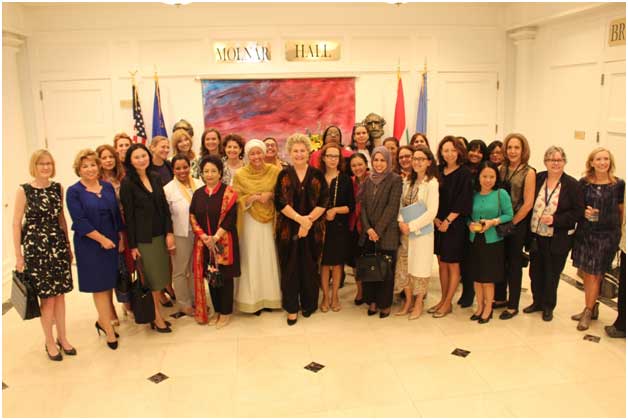
Circle of Women Ambassadors

UNITED NATIONS, Oct 8 2019 (IPS) – New York’s diplomatic community has continued to be enriched by a record number of women Permanent Representatives (PRUNs)—50 in all, as of October 2 – compared with about 15 to 20 back in the 1980s and early 1990s.


But the history-making number is still short of gender parity, falling far behind the 140 men who are PRUNs in the 193-member General Assembly, the highest policy-making body at the United Nations.

The remaining three women are designated Charge d’Affaires ad interim or acting heads of their respective diplomatic missions – and don’t hold the rank of PRUN.

https://protocol.un.org/dgacm/pls/site.nsf/files/HoM/$FILE/HeadsofMissions.pdf

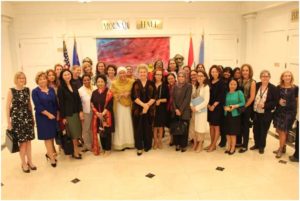
The 50 PRUNs, who are also designated as Ambassadors, are members of an exclusive association called the “Circle of Women Ambassadors”— even as the circle has steadily kept widening.

The only other glass-shattering UN event took place in September 2014 when six of the 15 members of the UN Security Council– long monopolized by men– were women.

“It’s a little strange that it’s taken us this long,” Ambassador Sylvie Lucas of Luxembourg, was quoted as saying, more than five years ago.

UN Secretary-General Antonio Guterres told delegates last week that “no country in the world is on track to attain gender equality by 2030, and women continue to be hampered by discriminatory laws, unequal access to opportunities and protections, high levels of violence, and damaging norms and attitudes.”

So, gender parity among men and women ambassadors may be a long way off.

Ambassador Anwarul K. Chowdhury, former Permanent Representative of Bangladesh, and a one-time UN Under-Secretary-General told IPS: “To me any progress which manifests equality and representation of women’s recognized engagement is welcome.”

The fact that, at the moment, the number of women Permanent Representatives to the UN at its headquarters has reached the highest point ever is a development worthy of our attention, he said.

“However, we have a long way to go even to reach the numerical equality among 193 Member States”, said Ambassador Chowdhury, the initiator of UN Security Council Resolution (UNSCR) 1325 as President of the Security Council in March 2000: a resolution that underlined the important role of women in the prevention and resolution of conflicts, and on peace negotiations and peace-building.

“In this context, I recall the Call to Action by civil society (which I proudly co-signed) for the world leaders on 25 September 2013 as they converged in New York for the General Assembly’s high level meetings urging them to take action for equality of women’s participation at all decision-making levels in four areas”, he added.

    • 1. Appointment of a woman as the next UN Secretary-General. [reality: none out of 9 Secretaries-General in 74 years of UN history]
    • 2. Nomination of Women as future Presidents of the General Assembly by the Regional Groups. [reality: only 4 out of 74 Presidents]
    • 3. Election of More Women as Heads of Various UN Governing Bodies, [reality: overwhelmingly underrepresented by women]
    4. Appointment by Member-states of More Women as Ambassadors to the UN in New York and Geneva. [reality: overwhelmingly underrepresented by women]

On all four points, the UN community needs to do much more to call it history-making, said Ambassador Chowdhury.

Kshenuka Senewiratne, Sri Lanka’s trailblazing ambassador– her country’s first female permanent representative (PRUN) in over 63 years– told IPS that gender empowerment has continued to advance in her home country, even as women outnumber men in many walks of life, and particularly in higher education.

She said this is also reflected in the Sri Lankan foreign service where women have dominated over men in open competitive exams.

“And it is possible the same trends continue in many developing nations— even as the UN tries to advance its 2030 Development Agenda where gender empowerment remains one of the priorities.”

But still, “I have yet to hear my colleagues here say that it was a concerted gesture of gender balance that they got posted to New York,” she declared.

Barbara Crossette, a former UN Bureau Chief for the New York Times, told IPS: “My initial thought is that this phenomenon of more powerful women in diplomacy is not unlike women rising on their own in politics and not just by inheriting leadership as widows, daughters or other kin of men, such as Indira Gandhi, Sirimavo Bandaranaike, Benazir Bhutto, Chandrika Kumaratunga or Cristina Fernández de Kirchner”.

She pointed out there are now more Angela Merkels, Michelle Bachelets or Elizabeth Warrens, to name only a few.

“Women are also rising in international agencies and civil society organizations, gaining expertise in global affairs, geopolitics and armed conflict, often in uniform and wearing a peacekeeper’s beret”, said Crossette, the senior consulting editor and writer for PassBlue and the United Nations correspondent for The Nation.

Asked whether more female diplomats will aid the cause of greater gender equality, she said: “ I would say, not necessarily, unless the Secretariat and missions in the field come down harder on denigrators and abusers of women. And, as Louise Frechette (a former UN deputy Secretary-General) told me in an interview, only if member states chose the most competent, outstanding women when making nominations to fill appointments in the UN system. They should be the models”, she declared.

Reinforcing his arguments further, Ambassador Chowdhury said the political significance of this increase in the number of the women Ambassadors would be that their joint actions would draw more attention, bearing, of course, in mind that all Ambassadors to the UN act generally on the basis of instructions from their respective capitals.

“But, I believe, their coalition can join hands to focus on issues particularly those directly related to women’s empowerment and equality, like Goal 5 of SDG.”

They can also ask for greater engagement of Secretary-General’s leadership in the implementation of UNSCR 1325 on women and peace and security which has made the realization of women’s equal participation at all decision-making levels obligatory on all members of the United Nations and whose 20th anniversary is coming up in October 2020, he noted.

Realizing gender parity at the senior posts of the UN, both at headquarters and at field levels, could be another area for joint effort.

“Women Ambassadors could strategize to turn this newly gained numerical enhancement into an effective coalition to attain global objectives of women’s equality and empowerment,” he argued.

Apart from this increase in the number of women Ambassadors, another encouraging development had been that three consecutive women Ambassadors have been elected as President of the Economic and Social Council (ECOSOC) in 2017 –from the Czech Republic, 2018, from St. Vincent and the Grenadines, and 2019 from Norway.

This has improved somewhat ECOSOC’s dismal record of women Presidents, he said.

Since its beginning in 1946 and all the way upto 2003, ECOSOC’s practice of electing only men was challenged by Ambassador Marjatta Rassi of Finland as its first woman President, followed by second woman in 2009 before the successive three women Presidents – a total of 5 out of 74, said Ambassador Chowdhury.

“Given the unacceptably poor women’s representation as General Assembly and ECOSOC Presidents, women Ambassadors can continue their relentless efforts to improve gender parity in high offices,” he declared.

Meanwhile, addressing a working luncheon of the Circle of Women Ambassadors last April, the former President of the General Assembly Maria Fernanda Espinosa Garces said: “At the UN too – where we should be leading by example – only a quarter of Permanent Representatives are women. Only one of the General Assembly’s main committees is chaired by a woman. I hope that we, in this Circle, can encourage our colleagues to nominate more women to leadership positions in the General Assembly, and across the UN.”

In his annual report on “The Work of the Organization” released last week, UN Secretary-General Antonio Guterres claimed the world body continues to make significant progress towards gender parity.

For the first time in the history of the United Nations, “we have achieved gender parity in the Senior Management Group and among Resident Coordinators, and are almost at parity among the senior leadership ranks across the Organization, well ahead of my target date of 2021.”

The writer can be contacted at thalifdeen@ips.org
  Source

Reforms Will Grant Nationality to Children of Iranian Women

Civil Society, Editors’ Choice, Featured, Gender, Global, Global Governance, Headlines, Human Rights, IPS UN: Inside the Glasshouse, TerraViva United Nations

Opinion

Rothna Begum is Senior Researcher, Women’s Rights Division at Human Rights Watch

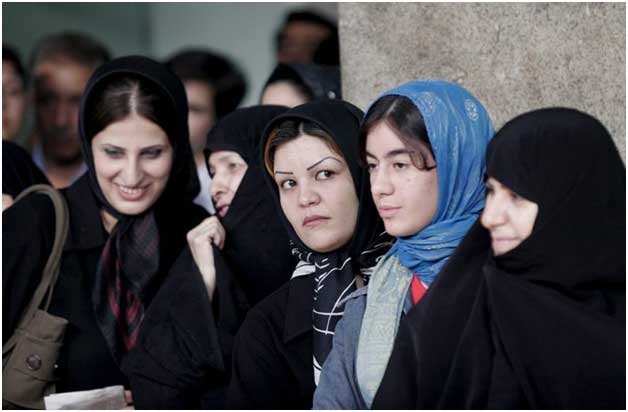
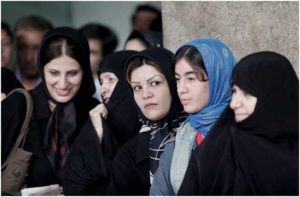
GENEVA, Oct 7 2019 (IPS) – After more than a decade of women’s rights activism, Iran’s Guardian Council has finally approved an amendment that would grant Iranian citizenship to the children of Iranian women married to foreign men.


The Guardian Council was the last body needed to approve this long overdue reform to Iran’s discriminatory citizenship law.

Previously, Iran’s civil code granted children and spouses of Iranian men citizenship automatically, while children born in Iran to Iranian women and foreign fathers must live in Iran at least until they are 19 before they can apply.

It is unclear how many children in Iran have Iranian mothers and foreign fathers. However, the issue has come to prominence in recent years because of tens of thousands of registered and unregistered marriages between Iranian women and Afghan men whose children are unable to obtain citizenship on an equal basis.

Rothna Begum

Research in other countries has shown that such discrimination can harm children’s access to education, health care, housing, and employment when they become adults.

The latest attempt to reform the law was inspired by Maryam Mirzakhani, a world-renowned Iranian mathematician and Fields Medal recipient who passed away from cancer in 2017. Because her husband is not Iranian, her daughter cannot obtain Iranian nationality.

In May, Iran’s Parliament finally adopted the proposed reform, but it went back and forth from the Guardian Council, a body of 12 Islamic jurists, to determine whether it is in accordance with Iran’s Constitution and Sharia (Islamic law). They approved the amendment last week.

While this is a long-awaited victory for Iranian women, the newly-amended law does not equalize access to citizenship completely. Iranian women must apply for nationality for their children, while children of Iranian men are granted nationality automatically.

Children who turn 18 can apply for nationality themselves. A security check is required in both cases.

Most concerning is that that the amended law requires the Intelligence Ministry or the Intelligence Organization of the Islamic Revolutionary Guard Corps (IRGC) to certify that there is no “security problem” before approving citizenship in these specific applications.

This vaguely defined provision can be used to arbitrarily disqualify applicants if they or their parents are seen as critical of the government, particularly in eastern and western border areas where cross-border marriages are more common and where authorities keep a tight grip over peaceful activism.

In a matter of weeks, Iran’s newly-amended law will finally see children of Iranian women able to apply for the same benefits that children of Iranian men have.

But Iran should remove the remaining obstacles to ensure that children of Iranian citizens, whether men or women, are granted citizenship on an equal basis. They are all, after all, Iranian children.

  Source

Watchdog Pushes U.S. to Publish ‘Duty to Warn’ Khashoggi Files

Civil Society, Editors’ Choice, Featured, Global Governance, Headlines, Human Rights, IPS UN: Inside the Glasshouse, Middle East & North Africa, Press Freedom, Regional Categories, TerraViva United Nations

Press Freedom

The Committee to Protect Journalists (CPJ) seeks disclosure of files under the U.S. intelligence community’s “duty to warn” obligations, which demand officials alert folks in imminent danger. The CPJ wants to know if they knew about an assassination plot against Jamal Khashoggi. Photo by Sam McGhee on Unsplash

UNITED NATIONS, Sep 30 2019 (IPS) A media watchdog has asked United States intelligence agencies to reveal whether they knew about an assassination plot against Jamal Khashoggi and failed to warn the Saudi journalist he was in mortal danger.

A legal brief, filed in a Washington DC district court by the Committee to Protect Journalists (CPJ), comes almost exactly one year after a Saudi hit squad butchered the renegade writer inside the Saudi consulate in Istanbul on Oct. 2.

CPJ’s advocacy manager Michael DeDora told IPS that his lawsuit against the U.S. government “asks a simple question: did the intelligence community know of yet fail to warn Jamal Khashoggi of threats to his life?”

Khashoggi, a U.S.-based Washington Post columnist, who was once a royal Saudi insider and had grown critical of the regime, was reportedly lured to the Saudi consulate in Istanbul in an elaborate and brutal plot to silence him.

Khashoggi was allegedly killed, dismembered and removed from the building; his remains were never found. The CIA reportedly assessed that crown prince Mohammad bin Salman, known as MBS, had ordered the operation.

The CPJ seeks disclosure of files under the U.S. intelligence community’s “duty to warn” obligations, which demand officials alert folks in imminent danger. The brief, filed Thursday, follows the Trump administration’s rejection of a previous CPJ disclosure request.

“Nearly one year after Khashoggi’s murder, disclosure of these documents would provide transparency and help efforts to secure accountability,” DeDora told IPS in an email.

“But this lawsuit has broader implications: journalists around the world should have the security of knowing that the U.S. will not ignore threats to their lives.” 

Khashoggi’s assassination sparked global outrage, blighted MBS’ global standing and undercut his ambitions to improve the kingdom’s poor human rights record and diversify its economy away from hydrocarbons. 

Saudi officials, who initially said Khashoggi had left the consulate unharmed, now say he was killed in a rogue operation that did not involve the prince. A domestic Saudi trial of 11 suspects is widely viewed as a sham.

Speaking with IPS among a small group of journalists in New York this month, Hatice Cengiz, Khashoggi’s former fiancée, explained how she was saddened by the lack of global pressure on Riyadh to come clean about the affair.

MBS has not visited Europe or the U.S. since the murder. While the prince was briefly shunned by foreign leaders, Riyadh’s long-standing diplomatic support from the U.S., Britain and others has largely resumed.

“This silence and inertia created huge disappointment on my side,” said Cengiz. 

“Countries could have demonstrated a more honourable attitude instead of remaining silent, particularly the United Nations, the European Union and the five members of the U.N. Security Council.”

Cengiz was joined at an event on the sidelines of the U.N. General Assembly by Agnes Callamard, the U.N. rapporteur on extrajudicial, summary or arbitrary executions who investigated the killing and concluded it was a “deliberate, premeditated execution,” and called for MBS and other officials to be probed.

Callamard, a French academic, said she knew that achieving justice for Khashoggi’s murder would be an uphill struggle, given Riyadh’s deep pockets, clout in the world energy markets and powerful friends in Washington, London and elsewhere.

“This single year [since Khashoggi’s death] is just the first phase in our journey for accountability and justice. And that means that it will demand and deserve patience, resilience, and time,” said Callamard.

“Early on, I could see that justice for Jamal Khashoggi would have to be found beyond the usual path and beyond our usual understanding of accountability.”

Callamard urged the CIA to publish its files, while also calling for an FBI investigation and a public inquest in Turkey. Meanwhile, a draft U.S. law on human rights and accountability, if enacted, would unmask and sanction the culprits and send “ripple effects” towards accountability around the world.

  Source

NYC Library Ditches Controversial Saudi Royal MBS’ Event

Active Citizens, Armed Conflicts, Civil Society, Crime & Justice, Editors’ Choice, Featured, Global Governance, Headlines, Human Rights, IPS UN: Inside the Glasshouse, Middle East & North Africa, North America, Peace, Press Freedom, Regional Categories, TerraViva United Nations

Human Rights

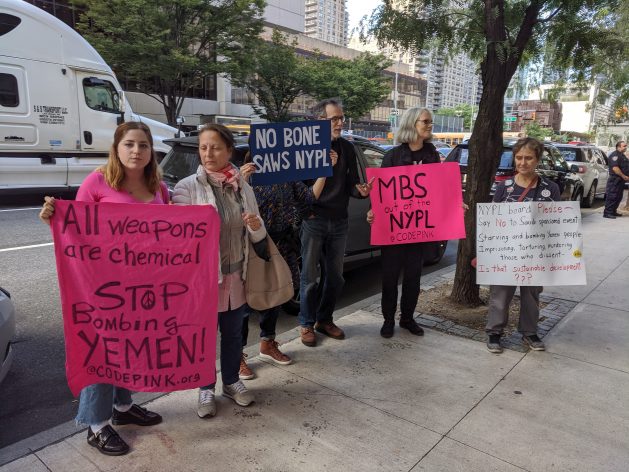
Protestors rallied outside a library building in Manhattan on Wednesday, carrying placards about Saudi Arabia’s war in Yemen and referencing the “bone saw” that was reportedly used to dismember Jamal Khashoggi, a prominent critic of Saudi prince Mohammad bin Salman. Credit: James Reinl/IPS

UNITED NATIONS, Sep 19 2019 (IPS) A New York library appeared to bow to pressure this week when it canceled an event that was being co-hosted by Saudi Arabia’s crown prince Mohammad bin Salman, who is accused of a range of human rights abuses.


On Wednesday, the New York Public Library (NYPL) said it was scrapping the so-called Misk-OSGEY Youth Forum, a workshop on Sept. 23 that was being co-hosted by bin Salman’s Misk Foundation and U.N. youth envoy Jayathma Wickramanayake. 

The event had been blasted by Human Rights Watch (HRW) and other campaign groups, who said it served to whitewash bin Salman’s reputation after the killing of Saudi journalist Jamal Khashoggi in October last year — reportedly on the crown prince’s orders. 

Evan Chesler, chairman of the NYPL board, said that dropping the workshop was the “appropriate thing to do” after weeks of protests and an online petition that had garnered more than 7,000 signatures.

In a statement, the library said it had cancelled the “space rental” amid “concerns about possible disruption to library operations as well as the safety of our patrons” amid “public concern around the event and one of its sponsors”. 

It remains unclear whether the Misk Foundation will seek an alternative venue for the workshop at short notice. A U.N. spokesman told IPS it was “up to Misk to provide information on whether the event will take place elsewhere or not”.

Saudi Arabia’s mission to the U.N. and the Misk Foundation declined to comment on the controversy.

Protestors rallied outside a library building in Manhattan on Wednesday, carrying placards about Saudi Arabia’s war in Yemen and referencing the “bone saw” that was reportedly used to dismember Khashoggi, a prominent critic of bin Salman. 

“This week’s protests show that the public will not keep quiet while the leadership of the NYPL, a treasured repository of civilisation, hires our library out to the butcherer of Khashoggi,” Matthew Zadrozny, president of the Committee to Save the New York Public Library, told IPS.

“The NYPL leadership must explain to the public it serves who signed the deal with bin Salman’s foundation and why.”

Kenneth Roth, director of HRW, blasted the “repression-whitewashing event” on Twitter and asked U.N. secretary-general Antonio Guterres to scrap the partnership between his youth envoy, Wickramanayake, and the crown prince’s charity. 

Suzanne Nossel, CEO of rights group PEN America, said the library had made the “right choice”, addiing bin Salman’s government had “orchestrated the murder and dismemberment of journalist Jamal Khashoggi”.

“Hosting this event just days before the anniversary of Jamal’s killing would have been particularly appalling not just for his family, friends, and colleagues, but also for those currently being persecuted in the kingdom.”

Nossel also noted that the library “is the crown jewel of the literary community in New York” and it stands for “free exchange of ideas and free expression, qualities that the crown prince has repeatedly disdained in both words and actions”.

The NYPL event was set to see some 300 budding young entrepreneurs learn about green themes, corporate responsibility and other parts of the U.N.’s Sustainable Development Goals (SDG) agenda.

Khashoggi, a U.S.-based journalist who frequently criticised the Saudi government, was killed and dismembered on Oct. 2 last year after visiting the Saudi consulate in Istanbul, where he collecting documents for his wedding.

The CIA assessed that bin Salman had ordered Khashoggi’s killing. U.N. expert Agnes Callamard has described the death as a “premeditated execution,” and called for bin Salman and other high-ranking Saudis to be investigated.

Officials in Riyadh, who initially said Khashoggi had left the premises unharmed, now say the journalist was killed by a rogue hit squad that did not involve bin Salman. Activists have since pushed for accountability over the killing.

  Source

Achieving Global Consensus on How to Slow Down Loss of Land

Asia-Pacific, Climate Change, Combating Desertification and Drought, Conferences, Editors’ Choice, Environment, Featured, Food & Agriculture, Global, Headlines, IPS UN: Inside the Glasshouse, Regional Categories, Sustainability, TerraViva United Nations

Combating Desertification and Drought

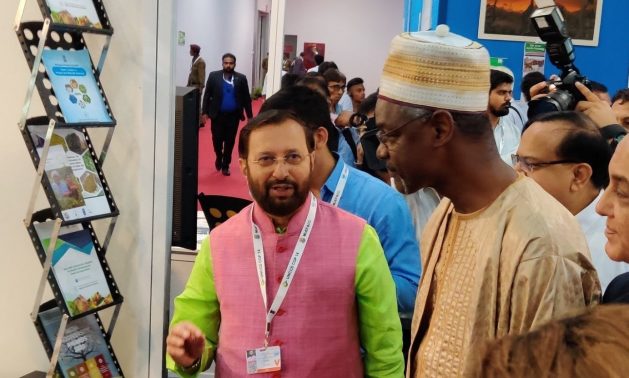
India’s minister for environment, forests and climate change, Prakash Javadekar (left), said he would be happy if CoP 14 could achieve consensus on such difficult issues as drought management and land tenure. Courtesy: Ranjit Devraj

NEW DELHI, Sep 4 2019 (IPS) – Expectations are high, perhaps too high, as the 14th Conference of the Parties (CoP 14) of the United Nations Convention to Combat Desertification (UNCCD), now into the third day of its two-week session, is being held outside the smog-filled Indian capital of New Delhi.


At the inauguration on Monday, India’s minister for environment, forests and climate change, Prakash Javadekar, soon after ceremonies to mark his taking over as president of the Convention for the next two years, said he would be happy if CoP 14 could achieve consensus on such difficult issues as drought management and land tenure.

Other issues on the agenda of CoP14, themed ‘Restore land, Sustain future’ and located in Greater Noida, in northern Uttar Pradesh state, include negotiations over consumption and production flows that have a bearing on agriculture and urbanisation, restoration of ecosystems and dealing with climate change.

According to Ibrahim Thiaw, executive secretary of the Convention, CoP14 negotiations would be guided by, its own scientific papers as well as the Special Report on Climate Change and Land of the U.N. Intergovernmental Panel on Climate Change (IPCC), released in August.

The IPCC report covered interlinked, overlapping issues that are at the core of CoP14 deliberations — climate, change, desertification, and degradation, sustainable land management, food security and greenhouse gas fluxes in terrestrial ecosystems.

“Sustainable land management can contribute to reducing the negative impacts of multiple stressors, including climate change, on ecosystems and societies,” the IPCC report said. It also identified land use change as the largest driver of biodiversity loss and as having the greatest impact on the environment.

Javadekar said he saw hope in the fact that of the 196 parties to the Convention 122, including some of the most populous like Brazil, China, India, Nigeria, Russia and South Africa have agreed to make the U.N. Sustainable Development Goal of achieving land degradation neutrality (LDN) targets by 2030 as national objectives.

But the difficulty of seeing results on the ground can be gauged from India’s own difficult situation. Nearly 30 percent of India’s 328 million hectares, supporting 1.3 billion people, has become degraded through deforestation, over-cultivation, soil-erosion and wetland depletion, according to a satellite survey conducted in 2016 by the Indian Space Research Organisation.

A study, conducted last year by The Energy and Resource Institute (TERI), an independent think-tank based in New Delhi, estimates India’s losses from land degradation and change in land use to be worth 47 billion dollars in 2014—2015.

The question before CoP14 is how participating countries can slow down loss of land and along with it biodiversity threatening to impact 3.2 billion people across the world. “Three out of every four hectares have been altered from their natural states and the productivity of one every four hectares of land has been declining,” according to UNCCD.

Running in parallel to CoP14 is the 14th session of UNCCD’s committee on science and technology (CST14), a subsidiary body with stated objectives — estimating soil organic carbon lost as a result of land degradation, addressing the ‘land-drought nexus’ through land-based interventions and translating available science into policy options for participating countries.

On Tuesday, as CoP4 launched into substantive business, the participants at the CST and other subsidiary bodies began to voice real apprehensions and demands.

Bhutan representing the Asia Pacific group, highlighted the need for cooperation at all levels to disseminate and translate identified technologies and knowledge into direct benefits for local land users.

Bangladesh pointed out that LDN targets are sometimes linked to transboundary water resources and also called for mobilising additional resources for capacity building.

Colombia, speaking for the Latin America and Caribbean group, appreciated the value of research by the scientific panels, but urged introduction of improved technologies and mitigation strategies to reduce the direct impacts of drought on ecosystems, starting with soil  degradation.

Russia, on behalf of Central and Eastern Europe, mooted the establishment of technical centres in the region to support the generation of scientific evidence to prevent and manage droughts, sustainable use of forests and peatlands and monitoring of sand and dust storms.

Civil society organisations, led by the Cape Town-based Environmental Monitoring Group, were also critical of the UNCCD for putting too much emphasis on LDN and demanded optimisation of land use through practical solutions that would ensure that carbon is retained in the soil.

“Retaining carbon in the soil is of particular value to India and its neighbouring countries, which presently have the world’s greatest rainwater runoffs into the sea,” says Himanshu Thakkar, coordinator, South Asia Network on Dams, Rivers and People (SANDRP), a New Delhi based NGO, working on the water and environment sectors.

“What South Asian countries need to do urgently is to improve the rainwater harvesting so as to recharge groundwater aquifers and local water bodies in a given catchment so that water is available in the post-monsoon period that increasingly see severe droughts,” Thakkar tells IPS. “This is where governments can be supportive.”

Benefits such as preventing soil degradation and consequent landslides that have become a common feature in South India, Sri Lanka and Bangladesh.

A study published in May said half of the area around 16 of India’s 24 major river basins is facing  droughts due to lowered soil moisture levels while at least a third of its 18 river basins has become non-resilient to vegetation droughts.

Responding to the suggestions and demands the Secretariat highlighted  recommendations to ensure mainstreaming of LDN targets in national strategies and action programmes, partnerships on science-policy to increase awareness and understanding of LDN and collaborations to assess finance and capacity development needs.

In all, the delegates, who include 90 ministers and more than 7,000 participants drawn from among government officials, civil society and the scientific community from the 197 parties will thrash out 30  decision texts and draw up action plans to strengthen land-use policies and address emerging threats such as droughts, forest fires, dust storms and forced migration.

“The agenda shows that governments have come to CoP14 ready to find solutions to many difficult, knotty and emerging policy issues,” said Thiaw at the inaugural session. The conference ends with the parties signing a ‘New Delhi Declaration’ outlining actions to meet UNCCD goals for 2018-2030.

  Source

U.N. Criticised for Link-up with Saudi Prince MBS

Armed Conflicts, Civil Society, Crime & Justice, Editors’ Choice, Featured, Global, Global Governance, Headlines, Human Rights, IPS UN: Inside the Glasshouse, Middle East & North Africa, Peace, Press Freedom, Regional Categories, TerraViva United Nations

Human Rights

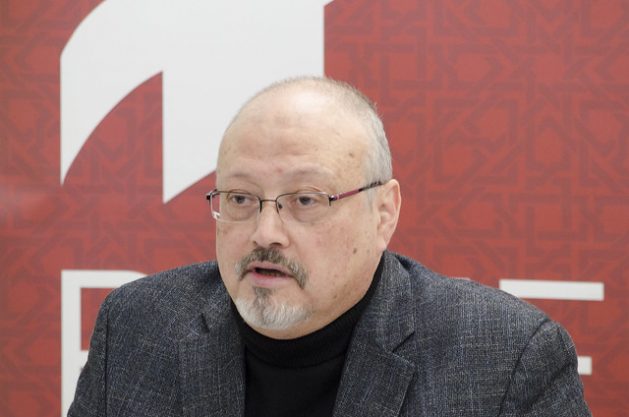
Jamal Kahshoggi, a US-based journalist who frequently criticised the Saudi government, was killed while visiting the Saudi consulate in Istanbul, where he was collecting papers for his wedding. Courtesy: POMED/CC by 2.0

UNITED NATIONS, Sep 4 2019 (IPS) The United Nations is under growing pressure to scrap an event it is co-hosting with the private foundation of Saudi Arabia’s crown prince Mohammad bin Salman, who has been linked to the killing of journalist Jamal Khashoggi.


On Tuesday, Sunjeev Bery, director of Freedom Forward, became the latest leader of a campaign group to press the U.N. to cancel the Sept. 23 event, saying it would help repair bin Salman’s reputation over the Khashoggi murder. 

The event, known as the Misk-OSGEY Youth Forum, is a partnership between the U.N.’s youth envoy, Jayathma Wickramanayake, and the Misk Foundation, a culture and education foundation chaired by bin Salman, who is better known as MBS.

“No one — especially not the U.N. — should be partnering with MBS or his personal Misk Foundation,” Bery told IPS.

“Saudi Arabia’s brutal crown prince is responsible for the deaths of thousands of Yemeni children. His thugs imprisoned leading women’s rights activists and murdered Jamal Khashoggi.”

Kenneth Roth, the director of Human Rights Watch, a campaign group, last week accused the world body of helping to “whitewash” MBS’s record; Mandeep Tiwana, from Civicus, a rights group, called the event “disturbing”.

The U.N. youth envoy’s office declined to comment on the row. U.N. spokesman Stephane Dujarric said the world body had repeatedly issued “very strong statements … calling for accountability” in Khashoggi’s killing.

The Misk-OSGEY Youth Forum will take place in New York only 10 days before the first anniversary of Khashoggi’s murder on Oct. 2 last year, when Saudi government agents killed and dismembered the journalist inside the country’s consulate in Istanbul.

The CIA later determined that MBS had personally ordered the hit. Saudi officials, who initially said Khashoggi had left the consulate alive, now say the journalist was killed in a rogue operation that did not involve MBS.

Saudi Arabia’s mission to the U.N. did not answer requests for comment from IPS.

The four-hour workshop for 300 young people at the New York Public Library will occur on the sidelines of the U.N. General Assembly and promote green themes, corporate responsibility and other aspects of the U.N.’s Sustainable Development Goal (SDG) agenda.

It will feature Alexandra Cousteau, an environmentalist and granddaughter of French explorer Jacques-Yves Cousteau; and Bart Houlahan, an entrepreneur who promotes sustainable business practices.

Other speakers include Andrew Corbett, an expert on entrepreneurship at Babson College, Paul Polman, former CEO of consumer goods firm Unilever, and Ann Rosenberg, an author and U.N. technology expert.

Dr. Reem Bint Mansour Al-Saud, a Saudi princess and an envoy to U.N. headquarters in New York, who advocates for empowering women and development in the Gulf kingdom, will also speak at the workshop.

Khashoggi, a United States-based journalist who frequently criticised the Saudi government, was killed while visiting the Saudi consulate in Istanbul, where he was collecting papers for his wedding.

U.N. expert Agnes Callamard issued a report in June that described the assassination as a “deliberate, premeditated execution,” and called for MBS and other Saudi officials to be probed.

The Misk-OSGEY Youth Forum comes after years of tensions between the U.N. and Riyadh over the war in Yemen, where Saudi Arabia is leading a military coalition against the country’s Houthi rebels. 

The conflict has killed tens of thousands of people and caused led to a major humanitarian crisis. 

“The crown prince and his violent government must be held accountable for their human rights crimes,” said Bery, who advocates for the U.S. to cut ties with Saudi Arabia and other authoritarian regimes.

“Instead, misguided U.N. staff are absurdly giving the crown prince a public relations platform as he attempts to wipe away the blood of so many dead Yemeni children.”

  Source