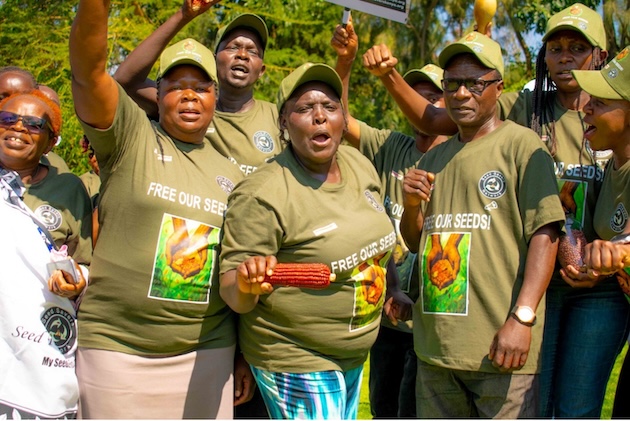
Farmers celebrate in Gilgil town in Kenya, after a court ruling that decriminalized the sharing of indigenous seeds. Credit: Jackson Okata/IPS
NAIROBI, Dec 18 2025 (IPS) – For years, smallholder farmers across Kenya have been engaged in a legal battle with the government over a law that criminalizes the practice of saving, sharing and exchanging indigenous seeds.
In 2022, a group of 15 Kenyan smallholder farmers petitioned the country’s High Court, seeking to compel the government to review sections of a law that bans the sharing and exchange of uncertified and unregistered seeds.
Kenya’s government enacted the law in 2012 to develop, promote, and regulate a modern and competitive seed industry, but farmers are calling for its review.
The informal farmer-managed seed system allows farmers to store a portion of their seeds after harvesting, which guarantees them seeds for the next planting season.
Victory for Farmers
In a decisive victory for food sovereignty and climate justice, the High Court on November 27, 2025, ruled in favor of smallholder farmers, declaring punitive sections of the Seed and Plant Varieties Act unconstitutional.
The judgment effectively decriminalizes the age-old practice of saving, sharing, and exchanging indigenous seeds, affirming that Farmer-Managed Seed Systems (FMSS) are a protected right, not a criminal activity.
Under the punitive law, farmers faced jail terms of up to two years and a fine of 1 million shillings (about 7,800 USD) for selling or exchanging unregistered seeds.
Farmer rights defenders had argued that the law gave control of the country’s food system to multinational corporations.
In her judgment, Justice Rhoda Rutto declared unconstitutional sections of the Act that gave seed inspectors sweeping powers to raid seed banks and seize seeds meant for the next harvest, made it illegal for farmers to process or sell seeds unless they were registered seed merchants, gave extensive proprietary rights to plant breeders and none to farmers, and made it illegal for farmers to save or share seeds from their harvest without prior knowledge of seed proprietors.
Samuel Wathome, a smallholder farmer who was a petitioner in the case, says that “just like his grandmother did, he can now freely save seeds for his grandchildren without fear of police or prison.”
According to Elizabeth Atieno, a Food Campaigner at Greenpeace Africa, the court ruling affirmed the long-known tradition of seed sovereignty.
“The court ruling removed shackles from Kenya’s farmers. This is not just a legal win; it is a victory for our culture, our resilience, and our future,” Atieno told IPS.
She added, “By validating indigenous seeds, the court has struck a blow against the corporate capture of our food system. We can finally say that in Kenya, feeding your community with climate-resilient, locally adapted seeds is no longer a crime.”
Protecting Biodiversity
According to Gideon Muya, Programs Officer, Biodiversity and Biosafety Association of Kenya, the judgment is a shield for the country’s biodiversity.
“Indigenous seeds are the library of life because they hold the genetic diversity we need to withstand droughts, pests, and a changing climate. The court has recognized that you cannot patent nature’s heritage. We have reclaimed the right to choose what we plant and what we eat, free from the coercion of commercial seed monopolies,” Muya told IPS.
Claire Nasike, an agroecologist, noted that the judgment indicates that the seed is life, and it is sovereign, and whoever controls it influences the lifeline of a generation.
Nasike observes that the ruling is a big boost for biodiversity, climate resilience and food sovereignty since indigenous seeds tend to be well adapted to local conditions like soil types, rainfall patterns, pests and disease traits that are often lost in uniform, certified commercial seeds.
“By enabling farmers to save, exchange and diversify their seed stock, communities can preserve genetic diversity, a key buffer against climate shocks like droughts and pests, as well as a safeguard for long-term food security.”
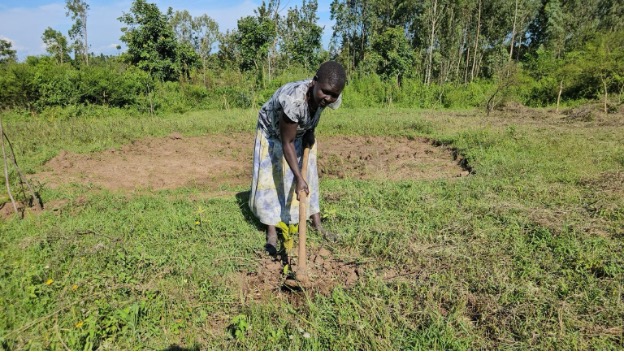
Caroline Awuor tends to tree seedlings on her farm in Siaya County, Western Kenya. She is a beneficiary of the My Farm Trees Project. Credit: Jackson Okata/IPS
SIAYA, Kenya , Dec 8 2025 (IPS) – For years, Morris Onyango had been trying to reforest his degraded land on the shores of River Nzoia, in Siaya county, 430 kilometers from Kenya’s Capital, Nairobi. But every time he planted trees on his farm, his efforts bore little fruit, as floodwaters would not only wash away his tree seedlings but also fertile topsoil on his land.
“The land became unproductive and bare. I tried reclaiming the land through reforestation, but the trees’ survival rate was too low,” Onyango said.
Siaya County has a 5.23 percent forest cover and is ranked 44th out of Kenya’s 47 counties. Judy Ogeche, a scientist from the Kenya Forestry Research Institute (KEFRI), says that the compromised forest and tree cover in the county and the lack of any gazetted forests have discouraged the integration of tree and crop farming.
“Communities here do not see tree growing as a lucrative venture. Some myths and beliefs discourage tree growing. For example, some people believe that growing the Terminalia mentalis (often known as the Panga Uzazi) tree attracts death,” says Ogeche.
According to Ogeche, another challenge is gender inequality in land ownership, with men owning most available land and making decisions on what should be planted.
“We have many women interested in restoring tree cover, but their husbands would not allow it,” Ogeche said.
Across Africa, reforestation projects struggle to survive beyond the seedling stage. However, in parts of Kenya, a groundbreaking digital innovation is transforming the landscape by empowering rural farmers to earn a living while restoring degraded lands with native trees.
Tech and Reforestation
In a bid to restore lost biodiversity and enhance tree cover in Kenya, Alliance Bioversity International and CIAT, in partnership with the International Union for Conservation of Nature (IUCN), launched the My Farm Trees project, a blockchain-based platform that offers guidance to subsistence farmers on seed selection, planting, and post-plant care, ensuring that seedlings survive and thrive in harsh conditions.
Implemented in the counties of Siaya, Turkana and Laikipia, MFT emphasizes genetically robust native species that support biodiversity, improve soil health, and provide long-term ecological and economic benefits.
Ogeche observes that the My Farm Trees project has motivated communities in Siaya to grow trees.
“They are given free seedlings and taught how to plant and take care of them, and when the trees grow, they are paid,” she said.
To provide the right seedlings, the project is partnering with the Kenya Forestry Research Institute (KEFRI), the Kenya Forest Services (KFS) and private tree nursery operators in the respective counties.
For farmers like Onyango, the My Farm Trees Project gave them the much-needed solution to their degraded lands and soils
“The project gifted me 175 seedlings of various trees, which I planted along the riverbank. The trees have helped me reclaim my land, prevent erosion and get paid for taking care of my own trees,” Onyango says.
How it Works
In the My Farm Trees project, participating farmers are registered on the MyGeo Farm App, which allows them to monitor seedlings from planting to growing. Through the app, farmers can track and report progress.
Francis Oduor, the National Project Coordinator, says since its rollout, the project has seen over 1,300 farmers registered on the MyGeo Tree App, and over 100,000 seedlings have been planted across the three counties.
“The project is especially interested in using indigenous trees for landscape restoration, which are native to specific areas, and to enhance genetic diversity,” says Oduor.
Oduor explains that My Farm Trees uses monitoring, verification, and incentives to empower local communities to become leaders and stewards of tree-planting projects that provide immediate short-term benefits.
“The project does not just focus on payment to farmers but the long-term benefits of restored landscapes for improved agricultural productivity, water regulation, and climate resilience,” said Oduor.
To ensure the use of native varieties and guarantee the production of quality tree seedlings, the project team collaborates with KEFRI to provide technical assistance to local tree nursery operators.
Lawrence Ogoda, a tree nursery operator, is among the project beneficiaries. He has been trained on seed collection, raising seedlings and record keeping.
“Through the MyGeo Tree and MyGeo Nursery Apps, I can collect data and track progress on seed collection, propagation and development at the nurseries.”
Before joining the My Farm Trees project, Caroline Awuor had not given much attention to growing trees. She received 110 seedlings, 104 of which have successfully survived and are earning her cash incentives.
“Most of them are fruit trees, including mangoes, avocado and jackfruit, while there are also some timber trees. In addition to the incentives from the project, I also earn money by selling the fruit,” she says.
Caroline intends to plant an additional 1,000 tree seedlings on her land, strategically located near the River Nzoia.
According to Joshua Schneck, the Green Climate Fund (GCF) Portfolio Manager for Global Programs at IUCN, My Farm Trees is an innovative project driven towards sustainable transformation.
The Impact
In Kenya, My Farm Tree has supported 3,404 farmers, 56 percent of whom are women. A total of 210,520 trees have been planted, with a survival rate of over 60 percent beyond the first year, with 1,250 hectares of land being restored across Siaya, Turkana, and Laikipia counties.
The program has released KES 26 million (approximately USD 200,000) in digital payments, directly benefiting 1,517 farmers. Additionally, 13 local nurseries have been strengthened in partnership with the Kenya Forestry Research Institute.
Also implemented in Cameroon, the project has seen the restoration of 1,403 hectares of forest land with over 145,000 seedlings being planted and 2,200 farmers registered on the platform. The project has also seen the restoration of 423 community lands and 315 sacred forests, with USD 130,000 in incentives distributed to farmers.
Oduor noted that the My Farm Trees project offers a scalable blueprint for forest restoration by combining science and Blockchain technology in tree selection, post-planting support, and farmer incentives, which gives it global relevance.
“MFT is a scalable model that aligns with climate action, poverty reduction, and ecosystem recovery. This approach supports the goals of the Paris Agreement, the United Nations Convention to Combat Desertification, and the UN Decade on Ecosystem Restoration,” Oduor said. IPS UN Bureau Report
Magdalene Ngimoe and Char Tito, learners at Kakuma Arid Zone Secondary School, making chairs from mathenge wood. Credit: Farai Shawn Matiashe/IPS
KAKUMA, Kenya, Jun 6 2025 (IPS) – Char Tito is hammering nails into wood at Kakuma Arid Zone Secondary School in Turkana County, northern Kenya. The 16-year-old is making a traditional chair under the scorching sun outside one of the classroom blocks.
The wood she is using is from an unpopular source in this community. It is from a species of mesquite named Prosopis juliflora, which is native to Central and South America and is known in Kenya as mathenge.
Many locals hate mathenge in Turkana County due to its invasiveness and its thorns that are harsh to humans and can cause injuries to livestock. Locals say rivers and dams dry fast in areas with mathenge, and it dominates other plants.
Over the years, the residents have found it an easy source of firewood and charcoal, fuel for many in this community.
But youths, including girls, are now repurposing the mathenge tree to make furniture, particularly chairs.
Char Tito, a learner at Kakuma Arid Zone Secondary School in Kakuma, is seated on a chair made from mathenge wood. Credit: Farai Shawn Matiashe/IPS
“Plastic chairs are expensive. This is why I started making chairs from mathenge earlier this month,” says Tito, who fled the war in South Sudan to seek refuge in Kakuma Refugee Camp in 2017.
“I was taught here at school. Mathenge is abundant. We have been using it for firewood for years. I did not know that it could be used to make chairs.”
Income-Generating Scheme
The land in Kakuma is barren with sparse vegetation and the soils are so poor that they do not support agriculture. Turkana County receives little or no rain and can go for five years without experiencing a single drop of rain.
Acacia trees and mathenge, which are always green despite the high temperatures and water scarcity, make up most of the trees in this community.
Government statistics indicate that the mathenge trees spread at a rate of 15 percent yearly and have so far colonized a million acres of land in Kenya.
Some use mathenge to fence their homes and to make livestock shelters.
Locals survive on livestock production and trading charcoal and firewood.
Dennis Mutiso, a deputy director at Girl Child Network (GCN), a grassroots non-governmental organization supporting Tito and hundreds of other refugees, says the project is equipping learners with green skills.
Magdalene Ngimoe, a learner at Kakuma Arid Zone Secondary School, is making chairs from mathenge wood in Kakuma. Credit: Farai Shawn Matiashe/IPS
“It is contributing to national climate plans. It aligns with the school curriculum,” he says.
Mutiso says those youths who have been trained in making chairs partner with those untrained to pass the knowledge to the community.
Tito, who lives with her mother and her three siblings, is so far making chairs for household use but is planning to make some for sale to her neighbors.
“This is a skill that I can use for my entire life. I am looking forward to earning a living out of carpentry,” she says, smiling.
Mathenge was introduced in the 1970s in the East African country to restore degraded dry lands. It is drought resistant, with its deep roots making it ideal for afforestation in areas like Turkana. The mathenge restored the area and blocked wind erosion in some areas, but at a cost to the locals.
Invasive mathenge tree in Kakuma, northern Kenya. Credit: Farai Shawn Matiashe/IPS
Despite the massive cutting down of this tree for firewood and charcoal, the mathenge regenerates fast, unlike other trees like Acacia.
Lewis Obam, a conservator at the Forestry Commission under Turkana County, says there was a negative perception of the mathenge in the community.
“Communities lost their goats after consuming the tree. Its thorns were affecting the community,” he says.
Obam says mathenge is a colonizer and spreads so fast.
“It was meant to counter desertification. The intention was good,” he says.
Obam says its hardwood is ideal for making chairs.
“It has more opportunities than we knew. It has the second hardest wood in this area. We need maximum use of the mathenge.”
Protecting Environment
To restore other trees in this semi-arid land, Tito and other girls are planting trees at school and in their homes. She has planted five trees at home and many at school, but water is a challenge amid temperatures that can go as high as 47 degrees Celsius.
Magdalene Ngimoe, a learner at Kakuma Arid Zone Secondary School in Kakuma, planting a tree. Credit: Farai Shawn Matiashe/IPS
“I am proud that I am contributing to measures that reduce the effects of climate change,” she says.
Sometimes, the girls bring water from home to school to ensure that the trees survive.
Trees help mitigate climate change by absorbing carbon dioxide from the atmosphere.
Kenya is targeting to plant at least 15 billion trees by 2032 through its National Tree Growing Restoration campaign launched in December 2022.
Magdalene Ngimoe, another learner at Kakuma Arid Zone Secondary School, says she has so far planted two trees at her home in Kiwandege village in Kakuma.
“I hate mathenge. It makes our lives difficult. But I am happy that I am using it to make chairs. I am also planting trees at school, which will provide shade to other students,” says the 16-year-old Kenyan Ngimoe, the firstborn in a family of seven.
Her family survives on selling meat and she hopes she will earn some money from her newly acquired craft.
Edwin Chabari, a manager at Kakuma Refugee Camp under the Department of Refugee Services, says Mathenge has been a menace not only within the camp but also in the area.
“The local youths can get cash from a tree that we thought was a menace,” he says.
GCN, with funding from Education Above All, a global education foundation based in Qatar, has so far planted 896,000 trees in Kakuma and Dadaab and is targeting 2.4 million trees by next year.
Ngimoe’s favorite subject is science and she wants to be a lawyer representing vulnerable children.
Established in 1992, Kakuma Refugee Camp is home to 304,000 people from more than 10 countries, like South Sudan, Burundi, Somalia, and the Democratic Republic of Congo (DRC).
Joseph Ochura, sub-county director in Turkana County under the Teachers Service Commission (TSC), says the tree-planting initiative has enhanced the learning environment.
“When you visit most of the schools that have been supported, you will see big shades of trees. Whenever there is a break time, learners sit there, including the teachers. Sometimes, some lessons are even carried out under that shade,” Ochura says.
He says that of the 15 billion trees set by the government, TSC was allocated 200 million trees.
Some schools also have their tree nurseries.
When ready, they plant the seedlings at the school and supply others to the community.
“Some of the girls are at the forefront in tree planting. That is a plus. That is what we are telling the girls—outside school, you can still do this in the community,” Ochura says.
Tito, whose favorite subject is English and who wants to be a doctor, is happy to be part of the green jobs being created in Kakuma.
“As a girl, I am proud of myself. I am contributing to environmental protection,” she says. IPS UN Bureau Report
A banner demanding an end to harmful subsidies is on display on the last day of the SBI meeting in Nairobi. Credit: Stella Paul/IPS
NAIROBI, Jun 3 2024 (IPS) – Regions struggling to revise and update their National Biodiversity Plans aligning them with the Global Biodiversity Framework adopted at COP15, will now be given the technical and scientific support to develop and submit their plans on time.
This was one of the key decisions of the 4th meeting of the Subsidiary Body on Implementation (SBI)—the crucial pre-COP meetings of the United Nations Convention on Biodiversity (UNCBD)—to review the status and challenges of implementing the Global Biodiversity Framework (GBF), which started on May 22 and ended in Nairobi late in the evening of May 29, 2024.
More than 1000 participants from 143 countries gathered for the nine-day meeting, which UNCBD referred to as one of the “largest SBI meetings ever,” to discuss a variety of issues pertaining to the timely implementation of the GBF. As the meeting ended, the participants came up with a list of recommendations that will be presented for nations to consider at the next Biodiversity COP (COP16), scheduled to be held in October in Cali, Colombia.
In December 2022, at the COP15, parties agreed to revise and update their national biodiversity plans (NBSAP), aligning the targets with the global biodiversity framework that was adopted at the COP. These updated plans are to be submitted to UNCBD by or before the next COP, scheduled to be held in October.
However, as earlier reported by IPS, despite being just five months away from the next COP, only 11 countries have submitted their NBSAPs, while the majority of the countries have not, citing various reasons, including a lack of capacity and resources.
The top agenda item of the SBI has been reviewing these reasons and recommending steps that can help countries close this gap and complete the task of submitting their plans on time.
David Cooper, acting Executive Director of UN Biodiversity and Chirra Achalendar Reddy, chair of SBI-4, address the press conference. Credit: Stella Paul/IPS
Capacity Building
After the nine-day discussions, delegates at the SBI decided that it would be necessary to provide all countries with specific technical and scientific support that can help them develop their NBSAPs and submit them on time. To provide this support, SBI decided that a network of technical and scientific support centers would be set up at regional and sub-regional level.
According to Chirra Achalender Reddy, Secretary, National Biodiversity Authority, India, and the chair of the SBI-4 meeting, the recommendation to set up these support centers was one of the key decisions made at the meeting.
“I thank the parties for their commitment to implementation of the Convention, as demonstrated by their engagement during the negotiations this week. While we have many issues to resolve at COP16, the foundation is laid for our discussions in Cali, Colombia, later this year,” said Reddy.
Elaborating further on the decision, David Cooper, Acting Executive Director of the UNCBD, said that 18 regional organizations have been selected worldwide as the support centers. “They will foster and facilitate technical and scientific cooperation as countries harness science, technology and innovation to help halt and reverse biodiversity loss by 2030.”
Cooper also expressed hope that, in the future, these 18 organizations could create more such support centers, expanding the network from regional and sub-regional to national level.
“These subregional support centers will also promote technology transfer among countries, including through joint research programs and joint technology development ventures, acting as “one-stop service centers” offering wide-ranging resources to help meet Biodiversity Plan targets. The centers are expected to help expand, scale up, and accelerate efforts such as the existing Bio-Bridge initiative,” Cooper added.
Resource Mobilization
In the Global Biodiversity Framework, the financial ambitions set out include investing USD 200 billion a year from both public and private sources until 2030. In addition, the goal also includes saving another USD 500 billion by ending subsidies that are harmful to biodiversity yet are still practiced by countries. This will bring the total available finance for biodiversity conservation to USD 700 billion per year until 2030, the deadline to achieve all GBF targets.
At the SBI, there was an intense discussion on resource mobilization. Several countries complained that, despite being signatories to the GBF, they had not been able to access any resources meant for biodiversity conservation, especially the Global Biodiversity Framework Fund (GBFF), which was launched last year and is managed by the Global Environment Facility.
Delegates from Syria, who spearheaded this discussion, revealed that their country had not been able to receive any money and suggested that the final document prepared by the CBD Secretariat reflect this. Syria’s voice was amplified by Russia, which said that Syria’s inability to access resources should be interpreted as a denial of resources.
Almost all the governments also discussed their own parameters for national biodiversity finance plans, the role of multilateral development banks, existing UN initiatives, and private finance.
An important discussion that took place was about setting up a new Global Biodiversity Fund, separate from the current Global Biodiversity Framework Fund (GBFF).
Women4Biodiversity, a group of women-led NGOs and gender champions, launched a training module on how to mainstream gender at the Global Biodiversity Framework meeting. Credit: Stella Paul/IPS
Gender and Indigenous Peoples
One of the most interesting developments that took place on the sidelines of the SBI meeting was the launch of a training module by Women4Biodiversity, a group that advocates for gender mainstreaming across all 23 targets of the GBF and participates in the meetings as an observer.
Titled “Training Module on Advancing Women’s Rights and Gender Equality in the Implementation of the Kunming Montreal-Global Biodiversity Framework,” the document was prepared in collaboration with World Wildlife Fund (WWF).
Speaking to the press about the training module, Alejandra Duarte, Policy Associate at Women4Biodiversity, said the main objective of the publication was to serve as a source of information for decision-makers, negotiators, indigenous peoples and local communities, women, youth, civil society, businesses, and the whole of society who are engaged in the planning, monitoring, and implementation of the Biodiversity Plan.
Mrinalini Rai, Director of Women4Biodiversity, also explained that the module was created to be understood by all and customized as per the context, community, or country.
Supporting Rai’s comments, Cristina Eghenter, senior global governance policy expert at WWF, said, “I hope that the module will help understand the gaps and what needs to be done for women to be a part of the Biodiversity Plan.”
Rodah Rotino, an indigenous community leader and President of the Pastoral Communities Empowerment Programme (PACEP), a Kenya-based women-led NGO, highlighted the contribution of indigenous women to biodiversity conservation across the world, including Africa.
“In my community, we have started a seed bank that preserves indigenous tree seeds. We plant indigenous plants that help preserve and conserve the local biodiversity and help community members benefit from their many uses, as they have done for centuries,” Rotino said, citing the example of her own community in West Pokot County, where women have started several initiatives. “We even promote the use of our traditional food systems, including the use of traditional indigenous crops, fruits, and vegetables, and we are seeing that after using these, our people, especially women and children, have many health improvements and quick recovery from some ailments. In short, we are going ahead with using our indigenous knowledge without even waiting for the formal implementation of the GBF.”
What’s Next
In Cali, Colombia, the CBD secretariat will present the decisions of the SBI-4 and the SBSTTA to the nations for their consideration and adoption.
However, just before the COP begins, yet another SBI meeting (SBI-5) will be held in Cali. The sole focus of that meeting will be to review the latest status of the national biodiversity plans and the plans that will be submitted between now and the COP.
“Right now, countries are in various stages of developing their NBSAPs and by October, we expect most of them to complete and make the submissions. The SBI-5 will review the plans and the status then,” Cooper explained.
The United Nations Office at Nairobi is hosting the 2024 United Nations Civil Society Conference on May 9 and 10, under the theme Shaping a Future of Global and Sustainable Progress. Credit: Joyce Chimbi/IPS
NAIROBI, May 9 2024 (IPS) – The world is neither on track to meet the Sustainable Development Goals (SDGs) nor is it leveraging emerging opportunities to effectively address global concerns such as extreme hunger, poverty, conflict, and climate change. Global concerns have outpaced existing structures for international cooperation and coping.
To forge a global perspective, the United Nations Office in Nairobi is currently hosting the 2024 United Nations Civil Society Conference under the theme Shaping a Future of Global and Sustainable Progress. Bringing together more than 2,000 participants from civil society organizations, academic institutions, think tanks, member states, private sector companies, UN entities, change-makers, and other relevant stakeholders from across the globe.
“That civil society engagement remains a critical cog in the wheel of development is well established. Greater collaboration between civil society organizations, governments, and the private sector can therefore not be more urgent at this time as we gear up for the Summit of the Future,” says Carole Ageng’o, Global Initiatives Lead & Africa Regional Representative at HelpAge International.
“Indeed, civil society participation will contribute greatly towards meeting the aspiration of an international system that is better prepared to manage the challenges we face now and, in the future, for the sake of all humanity and for future generations.”
Since 1947, sixty-eight civil society conferences have resulted in successful outcomes due to previous interactions with civil society organizations. The ongoing conference is the premier event on the civil society calendar at the United Nations and the first of the UN’s civil society conferences to be held in Africa.
Born in Zimbabwe and currently working in South Africa as a human rights defender, Constance Mukarati told IPS that the role of civil society organizations and, more so, human rights defenders cannot be overstated towards ensuring that no one is left behind.
“For us, SDG 5 is really SDG 1. As a matter of urgency, women and girls everywhere must have equal rights and opportunities. We are still in an era where girl child education is not a priority and a gathering such as this is an opportunity for a revolution in how we think about issues of national and global concern, how we talk about these issues, who is in the room and how we execute and implement commitments towards sustainable development,” says Mukarati from the African Initiative of Women Human Rights Defenders.
The ongoing gathering of civil society and other stakeholders is on track to provide preliminary discussions and data ahead of the world’s leaders’ Summit of the Future on September 22–23, 2024, at the UN Headquarters in New York. The Summit is part of a monumental effort to reset global cooperation towards accelerating efforts to meet our existing international commitments and take concrete steps to respond to emerging challenges and opportunities.
Ultimately, the Summit of the Future is about rethinking what multilateralism means in a world characterized by plummeting levels of trust in public institutions, glaring wealth inequalities, and a majority of the world’s population in underdeveloped and developing nations being left furthest behind, falling deeper into extreme hunger and poverty. To address global concerns, the Summit will produce three international frameworks: the Pact for the Future (available as a zero draft), the Global Digital Compact, and the Declaration on Future Generations.
“It is highly urgent that the UN systems relook and redesign how they engage its global citizenry so that the citizens can in turn engage the UN more effectively. This is what is needed to bring the SDGs back on track. What are people saying about the multiple challenges they face today? There is a feeling within the civil society movement that governments’ voices are prioritized within the UN system. This engagement is unique and highly relevant for our voices as activists and human rights defenders, which will inform and influence the direction that the Summit of the Future takes,” Eric Omondi, a Nairobi-based activist, told IPS.
This is a historic gathering aimed at galvanizing collaboration and reinforcing civil society organizations engagement in sustainable development. “We recognize that our generation stands at a critical junction where every action we take can significantly shape the future of our shared planet,” said Florence Syevuo, Executive Director, SDG Kenya Forum, and Co-Chair, Coalition for the UN We Need, Nairobi.
She stressed that the need to recognize the urgency of addressing global concerns such as climate change has never been more tangible as the effects of human interactions with nature become even more evident, underpinning why the outcome of the conference matters to all.
The Civil Society Conference and the Summit of the Future are critical platforms for deepening the engagement of citizens in international cooperation. As a prelude to the Summit of the Future, the Civil Society Conference features in-depth dialogues, a variety of workshops, and exhibits centered on three main objectives: inclusivity, impact, and innovation.
Inclusivity helps broaden the scope of discourse on global issues by enhancing the visibility and impact of diverse voices. On impact, participants are shaping global multi-stakeholder coalitions to advocate for and push the key issues that will be the outcome of the September Summit of the Future. On innovation, the two-day gathering is redefining the interaction between civil society and intergovernmental processes, showcasing a new model of collaboration that spans generations and sectors.
“The inclusion of youths and young voices in the SDG processes and other related commitments must become a priority. I recently completed my studies in law at Kampala International University and I intend to use my legal knowledge to amplify the most pressing problems facing young people in the global south and the communities in which they live,” Kiconco Shallom Esther, a youth participant from Uganda, told IPS.
As the curtain fell on the first day of the landmark civil society conference, there was consensus around the need to promote civil society’s insights and initiatives to bolster the Member State-led Summit of the Future process. Further emphasizing that a reinvigorated, organized civil society group can more effectively hold governments and powers accountable for progress towards a just, fair, and equitable shared future.
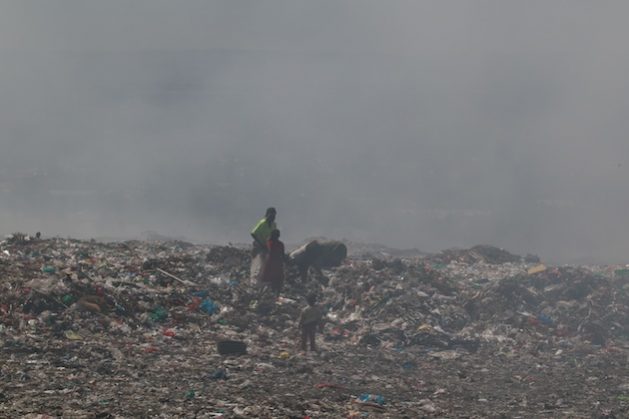
A mother and her children are seen wading through a cloud of smoke at the Dandora dumpsite, Kenya’s largest open landfill. Smoke emanating from the dumpsite is cited as a contributor to air pollution in Nairobi. Credit: Jackson Okata/IPS
NAIROBI, Feb 29 2024 (IPS) – Deborah Adhiambo (43) has been battling mild asthma since 2022, a condition she describes as “both a health and economic burden.’’ The mother of three lives within Dandora Estate, nine miles east of Kenya’s capital, Nairobi. Dandora is home to Kenya’s largest open landfill, which receives more than 2,000 metric tonnes of waste daily.
For five years, Adhiambo operated a makeshift restaurant near the dumpsite, where her main clients were waste pickers working within its environs.
“Working near the dumpsite exposed me to the heavy smoke that billows from the dumpsite. I started developing chest pains gradually and would take painkillers to subdue the pain. It was later that I was diagnosed with asthma,’’ Adhiambo told IPS.
Adhiambo’s doctors told her that prolonged and constant exposure to toxic fumes was the root cause of her asthma. She was forced to close her business since she could not venture out of her house early in the morning, late in the evenings or during cold seasons.
“The closure of my business due to sickness crippled me economically as it was my only source of income. Getting medication and feeding my family has been hard because now I have to rely on my husband, who also works at the dumpsite,” she says.
Nairobi’s Air Quality
More than 70 percent of Nairobi’s 5.3 million residents live in informal settlements like Dandora, which analysts say have the worst air quality, with vulnerable populations, particularly women and children, bearing the brunt of polluted air. Vehicles, open burning of waste, and industrial emissions are cited as the major sources of air pollutants in Nairobi. Motor vehicles contribute an estimated 40 percent of Nairobi’s particulate matter (PM2.5) air pollution concentrations, with illegal dumping and open waste burning contributing 25 percent.
And as both the population and economic output of Kenya’s capital keep expanding, the demand for energy from fossil fuels is also on the rise. The rapid expansion of Nairobi has taken an environmental toll on the city, which is evident in the worsening air pollution levels. Air pollution in Kenya’s capital is 4.2 times higher than the World Health Organization’s (WHO) recommended average annual concentration levels.
According to the World Health Organization, Nairobi’s air pollution is 2.4 times higher than recommended levels, with 19,000 poor air quality deaths being reported in Kenya annually.
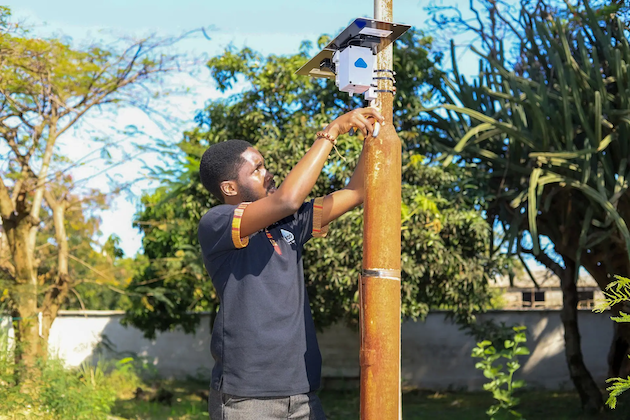
A technician installs a low-cost air quality monitor sensor in Nairobi, Kenya. Air quality monitors are helping Nairobi collect data on air pollution. Credit: Jackson Okata/IPS
Tech and Data
To enhance her efforts in combating air pollution, the City of Nairobi has been incorporating the use of technology. The city management has been installing low-cost air quality monitors and sensors to gather and share data on the levels of air pollution trends across the city. The data collected is then analyzed and guided in the formulation of policies and legal frameworks to combat air pollution, even as East Africa’s economic giant works towards realizing her ambitious target of becoming a net-zero green city by 2030.
Dubbed AirQo monitors, the low-cost air quality sensors developed by a team of young engineering and computer science students at Uganda’s Makerere University are in use in eight countries, including Kenya.
Engineer Bainomugisha, an Associate Professor of Computer Science at Makerere University and lead developer of the AirQo monitoring system, says Sub-Saharan Africa lacks usable air quality data that can help in the formulation of proper and effective policies to combat air pollution. AirQo monitors collect information about air pollution levels, types of air pollutants, and air quality
Bainomugisha explains that the air quality monitors main aim is to “close the existing gap in air quality monitoring.” AirQo air quality monitors collect air samples, which are then analyzed through a light scattering technology that quantifies the particulate matter concentration.
The information is then relayed to a cloud-based network that determines the pollution levels in a specific area. The devices measure the air particulate matter PM2.5 and PM10, which is a mixture of solid particles in the air. They also capture ambient meteorological conditions such as humidity and atmospheric pressure
“The air quality monitors run on a 2G GSM-enabled network configuration for loT sim cards and are optimized to work in areas with unstable internet and power connectivity,” says Gideon Lubisia, AirQo’s international operations embedded systems and network support engineer.
AirQo has also developed a mobile app that allows people to receive periodic and real-time updates on the air quality in their city. The monitors are mounted at strategic points within the city’s Central Business District, industrial areas, markets, along major city highways and in select residential areas. while others are mounted on motorbikes that move from one location to another, collecting data.
Data and Policy Formulation
With the monitors in place, Nairobi City has been able to develop two air quality collocation installations and infrastructure reference grade monitors, according to Nairobi City County Deputy Director in Charge of Air Quality and Climate Maurice Kavai.
“The one-stop center collocation enables our research teams to compare air quality data collected from various points within the city, which is key in developing appropriate action,” Kivai explained.
“The availability of periodic data collected by the monitors enables the city to establish the extent of pollution in particular areas, identify the causes, and develop necessary actions,” he said.
Through air quality data collected through the monitors and establishing the extent of air pollution in the city, Nairobi has been able to develop a city Air Quality Action Plan as well as enact the Nairobi City County Air Quality Act which have become critical policy and legal assets in tackling the problem of air pollution.
AirQo monitors are now in use within select cities in eight African countries, including Uganda, Kenya, Nigeria, Cameroon, Burundi, Ghana, Mozambique, and Senegal.
Global Push for Clean Air
During the Climate and Clean Air Conference(CCAC) 2024 in Nairobi between February 21 and 23, 2024, ahead of the sixth session of the UN Environment Assembly (UNEA-6), member states and partners launched a Clean Air Flagship effort to provide, among other things, data-led policy action towards combating air pollution
Inger Andersen, UNEP’s Executive Director, said, “We need to push harder on superpollutants. Just as you need a superhero to defeat a supervillain, we need super solutions to face down super pollutants. And we need you to mastermind these solutions.”
Speaking on the sidelines of the CCAC, Kenyan environmentalist Elizabeth Wathuti observed that “the very essence of life starts with a breath, a gasp of air that signifies the beginning of our journey on this Earth. Yet, for too many across our globe, this fundamental act of breathing has become a hazard, a risk, and a gamble against the odds of pollution and climate-induced adversities.” According to Wathuti, the commitment to clean air and a stable climate is not just an environmental cause but a fight for the very right to life.
The World Health Organization estimates that 99 percent of the world’s population lives in places with poor air quality, leading to nearly seven million premature deaths per year, primarily in low- and middle-income countries.
According to UNEP, in Africa alone, ambient air pollution caused an estimated 400,000 premature deaths in 2019, while indoor air pollution caused more than one million premature deaths in the same year. Some of the leading air pollution-related ailments that contribute to these premature deaths include pneumonia, heart disease, stroke, diabetes, chronic lung disease, and lung cancer. Ambient air pollution and household air pollution are associated with 6.7 million premature deaths annually.