Prof. Helen Roy, Prof. Peter Stoett, and Prof. Anibal Pauchard – Co-Chairs of the IPBES Invasive Alien Species Assessment
The Asian hornet, also known as the yellow-legged hornet or Asian predatory wasp, is a species of hornet indigenous to Southeast Asia. It is of concern as an invasive species in some other countries.
BONN, Germany, Jun 12 2023 (IPS) – Nature is declining rapidly, and the rate of species extinction is accelerating. The Global Assessment Report of the Intergovernmental Science Policy Platform on Biodiversity and Ecosystem Services (IPBES) (2019) revealed that one million species are at risk of extinction. Invasive alien species, alongside climate change, changing use of sea and land, direct exploitation of organisms and pollution, are all major causes of the unprecedented and ongoing declines in biodiversity and ultimately the nature crisis that we are facing now.
Biological invasions defined
Species have been introduced through human activities around the world for centuries. These species, introduced intentionally and unintentionally into regions within which they would not naturally occur, are termed alien species. Following their introduction, some of these alien species establish and spread causing adverse, and in some cases irreversible impacts. This subset of alien species is termed invasive alien species. Across Europe alone there are more than 14 000 alien species, including many different plants and animals, and a proportion of these are invasive. There are many ways in which invasive alien species cause problems for other species – for example through predation, competition, transmission of disease or hybridisation. Invasive alien species are implicated in many extinctions worldwide, especially on islands which are particularly vulnerable to biological invasions.
Prevention underpins the global target to mitigate the impacts of invasive alien species
Eliminate, minimize, reduce and/or mitigate the impacts of invasive alien species on biodiversity and ecosystem services by identifying and managing pathways of the introduction of alien species, preventing the introduction and establishment of priority invasive alien species, reducing the rates of introduction and establishment of other known or potential invasive alien species by at least 50 percent, by 2030, eradicating or controlling invasive alien species, especially in priority sites, such as islands.
Target 6 acknowledges that preventing the arrival of alien species by managing pathways of introduction is the most effective approach to mitigating the impacts of biological invasions. However, managing established invasive alien species is also important and many possible approaches can be adopted to sustainably address the threat of biological invasions.
Citizen science: an important tool for tracking invasive alien species
Monitoring and surveillance are critical to informing both prevention and management, and play an important role in mitigating impacts at all stages of the biological invasion process. Citizen science is one of the many tools that can contribute to monitoring and surveillance of invasive alien species. This involves volunteers in data collection and in some cases analysis and interpretation. The profile of citizen science is rising and its value in supporting research and public engagement with science is widely recognised. Additionally, innovative approaches, including the use of smartphone apps for reporting invasive alien species, and the use of emerging tools such as artificial intelligence to support participants with species identification are also contributing to the popularity of citizen science. Many people are using the iNaturalist app to document their observations of plants and animals around the world. The Asian Hornet Watch app contributes to early warning of Vespa velutina and has underpinned the successful eradication of this hornet in the UK.
“Citizen science not only provides valuable data, it can increase awareness of the threats of biological invasions, foster a sense of community ownership and stewardship, and empower individuals to take action to protect their local environment.”
Empowering people to take biosecurity action
Citizen science not only provides valuable data, it can increase awareness of the threats of biological invasions, foster a sense of community ownership and stewardship, and empower individuals to take action to protect their local environment. Many citizen science approaches include information on biosecurity which encourages people to take action to reduce their part in spreading invasive alien species.
Celebrating collaborations through the IPBES thematic assessment of invasive alien species and their control
Global collaboration and partnerships are critical to addressing the threats of environmental change including biological invasions. The IPBES thematic assessment of invasive alien species and their control, prepared over the past four years by 86 leading experts from all regions of the world and across many disciplines, will constitute the first comprehensive and evidence-based assessment of invasive alien species. It will be considered by the member States of IPBES at their tenth Plenary session in August 2023 and represents a significant step forward in addressing the urgent and complex issue of biological invasions.
The report will present and critically evaluate the available evidence on the trends, drivers and impacts of biological invasions on people and nature. Furthermore, it will outline key management and policy options to achieve the targets set by the Kunming-Montreal Global Biodiversity Framework and the 2030 Agenda for Sustainable Development on biological invasions. This IPBES thematic assessment report on invasive alien species and their control will become an indispensable tool for governments, civil society, Indigenous Peoples and local communities, the private sector and all those seeking to address the issue of biological invasions. Effectively preventing and controlling invasive alien species will have far-reaching consequences in protecting the incredible diversity of life on Earth and ultimately contributing to the quest to reverse biodiversity loss.
Prof. Helen Roy is an ecologist at the UK Centre for Ecology & Hydrology, United Kingdom.
Prof. Peter Stoett is dean and professor at the Faculty of Social Science and Humanities, University of Ontario Institute of Technology, Canada.
Prof. Anibal Pauchard is a professor at the Faculty of Forest Sciences, University of Concepción, Chile, and the Institute of Ecology and Biodiversity, Chile.
Conscious Food Systems Alliance (CoFSA) promotes consciousness as a key evidence-based practice to support systemic change – reframing how people think about food to unlock food systems transformation, nourishing all people, and regenerating planet Earth. Pictured here a farmer in Katfoura village on the Tristao Islands in Guinea benefits from opportunities to generate income and improve community life. Credit: UN Women/Joe Saade
NAIROBI, Jun 12 2023 (IPS) – Deep in the Egyptian desert, the SEKEM community celebrates its first wheat crop – grown to alleviate shortages and price increases caused by the war in Ukraine, and the latest crop in a 46-year history of regenerative development, which has effectively made the desert bloom. On another continent, a consumer who buys acai collected and produced by the Yawanawá in Brazil helps protect 200,000 acres of land.
Food connects people, cultures, and planet Earth. But rather than nourishing global health and well-being, food systems remain at the heart of the global community’s social and environmental crises today.
Massive investment and efforts to transform food systems and existing policy and technical solutions are not delivering the desired impact. In the face of the global food systems crises manifested in food insecurity, unsustainable agricultural practices, and climate change, re-examining the origins of ongoing crises and barriers to transformation is critical.
Reframing How People Think About Food
Against this backdrop, the Conscious Food Systems Alliance (CoFSA) promotes consciousness as a key evidence-based practice to support systemic change. The alliance is built on the premise that reframing how people think about food is the key to unlocking food systems transformation, nourishing all people, and regenerating planet Earth.
“We know our food systems are in a critical state and sit at the core of the regeneration process this world greatly needs, and we believe this can only happen with a change of mindsets and heart-sets, with different values and worldviews,” says Thomas Legrand, CoFSA Lead Technical Advisor.
Convened by UNDP, CoFSA is a movement of food, agriculture, and consciousness practitioners united around a common goal: to support people from across food and agriculture systems to cultivate the inner capacities that activate systemic change and regeneration.
The alliance aims to leverage “the power of consciousness and inner transformation, including proven approaches such as mindfulness, compassion, systems leadership, indigenous and feminine wisdoms, to support systemic change towards sustainability and human flourishing in the food and agriculture sector.”
CoFSA Challenge Fund to Support Regenerative Food System Projects
The CoFSA Challenge Fund, which is about to be launched, intends to support the development of strategic, innovative ideas and solutions to scale up and accelerate progress toward the 2030 Agenda for Sustainable Development through the transformation of food systems, which is critical to achieving the UN’s SDGs.
The Challenge Fund focuses on cultivating inner capacities for regenerative food systems. This constitutes a new field of practice that requires testing and innovation to identify, develop and nurture potentially transformative solutions.
In this first round of calls for proposals, UNDP will support approximately four pilot projects of up to USD 20,000.
[embedded content]
Conscious Food System Links Supply Chain
A conscious food system is a holistic approach to the well-being of people and ecosystems, and where there is a connection and awareness between stakeholders across the whole supply chain, says Helmy Abouleish, SEKEM’s CEO. He heads the holistic, sustainable development community established in 1977 by his father, Dr Ibrahim Abouleish, in the Egyptian desert.
According to UNDP, to transform the systems that harm people and the planet and how food is produced and consumed, “We need to look beyond the problems’ symptoms and even systems’ patterns and structures, at what fundamentally drives the systems.”
Consciousness and mental models, or regenerative mindsets and cultures, are increasingly recognized as the key to unlocking systems change in food and agriculture. To this end, CoFSA applies consciousness approaches to technical solutions to support the cultivation and consideration of inner capacities based on the premise that sustainable change comes from within.
Christine Wamsler, Professor of Sustainability Science at LUND University, emphasizes that there is “increasing scientific consensus that creating sustainable, regenerative systems do not only require a change in our external worlds. Instead, it has to go hand-in-hand with a fundamental shift in our relationships — in the way we think about ourselves, each other, and life as a whole.”
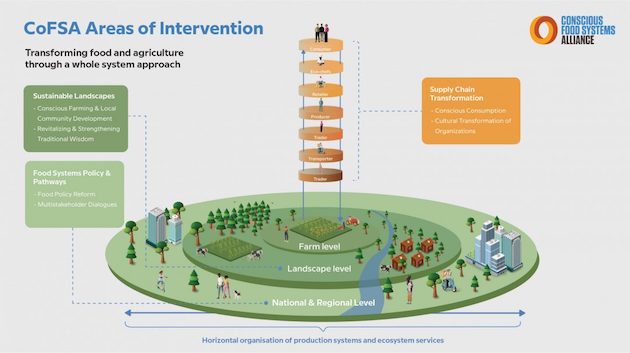
Graphic representation of the Conscious Food Systems Alliance (CoFSA) concept. Credit: UNDP/CoFSA
Similarly, senior lecturer at the Massachusetts Institute of Technology, Otto Scharmer, stresses, “You cannot change a system unless you change the mindsets or the consciousness of the people who are enacting that system.”
At the heart of it, mindful eating and activating transformation from the inside is a recognition that changing behavior is, at times, more about identity, emotions, and connections than data and analyses in the same way elections are campaigned and won against a backdrop of long-held beliefs and opinions.
Question Impact of Consumer Choices
“I think today, whatever you eat, however you dress, you need to ask yourself where they come from, what kind of impact they are giving back to the Mother Earth, cultural, economic, and spiritual environment,” says Tashka Yawanawá, Chief of the Yawanawá that has survived for centuries in the Brazilian rainforests.
Awareness of the people and processes in food and agriculture systems aligns with indigenous wisdom and is at the heart of the approach taken by the Yawanawá people. For instance, Tashka Yawanawá says: “When somebody drinks the acai collected and produced by the Yawanawá, they’re helping protect 200,000 acres of land.”
“They are also supporting the preservation of our language, our culture, our cultural and spiritual manifestation. Making that link gives value to where you source these products from … when you buy acai made by Yawanawá, you have an awareness that you’re supporting conscious food.”
UNDP stresses that farmers’ lives depend on being seen as human beings, not just economic agents, and says it is “Time to build safe, reflective and connecting spaces to engage in the deep conversations we need for right relationships to replace market rules.”
In the world of conscious thinking and mindful eating, everyone has a role.
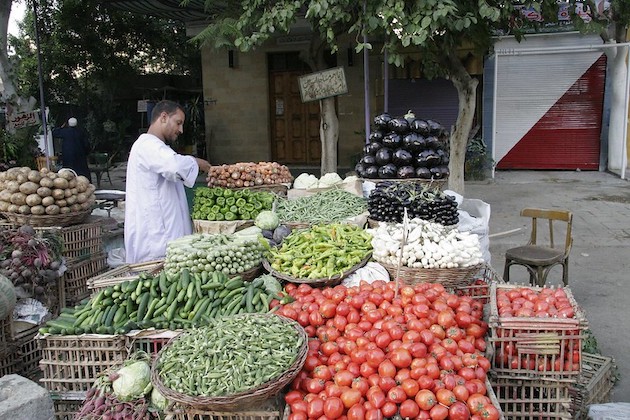
A marker trader at a vegetable stall in the village of El-Maadi near Cairo with heaps of fresh vegetables. CoFSA aims to renew lost ties between producers, the foods they grow, cooks, and consumers. Credit: Gavin Bell
Teresa Corção, founder of Instituto Maniva, a non-profit in Brazil that values traditional food knowledge and renews the ties lost between producers, the foods they grow, cooks, and consumers, says chefs have a critical role in listening more to the people who grow the food.
“I think we all see now more and more we need other ways of both changing ourselves and helping others change the way they think in order for us to have the right mindsets to make choices that are more sustainable,” says Andrew Bovarnick, UNDP’s Food, and Agricultural Commodity Systems, Global Head.
CoFSA is built on bringing consciousness to food systems to support the transition to a holistic, bio-regional approach and creating productive landscapes of regeneration.
That consciousness can help restore the balance in food systems between food production, conservation, and well-being, support the uptake of agroecological practices which regenerate the soil, and strengthen the capacity of food to distribute wealth and well-being in communities.
LONDON, Jun 9 2023 (IPS) – Nothing was more predictable than repression. Merely for holding candles and flowers, people were taken away by Hong Kong’s police.
The occasion was the anniversary of the Tiananmen Square Massacre, 4 June 1989. Hong Kong was until recently home to mass annual vigils where thousands gathered to keep alive the memory of that day. But that’s all gone now in the crackdown that followed large-scale protests for democracy that erupted in 2019.
Hong Kong’s authorities are evidently determined to erase any form of acknowledgement that the massacre ever happened. Memorials and artworks commemorating it have been removed. Books that mention the tragedy have disappeared from libraries. Shops selling the LED candles commonly used to mark the occasion were visited by the authorities in the run up to this year’s anniversary.
The organisation behind the vigil, the Hong Kong Alliance in Support of Patriotic Movements in China, closed itself down in 2021 following a police investigation. Several of its leaders were jailed in March.
Instead of hosting the usual vigil, this year Hong Kong’s Victoria Park was home to a carnival celebrating Chinese rule. People wanting to mark the occasion had to do so in private.
This is only the tip of the iceberg. People are mourning not only the many who died on 4 June 1989 but also the Hong Kong vanishing before their eyes.
Further than ever away from democracy
When Hong Kong was handed over to China by the UK in 1997, China agreed to maintain the country’s distinct political and economic structures for the next 50 years, under the banner of ‘one country, two systems’.
Hong Kong’s Basic Law guaranteed civic rights, including freedoms of association, peaceful assembly and expression. China committed to move towards universal suffrage for the election of Hong Kong’s Chief Executive, the head of government.
But following the democracy protests that burst out in 2019, China has unilaterally torn up that agreement. Three years ago, the government passed the National Security Law, a sweeping piece of legislation that criminalises criticism of the authorities. It’s been used alongside existing laws, such as the law on sedition, to jail leaders of the democracy movement.
China never made good on its promise of universal suffrage. It’s gone in the opposite direction. Current Chief Executive John Lee – who as security chief led the violent crackdown on democracy protests – was chosen last year by a hand-picked 1,500-member Election Committee, which duly endorsed him as the sole candidate.
The Legislative Council, Hong Kong’s parliament, had already been neutered. The number of directly elected seats has been slashed and people are disqualified from standing if they question China’s sovereignty over Hong Kong.
Now the District Councils are in the firing line. When the last elections for the municipal bodies were held, in the thick of democracy protests in November 2019, pro-democracy parties triumphed.
Such a result is now impossible. In 2021, a law was passed requiring all district councillors to swear an oath of allegiance affirming their ‘patriotism’ for China. Most of the pro-democracy candidates elected in 2019 were disqualified or resigned.
Now when new district councillors are chosen in November, only 20 per cent of seats will be directly elected. The authorities will fill the rest with their supporters, all vetted to ensure their ‘patriotism’. Little wonder that the Civic Party, one of Hong Kong’s leading pro-democracy parties, recently announced it was closing down.
A hollowed-out Hong Kong
Hong Kong was once a country where people felt safe to protest. It had a flourishing media and publishing industry. Now journalists are criminalised and key independent media have shut down.
Civil society organisations and trade unions have done the same. The remaining organisations are scattered, practising self-censorship. Protests continue to be heavily restricted: this year a planned International Women’s Day march was cancelled after police threats.
People continue to try to find ways to express dissent, but any small gesture can attract the state’s ire. The death of Queen Elizabeth II gave people an opportunity to use public mourning to express at with the regression since handover. But when a vigil was held during the Queen’s funeral, a harmonica player was arrested for daring to play the tune Glory to Hong Kong, associated with the democracy protests.
Last year five speech therapists were convicted of producing ‘seditious publications’. Their crime was to produce children’s books in which sheep defend their villages from wolves. This was taken to be an allegory of China’s control of Hong Kong.
Everyday repression is making Hong Kong a hollowed-out country, its population falling. Some schools face closure due to falling student numbers. Many have fled, not wanting their children to grow up in a country where education is indoctrination. The curriculum has been reworked to teach students loyalty rather than independent thought. Many teachers are leaving the country or taking early retirement.
With the legal system facing increasing interference and political pressure, lawyers are also among those fleeing.
A key test will be the trial of Jimmy Lai, former media owner and democracy campaigner. He’s already been found guilty on numerous counts. His newspaper, Apple Daily, once Hong Kong’s most widely read pro-democracy paper, shut down in 2021. He faces trial under the National Security Law, which could mean a life sentence.
The judges who will try Lai have been handpicked by John Lee. Meanwhile the authorities have tried to prevent Lai’s defence lawyer, UK barrister Tim Owen, representing him in court. In March they passed a law giving Lee the power to ban foreign lawyers working on national security cases. It isn’t looking promising.
Lai is one of Hong Kong’s 1,508 political prisoners. Even as the population shrinks, the imprisoned population just keeps getting bigger. The candles that commemorate the Tiananmen Square Massacre and the yearning for democracy will continue to flare around the world in exile – but those lights are being extinguished in Hong Kong.
May 25th is World Africa Day! Did you know there are 54 countries that make up the continent of Africa? Yes, each of these countries have their own history and culture that continue to change the world everyday.
Below you will see a brief overview of each country and link to learn more about the entertainment, languages, food and so much!
Cabo Verde
[embedded content]
Cabo Verde aka Cape Verde is pronounced “kaa·bowvehr·day”and is one of the 6 island nations in Western Africa. The name Cabo Verde means “green cape.” This country consists of 10 islands and gained its independence on July 5, 1975 from Portugal.
Comoros is pronounced “kaa·mur·owz” and is one of the 6 island nations of Africa. The name Comoros is derived from the Arab word ‘kamar’ which means the moon. This country gained it’s independence on July 6, 1975 from France. This country is known as the perfume island.
Madagascar is pronounced “ma·duh·ga·skaar” and is one of the 6 island nations of Africa. This country gained it’s independence on June 26, 1960 from France. This country is known for their lemurs which are primitive relatives of monkeys. Continue reading below to learn more about the beautiful African country, Madagascar.
Mauritius is pronounced “mur·i·shuhs” and is one of the 6 island nations of Africa. This country gained its independence on March 12, 1968 from Britain. Mauritius is a island nation known for it’s beaches, lagoons and reefs with over 700 species of indigenous plants. This country is ranked as one of the best beach and honeymoon locations in the world.
The Democratic Republic ofSão Tomé and Príncipe is pronounced “sow toe·may and prin·see·pay” andand is one of the 6 island nations of Africa. This country is made of 2 islands; São Tomé received its name after being discovered by Portuguese explorers on St Thomas Day and Príncipe received its name as a shorter version of the original Portuguese name of “Ilha do Principe” which means Isle of the Prince. São Tomé and Príncipe gained its independence on July 12, 1975 from Portugal. This country is 2nd smallest African country and home to the world’s smallest bird, the ibis. It’s known as “The Africa Galápagos”.
Seychelles is pronounced “say·shelz” and is one of the 6island nations of Africa. This country is made up of 115 islands in the Indian Ocean. Seychelles was named after Jean Moreau de Séchelles, Louis XV‘s Minister of Finance, in 1756 when the French set a Stone of Possession on the islands Mahé. This country gained its independence on June 29, 1976 from the British and is known as “the land of perpetual summer.”
Algeria is pronounced “al·jee·ree·uh”and is one of the 6 countries located in North Africa. Algeria is the largest country in Africa and its name derived from the name of the city of Algiers. This country gained its independence on July 5, 1962.
Egypt is pronounced “ee·juhpt”and is one of the 6 countries located in North Africa. Egypt’s name means ‘Temple Of The Soul Of Ptah’ (Ptah is the creative god associated with Memphis, the ancient city of Egypt). This country gained its independence on February 28, 1922 from Britain. This country is known for having the oldest of all the pyramids, the Great Pyramid of Giza which is known for being one of the giant pyramids in the world.
Libya is pronounced “li·bee·uh”and is one of the 6 countries located in North Africa. The name Libya derived from the Egyptian term Libu. This country gained its independence on December 24, 1951 from Italy. This country is known for containing some of the world’s most well-preserved ruins from ancient civilizations.
Morocco is pronounced “mur·aa·co”and is one of the 6 countries located in North Africa. Morocco gained its independence on April 7, 1956 from France. This country was originally named Marrakesh from the Berber which means “land of God” or “sacred land”. This country is the home of the Sahara desert which is the world’s largest desert. Continue reading below to learn more about the beautiful African country, Morocco.
Sudan aka North Sudan is pronounced “sue·dan”and is one of the 6 countries located in North Africa. Sudan’s name derives from the Arabic bilad al-sudan, which means “land of the blacks.” This country gained its independence on January 1, 1956 from the United Kingdom and Egypt. As of 2012, according to the American Community Survey, there are 48,763 people of Sudan decent living in the United States. Continue reading below to learn more about the beautiful African country, Sudan.
Tunisia is pronounced “too·nee·zhuh”and is one of the 6 countries located in North Africa. The name Tunisia means “to lay down” or “encampment”. This country gained its independence on March 20, 1956 from France and is known for its unique blend of Arab and Berber cultures and influence. According the 2022 census there are 24,735 Tunisian Americans in the United States.
Burundi is pronounced “buh·roon·dee” and is one of the 10 countries located in East Africa. Burundi is named after the King of Burundi, who ruled the region starting in the 16th century This country gained it’s independence on July 1, 1962. This country is known as “The Heart of Africa”.
Djibouti is pronounced “juh·boo·tee” andis one of the 10 countries located in East Africa. Djibouti means “boiling pot” in the Afar language based off its dry and hot weather all year. This country gained its independence on June 27, 1977 from France.
Eritrea is pronounced “air·uh·tree·uh” and is one of the 10 countries located in East Africa. The name Eritrea derives from the Greek term Sinus Erythraeus, which means Red Sea.This country gained its independence on May 24, 1991 from Ethiopia. This country is known for having one of the oldest port cities in Africa.
Ethiopia is pronounced “ee·thee·ow·pee·uh” andand is one of the 10 countries located in East Africa. It is said that the name Ethiopia derived from the Greek Αἰθιοπία Aithiopia which means “of burnt ( αιθ-) visage (ὄψ)”. Ethiopia is the oldest independent country in Africa and one of the oldest in the world. This country is birth place of coffee.
Kenya is pronounced “ken·yuh” and is one of the 10 countries located in East Africa. This country is named after Mount Kenya or ‘Kirinyaga‘, the ‘Mountain of Whiteness’. Kenya gained its independence on December 12, 1963 from Britain. This country is known for being the world’s best safari destination.
Rwanda is pronounced “ruh·waan·duh” and is one of the 10 countries located in East Africa. This country gained it’s independence on July 1, 1962. This country is known as ‘The Land of a Thousand Hills‘. Continue reading below to learn more about the beautiful African country, Rwanda.
Somalia is pronounced “sow·maa·lee·uh” and is one of the 10 countries located in East Africa. The name Somalia comes from the indigenous Somali people. This country gained its independence on July 1, 1960 and is known as the ‘Horn of Africa’. As of 2022, there are about 300,000 people from Somalia that live in the United States according to VOA.
South Sudan is pronounced “sowthsoo·dan” andis one of the 10 countries located in East Africa. It is one of the newest countries of Africa receiving it’s name after it’s independence from Sudan. The name Sudan means derives from the Arabic bilad al-sudan, which means “land of the blacks.” This country gained its independence on July 9, 2011 from Sudan. As of 2007, according to former Ambassador Ezekiel Lol Gatkuoth, there are over 100,000 people of South Sudan decent living in the United States. Continue reading below to learn more about the beautiful African country, South Sudan.
Tanzania is pronounced “tan·zuh·nee·uh” or “tan·zawn·yuh“and is one of the 10 countries located in East Africa. This country’s name is a combination of the first letters of Tanganyika and Zanzibar, which are the two states that merged to form Tanzania in 1964. This country gained its independence on December 9, 1961. As of 2020, there are about 73,000 people of Tanzanian decent that live in the United States.
Uganda is pronounced “you·gaan·duh” andand is one of the 10 countries located in East Africa. Uganda got it’s name from the Buganda kingdom. This country gained its independence on October 9, 1962 from England and is known as ‘The Pearl of Africa’. As of 2014, there are 20,248 Ugandan Americans in the United States.
Angola is pronounced “ang·gow·luh” andand is one of the 9 countries located in Central Africa. This country gained its independence on November 11, 1975 from Portugal.
Cameroon is pronounced “ka·mur·oon” and is one of the 9 countries located in Central Africa. Has the longest ruling leader, Paul Biya. Cameroon was named by Portuguese explorers for the Rio dos Camarões (‘River of Prawns’). This country gained it’s independence on October 1, 1961 from France.
Central African Republic is pronounced “sen·truhla·fruh·kuhnruh·puh·bluhk” and is one of the 9 countries located in Central Africa. This country gained it’s independence on August 13, 1960. This country is known to have the world’s 2nd largest rainforest, The Congo Basin and home to the ethnic group of the PeeWee People. The PeeWee People are known for their short stature typically under 5 feet tall.
Chad is pronounced “ch·ad” andand is one of the 9 countries located in Central Africa. The largest landlocked country in Africa. This country gained its independence on August 11, 1960. This country was named after Lake Chad.
Republic of the Congo aka Congo is pronounced “kaang·gow” andand is one of the 9 countries located in Central Africa. The name Congo is from the Congo River which derived from Kongo, a Bantu kingdom that got its name from its people, the Bakongo (hunters). This country gained its independence in 1960 from France. This country is also known as Middle Congo, Congo-Brazzaville, and Congo.
Democratic Republic of the Congo aka DR Congo is pronounced “kaang·gow” andand is one of the 9 countries located in Central Africa. DR Congo is the 2nd largest country in Africa after Algeria. The name Congo is from the Congo River which derived from Kongo, a Bantu kingdom that got its name from its people, the Bakongo (hunters). This country gained it’s independence on June 30, 1960 from Belgium.
Equatorial Guinea is pronounced “eh·kwuh·taw·ree·uhlgi·nee” and is one of the 9 countries located in Central Africa. Equatorial Guinea was formally the Spanish Guinea. This country is along the Gulf of Guinea in the Guinea region of West Africa and lies right above the Equator, which is what “equatorial” refers to. This country gained its independence on October 12, 1968 from Spain. Equatorial Guinea is the only African country with Spanish as its official language.
Gabon is pronounced “ga·bone” andand is one of the 9 countries located in Central Africa. Gabon was named after the Portuguese word gabão and this country’s official name is the Gabonese Republic. This country gained its independence on August 17, 1960 from France. In 2021 there were only 131 people from Gabon in the United States.
Botswana is pronounced “baat·swaa·nuh” andis one of the 9 countries located in Southern Africa. Botswana means “Land of the Tswana.” This country gained its independence on September 30, 1966. Botswana is known for being the home to the world’s largest concentration of African Elephants plus the world’s second largest gem quality diamond was discovered here in 2021.
Eswatini aka Swaziland is pronounced “eh·swaa·tea·nee” and is one of the 9 countries located in Southern Africa. This country gained its independence on September 6, 1968 from Britain. The Kingdom of Eswatini is one of the three remaining kingdoms in the continent of Africa. This country is landlocked inside the country of South Africa.
Lesotho is pronounced “luh·sue·too” and landlocked in South Africa. Lesotho’s name means “land of the Sotho.” The Sotho people are a Bantu nation native to southern Africa, they are also known as the Basuto or Basotho. Lesotho gained its independence on October 4, 1966 from Great Britain. This country is one of the three remaining Kingdoms on the continent of Africa and is one of 3 enclaved countries in the world (Enclaved countries are those completely surrounded by another country’s land).
Malawi is pronounced “muh·laa·wee” and is one of the 13 countries located in Southern Africa. The name Malawi means “flaming waters” and was taken from a tribal word that described how rays of sun glinted off Lake Nyasa. This country gained its independence on July 6, 1964 from Britain. This country is known for Lake Malawi which is the home to the largest number of fish species of any lake in the world.
Mozambique is pronounced “mow·zam·beek” and is one of the 9 countries located in Southern Africa. This countries original name by the Portuguese was Moçambique after the Island of Mozambique. It derived from Mussa Bin Bique or Mussa Ibn Malik who was an Arab trader who allegedly first visited the island. This country gained its independence on June 25, 1975 from Portugal.
Namibia is pronounced “nuh·mi·bee·uh” andis one of the 9 countries located in Southern Africa. This country gained its independence on March 21, 1990 from South Africa. This country is known for one of the world’s most extensive meteorite showers. The Gibeon Meteorite Shower is the largest known meteorite shower on Earth. Continue reading below to learn more about the beautiful African country, Namibia.
South Africa is pronounced “sowtha·fruh·kuh” and is one of the 9 countries located in Southern Africa. This country got its name because of it’s location at the southern tip of Africa. This country is known for its abundant wildlife. According to the American Community Survey, as of 2021 there are 123,461 people from South Africa that live in the United States.
Zambia is pronounced “zam·bee·uh” and is one of the 9 countries located in Southern Africa. The name Zambia derived from the Zambezi river which means “River of God.” This country gained its independence on October 24, 1964 from Britain.
Zimbabwe is pronounced “zim·baab·way” and is one of the 9 countries located in Southern Africa. The name Zimbabwe means Great House of Stone. This country gained its independence on April 18, 1980 from Great Britain and is known as the “Jewel of Africa”. As of 2017, there are about 30,000 Zimbabweans that live in the United States.
Burkina Faso is pronounced “bur·kee·nuhfaa·sow”and is one of the 16 countries located in West Africa. The name Burkina Faso means “Land of Incorruptible People”. This country gained its independence on August 5, 1960.
Côte d’Ivoire aka Ivory Coast is pronounced “coatduh·vwaar”and is one of the 16 countries located in West Africa. This country gained it’s independence on August 7, 1960 from France. This country is known for being the world’s top exporter of cocoa and raw cashew nuts.
The Gambia is pronounced “gam·bee·uh”and is one of the 16 countries located in West Africa. The Gambia was named after ‘The River Gambia.’ This country gained its independence on February 18, 1965 from Britain. This country is known as a birdwatcher’s paradise with over 500 species of birds who call The Gambia home.
Ghana is pronounced “gaa·nuh”and is one of the 16 countries located in West Africa. The name Ghana means “king.” This country gained its independence on March 6, 1957 from Britain. Ghana was the first sub-Saharan African country to gain independence from colonial rule. As of 2015, there are more than 235,000 people of Ghanian decent that live in the United States.
Guinea is pronounced “gi·nee”and is one of the 16 countries located in West Africa. Guinea means “land of the blacks.” This country gained its independence on October 2, 1958 from France.
Guinea-Bissau is pronounced “gi·nee buh·sau”and is one of the 16 countries located in West Africa. The name Guinea means “the land of the blacks” and “Bissau” is the name of the capital. Guinea-Bissau gained its independence on September 24, 1973 from Portugal. This country is known as being one of the top cashew producers in the world.
Liberia is pronounced “lai·bee·ree·uh“and is one of the 16 countries located in West Africa. This country gained its independence on July 26, 1847 from the American Colonization Society. Liberia has never subjected to colonial rule and is Africa’s oldest republic. Its name means “land of freedom” referring to its settlement in the early 1800s by freeborn and former enslaved Black Americans.
Mali is pronounced “maa·lee”and is one of the 16 countries located in West Africa. Mali is named after the Mali Empire and means “the place where the king lives.” This country gained it’s independence on September 22, 1960 from France.
Mauritania is pronounced “more·uh·tay·nee·uh”and is one of the 16 countries located in West Africa. This country gained its independence on November 28, 1960 from France. Mauritania was the last country in the world to abolish slavery in 1981. The name Mauritania derived from the Latin word Mauretania which means “west.” .
Niger is pronounced “n·eye·jer”and is one of the 16 countries located in West Africa. Niger was named after the Niger River that flows through the country and means ‘flowing water’ in Tuareg n’eghirren. This country gained its independence on August 3, 1960 from France. Niger is home to the largest protected area in Africa.
Nigeria is pronounced “nai·jee·ree·uh”and is one of the 16 countries located in West Africa. The name Nigeria is taken from the Niger River running through the country. This country gained its independence on Oct 1, 1960 from Britain. This country is known as the “Giant of Africa”. As of 2016, according to the American Community Survey there were about 380,785 people of Nigerian decent that live in the United States.
Sengal/Sénégal is pronounced “seh·nuh·gaal” and is one of the 16 countries located in West Africa. Sénégal’s Independence Day is August 20, 1960. As of 2019, there are 18,091 people from Senegal that live in the United States.
Sierra Leone is pronounced “see·eh·ruhlee·own”and is one of the 16 countries located in West Africa. The name Sierra Leone means “lion mountains”. This country gained it’s independence on April 27, 1961 from Britain. According to American Community Survey, there are 34,161 people from Sierra Leone that live in the United States.
Togo is pronounced “toe·go”and is one of the 16 countries located in West Africa. The name Togo is translated from the Ewe language as “behind the river”. This country gained its independence on April 27, 1960 from France and is known as “land where lagoons lie”. According to the 2021 census there are around 16,000 Togolese-born individualsthat live in the United States.
MONTEVIDEO, Uruguay, May 25 2023 (IPS) – As a matter of global justice, the climate crisis has rightfully made its way to the world’s highest court.
On 29 March 2023, the United Nations General Assembly (UNGA) unanimously adopted a resolution asking the International Court of Justice (ICJ) to issue an advisory opinion on the obligations of states on climate change. The initiative was led by the Pacific Island state of Vanuatu, one of several at risk of disappearing under rising sea levels. It was co-sponsored by 132 states and actively supported by networks of grassroots youth groups from the Pacific and around the world.
Civil society’s campaign
In 2019, a group of law students from the University of the South Pacific formed Pacific Islands Students Fighting Climate Change (PISFCC), a regional organisation with national chapters in Fiji, the Solomon Islands, Tonga and Vanuatu. PISFCC advocated with the Pacific Island Forum – the key regional body – to put the call for an ICJ opinion on its agenda. The government of Vanuatu announced it would seek this in September 2021, and Pacific civil society organisations (CSOs) formed an alliance – the Alliance for a Climate Justice Advisory Opinion – that has since grown to include CSOs and many others from around the world, including UN Special Rapporteurs and global experts.
The campaign made heavy use of social media, with people sharing their stories on the impacts of climate change and emphasising the importance of an ICJ opinion to help support calls for climate action, including climate litigation. It organised globally, sharing a toolkit used by activists around the world, and took to the streets locally. In Vanuatu, where it all started, children demonstrated in September 2022 to call attention to the impacts of climate change as their country’s single greatest development threat and express support for the call for an ICJ opinion.
In the run-up to the UNGA session that adopted the historic resolution, thousands of CSOs from around the world supported a letter calling for governments to back the vote.
[embedded content]
The ICJ’s role
The ICJ is made up of 15 judges elected by the UNGA and UN Security Council. It settles legal disputes between states and provides advisory opinions on legal questions referred to it by other parts of the UN system.
The questions posed to the ICJ aim to clarify the obligations of states under international law to protect the climate system and environment from human-induced greenhouse gas emissions. They also ask about the legal responsibilities of states that have caused significant environmental harm towards other states, particularly small islands, and towards current and future generations.
To provide its advisory opinion, the ICJ will have to interpret states’ obligations as outlined in the 1992 UN Framework Convention on Climate Change and the 2015 Paris Agreement as well as the Universal Declaration of Human Rights and a variety of international covenants and treaties. It may consider previous UNGA resolutions on climate change, such as the recent one recognising access to a clean, healthy and sustainable environment as a universal human right, and other resolutions by the UN Human Rights Council and reports by the Office of the UN High Commissioner of Human Rights and its independent human rights experts. It may also take into account decisions by UN treaty bodies and its own jurisprudence on climate and environmental matters.
Next steps
According to its statute, the ICJ can seek written statements from states or international organisations likely to have relevant information on the issue at hand. On 20 April, it communicated its decision to treat the UN and all its member states as ‘likely to be able to furnish information on the questions submitted to the Court’ and gave them six months to submit written statements, after which they will have three months to make written comments on statements made by other states or organisations.
Civil society doesn’t have any right to submit formal statements, so climate activists are urging as many people as possible to advocate towards their governments to make strong submissions that will lead to a progressive ICJ opinion. After submissions close, the ICJ is likely to take several months to deliberate, so its opinion may be expected at some point in 2024, likely towards the end of the year.
Advisory opinions aren’t binding. They don’t impose obligations on states. But they shape the global understanding of states’ obligations under international law and can motivate states to show their compliance with rising standards. An ICJ opinion could positively influence climate negotiations, pushing forward long-delayed initiatives on funding for loss and damage. It could encourage states to make more ambitious pledges to cut greenhouse gas emissions. It might also help raise awareness of the particular risks faced by small island states and provide arguments in favour of stronger climate action, helping climate advocates gain ground within governments.
A progressive advisory opinion could also help support domestic climate litigation: research shows that domestic courts are increasingly inclined to cite ICJ opinions and other sources of international law, including when it comes to determining climate issues.
The risk can’t be ruled out of a disappointing ICJ opinion merely reiterating the content of existing climate treaties without making any progress on states’ obligations. But climate activists find reasons to expect much more: many see this as a unique opportunity, brought about by their own persistent efforts, to advance climate justice and push for action that meets the scale of the crisis.
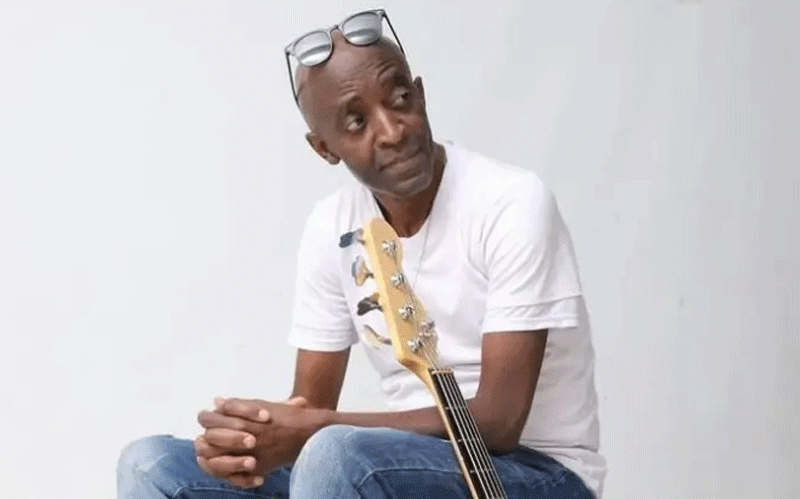
I WAS completely devastated to hear that legendary bass player, music producer, songwriter, sound engineer and Jazz Invitation frontman Kelly Rusike, aged 59, is gone.
He died from diabetic complications on Wednesday.
Kelly played the funkiest and most memorable killer bass riffs Zimbabwe has ever seen.
Where were you in 1980 when Zimbabwe attained independence from British rule?
Perhaps you were not yet born, but I must tell you about the exciting moments of the 1980s.
There was this pop band which came from Zambia with a big bang. They called themselves the Rusike Brothers. Kelly Rusike was one of them.
The Rusike Brothers were a family band made up of five brothers, just like the Jackson Five.
They were very popular in the 1980s and 1990s and were famous for their dazzling dancing styles and also for their weird sense of fashion as evidenced by their donning saggy and baggy gunshot jeans with holes in them.
Sometimes they went out of their way to tear the jeans in keeping with the fashion trends of the day.
They were one of the first Zimbabwean pop groups in the 1990s at most club nights as well as dance halls such as Arcadia Community Hall in Harare.
For two decades, the Rusikes dominated the changing face of post-independence popular music in Zimbabwe when everybody danced to the pulse of rhythm from the Rusikes.
The Rusike family band was formed in 1978 in Lusaka, Zambia.
With the influence of their father who was simply known as A, B, C (short for Abiathar Benjamin Chakuvinga), Tawanda (born on June 9, 1958), Abbie, Phillip, the twins Kelly and Colin (born on March 17, 1964) became southern Africa’s answer to the Jackson Five.
Most of their early music was influenced by the Jacksons and their dancing routines were modelled around top Black American pop acts of the 1970s. They even tried the famous moonwalk.
It is difficult to separate Kelly from the Rusike Brothers, although at a later stage he formed his own band known as Jazz Invitation (more about that later).
The Rusikes had moved from Zimbabwe to Zambia in 1965 during the liberation struggle. Kelly was only one-year-old at the time.
Their father was also a musician in a band called The Boogie Woogie Stars in the 1960s.
He was also a teacher and journalist in the then Rhodesia.
After finding it difficult to continue to write freely in an oppressive State, he chose to move his family to Zambia, a country which had just attained its independence from Britain.
Kelly and Colin, the twins in the family, were only close to two years old at the time of their move to Zambia.
Kelly, in particular, told me about the moments he and Colin started school at the Dominican Convent in Ndola, where he learned to speak Bemba just like any Zambian.
From the albums his father bought, they used to listen to music from Sonny Sondo, who sang in Bemba.
Kelly had mastered the language to the extent that on April 28, 2015, he sang two songs when he shared the stage with the former President of Zambia, the late Kenneth Kaunda, one titled Tiende Pamodzi , and another called Mupende Bwino to which they both received a standing ovation from the audience present.
In 1980 when Zimbabwe attained Independence and after performing in front of large audiences in Zambia, the family packed their bags and returned to the newly independent Zimbabwe, where they were an instant hit with Saturday Night, their debut single.
With an aggressive push from ABC, who was also their manager, they were given several advertising jobs.
These included voice-overs on the Post Office Savings Bank advertisement, Roller Meal videos, Merlins linen, newspaper and video advertisements.
The most popular jingle they ever did was Ngwerewere Sadza, which advertised Ngwerewere mealie-meal, Zimbabwe’s staple food.
Two singles were released between 1981 and 1985 and despite this seemingly lack of progress in the recording business, the Rusikes made a lot of business in top night clubs of Harare and Bulawayo. They also made a great impact at live shows.
In 1982, they were the supporting act for ASWAD, a reggae group from England, when it toured Zimbabwe. In 1988, their debut album Rhythm of My Heart was released.
This included their hit single, a version of Simon Garfunkel’s Cecilia which featured on Radio 3’s (now Power FM) HitPick for 12 weeks.
In 1990, the Rusikes became the main support act for Randy Crawford’s show in Harare.
Work on a second album began at the same time, but a few snags at the studio plus the untimely death of their father, ABC, forced the Rusikes to abandon the work on the album.
Instead, a re-mix version of Saturday Night was released.
In 1992, I was part of the team that went to the United Kingdom with the Rusikes.
Due to poor planning on the part of their Malawian promoter, Jeff Macadam, their trip did not make a big impact overseas.
The Rusikes became Zimbabwe’s top family group which stayed together for a long time as performers.
It was also the Rusikes who started off artistes such as the now-internationally acclaimed Rozalla Miller whose hit single, Everybody is Free to Feel Good wowed the world a few years ago.
In 1995, they recorded an album that included a Paul Simon classic and hit song entitled If You Really Need Me.
Now back to Kelly as I promised:
I negotiated the contract for the jingle Ngwerewere Sadza with management at the Grain Marketing Board.
The band went to shoot a video of the advertisement. The contract was supposed to last one year only, but because the video was so popular in Zimbabwe, they kept playing it beyond the agreed 12 months.
Kelly came to me and suggested that I go with him to stop the advertisement.
We negotiated with the management and they gave us a cheque of an extra $10 000 on condition that the band changed from the black and white video to a colour one, which they would continue to use for another two years.
I suggested that the cheque should be written in Kelly’s name. Kelly went to cash the cheque and did not share the money with his brothers. Tawanda and Abby were upset.
The dispute rose to the extent that Kelly decided to quit the Rusike Brothers band.
It was a difficult decision as he remained part of the family which had a long and rich history together as a band.
By 2000, Colin and Kelly, the twins, had both left the group. Kelly formed his own group, The Jazz Invitation, with female singer Prudence Katomeni-Mbofana, Bernie Bismarck on keyboards, Simba Dembedza on drums, Matthew Ngorima on guitar, Vee Mukarati on saxophone and also Patience Musa on vocals.
Besides being the band leader of Jazz Invitation, Kelly also owned Shed Studios, which recorded songs such as BP Yangu Yakwira (written by Filbert Marova and sung by Prudence Katomeni-Mbofana).
Kelly, like Michael Jackson who decided to split from his brothers after the Victory Tour in 1984, also decided to go solo when he formed Jazz Invitation, which started to play a different genre of music from the Rusikes.
The concept, Jazz Invitation, was originally conceived by drummer and musical entrepreneur from Mutare, Sam Mataure, who initially invited different musicians to play at Jazz festivals around the country.
The novel idea caught on like wildfire as it brought together musicians of varied styles and tastes.
The band’s line-up changed several times over the years with Kelly (bassist/vocals) remaining the only constant.
It started with Victor on the drums and eventually incorporated Mataure, Richie Lopes, Kudzie and Louis Mhlanga.
When the Frontline Kids split up, Kelly took Filbert Marova as Jazz Invitation’s keyboards player.
I asked Kelly whether he no longer belonged to the Rusike Brothers and why he found it necessary to form a band without his brothers.
Here is what he had to say:
“I will always be a part of the Rusike Brothers, because, and most importantly, we are family. I owe a lot of my musical journey to my brothers. Even though Jazz Invitation is my pride and passion, I still do play with them from time to time and will continue to do so when time allows. We might have our differences, but the important thing is that we are family”.
Indeed, in June 2014, a music promoter in Slovakia visited the social media platform, YouTube, and saw the Rusike Brothers doing their thing.
He likened them to the Jackson 5 and was amazed to know that such a group existed in Africa. He was impressed. He called Zimbabwe to find out how he could get in touch with the group.
In no time at all, he had invited the Rusikes to do a two-week tour in Slovakia, where the three brothers Tawanda, Philip and Abbie teamed up with their prodigal brother, Kelly of Jazz Invitation, Jose on drums, Kurt Rusike on vocals and Isheunopa Jera on keyboards to showcase to the rest of the Czech Republic and Slovakia what the promoter saw and liked.
Missing from the original team was Kelly’s twin brother, Colin, who went to the UK during the Rusikes tour of the UK and has not been heard of since. There is speculation that he might also be dead.
Kelly’s skill and passion is legendary. He will be sorely missed.
His passing leaves a big void in Zimbabwe’s music legacy. May his dear soul rest in eternal peace.