Looking for a movie the whole family can enjoy as you recover from the turkey coma this Thanksgiving? While there aren’t as many Thanksgiving movies specifically about Thanksgiving as there are for Christmas, plenty of heartwarming films and TV specials embody the holiday’s spirit of love and gratitude. From old classics like A Charlie Brown Thanksgiving to modern favorites including Free Birds and Jim Henson’s Turkey Hollow, we’re taking a look at some of the best Thanksgiving family movies, and how to stream them on Amazon, Disney+, Netflix and . Here are the best Thanksgiving movies for kids.
Here at Parade.com, we’re all about sharing products we love with our audience. When you make a purchase on an item seen on this page, we may earn a commission, however, all picks are independently chosen unless otherwise mentioned.
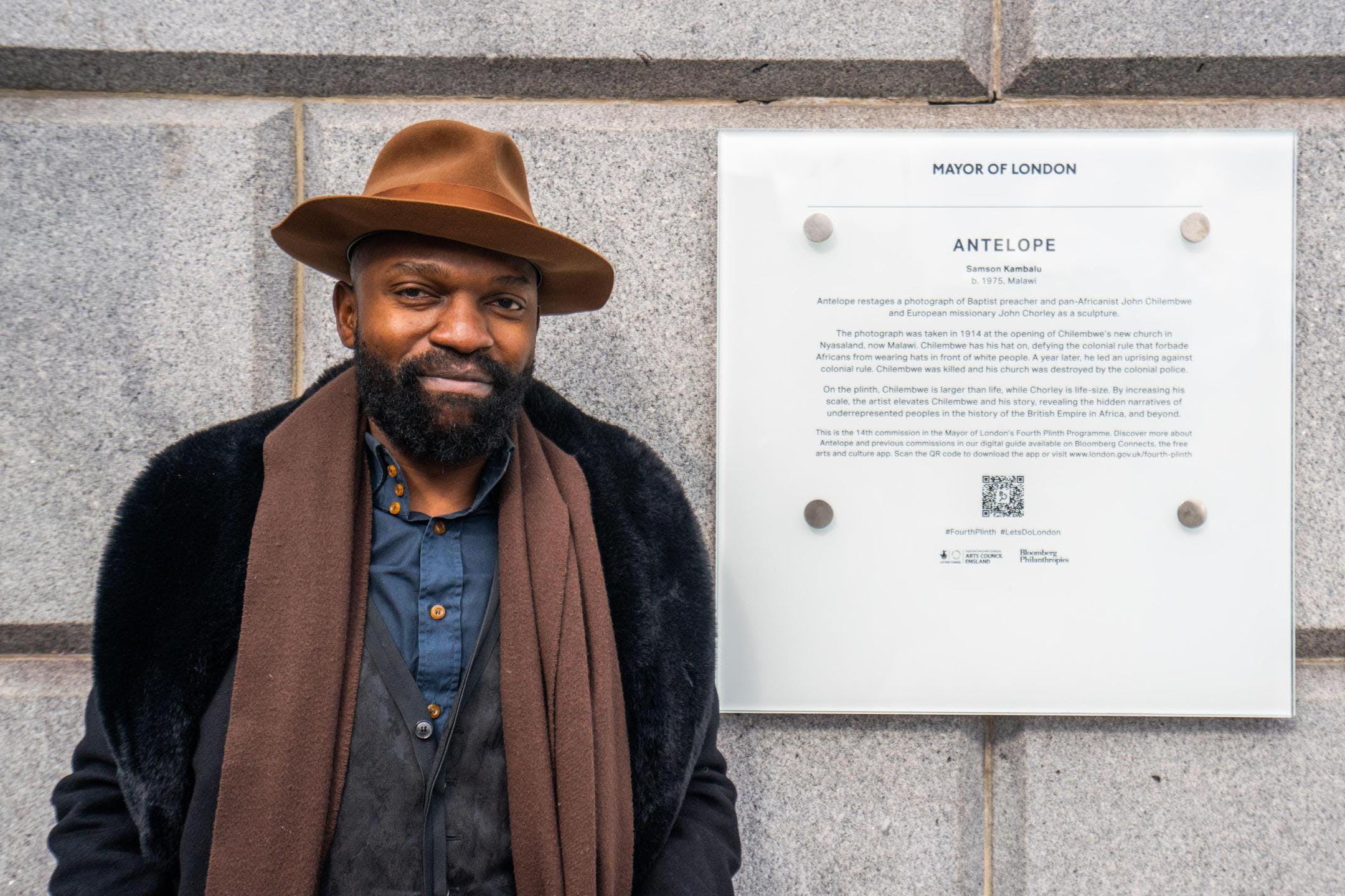
Ivery much like antelope, the new installation on Trafalgar Square’s Fourth Plinth which sets the Malawian anti-colonial rebel John Chilembwe face-to-face with those full-blooded heroes of empire Nelson, Napier and Havelock. It echoes the tradition of conciliatory statue pairings found elsewhere in London, from Cromwell and Charles I to Churchill and Gandhi.
Samson Kambalu
It is the work of Samson Kambalu, a professor of contemporary art at Oxford, and was chosen in the wake of Black Lives Matter and the toppling of Edward Colston as an obvious salvo in the culture wars. However, in a surprising gesture, Kambalu has actually set two statues on the plinth. The second is of a British missionary, John Chorley, who was Chilembwe’s friend, but here stands for more than that. Men like him eradicated slavery from Malawi, brought stability to the region, and then devoted their lives to its improvement. Antelope invites honest discussion of this complex period: there are two sides to every story, Chilembwe and Chorley together remind us.
Unfortunately, media commentary — perhaps taking a lead from the official guide to the statues — peddle the same clichés and misinformation that this is a story of black and white, good and evil, and another reason to disparage Britain’s past.
Reading any of them, you would conclude that Chilembwe’s 1915 rebellion tapped into widespread discontent in colonial Malawi. The evidence does not support that assumption. Chilembwe was an exceptional figure, in many ways ahead of his time. Despite ten years of fomenting unrest, he succeeded only in inciting a few hundred followers to rebel. More indigenous people welcomed — or even participated in — efforts to suppress the rising than ever joined Chilembwe.
Chilembwe was remembered for his courage and defiance, but his methods were not emulated
The British were not only tolerated in Malawi; for a long time they enjoyed considerable loyalty from the local population. Before they established a protectorate in 1891, the region was at the heart of the vast Indian Ocean slave trade. Its peoples had been predated upon for centuries by Arabs, their Islamised African accomplices and, latterly, marauding tribes of the Zulu diaspora, and the Portuguese. With very little force, the British established peace and extirpated slavery, mainly through the efforts of missionaries. The memory of all this was still fresh when Chilembwe launched his rebellion. Indeed his own mother had been a slave, his father her captor.
With peace and stability, there emerged an immense appetite for education, which the missionaries fed at institutions of astonishing ambition. For a period, Malawi had one of the best-educated populations on the continent, and an explicit goal throughout was to equip the country with leaders of its own. These soon emerged, conscientious men and women who worked peacefully towards independence, achieved in 1964. These pioneers have often been overshadowed by Chilembwe’s flash in the pan.
Chilembwe was remembered for his courage and defiance, but his methods were not emulated. Veneration came in the post-colonial period, when sanguinary heroes were in demand. Even then, the praise of Malawi’s notorious and eccentric president Hastings Kamuzu Band was faint: during his 30-year rule, Chilembwe was commemorated with a postage stamp. Only after Banda’s downfall in 1994 did “Chilembwe Day” become a national holiday, as Malawi’s new government looked for ways to supplant the cult of the old regime.
Is Chilembwe then undeserving of our attention? On the contrary, his story is highly instructive, but it is dark and ambiguous, quite unlike the simplistic fable that has recently been propagated.
Chilembwe’s career began as the servant and protégé of Joseph Booth, an itinerant English born-again Christian, who evangelised as a pacifist, anti-colonialist missionary. Booth claimed to have coined the phrase “Africa for the Africans”; he also introduced Chilembwe to a millenarian American church that claimed the Day of Judgement would occur in 1915.
Livingstone was decapitated in front of his wife and children
Booth took Chilembwe to the United States, where they were both feted by Black American churches, and Chilembwe was sponsored to study in a Baptist seminary. When he returned to Malawi two years later as a minister, he clearly felt a sense of alienation. His radical ideas put him at odds with colonial society and also with his own “benighted” people, of whom he often wrote with disdain. As he contemplated marriage, he observed that “the ordinary African woman in her heathen state is ignorant, uninteresting, and unlovable”. (His wife Ida seems to have been of mixed Portuguese and African heritage.)
Chilembwe founded his own mission and, for a time, prospered. Some European missionaries were suspicious and contemptuous of his efforts, but others were supportive. Even his sermonising against white society was tolerated for over a decade until the Germans invaded from Tanzania in 1914. When Chilembwe denounced the British war effort, the government decided to deport him, and it was then that he incited his congregation to rebellion.
His followers attacked the homes of two plantation managers and an arms depot in the nearby town. In total, they killed two local Malawians and three Europeans.
One of the victims was William Jervis Livingstone, a neighbour with whom Chilembwe had long feuded, and whom he identified in his sermons as the Antichrist. Livingstone was decapitated in front of his wife and children, and his head set on a pole, beneath which Chilembwe conducted a church service the next day.
The rebels later attacked a nearby mission, but found it evacuated except for one priest who had stayed behind to tend a sick child. They tried to stab him to death, but he recovered from his wounds. Within a few days, government forces regained control and the rebellion petered out. Chilembwe fled into the forest, where he was shot dead by askaris. A total of 46 of his followers were later executed, and 300 received prison sentences. Life then went on much as before.
In an otherwise detailed discussion, the official guide to the statues mentions none of this. Nor does it note that Chilembwe appealed to the Germans for alliance shortly before his death, but this is important. Ten years previously, the Germans had suppressed an uprising in their vast colony to the north by killing perhaps as many as 300,000 people. “Maji Maji” was a massive rebellion that united disparate tribes against a regime that was universally detested. Chilembwe’s was nothing of the sort.
The rebels in Malawi experienced oppression mainly through a system of labour extortion called thangata. White settlers — many of whom had acquired land dishonestly — offered tenancy to Africans in exchange for labour. Once installed, the terms were twisted, corporal punishment was commonly administered, and workers faced eviction if they did not comply with landowners’ demands. It was so cruel and exploitative that one missionary denounced it as “the yoke of a new slaver”.
Yet it was importantly different from the slavery that preceded it. Europeans took some of the best land for themselves, but only a small proportion of the whole. The country did not become a settler colony like Kenya or Rhodesia.
We cannot be really sorry for what was done unless we know the truth of it
The predominant shortagewas of labour, not of land, and while workers endured appalling hardships, they could exercise some choice. Most labourers on white-owned estates were economic migrants from neighbouring Mozambique, who continued to “vote with their feet” long after Chilembwe’s rebellion. “This place is wonderful” ran the refrain of a popular song from the period, which was still being sung into the 1980s, in memory of conditions under British rule. Nevertheless many were treated badly, and it was from this unsettled and misused population that Chilembwe drew mos 2212 19 Feat Moynihan t of his support.
Kambalu’s statues are intended to “reveal the hidden narratives of under-represented peoples”, insists the plaque appended to the plinth by the Mayor of London’s team. And it is an excellent thing to be reminded of John Chilembwe, and the racism and rapacity which he opposed. But there are other under-represented people in this story, most notably the missionaries. So many sacrificed their lives for the betterment of the region, but few in Britain remember them today.
Charles mackenzie was buriedin a hastily dug grave following a disastrous early attempt at armed confrontation with the slavers. His successors operated mainly through a heroic appeal to better nature.
William Johnson was an Oxford graduate who spent his whole life wandering the shores of Lake Malawi, preaching peace on earth and goodwill to all men, patiently winning the trust of hostile tribes. David Clement Scott championed the indigenous culture, fostered African church leaders, and fought white settlers for the rights of local people. He lost his wife, brother and young son to fever, before dying himself.
Robert Laws, the son of an Aberdeen cabinet maker, insisted on the highest possible education being offered to Africans. His Overtoun Institute produced independent-minded graduates who shaped politics not just in Malawi, but throughout southern Africa.
Not under-represented but misrepresented is John Chorley, a friend to Chilembwe, and by all accounts a decent man. Little else is known about him, but the official guide to the statues claims that he only supported Chilembwe for money. There is no evidence for this, and the story on which it is based actually relates Chorley’s surprise when Chilembwe offered him his congregation’s collection to help with repairs on his church. It is a trivial detail, but the distortion is dishonest and malevolent, and diminishes the authority of Kambalu’s work.
Chilembwe and Chorley are shown wearing hats, which Kambalu (in his otherwise excellent autobiography The Jive Talker) has claimed was illegal for Africans in colonial Malawi. When I challenged him on this via Twitter, he conceded that it was not illegal but “forbidden”: many whites insisted that Africans remove hats in their presence. Within a few hours of our exchange, the BBC’s article on the statues was quietly changed to reflect this.
Hats were certainly a contentious issue, and commissioners at the official enquiry into the rebellion were bewildered that so many witnesses raised the subject. Some of their stories are harrowing: prosperous, educated Malawians who sought to emulate the style of their white counterparts by dressing formally often found themselves laughed at and abused. Some had been threatened with violence and insulted with the worst racist slurs for not removing their hats.
It was pointed out that Africans had recourse to law if they were mistreated in this way. But clearly it did not work in practice. The veteran Scots missionary Alexander Hetherwick pointedly averred that black and white should both raise their hats “because it shows two gentlemen have met and not just one”. But his view was not shared by everyone; nastiness and belittling were widespread.
The situation wasworse than illegality, Kambalu commented in his exchange with me, and he may well be right. But that is all the more reason to report the facts accurately. It seems worth asking which is worse, a society that enshrines racism in petty legislation, such as apartheid South Africa, or one where it lurks insidiously under the radar, as in colonial Malawi?
The real damage of colonialism, Frantz Fanon famously argued, was psychological, and the hats issue is an interesting example of this. The British were respected, but when Malawians tried to emulate them, their efforts were spat back in their faces. That is a story of racism far more compelling than the unnecessary fabrications that have been circulated.
We cannot be really sorry for what was done unless we know the truth of it. But ideologues dislike the truth because it often throws up something inconvenient, like a shared history that might arouse pride as well as shame. So instead we get caricatures, which feed our undeserved sense of superiority over the past. Kambalu’s thoughtful, generous work deserves better than this.
Enjoying The Critic online? It’s even better in print
Try five issues of Britain’s newest magazine for £10
Textile artists have long used their medium as a vehicle for storytelling. Much like ceramic art, it has long trodden the foggy line between art and craft. It comes dressed in many forms: fibre art, tapestry, weaving, embroidery, knitting, and often spreads beyond the borders of art into fashion, design, science and technology.
The last century has seen a renaissance in thread-based art. It was only during the Bauhaus years in the early 20th century that textiles began to enter the vocabulary of modern art, a move indebted to textile masters like Anni Albers, who turned her weaving loom into a vehicle for innovation. Albers saw the potential of textiles beyond a ‘women’s craft’ and has since influenced swathes of creatives including Sheila Hicks, who studied under both Anni and Josef Albers and myriad fashion designers. Other artists who took textiles to new heights in the 20th century include Sonia Delaunay, Judith Scott, and Louise Bourgeois.
In the 1970s, coinciding with the women’s liberation movement, and the rise of feminist art, textiles underwent its own revolution. Fibre art was born: textiles was catapulted beyond the domestic space and unshackled from veiled art world snobbery. The medium took on a life beyond functional craft; it became textiles for textiles’ sake.
From immersive site-specific installations to work that reinterprets the codes of history, contemporary textile art is a conceptual and political tool, fuelled by postmodernist ideals and the experimental spirit of those who command it.
Ibrahim Mahama
(Image credit: Purple Hibiscus 2023-24. Courtesy Ibrahim Mahama, Red Clay Tamale, Barbican Centre, London and White Cube Gallery.)
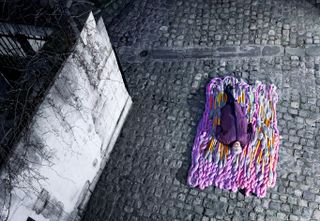
In his home country of Ghana, Ibrahim Mahama‘s contemporary art centre provides the social infrastructure for arts education; in his exhibitions internationally, he cultivates a collaborative focus. Recently, Mahama has unveiled possibly his greatest collaborative work – and certainly his largest scale public commission – in the UK yet. Purple Hibiscus, exhibited over the exterior of the Barbican, named after Chimamanda Ngozi Adichie’s 2003 novel, encompasses around 2000 square metres of billowing panels of pink and purple fabric, woven and sewn in collaboration with hundreds of craftspeople from Tamale in Ghana. On the panels, around 100 batakaris have been embroidered – robes traditionally worn by both ordinary people as well as northern Ghanaian royals – which Mahama has been collecting over the years, without at first knowing for what purpose.
The project is a natural extension of his fascination with materials, building on previous work which saw him reflect on global exchange, communism and colonialism through jute bags. He became interested in their physical journey – originally created in India and Bangladesh, they became useful for the transmission of cocoa and became a commodity themselves, becoming stained and ripped and stitched back together. The transformation began a new life cycle triggered by human intervention.
Writer: Hannah Silver
Rachel Scott
Installation view, ‘Rachel Scott. weaving my world’, Make Hauser & Wirth Somerset, 2022
(Image credit: Courtesy Rachel Scott and Hauser & Wirth Photography: Dave Watts)
Rachel Scott’s approach to textile art is one of pure dedication. In her Pimlico studio, mornings are spent weaving and evenings are devoted to spinning wool for the next day. Since she started weaving in 1976, her wide-ranging practice has comprised everything from handwoven rugs and knitted patchwork-covered chairs to cushions, bags, scarves, dresses and even chess sets in her signature earthen palette and angular patterning. In a new show, ‘weaving my world’ at Make Hauser & Wirth, Somerset, Scott offers a snapshot of her prolific textile output, as well as early paintings dating from the 1960s. In addition to Scott‘s work, the exhibition will feature pieces by her husband, Frank Bowling and her daughters, Marcia and Iona Scott. As Scott says: ‘Making things by hand for me is the only way and has been since I was a child. What else would I do with my time?’
Richard McVetis
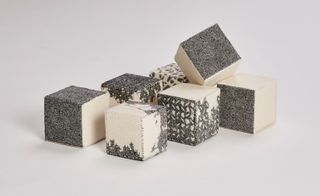
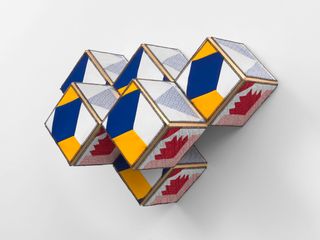
Richard McVetis, Units of Time, 2015, Hand embroidery, cotton on wool.
(Image credit: Courtesy of Huddersfield Art Gallery)
Repetition, ritual, rhythm and obsession, British textile artist Richard McVetis’ work has long been concerned with the subtle differences that arise in habitual, labour intensive making. His ‘Variations of a Stitched Cube’, shortlisted for the 2018 Loewe Craft Prize, examine the systems in which we measure time. These distinctive, often three-dimensional and cubic textile works seek to record human presence, time and decay through meticulous stitching, making a portrait of both the artist and the broader human condition.
Receive our daily digest of inspiration, escapism and design stories from around the world direct to your inbox
(Image credit: Photography: Todd-White Art Photography. Courtesy of Massimo de Carlo Gallery)
American artist Sanford Biggers draws connections between apparently disparate cultural practices and examines current socio-political events while unearthing the contexts that conceived them. Biggers’ works reference African American history, ongoing police brutality against Black Americans, and Buddhist spiritualism. The Harlem-based artist’s work spans film, performance, music and sculpture, and he has frequently turned to textile art to explore new narratives, with his quilt pieces often originating as antique heirlooms, which he acquires and alters. As the artist explained of the works: ‘My embellishment, erasure, defacement, and repair complicates the provenance and gender of these relics of Americana. They are remixed, chopped and screwed but their softness is ultimately their power.’
Faig Ahmed
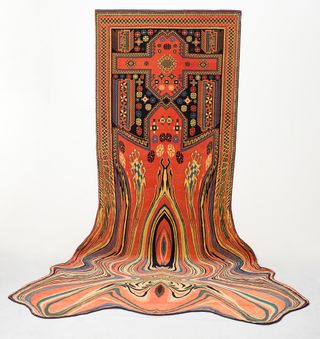
Seyid Yahya Bakuvi (Shirvani), 2021. Faig-Ahmed.
(Image credit: Image Courtesy of Faig Ahmed Studio)
The work of Azerbaijani artist Faig Ahmed is interwoven with complex layers of historical, literary, mystical, and craft. He is best known for surreal, often psychedelic twists to traditional Islamic rugs. His carpets – like optical illusions in textile form – warp, melt, pixelate, unravel, and appear to spill from the wall and onto the floor like intricate pools of liquid. Despite the contemporary interventions, the artist’s textile art is created by skilled practitioners who follow traditional Azerbaijani weaving techniques. Ahmed, who represented Azerbaijan at the Venice Biennale in 2007, presented three new carpet works in his solo show, ‘Pir’ at Sapar Contemporary, New York. Each work is titled after poets and spiritual masters whose works had a lasting influence on the cultural history of Azerbaijan: Shams Tabrizi, Yahya al-Shirvani al-Bakuvi, and Nizami Ganjavi.
(Image credit: Courtesy of Volume Gallery, Chicago and the artist)
Textile artist Tanya Aguiñiga, now based in Los Angeles, spent a childhood in Tijuana, Mexico. During this time, she travelled several hours each day across the border to attend school in San Diego, an experience that would go on to have a profound impact on her work. Her furniture, textiles, wearable pieces, sculptures, and site-specific installations involve a spectrum of natural materials, from beeswax to human hair and stitch together complex ideas of gender and nationality. Beyond her individual practice, Aguiñiga frequently collaborates with artists and activists to create sculptures, installations, performances, and collective community-based art projects. These ‘performance crafting’ happenings explore notions of divided, transnational identities, political and human rights issues at the US-Mexico border, and the power of art to weave communities together.
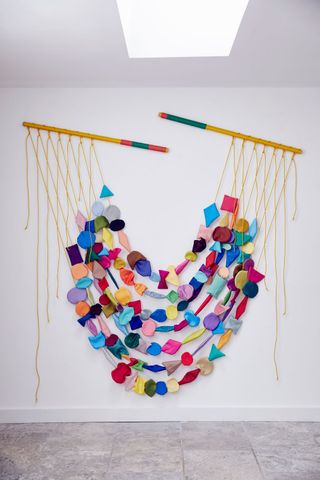
Sheila Hicks
Portrait of Sheila Hicks, 2011.
(Image credit: Giulia Noni)
Sheila Hicks’ name is almost synonymous with fibre art. Over more than half a century, she has removed the seams between art, architecture and design with bold, groundbreaking work, often dominating public spaces. The American artists’ extensive travels across several continents and studies of vernacular textile traditions informed an expansive, yet unmistakable practice that ranges from intricate wall hangings (or ‘minimes’) to cascades of vibrant fabric balls and maximal site-specific installations which envelop viewers and overwhelm senses. Hicks’ work draws on everything from Peruvian and Bolivian archaeological sites to pre-Columbian textiles. She was also deeply inspired by her former Yale tutor Josef Albers’ approach to colour and the pioneering structures in the work of his wife, Anni Albers. American design firm Knoll became one of Hicks’s first major commercial clients; together they created Inca, inspired by Andean patterns. In Hicks’ work, textile art is sculpture, painting, architecture and an independent discipline in its own right.
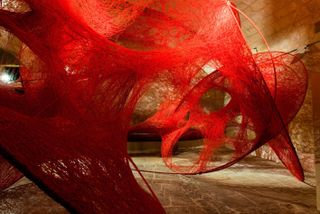
Chiharu Shiota
Chiharu Shiota, Circulation, 2018. Installation: metal rings, red wool Valletta 2018 European Capital of Culture, Valletta, Malta.
(Image credit: Photography: by Daniel Mifsud Copyright VG Bild-Kunst, Bonn, 2021 and the artist)
Chiharu Shiota’s elaborate entanglements are difficult to forget and easy to get lost in. Her labyrinthine installations are vast, surreal waves of blood-red, black or white threads, and appear almost as though humans could weave webs. Within these environments, the Japanese, Berlin-based artist often traps objects of personal significance such as clothes, keys, boats, suitcases, and even herself. Shiota’s work is deeply rooted in performance art; the artist studied under Marina and holds a deep affinity with late Cuban-American artist Ana Mendieta. Her textile installations are both performative and painterly; as the artist told us, ‘The single line of thread is like a line in a painting. With the thread, I am drawing in the air, in an unlimited space. With the material, I can create new spaces. They might be deconstructed after the exhibition, but they will live in the memory of the visitors forever.’
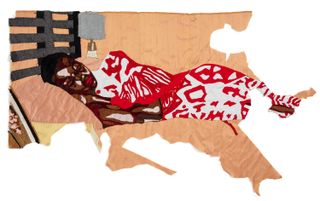
Billie Zangewa
Billie Zangewa, An Angel at My Bedside, 2020, Hand-stitched silk collage.
(Image credit: Courtesy the artist and Lehmann Maupin, New York, Hong Kong, Seoul, and London)
South African–Malawian artist Billie Zangewa is well known for creating moving stories of femininity, domesticity, motherhood and the exploitation of the Black female body rendered in delicate hand-stitched fragments of raw silk. Within these scenes, often figurative, urban and referencing themes of everyday life, Zangewa explores gender stereotypes and socio-political notions around the undervaluing of women’s labour. Through self-portraiture, the artist also critically confronts the male gaze, and conversely, explores what a female gaze on womanhood might look like.
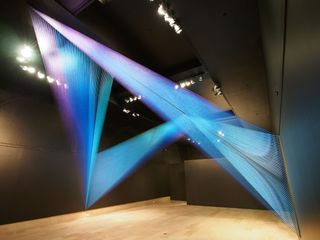
Gabriel Dawe
Gabriel Dawe, Plexus No. 31, 2015, Site-specific installation at the Newark Museum, Newark, NJ
(Image credit: press)
Best known for his dazzling Plexus series, Mexican artist Gabriel Dawe is well versed in pushing textile art to its extremities. His vast installations explore the intersection of fashion, architecture and optical illusion. Dawe takes the core component of clothing, and augments it on an architectural scale, creating hypnotic work which seems to make the tangible appear intangible. The artist uses ordinary polyester embroidery threads to create extraordinary illusions which resemble something close to vivid, laser projections. Beneath his work’s obvious aesthetic appeal, Dawe speaks to something deeper: the human need for shelter and protection, and the hyper-masculine ideals prevalent in Mexican culture. gabrieldawe.com
Anna Ray
Anna Ray, Capture.
(Image credit: Image courtesy of Anna Ray and House on Mars Gallery. Photography: Alun Callender)
Anna Ray has a knack for harnessing the emotive power of her materials. Through large-scale, handmade work and avid experimenting, she blurs the boundaries between the two- and three-dimensional with wall-based pieces that almost assume the quality of sculptural reliefs. Predominantly fibre-based, the artist’s work spans silk, cotton, velvet, wool and paper, often using humble, domestic materials such as a sewing machine, scissors, pliers and a needle. Earlier this year, Ray became the second recipient of the Brookfield Properties Crafts Council Collection Award at Collect 2021. The artist charmed the judges with her ability to exude joy, optimism and energy through her sculptural works. As part of the award, her striking pieces, Capture and Weave (made during and directly after the first UK Covid-19 lockdown) was exhibited at 99 Bishopsgate and Aldgate Tower in summer and autumn 2021.
Diedrick Brackens
Diedrick Brackens, summer somewhere, 2020, woven cotton and acrylic yarn.
(Image credit: Courtesy of the artist, Jack Shainman Gallery, New York and Various Small Fires, Los Angeles)
Texas-born Diedrick Brackens’ rich tapestries interweave personal stories, American history and narratives of African American and queer identities. Fusing techniques and traditions from West African weaving, quilting from the American South and European tapestry-making, he creates intricate, often vibrantly-coloured visions of history, folklore and contemporary American life. Created in hand-dyed cotton, his pieces are charged with a consciousness of the material’s complex and barbaric history. Since receiving the revered Studio Museum in Harlem’s Joyce Alexander Wein Prize in 2018 (an honour previously awarded to the likes of Simone Leigh, Lorna Simpson and Glenn Ligon), the artist has become a pivotal figure in the contemporary fibre art renaissance.
Security Council members vote to adopt a resolution endorsing special measures for protection from sexual exploitation and abuse by UN peacekeepers. Credit: UN Photo/Loey Felipe
UNITED NATIONS, Nov 21 2022 (IPS) – The United States, which recently laid down a set of guidelines to monitor sexual exploitation and abuse (SEA) by US citizens in international organizations, including the United Nations and its agencies worldwide, has implicitly accused the UN of faltering on a high-profile case last month.
The U.S. District Court for the Southern District of New York sentenced Karim Elkorany, an American citizen and a former UN employee, to 15 years in prison for the drugging and sexual assault of one victim and making false statements to cover up another sexual assault.
As part of the federal investigation, Elkorany admitted that he had drugged and/or sexually assaulted 17 additional victims between 2002 and 2016.
Ambassador Chris Lu, U.S. Representative for UN Management and Reform at the US Mission to the United Nations, said that consistent with State Department policies, “we have referred this matter to the Office of Inspector General for review to ensure a culture of accountability”
“We also call on the United Nations to undertake a similar review that includes a comprehensive examination of the handling of any sexual exploitation and abuse or sexual harassment (SEAH) allegations against Mr. Elkorany during his employment with the United Nations”.
The investigation, he said, should examine whether UN officials were aware of Elkorany’s misconduct and failed to take appropriate action, including ensuring the availability and accessibility of assistance to survivors.
In line with the “Principles on Protection from Sexual Exploitation and Abuse and Sexual Harassment (SEAH) for U.S. Government Engagement with International Organizations”, the United States said it is committed to preventing and responding to sexual exploitation and abuse and sexual harassment in the UN system.
“We strongly support the United Nations’ zero tolerance policy and the Secretary-General’s efforts to strengthen its implementation”.
“Protection from SEAH is the responsibility of leadership and managers at every level who have a duty to take action in response to allegations of SEAH and ensure implementation of governance policies and delivery of services in a manner that respects the rights and dignity of all personnel and communities served by our institutions.”
The critical stand against the UN comes amid “16 Days of Activism against Gender-Based Violence”, beginning November 25, and billed as an opportunity to call for prevention and elimination of violence against women and girls.
Meanwhile, UN Secretary General Antonio Guterres has established a Chief Executive Board Task Force to review policies to prevent sexual harassment and develop improved and consistent approaches across the UN, including a review of how the UN defines sexual harassment.
Tsitsi Matekaire, the Global Lead on Equality Now’s End Sexual Exploitation Programme based in the UK, told IPS the publication of these principles by the US government is a welcome development.
They echo similar positive initiatives by countries such as Australia and the UK, which have introduced measures following highly publicized scandals in recent years within the international aid sector.
“It is good to see more organizations introducing and extending safeguarding policies, but words must be underpinned by effective action and we need more evidence about the impact of these commitments. It is no good having protection strategies and procedures in place if they are not being well implemented and abuse continues unchecked”, said Matekaire.
“We don’t know the true scale of the problem, but we do know from frequent revelations that sexual harassment, sexual exploitation and abuse remain a widespread problem inside the United Nations system and within other international development organizations”.
In September 2022, she pointed out, a media investigation disclosed sexual abuse by humanitarian workers at an UN-run camp in South Sudan. It was reported that abuse occurred “on a daily basis” over a number of years and aid officials were aware as early as 2015.
Although the UN did take some action, it faced criticism for failing to introduce effective strategies to end the problem, and an external review cited a lack of victim support, she noted.
“The UN and all international development agencies must enforce a zero-tolerance approach to sexual abuse and harassment directed at, and perpetrated by, staff. This must apply to everyone, regardless of what level their position is”.
“All staff should receive training, with policies and procedures well communicated. Reports of abuse should be taken seriously, investigations carried out swiftly and effectively, and perpetrators held fully to account”.
She also said that aid workers and other whistle-blowers need to be well protected so they are able to disclose allegations of abuses without fear of negative repercussions, including retaliation or sidelining.
And safeguarding and reporting mechanisms need to ensure sexual predators are not able to evade punishment or move to different jobs where they are able to commit further offences.”
And here is the link to the article about the South Sudan story referenced above.
Meanwhile, a Reuters report of November 1 said the World Health Organization (WHO) has suspended a senior manager at its Geneva headquarters after a British doctor publicly alleged she was sexually assaulted at a health conference last month, according to two sources familiar with the matter.
Rosie James, a 26-year-old junior doctor working for England’s National Health Service tweeted last month that the assault occurred at the World Health Summit in Berlin. The event, which took place from Oct. 16-18, was jointly organized by the WHO. James said at the time that she planned to report the incident.
“The alleged perpetrator is on leave and the investigation is on-going,” a WHO spokesperson said in an emailed response to Reuters about James’s statements, without naming him.
The set of “Government Engagement Principles on Protection from Sexual Exploitation Abuse and Sexual Harassment within International Organizations, laid down by the US includes six key components:
Zero Tolerance
The United States will continue to promote the full implementation of policies of zero tolerance for sexual exploitation and abuse and sexual harassment, including zero tolerance for inaction in response to allegations, across the United Nations and other International Organizations.
This includes support for policies that prioritize prevention and mitigation efforts, monitor the effectiveness of such efforts, ensure safe access to confidential SEAH reporting mechanisms and appropriate survivor support, and embed survivor-centered principles across all actions in response to reported allegations – including investigations.
The United States recognizes that an absence of reporting does not mean incidents are not being perpetrated, nor does it indicate that zero tolerance policies are being fully implemented.
A Survivor-centered Approach
The United States expects all allegations or incidents of sexual exploitation and abuse and sexual harassment to be reviewed and addressed, while respecting principles of due process.
In its engagement with the United Nations and other International Organizations, the United States will continue to advocate for the use of survivor-centered principles and standards – an approach that recognizes and empowers survivors as individuals with agency and unique needs, safeguarding their dignity and wellbeing.
Prevention and Risk Mitigation
The United States will work with the United Nations and other International Organizations to institutionalize prevention and mitigation measures that go beyond basic awareness-raising, training, capacity-building or dissemination of codes of conduct, and include a commitment to promote adequate funding, dedicated technical staff, and meaningful risk analysis and mitigation.
The United States will hold the United Nations and other International Organizations to the highest standard, including from the onset of a crisis, conflict or emergency, to mitigate against such risk, especially with highly vulnerable populations.
Accountability and Transparency
The United States expects the leadership of the United Nations and other International Organizations to take meaningful action to support accountability and transparency through, among others, the following: the conduct of timely and survivor-centered investigations; response efforts driven by the needs, experiences, and resiliencies of those most at risk of SEAH; clear reporting and response systems, including to inform Member States of allegations or incidents; and accountability measures, including termination of employment or involvement of law enforcement, as needed.
Organizational Culture Change
The United States will work to advocate for the development by the United Nations and other International Organizations of evidence-based metrics and standards of practice in the implementation of zero tolerance policies, promote holistic approaches, empower women and girls, and reinforce leadership and organizational accountability.
Policies, statements, and training are essential, but alone are insufficient to produce lasting positive change. Systems-level change requires a shift in organizational culture, behavior, and the underlying processes and mechanisms to deliver assistance and promote internal accountability.
Empowerment of Local Communities
The United States will prioritize, in partnership with the leadership of the United Nations and other International Organizations, the critical importance of locally-led efforts, particularly those led by women and girls, who, when meaningfully supported and engaged, can inform the measures that may mitigate risks and promote safer foreign assistance programming.
Egyptian Foreign Minister Sameh Shoukry, chair of COP27, reads the nine-page Sharm El Sheikh Implementation Plan, the document that concluded the climate summit on Sunday Nov. 20, to an exhausted audience after tough and lengthy negotiations that finally reached an agreement to create a fund for loss and damage, a demand of the global South. CREDIT: Kiara Worth/UN
SHARM EL SHEIKh , Nov 20 2022 (IPS) – They were on the brink of shipwreck and did not leave happy, but did feel satisfied that they got the best they could. The countries of the global South achieved something decisive at COP27: the creation of a special fund to address the damage and loss caused by climate change in the most vulnerable nations.
The fund, according to the Sharm El Sheikh Implementation Plan, the official document approved at dawn on Sunday Nov. 20 in this Egyptian city, should enable “rehabilitation, recovery and reconstruction” following extreme weather events in these vulnerable countries.
Decisions on who will provide the money, which countries will benefit and how it will be disbursed were left pending for a special committee to define. But the fund was approved despite the fact that the issue was not even on the official agenda of the summit negotiations, although it was at the center of the public debate before the conference itself.
“We are satisfied that the developed countries have accepted the need to create the Fund. Of course, there is much to discuss for implementation, but it was difficult to ask for more at this COP,” Ulises Lovera, Paraguay’s climate change director, told IPS, weary from a longer-than-expected negotiation, early Sunday morning at the Sharm El Sheikh airport.
“This COP has taken an important step towards justice. I welcome the decision to establish a loss and damage fund and to operationalize it in the coming period,” said U.N. Secretary-General António Guterres. He also described as an achievement that a “red line” was not crossed, that would take the rise in global temperature above the 1.5-degree limit.
More than 35,000 people from nearly 200 countries participated in the 27th Conference of the Parties (COP27) on Climate Change in Sharm El Sheikh, an Egyptian seaside resort on the Red Sea, where the critical dimension of global warming in the different regions of the world was on display, sometimes dramatically.
Practically everything that has to do with the future of the modes of production and life of humanity – starting with energy and food – was discussed at a mega-event that far exceeded the official delegations of the countries and the great leaders present, such as U.S. President Joe Biden and the Brazilian president-elect, Luiz Inácio Lula da Silva.
Hundreds of social organizations, international agencies and private sector stakeholders came here to showcase their work, seek funding, forge alliances, try to influence negotiations, defend their interests or simply be on a stage that seemed to provide a space for all kinds of initiatives and businesses.
At the gigantic Sharm El Sheikh International Convention Center there was also a global fair with non-stop activities from morning to night in the various pavilions, in stands with auditoriums of between 20 and 200 seats, where there was a flurried program of presentations, lectures and debates, not to mention the more or less crowded demonstrations of activists outside the venue.
In addition, government delegates negotiated on the crux of the summit: how to move forward with the implementation of the Paris Agreement, which at COP21 in 2015 set global climate change mitigation and adaptation targets.
United Nations Secretary-General António Guterres (3rd-R) walks hurriedly through the Sharm El Sheikh Convention Center during the last intense hours of the COP27 negotiations, when there were moments when it seemed that there would be no agreement and the climate summit would end in failure. CREDIT: Daniel Gutman/IPS
On the brink of failure
Once again, the nine-page Sharm El Sheikh Implementation Plan did not include in any of its pages a reference to the need to abandon fossil fuels, but only coal.
The document was the result of a negotiation that should have ended on Friday Nov. 18, but dragged on till Sunday, as usually happens at COPs. What was different on this occasion was a very tough discussion and threats of a walkout by some negotiators, including those of the European Union.
But in the end, the goal of limiting the temperature increase to 1.5 degrees Celsius, established in the Paris Agreement, was maintained, although several countries tried to make it more flexible up to 2.0 degrees, which would have been a setback with dramatic effects for the planet and humanity, according to experts and climate activists.
“Rapid, deep and sustained reductions in global greenhouse gas emissions (are) required – lowering global net greenhouse gas emissions by 43 percent by 2030 relative to the 2019 level – to limit global warming to 1.5°C target,” reads the text, although no mention is made of oil and gas, the fossil fuels most responsible for those emissions, in one of the usual COP compromises, since agreements are reached by consensus.
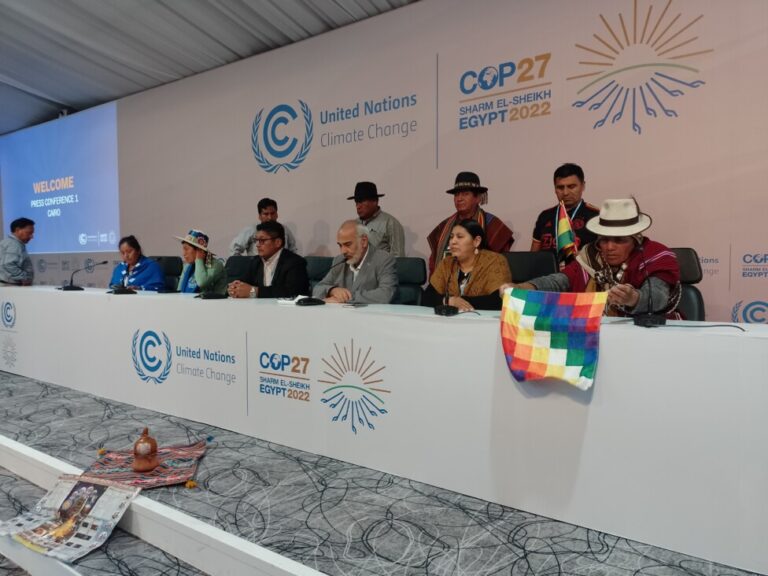
The Bolivian delegation in Sharm El Sheikh, which included officials as well as leaders of indigenous communities from the South American country, take part in a meeting with journalists at COP27 to demand more ambitious action. CREDIT: Daniel Gutman/IPS
The priorities of the South
Developing countries, however, focused throughout the COP on the Loss and Damage Fund and other financing mechanisms to address the impacts of rising temperatures and mitigation actions.
“We need financing because we cannot deal with the environmental crisis alone. That is why we are asking that, in order to solve the problem they have caused, the rich nations take responsibility,” Diego Pacheco, head of the Bolivian delegation to Sharm El Sheikh, told IPS.
Environmental organizations, which showed their power in Egypt with the presence of thousands of activists, also lobbied throughout COP27 for greater commitments, including mitigation actions.
“This conference cannot be considered an implementation conference because there is no implementation without phasing out all fossil fuels,” the main cause of the climate crisis, said Zeina Khalil Hajj of the international environmental organization 350.org.
“Together for implementation” was precisely the slogan of COP27, calling for a shift from commitments to action.
“A text that does not stop fossil fuel expansion, that does not provide progress from the already weak Glasgow Pact (from COP26) makes a mockery of the millions of people living with the impacts of climate change,” said Khalil Hajj, head of global campaigning at 350.org.
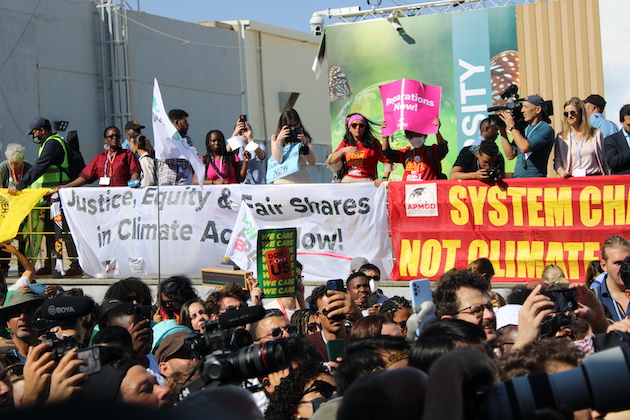
One of the demonstrations by climate activists at COP27 held in Egypt Nov. 6-20, demanding more ambitious climate action by governments, as well as greater justice and equity in tackling the climate crisis. CREDIT: Busani Bafana/IPS
The crises that came together
Humanity – as recognized by the States Parties in the final document – is living through a dramatic time.
It faces a number of overlapping crises: food, energy, geopolitical, financial and economic, combined with more frequent natural disasters due to climate change. And developing nations are hit especially hard.
The demand for financing voiced by countries of the global South thus takes on greater relevance.
Cecilia Nicolini, Argentina’s climate change secretary, told IPS that it is the industrialized countries, because of their greater responsibility for climate change, that should finance developing countries, and lamented that “the problem is that the rules are made by the powerful.”
However, 80 percent of the money now being spent worldwide on climate change action is invested in the developed world, according to the Global Environment Facility (GEF), the world’s largest funder of climate action, which has contributed 121 billion dollars to 163 countries over the past 30 years, according to its own figures.
In this context, the issue of Loss and Damage goes one step further than adaptation to climate change, because it involves reparations for the specific impacts of climate change that have already occurred, such as destruction caused by droughts, floods or forest fires.
“Those who are bearing the burden of climate change are the most vulnerable households and communities. That is why the Loss and Damage Fund must be established without delay, with new funds coming from developed countries,” said Javier Canal Albán, Colombia’s vice minister of environmental land planning.
“It is a moral and climate justice imperative,” added Canal Albán, who spoke at a press conference on behalf of AILAC, a negotiating bloc that brings together several Latin American and Caribbean countries.
But the text of the outcome document itself acknowledges that there is a widening gap between what developing countries need and what they actually receive.
The financing needs of these countries for climate action until 2030 were estimated at 5.6 trillion dollars, but developed countries – as the document recognized – have not even fulfilled their commitment to provide 100 billion dollars per year, committed since 2009, at COP15 in Copenhagen, and ratified in 2015, at COP21 which adopted the Paris Agreement.
It was the absence of any reference to the need to accelerate the move away from oil and natural gas that frustrated several of the leaders at the COP. “We believe that if we don’t phase out fossil fuels there will be no Fund that can pay for the loss and damage caused by climate change,” Susana Muhamad, Colombia’s environment minister, who was at the two-week conference in Sharm El Sheikh held Nov. 6-20, told IPS.
“We have to put the victims first in order to make an orderly and just transition,” she said, expressing the sentiments of the governments and societies of the South at COP27.
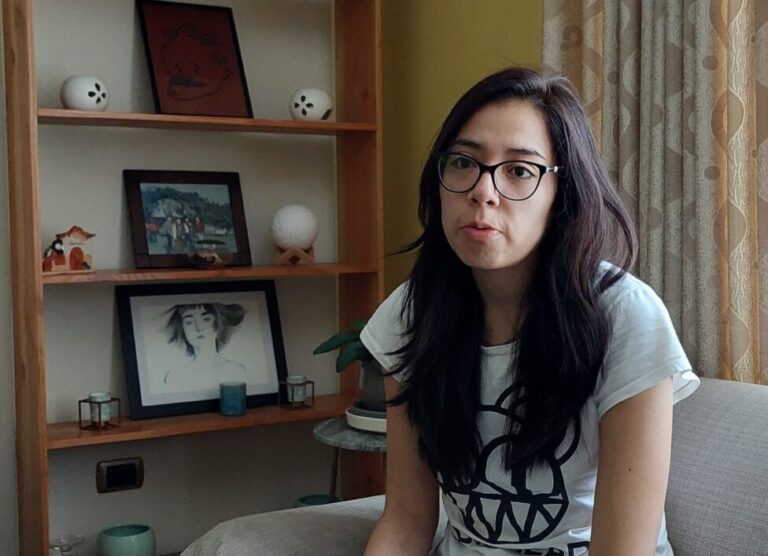
Yomira Cuadros faced motherhood at an early age, as well as the obstacles of a sexist society like Peru’s, regarding her reproductive decisions. In the apartment where she lives with her family in Lima, she expresses faith in the future, now that she has finally started attending university, after having two children as a result of unplanned pregnancies. CREDIT: Mariela Jara/IPS
LIMA, Nov 18 2022 (IPS) – No woman in Peru should have to die, have her physical or mental health affected, be treated as a criminal or have an unwanted pregnancy because she does not have access to abortion, said Dr. Rocío Gutiérrez, an obstetrician who is the deputy director of the Manuela Ramos Movement, a non-governmental feminist center that works for gender rights in this South American country.
In this Andean nation of 33 million people, abortion is illegal even in cases of rape or fetal malformation. It is only legal for two therapeutic reasons: to save the life of the pregnant woman or to prevent a serious and permanent health problem.
Peru thus goes against the current of the advances achieved by the “green wave”. Green is the color that symbolizes the changes that the women’s rights movement has achieved in the legislation of neighboring countries such as Uruguay, Colombia, Argentina and some states in Mexico, where early abortion has been decriminalized. These countries have joined the ranks of Cuba, where it has been legal for decades.
“I didn’t tell my parents because they are very Catholic and would have forced me to go through with the pregnancy, they always instilled in me that abortion was a bad thing. But I started to think about how pregnancy would change my life and I didn’t feel capable of raising a child at that moment.” — Fatima Guevara
But Latin America remains one of the most punitive regions in terms of abortion, with several countries that do not recognize women’s right to make decisions about their pregnancies under any circumstances. In El Salvador, Honduras, Nicaragua, the Dominican Republic and Haiti it is illegal under all circumstances, and in some cases draconian penalties are handed down.
In the case of Costa Rica, Guatemala, Peru and Venezuela, meanwhile, abortion is allowed under very few conditions, while there are more circumstances under which it is legal in Bolivia, Brazil, Chile and Ecuador.
“In Peru an estimated 50,000 women a year are treated for abortion-related complications in public health facilities,” Dr. Gutiérrez told IPS. “This is not the total number of abortions in the country, but rather the number of women who reach public health services due to emergencies or complications.”
The obstetrician spoke to IPS from Buenos Aires, where she participated in the XV Regional Conference on Women, held Nov. 7-11 in the Argentine capital.
Gutiérrez explained that the cases attended are just the tip of the iceberg, because for every abortion complicated by hemorrhage or infection treated at a health center, at least seven have been performed that did not present difficulties.
Multiplying by seven the 50,000 cases treated due to complications provides the shocking figure of 350,000 unsafe clandestine abortions performed annually in Peru.
The doctor regretted the lack of official statistics about a phenomenon that affects the lives and rights of women “irreversibly, with damage to health, and death.”
Gutiérrez said that another of the major impacts is the criminalization of women who undergo abortions, due to mistreatment by health personnel who not only judge and blame them, but also report them to the police.
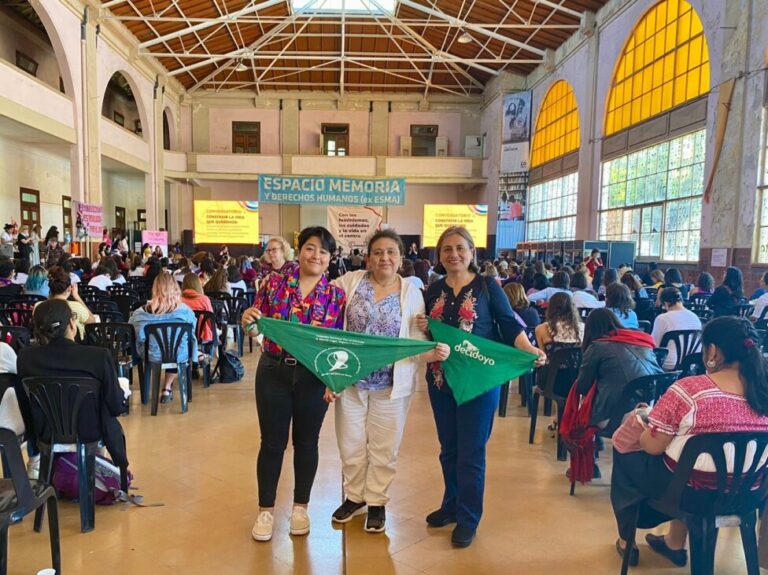
Obstetrician Rocío Gutiérrez (C), deputy director of the feminist Manuela Ramos Movement, stands with two fellow activists holding green scarves – representing the struggle for reproductive rights – during the XV Regional Conference on Women held this month in the city of Buenos Aires. CREDIT: Courtesy of Rocío Gutiérrez
Under article 30 of Peru’s General Health Law, No. 26842, a physician who attends a case of presumed illegal abortion is required to file a police report.
Gutiérrez also referred to the fact that unwanted pregnancies have numerous consequences for the lives of women, especially girls and adolescents, in a sexist country like Peru, where women often do not have the right to make decisions on their sexuality and reproductive health.
Healing the wounds of unwanted motherhood
By the age of 19, Yomira Cuadros was already the mother of two children. She did not plan either of the pregnancies and only went ahead with them because of pressure from her partner.
In 2020, according to official data, 8.3 percent of adolescents between the ages of 15 and 19 were already mothers or had become pregnant in Peru.
Cuadros, whose parents are both physicians and who lives in a middle-class family, said she never imagined that her life would turn out so differently than what she had planned.
“The first time was because I didn’t know about contraceptives, I was 17 years old. The second time the birth control method failed and I thought about getting an abortion, but I couldn’t do it,” Cuadros told IPS.
At the time, she was in a relationship with an older boyfriend on whom she felt very emotionally dependent. “I had made a decision (to terminate the pregnancy), but he didn’t want to, he told me not to, the pressure was like blackmail and out of fear I went ahead with the pregnancy,” she said.
Making that decision under coercion hurt her mental health. Today, at the age of 26, she reflects on the importance of women being guaranteed the conditions to freely decide whether they want to be mothers or not.
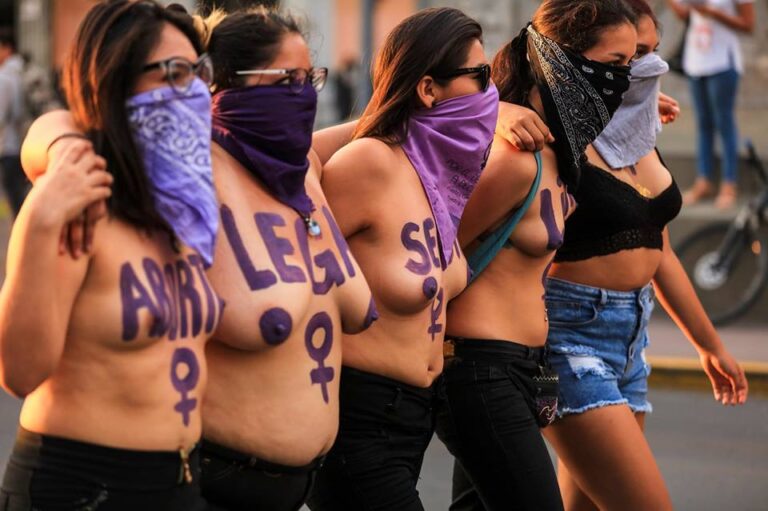
Peruvian activists go topless to demand the right to legal abortion, during a demonstration in the streets of the capital on Mar. 8, 2018. CREDIT: Mariela Jara/IPS
In her case, although she had the support of her mother to get a safe abortion, the power of her then-partner over her was stronger.
“Becoming a mother when you haven’t planned to is a shock, you feel so alone, it is very difficult. I didn’t feel that motherhood was something beautiful and I didn’t want to experience the same thing with my second pregnancy, so I considered terminating it,” she said.
Finding herself in that unwanted situation, she fell into a deep depression and was on medication, and is still in therapy today.
“I went from being a teenager to an adult with responsibilities that I never imagined. It’s as if I have never really gone through the proper mourning process because of everything I had to take on, and I know that it will continue to affect me because I will never stop being a mother,” she said.
She clarified that “it’s not that I don’t want to be a mother or that I hate my children,” and added that “as I continue to learn to cope, I will get better, it’s just that it wasn’t the right time.”
She and her two children, ages nine and seven, live with her parents and brother in an apartment in the municipality of Pueblo Libre, in the Peruvian capital. She has enrolled at university to study psychology and accepts the fact that she will only see her dreams come true little by little.
“Things are not how I thought they would be, but it’s okay,” she remarked with a newfound confidence that she is proud of.
Gutiérrez said more than 60 percent of women in Peru have an unplanned pregnancy at some point in their lives, and argued that the government’s family planning policies fall far short.
The National Institute of Statistics and Informatics reported that the total fertility rate in Peru in 2021 would have been 1.3 children on average if all unwanted births had been prevented, compared to the actual rate of 2.0 children – almost 54 percent higher than the desired fertility rate.
“There are a set of factors that lead to unwanted pregnancies, such as the lack of comprehensive sex education in schools, and the lack of birth control methods and timely family planning for women in all their diversity, which worsened during the pandemic. And of course, the correlate is access to legal and safe abortion,” said Gutiérrez.
She lamented that little or no progress has been made in Peru in relation to the exercise of sexual and reproductive rights, including access to safe and free legal abortion, despite the struggle of feminist organizations and movements in the country that have been demanding decriminalization in cases of rape, artificial insemination without consent, non-consensual egg transfer, or malformations incompatible with life.
University student Fátima Guevara decided to terminate an unwanted pregnancy when she was 19 years old. Four years later, she is sure that it was the right decision, in terms of her plans for her life. The young woman told her story at a friend’s home, where she was able to talk about it openly, in Lima, Peru. CREDIT: Mariela Jara/IPS
The obscurity of illegal abortion
The obscurity surrounding abortion led Fátima Guevara, when she faced an unwanted pregnancy at the age of 19, to decide to use Misoprostol, a safe medication that is included in the methods accepted by the World Health Organization for the termination of pregnancies.
“I didn’t tell my parents because they are very Catholic and would have forced me to go through with the pregnancy, they always instilled in me that abortion was a bad thing. But I started to think about how pregnancy would change my life and I didn’t feel capable of raising a child at that moment,” she told IPS in a meeting at a friend’s home in Lima.
She said that she and her partner lacked adequate information and obtained the medication through a third party, but that she used it incorrectly. She turned to her brother who took her to have an ultrasound first. “Hearing the fetal heartbeat shook me, it made me feel guilty, but I followed through with my decision,” she added.
After receiving proper instructions, she was able to complete the abortion. And today, at the age of 23, about to finish her psychology degree, she has no doubt that it was the right thing to do.