New Constitution Would Declare Chile a Plurinational State

Civil Society, Democracy, Editors’ Choice, Featured, Headlines, Human Rights, Indigenous Rights, Latin America & the Caribbean, Regional Categories, TerraViva United Nations

Indigenous Rights

A Mar. 3 plenary session of the constitutional convention of Chile, where in long working days its members are drafting a new constitution, which must be completed by Jul. 4 at the latest. On Feb. 17, they approved by a large majority the new definition of Chile as a regional, plurinational and pluricultural State. CREDIT: Orlando Milesi/IPS

A Mar. 3 plenary session of the constitutional convention of Chile, where in long working days its members are drafting a new constitution, which must be completed by Jul. 4 at the latest. On Feb. 17, they approved by a large majority the new definition of Chile as a regional, plurinational and pluricultural State. CREDIT: Orlando Milesi/IPS

SANTIAGO, Mar 9 2022 (IPS) – Chile could change the course of its history and become a diverse and multicolored country this year with a “plurinational and intercultural state” that recognizes and promotes the development of the native peoples that inhabited this territory before the Spanish conquest.


By 112 votes in favor and 32 against, the constitutional convention approved this proposal which now forms part of the draft constitution that Chilean voters will approve or reject in an August or September referendum.

“The current Chilean constitution and the previous ones make no mention of the words Indian, native…indigenous peoples, or original peoples. Nothing. They are erased from the constitution because they were made invisible socially, culturally, economically, politically and militarily.” — Domingo Namuncura

The constitutional convention is debating and drafting a new constitution which is the result of the work of 155 constituents – half men and half women, with 17 indigenous members – elected by popular vote in October 2020 who began the task on Jul. 4, 2021. They have until Jul. 4 to finish their work.

In the country’s last census, in 2017, 2.18 million Chileans self-identified as indigenous people.

In other words, 12.8 percent of the 17.07 million inhabitants of Chile at that time (today the population stands at 19.4 million) were recognized as belonging to one of the indigenous peoples distributed throughout this long narrow South American country: the Mapuche (the largest native group), followed by the Aymara, Rapa Nui, Diaguita, Atacameño, Quechua, Colla, Kawesqar and Yagan.

Domingo Namuncura, a Mapuche social worker and professor at the Catholic University of Valparaíso, told IPS that “we are facing a very important historic event. The declaration of a plurinational State has always been a dream of the indigenous peoples of Chile.”

The creation of the constitutional convention was the response to months of protests and social unrest in 2019, the repression of which tainted the second term of right-wing President Sebastián Piñera, a businessman who had already governed the country between 2010 and 2014, and who will be succeeded as of Mar. 11 by the leftist Gabriel Boric, winner of the December elections.

Chile has been governed since 1980 by the constitution imposed by the dictatorship of General Augusto Pinochet (1973-1990), who used legislation to put in place a neoliberal and authoritarian economic and political regime, which democratic governments have only been able to partially dismantle since 1990.

The result is a country with a dynamic economy based on exports of mining and agricultural products, but with one of the most unequal societies in the world, which was at the basis of the 2019 demonstrations, as was the failure to fulfill promises of change, such as a new constitution, the reform of the educational system or improvements in social rights.
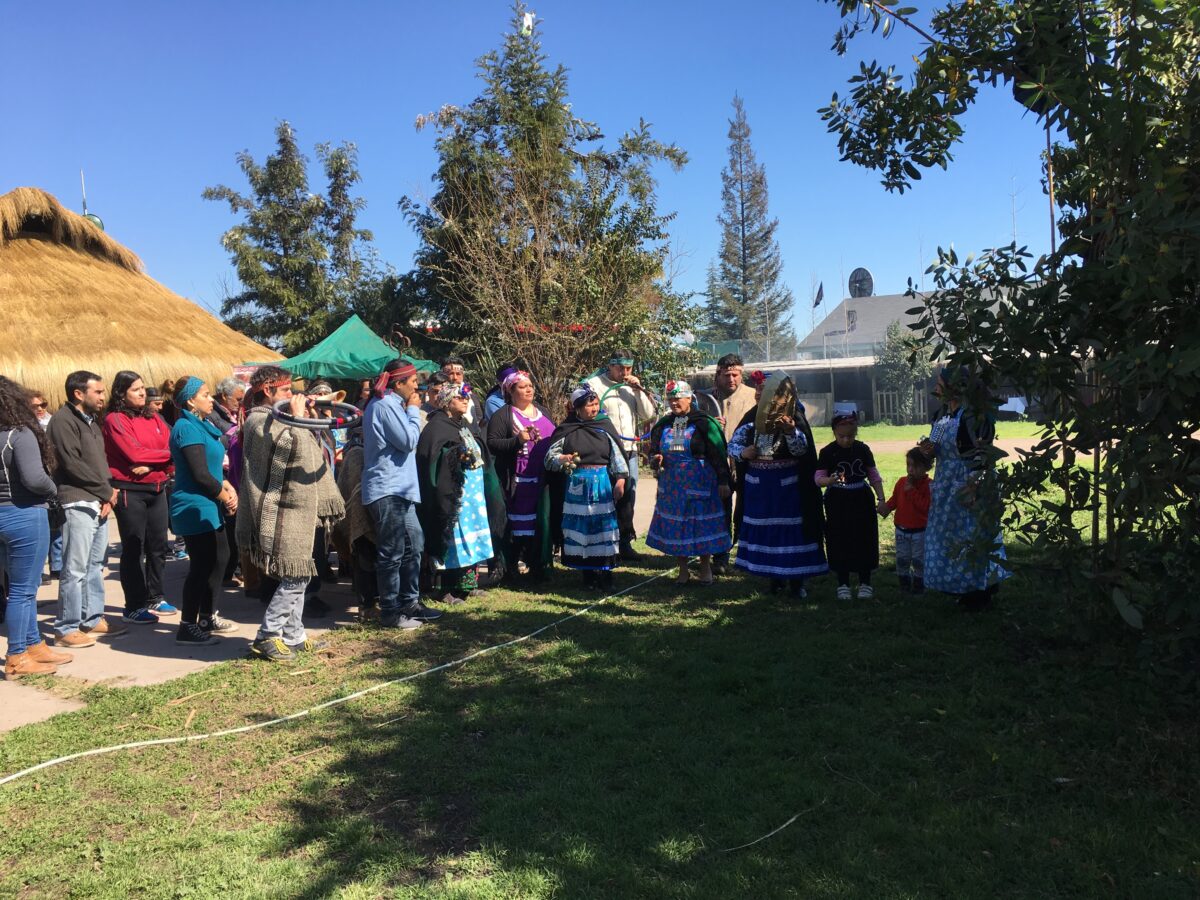
Mapuche Indians living in the metropolitan region. Data from 2021 indicate that the Mapuche, Chile's largest indigenous people, number 1.8 million, followed by the Aymara (156,000) and the Diaguita (88,000). CREDIT: Orlando Milesi/IPS

Mapuche Indians living in the metropolitan region. Data from 2021 indicate that the Mapuche, Chile’s largest indigenous people, number 1.8 million, followed by the Aymara (156,000) and the Diaguita (88,000). CREDIT: Orlando Milesi/IPS

Arguments of the constituents

No previous Chilean constitution has mentioned indigenous people and their rights, by contrast with other Latin American constitutions that have emerged since 1980. And the only precedent of declaring a “plurinational state” is that of neighboring Bolivia, which did so in its 2009 constitution.

“The current Chilean constitution and the previous ones make no mention of the words Indian, native…indigenous peoples, or original peoples. Nothing. They are erased from the constitution because they were made invisible socially, culturally, economically, politically and militarily,” said Namuncura.

Adolfo Millabur, Chile’s first Mapuche mayor, elected in 1996 in the southern town of Tirúa, resigned from his post to become a member of the constitutional convention, to occupy one of the seats reserved for Mapuche representatives. He maintained that “if Chile is transformed and defines itself as a plurinational state, what changes is its democratic vocation.”

“By acknowledging the peoples that lived here prior to the creation of the Chilean State, a collective actor is given value. Different forms of relations should begin to be established, especially in the area of political definition and participation,” he told IPS.

Lawyer Tiare Aguilera, a member of the constitutional convention from the Rapa Nui people, believes that “the most important thing is to reach the referendum with a citizenry that is informed about plurinationality and its implications.”

In her view, “through plurinationality, our country will finally be able to advance towards reparations for the native peoples of Chile.

“There is a great deal of ignorance among the public. If we correctly inform and educate the public about their meanings and implications, we believe that the changes in the definition of the State will be understood,” she told IPS.

The facade of the old National Congress, where since July 2021 the members of the constitutional convention have been debating the new form of State that will govern Chile starting this year, if the draft constition is approved in a referendum. CREDIT: Orlando Milesi/IPS

The facade of the old National Congress, where since July 2021 the members of the constitutional convention have been debating the new form of State that will govern Chile starting this year, if the draft constition is approved in a referendum. CREDIT: Orlando Milesi/IPS

Jaime Bassa, a member of the constitutional convention who was its vice-president until January, said “the normative proposals approved in commissions and in the plenary on plurinationality speak to us of a sense of reality, of accepting ourselves in legitimate diversity and coexistence, of recognizing our historical roots, of valuing ourselves based on our cultural identity.

“In comparative experiences, plurinationalism and multilingualism have brought about interesting cultural changes that have led to innovative and sustainable development alternatives,” he told IPS.

In his opinion, “the growth and development model we are moving towards within the framework of the constituent process that is underway should promote ethics and inter-territorial solidarity, care for the environment and sustainability, as foundations for political equality, and to ensure collaborative, resilient contexts of respect for rights that allow us to broaden and deepen our democracy.”

Bassa said the constitutional convention “is working on a proposal for a plurinational and decentralized legislative power in which there is equality, which would give rise to representation for the different territories, that would participate in the process of law-making, effectively representing the peoples and nations that coexist within the State.”

The regulation approved on Feb. 17 states that “Chile is a regional, plurinational and intercultural State made up of autonomous territorial entities, within a framework of equity and solidarity among all of them, preserving the unity and integrity of the State.”

According to Namuncura, who was the first Mapuche to serve as a Chilean ambassador, to Guatemala, “Chile has always been plurinational because it is constituted on the basis of different native populations that were already in this territory and that joined as native peoples or nations, by force or otherwise, in the construction of the national State.

“From the Aztec, Mayan, Inca and Mapuche cultures, before the arrival of the Spaniards, America was already a plurinational continent populated by more than 1,200 indigenous nationalities that were formed many centuries ago,” he pointed out.

The convention is also discussing other norms for indigenous peoples, such as their own courts of justice in coordination with the national justice system, a parliament with indigenous representation and a regime governing natural resources located in their territories.
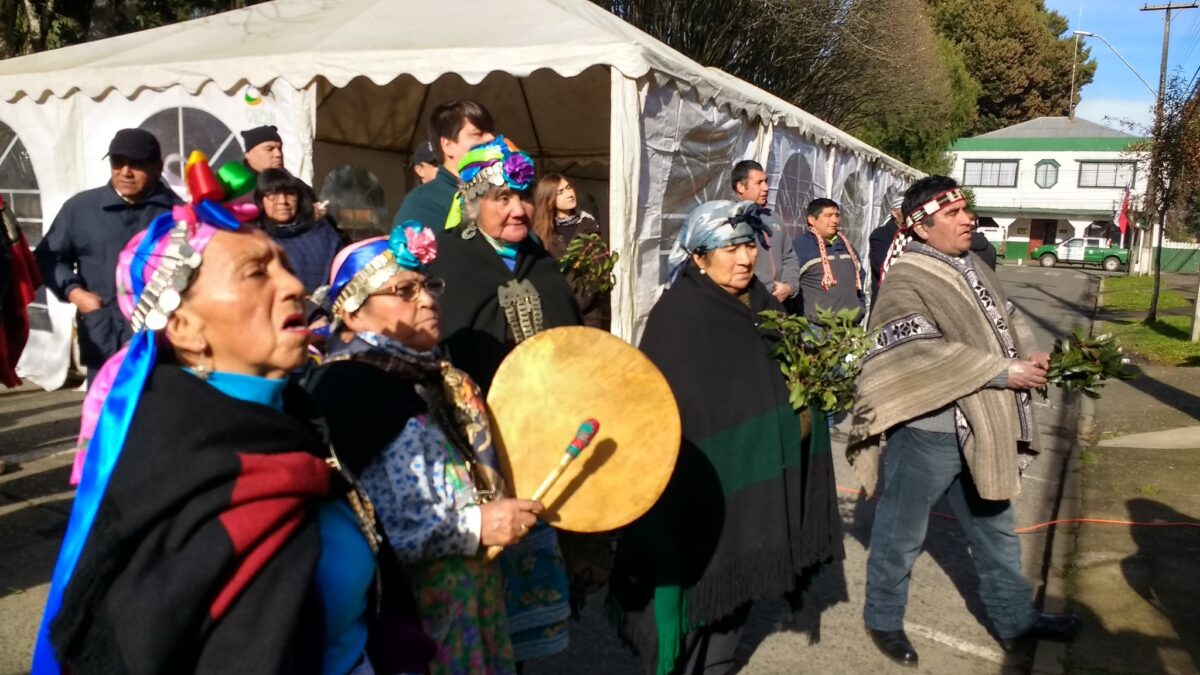
Representatives of the Mapuche, Lonko and Machi peoples take part in the raising of the flag in the Plaza de Armas in Vilcún, 700 km south of Santiago, in one of the many events held in Chile every Jun. 24, declared a national holiday for We Tripantu (new sunrise), the Mapuche New Year. CREDIT: Mirna Concha/IPS

Representatives of the Mapuche, Lonko and Machi peoples take part in the raising of the flag in the Plaza de Armas in Vilcún, 700 km south of Santiago, in one of the many events held in Chile every Jun. 24, declared a national holiday for We Tripantu (new sunrise), the Mapuche New Year. CREDIT: Mirna Concha/IPS

Business leaders unhappy

This process is of great concern to the business leaders grouped in the Confederation of Production and Commerce (CPC), whose board, headed by Juan Sutil, met several times with Mapuche representative Elisa Loncón, who was president of the convention until January, and her successor, María Elisa Quinteros.

The CPC was behind numerous Popular Standards Initiatives seeking to include its positions in the debate. It invited everyone to support these initiatives “that defend the values of freedom of thought and free enterprise,” among others, in order to achieve “a robust democracy” with public-private collaboration.

The CPC gathered 507,852 signatures and was able to submit 16 initiatives with its views on the constituent process. Three of them have already been rejected: “Free enterprise”, “Economic model, freedom of entrepreneurship and promotion of small and medium-sized enterprises”, and “Water for all”. One more is still being processed: “Towards sustainable mining for Chile”.

Business leaders have raised the tone of their opposition to the convention, which they accuse of distancing itself from the real Chile and from the work for a constitution for all.

“I am concerned that the constitution that is being drafted is not generating the proper balances and will not be a constitution that takes into account the sensibilities of all Chileans,” said Sutil.

Those sensitivities, he said, are especially from “a minority sector, which could be the center right, the right and even people from the center within the convention itself who are not being taken into consideration at all,” he told a local radio station.

“Chile is much more than what the constitutional convention reflects. The correlation of forces is very different in the real Chile than what is happening in the convention,” he argued.

According to Sutil, criticism of the convention is widespread and “this is bad not only because it jeopardizes the process, but also because it jeopardizes the future of the country from an institutional point of view, and from the point of view of its development and growth.”

Forestry companies own approximately 1.9 million hectares in an enormous area in the south, across three of the country’s regions. A significant part of these hectares are the ancestral lands of indigenous peoples.
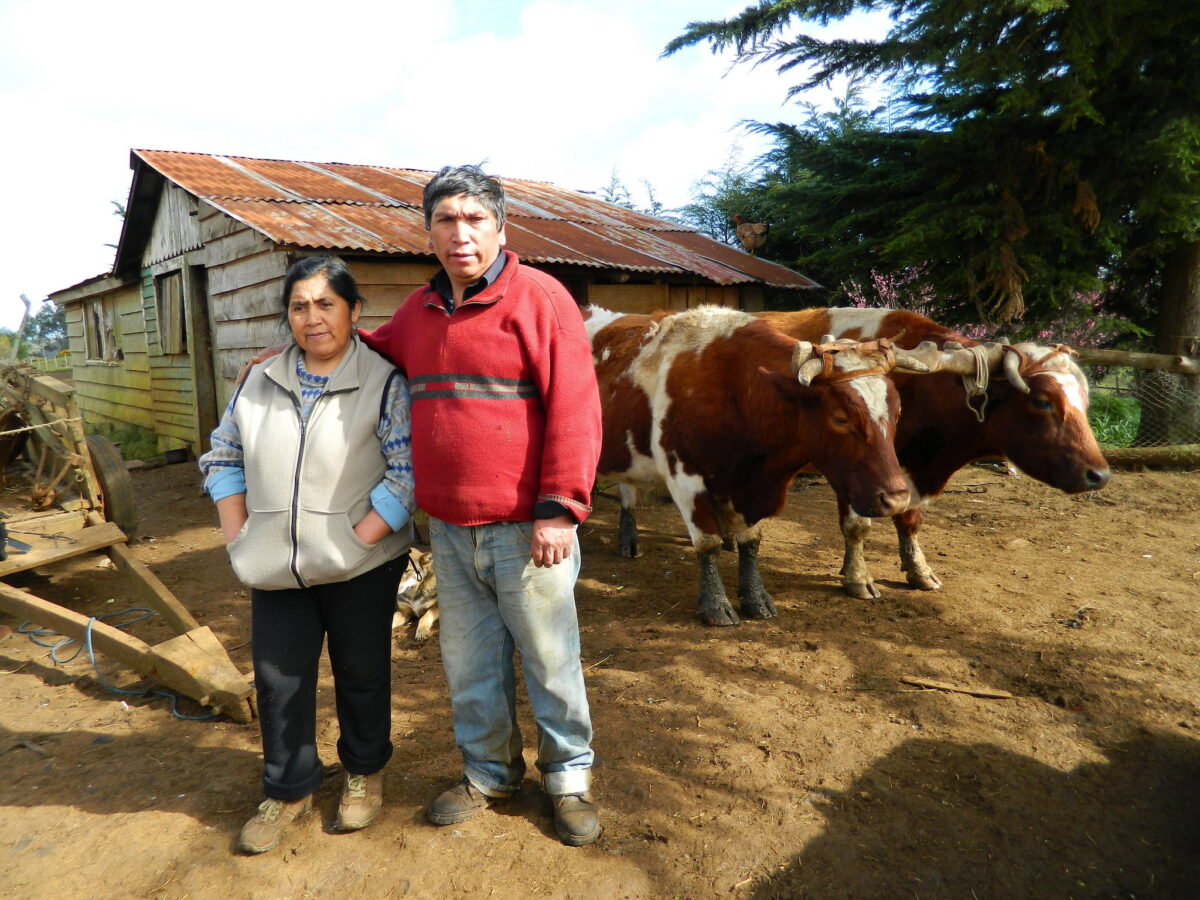
Catalina Marileo and Luis Aillapán, a Mapuche couple, stand in front of their home in Puerto Saavedra in the central Chilean region of La Araucanía. They have been among the many members of native peoples tried under an anti-terrorism law inherited from the dictatorship for acts such as, in their case, opposing the military for building a road on their land. Now Chile could be declared a plurinational State. CREDIT: Marianela Jarroud/IPS

Catalina Marileo and Luis Aillapán, a Mapuche couple, stand in front of their home in Puerto Saavedra in the central Chilean region of La Araucanía. They have been among the many members of native peoples tried under an anti-terrorism law inherited from the dictatorship for acts such as, in their case, opposing the military for building a road on their land. Now Chile could be declared a plurinational State. CREDIT: Marianela Jarroud/IPS

Precedents of a truth commission

The Historical Truth and New Deal with Indigenous Peoples Commission, created by then president Ricardo Lagos in 2001 and composed of 24 members with cross-cutting representation, found that 500,000 hectares were awarded to indigenous peoples between 1884 and 1929. This was verified after reviewing 413 titles issued in that time span.

The purpose of the Commission was to “correct the historical invisibility of native peoples, recognize their identity, repair the damage done to them and contribute to the preservation of their culture.”

In its final report, in 2003, the Commission proposed a hundred measures. In the area of land, it called for protecting lands belonging to indigenous peoples, demarcating and titling ancestral lands of native communities, and establishing a land reclamation mechanism.

Regarding natural resources, it proposed recognizing the indigenous peoples’ right of ownership, use, administration and benefit, the preferential right in State concessions, and the right of use, management and conservation.

So far, the greatest gesture by the State for the mistreatment of indigenous peoples was made by the current United Nations High Commissioner for Human Rights Michelle Bachelet, who as president of Chile (2006-2010 and 2014-2018) apologized in June 2017 to the Mapuche in a solemn official act for “the errors and horrors” committed against them.

Namuncura believes that a pending task is “to reach a political agreement with the large forestry companies so that a part of these lands, which today are their property, are returned to the indigenous peoples through a long-term political and financial commitment, with the possibility of considering the value of this restitution.”

The wording already approved for the first draft will now be analyzed by the Harmonization Commission, which will ensure “the concordance and coherence of the constitutional norms approved by the plenary.”

The version that emerges from that process will be voted by the plenary which, by two thirds, will define the text to be voted on by all Chileans in the referendum.

  Source

Changing a System that Exploits Nature and Women, for a Sustainable Future

Active Citizens, Civil Society, Climate Action, Climate Change, Conferences, Environment, Gender, Global Governance, Headlines, Human Rights, Indigenous Rights, IPS UN: Inside the Glasshouse, Latin America & the Caribbean, Regional Categories, Women & Climate Change

Women & Climate Change

Peruvian farmer Hilda Roca, 37, stands in her agro-ecological garden in Cusipata, a town located at more than 3,300 meters above sea level in the highlands of Cuzco, where she grows vegetables for her family and sells the surplus with the support of her adolescent daughter and son. CREDIT: Mariela Jara/IPS

Peruvian farmer Hilda Roca, 37, stands in her agro-ecological garden in Cusipata, a town located at more than 3,300 meters above sea level in the highlands of Cuzco, where she grows vegetables for her family and sells the surplus with the support of her adolescent daughter and son. CREDIT: Mariela Jara/IPS

LIMA, Mar 7 2022 (IPS) – “Pachamama (Mother Earth) is upset with all the damage we are doing to her,” says Hilda Roca, an indigenous Peruvian farmer from Cusipata, in the Andes highlands of the department of Cuzco, referring to climate change and the havoc it is wreaking on her life and her environment.


From her town, more than 3,300 meters above sea level, she told IPS that if women were in power equally with men, measures in favor of nature that would alleviate the climate chaos would have been approved long ago. “But we need to fight sexism so that we are not discriminated against and so our rights are respected,” said the Quechua-speaking farmer.

The link between climate change and gender is the focus of the United Nations’ celebration of this year’s International Women’s Day, Mar. 8, under the theme “Gender equality today for a sustainable tomorrow”.

The aim is to “make visible how the climate crisis is a problem that is closely related to inequality, and in particular to gender inequality, which is expressed in an unequal distribution of power, resources, wealth, work and time between women and men,” Ana Güezmes, director of the Gender Affairs Division of the Economic Commission for Latin America and the Caribbean (ECLAC), told IPS.

Latin America is highly vulnerable to the climate crisis despite the fact that it emits less than 10 percent of the greenhouse gases that are warming the planet.

In addition, climate injustice has a female face in the region: lower-income population groups, where the proportion of women is higher, are more exposed to climate effects due to their limited access to opportunities, despite the fact that they are less responsible for emissions.

The extreme poverty rate in the region increased from 13.1 percent to 13.8 percent of the population – from 81 to 86 million people – between 2020 and 2021, according to data released by ECLAC in January. Women between 25 and 59 years of age are the most affected compared to their male counterparts. This situation is worse among indigenous and rural populations, who depend on nature for their livelihoods.

These aspects were highlighted at ECLAC’s 62nd Meeting of the Presiding Officers of the Regional Conference on Women, held Jan. 26-27, whose declaration warns that women and girls affected by the adverse impacts of climate change and disasters face specific barriers to access to water and sanitation, health and education services, and food security.

And it is women who are mainly responsible for feeding their families, fetching water and firewood, and taking care of the vegetable garden and animals.

“That is why we maintain that the post-pandemic recovery must be transformative in terms of sustainability and equality,” Güezmes emphasized from ECLAC headquarters in Santiago, Chile.

To this end, she said, this recovery “must untie the four structural knots of gender inequality that affect the region so much: socioeconomic inequality and poverty; the sexual division of labor and the unjust organization of caregiving; the concentration of power and patriarchal, discriminatory and violent cultural patterns; and the predominance of the culture of privilege.”

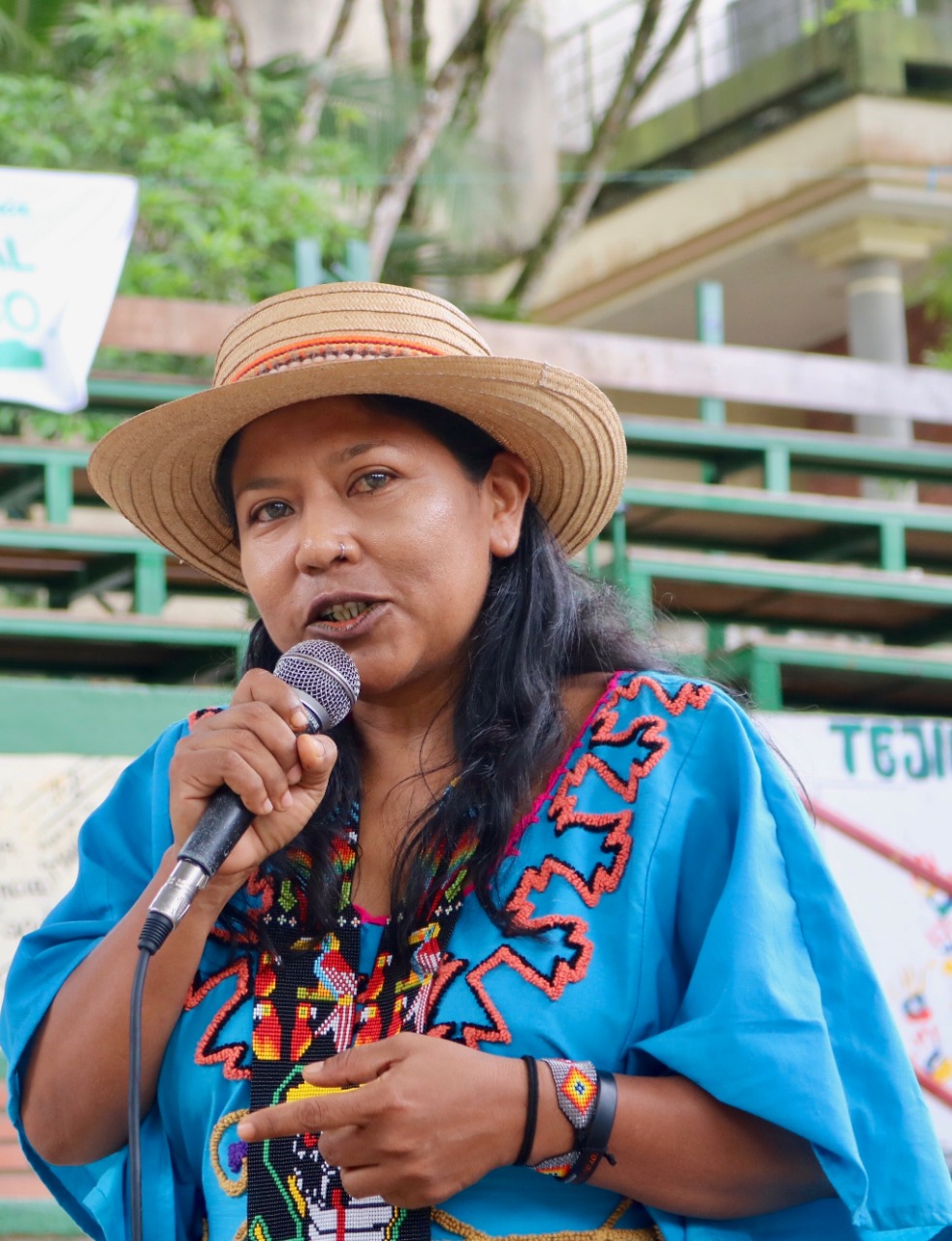
Luz Mery Panche, an indigenous leader of the Nasa people of Colombia. : Courtesy of Luz Mery Panche

Luz Mery Panche, an indigenous leader of the Nasa people of Colombia. : Courtesy of Luz Mery Panche

Reconciling with Mother Earth

Luz Mery Panche, an indigenous leader of the Nasa people, discussed the need to incorporate a gender perspective into the climate crisis. She talked to IPS from San Vicente del Caguán, in the department of Caquetá, in the Amazon region of Colombia, a country facing violent attacks on defenders of land and the environment.

For her, more than sustainable, “it is about moving towards a sustainable future.”

“We need to change the conditions that have generated war and chaos in the country, which is due to the hijacking of political and economic power by an elite that has been in the decision-making spaces since the country emerged 200 years ago,” she said.

Panche is a member of the National Ethnic Peace Coordination committee (Cenpaz) and in that capacity is part of the special high-level body with ethnic peoples for the implementation of the peace agreement in her country. She is a human rights activist and a defender of the Amazon rainforest.

She argued that to achieve a sustainable future “we must reconcile with Mother Earth and move towards the happy, joyful way of life that we deserve as human beings.”

This, she said, starts by changing the economic model violently imposed on many areas without taking into account the use of the soil, its capacities and benefits; by changing concepts of economy and the educational model; and by organizing local economies and focusing on a future of respect, solidarity and fraternity.

Panche said that in order to move towards this model, women “must have informed participation regarding the effects of climate change.

“Although we prefer to call Mother Earth’s fever ‘global warming’. And it is up to us to remember to make decisions that put us back on the ancestral path of harmony and balance, what we call returning to the origin, to the womb, to improve coexistence and the sense of humanity,” she said.

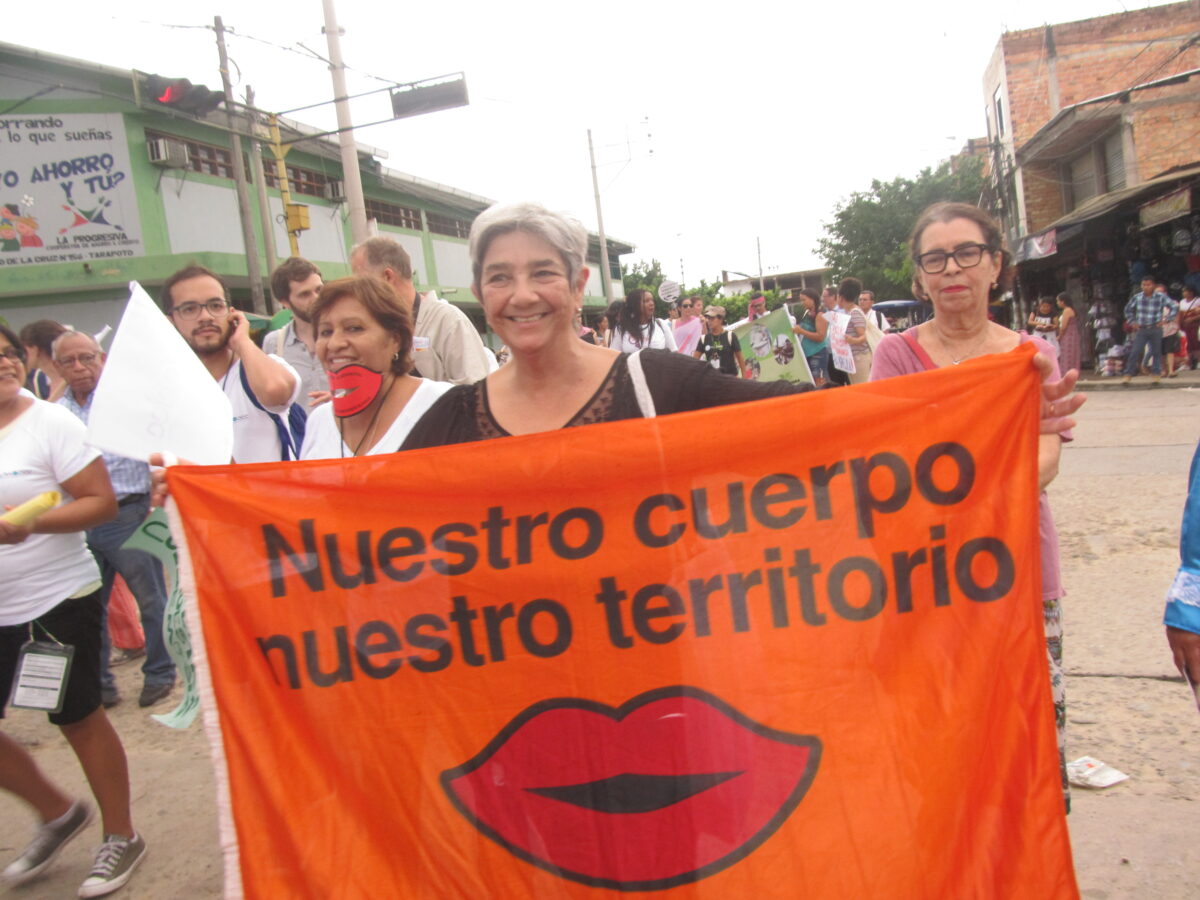
Uruguayan ecofeminist Lilian Celiberti carries a banner reading "Our body, our territory" in the streets of Tarapoto, a city in the central Peruvian jungle, during an edition of the Pan-Amazon Social Forum. CREDIT: Mariela Jara/IPS

Uruguayan ecofeminist Lilian Celiberti carries a banner reading “Our body, our territory” in the streets of Tarapoto, a city in the central Peruvian jungle, during an edition of the Pan-Amazon Social Forum. CREDIT: Mariela Jara/IPS

Changing times: another kind of coexistence with nature and equality

Lilian Celiberti, Uruguayan ecofeminist and founder of the non-governmental Cotidiano Mujer and Colectivo Dafnias, told IPS from Montevideo that governments have the tools to work on gender equality today in order to have a sustainable future tomorrow, as this year’s Mar. 8 slogan states.

But against this, she said, there are economic interests at play that maintain a development proposal based on growth and extreme exploitation of nature.

She called for boosting local economies and agroecology among other community alternatives in the Latin American region that run counter to the dominant government approach.

“But I believe that we are at a very complex crossroads and that only social participation will be able to find paths of multiple, diverse participation and collective sustainability that incorporate care policies and awareness of the eco-dependence of human society,” she said.

Celiberti said “we are on a planet of finite resources and we have to generate a new relationship with nature, but I see that governments are far from this kind of thinking.”

ECLAC’s Güezmes emphasized that social movements, especially those led by young indigenous and non-indigenous women in the region, have exposed the multiple asymmetries and inequalities that exist.

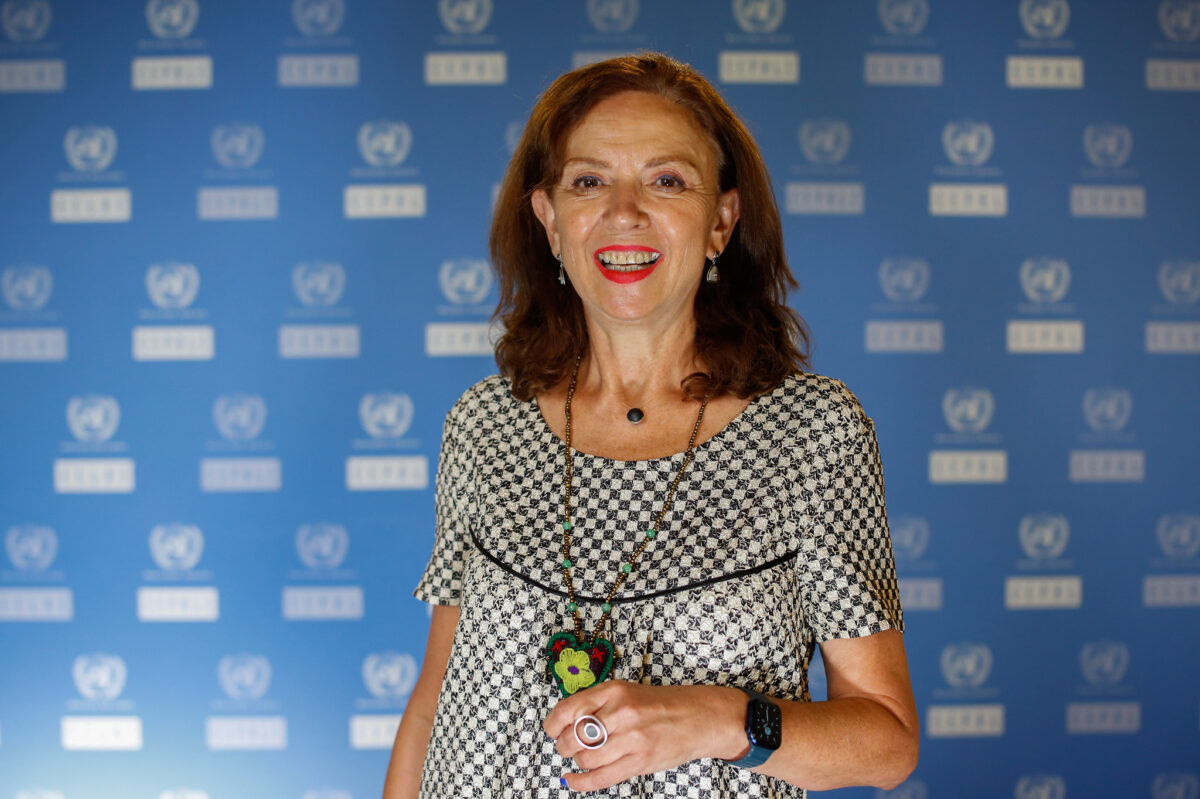
Ana Güezmes is director of the Gender Division of the Economic Commission for Latin America and the Caribbean. CREDIT: ECLAC

Ana Güezmes is director of the Gender Division of the Economic Commission for Latin America and the Caribbean. CREDIT: ECLAC

“We have an intergenerational debt, where young women have put at the center of the debate the unsustainability of the current development style that has direct impacts on our future at a global level and direct impacts on their livelihoods, territories and communities,” said Güezmes, who is from Spain and has worked for years within the United Nations in several Latin American countries.

She recognized the contribution of feminist movements that focus on a redistribution of power, resources and time to move towards an egalitarian model that includes the reduction of violence.

And she warned that from a climate perspective, the window of opportunity for action is closing, so we must act quickly, creating synergies between gender equality and climate change responses.

Güezmes said that “we are looking at a change of era” with global challenges that require a profound transformation that recognizes how the economy, society and the environment are interrelated. “To leave no one behind and no woman out, we must advance synergistically among these three dimensions of development: economic, social and environmental,” she remarked.

The expert cited gender equality as a central element of sustainable development because women need to be at the center of the responses. To this end, ECLAC plans to promote affirmative actions that bolster comprehensive care systems, decent work and the full and effective participation of women in strategic sectors of the economy.

She also raised the need to build “a renewed global pact” to strengthen multilateralism and achieve greater solidarity with middle-income countries on issues central to inclusive growth, sustainable development and gender equality.

“We have reiterated the urgent need to advance new political, social and fiscal pacts focused on structural change for equality,” Güezmes stressed.

She stated that in this perspective, the participation of women in all their diversity in decision-making processes is very important, particularly with regard to climate change.

To this end, she remarked, it is necessary to monitor their degree of intervention at the local, national and international levels – where asymmetry persists – and to provide women’s organizations, especially grassroots ones, with the necessary resources to become involved in such spaces.

“It involves strengthening financial flows so that they reach women who are at the forefront of responses to climate change and who are familiar with the situation in their communities, and boosting their capacities so that women from indigenous, native and Afro-descendant peoples participate in decision-making spaces related to the environment to promote the exchange of their ancestral knowledge on adaptation and mitigation measures,” she said.

Güezmes highlighted the contribution of women environmental activists and defenders to democracy, peace and sustainable development. It is necessary to “recognize their contribution to the protection of biodiversity and to development, despite doing so in conditions of fragility and exploitation and having less access to land, productive resources and their control,” she said.

For her part, Roca, who like other local women in the Peruvian Andes highlands practices agroecology to adapt to climate change and reconcile with Pachamama, calls for their voices to be heard.

“We have ideas and proposals and they need to be taken into account to improve the climate and our lives,” the indigenous farmer said.

  Source

A Tale of Two Refugee Crises

Civil Society, Development & Aid, Editors’ Choice, Featured, Global, Headlines, Humanitarian Emergencies, Migration & Refugees, TerraViva United Nations

Opinion

Families carry their belongings through the Zosin border crossing in Poland after fleeing Ukraine. Credit: UNHCR/Chris Melzer

GENEVA, Mar 7 2022 (IPS) Russia’s brutal and devastating invasion of Ukraine has triggered the largest and fastest refugee movement in Europe since World War II. After only a single week, more than one million people had already fled the country.


The UN High Commissioner for Refugees (UNHCR) initially predicted that as many as four million people would flee; the UN now thinks that some 10 million will eventually be displaced.

While the EU calls this the largest humanitarian crisis that Europe has witnessed in “many, many years,” it is important to remember that it was not so long ago that the continent faced another critical humanitarian challenge, the 2015 refugee “crisis” spurred by the conflict in Syria.

But the starkly different responses that Europe has directed at these two situations—in addition to its draconian response to ongoing African migration across the Mediterranean—provide a cautionary lesson for those hoping for a more humane, generous Europe.

These differences also help explain why some of those fleeing Ukraine—in particular, nationals from Africa, Asia, and the Middle East—are not receiving the same generous treatment as the citizens of Ukraine.

Ukraine’s neighbours have thus far responded with an outpouring of public and political support for the refugees. Political leaders have said publicly that refugees from Ukraine are welcome and countries have been preparing to receive refugees on their borders with teams of volunteers handing out food, water, clothing, and medicines.

Slovakia and Poland have said that refugees fleeing the war in Ukraine will be allowed to enter their countries even without passports, or other valid travel documents; other EU countries, such as Ireland, have announced the immediate lifting of visa requirements for people coming from Ukraine.

Across Europe, free public transport and phone communication is being provided for Ukrainian refugees. On 3 March, the EU voted to activate the Temporary Protection Directive, introduced in the 1990’s to manage large-scale refugee movements during the Balkans crisis.

Under this scheme, refugees from Ukraine will be offered up to three years temporary protection in EU countries, without having to apply for asylum, with rights to a residence permit and access to education, housing, and the labour market.

The EU also proposed simplifying border controls and entry conditions for people fleeing Ukraine. Ukrainian refugees can travel for 90 days visa-free throughout EU countries, and many have been moving on from neighbouring countries to join family and friends in other EU countries. Throughout Europe, the public and politicians are mobilizing to show solidarity and support for those fleeing Ukraine.

This is how the international refugee protection regime should work, especially in times of crisis: countries keep their borders open to those fleeing wars and conflict; unnecessary identity and security checks are avoided; those fleeing warfare are not penalized for arriving without valid identity and travel documents; detention measures are not used; refugees are able to freely join family members in other countries; communities and their leaders welcome refugees with generosity and solidarity.

But we know that this is not how the international protection regime has always operated in Europe, particularly in those same countries that are now welcoming refugees from Ukraine.

Public discourse in Poland, Hungary, Slovakia, and Romania is often tainted by racist and xenophobic rhetoric about refugees and migrants, in particular those from Middle Eastern and African countries, and they have adopted hostile policies like border push-backs and draconian detention measures.

A case in point is Hungary: The country has refused to admit refugees from non-EU countries since the 2015 “refugee crisis.” Prime Minister Victor Orbán has described non-European refugees as “Muslim invaders” and migrants as “a poison,” claiming that Hungary should not accept refugees from different cultures and religions to “preserve its cultural and ethnic homogeneity.”

In May 2020, The European Court of Justice found that Hungary’s arbitrary detention of asylum seekers in transit zones on its border with Serbia was illegal.

Hungary was not alone in its harsh response to the 2015 “crisis.” In their book Immigration Detention in the European Union: In the Shadow of the “Crisis” (Springer 2020), Global Detention Project (GDP) researchers detailed the evolution of the detention systems of all EU Members States before, during, and after the 2015 refugee crisis.

Among their key findings: During the years leading up to 2015, migration-related detention had largely plateaued across the EU, but refugee pressures spurred important increases in detention regimes across the entire region, which remained in place long after the “crisis” had subsided.

Fuelling these increases was anti-migrant rhetoric that spread from Brussels across the entire continent, abetted by EU-wide migration directives that allowed for lengthy detention periods. Then-European Council President Donald Tusk argued at that time that all arriving refugees could be detained for up to 18 months, in line with the limits in EU directives, while their claims were processed.

More recently, in late 2021, the terrible treatment of migrants and asylum seekers, most of them from Iraq and Afghanistan, trapped on Belarus’s borders with Poland and Lithuania sparked outrage across Europe. Belarus was accused of weaponizing the plight of these people, luring them to Belarus in order to travel on to EU countries as retaliation against EU sanctions.

Polish border guards were brutal in their treatment of these refugees and migrants, many of whom sustained serious injuries from Polish and Belarussian border guards. Thousands were left stranded in the forests between the two countries in deplorable conditions with no food, shelter, blankets, or medicines: at least 19 migrants died in the freezing winter temperatures.

In response to this situation, Poland sent soldiers to its border, erected razor-wire fencing, and started the construction of a 186-kilometre wall to prevent asylum seekers entering from Belarus. It also adopted legislation that would allow it to expel anyone who irregularly crossed its border and banned their re-entry.

Even before the stand-off between Poland and Belarus, refugees in Poland did not receive a warm welcome. Very few asylum seekers were granted refugee status (in 2020 out of 2,803 applications, only 161 were granted refugee status) and large numbers of refugees and migrants were detained: a total of 1,675 migrants and asylum seekers were in detention in January 2022, compared to just 122 people during all of 2020.

With this recent history as backdrop, the double standards and racism inherent in Europe’s refugee responses are glaring. There are no calls from Brussels today to detain refugees fleeing Ukraine for up to 18 months.

Why? Because, as Bulgarian Prime Minister Kiril Petkov said recently about people from Ukraine: “These are not the refugees we are used to. … These people are Europeans. … These people are intelligent, they are educated people. … This is not the refugee wave we have been used to, people we were not sure about their identity, people with unclear pasts, who could have been even terrorists.”

Similarly, Hungary’s Orban has said that every refugee coming from Ukraine will be “welcomed by friends in Hungary,” adding that one doesn’t have to be a “rocket scientist” to see the difference between “masses arriving from Muslim regions in hope of a better life in Europe” and helping Ukrainian refugees who have come to Hungary because of the war.

Sadly, these double standards have reared in the response to non-Ukrainians fleeing the war in Ukraine. There are a growing number of accounts of students and migrants from Africa, the Middle East, and Asia who have faced racist treatment, obstruction, and violence trying to flee Ukraine.

Many described being prevented from boarding trains and buses in Ukrainian towns while priority was given to Ukrainian nationals; others described being aggressively pulled aside and stopped by Ukrainian border guards when trying to cross into neighbouring countries.

There are also accounts of Polish authorities taking aside African students and refusing them entry into Poland, although the Polish Ambassador to the UN told a General Assembly meeting on 28 February that assertions of race or religion-based discrimination at Poland’s border were “a complete lie and a terrible insult to us.”

He asserted that “nationals of all countries who suffered from Russian aggression or whose life is at risk can seek shelter in my country.” According to the Ambassador, people from 125 different nationalities have been admitted into Poland from Ukraine.

Several African leaders have strongly criticized the discrimination on the borders of Ukraine, saying everyone has the same right to cross international borders to flee conflict and seek safety.

The African Union stated that “reports that Africans are singled out for unacceptable dissimilar treatment would be shockingly racist and in breach of international law,” and called for all countries to “show the same empathy and support to all people fleeing war notwithstanding their racial identity.”

Similar messages were shared by the UN Secretary General, Antonio Guterres, who said in a Tweet: “I am grateful for the compassion, generosity and solidarity of Ukraine’s neighbours who are taking in those seeking safety. It is important that this solidarity is extended without any discrimination based on race, religion or ethnicity,” and the UN High Commissioner for Refugees who stressed that “it is crucial that receiving countries continue to welcome all those fleeing conflict and insecurity—irrespective of nationality and race.”

The Ukraine refugee crisis presents Europe with not only an important opportunity to demonstrate its generosity, humanitarian values, and commitment to the international refugee protection regime; it is also a critical moment of reflection: Can the peoples of Europe overcome their widespread racism and animosity and embrace the universalist spirit of the 1951 Refugee Convention?

As Article 3 of the Convention holds, all member states “shall apply the provisions of this Convention to refugees without discrimination as to race, religion or country of origin.”

Rachael Reilly and Michael Flynn are based at the Global Detention Project in Geneva.

  Source

Senior royals speak out against Russia’s invasion of Ukraine

A war in Europe was unimaginable two weeks ago. There’s been widespread shock around the world over Russian President Vladimir Putin’s merciless and unprovoked attack on Ukraine, and among many in his own homeland.

It is at times like these that we look to our own leaders to express how we feel and to respond accordingly. Britain’s Prime Minister, Boris Johnson, has risen to the occasion enough for many to forget — for now at least — about lockdown parties that led to calls for his resignation.

The Queen has been lying low at Windsor Castle as she continues to recover from COVID-19. She has been well enough to do paperwork and host virtual audiences but little else (more on that later). We learned on Thursday, though, that she was so moved by events in Ukraine she had privately made a “generous” donation to the humanitarian appeal from the Disasters Emergency Committee — a group of 15 leading U.K. aid charities. Buckingham Palace confirmed the Queen’s donation but would not comment further, telling us it was a “private matter.”

Other members of her family have stepped up in her absence, as is the form these days.

The Duke and Duchess of Cambridge said in a tweet over the weekend that they “stand with the President and all of Ukraine’s people as they bravely fight for that future.”

Ukraine’s President, Volodymyr Zelensky, tweeted back, saying he and wife Olena were grateful to the couple that “at this crucial time, when Ukraine is courageously opposing Russia’s invasion, they stand by our country and support our brave citizens.”

From California, on the day Russia launched its invasion, Prince Harry and Meghan expressed their solidarity with the people of Ukraine “against this breach of international and humanitarian law” and urged “the global community and its leaders to do the same.”

On Tuesday, Prince Charles went further, speaking of “democracy” and “an open society” coming under attack in Ukraine “in the most unconscionable way.” He went on: “We are in solidarity with all those who are resisting brutal aggression.”

If the U.K. were ever to try to rebuild bridges with Putin, these comments will hang over Charles. That’s why, as a rule, royals don’t cast judgment on foreign heads of state. They’re in it for life, unlike transient politicians. Putin, however, has crossed the line on this one for Charles, as he has for most of the Western world.

But it was perhaps his wife, the Duchess of Cornwall, who best expressed the nation’s shock without words, during the couple’s visit to a Ukrainian Catholic Cathedral in London on Wednesday.

The pair went to the Cathedral of the Holy Family — which has become a rallying point for the British Ukrainian community — where they met the Ukrainian Ambassador to the U.K., Vadym Prystaiko, and his wife, Inna Prystaiko, as well as Bishop Kenneth Nowakowski.

On arrival, the royals met children from an associated Ukrainian school and received a traditional offering of bread and salt. The couple also lit a candle and laid sunflowers, Ukraine’s national flower, at the altar.

Addressing members of the Ukrainian community working to support relief efforts, Charles praised the group for their courage in the face of wanton aggression. He said: “My wife and I have been deeply moved by everything we’ve heard today during our visit and, above all, by the extraordinary bravery, generosity and fortitude of the Ukrainian community in the face of such truly terrible aggression. So, if I may say so, our thoughts and prayers, however inadequate they may be, are with all of you at this most critical time.”

During the visit, a camera picked up tears in Camilla’s eyes and a journalist from the Royal Rota covering the event reported the duchess “wept frequently during the engagement and comforted the ambassador’s wife, who was also crying.”

NEWS OF THE WEEK

The Queen seems to be on the mend after contracting coronavirus nearly two weeks ago, undertaking a number of video calls this week.

On Thursday, she held two virtual audiences from Windsor with the new ambassadors for Trinidad and Tobago and Malawi. Earlier this week, she also welcomed incoming envoys to the U.K. from Andorra and Chad in video meetings.

The palace has been reluctant to give a daily health update but clearly the monarch is feeling well enough to return to virtual engagements. It is understood she will continue with other duties and has some private engagements in her diary.

One event that was taken off the books was a diplomatic reception that was due to take place at Windsor Castle on Wednesday. Buckingham Palace said over the weekend the Queen had “accepted the Foreign Secretary’s advice” to postpone the event. Rather than being related to her health, it’s likely UK Foreign Secretary Liz Truss made the suggestion in the light of the ongoing crisis facing Ukraine.

The next major events the Queen is hoping to attend are the annual Commonwealth Service at Westminster Abbey on March 14 and a service of thanksgiving for her late husband, Prince Philip, at the same venue on March 29.

WHAT ELSE IS HAPPENING?

Charles celebrates success of Black Britons.

The Prince of Wales brought together some of the most influential Black Britons when he hosted a reception for supporters of the Powerlist at Clarence House on Tuesday. The Powerlist is an annual celebration of 100 of the most influential people of African, African-Caribbean and African-American heritage. “These communities have made and continue to make an incredibly positive difference to society as a whole and, in doing so, have built a real community spirit and cohesion,” Charles said. The heir to the throne added it was “particularly pleasing to see the diversity of talent” recognized by the initiative, from the arts to business, the environment and technology, among other sectors. Charles said the Powerlist — now in its 16th year — has helped identify “expertise and leadership” that will aid the UK in meeting the challenges it continues to face across society.

William and Kate mark St. David’s Day in Wales.

The Cambridges took a trip to Wales to celebrate St. David’s Day, where they were greeted by throngs of well-wishers. The trip was focused on the importance of the agricultural industry, with their engagements centered around how community groups are supporting young people, while also celebrating the region’s history. In Abergavenny, they stopped at a goat farm that has supplied milk to local cheesemakers for almost two decades. Meanwhile, in Blaenavon, the pair rolled up their sleeves in the kitchen of a local youth center, where they baked Welsh cakes before playing a game of pool.

DID YOU KNOW?

Meghan praises historic Supreme Court nomination.

The Duchess of Sussex weighed in on Ketanji Brown Jackson’s historic Supreme Court nomination to become the first Black woman to sit on the highest court in the United States. Meghan spoke to Anita Hill, an American lawyer who became a household name in 1991 when she testified about sexual harassment she allegedly endured from then-Supreme Court nominee Clarence Thomas, for URL Media. Reflecting on Jackson’s nomination, Hill wrote in an op-ed that she wanted to seek the thoughts of others who had “entered arenas once thought to be inaccessible,” so she reached out to Meghan. The duchess praised President Joe Biden’s pick, telling her “the civil rights history of tomorrow is being written today.” Meghan added that Jackson’s nomination “opened new ground for women’s representation at the highest level of a judicial system that for too long has tilted against the very community she hails from.” Read Hill’s op-ed here.

DON’T MISS

New Diana portrait goes on display.

An exhibition opening Friday at London’s Kensington Palace will debut a portrait of Princess Diana that’s never been seen by the public. Taken by fashion photographer David Bailey in 1988, the image was originally commissioned by the National Portrait Gallery but has remained in Bailey’s archive until now. The black-and-white image shows an elegant 27-year-old Diana gazing into the distance, wearing a satin off-the-shoulder gown and a pair of teardrop earrings.

Bailey, who has photographed multiple cultural legends, including Andy Warhol, Twiggy and the Beatles, was selected by Diana for his high-contrast lighting and minimalist style. Her choice “reflected her desire to establish a new photographic identity for herself,” distinct from the more established forms of royal portraiture, according to a news release from Historic Royal Palaces, the British charity tasked with running six of the UK’s palaces. Revealed now after 34 years, the image further solidifies her public reputation as one of the most fashion-forward members of the British royal family. Read more on CNN Style.

FEATURED PHOTOS

In addition to the Diana portrait, the exhibition, titled “A Life Through A Royal Lens,” will showcase a range of works exploring the relationship between photography and the monarchy.

It includes photos snapped on royal tours and portraits of heads of state, as well as off-duty moments away from the public eye. Also on show for the first time is a selection of images taken by members of the royal family themselves.

Nearly 1,000 images were submitted from people around the world who were keen to share their encounters with royals, with photographs ranging from royal walkabouts in the 1950s to the traditional Christmas Day service at Sandringham, the Queen’s private residence in Norfolk.

Check out more of the amateur snaps here.

IN THE ROYAL DIARY

The Duchess of Cornwall has a busy week ahead, with two major engagements on her calendar.

Tuesday, March 8: In her role as president of WOW – Women of the World Festival, Camilla will host a reception to mark International Women’s Day at Clarence House in London.

Thursday, March 10: She’ll open the new Royal Academy of Dance (RAD) headquarters in Battersea, south London. The duchess has been vice-patron of the RAD since 2020.

PHOTO OF THE WEEK

Charles, Camilla, Pier Train

Prince Charles and Camilla unveiled an eco-friendly pier train named in honor of murdered British politician David Amess, during a visit to Southend, east of London on March 1. Amess, a veteran Conservative lawmaker, was stabbed to death in his constituency in October.

Source

It’s Time to Step up for Street Vendors’ Rights

Asia-Pacific, Civil Society, Headlines, Labour, Poverty & SDGs

Opinion

Street Vendors Act - Since the passing of the act around seven years ago, only a minor fraction of its extensive recommendations has been implemented. Picture courtesy: Adam Cohn.

Since the passing of the act around seven years ago, only a minor fraction of its extensive recommendations has been implemented. Picture courtesy: Adam Cohn.

MUMBAI, India, Mar 2 2022 (IPS) – In the second week of January 2022, Purushottam—locally known as Prashant—a street vendor in central Delhi’s Connaught Place area, died by suicide. It was later discovered that the reason for his death was his inability to pay certain debts.


Ground reports show that, since November 8, 2021, approximately 150 street vendors in Connaught Place, including Purushottam, have lost their livelihoods due to forced eviction by municipal authorities.

Over the past few years, the vast population of vendors has reported facing repeated harassment or eviction at the hands of the police, local authorities, and society. Therefore, street vendors remain marginalised and their situation grows increasingly precarious, despite the fact that they are protected by the law

It is a complex combination of pressures from market traders’ associations, insensitive court orders, bureaucracy, and non-existent planning standards that have disallowed street vending—one of the largest economies for self-employed workers—in Connaught Place.

This removal of street vendors has further been replicated in other well-established markets of Delhi such as Lajpat Nagar, Sarojini Nagar, and Chandni Chowk, and is now being extended to other cities across India.

What the Street Vendors Act 2014 guarantees

In 2014, the central government passed the Street Vendors (Protection of Livelihood and Regulation of Street Vending) Act based on Article 21 of the Constitution of India—the right to live with dignity. As the title suggests, the act is designed to ‘protect’ and ‘regulate’ street vending in urban areas.

Till 2014, street vending was an ungoverned territory where ‘regulation’ meant the removal of vendors, who were considered illegal and unfit to be in cities. The Street Vendors Act 2014 attempted to change this mindset in the following ways:

  • It acknowledged vendors as an integral part of Indian cities and granted legal recognition to them by protecting them from evictions till they were surveyed.
  • The act created a governance framework that is participatory and decentralised, and primarily led by the town vending committees (TVCs) located in urban local bodies. TVCs are in charge of enumerating, identifying, and allocating vending zones in a city. Each TVC requires at least 40 percent of its members to be street vendors, with the rest of the committee including representation from local authorities, planning authorities, police, residential welfare associations, nonprofits, and market associations.
  • It allowed street vendors to be included in the city planning process by letting up to 2.5 percent of the city population engage in street vending.
  • It specifically mandated prevention against eviction and harassment.
  • The act laid out various inclusionary measures for the legal support and promotion of street vending through vendors’ welfare, training, and capacity building.

Overall, the act is a nuanced, well-designed legislation that is a result of numerous years of contributions from social movements led by street vendors’ associations and incremental progressive court directives.

Why are forced evictions taking place in Delhi?

Poor implementation of the act

The evictions taking place in Delhi have set a dangerous precedent by undermining the Street Vendors Act 2014—the only progressive legislation enacted for the upliftment of working-class groups such as street vendors. Since the passing of the act around seven years ago, only a minor fraction of its extensive recommendations has been implemented.

With much reluctance, it is only now that street vendors are being surveyed and issued licenses and certificates of vending in Delhi. However, with no demarcation of the vending and non-vending zones in the city, the vendors find themselves without ‘space’ on the city streets.

Over the past few years, the vast population of vendors has reported facing repeated harassment or eviction at the hands of the police, local authorities, and society. Therefore, street vendors remain marginalised and their situation grows increasingly precarious, despite the fact that they are protected by the law.

Judicial apathy

In 2021, various market traders’ associations put forth petitions challenging the act. While listening to their grievances, the Delhi High Court passed unfavourable comments on the legal rights of street vendors in Delhi.

The bench further questioned the basis of the act and said that “the country will go to [the] dogs if this act is implemented in its entirety. What will happen if street vendors start sitting on your doorsteps?”

The court also raised concerns over the rising number of vendors in the city and questioned how Delhi could become like London if the planning aspect wasn’t focused on. These comments were made alongside the passing of a legal order to remove street vendors from their spaces of work.

The same bench also stated that the act is heavily biased towards the street vendors and that there are no experts in the TVCs.

It should be noted that street vendors in Delhi make up only 40 percent of the TVC by having 12 seats out of 30, whereas 10 seats are taken by local authorities, planning authorities, the police and traffic police, the revenue department, the medical officer, and the CPWD/PWD/works department of the local authority.

The committee also offers eight seats to nonprofits, resident welfare associations, community-based organisations, and market traders’ associations—independent bodies that are nominated by the state government itself. With such a comprehensive list, encompassing the economic, spatial, health, social, and administration perspectives, the TVC is full of experts and, therefore, is not tilted towards the vendors.

Stagnant functioning of TVCs

As per the Street Vendors Act 2014, Delhi’s Street Vendor (Protection of Livelihood and Regulation of Street Vending) Rule 2017, and the Street Vendor (Protection of Livelihood and Regulation of Street Vending) Scheme 2019, Delhi has 27 TVCs across the three municipal corporations of Delhi, North Delhi Municipal Corporation, and Delhi Cantonment.

In spite of many deliberations in the TVCs where vendor representatives have pushed for a comprehensive survey to identify and register street vendors, there has been a bureaucratic lethargy and rigidness in execution. For example, the TVC meetings are not held regularly and survey and certificate issuance processes are slow.

Often the chairpersons—who are usually IAS officers—don’t listen to the TVC members, thus systematically undermining the democratic nature of TVCs.

From the minutes of the TVC meetings1 it is apparent that members representing government authorities such as the health, police, and planning departments do not attend them, thus missing the opportunity to make these meetings enriching and participatory. Together, the poor functioning of the TVCs inhibits the proper implementation of the act and allows forced evictions to continue.

Exclusionary urban planning

The recent eviction orders are unlawful also because they are based on the Master Plan of Delhi (MPD) 2021 and older vending zones—both of which were made prior to the passing of the Street Vendors Act 2014.

Moreover, as mentioned previously, the act mandates the right of TVCs to decide on vending and non-vending zones. Unfortunately, this right has been curtailed under the present MPD 2001–21 since the plan has not been amended in line with the Street Vendors Act 2014.

Now the latest draft of the MPD 2041 has also carried forward the same legacy by excluding the 2.5 percent norm on the number of street vendors in a city, TVCs, and participatory process on the vending zone demarcation. It is not a matter of coincidence that the North Delhi Municipal Corporation’s smart city plans—like the smart city plans of many other cities—have demarcated the central park and surrounding areas as ‘hawker-free zones’.

Outside the bureaucratic and city planning hurdle, societal apathy and disdain towards the vendors comes from a colonial mindset where they are viewed as smugglers and encroachers occupying public spaces, posing a threat to pedestrians’ right of way.

How do we move forward and course-correct?

The Street Vendors Act 2014 is the only legal framework that protects street vendors, as it focuses on enhancing their livelihoods and safeguarding them from evictions and harassments.

It uplifts the values of democracy by setting up the TVCs as decision-making authorities that conduct surveys, issue certificates of vending, and provide vendors with spatial right to the city.

Due to the COVID-19 pandemic, the last couple of years have been extremely difficult for street vendors and the informal economy.

Our research has shown that their incomes have reduced by more than 40 percent in the case of Delhi, and many vendors have reported falling into debt traps. The proactive measures taken by the government through the PM SVANidhi scheme and the Delhi government reaching out with PDS and non-PDS relief were only of temporary help.

The bigger problem for street vendors is that they were not legally permitted to work in the city even prior to the pandemic. Addressing this problem requires concrete efforts from the government at the central, state, and local levels.

The first step is to explicitly integrate urban development schemes such as the MPD, Smart Cities Mission, and Swachh Bharat Abhiyan with the objectives and mandates of the Street Vendors Act 2014. Since these schemes are integral to a city’s strategic planning and welfare, they must recognise the needs and aspirations of street vendors.

There is also a need to focus on training and capacity building of urban local bodies, TVCs, and vendors so that they can play a decisive role in executing the act, for example, to identify and demarcate vending zones.

Further, the Delhi Development Authority needs to acknowledge the absence of street vending and other informal livelihoods from the MPD. Lastly, there is a need to include natural markets, weekly markets, women’s markets, and other heritage markets in the MPD 2041.

Unless we reform urban planning both in theory and in practice, our cities will continue to see exclusionary development. The implementation of the Street Vendors Act 2014 could be seen as an opportunity to prioritise the welfare of the urban poor and enhance their livelihoods.

Aravind Unni is an urban rights activist and researcher associated with the National Hawker Federation.

Shalaka Chauhan is a social designer by training. Her work focuses on urban planning vis-à-vis urban poverty and inequality. 

This story was originally published by India Development Review (IDR)

  Source

Yeshua, not Josh: Why Americans need a Jesus of color

One of my favorite things about my university’s library is its generosity. As it is excruciatingly old, from time to time it decides to rid itself of its multitude of outdated material. Every once in a while, when you walk in to crank out a paper, you might pass by a cart stacked from bottom to top with books, primarily related to the parenting, ministry or both. However, sometimes the free book cart contains other material. Today on my journey into distraction, I found that the library was giving away some illustrated children’s books. Per usual, I decided my backpack had enough room. I found some fun copies of fairy tales, books teaching children about the world and, of course, some illustrated Bible stories. As I excitedly opened the “Children’s Old and New Testaments,” I physically winced at the bright white skin I saw on the faces of Adam and Eve. In almost a morbid curiosity, I flipped farther ahead, and my suspicions were confirmed. There, before my very eyes, was a white-skinned, red-haired Jesus Christ.

What’s wrong with “white Jesus,” you might ask? Christianity is a global religion! Is it not best expressed in an artistic sense through a multicultural lens? In fact, if you were to step into the office of John Brown University’s intercultural studies professor, you might see on her walls art representing Bible stories in a Picasso-esque style with a Chinese flair. This is the work of He Qi, a Chinese artist and theologian who has sought to combine his culture with his training and understanding of Scripture. For generations, as formerly colonized countries have come forth in claiming Christianity as their very own, their artists have similarly taken ownership of Biblical narratives by portraying them as appropriate to their cultural contexts. As early as the 1970s, Christian artistry has arisen from Malawi, Puerto Rico, native New Zealand and Papua New Guinea, portraying the Madonna and Child, Nativity scenes, Adoration of the Magi and more.

As Christianity spread through Europe and retained its claim for generations, a wealth of Eurocentric Christian art has been produced. This fits within the pattern of cultural claims to Christianity. As the faith spreads, depictions of Scripture and Christ Himself are made to resemble the culture which it now bears. If this is all true, then why negate the existence of “white Jesus”? Is his existence not an extension of the European claim to the Christian faith?

If there is one characteristic that Christ was certain to take on in his human form, it was lowliness. “For the Son of Man came not to be served but to serve, and to give his life a ransom for many” (Mark 10:45, NRSV). Jesus walked on this earth as a humble servant and poor teacher who was inevitably put to death by the political powers of the time. Even his ethnic identity as a Jew put him at a lower social rung than most in his ancient Roman context. Jesus Christ was not associated with social or earthly power. He possessed none of it whatsoever. However, his modern-day followers of European descent, especially in the United States, do possess said power. America was founded upon a race-based hierarchy, with Black, brown and Indigenous people at the bottom, topped off with none other than white people. After years of oppression, slavery and outright genocide, with a multitude of legislation attempting to make up for what had been stolen, to this day a power distance remains.

Generational wealth has been gained by white Americans, extending back even to times when many of their ancestors were slaveholders. Black Americans are unabashedly behind, often confined to a lower-class status due to their lack of a head start. Native Americans, having been ripped from their ancestral land, live on pathetic reservations which are far from comfortable or quality living. The cultural consciousness of the average American favors whiteness and looks down on or feels threatened by Black, brown, and Indigenous citizens. To me, it is undeniably clear that in the United States, whiteness is power. It is privilege. As Americans look upon this lover of us all, Jesus Christ, through the lens of whiteness, we are sorting him into our own social structure. He receives the benefit of white power and privilege and is placed at a distance from his followers of color. For Americans to truly understand the character of Jesus Christ, we must see him through our social cultural context. He was not white. He was Indigenous. He was Black. He was downtrodden, oppressed and impoverished.

To love this image of Jesus is to love the weary and downcast of our world, and to truly wear the desires of his own heart. “Truly I tell you, just as you did it to one of the least of these who are members of my family, you did it to me” (Matthew 25:40, NRSV). 

Photo courtesy of Arturo Rey at Unsplash

Source