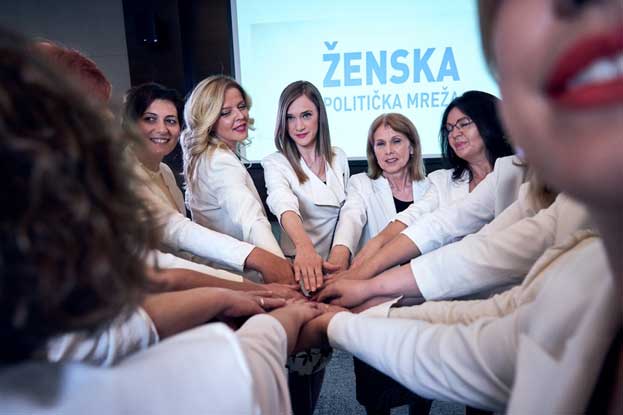
Women’s Political Network, Credit: UNDP Montenegro
The Women’s Political Network was established in Montenegro in November 2017 to promote equal political and economic rights and to combat gender-based-violence. The initiative was funded by the Delegation of the European Union to Montenegro and implemented by UNDP in partnership with the Ministry of Human and Minority Rights.
Meanwhile the UN will be commemorating International Day of Parliamentarism on June 30.
NEW YORK, Jun 28 2021 (IPS) – In elections last October in Georgia, women’s share of seats in parliament went up by nearly seven percent, following the enforcement of a 25 percent quota for women candidates.
In North Macedonia, Serbia and Croatia, which apply a 40 percent legislated gender quota, women exceeded 30 percent in parliament. And in Kosovo*, women won more seats in parliament during the 2021 February election than in any previous year, gaining a 40 percent share.
But, as heartening as these results are, they are rare stars for women in the political firmament.
At this rate it will take 50 years for parliaments to reach gender parity. Other estimates lead to gloomier forecasts – such as 145.5 years to reach gender parity in legislative and executive branches of the government.
Among countries that are likely to reach gender parity, more than half have adopted gender quotas. One of the most widely applied tools to accelerate progress on women’s political representation, legislated quotas allow more women to get elected and have a shot at changing gender social norms.
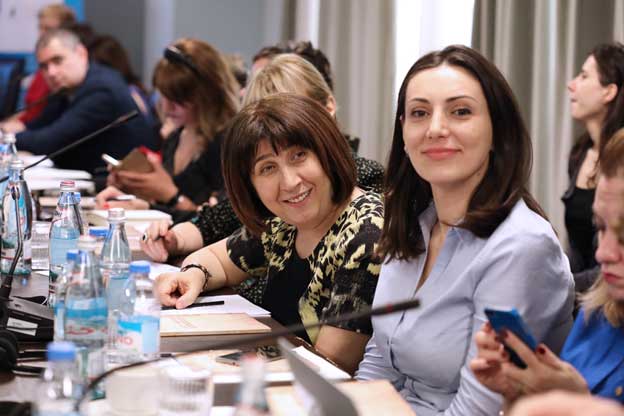
A 2017 survey conducted among top and middle management of parliamentary political parties in Georgia – complemented with the reports and personal experiences of female politicians and activists – highlighted the obstacles faced by Georgian women striving for a political career. Credit: Daro Sulakauri/UNDP Georgia
Numbers matter. Part of the solution to increasing women’s political participation lies in the ability to track progress and comparing data across countries. For example, legislated quotas – despite being a somewhat contested phenomenon – were applied last year in 81 states globally, including 25 countries and territories represented on UNDP’s recently updated Equalfuture platform.
Equalfuture now features updated data on women’s presence in electoral politics.
It shows that, despite progress, women in the ECA region have just over a fourth of seats in national legislatures. In only six countries in the region are women speakers of parliament – Azerbaijan elected a woman speaker for the first time in 2020 – while there are women speakers in just 20 of the 57 countries in the UNECE region.
To argue that there have never been so many opportunities open to women as there are today is to ignore the powerful hold of gender bias in society. Nearly half of the population in Europe and Central Asia (ECA) believe men make better political leaders than women. The bias ranges from more than 60 percent in Armenia, Kyrgyzstan and Tajikistan supporting this view to less than 30 percent in Croatia and Montenegro.
This could be one of many reasons why young women in 2020 made less than one percent of all parliamentarians worldwide.
Gender bias is just one in a constellation of factors in the slow crawl in women’s political representation.
Violence against women in politics is a formidable obstacle to women’s entry to the political sphere. This increasingly recognized phenomenon is alarmingly pervasive: in 45 UNECE countries, most women parliamentarians have suffered psychological violence or been the target of online sexist attacks on social media during their mandate. Almost half received death threats or threats of rape and beating, and a quarter suffered sexual violence.
Women aspiring to politics are also subject to vicious forms of cyberviolence not foreseen in the Beijing Platform for Action which called on parliaments to have no less than 30 percent of women in their ranks. Abusive online comments aimed at women politicians are inversely proportional to the number of women in political office. During the parliamentary elections campaign in Georgia in 2020, 40 percent of the abusive comments on Facebook targeted women candidates, who comprised only 22 percent of the monitored profiles. Most comments called on them to stay home and give up their political ambition.
Given the many gender fault lines laid bare by the COVID-19 pandemic, it is little surprise that women make up only 24 percent of the COVID-19 task force members worldwide. With its profound impacts on women’s paid and unpaid work, the pandemic has set back decades of hard-won gains in gender equality.
More women than men lost their jobs while their care burdens intensified during the pandemic. With fewer resources and less time to spend on the activities outside the household, fewer women are likely to engage in politics.
However, without women’s input, countries risk making poor decisions at a pivotal moment of recovery from crisis.
On the upcoming International Day of Parliamentarism (June 30), let us celebrate not only parliamentarians but gender-equal parliaments as a cornerstone of a well-functioning democracy. And let us redouble our efforts to dismantle the barriers and dislodge the biases that hold women back from an equal future in political decision-making.
Mirjana Spoljaric Egger is Assistant Secretary-General of the United Nations, Assistant Administrator of UNDP, and Director of the UNDP Regional Bureau for Europe and the CIS. She was appointed to this position by the UN Secretary-General in August 2018 and assumed duties in October 2018. She oversees UNDP operations in 18 countries and territories of Europe and Central Asia: https://www.eurasia.undp.org/content/rbec/en/home/about-us/about-the-region.html
Learn more about the progress of women’s participation in politics in 57 countries and territories over the past 26 years through UNDP Eurasia’s online platform Equalfuture.
* References to Kosovo shall be understood to be in the context of Security Council resolution 1244 (1999)
SANTA CRUZ, California, Jun 25 2021 (IPS) – In July, the United Nations will convene “Science Days”, a high-profile event in preparation for the UN Food Systems Summit later this year. Over the course of two days, the world will be treated to a parade of Zoom sessions aimed at “highlighting the centrality of science, technology and innovation for food systems transformation.”
Maywa Montenegro
Nobody disputes the need for urgent action to transform the food system. But the UNFSS has been criticized by human rights experts for its top-down and non-transparent organization. Indigenous peoples, peasants, and civil society groups around the world know their hard-won rights are under attack. Many are protesting the summit’s legitimacy and organizing counter-mobilizations.
Scientists are also contesting a summit because of its selective embrace of science, as seen in a boycott letter signed by nearly 300 academics, from Brazil to Italy to Japan.
Through the Summit, “science” has been weaponized by powerful actors not only to promote a technology-driven approach to food systems, but also to fragment global food security governance and create institutions more amenable to the demands of agribusiness.
Recipe for Elite Global Governance
The UNFSS was announced in 2019 by the UN Secretary General as part of the Decade of Action to achieve the Sustainable Development Goals by 2030. The announcement came just after the UN signed a strategic partnership with the World Economic Forum. It also elicited outcry from social movements when Agnes Kalibata, President of the Alliance for a Green Revolution in Africa, was chosen to lead the forum — a powerful signal of UNFSS allegiances.
The “multi-stakeholder” structure of the summit has raised concerns from observers who recognize the privatization of multilateral public governance it presages. While Kalibata describes the UNFSS as an inclusive “peoples’ summit,” more than 500 smallholder and peasant organizations signed a letter criticizing the summit’s multi-stakeholder platforms: “Instead of drawing from the innovative governance experiences that the UN system has to offer, the UN-WEF partnership is helping to establishing “stakeholder capitalism” as a governance model for the entire planet.”
Matthew Canfield
Through one lens, multistakeholderism looks like a set of “inclusive” practices: the summit has five Action Tracks (e.g. “Ensuring Access to Safe and Nutritious Food for All” and “Boosting Nature Positive Production at Sufficient Scale”), an endless number of “dialogues,” and an elaborate online forum where anyone can participate.
However, this profusion of spaces obscures the fact that the UNFSS has no built-in structures of accountability. This is particularly troublesome because, as UN special rapporteurs have observed, the summit’s process was pre-determined by a small set of actors: “The private sector, organizations serving the private sector (notably the World Economic Forum), scientists, and economists initiated the process. The table was set with their perspectives, knowledge, interests and biases.”
The scientific ideas shaping those parameters, then, should invite our curiosity and concern. What kinds of science are included — and excluded? What are the implications for the future of global food system governance?
Defining Science as Investment-Friendly Innovation
A new Scientific Group of the UNFSS, created to support a “science- and evidence-based summit,” provides some clues. In theory, the Scientific Group works to “ensure the robustness, breadth and independence of the science that underpins the summit and its outcomes.” In practice, the Group’s practices impoverish the scientific base on which the summit is meant to make policies.
Unlike existing global science advisory panels where experts are nominated through an inclusive and democratic process, the Scientific Group is handpicking experts amenable to “game-changing” solutions — access to gene-edited seeds, digital and data-driven technologies, and global commodity markets.
Alastair Iles
As a result, key areas of expertise, such as agroecology, Indigenous knowledge, and human rights are being excluded while industry and investor-friendly viewpoints are promoted as visionary.
While the Scientific Group appears at first to be diverse in terms of disciplines and geographies, it in fact reflects a set of overlapping, elite networks. Partners include well-worn institutional champions of the Green Revolution (the CGIAR), the central nervous system for “free trade” policy globally (the World Trade Organization), and a powerful consortium of wealthy nation-states (the Organisation for Economic Cooperation and Development), among others.
By drawing on these networks, the Scientific Group is serving as a gatekeeper for determining the meaning and boundaries of “science.” An analysis of its publications reveals critical flaws stemming from the Scientific Group’s narrow approach to scientific expertise. These include:
• Science, technology, and innovation are uprooted from their political-economic and social conditions. As a result, structural drivers that produce hunger even as they generate wealth (e.g. for Bill Gates) are eclipsed in favor of boosting productivity with a twist of sustainability. • Biotechnology, Big Data, and global value chains are offered as the solution to all agronomic problems and the crisis of overfishing. • Multicultural “digital” inclusion is redeployed to promote Black, Brown, and Indigenous incorporation into an imperial model of Science, Technology, and Innovation. This ignores the rich knowledge these communities already hold — and obscures that Indigenous and agroecological knowledge cannot survive without land.
Science can and should play a role in global food governance. But far from the current UNFSS model, science can support in all its complexity and breadth, alongside many other expertises with equal rights to shape the future of food.
Maywa Montenegro works as an assistant professor of Environmental Studies at the University of California, Santa Cruz, specializing in politics of knowledge, biotechnology, and agroecology.
Matthew Canfield is an assistant professor of Law and Society & Law and Development at Leiden Law School specializing in human rights and global food governance.
Alastair Iles works as an associate professor at the University of California, Berkeley, researching agroecology policies and sustainability transitions.
On today’s 51%, we learn how some high school girl scouts have been helping their communities during the COVID-19 pandemic. And we’ll learn how the Girl Scouts are trying to diversify.
When you think of the Girl Scouts, what comes to mind? For me, it’s cookies. Samoas, specifically. It’s cute little hats and sashes with badges and if I’m being honest, those little plastic boondoggle crafts that I could never get to look good enough to give as a keychain gift on Christmas.
Whatever I thought I’d find in this banquet hall, it certainly wasn’t these composed, serious-looking high school girls who are changing the world.
Madison Mackey
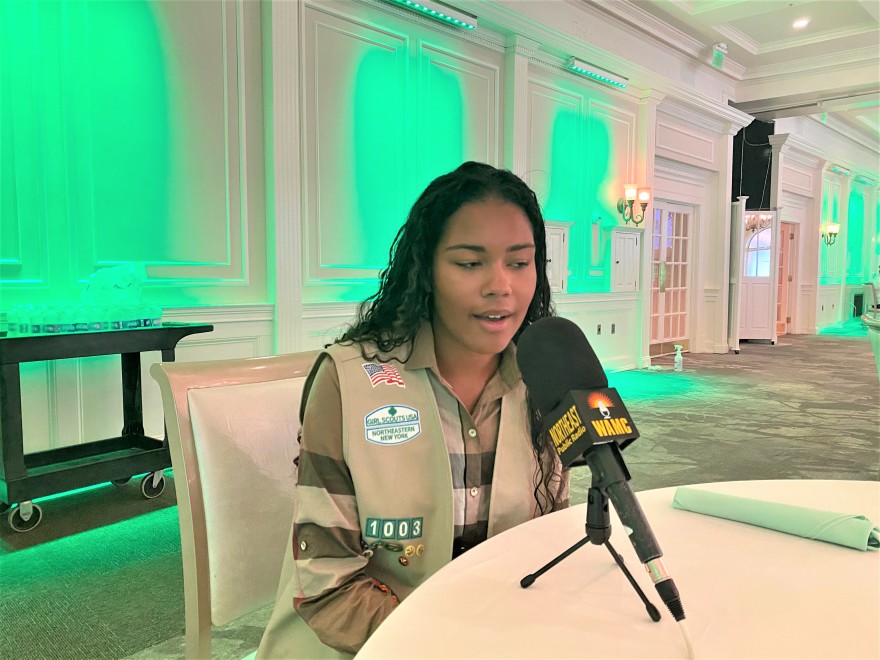
At the Girl Scouts Gold Award ceremony at Glen Sanders Mansion outside Schenectady, about 30 young
Credit Jackie Orchard / WAMC
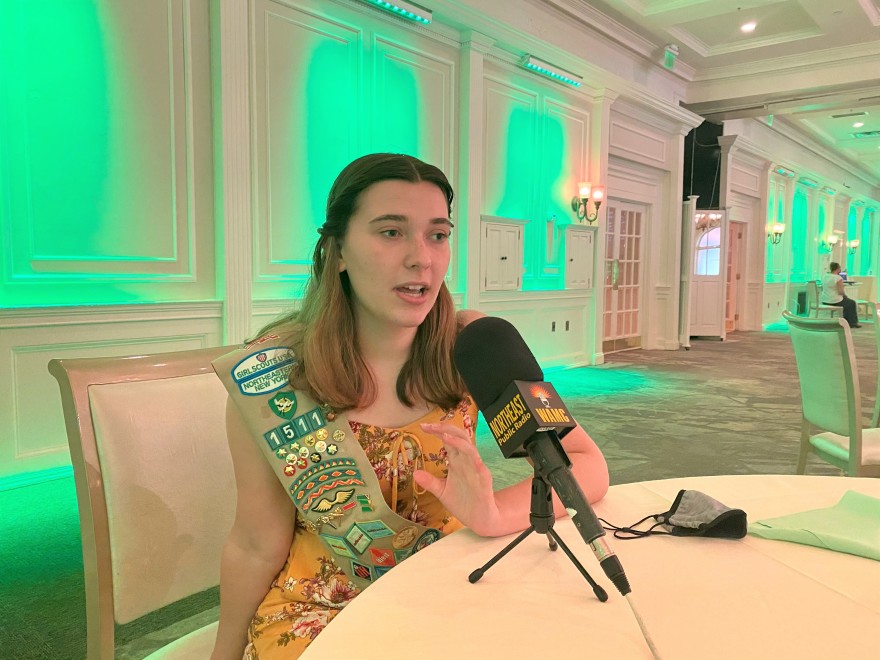
17-year-old Madison Mackey
women in sun dresses and sashes, joined by their parents, sit in a socially distanced banquet hall
with the walls backlit Girl Scout green.
17-year-old Madison Mackey joins me after all the awardees are announced. Mackey attends the Academy of the Holy Names in Albany, New York. She joined the Daises in kindergarten and is now a Cadet Senior Girl Scout.
“I think that girl scouts has really taught me leadership and just being able to be empowering to other women that are less fortunate in the community,” Mackey said.
Mackey just received “the Gold Award” – the highest award in the Girl Scouts – for her work during the COVID-19 pandemic over the past year.
“For my project I created an annual day at Academy of the Holy Names in Albany, New York, which allows girls to create reusable and washable menstrual kits in partnership with the Moon Catcher Project, who is a local nonprofit organization in Schenectady, New York, who makes reusable and washable menstrual kits for girls in third world countries, from Malawi to Zimbabwe, Haiti, Honduras, Kenya, all across Africa, some countries in the Caribbean, and a lot of underserved countries and communities,” Mackey said.
Mackey says she got the idea at a church event a few years ago, when they hosted the Moon Catcher Project, and locals participated in making the feminine hygiene kits.
“And I absolutely fell in love with the project once I was able to fully comprehend what it meant to be able to menstruate and really be able to relate to other girls that are not being able to go to school and missing up to 50 days of school a year because they are menstruating,” Mackey said. “And in these countries, the girls are considered ‘dirty’ or ‘soiled.’ And they have no access to menstrual products. So therefore they’re using plastic bags, mud, leaves, or they’re not going to school because they’re menstruating. And in their society, men are looking at them as objects. And because in these countries, the poverty is so bad, the girls are often getting married off because their families aren’t able to afford to care for them anymore. Because often these families are making 123 dollars a week. So they’re not able to care for their children, and they’re not being able to supply them with menstrual supplies. So they’re getting married off and they’re often getting pregnant at 13 years old.”
Mackey says the project helped her to navigate the pandemic, while the Girl Scouts were scaled back and largely virtual.
“I think that being able to work on my gold Service Award and really just kind of navigate through a pandemic,” Mackey said. “I was just really happy that I was able to kind of reinvent my project and what I was doing and being able to do tons of more virtual opportunities and virtual educational sessions to make people more aware of such an important global issue that impacts women, and especially as girls — like we can all relate to this issue. So I think that it was really important that I was still in Girl Scouts and I was still working on this award and just being able to have resilience to be able to navigate through a pandemic.”
Looking around the room at the Gold Awards, Mackey is the only Girl Scout of color. She also serves on the Board of Girl Scouts of Northeastern New York as the “Girl Member at Large.” She says she would like to see the Girl Scouts diversify, and reach out to underserved communities.
“Being an African American, I’m very fortunate to be able to live in a suburban town where there is a Girl Scout troop,” Mackey said. “But often in the city of Albany, there aren’t many Girl Scout troops and girls that live in like urban areas or in the city don’t really have access to a Girl Scout troop, because of just kind of geographical areas and also, like other African American troop leaders that would want to start a troop. But I think that it’s extremely important. And I think that that’s definitely one area where Girl Scouts can improve is just the outreach to the inner city, and being able to improve diversity within troops and within Girl Scouts itself.”
Mackey says Girl Scouts is more affordable than people might assume. She says the membership is $25 a year. She says there are scholarships and fundraisers for girls who can’t afford it. And she says it’s worth the time you put in.
“You have great exposure with the badges that you’re able to do,” Mackey said. “The community service work, giving back, just being able to be so involved I think is so important, and especially underserved kids that don’t usually have access, I think that it’s so important to be able to learn these skills and just be a part of a community and a sisterhood.”
Mackey is in troop number 1003. She is a junior in high school and says she plans to go to business school after she graduates.
“Right now I’m just in the college process of doing college visits and figuring out where’s the right fit for me,” Mackey said.
Mackey says people assume Girl Scouts is just for young girls.
“But as you grow older, I think that you learn more about other communities, about local and global issues, and ways that you can really reach back into the community,” Mackey said. “And I think that as you grow older in Girl Scouts, you’re really able to do a lot more and you have more opportunity and access to different opportunities that you can do. And just tons of experiences like sailing, going to Nassau, going to Washington, D.C., there’s tons of trips and opportunities that you’re able to do with Girl Scouts.”
In 2018, the Boy Scouts started accepting girls as Cub Scouts and in 2019 older girls were accepted into Eagle Scout programs. Mackey says she never even considered switching over.
“I actually never really thought of Boy Scouts at all,” Mackey said. “I thought that girl scouts was awesome. Like we were our own organization. We were doing awesome things. Everyone knew us for cookies. And I never really compared the two I honestly never even really looked into Boy Scouts because I love Girl Scouts so much and I’ve been so involved that boy scouts never really crossed my mind at all.”
Mackey says the pandemic has been challenging for young people, but she wants young women to keep their goals in sight. She says she lost her father during COVID-19, and helping others is what pulled her through her grief.
“My father passed away February 1, after a long battle of heart disease and heart failure,” Mackey said. “And after he passed away, I was feeling so down and I actually started a Facebook fundraiser for the Moon Catcher Project and for the month of March in support of women’s month. I raised over $3,000 for the Moon Catcher Project, which was amazing because in the midst of a pandemic, it was very hard to ship the materials to all of the different regions and countries within Africa because of the shipping delays with COVID. So the fundraiser really helped with progressing the project, and also being able to get the materials over and also making the kits as well. And my family then founded the Warren and Denise Mackey Foundation, which is in memory of my father that gives back to the local community, the Albany community, where we are giving back to underserved youth and elements of sports.”
Mackey says Girl Scouts has helped her to look outward.
“I think that it’s really important that even when you struggle with things in yourself, and just processing everything, being able to really give back and support other people,” Mackey said. “It’s just something that my father really emulated, with giving back to the Albany community and being such like a monumental figure here. And I just really wanted to be able to continue his legacy, especially with our families Foundation, with being able to give back.”
Brigid Mack
18-year-old Brigid Mack has been in the Girl Scouts for 11 years. She won her Gold Award for creating
Credit Jackie Orchard / WAMC
18-year-old Brigid Mack
sensory toys for children with special needs during the pandemic. She started by contacting the Wynantskill Community Special Education Parent-Teacher Association.
“To reach out to kids specifically with disabilities, and families who were in need of sensory toys, and sensory items that can maybe help in situations such as the COVID pandemic,” Mack said.
About 90 of these sensory bags have been distributed to families across the region with laminated story booklets explaining COVID regulations, like mask wearing and washing hands. Mack says children with disabilities struggled the most during the pandemic. She says she saw it first hand with her brother.
“He does have autism, and you know, kind of traveling with him and going about, you know, it comes with challenges, as it always does,” Mack said. “But with mask wearing, social distancing, they’re not always concepts that they’re used to, really anyone with disability and anyone in general, their routine is kind of stunted. Their usual day-to-day practices, they have to be changed, they have to be reconstructed. So that’s what the social stories help with is kind of reconstructing the ritual, the routine that they’re used to in the day. And it probably comes with a lot of stressors as well to have to change like that. And so those, the sensory toys are meant to help with that stress to kind of handle it in a more healthy way.”
Mack says a sensory toy can be anything from squishy sand to tiny lava-lamp bubbler toys you can endlessly flip to watch the colors change. Mack says many families accessed these toys in school, but the pandemic disrupted that access.
“I mean, we weren’t in school for like forever,” Mack said. “And then you’re not also not able to have access to those sensory toys like you were able to. Because you know, terms, you can’t you not all children can share those toys. So now, when I distributed those bags, to the children in the community, they were able to have their own set, they were able to take them wherever they wanted to, to have them ready available to them.”
Mack says the project provided an outlet when she was struggling with mental health issues, particularly in the winter, during pandemic lockdowns.
“I was kind of struggling to like, just keep up, keep focused and anything,” Mack said. “I myself have anxiety and OCD. And I was handling that very well up until the pandemic and once it started, I was definitely feeling not very myself, I was stuck home all the time — I did go to school. But as a hybrid schedule I was… I felt not myself, I guess. And I’m still struggling with that as well. And so but this project, even though it was a struggle to get through, it still was very much worth it like the hard work, it really meant something to me. And when it came to the process, making the sensory story, the social stories, that took a lot of a lot of time to laminate and then put the bags together. It was like task work, but it was good task work.”
She says the culmination of the project was when she distributed the sensory bags to families, in a park, socially distanced.
“It was like the first time I actually got to see the kids that I was doing this for,” Mack said. “This was in, I think it was the first weekend in November. And I got to see the kids, and I felt so lucky to meet them. And I got to see them use the bags and like enjoy all the stuff. And I got to notice like which ones they liked best. Like, I guess a favorite was like, I had these like rocks, these like smooth rocks in there, they’re kind of cool to the touch. A lot of the kids liked that. They were also squish balls, I use those, there was cloud dough, which is kind of like, it’s like a mix of playdough and kinetic sand. It’s really fun, I love it. And then also had like, these, like lava globes that this was actually a DIY project that I did that took up a lot of time as well to figure out and basically you can kind of swish it around and there was like little glitter and it’s made of like baby oil and water with food coloring in it was very fun to make and it’s very fun to watch and play with. So the kids really liked that too.”
Mack says that day in the park pulled some emotions out of her that had been festering during the pandemic.
“Me, my brother, and my mom, we went to McDonald’s after and I was crying at the drive thru and I’m like, ‘Mom, I miss people I miss — I miss seeing children.’ Like, I’m very used to being around children and I was like, ‘I missed this. I miss human connection,’” Mack said.
Mack attends Columbia High School in East Greenbush, New York. After that? SUNY Purchase, majoring in vocal performance in opera. She says later in her career she will likely focus on music therapy for those with special needs.
Board Chair Kristen Navarette
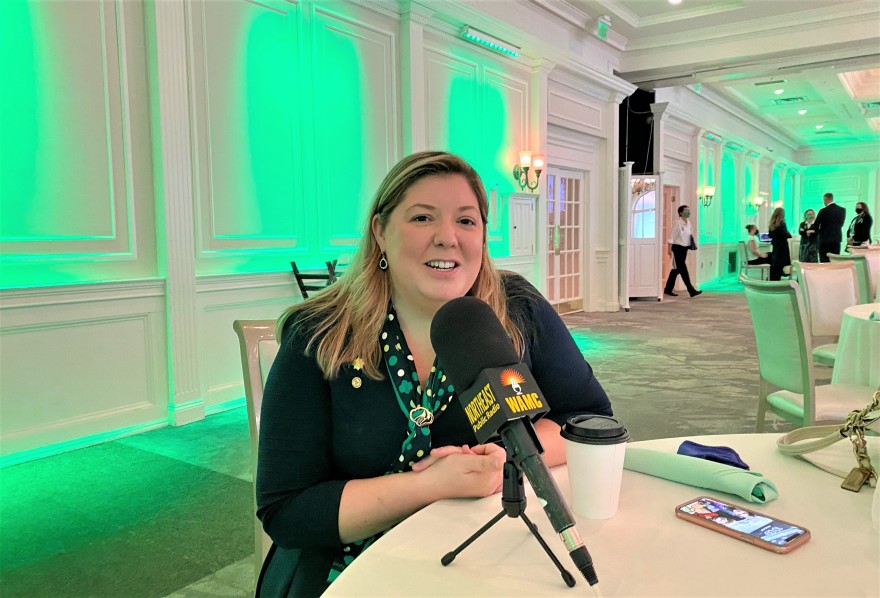
Dr. Kristen Navarette is Board Chair of Girl Scouts of Northeastern New York.
Credit Jackie Orchard / WAMC
Dr. Kristen Navarette, Board Chair of Girl Scouts of Northeastern New York.
“So we serve over 10,000 girls across a very large area that ranges all the way up to the Canadian border down into the Hudson Valley area, and over 5,000 adults and volunteers,” Navarette said.
Navarette says she is responsible for the “strategic vision,” of the Girl Scouts, making sure that they are providing a modern leadership program for the girls with opportunities that build girls “of confidence character” – who will make the world a better place. She says it’s a steep goal during a pandemic, especially for an organization that thrives on in-person education.
“We did a lot of virtual programming,” Navarette said. “Our camps this year, this past year, were virtual, a lot of troops moved to a virtual platform. And so we provided support to leaders so that they could be equipped to be able to do that. And so we saw them do incredible things, with new and innovative ways they were able to bring in guest speakers into troop meetings that maybe they hadn’t in the past, because sometimes it’s difficult to get someone physically in person. And they continue to do really cool things like coding, pottery, making jewelry for the younger ones. For the older ones, they certainly learned a lot about leadership skills. I know many of these girls are able to earn these highest awards using lots of various virtual platforms to meet with people and find out about the various needs for their project.”
Navarette says the Gold Awards represent the completion of a leadership journey for the girls.
“They go on this journey to identify needs in their community, build a team, put that together, to then accomplish their goals to addressing the issue that they see,” Navarette said. “So, for Girl Scouts, it really is the highest award. And it’s quite challenging. One of the important components of the Gold Award Girl Scout achievement is to ensure sustainability. So whatever they put into place, whatever solution they find, to find a way to make sure that once they move on to the next thing in life, that that solution persists. So that that problem doesn’t continue, even after they’ve moved on.”
Navarette says the girls rose to the occasion this year in a way she never could have imagined.
“The Gold Award is an incredibly difficult achievement to accomplish at a normal year,” Navarette said. “And so to be presented with all the various challenges that they were this year, and they had to be incredibly flexible and resilient — having to shift, whether it was the original solution couldn’t be done in this new world of COVID because of various COVID restrictions, even just trying to meet with people to learn about the various needs and get their goals accomplished. All had to be done in new and innovative virtual ways. And so it’s a real testament to their incredible leadership skills and the value that they’re bringing to the world as leaders.”
From its founding in 1912, the Girl Scouts declared itself open to all girls.
Still during segregation, the first troop for Black girls was formed in 1917.
In 1956, after an interracial Girl Scouts troop formed in Kentucky, Martin Luther King Jr. called the Girl Scouts “a force for desegregation.”
Nineteen years later, the first African American Girl Scouts of USA President, Dr. Gloria Scott, was elected. And Girl Scouts partners with historically Black colleges and universities, companies, and organizations to make the organization more accessible to the Black community.
In 2020, Judith Batty made history as the first Black woman to lead the Girl Scouts USA.
Navarette says diversifying the Girl Scouts is still a priority.
“Our mission is to serve all girls,” Navarette said. “And so we really have been undertaking initiatives to look at how we are serving girls to make sure that we are including everyone. We do have a diversity, equity and inclusion Task Force who are making recommendations about how we can make sure that we are able to reach out to all communities and make sure that all communities feel welcomed at Girl Scouts. We’re also looking at our programming to make sure that it meets families where they are. We recognize that families come from all different backgrounds. And so we want to make sure that our model is flexible enough that all families can find a way to feel welcomed and included in Girl Scouts. And we also have an after school program that we are working to reinstitute again — during the pandemic It was difficult with all the challenges in schools. And so we’re very excited and looking forward to bring back that after school program in the inner city area as that is probably a great way to help serve a lot of our families.”
Navarette says she isn’t bothered by Girl Scouts wanting to become Eagle Scouts.
“We are the preeminent leadership organization for girls,” Navarette said. “And so we really want to make sure that we’re delivering a high quality program that girls want to be a part of, we really are the girl experts. And so we want to make sure that girls see us that way, and therefore want to be a part of our organization. We certainly welcome girls to explore all the opportunities that are out there, though.”
Navarette says there’s nothing the Boy Scouts offer that the Girl Scouts are lacking.
“And I can say that having been a Girl Scout, as a Girl Scout leader, and now even as board chair, you know, we provide everything from the STEM activities, to the more traditional outdoor experience, that’s actually one of my favorite parts of Girl Scouts, we just took our girls to do an outdoor day where they learned survival skills, and went canoeing, and boating and had all kinds of fun out at our camp,” Navarette said. “So we really provide very broad programming, and it’s very girl led, which I think is one of the challenges sometimes is that, you know, not all girls have the same interest sometimes. And so, you know, it’s a pick your own adventure at times. And so we want to make sure that girls know that in Girl Scouts, they get to choose what they want to do.”
Navarette says the Girl Scouts is LGBTQ friendly.
“Anyone who identifies as a girl is absolutely welcomed in Girl Scouting,” Navarette said. “We are the preeminent leaders of organizations for girls. And so anyone who identifies as a girl is absolutely welcome to be part of our sisterhood.”
Navarette says the most common misconception about the Girl Scouts is that it’s just a bunch of girls doing arts and crafts on the weekend.
“And I think that’s one of the challenges is — to try to break that myth,” Navarette said. “And again, put the emphasis on the fact that we really offer a very diverse set of opportunities, you can really do anything that your heart wants to do or that your imagination can lead you to want to do those opportunities that are available in Girl Scouts. So whether you want to become a rocket scientist and learn about space, or you want to become a coder, if you want to go and be a great artist, if you want to go and be an outdoor wilderness survival experts, you can get all of those foundations and Girl Scouts.”
Navarette says COVID has hit some people hard, and she understands if families can’t pay for any “extra” activities right now. She says membership is $25 and other small activity fees can add up to about $100 per year.
“Our core mission is to serve all girls and give them a really excellent leadership experience,” Navarette said. “So we do offer scholarship opportunities. So I would say to anyone who is concerned about financial issues with being part of the Girl Scouts, please don’t let that dissuade you from joining the organization and providing that experience for your girl.”
Navarette says this is the time to join.
“We are at a time in history where girls are really being able to start taking leadership opportunities and take advantage of those that weren’t necessarily available to them historically,” Navarette said. “And so I think looking for opportunities where girls can really build those skills is really, really important. And so I think like for all the opportunities, including here at Girl Scouts, is a really important thing for all families to think about how they’re going to get those girls, those experiences and those skills to help them be the leaders and the next generation that are going to really make a difference in our world.”
According to the 2017 “State of Girls” report on GirlScouts.org, the most recent report, girls are increasingly struggling with obesity, marijuana use, and emotional health. In 2007, 19% of high school girls had considered suicide. In 2015, that number jumped to 23 percent.
In the United States, there are about 2.5 million Girl Scouts — including 750,000 adult members who work as volunteers with over 100 local Girl Scout councils. More than 50 million women in America have been in the Girl Scouts.
According to the Pew Research Center, in 2018 only 5% of CEOs and 12% of other top executives in the S&P 500 were women.
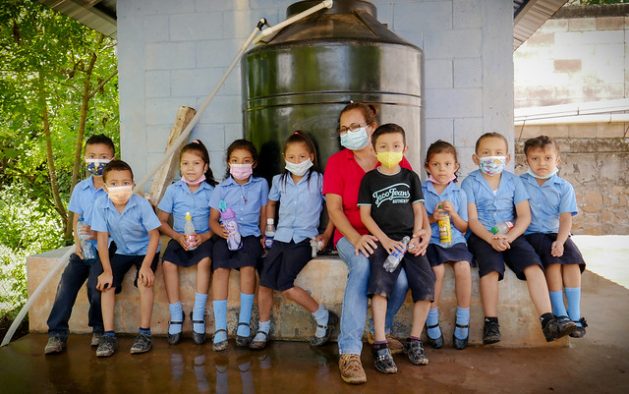
Angélica María Posada, a teacher and school principal in the village of El Guarumal, in eastern El Salvador, poses with primary school students in front of the school where they use purified water collected from rainfall, as part of a project promoted by FAO and Mexican cooperation funds. The initiative is being implemented in the countries of the Central American Dry Corridor. CREDIT: Edgardo Ayala/IPS
SENSEMBRA, El Salvador , Jun 23 2021 (IPS) – At the school in El Guarumal, a remote village in eastern El Salvador, the children no longer have to walk several kilometers along winding paths to fetch water from wells; they now “harvest” it from the rain that falls on the roofs of their classrooms.
“The water is not only for the children and us teachers, but for the whole community,” school principal Angelica Maria Posada told IPS, sitting with some of her young students at the foot of the tank that supplies them with purified water.
The village is located in the municipality of Sensembra, in the eastern department of Morazán, where it forms part of the so-called Central American Dry Corridor, a semi-arid belt that covers 35 percent of Central America and is home to some 11 million people, mostly engaged in subsistence agriculture.
In the Corridor, 1,600 kilometers long, water is always scarce and food production is a challenge, with more than five million people at risk of food insecurity.
In El Guarumal, a dozen peasant families have dug ponds or small reservoirs and use the rainwater collected to irrigate their home gardens and raise tilapia fish as a way to combat drought and produce food.
“We are all very proud of this initiative, because we are the only school in the country that has a (rainwater harvesting) system like this.” — Angélica María Posada
This effort, called the Rainwater Harvesting System (RHS), has not only been made in El Salvador.
The aim of the RHS was to create the conditions for poor, rural communities in the Dry Corridor to strengthen food security by harvesting water to irrigate their crops and raise fish.
In Guatemala, work has been done to strengthen an ancestral agroforestry system inherited from the Chortí people, called Koxur Rum, which conserves more moisture in the soil and thus improves the production of corn and beans, staples of the Central American diet.
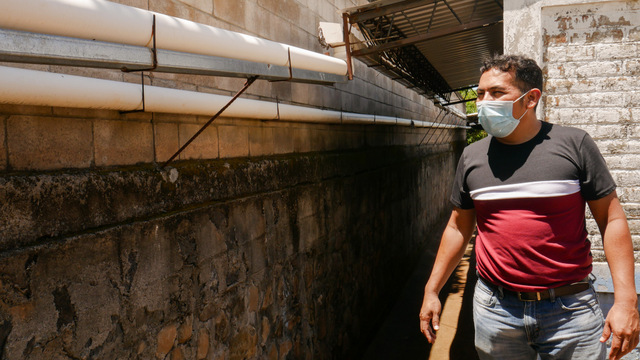
José Evelio Chicas, a teacher at the school in the village of El Guarumal, in El Salvador’s eastern department of Morazán, supervises the PVC pipes that carry rainwater collected from the school’s roof to an underground tank, from where it is pumped to a filtering and purification station. The initiative is part of a water harvesting project in the Central American Dry Corridor. CREDIT: Edgardo Ayala/IPS
“The best structure for conserving water is the soil, and that is where we have to work,” Baltazar Moscoso, national coordinator of Mesoamerica Hunger Free, told IPS by telephone from Guatemala City.
Healthy schools in El Salvador
The principal of the El Guarumal school, where 47 girls, 32 boys and several adolescents study, said that since the water collection and purification system has been in place, gastrointestinal ailments have been significantly reduced.
“The children no longer complain about stomachaches, like they used to,” said Posada, 47, a divorced mother of three children: two girls and one boy.
She added, “The water is 100 percent safe.”
Before it is purified, the rainwater that falls on the tin roof is collected by gutters and channeled into an underground tank with a capacity of 105,000 litres.
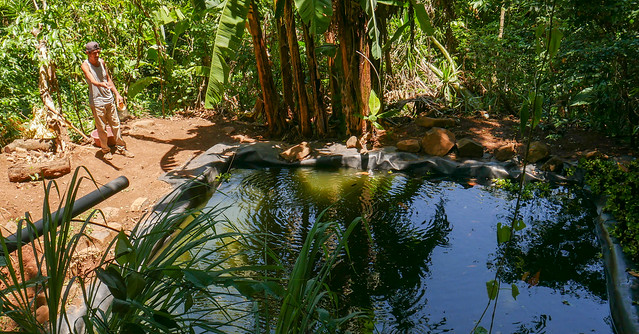
Farmer Cristino Martínez feeds the tilapia he raises in the pond dug next to his house in the village of El Guarumal in eastern El Salvador. A dozen ponds like this one were created in the village to help poor rural families produce food in the Central American Dry Corridor. CREDIT: Edgardo Ayala/IPS
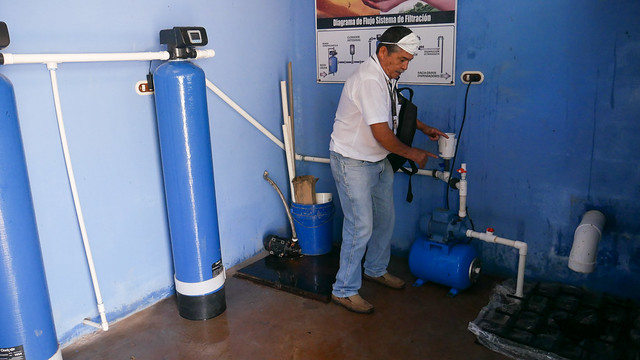
It is then pumped to a station where it is filtered and purified, before flowing into the tank which supplies students, teachers and the community.
The school reopened for in-person classes in March, following the shutdown declared by the government in 2020 to curb the spread of the COVID-19 pandemic.
“We are all very proud of this initiative, because we are the only school in the country that has a system like this,” added the principal.
There are 40 families living in El Guarumal, but a total of 150 families benefit from the system installed in the town, because people from other communities also come to get water.
A similar system was installed in 2017 in Cerrito Colorado, a village in the municipality of San Isidro, Choluteca department in southern Honduras, which benefits 80 families, including those from the neighbouring communities of Jicarito and Obrajito.
Rainwater is filtered and purified in a room adjacent to the classrooms of the school in the village of El Guarumal, in the eastern department of Morazán, El Salvador. Gastrointestinal ailments were reduced with the implementation of this project executed by FAO and financed by Mexican cooperation funds. CREDIT: Edgardo Ayala/IPS
Vegetable gardens and tilapias boost food security
About 20 minutes from the school in El Guarumal, following a narrow dirt road that winds along the mountainside, you reach the house of Cristino Martínez, who grows tomatoes and raises tilapia in the pond dug next to his home.
The ponds are pits dug in the ground and lined with a polyethylene geomembrane, a waterproof synthetic material. They hold up to 25,000 litres of rainwater.
“The pond has served me well, I have used it for both the tilapia and watering tomatoes, beans and chayote (Sechium edule),” Martínez told IPS, standing at the edge of the pond, while tossing food to the fish.
The cost of the school’s water harvesting system and the 12 ponds totaled 77,000 dollars.
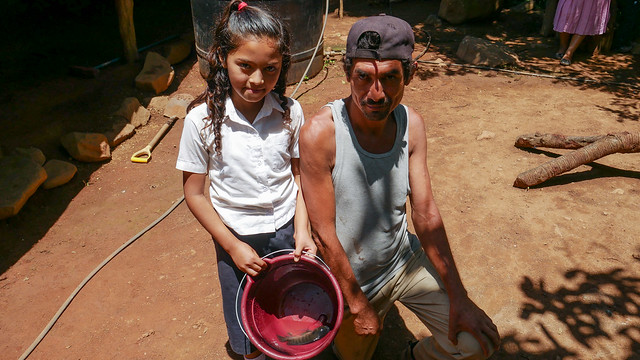
Martínez has not bothered to keep a precise record of how many tilapias he raises, because he does not sell them, he said. The fish feed his large family of 13: he and his wife and their 11 children (seven girls and four boys).
And from time to time he receives guests in his adobe house.
“My sisters come from San Salvador and tell me: ‘Cristino, we want to eat some tilapia,’ and my daughters throw the nets and start catching fish,” said the 50-year-old farmer.
Cristino Martínez and one of his daughters show the tilapia they have just caught in the family pond they have dug in the backyard of their home in the village of El Guarumal in the eastern department of Morazán, El Salvador. The large peasant family raises fish for their own consumption and not for sale. CREDIT: Edgardo Ayala/IPS
According to FAO estimates, the ponds can provide about 500 fishes two to three times a year.
The ponds are built on the highest part of each farm, and the drip irrigation system uses gravity to water the crops or orchards planted on the slopes.
Tomatoes are Martínez’s main crop. He has 100 seedlings planted, and manages to produce good harvests, marketing his produce in the local community.
“The pond helps me in the summer to water the vegetables I grow downhill,” another beneficiary of the programme, Santos Henríquez, also a native of El Guarumal, told IPS.
Henríquez’s 1.5-hectare plot is one of the most diversified: in addition to tilapias, corn and a type of bean locally called “ejote”, he grows cucumbers, chili peppers, tomatoes, cabbage and various types of fruit, such as mangoes, oranges and lemons.
“We grow a little bit of everything,” Henríquez, 48, said proudly. He sells the surplus produce in the village or at Sensembra.
However, some beneficiary families have underutilised the ponds. They were initially enthusiastic about the effort, but began to let things slide when the project ended in 2018.
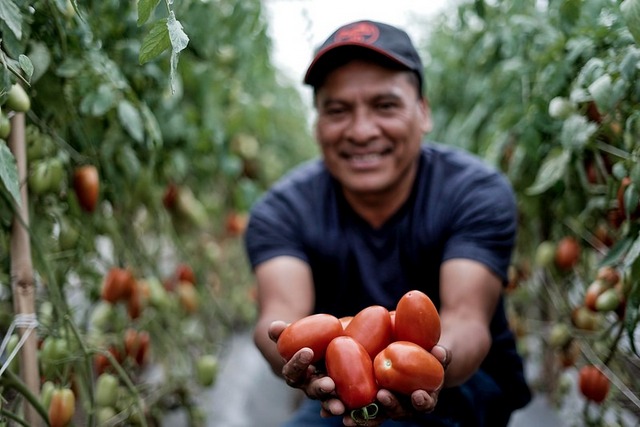
A farmer proudly displays some of the tomatoes he has grown in the region known as Mancomunidad Copán Chortí in eastern Guatemala, which includes the municipalities of Camotán, Jocotán, Olopa and San Juan Ermita, in the department of Chiquimula. Water harvesting initiatives have been implemented in the area to improve agricultural production in this region, which is part of the so-called Central American Dry Corridor. The initiative is supported by FAO and Mexican cooperation funds. CREDIT: FAO Guatemala
An ageold Chorti technique in Guatemala
In Guatemala, meanwhile, some villages and communities are betting on an agroforestry technique from their ancestral culture: Koxur Rum, which means “wet land” in the language of the Chortí indigenous people, who also live in parts of El Salvador and Honduras.
The system allows corn and bean crops to retain more moisture with the rains by combining them with furrows of shrubs or trees such as madre de cacao or quickstick (Gliricidia sepium), a tree species that helps fix nitrogen in the soil.
By pruning the trees regularly, leaves and crop stubble cover and protect the soil, thereby better retaining moisture and nutrients.
“Quickstick sprouts quickly and gives abundant foliage to incorporate into the soil,” farmer Rigoberto Suchite told IPS in a telephone interview from the village of Minas Abajo, in the municipality of San Juan Ermita, Chiquimula department in eastern Guatemala, also located in the Central American Dry Corridor.
Suchite said the system was revived in his region in 2000, but with the FAO and Amexcid project, it has become more technical.
As part of the programme, some 150 families have received two 1,500-litre tanks and a drip irrigation system, he added.
“Now we are expanding it even more because it has given us good results, it has improved the soil and boosted production,” said Suchite, 55.
In the dry season, farmers collect water from nearby springs in tanks and, using gravity, irrigate their home gardens.
“Many families are managing to have a surplus of vegetables and with the sales, they buy other necessary food,” Suchite said.
The programme is scheduled to end in Guatemala in 2021, and local communities must assume the lessons learned in order to move forward.
JEDDAH, Saudi Arabia , Jun 23 2021 (IPS) – Earlier this month, Abdulla Shahid, the Maldives’ foreign minister, was elected President of the 76th Session of the United Nations General Assembly (UNGA), which commences in September.
This is the sixth time a candidate from a Small Island Developing State (SIDS) has been elected to steer the work of the UN’s highest policy-making organ during its 76-year history:
Rudy Insanally of Guyana became the first president of the General Assembly elected from the UN-SIDS category in 1993; followed by Saint Lucia’s Julian Hunte in 2003; Haya Rashed Al-Khalifa of Bahrain in 2006; and the late John William Ashe of Antigua and Barbuda in 2013, while Peter Thomson of Fiji, took the helm during the GA’s 71st session in 2016.
It may seem surprising that such small nations have so frequently been named to this high position—the aggregate population of all SIDS is only 65 million, less than one percent of the global population—but the UN’s 38 SIDS constitute one fifth of the international organization’s total voting membership.
This position gives SIDS outsized power as a voting bloc, which they have wielded to great effect, perhaps most significantly when it comes to climate change, which as we will see has benefited the entire global community.
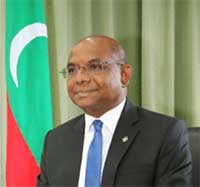
Abdulla Shahid. Credit: United Nations
Far from representing a monolithic group, SIDS hail from every region of the world and are home to dozens of languages and a wide variety of social and economic characteristics. Some, like Guyana and Belize, are not even islands, but they all share unique social, economic and environmental vulnerabilities (like size, remoteness, and limited resources base) that the UN has recognized a distinct group of developing countries since 1992.
They are also highly vulnerable to the impacts of climate change, like extreme weather, sea level rise, and biodiversity loss, making them natural allies in the fight to cut the greenhouse gas emissions responsible for the crisis.
In fact, in 1989, the Maldives hosted one of the first international conferences on sea level rise, a consequential event in the international climate change fight and the inspiration for the creation of the Alliance of Small Island States (AOSIS), which has been credited to establish the the United Nations Framework Convention on Climate Change in 1992 and winning the inclusion of the 1.5 degree Celsius temperature goal in the Paris climate accord in 2015, the latter during the Maldives chairmanship of the group.
SIDS have also shown critical leadership in the creation of the UN’s Sustainable Development Goals (SDGs).
In 2014, SIDS helped lead the negotiations, ultimately creating what is known as the SAMOA Pathway, a blueprint to ensure priorities of SIDS were reflected in the final 17 SDGs.
Before that, John William Ashe skillfully set the stage for the SDGs by working with larger countries to create a process for the SDGs that truly had global buy in.
All along, SIDS main argument that the specific challenges they face need to be given special consideration, and today a number of the SDGs do just that, including sustainable management of fisheries, aquaculture, and tourism. Such recognition was further solidified in 2015 as part of the Addis Ababa Action Agenda adopted at the UN Conference on Financing for Development and again that year in the Sendai Framework for Disaster Risk Reduction.
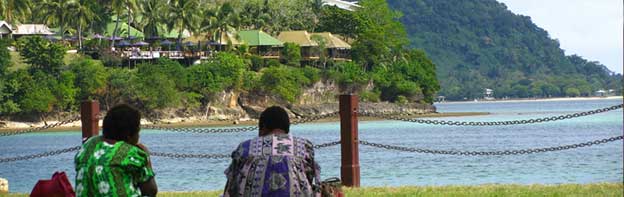
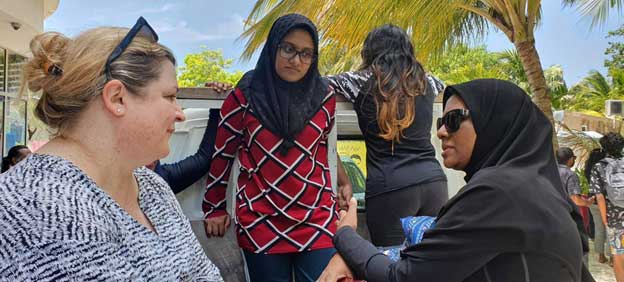
Catherine Haswell, the UN Resident Coordinator in the Maldives (left) meets a group of local women. May 2021. Credit: UN Maldives/Nasheeth Thoha
Unsurprisingly, another theme that has emerged in SIDS international diplomacy over the years is ocean conservation. In December 2017, under Peter Thomson’s leadership, the General Assembly decided to convene negotiations towards an international legally binding instrument under the UN Convention on the Law of the Sea (UNCLOS) on the conservation and sustainable use of marine biological diversity of areas beyond national jurisdiction, what is known as the high seas.
Thomson was also instrumental in developing the UN Ocean Conference that sets out to conserve and sustainably use ocean resources.
SIDS’ important endeavors during the General Assembly not only showcase the value of their contributions there, but of the GA itself, a place where all 193 UN countries, large and small, can elevate their concerns.
During the campaign for the post competing with Zalmai Rassoul, the candidate from Afghanistan, the Maldives’ Shahid launched “a presidency of hope”, noting that his priorities during the year-long presidency are to recover from the Covid-19 pandemic and rebuild economies better and greener.
“The General Assembly can boost efforts towards greater climate action” and “renew momentum” on issues of energy, biological diversity, sustainable fisheries, desertification and the oceans – that are at the heart of SIDS’ concerns.
The UN Secretary General Antonio Guterres, while welcoming the new President-elect Shahid commended his “selection of hope as the central theme in his vision statement” and noted that, “coming from a small island developing state, Mr. Shahid will bring unique insights to the 76th session of the General Assembly, as we prepare for COP26 in Glasgow in November.”
Shahid’s election, as with the SIDS leaders before him, not only offers new hope for islands, but the whole international community. At this precarious moment in history, it is truer than ever that by promoting the interests of SIDS, what we are really doing is protecting the future of mankind.
Ahmed Sareer was the Ambassador/ Permanent Representative of the Maldives to the United Nations from 2012 to 2017 and chairman of the Alliance of Small Island States from 2015 to 2017. He is presently serving at the General Secretariat of the Organization of Islamic Cooperation (OIC) based in Jeddah.
SAN FRANCISCO (KGO) — The state of the pandemic is always changing-but one thing is certain. There are still plenty of safe and fun activities that you and your family can do to create a “better weekend.” ABC7’s Jobina Fortson has a list of events happening where you live.
Weekend of October 22 – 24
The Alameda County fair kicks off Friday under the theme “Come Together” – as organizers celebrate the revival of the fair after a series of COVID-19 related closures. Live concerts are back at 8 p.m. nighty! Fair favorites like the carnival and pig Racing will return, and so will all that fried, greasy, cheesy, but oh-so-delicious food. The fair is operating under state and county safety protocols and will have sanitizing stations and touchless payment options on hand.
Join ABC7 Meteorologist Mike Nicco at the Walk to End Alzheimer’s at Bishop Ranch in San Ramon, or you can walk on your own at home. The Walk to End Alzheimer’s is full of flowers, each carried by someone committed to ending the disease. The event is raising awareness and funds for a breakthrough in the fight against Alzheimer’s and all other forms of dementia.
How about winding down your weekend with some Beethoven? The San Francisco Civic Music Association is presenting its first FREE concert of the 2021-2022 season at the Herbst Theater this Sunday. Enjoy!
Event availability may be subject to change. Always be sure to check the event’s official website before planning your weekend!
Alameda County Fair Pleasanton 10/22/2021 Forget pumpkin spice lattes, this fall the smell of corn dogs is what’s filling the air as the Alameda County Fair returns to Pleasanton October 22 -31. The 2021 theme “Come Together” celebrates the revival of the Fair and the community reuniting safely after nearly a year and a half of COVID-19 related closures.
Outlaw Music Festival Mountain View 10/23/2021 With Willie Nelson and the Avett Brothers.
Oxbow Riverstage: Death Cab for Cutie Napa 10/23/2021 Death Cab for Cutie will perform at the Oxbow RiverStage in Downtown Napa on Saturday, October 23rd, 2021! Illuminati hotties will open the show.
USS Hornet: History Mystery “After-Hours” Tour Alameda 10/22/2021 Your behind-the-scenes tour includes areas aboard the USS Hornet that have not yet been opened to the public, virtually untouched since the ship’s decommissioning over forty years ago, as well as other eerie spaces that have been reported to host unseen visitors.
International Stuttering Awareness Day Community Celebration San Francisco 10/22/2021 Join PROUD STUTTER Podcast co-hosts and creators Maya and Cynthia to celebrate verbal diversity on International Stuttering Awareness Day. This event celebrates all forms of diversity. We can’t wait to drink, eat and be merry with you!
Goblin Jamboree 2021: Bay Area Discovery Museum Sausolito 10/23/2021 Celebrate the spooky season at the Bay Area Discovery Museum! Goblin Jamboree returns for a week-long celebration packed with Halloween themed programs and frightful delights. Capacity is limited for these special themed days.
‘The Great Pumpkin South City’ Halloween 2021 South San Francisco 10/23/2021 Time to get into the Halloween spirit with this fun event for all community members to enjoy! Join fellow community members for a fun Halloween event. The afternoon will be filled with activities for all ages including a pumpkin patch, games, Zombie Zone, and much more!
A Halloween Drag Queen Brunch 2021: The Vault Garden San Francisco 10/24/2021 High kick your Halloween into high gear with Ducal Council’s newly-crowned Grand Duchess, Bobby Friday & Friends for a wildly fun & fantastic spook-tactular Halloween-themed show. Channel your favorite Queen and get the royal treatment at The Vault Garden this spooky season. Tickets are $69 and include a 3-course brunch including sweets, savory and everything in between.
Embarcadero Center Photo Contest San Francisco 10/22/2021 Do you want to win a gift card to any Embarcadero Center retailer of your choice? Enter the Embarcadero Center Photo Contest to win! Enter to win by locating murals throughout the center and taking a photo of yourself. Full rules at the website.
Ocean Avenue Halloween Block Party San Francisco 10/23/2021 Ocean Avenue’s community leaders are back to do what they do best — put on another spectacular Halloween block party! OMI Cultural Participation Project joins together with SF African American Early Childhood Educators, Ocean Incubators, Ingleside Merchants Association and OMI Community Collaborative to throw the annual “Halloween Block Party” on Saturday, October 23rd, 2021 starting at noon. Trick or treat yourself to the free event, open to the public. All community members are invited to mingle, play games and show off their scariest looks on Faxon Avenue, while enjoying some music from the DJ.
Masquerade Halloween Party at Selfie Market San Francisco 10/23/2021 The Selfie Market presents Masquerade is a music themed costume event. Dress like your favorite pop-star, hip-hop artist, rocker, hippie, studio54 or maybe best music era. Live DJ spinning, special effects through the space. Capture your best moments in over 30 installations themed all about music.
Spirits of the Barbary Coast: A Haunted Pub Crawl San Francisco 10/22/2021 Starting at High Horse in the Jackson Square Historic District, we’ll spend an evening in the very oldest parts of the City. Learn the history and lore of the Barbary Coast, North Beach, and Chinatown. We’ll hear about a miner who solved his own murder, star crossed lovers of the Gold Rush Days, and SF’s long standing reputation as a place of pleasure and vice. Max 15 people.
Hayes Valley Pet Parade San Francisco 10/23/2021 FREE EVENT! HVAW and SFWalkies are organizing a Doggie Costume Parade! More details to follow from our cohosts, SFWalkies! From 11 AM to 1 PM on Saturday, October 23. Bring your hat in their best costume or come look through our box of potassium’s or buy a costume from one of our sponsors.
39TH Annual LEAP Sandcastle Classic San Francisco 10/23/2021 Leap Arts in Education is back at Ocean Beach to host the largest sandcastle contest in Northern California; featuring team competition, food trucks, and music all day. The 2021 theme is “Onward & Upward!” and the public is invited to join in the fun and experience the construction of dozens of jaw-dropping, supersized sand sculptures.
Shipyard Open Studios 2021 San Francisco 10/23/2021 The Hunters Point Shipyard Artists offer the public an opportunity to explore this singular creative community in one fell swoop this fall during its Shipyard Open Studios, connecting with over one hundred art makers in their spaces and supporting them directly with purchases of their work. Open Saturday, October 23 and Sunday, October 24 from 11am-6pm, this is a rare chance for visitors to visit the Shipyard, which is only open to the public twice a year for artist events. The public is invited to drop in anytime over the weekend free of charge to enjoy this lively gathering of artists in their studios, located within six adjacent Shipyard buildings. Local food vendors and musical entertainment are planned as well. Parking is plentiful.
Almanac’s Backyard Hootenanny Alameda 10/22/2021 Join us for an Almanac Backyard Hootenanny! We’ve got pumpkins and hay bales galore for a picture-perfect photo-op, food specials including kettle corn and pumpkin ice cream, beer specials, cider, and bluegrass bands rocking all 3 days!
“ShakesFEAR in the Dark” Zombies Vallejo 10/22/2021 Are you prepared for the Zombie Scourge? Enter at your own risk! Participants will be led through our Zombie Apocalypse where our world has been overrun by the undead. But not to worry. Tourists to our Zombie Experience will be socially distanced from the biting Zombies as long as they stay on the lighted path and listen to their guide.
Red Bull “Short Circuit” Indoor Bike Race on Go-Kart Track South San Francisco 10/22/2021 Red Bull Short Circuit is a brand new high-octane, heart-pounding, limit-testing fixed gear elimination race on an indoor go-kart track. 144 lucky riders will enter the arena, battling their way through qualifying, semi-final, and final rounds, but only one rider will emerge victorious. Success in an elimination race – where the last rider to cross the line every lap is eliminated – requires more than just pure strength: lightning-quick reflexes and split-second decision-making could mean the difference between winning and losing. Free to watch!
Harvest Festival at Alemany Farm San Francisco 10/23/2021 Celebrate the fall season with your family and friends! Come to Alemany Farm for food and autumn-themed activities including: live music, winter crop plant sale, make-your-own-salt scrubs, veggie pickling, garlic planting, farm tours, beekeeping showcase, and more!
SF’s Museum of the African Diaspora (MoAD) Reopening Community Free Day San Francisco 10/23/2021 The Museum of the African Diaspora reopens for the first time since the start of the pandemic this October and is celebrating with a free admission Community Day on Saturday, October 23! With renovations complete to the Museum’s lobby, theater, and gallery spaces, the highly anticipated reopening features a line-up of original exhibitions including first-time solo museum exhibitions of work by two of Africa’s most important contemporary artists working on the international stage today-Ghanaian painter Amoako Boafo and Malawi-born, Johannesburg-based artist Billie Zangewa. In addition, there will be a site-specific installation by San Francisco-based artist Sam Vernon in the newly redesigned lobby; the work of San Francisco multimedia artist Sydney Cain as part of the Museum’s Emerging Artist Program; and a presentation of short films by contemporary African artists curated by Leila Weefur in the newly upgraded theater.
SF’s Mini Renaissance Faire San Francisco 10/23/2021 Come join in the fun of a Renaissance Faire inspired event held outdoors in the beautiful City of San Francisco. Spend an afternoon hearing great madrigals, engaging with our singers and players, and enjoy entertainment the whole family can enjoy. This is a first for SFRV as we engage our patrons, fans, and newcomers in this jovial afternoon. Attendees are encouraged to dress in Renaissance attire and to fully participate in the exhilarating afternoon perfect for fans of all ages. Bring your own picnic blankets or lawn chairs and take in beautiful music with some of San Francisco’s most captivating views!
SF Civic Symphony’s Free Fall Concert at Herbst Theater San Francisco 10/24/2021 The San Francisco Civic Music Association presents our first FREE concert of the 2021-2022 season. Performances include Beethoven’s “Dankgesang” from Op. 132 String Quartet, Mendelssohn’s String Symphony No. 8 in D.
Lakehouse Jazz San Francisco 10/22/2021 Enjoy Lakehouse Jazz, a unique and intimate concert experience in the iconic Golden Gate Park at a hidden and iconic boathouse. As Karl the Fog moves over the lake and covers a slew of colorful boats, we’ll sit inside our intimate and improvised concert venue where the music of the best musicians in the Bay Area and a glass of beer or wine will be the perfect way to unwind your week. By attending this event not only you’ll listen and learn jazz from some of the best musicians in The Bay Area but also, you’ll be actively supporting the local art scene and its musicians.
Street Art Festival at Pier 70 San Francisco 10/23/2021 Bring the family, your friends, your neighbors or just yourself for an immersive art experience with leading street artists. Watch the artists painting live or participate and learn the art of mural painting and together transform an outdoor wall at Pier 70 into an explosion of colors and creativity. Talking Walls orchestrates the day of spray, play and learning – paint with muralists and unleash your creative side. Enjoy food from La Cocina’s Kayma Algerian Eatery. The workshop fee covers the cost for materials to paint with Talking Walls artists.