


Aid, Caribbean Climate Wire, Civil Society, Climate Action, Climate Change, Conferences, Development & Aid, Environment, Headlines, Humanitarian Emergencies, Latin America & the Caribbean, Small Island Developing States, Sustainable Development Goals, TerraViva United Nations
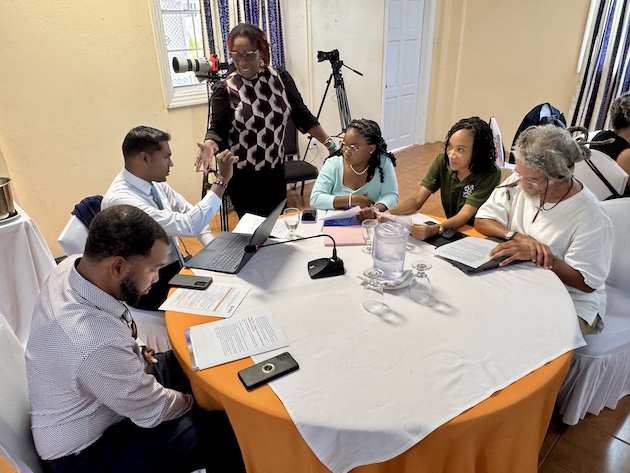
Civil society representatives in discussion during the first day of the Caribbean convening organised by the Fossil Fuel Treaty Initiative. Credit: Alison Kentish/IPS
– As the world edges closer to breaching key climate thresholds, Caribbean policymakers, scientists and civil society leaders gathered in Saint Lucia this month to coordinate the region’s position ahead of a landmark global meeting on transitioning away from fossil fuels.
The two-day convening, held on 2–3 March, brought together civil society representatives and government officials under the umbrella of the Fossil Fuel Treaty Initiative to discuss the Caribbean’s priorities for the upcoming First International Conference on the Phase-Out of Fossil Fuels in Colombia.
The conference, scheduled for late April in Santa Marta and co-hosted by Colombia, The Netherlands, and Tuvalu, is expected to examine strategies for a unified global transition away from fossil fuels, including financing, governance, and legal structures.
For Caribbean nations reeling from climate impacts, the discussions are far from theoretical.
“Our exposure to climate impacts is acute,” said Dr James Fletcher, climate envoy for CARICOM, in opening remarks to the gathering. “The transition is both an existential necessity and a structural transformation challenge.”
Preparing the Region’s voice
The Saint Lucia meeting was structured across two days: the first dedicated to civil society organisations and the second to government technical officials.
Organisers said the goal was to ensure both groups enter the Santa Marta conference with clear priorities and a coordinated regional position.
The Caribbean has historically played an outsized role in global climate diplomacy. Small island states were instrumental in securing the 1.5°C temperature target within the landmark Paris Agreement, despite contributing only a fraction of global greenhouse gas emissions.
Yet that goal now appears increasingly fragile.
“We will overshoot 1.5 degrees Celsius — at least temporarily,” Fletcher told participants. “The question we now have to grapple with is for how long and by how much.”
Scientists warn that without deep cuts to greenhouse gas emissions, global warming could approach or exceed 2°C by the end of the century. For low-lying island states, that difference could mean the loss of ecosystems, infrastructure and territory.
A Push for Global Coordination
A key focus of the discussions was the proposal for a global fossil fuel treaty. It is an idea that is gaining traction among a coalition of countries and civil society organisations.
The treaty proposal seeks to create an international framework that would manage the decline of fossil fuel production in a coordinated and equitable way.
“The proposal came into the world because many civil society organisations realised that simply saying ‘end fossil fuels’ was not enough,” said Alex Rafalowicz, executive director of the Fossil Fuel Treaty Initiative.
“If we are truly going to address the question of fossil fuels, we have to move beyond rhetoric and get into the details,” he said. “Those details require coordination and cooperation between countries.”
Eighteen countries are currently participating in discussions on the idea, including several small island states such as Antigua and Barbuda, The Bahamas and Saint Kitts and Nevis.
The Science Behind the Urgency
Scientific evidence presented at the Saint Lucia meeting reinforced the sense of urgency.
Professor Tannecia Stephenson, a climate scientist at the University of the West Indies, warned that the world is already experiencing “widespread, unprecedented, rapid and intensified climate change”.
Unless there are “immediate, rapid and sustained large-scale reductions in greenhouse gas emissions”, she told the convening, the goal of limiting warming to 1.5°C will slip out of reach.
The Caribbean, she noted, faces a convergence of climate hazards, stronger hurricanes, rising sea levels and more severe droughts that threaten key sectors such as tourism, agriculture, and water security.
“How does a small island really prepare for a Category 5 storm of the strength and magnitude that we are now seeing?” she asked.
The answer, many participants argued, lies partly in addressing the root cause of climate change, that is, the continued expansion and use of fossil fuels.
Balancing Transition and Reality
Despite the urgency, the transition away from fossil fuels presents complex challenges for the Caribbean.
Many countries remain heavily dependent on imported oil and gas for electricity generation, transport and industry. Others rely on fossil-fuel-related revenues.
At the same time, the region faces chronic fiscal constraints and rising debt levels, often exacerbated by repeated climate disasters.
“Many of our countries are carrying high debt burdens,” Fletcher said. “Why? Because they continuously have to borrow money to recover from the last extreme weather event.”
This financial pressure complicates the transition to renewable energy and climate-resilient infrastructure.
To address this, discussions during the government officials’ session explored potential financing mechanisms linked to a fossil fuel treaty, including proposals for a climate-related debt resolution facility and international transition funds.
Advocates argue that such mechanisms could help ensure that poorer and more vulnerable countries are not left behind as the world shifts toward cleaner energy systems.
Civil Society Demands
The first day of the Saint Lucia convening focused on civil society perspectives, including community organisations and environmental groups from across the Caribbean.
Participants worked in groups to identify priorities and “red lines” for the region ahead of the Santa Marta meeting.
Among the themes raised were the need for stronger international commitments to phase out fossil fuel production, greater financial support for climate-vulnerable countries and protections for workers and communities affected by the energy transition.
Organisers also discussed plans for civil society mobilisation around the Santa Marta conference, including a people’s summit intended to amplify grassroots voices.
A Diplomatic Opening
While the Santa Marta conference is not formally part of the United Nations climate negotiations, many observers see it as an important diplomatic opportunity.
Fletcher described it as a “space outside the formal structure” of the United Nations Framework Convention on Climate Change to explore new governance options and political alignments.
Its significance was underscored when it was referenced during the closing plenary of the COP30 climate summit in Belém, Brazil.
For the Caribbean, preparing a coordinated position is essential, Fletcher said.
“Caribbean leadership is most effective when it is coordinated — when we move as a bloc,” he told participants.
Punching Above Their Weight
Small island states have long leveraged their moral authority in climate negotiations, drawing attention to the disproportionate impacts they face despite contributing little to global emissions.
Fletcher reminded the audience that Caribbean countries helped secure the 1.5°C target in the Paris Agreement and have been at the forefront of campaigns on climate justice, loss and damage financing and reform of the global financial system.
“We do not lead because we are powerful,” he said. “We lead because we are principled. We lead because we are credible.”
But leadership, he added, must be matched with strategy and unity.
As delegates left the Saint Lucia meeting, the message was clear: the Santa Marta conference could represent an important step toward building global momentum for a managed phase-out of fossil fuels.
For the Caribbean, however, the stakes could hardly be higher.
“The Caribbean has often been the moral compass of global climate diplomacy,” Fletcher said. “We must continue to lead strategically, coherently and decisively.”








