Awareness Should be the Priority in Public Health Efforts against Leprosy

Asia-Pacific, Civil Society, Conferences, Development & Aid, Featured, Global, Global Governance, Headlines, Health, Human Rights, Population, Poverty & SDGs, Regional Categories, TerraViva United Nations
Health

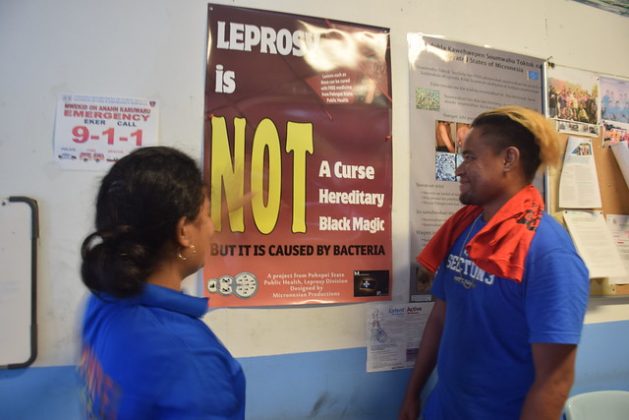
Dexter, a 25-year-old fisherman from Pohnpei in the Federated States of Micronesia, received treatment for Hansen’s disease, also known as leprosy, for over a year. He has been cured of the disease. Credit: Stella Paul/IPS

MANILA, Sep 9 2019 (IPS) – Increasing awareness of the continuing existence of Hansen’s Disease (leprosy) is critical to sustaining effective public health efforts against the disease, eliminating the social stigma associated with it, and halting its transmission.


That was the consensus reached by participants at the Global Forum of People’s Organisations on Hansen’s Disease in Manila on Sept. 9, following a lecture by Dr. Arturo Cunanan, the Chief Medical Officer of the Culion Sanitarium and General Hospital in the Philippines.The forum was organised by Japan’s Sasakawa Health Foundation (SHF) and The Nippon Foundation. 

Cunanan noted that for several years, the number of new cases has plateaued at about 200,000 per year, a troubling statistic that he attributed in part to a lack of awareness among public health bodies as well as people affected by the disease.

The social stigma attached to leprosy is a barrier to early detection of the disease, which is the key to slowing its rate of transmission. Cunanan said that the average length of time between the onset of the disease and the beginning of treatment is about two years.

This happens because on the one hand, patients are unaware of medical help available to them, unwilling, or otherwise unable to seek treatment due to stigma; and on the other, a lack of expertise and resources on the part of public health departments due to a misunderstanding of the persistence of the disease.

Not a priority

“Many public health and government officials confuse elimination and eradication,” Cunanan told the forum participants. “They think that leprosy being eliminated as a public health problem means it has been eradicated, so they are surprised when they learn it still exists.”

What this has resulted in is a decline in the material and human resources available for combatting leprosy. “Leprosy will never be a priority” for government health programmes, Cunanan said. “There are more pressing problems, bigger emergencies.”

The Philippines is a good example. The disease is considered a minor problem, and the number of new cases each year is relatively low – there were 2,108 new cases in 2017, out of a national population of about 107 million – but has been relatively consistent year after year, “between 2,000 and about 3,000”.

Because of the mistaken belief that leprosy has either disappeared entirely or has become rare, medical expertise and programmes have disappeared from public health institutions. That in turn has degraded the supervision and monitoring needed to identify new cases and prevent the transmission of the disease, Cunanan explained.

Lucy Massao, a member of the Tanzania Leprosy Association (TLA), noted that the stigma and lack of understanding of leprosy among the public in her country was also reflected in the shortcomings of the public health framework.

“We at TLA really spend a lot of time trying to educate people, including the officials,” she said. “Many patients, the health officials refer to us, because they cannot offer much support except for the medications. But they are improving, through working with us.”

Role of people’s organisations

Public health authorities elsewhere are also gradually recognising the value of the organisations of people who have been affected by leprosy. “You are the best experts,” Cunanan told the forum participants, “Because you have first-hand experience.”

Organisation members can assist in early detection and outreach, Cunanan explained, and help public health authorities improve their services to leprosy patients.

In the Philippines, collaboration with people’s organisations such as Coalition of Leprosy Advocates of the Philippines has actually been included in official policy. Philippine Assistant Secretary of Health Dr. Maria Laxamana, who delivered the keynote address on the forum’s first day, noted that “intensified collaborative efforts among [government] agencies and with private partners” is a key objective of the government’s National Leprosy Control Programme.

Dr. V.R. Pemmaraju of the World Health Organisation’s (WHO) Global Leprosy Programme said that there has been a marked growth in talent and inclusiveness among people’s organisations, which is increasing their effectiveness in supporting and extending public health efforts towards leprosy.

“What we’re seeing, and you can see it at this forum, is that the groups are more global, include more women, and are more educated about the disease and the support needed,” Pemmaraju told IPS.

“This has been very good from the point of view of the WHO, because of the added social aspect of the Global Leprosy Partnership,” he explained. Where people’s organisations still need to develop is in working effectively with governments.

“They [the organisations] have the experience and knowledge about leprosy, but what I’ve seen is that most need more skills in negotiating and engaging with government officials,” Pemmaraju said. “There is still some gap in inclusion of people’s organisations in forming public health policy [related to leprosy], and developing those skills would help to reduce that.”

Pemmaraju is upbeat about the prospects of people’s organisations gaining a bigger voice in public health policy towards leprosy.

“In each of these meetings, I see the groups growing globally and gaining more influence,” Pemmaraju said. “With the engagement of the people’s organisations, we [the WHO] are optimistic that we can achieve our goal of ‘zero leprosy.’”
 

The Business of Social Enterprise

Active Citizens, Asia-Pacific, Civil Society, Conferences, Development & Aid, Economy & Trade, Featured, Global, Headlines, Human Rights, Poverty & SDGs, Regional Categories, TerraViva United Nations

Human Rights

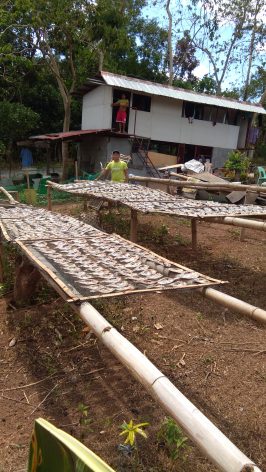
Ariel Lazarte of the Coalition of Leprosy Advocates of the Philippines (CLAP) shows off the dried fish production run by patients of a transient house operated by HD (Hope & Dignity) Philippines. Courtesy: Ariel Lazarte

MANILA, Sep 8 2019 (IPS) – Organisations supporting people affected by Hansen’s disease (leprosy) have social rather than capitalist aims, but they need to take a business-minded approach to their work if they wish to be sustainable, experts at a global conference in Manila, Philippines said.


In workshops conducted at the Global Forum of People’s Organisations on Hansen’s Disease in Manila on Saturday and Sunday, Sept. 7 and 8, representatives of organisations from Asia, Africa, and Latin America agreed that sustainability is the biggest challenge they face.

Every organisation faces some uncertainty over the continuity of donor or government financial support, so reducing or eliminating reliance on external funding is considered a critical priority.

Japan’s The Nippon Foundation (TNF) and Sasakawa Health Foundation (SHF), which sponsored the global forum and provided capacity support to the participating organisations, have long taken the view that sustainability should be the ultimate goal.

At a regional conference of people’s organisations held here in March, SHF Executive Director Dr. Takahiro Nanri stressed that his foundation’s goal was to see its beneficiaries become self-supporting. “In order to be truly sustainable, the organisation needs to develop an income-generating programme,” Nanri said at the time.

Dr. Marie Lisa Dacanay president of the Institute for Social Entrepreneurship in Asia (ISEA) outlined the fundamentals of effective social enterprises, which were derived from research conducted by ISEA in India, Indonesia, Bangladesh and the Philippines. Credit: Ben Kritz/IPS

Fundamentals of social enterprises

On Sunday Sept. 8, Dr. Marie Lisa Dacanay president of the Institute for Social Entrepreneurship in Asia (ISEA) outlined the fundamentals of effective social enterprises, which were derived from research conducted by the institute in India, Indonesia, Bangladesh and the Philippines.

Social enterprises have three common traits, Dacanay explained:

  • They are driven by a social mission instead of an enterprise mission;
  • Successful social enterprises are wealth-creating organisations that provide some form of marketable products or services; and
  • They follow a distributive enterprise philosophy in that profits are directed towards the social mission rather than being collected as return on investment.

In carrying out its mission, a social enterprise faces a number of external and internal challenges, Dacanay said.

External pressures come in the form of climate or environmental factors – a significant concern of agriculture-based enterprises; unfavourable government policies; harmful industry or market practises; inadequate government support for social programs; and institutional corruption.

Internal challenges include difficulty in accessing needed technology; securing initial financing; organisational and management capacity; production efficiency; and developing practical measures of the enterprise’s social impact.

Based on ISEA’s research, successful social enterprises can be organised following an entrepreneur non-profit model, a social cooperative model, a social business model, or what she described as “social entrepreneurship intervention,” which is a hybrid combining characteristics of all three models.
In determining which form of organisation is most suitable to the social mission, Dacanay told IPS, “I think everything starts with the reality. Every social entrepreneur starts with, ‘what are the needs, and the problem?’”

“The first step is really understanding the stakeholders you want to help,” Dacanay continued, “find out what they are doing already, and look at what gaps there are. That, along with the resources and capabilities available, define a way of moving forward, and then the organisational form will follow.”

Social business is still business

In the Saturday workshop, Earl Parreno, the chairman of the Philippines’ Altertrade Foundation, Inc. (ATFI) conducted a training in business planning basics for the assembled people’s organisations.

Defining a social enterprise as one that pursues a triple bottom line philosophy (financial, social, and environmental results), Parreno explained that the fundamentals of business planning must still be applied, but that organisations that are made up of people who are both the providers and beneficiaries of a social mission are often handicapped by a complete lack of capacity.

“Poverty is not just lack of financial resources,” Parreno told the workshop participants in his presentation, “It’s really incapability, a lack of knowledge.”

Developing the capabilities can be an arduous process, but is achievable. One of ATFI’s areas of focus in the Philippines is among poor farmworkers in Negros Province, a centre for sugar production. Parreno described the success of the social enterprise supported by ATFI in marketing Muscovado sugar – semi-raw sugar that was at one time considered “poor man’s sugar,” but is now a premium-priced staple in organic food stores.

“The business ideation is really critical,” Parreno explained to IPS. “We have a saying here in the Philippines: gaya-gaya puta maya, which means something like ‘copycat.’” A common problem among new social enterprises, Parreno said, is a lack of originality in the revenue-generating product or service they wish to pursue.

“What we stress to our social enterprise partners is that they should not conceive a product or service that’s just better, but one that is truly different and has a ‘solidarity market,’” Parreno said, such as the market of “mindful consumers” for organic Muscovado sugar discovered by the Negros sugar farmers. “That solidarity market is so important. It really gives the people’s organisation a fighting chance.”

According to Parreno, developing a sound business plan, from business ideation through resource mapping, feasibility study, and market analysis answers one of the key concerns expressed by many of the forum participants in the post-workshop discussion: The difficulty in securing initial funding to launch a social enterprise.

“The only difference between this kind of (social) business and a conventional business is where the profits go,” Parreno explained. “The discipline and the steps that need to be taken to develop it are very much the same, and if the result is a good business plan, the investors to get it off the ground will follow.”

A poultry and dried fish production project located in Baras, Rizal Province, east of the Philippine capital, employs about 10 people, all residents of a transient house for leprosy patients. It is a good example of a social enterprise that has proved successful.

Ariel Lazarte, a member of Coalition of Leprosy Advocates of the Philippines (CLAP) who runs the social enterprise, told IPS that sales have been good enough that his out-of-pocket expenses have been fully covered by the revenue, as well as providing much-needed funding for the transient house residents.
The social enterprise, part of HD (Hope and Dignity) Philippines, a non-profit managed by Lazarte, makes about 560 dollars a month.

Half of this is ploughed back into the social enterprise and the remainder is used to pay for the living expenses of the patients, including paying for medicines, transport, food, water, and vitamins.
“The only outside funding we had was for [the pen for the chickens],” Lazarte told IPS, noting that the Tikkun Olam Foundation, which supports Hansen’s disease in the country, provided the funding for this.

“The residents of the house who are capable help to tend the chickens, which are layers, and produce the dried fish. We then sell the eggs and fish in the local market.”

Part of the marketing advantage the poultry project has is that the eggs are organic. “We use organic feed for the chickens,” Lazarte said. “No synthetic feed.”


Global Network Key to Strengthening Leprosy Organisations

Active Citizens, Civil Society, Conferences, Development & Aid, Featured, Headlines, Health, Human Rights, Regional Categories

Human Rights

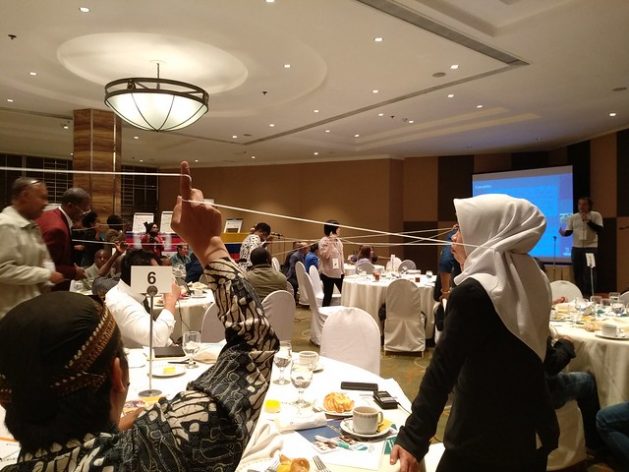
Participants at the first Global Forum of People’s Organizations on Hansen’s Disease which began on Sept. 7 in Manila, Philippines, play a game to build better connectivity among themselves. Credit: Stella Paul/IPS

MANILA, Sep 7 2019 (IPS) – Organisations of people affected by Hansen’s Disease or leprosy agree that a global network of volunteer groups is key to eradicating the disease, but concrete steps need to be taken to move the idea from an often-discussed concept to a reality.


“I don’t think anyone here is not convinced about the importance of a network,” Dr. Arturo Cunanan Medical Director of Culion Sanitarium and General Hospital told attendees following a workshop on volunteers and networking at the Global Forum of People’s Organisations on Hansen’s Disease in Manila on September 7. “But we need to put our foot forward.”

Artur Custodio Moreira de Sousa, who heads Brazil’s Movement for Reintegration of People Affected by Hansen’s Disease (MORHAN), led the workshop and firmly agreed with Cunanan’s observation, but was more upbeat.

“This forum exists because the network already exists,” Sousa said, speaking through an interpreter. “The idea exists, the network is created, the work needs to continue to solidify and formalise it.”

Sousa conducted the workshop at the forum organised by Japan’s Sasakawa Health Foundation (SHF) and The Nippon Foundation to share some ofMORHAN’s success in organising volunteers and networks in Brazil, encouraging the participating groups from Asia, Africa, and South America to consider ways in which they could contribute to an effective global network.

Making the most of volunteers

As Sousa described it, the development of a network is in a sense development of a volunteer organisation writ large. MORHAN, which was formed after the fall of Brazil’s dictatorship in 1981, is itself a network of local volunteer groups. Keeping these human resources organised and making the best use of individual talents and intentions is a significant focus area for MORHAN.

“Attracting the people (volunteers) is easy,” Sousa told the forum attendees. “Maintaining the people is very difficult.” Where MORHAN has been successful in this is by encouraging its volunteers to decide how they can contribute. “The people must be free to create,” Sousa said.

Morhan community outreach volunteer Glaucia Maricato, who was doing double duty at the forum as an English interpreter for her Portuguese-speaking colleagues, is a good example of how MORHAN uses volunteers to the best advantage for the individual and the organisation.

Maricato, an anthropologist, explained that she first was introduced to MORHAN in 2010, after the group made an agreement with a group of geneticists to reunite children who had been separated from their families due to leprosy – with either the children or the parents isolated in a sanitarium. “The idea was to use DNA testing to prove who the children’s parents were,” Maricato explained. “I was interested in the project so I got in touch with MORHAN, and then started doing fieldwork,” as the project was related to Maricato’s doctoral studies.

To Maricato, the volunteer work has far more significance than simply applying a person’s skills to a task. “MORHAN was born with democracy in Brazil [in 1981],” Maricato said. “And that spirit really carries on its work, in the DNA testing project and overall. It’s the sense of building equality, removing barriers between people.”

From local organisation to network

Organising volunteers into effective networks can greatly facilitate management of organisations and the services they provide, the chairperson of the Philippines’ Coalition of Leprosy Advocates of the Philippines (CLAP) Francisco Onde agreed.

“Our country is an archipelago, so traveling from one place to another to deal with situations is sometimes difficult,” Onde told the forum participants.

“For example, we had an issue between one of our groups and the administration of the Tala Sanitarium [located north of Manila], but we’re located in Cebu [in the central Philippines]. But through our network and our Luzon coordinator, we were able to get an attorney to assist our colleagues to resolve the problem.”

Scaling up that sort of effective communication and action to a global level is the aspiration of the people’s organisations gathered at the forum, with representatives from the various groups urging their colleagues to join the effort by applying the tools to organising volunteers discussed in the workshop. Kofi Nyarko, president of International Association for Integration, Dignity, and Economic Advancement (IDEA) Ghana stressed that the key to effective action was for people’s organisations “to first help themselves.”

“If we do this, we can do something for the public as much as the public can do something for us,” Nyarko said. “Inclusiveness is very important.”

Evidently encouraged by Cunanan’s call to not let the idea of a global network “be a talking network just within this four-cornered room,” representatives of the people’s organisations in attendance held an impromptu meeting led by Sousa and Cunanan following the workshop that ended the forum’s first day to discuss formalising efforts to create the global network, the initial details of which Cunanan told attendees he hoped would be available for presentation “at the next meeting”.


U.N. Criticised for Link-up with Saudi Prince MBS

Armed Conflicts, Civil Society, Crime & Justice, Editors’ Choice, Featured, Global, Global Governance, Headlines, Human Rights, IPS UN: Inside the Glasshouse, Middle East & North Africa, Peace, Press Freedom, Regional Categories, TerraViva United Nations

Human Rights

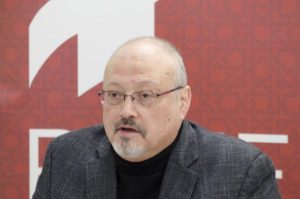
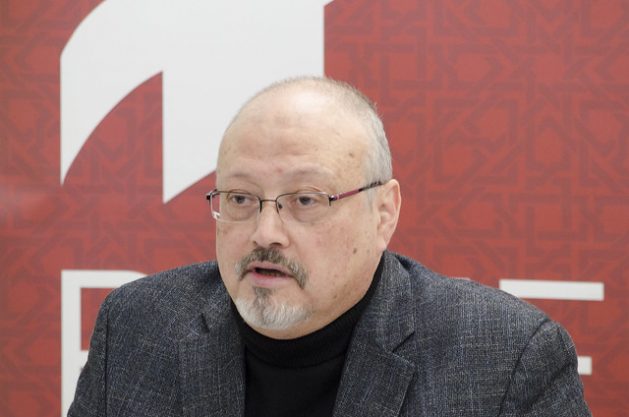
Jamal Kahshoggi, a US-based journalist who frequently criticised the Saudi government, was killed while visiting the Saudi consulate in Istanbul, where he was collecting papers for his wedding. Courtesy: POMED/CC by 2.0

UNITED NATIONS, Sep 4 2019 (IPS) The United Nations is under growing pressure to scrap an event it is co-hosting with the private foundation of Saudi Arabia’s crown prince Mohammad bin Salman, who has been linked to the killing of journalist Jamal Khashoggi.


On Tuesday, Sunjeev Bery, director of Freedom Forward, became the latest leader of a campaign group to press the U.N. to cancel the Sept. 23 event, saying it would help repair bin Salman’s reputation over the Khashoggi murder. 

The event, known as the Misk-OSGEY Youth Forum, is a partnership between the U.N.’s youth envoy, Jayathma Wickramanayake, and the Misk Foundation, a culture and education foundation chaired by bin Salman, who is better known as MBS.

“No one — especially not the U.N. — should be partnering with MBS or his personal Misk Foundation,” Bery told IPS.

“Saudi Arabia’s brutal crown prince is responsible for the deaths of thousands of Yemeni children. His thugs imprisoned leading women’s rights activists and murdered Jamal Khashoggi.”

Kenneth Roth, the director of Human Rights Watch, a campaign group, last week accused the world body of helping to “whitewash” MBS’s record; Mandeep Tiwana, from Civicus, a rights group, called the event “disturbing”.

The U.N. youth envoy’s office declined to comment on the row. U.N. spokesman Stephane Dujarric said the world body had repeatedly issued “very strong statements … calling for accountability” in Khashoggi’s killing.

The Misk-OSGEY Youth Forum will take place in New York only 10 days before the first anniversary of Khashoggi’s murder on Oct. 2 last year, when Saudi government agents killed and dismembered the journalist inside the country’s consulate in Istanbul.

The CIA later determined that MBS had personally ordered the hit. Saudi officials, who initially said Khashoggi had left the consulate alive, now say the journalist was killed in a rogue operation that did not involve MBS.

Saudi Arabia’s mission to the U.N. did not answer requests for comment from IPS.

The four-hour workshop for 300 young people at the New York Public Library will occur on the sidelines of the U.N. General Assembly and promote green themes, corporate responsibility and other aspects of the U.N.’s Sustainable Development Goal (SDG) agenda.

It will feature Alexandra Cousteau, an environmentalist and granddaughter of French explorer Jacques-Yves Cousteau; and Bart Houlahan, an entrepreneur who promotes sustainable business practices.

Other speakers include Andrew Corbett, an expert on entrepreneurship at Babson College, Paul Polman, former CEO of consumer goods firm Unilever, and Ann Rosenberg, an author and U.N. technology expert.

Dr. Reem Bint Mansour Al-Saud, a Saudi princess and an envoy to U.N. headquarters in New York, who advocates for empowering women and development in the Gulf kingdom, will also speak at the workshop.

Khashoggi, a United States-based journalist who frequently criticised the Saudi government, was killed while visiting the Saudi consulate in Istanbul, where he was collecting papers for his wedding.

U.N. expert Agnes Callamard issued a report in June that described the assassination as a “deliberate, premeditated execution,” and called for MBS and other Saudi officials to be probed.

The Misk-OSGEY Youth Forum comes after years of tensions between the U.N. and Riyadh over the war in Yemen, where Saudi Arabia is leading a military coalition against the country’s Houthi rebels. 

The conflict has killed tens of thousands of people and caused led to a major humanitarian crisis. 

“The crown prince and his violent government must be held accountable for their human rights crimes,” said Bery, who advocates for the U.S. to cut ties with Saudi Arabia and other authoritarian regimes.

“Instead, misguided U.N. staff are absurdly giving the crown prince a public relations platform as he attempts to wipe away the blood of so many dead Yemeni children.”

  Source

Festival Pays Tribute to Singer, Civil-Rights Icon Nina Simone

Active Citizens, Arts, Featured, Gender, Global, Headlines, Human Rights, TerraViva United Nations

Arts

LONDON, Aug 29 2019 (IPS) – It must be a daunting prospect to sing songs made famous by the incomparable Nina Simone, but performers Ledisi and Lisa Fischer brought their individual style to a BBC Proms concert in London, honouring Simone and gaining admiration for their own talent.


The show, “Mississippi Goddam: A Homage to Nina Simone”, paid tribute to the singer, pianist and civil rights campaigner – a “towering musical figure” – at the Royal Albert Hall on Aug. 21, more than 16 years after Simone died in her sleep in southern France at the age of 70.
This was a celebration to recognise her “unique contribution to music history”, according to the Proms, an annual summer festival of classical music that also features genres “outside the traditional classical repertoire”.

The concert’s title refers to the song that marked a turning point in Simone’s career, when she composed it in fury and grief following the murder of civil rights activist Medgar Evers in Jackson, Mississippi, and the deaths of four African-American girls in the bombing of the 16th Street Baptist Church in Birmingham, Alabama, in 1963.

Performing the song at the tribute, New Orleans-born vocalist Ledisi held nothing back. She put all the anger and anguish that the lyrics required into her rendition, creating one of the high points of the concert.

The composition stood out particularly because of the contrast between the lyrics and the rhythm, and Ledisi – who’s also an actress and writer – emphasized this disparity. While the “tune has an almost fun-filled, pulsating vibe” (as conductor Jules Buckley put it in his written introduction to the show), the message itself is uncompromising.

“It speaks of murder, of dashed dreams and severe inequality, and it shattered the assumption that African-Americans would patiently use the legislative process to seek political rights,” Buckley wrote. Listeners got the full context, and they were reminded that some things have not changed much in the United States.

Conducting the Metropole Orkest, whose members played superbly, Buckley said that in putting together the programme he wanted to shine a light not only on Simone’s hits but also on a “few genius and lesser-known songs”. With the sold-out concert, he and the performers succeeded in providing the audience a clear idea of the range of Simone’s oeuvre.

The concert began with an instrumental version of “African Mailman” and segued into “Sinnerman”, the soulful track about the “wrongdoer who unsuccessfully seeks shelter from a rock, the river and the sea, and ultimately makes a direct appeal to God”, to quote Alyn Shipman, the author of A New History of Jazz who compiled the programme notes.

The orchestral introduction paved the way for Lisa Fischer’s arresting entrance. With her shaved head and flowing black outfit, she moved across the stage, singing “Plain Gold Ring” in her inimitable voice, evoking the image of an operatic monk. The two-time Grammy winner displayed the genre-crossing versatility for which she has become known, using her voice like a musical instrument and hitting unexpected lows before again going high. The audience loved it.

Fischer introduced Ledisi, who wore a scarlet gown (before changing to an African dress after the intermission), and the two women then took turns singing Simone’s repertoire, expressing love for the icon as well as appreciation for each other’s performances.

They both kept topping their previous song, and the temperature rose with “I Put a Spell on You” (Ledisi), “Don’t Let Me Be Misunderstood” (Fischer), “Ne me quitte pas” (poignantly rendered by Ledisi) and “I Loves You, Porgy” (memorably delivered by Fischer).

Then there was, of course, “Mississippi Goddam”, which followed a haunting, syncopated “Dambala”, a song made famous by Bahamian musician Tony McKay aka Exuma, who inspired Simone. Fischer performed “Dambala” with the requisite mysticism, getting listeners to shake to the beat.

Back-up vocalists LaSharVu, comprising three powerhouse singers, also contributed to the energy and success of the concert. Two of them joined Ledisi and Fischer for an outstanding and moving presentation of “Four Women” – Simone’s 1966 song about the lives of four African-American women that has become an essential part of her artistic legacy.

For other songs, LaSharVu teamed up with the orchestra to provide “percussive accompaniment” through clapping, and the orchestra’s skill on moving from reggae (“Baltimore”) to gospel underpinned the overall triumph of the show.

The concert ended with an encore, as Fischer and Ledisi performed “Feeling Good” to a standing ovation, and to comments of “fantastic”, “fabulous”, “amazing” and other superlatives.

The show was not the only part of the homage to Simone. Earlier in the day, the BBC’s “Proms Plus Talk” programme had featured a discussion of the “life, work and legacy” of the singer, with poet Zena Edwards and singer-musician Ayanna Witter-Johnson interviewed by journalist Kevin Le Gendre, author of Don’t Stop The Carnival: Black Music In Britain.

During this free public event, held at Imperial College Union, the three spoke of the impact Simone has had on their work and recalled her style and performances. They also discussed the abuse she suffered from her second husband and the painful relationship she had with her only daughter, Lisa, whom Simone in turn physically abused.

Witter-Johnson said that Simone had inspired her to feel empowered in performing different genres, so that she could sing and play music across various styles. “Her courage, outstanding musicianship and love of her heritage will always be a continual source of inspiration,” she said later.

In response to a comment from an audience member, a publisher, that Simone had been an extremely “difficult” person, Edwards stressed that Simone had been a “genius” and could be expected to not have an easy personality. Le Gendre meanwhile pointed to the difficulties Simone herself had experienced, with relationships, record companies, and the American establishment, especially after she began defending civil rights.

In an email interview after the tribute, Le Gendre said Simone’s music had had a “profound effect” on him throughout his life.

“There are so many anthems that she recorded it is difficult to know where to start, but a song like ‘Four Women’ can still move me to tears because it is such an unflinchingly honest depiction of the black condition that African-Americans, African-Caribbeans and black Britons can easily relate to,” he said.

“The way she broaches the very real historical issues of rape on a plantation, girls forced into prostitution and the internal battles based on skin shade affected me a great deal because, having lived in the West Indies and the UK and visited America several times, I know that what she is talking about is simply the truth,” he added.

“There is a war within the race as well as between the races, and we will only move beyond self-destruction if we firstly recognise these painful facts. I continue to be inspired by her ability to ‘keep it real’ as well as her great musicianship. Above all else she has made me think, as well as listen and dance.”

The BBC Proms classical music festival runs until Sept. 14 at the Royal Albert Hall in London. A concert on Aug. 29 features “Duke Ellington’s Sacred Music”, with conductor Peter Edwards, pianist Monty Alexander and tap dancer Annette Walker.

(This article is published by permission of Southern World Arts News – SWAN. You can follow the writer on Twitter: @mckenzie_ale)

  Source

Triumph of the Right is Changing the World Order

Civil Society, Democracy, Featured, Global, Global Governance, Headlines, Human Rights, TerraViva United Nations

Opinion

Katharina Hofmann de Moura holds a diploma in political science from the Free University (FU) Berlin. She currently leads the Brazil office of Friedrich Ebert Stiftung (FES). Before that she was the head of the FES Mozambique (2011-2016) and worked with the FES in Berlin and Shanghai.

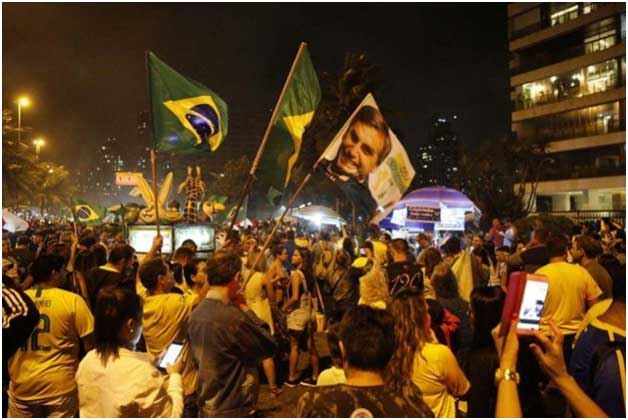
Supporters of president-elect Jair Bolsonaro celebrated his triumph in the early hours of Oct. 29, in front of the former captain’s residence on the west side of Rio de Janeiro. The far-right candidate garnered 55.13 percent of the vote and began his four-year presidency on Jan. 1, 2019. Credit: Fernando Frazão/Agencia Brasil

SAO PAULO, Brazil, Aug 29 2019 (IPS) – The crisis of regional and multilateral institutions goes hand in hand with the international rise of right-wing populism. In the US, the UK, Russia, Italy, Poland, Hungary, Turkey, the Philippines and Brazil, we are experiencing the rise of right-wing populist politicians who throw headline-grabbing barbs at global compromises and the negotiating processes of supranational institutions such as the UN.


The more countries succumb to right-wing populism, the lower the chances of curbing climate change and social inequality and triggering the transition to a sustainable economic model.

While criticism of economic globalisation came predominantly from the left in the past, it’s currently becoming the core narrative of the Right. All over the world, right-wing populists are making protectionism the key theme of their regime.

They are using frustration with the social upheavals of neoliberal globalisation as a narrative. Job losses due to relocations, the decline of whole industrial sites, concerns about uncontrolled immigration and the search for identity in a multipolar world are skilfully exploited. The result is a historic, authoritarian-style populist ‘backlash’.

Despite their anti-globalisation rhetoric, however, the right-wing populists are not convincing protagonists against free trade. Rather, they are usually aligned with or even part of economic and financial elites. Their target group is the lower middle class who often does not actually benefit from their policies.

People in this electoral group feel that they are net losers from globalisation. In the populists’ promises, they see compensation for the perceived and sometimes real loss of national sovereignty.

Katharina Hofmann De Moura

Right-wing populists are making inroads into the centres of political power because they focus on the issues that are causing uncertainty and growing inequality: fear of downward social mobility, unemployment and lack of prospects.

The globalisation of right-wing populism

Alignment of these global right-wingers is progressing apace. For instance, current Brazilian president Jair Bolsonaro based his election campaign on Donald Trump’s strategy. ‘The Movement’, headed by Steve Bannon, Trump’s former election campaign advisor, has successfully forged links in Europe and Latin America as well as the US.

The formula is always the same: building up the national economy as a bastion against foreign influence while attacking the left for supposedly neglecting the interests of the majority of the population in favour of a ‘politics of identity’ geared towards minorities and a snobbish urban electorate.

The Western model of liberal democracy, so heavily influenced by Germany in the post-war era, is visibly ailing.

The right-wing populists rely on dividing society and pit various population groups and their interests against each other. Brazil provides a powerful example of this. ‘Only vegans are interested in nature,’ was Bolsonaro’s response to accusations of large-scale environmental destruction.

Accordingly, ‘America First’ has become ‘Brasil Primeiro’. The focus on neoliberal economic policy is underpinned with contemptuous remarks against minorities, extending as far as incitement to violence. Society is extremely polarised and the centre is fading away.

In a WhatsApp campaign focused on inadequate public safety and spiralling corruption, Bolsonaro managed to win the elections in the largest and, until the controversial removal of Dilma Roussef in 2016, most progressively governed country in Latin America.

The Brazilian election campaign is a good example of how right-wing movements use ‘social’ media to get closer to the people. They convey a sense of direct influence and apparent power and portray themselves on Twitter as ‘down-to-earth’.

Denial, denial, denial

Science and facts are flatly denied. For instance, Brazil’s foreign minister Ernesto Araujo has dismissed climate change as a ‘Communist invention’. This statement echoes Trump’s anti-climate ideology.

Bolsonaro denies the authenticity of satellite images that show how deforestation of the Amazon has doubled since he took office, and summarily dismissed the director of the renowned INPE institute (Instituto Nacional de Pesquisas Espaciais) when it published the corresponding data.

Historical denial is also part of the package, such his ‘own account’ of the military dictatorship, shamelessly praising torture. Right-wing populist movements manipulate citizens and employ an anti-intellectualism, a hatred of the so-called ‘elite’ – which obviously means the educational rather than the economic elite.

The right-wing populist is a self-styled ‘straightforward man’ of the people. The anti-politician is coming to the fore. Ideological confrontation is the aim, not least in order to deflect from the results of his own economic policy – Brazil remains mired in an economic crisis, with growth of just 0.8 per cent.

The rise of right-wing populism is exacerbating the crisis of the international order. The unprecedented rise of China is weakening Europe’s position as a global democratic power, while also challenging the decades-long formula of ‘democracy combined with economic growth’.

Economic development just seems to be achievable more quickly without democracy, as democratic processes require votes and compromises and everything is based on dialogue. That’s why many countries in the South admire the rise of China and not division-wracked Europe.

The Western model of liberal democracy, so heavily influenced by Germany in the post-war era, is visibly ailing. Many analysts are already talking of the end of the liberal international order. Pressure on the European states will grow, as the upcoming emerging nations show no ambitions to assume regional or multilateral responsibility.

For instance, the Brazilian president says, ‘The Amazon is ours, not yours,’ and brooks no criticism from Europe. No international responsibility and no external interference is the guiding principle of authoritarian rulers.

Although it is currently weakened, Brazil has a well-organised left-wing civil society as well as trade unions and the Workers’ Party.

Gone is the optimistic era of global governance that only recently was largely shaped by the BRICS alliance (Brazil, Russia, India, China and South Africa). BRICS embodied the ‘rise of the South’, aimed at building a better world on an equal footing with the North.

The euphoria of multilateralism has since faded away. Whereas there were still hopes in the early 2000s that the emerging nations would become ‘anchor countries’, taking responsibility for regional integration and democratisation, most of their heads of state are now populists.

They too are looking for new alliances, but under different premises. So, the world is indeed converging, but only because of a growth in populism in Europe rather than an upturn in democracy in the South. Whole new alliances are being forged.

For instance, on the UN Human Rights Council, Bolsonaro is backing the Arab nations, which criticise the term ‘gender’ and jointly aim to stand up for ‘traditional family values’.

So what’s left for the left?

Left-wing governments cannot resolve this dilemma in the short term. The left’s partly self-inflicted loss of power because of its naive embracing of globalised free trade has been underestimated.

Now, business owners like Blackrock and the large multinationals have hit on a hitherto unknown form of capital accumulation that produces a form of wealth redolent of feudal times. Big corporations control social media, enabling them to build up their own influence even more and further undermine that of politicians (a phenomenon now known as ‘corporate capture’).

According to research by the Folha de São Paulo newspaper, owners of large stores and restaurant chains paid 12 million reais (€3 million) per WhatsApp campaign to service providers, ensuring mass distribution of lots of fake news against the Workers’ Party (Partido dos Trabalhadores) in the Brazilian election campaign. Bolsonaro’s supporters then forwarded this fake news to their individual contact lists in a snowball process.

Democratic politicians were no match for the right in terms of their method – but that’s alright, as it is illegal. Before the 2018 elections, election campaign financing by companies was banned for the first time in Brazil’s history. The above-mentioned business owners had to pay fines, yet the elections were declared valid.

However, the Brazilian left is using social media to mobilise protests, for example against cuts to the education budget and health and social programmes, against liberalisation of weapons laws, in favour of women’s and LGTBI rights, and against an unfair pension reform.

Although it is currently weakened, Brazil has a well-organised left-wing civil society as well as trade unions and the Workers’ Party. And they will not readily give into right-wing populism.

  Source