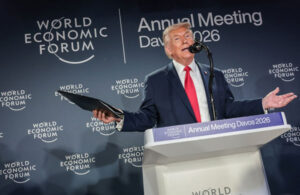
BRUSSELS, Belgium, Feb 13 2026 (IPS) – The latest World Economic Forum made clear the current crisis of multilateralism. Over 60 heads of state and 800 corporate executives assembled in Davos under a ‘Spirit of Dialogue’ theme aimed at strengthening global cooperation, but it was preceded by a series of events pointing to a further unravelling of the international system.
On 3 January, Donald Trump launched an illegal military strike on Venezuela to abduct President Nicolás Maduro, which was widely condemned as a violation of international law. On 7 January, he signed an executive order withdrawing the USA from 66 international bodies and processes, including 31 UN entities, such as the UN Democracy Fund, the UN Framework Convention on Climate Change and UN Women. Then came the launch of Trump’s Board of Peace, evidently an attempt to supplant the UN Security Council. The country that helped build the multilateral system is walking away from the parts it doesn’t like and seeking to reshape the rest in its interests.
Trump’s approach to multilateralism is nakedly transactional. His administration engages with international processes only when they advance immediate US interests and withdraws from those that impose obligations. This disassociates multilateralism from its core principles: accountability over shared standards, equality among nations and universality. It encourages other states to follow suit.
This approach brings devastating financial impacts. US threats to defund international bodies have left institutions scrambling. UN development, human rights and peacekeeping programmes all depended heavily on US financial contributions. The World Health Organization faces shortfalls that threaten its ability to respond to health emergencies because the US government quit without paying its overdue contributions.
The USA’s closest allies aren’t safe. Trump threatened NATO member Denmark with 25 per cent tariffs unless it agreed to the USA’s purchase of Greenland, and suggested he might seize the territory by force. NATO’s Article 5 on collective defence – invoked only once, by the USA after 9/11 – lies in doubt. European states are reacting by seeking strategic autonomy, slashing development aid and reducing UN contributions while finding extra billions for military spending.
Problematic alternatives are looking to capitalise on crisis. At Davos, China positioned itself as the grown-up alternative to Trump, promoting its Friends of Global Governance initiative, a group of 43 mostly authoritarian states including Belarus, Nicaragua and North Korea.
The queue of heads of government meeting China’s leader Xi Jinping shows many states are pivoting this way. But it comes at a cost: in China’s vision of international cooperation, state sovereignty is paramount and there’s no room for international scrutiny of human rights or cooperation to promote democratic freedoms.
It’s the same story with the new Board of Peace. The body originated in a controversial November 2025 Security Council resolution establishing external governance for Gaza, but Trump clearly envisions a permanent, wider role for it. He chairs it in a personal capacity, with full power to veto decisions, set agendas and invite or dismiss members. Permanent membership costs US$1 billion, with the money’s destination unclear.
The Board’s draft charter makes no mention of human rights protections, contains no provisions for civil society participation and establishes no accountability mechanisms. Most members so far are autocratic states such as Belarus, Egypt and Saudi Arabia. Its credibility is further undermined by the fact that Israel has just joined, despite having made a mockery of international humanitarian law. More democratic states have declined invitations, mostly due to concerns about the body’s unclear relationship with the UN. Trump’s response was to threaten increased tariffs against France and withdraw Canada’s invitation. He has made clear he considers himself above international law, casting himself as a de facto world president able to resolve conflicts through personal power and pressure.
As the old order dissolves, civil society must play a critical role in defining what comes next. While the UN – particularly its Security Council, hamstrung by the use of veto powers by China, Russia and the USA – needs reform, it remains the only global framework built on formal equality and universal human rights. As the UN faces assault from those abandoning it or seeking to dilute its human rights mandate, civil society must mobilise to keep it anchored to its founding principles and challenge the hierarchies that exclude global south voices.
It falls on civil society to organise across borders to uphold international law, document violations of international humanitarian and human rights law and demand accountability. Not for the first time, civil society needs to win the argument that might doesn’t make right.
Paramilitary forces in Sudan unleashed “a wave of intense violence…shocking in its scale and brutality” during their final offensive to capture the besieged city of El Fasher last October, committing atrocities that amount to war crimes and possible crimes against humanity, according to a report released on Friday by the UN human rights office, OHCHR.
Feb 9 2026 (IPS) – CIVICUS discusses the genocide case against Myanmar at the International Court of Justice (ICJ) with Mohammed Nowkhim of the Arakan Rohingya Society for Peace & Human Rights (ARSPHR), a civil society organisation led by Rohingya people born out of refugee camps in Bangladesh to document atrocities, preserve survivor testimony and advocate for accountability and justice.
Mohammed Nowkhim
On 12 January, the ICJ began hearings in the genocide case brought by The Gambia against Myanmar over the military’s treatment of the Rohingya Muslim minority. The Gambia, representing the Organisation of Islamic Cooperation’s 57 members, accuses Myanmar of breaching the Genocide Convention. The Gambia’s justice minister presented evidence of mass killings, sexual violence and village destruction during a government crackdown in 2017 that forced over 700,000 Rohingya people to flee to Bangladesh. Rohingya survivors testified in closed sessions. Myanmar denies genocidal intent, characterising its actions as counterterrorism. A final judgment is expected before the end of the year.
What atrocities were committed against Rohingya people and what is being examined in court?
During what were called ‘clearance operations’ in 2017, Myanmar security forces burned entire villages, raped women, killed children and threw them into fires and wells. According to documented reports, over 10,000 people were killed and around 700,000, including me, were forced to flee Myanmar. These were not random acts of violence; they were systematic and targeted attacks aimed at erasing our community.
In 2019, The Gambia, supported by 11 other states, filed a case against Myanmar at the ICJ, accusing it of genocide. Judges are now examining evidence of mass killings, sexual violence, village destruction and forced displacement. They are also reviewing official policies and actions that show intent to destroy Rohingya people as a group, including patterns of violence, coordination by state forces and the systematic denial of basic rights.
This case shows that genocide claims can be examined through law rather than dismissed for political convenience. But for the Rohingya, this is not just a legal process. It represents acknowledgment and a source of hope for present and future generations. After decades of denial and silence, our suffering is being heard at the world’s highest court and recognised in a legal space where truth matters. The hearings can’t erase our wounds, but they can offer some solace and a path towards justice.
Civil society played a key role when states failed to act. Even when the world looked away, organisations continued to document the truth and refused to let these crimes be erased or rewritten. Long before any court agreed to listen, groups including the ARSPHR were collecting survivor testimonies, documenting violations and carefully preserving evidence, knowing it might one day be used in court. Without that work, much of what happened would have been lost and perpetrators couldn’t have been challenged.
In a way, civil society became the memory of the Rohingya people. Today, this evidence forms part of the case before the ICJ.
Why is accountability so difficult?
Politics often protects perpetrators. Those with power choose stability over justice and shield those responsible for crimes. Myanmar’s authorities continue to deny wrongdoing and refuse to cooperate, which delays justice.
International law also has its limits. Justice moves slowly because ICJ rulings do not automatically lead to consequences. International courts can establish the truth, but they can’t force states to act. Enforcement depends on political will, often through the UN Security Council, where countries such as China and Russia can block action, even when crimes are clear and well documented.
What must happen to ensure justice?
There must be real action. Perpetrators must be held accountable, Rohingya citizenship must be restored and discriminatory laws that enabled genocide must be removed. Any return of refugees must be voluntary, safe and dignified. It can’t happen without international monitoring and guarantees of protection. People can’t be sent back to the same conditions that forced them to flee.
Ultimately, justice is not only about the past, but also about ensuring that future generations of Rohingya can live with rights, safety and dignity. This case is only the beginning. What happens after the judgment will decide whether justice is real or only symbolic.
CIVICUS interviews a wide range of civil society activists, experts and leaders to gather diverse perspectives on civil society action and current issues for publication on its CIVICUS Lens platform. The views expressed in interviews are the interviewees’ and do not necessarily reflect those of CIVICUS. Publication does not imply endorsement of interviewees or the organisations they represent.
A recent report reveals that Asia faces about 100 natural disasters every year, affecting 80 million people. Beyond the statistics are the disrupted lives, damaged homes, and a cycle of repair that drains communities.
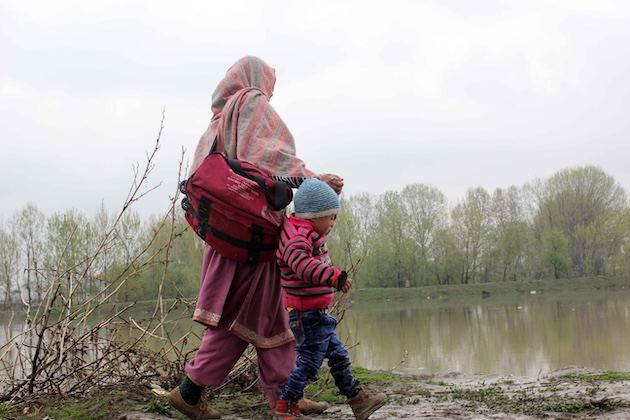
A woman in a remote hamlet in Kashmir, India, migrates to a safer location with her child as floodwater inundates her hometown. Credit: Umar Manzoor Shah/IPS
SRINAGAR & NEW DELHI, Feb 9 2026 (IPS) – When the rain begins in Kashmir’s capital Srinagar, Ghulam Nabi Bhat does not watch the clouds with relief anymore. He watches them with calculation. How much can the gutters take? How fast will the river rise? Which corner of the house will leak first? Where should the children sleep if the floor turns damp?
“Earlier, rain meant comfort,” said Bhat, a resident of a low-lying neighbourhood close to the city’s waterways. “Now it feels like a warning.”
On many days, the rain does not need to become a flood to change life. Streets fill up within hours. Shops shut early. The school van turns back. A phone call spreads across families, asking the same question, “How is your area?”
For millions across India and the wider region of emerging Asia (a group of rapidly developing countries in the region, including China, India, Indonesia, Malaysia, the Philippines, Thailand, and Vietnam), this is the new normal. Disasters no longer arrive as rare, once-in-a-generation ruptures. They come as repeated shocks, each one leaving behind repair bills, lost wages, and a deeper sense that recovery has become a permanent routine.
A recent analysis from the OECD Development Centre shows that emerging Asia has been facing an average of around 100 disasters a year over the past decade, affecting roughly 80 million people annually. The rising trend is powered by floods, storms, and droughts. The report estimates that natural disasters have cost India an average of 0.4 percent of GDP every year between 1990 and 2024.
Behind the national figure lies a quieter, more poignant story. It is the story of how repeated climate and weather shocks get absorbed by households and not just spreadsheets. By the savings a family built for a daughter’s education. By a shopkeeper’s stock bought on credit. By a farmer’s seed money saved from the last season.
In the north Indian state of Bihar’s flood-prone belt, Sunita Devi, a mother of three, says she has stopped storing anything valuable on the floor. Clothes sit on higher shelves. The grain container has moved to a safer corner. The family’s documents stay wrapped in plastic.
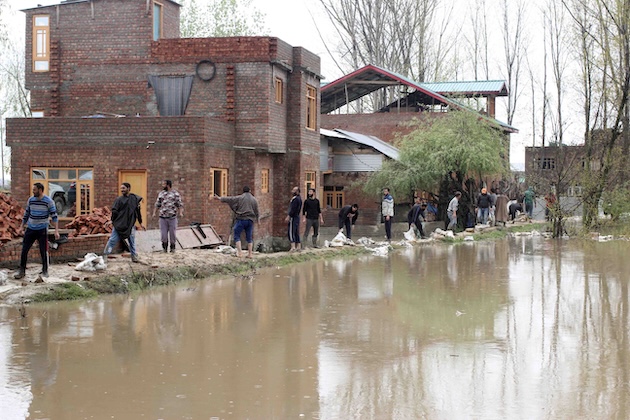
Local residents in Kashmir’s capital, Srinagar, stack sandbags to safeguard their homes from floods in 2025. Credit: Umar Manzoor Shah/IPS
“When water comes, you run with children,” she said. “The rest is left to fate. You can rebuild a wall. You cannot bring back the days you lost.”
Her village has lived with floods for decades, but she says what has changed is frequency, uncertainty, and cost. It is not only about big river floods that make headlines. It is also about sudden waterlogging, damaged roads, broken embankments, and illnesses that rise after the water recedes.
“Earlier we could predict. Now we cannot. Sometimes the water comes fast. Sometimes it stays. Sometimes it leaves and then comes again,” Devi told IPS.
Professor Kaveh Madani, director of the United Nations University’s Institute for Water, Environment, and Health, told IPS that water bankruptcy in Asia should be treated as a national security issue, not a sector issue.
“The priority is shifting from crisis response to bankruptcy management: honest accounting, enforceable limits, protection of natural capital, and a just transition that protects farmers and vulnerable communities,” said Madani.
Across emerging Asia, floods have emerged as one of the strongest rising trends since the early 2000s, the OECD Development Centre report notes. The reasons vary from place to place, but the result looks familiar: disrupted lives, damaged homes, and a cycle of repair that drains communities.
In Kashmir’s capital Srinagar, small shop owner Bashir Ahmad keeps an old wooden rack near the entrance. It is not for display. It is for emergencies. When rain intensifies, he quickly moves cartons of goods off the floor.
“My shop is small; my margin is smaller. One day of water is enough to destroy many things. Customers do not come. Deliveries stop. You just wait and watch,” Ahmad said.
He says the biggest loss is not always the damaged stock. It is the days without work. For families that live week to week, even a short shutdown becomes a long crisis. Rent does not pause. School fees do not pause. Loans do not pause.
The OECD analysis, while regional in scope, points to a hard truth that communities already know. It claims that disasters have economic aftershocks that last long after television cameras leave. When repeated losses occur every year, they reduce growth and reshape choices. Families postpone building stronger houses. They avoid investing in small businesses. They spend more time recovering than progressing.
“Disasters are no longer exceptional events. They have become recurring economic shocks. The problem is not only the immediate damage. It is the repetition. Repetition breaks household resilience,” Dr Ritu Sharma, a climate risk researcher based in Delhi, said.
Sharma says India’s disaster losses should not be viewed as a headline percentage alone.
They should be viewed as accumulated pressure on ordinary life.
“A flood does not only damage a bridge. It delays healthcare visits. It interrupts immunisation drives. It breaks supply chains for food and medicines. It can push vulnerable families into debt traps. What looks like a climate event becomes a social event. It becomes a health event. It becomes an education event.”
In the report’s regional comparisons, the burden is uneven. Some countries face higher average annual losses as a share of GDP, especially those exposed to cyclones and floods. India’s size allows it to absorb shocks on paper, but that size also means more people remain exposed. From Himalayan slopes vulnerable to landslides to coastal districts bracing for cyclones to plains dealing with floods and heat, risk is spread across geography and across livelihoods.
Prof. Nasar Ali, an economist who studies climate impacts, says the real damage is often hidden in the informal economy.
“A formal sector company can claim insurance, borrow on better terms, and restart faster. A vegetable vendor cannot. A small grocery shop cannot. A family with a single daily wage earner cannot. Their loss is immediate and personal. They also take the longest to recover,” Ali said.
He believes disaster impacts also deepen inequality because the poorest households lose what they cannot replace.
“A damaged roof for a rich family is a renovation problem. A damaged roof for a poor family can mean sleeping in damp rooms for weeks, infections, missed work and children dropping out temporarily.”
The report also turns attention toward a policy question that has become urgent across Asia: how should governments pay for disasters in a way that does not repeatedly divert development funds?
The analysis highlights disaster risk finance, tools that help governments prepare money in advance rather than relying mainly on post-disaster relief. This includes dedicated disaster funds, insurance mechanisms, and rapid financing that can be triggered quickly after a shock.
For communities, the debate may sound distant. But the outcomes are visible in the speed of recovery and the dignity of response.
“When a disaster happens, help should come fast,” said Meena Devi, who runs a small grocery shop in Jammu’s RS Pura area and has seen repeated waterlogging during intense rains. “We close our shop. Milk spoils. People cannot buy things. Then we borrow money to restart. If support is slow, we fall behind.”
She said her biggest fear is not a single disaster but the feeling that another one is always near.
“If it happens once, you survive. If it happens again and again, you get tired from inside,” she said.
For Sharma, preparedness must be more than emergency drills. It must include planning that reduces exposure in the first place.
“Some risks are unavoidable, but many are amplified by where and how we build,” she said. “If cities expand without drainage capacity, or if construction spreads into floodplains, then disasters become predictable. That is not nature alone. That is policy.”
In Srinagar, Bhat says residents often feel they fight the same battle every year. Cleaning drains. Stacking sandbags. Moving belongings. Calling relatives. Watching the river level updates. The work looks small, but it is exhausting because it never ends.
“We always think, maybe this year it will be better,” he said. “Then rain comes, and your heart starts beating faster.”
Asked what would make him feel safe, he did not talk about big promises. He spoke about basics. A drain that works. A road that does not collapse. A warning that comes early. Help that comes on time.
For Sunita Devi in Bihar, the dream is even simpler: a season where the family can plan without fear.
“We want to live like normal people. We want to save money, not spend it on repairing what the water broke,” she said.
An artist in Colombia draws an image of the Universal Declaration of Human Rights. Credit: UN Colombia/Jose Rios Source: UN News
GENEVA, Feb 6 2026 (IPS) – The UN High Commissioner for Human Rights Volker Türk has launched a USD 400 million funding appeal for 2026 to address global human rights needs, warning that with mounting crises, the world cannot afford a human rights system in crisis.
“The cost of our work is low; the human cost of underinvestment is immeasurable,” Türk told States at the launch. “In times of conflict and in times of peace, we are a lifeline for the abused, a megaphone for the silenced, a steadfast ally to those who risk everything to defend the rights of others.”
In 2025, staff working for the UN Human Rights Office in 87 countries observed more than 1,300 trials, supported 67,000 survivors of torture, documented tens of thousands of human rights violations, and contributed to the release of more than 4,000 people from arbitrary detention.
Türk also stressed that addressing inequalities and respecting economic and social rights are vital to peace and stability. “Human rights make economies work for everyone, rather than deepening exclusion and breeding instability,” he said.
The Office in 2025 worked with more than 35 governments on the human rights economy, which aims to align all economic policies with human rights. For example, in Djibouti, it helped conduct a human rights analysis of the health budget, with a focus on people with disabilities. It provided critical human rights analysis to numerous UN Country Teams working on sustainable development.
Türk outlined several consequences of reduced funding in 2025. For instance, the Office conducted only 5,000 human rights monitoring missions, a decrease from 11,000 in 2024. The Office’s programme in Myanmar suffered cuts of more than 60 percent. In Honduras, support for demilitarisation of the prison system and for justice and security sector reforms was reduced. In Chad, advocacy and support for nearly 600 detainees held without legal basis had to be discontinued.
“Our reporting provides credible information on atrocities and human rights trends at a time when truth is being eroded by disinformation and censorship. It informs deliberations both in the UN Security Council and the Human Rights Council, and is widely cited by international courts, providing critical evidence for accountability,” he said.
The liquidity crisis of the regular budget also significantly affected the work of the broader human rights ecosystem. For instance, 35 scheduled State party dialogues by UN Human Rights Treaty Bodies could not take place.
Four out of eight planned country visits by the Sub-Committee on Prevention of Torture had to be cancelled. UN Special Rapporteurs’ ability to carry out country visits was curtailed, and the Human Rights Council’s investigative bodies were unable to fulfil their mandates fully.
The UN Human Rights Chief also regretted that the Office lost approximately 300 staff out of a total of 2,000 and was forced to close or radically reduce its presence in 17 countries, erasing entire programmes critical for endangered, threatened, or marginalised communities, from Colombia and Guinea-Bissau to Tajikistan.
“All this is weakening our ‘Protection by Presence’ – a simple idea with powerful impact: that the physical presence of trained human rights officers on the ground deters violations and reduces harm,” Türk said.
In 2025, the Office’s approved regular budget was USD 246 million, but it received only USD 191.5 million, resulting in a USD 54.5 million shortfall. It had also requested USD 500 million in voluntary contributions and received only USD 257.8 million.
The UN Human Rights Chief thanked the 113 funding partners – Governments, multilateral donors, private entities, among others – who contributed to the 2025 budget and helped save and improve lives.
For 2026, the UN General Assembly has approved a regular budget of USD 224.3 million, which is based on assessed contributions from Member States. This amount is 10 per cent lower than in 2025, and further uncertainty remains about the actual amount the Office will receive due to the liquidity crisis the UN is facing.
Through its 2026 Appeal, the Office is requesting an additional USD 400 million in voluntary contributions.
“Historically, human rights account for an extremely small portion of all UN spending. We need to step up support for this low-cost, high-impact work that helps stabilise communities, builds trust in institutions, and supports lasting peace,” the High Commissioner said.
“And we need more unearmarked and timely contributions so we can respond quickly, as human rights cannot wait.”