‘It’s Time UN Turned Ideas to ‘UNMute’ Civil Society into Action’

Activists, CSOs and faith-based leaders this week pondered how you get a seat at the table when they couldn't even get access to the UN building.

Activists, CSOs and faith-based leaders this week pondered how you get a seat at the table when they couldn’t even get access to the UN building.

By Abigail Van Neely
NEW YORK , Jul 21 2023 (IPS)

How do you get a seat at the table when you can’t even access the building? This question loomed as activists, faith-based leaders, and NGO representatives gathered at the NY Ford Foundation. They discussed how to amplify the voice of civil society organizations at the UN Headquarters across the street.


“How to UNMute” was hosted on July 20, 2023, as a side event during the ongoing 2023 High-Level Political Forum (HLPF). The event kicked off the creation of a manual to break down barriers to civil society engagement as the first step towards turning ideas into action.

Maithili Pai, the UN advocate for the International Service for Human Rights, illustrated the divide between the UN’s verbal commitments and its actual practices. Sometimes, Pai said, civil society representatives could not enter UN meeting rooms or waited years for UN accreditation. According to Pai, some representatives even faced retaliation for trying to interact with UN bodies.

“We understand very well that civil society is under attack and that there are people pushing you back,” Costa Rica’s Ambassador to the UN, Maritza Chan, told the audience.

Chan stressed that meeting the UN’s 17 sustainable development goals (SDGs) required empowering civil society organizations that provide critical insight.

“We need civil society in the room at all times, providing advice, supporting states, and also calling us when we are not doing things right,” Chan said.

Recommendations for the manual on ‘unmuting’ civil society were developed at a recent workshop. They include better-resourced UN NGO support offices, increased financing for participation in UN events, and more supportive visa processes, especially for delegates from the global south who have been historically excluded. Advocates also called for more systematic flows of information, methods of participation, and pathways into the UN.

Arelys Bellorini, the senior UN representative from World Vision, said she has to go to friendly missions to facilitate youth access to the UN.

Nelya Rakhimova, a sustainable development specialist, said she was asked to pay $1,500 to be at the UN.

Carmen Capriles, an environmental policy expert at the United Nations Environment Program, said she could not attend meetings on climate change because they were closed.

The Ambassador to the UN from Denmark, Martin Bille Hermann, pushed these advocates to present specific action items. “You’re not giving me easy avenues to deliver,” Hermann said. “Develop a toolbox that would allow us to continue to live in an old house.”

“We cannot expect different results by doing the same things,” Chan added.

This is not the first time these issues have been raised.

On the 75th anniversary of the UN in 2020, the General Assembly committed to making the UN more inclusive to respond to common challenges. The following year, a set of steps to strengthen the meaningful participation of stakeholders across the UN was presented to the secretary general by a group of civil society organizations and the permanent missions of Denmark and Costa Rica. The recommendations were endorsed by 52 member states and 327 civil society organizations.

The 2021 letter focused on the use of technology to make UN meetings more accessible. It cited an evaluation survey that found 50 percent of participants during the virtual 2020 HLPF joined for the first time. Most of these new participants represented civil societies in developing countries.

One suggestion for bridging digital divides and incorporating a more diverse range of participants was to host hybrid events and offer internet connection at UN country-based offices. However, Rakhimova pointed out that some events still do not have hybrid options.

The 2021 letter also called for a civil society envoy to the UN and an official civil society day. Neither recommendation has been formally implemented yet.

Mandeep Tiwana, chief officer of CIVICUS, a global alliance of civil society organizations with a strong presence in the global south, addressed inequalities in who influences international decision-making. Tiwana expressed concern that wealthy members of the private sector can “come in through the backdoor.” Meanwhile, activists already facing restrictions on their work wait outside.

“The time to open the doors to the UN virtually, online, and in person has come,” Chan said.
IPS UN Bureau Report


!function(d,s,id){var js,fjs=d.getElementsByTagName(s)[0],p=/^http:/.test(d.location)?’http’:’https’;if(!d.getElementById(id)){js=d.createElement(s);js.id=id;js.src=p+’://platform.twitter.com/widgets.js’;fjs.parentNode.insertBefore(js,fjs);}}(document, ‘script’, ‘twitter-wjs’);  

Source

Mandela Day Reminder to Stand Witness to Human Rights Defenders

Nelson Mandela, then Deputy President of the African National Congress of South Africa, raises his fist in the air while addressing the Special Committee Against Apartheid in the General Assembly Hall, June 22, 1990. Global alliance CIVICUS commemorated Mandela Day with a reminder that many rights defenders are jailed and intimidated. Credit: UN Photo/Pernaca Sudhakaran

Nelson Mandela, then Deputy President of the African National Congress of South Africa, raises his fist in the air while addressing the Special Committee Against Apartheid in the General Assembly Hall, June 22, 1990. Global alliance CIVICUS commemorated Mandela Day with a reminder that many rights defenders are jailed and intimidated. Credit: UN Photo/Pernaca Sudhakaran

By Joyce Chimbi
NAIROBI , Jul 18 2023 (IPS)

As human rights increasingly deteriorate, rights defenders are being violently suppressed. Abducted, detained, tortured, and humiliated, many now live one day at a time. They have been told, in no uncertain times, that anything could happen. They are now asking the global community to stand as a witness.


“Like Nelson Mandela was, hundreds of human rights defenders around the world are in prison for their human rights activities. Just like him, they are unjustly treated, fictitious charges levelled against them and handed the most serious sentences that are often used against criminals. One of our priorities is to work with human rights defenders to advocate for their release,” says David Kode from CIVICUS, a global alliance of civil society with a presence in 188 countries around the world.

Inspired by the life story of the late iconic South African President Nelson Mandela, the Stand As My Witness Campaign was launched on Nelson Mandela Day in 2020 by CIVICUS, its members and partners.

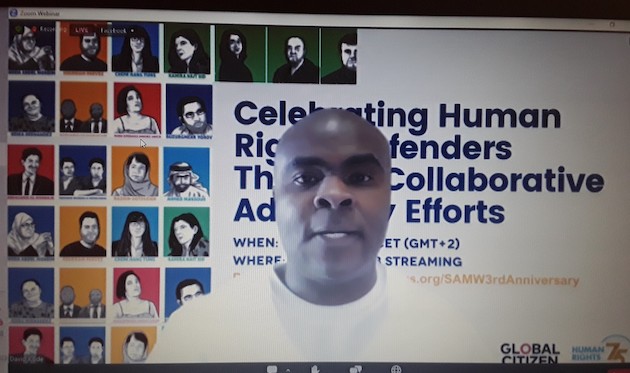
In commemoration of the third anniversary of the Stand As My Witness campaign, CIVICUS and its partners, including human rights defenders, hosted a public event titled, ‘Celebrating Human Rights Defenders through Collaborative Advocacy Efforts’, to celebrate the brave contributions of human rights defenders and raise awareness about those who are still in detention.

David Kobe said that CIVICUS had profiled at least 25 human rights defenders since the Stand As My Witness Campaign started three years ago. Credit: Joyce Chimbi/IPS

David Kobe said that CIVICUS had profiled at least 25 human rights defenders since the Stand As My Witness Campaign started three years ago. Credit: Joyce Chimbi/IPS

“Over the last three years, we have profiled more than 25 human rights defenders collectively because some human rights defenders are profiled as individuals and others, such as those in Burundi, are profiled as a group because they were arrested as a group. More than 18 human rights defenders have been released over the last three years. As we celebrate, we must recognize that the journey has just started, it is quite long, and the battle is far from over,” Kode said.

The event brought together families and colleagues of detained human rights defenders, previously detained human rights defenders, representatives from the Office of the High Commissioner for Human Rights (OHCHR) and other human rights mechanisms and civil society organisations.

Lysa John, the Secretary General of CIVICUS, spoke about how special Mandela Day is, for it is the one day of the year when the spirit of solidarity is celebrated in his memory. It is also a day to look back at what has been achieved and how much more could be achieved in solidarity.

She further addressed issues of civic space restrictions, closure of civic space and how these restrictions impact societies and individuals. John stressed that the event was held in the context of the 25th anniversary of the adoption of the UN Declaration on Human Rights Defenders and the 75th anniversary of the UNDHR or Human Rights 75 to promote their objectives.

“One-third of the population of the world live in contexts which are closed. Where attacks on people who speak out or exercise their civic freedoms are attacked or arrested without any accountability. More and more people in the world, in fact, the largest section of the world, estimated at 44 percent live in countries where civic space and civic freedoms are restricted. In this regard, civic society is more than ever reinventing itself, and there is increased support for them,” she said.

Birgit Kainz from OHCHR spoke about the importance of bringing to life the UN Declaration on Human Rights Defenders for its adoption was a consensus that human dignity is at the core of everything.

She spoke about the need to be deliberate in the defence of civic space as it enables people to shape their future and that of their children. Kainz said that protection and security are two sides of the same coin and urged participants to network and connect to improve civic space and to also play a complementary role. Further emphasizing the need to maintain data, especially about who is in detention and where in line with SDGs.

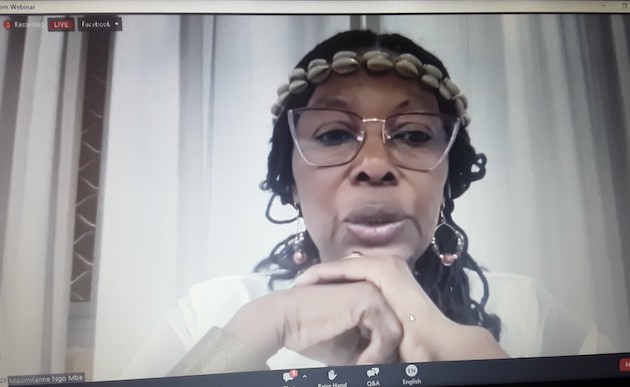
Maximilienne Ngo Mbe from Cameroon is one of the most prolific human rights defenders in Africa. She spoke about the need to create safe spaces for women rights defenders. Photo Joyce Chimbi.jpg

Maximilienne Ngo Mbe from Cameroon is one of the most prolific human rights defenders in Africa. She spoke about the need to create safe spaces for women rights defenders. Credit: Joyce Chimbi/IPS

Maximilienne Ngo Mbe spoke about the life and times of human rights defenders today. She is one of the most prolific human rights defenders in Africa and continues to receive a lot of restrictions for her fearless human rights activities that often have her fleeing from Cameroon to other countries for safety.

“We need a network for women rights defenders because of the special challenges they face as girls, wives, mothers and vulnerable people. Women are engaging less and less because of these challenges and the multiple roles they play in society,” she said.

The event was an opportunity for released human rights defenders such as Maria Esperanza Sanchez from Nicaragua to speak about resilience in the face of brutal regimes. She spoke about how armed men often came to her house to threaten and intimidate her. Of her arrest, humiliation and torture in 2020, being sentenced to 10 years in prison and her eventual release.

It was also an opportunity to speak on behalf of those who cannot. They include Khurram Parvez, a prolific human rights defender in India. At the time of his arrest for human rights activities, he was leading two critical organizations at the national and regional levels.

Parvez is being charged as a terrorist. His story aligns with that of Kenia Hernandez, a 32-year-old indigenous Amuzga woman, mother of two, lawyer and an advocate for human rights who is currently detained in a maximum-security prison in Mexico and has been sentenced to 21 years. Her story is illustrative of the high-risk female rights defenders and people from marginalized groups face.

Ruben Hasbun from Global Citizen spoke about how to effectively advocate for the release of human rights defenders, sharing lessons from Stand As My Witness campaigners.  The event further opened up space to address the role of the private sector.

Christopher Davis from Body Shop, a brand that continues to be at the forefront of supporting human rights and rights defenders, fighting social and environmental injustice.

At the end of the session, participants were invited to sign a petition to have the United Arab Emirates immediately and unconditionally release all those detained solely for the exercise of their human rights and end all abuse and harassment of detained critics, human rights defenders, political opposition members, and their families.

IPS UN Bureau Report


!function(d,s,id){var js,fjs=d.getElementsByTagName(s)[0],p=/^http:/.test(d.location)?’http’:’https’;if(!d.getElementById(id)){js=d.createElement(s);js.id=id;js.src=p+’://platform.twitter.com/widgets.js’;fjs.parentNode.insertBefore(js,fjs);}}(document, ‘script’, ‘twitter-wjs’);  

IPS – UN Bureau, IPS UN Bureau Report, CIVICUS

Source

Human Rights Concerns Ahead of Zimbabwe Polls

Analysts are concerned about pre-election violence and intimidation ahead of next month's Zimbabwean poll. Credit: Ignatius Banda/IPS

Analysts are concerned about pre-election violence and intimidation ahead of next month’s Zimbabwean poll. Credit: Ignatius Banda/IPS

By Ignatius Banda
BULAWAYO, Jul 13 2023 (IPS)

Zimbabwe holds general elections next month amid growing human rights and press freedom concerns in what analysts say could mar conditions for undisputed poll results.


Lawyers representing opposition political activists have not been spared assaults from police and suspected ruling Zimbabwe African National Union Patriotic Front (Zanu PF) party supporters as economic conditions worsen.

In January, Kudzayi Kadzere, a human rights lawyer, was beaten up by police and his arm broken after being dispatched to a local police station in the capital city, Harare, to represent arrested opposition political party supporters. The police accused him of being a “criminal nuisance.”

Early this month, the country’s security forces allegedly attacked Obey Shava, a human rights lawyer who has represented several opposition Citizens for Coalition for Change (CCC) officials and other human rights abuse victims. Unknown assailants broke his legs.

However, the country’s main political opposition led by Nelson Chamisa, the CCC, was quick to point fingers at ruling party activists and the country’s secret police for Shava’s attack. The CCC has routinely been tipped to win successive elections without success.

These incidents have been met with widespread condemnation on the eve of what is seen as crucial elections slated for 23 August, with the British parliament discussing and raising concerns early this month about what is seen as deteriorating human rights conditions in Zimbabwe ahead of the polls.

“What we are seeing in this election cycle is lawfare or the weaponisation of the law,” said Ringisai Chikohomero, a senior analyst at the  Institute for Security Studies (ISS) in Pretoria, South Africa.

“This has led to a lot of prosecution and persecution, and what this has done is to create an atmosphere of fear that you can be locked up for a long time without actually going to trial,” Chikohomero told IPS.

These comments come when human rights organisations say almost a hundred political prisoners are incarcerated, with former opposition legislator Job Sikhala having spent more than a year behind bars and accused of obstruction of justice.

Amnesty International has condemned Sikhala’s long detention, with Flavia Mwangovya, Deputy Director for East and Southern Africa, Amnesty International saying in a May statement  that “there is a worrying restriction of civic space underway in Zimbabwe with growing attempts to persecute anyone who dares to freely express themselves.”

The developments come amid escalating economic hardships, with President Emmerson Mnangagwa accusing the business sector of deliberately sabotaging the economy to stoke anti-government sentiment.

While Mnangagwa has used the campaign trail and radio jingles to denounce violence and appeal for peaceful elections, human rights defenders have questioned the continuing human rights abuses despite its condemnation from the highest office in the land.

“The challenge about the pre-election conditions is that can it be proven that there have been systematic human rights violations,” said Piers Pogue, senior analyst at the International Crisis Group.

“Though international observers from the EU are coming, it is quite clear that six weeks before elections doesn’t constitute long-term observation,” Pogue told IPS.

Already, police have banned or placed stringent conditions for opposition political rallies, such as outlawing the chanting of slogans, further setting the stage for possible confrontations and running battles with party supporters as has happened in past elections.

However, analysts say there is a need for the country to move from continued disputed poll outcomes, and one of the recommendations is to have long-term observer teams from such groups as the African Union and the Southern African Development Community (SADC).

“Ideally, the AU and SADC should have deployed longer-term observer teams. We have seen in the past that only long-term missions manage to get to grips with election conditions. Differences between long and short-term observer missions expose the contradictions of how electoral conditions are assessed,” Pigou said.

Zimbabwe’s elections have for years hogged regional and international headlines after successive controversial victories by the founding Zanu (PF) party amid decades-old worsening economic conditions; with eleven presidential candidates in next month’s general election, the stage could be set for yet another contentious poll outcome.

Meanwhile, as election day approaches, the Zimbabwe Catholic  Bishops Conference has added its voice to concerns about the pre-election conditions, appealing to voters to exercise their democratic right to vote.

“Do not be intimidated, coerced or manipulated to vote against your will. Please refuse to be used in violent attacks against your fellow brothers and sisters,” the Catholic bishops said on 9 July.

The clerics also appealed to the country’s security services, long accused of doing the ruling party’s bidding, to maintain law and order without taking sides.

“To members of the security sector, we appeal to you to work to maintain peace and justice and let all the perpetrators of political violence be held accountable,” the bishops said.

IPS UN Bureau Report


!function(d,s,id){var js,fjs=d.getElementsByTagName(s)[0],p=/^http:/.test(d.location)?’http’:’https’;if(!d.getElementById(id)){js=d.createElement(s);js.id=id;js.src=p+’://platform.twitter.com/widgets.js’;fjs.parentNode.insertBefore(js,fjs);}}(document, ‘script’, ‘twitter-wjs’);  

Source

Guatemala Clings to Democratic Promise

Credit: Silvia Rodríguez/AFP via Getty Images

By Inés M. Pousadela
MONTEVIDEO, Uruguay, Jul 5 2023 (IPS)

When Guatemalans went to the polls on 25 June, distrust and disillusionment were rife. First place in the presidential contest was claimed by none of the candidates: it went to invalid votes, at 17 per cent. Many didn’t bother, resulting in an abstention rate over 40 per cent.


But an unexpected development brought some hope: Bernardo Arévalo, leader of the progressive Movimiento Semilla, made it to the runoff.

Arévalo’s promise to fight against systemic corruption and bring back the numerous justice operators – people such as judges, prosecutors and public defenders – currently in exile to help clean up institutions is causing great concern for those who profit from the current state of affairs. The fact that Arévalo could become Guatemala’s next president has made the election results an instant object of contention.

Corruption and democratic decline

Guatemalan electoral processes aren’t pristine, but that isn’t where the most serious problems lie. Civic freedoms are steadily deteriorating and state institutions have been weakened by predatory elites and coopted by organised crime. Transparency International finds evidence of strong influence by organised criminals over politics and politicians, with some criminals themselves in office.

No wonder Guatemalans have a low level of confidence in state institutions. In the latest Latinobarómetro report, the church was by far the most trusted institution, winning the trust of 71 per cent of people, followed at some distance by the armed forces and police. But only nine per cent of people trust political parties, and trust is also very low in Congress, electoral bodies and the judiciary.

At 25 per cent, satisfaction with the performance of democracy is extremely low – as is the number of people who think the country is ruled for the benefit of all rather than just elites.

The run-up to the vote

Those denouncing corruption, collusion, illegal private sector practices and human rights abuses have increasingly been subjected to smear campaigns, surveillance, harassment and criminalisation by state authorities. Many have been pushed into exile. Rising violence against journalists and human rights defenders, including killings – the latest being that of journalist Orlando Villanueva – recently led the CIVICUS Monitor to downgrade its civic space rating for Guatemala to the second-worst category, repressed.

Restrictions on civic freedoms increased in the run-up to elections, ranging from smear campaigns to criminalisation. On 14 June, José Rubén Zamora, head of the newspaper elPeriódico, which had exposed more than 200 corruption cases, was sentenced to six years in prison for alleged money laundering. Zamora had been subjected to harassment and intimidation for years and had survived an assassination attempt.

An observation mission carried out by Reporters Without Borders and others ahead of voting warned that the absence of basic press freedoms made it impossible to guarantee a legitimate electoral process.

The process was indeed marred by multiple irregularities, starting with the disqualification of several contenders, including Indigenous leader Thelma Cabrera and her running mate, Jordán Rodas Andrade, the only left-wing candidacy polls showed stood a fighting chance. The candidate who led opinion polls, conservative business leader and TikTok star Carlos Pineda, was also disqualified.

What happened on 25 June

With two dozen candidates competing in the presidential race, it was no surprise that none reached the 50 per cent threshold required to avoid a runoff. What was unexpected was Arévalo’s good performance.

The front-runner, Sandra Torres of National Unity of Hope, is a political insider, Guatemala’s first lady between 2008 and 2011. Now standing for the third time in a row, she received 16 per cent of the vote. If elected, she would become Guatemala’s first female president. But she’s by no means a champion of women’s rights: she’s a vocal anti-abortion activist and her running mate is an evangelical pastor.

Runner-up Arévalo is an unusual politician at the head of an unusual party. Originally an academic with social-democratic views, he’s currently a member of Congress, where he leads a five-member progressive caucus. His running mate, low-key feminist Karin Herrera, is a microbiology researcher and university professor.

Unlike many Guatemalan parties, Arévalo’s party wasn’t created as a vehicle for someone’s presidential ambitions or corrupt interests: it was the creature of a group of concerned people that grew out of mass anti-corruption protests that broke out in 2015. In 2019, its presidential candidate was disqualified. But it found its footing among middle class groups, young people and women, particularly in Guatemala City.

The aftermath

Opinion polls had placed Arévalo eighth or ninth among the many contenders, so his performance caught elites off guard.

There’s no guarantee he’ll win the run-off. He’d have to gain the votes of the many who abstained or cast blank and invalid votes. But the fact that Arévalo might win has galvanised those who currently profit from the corrupt status quo, and they’re trying to push him out of the race. A majority of pro-establishment parties, including Torres’s party, have submitted complaints demanding a recount. Their supporters converged outside the Supreme Electoral Tribunal (TSE), quickly pushing further and calling for a rerun.

While various incidents were recorded on election day – including instances of vote buying, mostly by parties linked to the ruling alliance – international and domestic observers alike concluded that the results were valid and the gap of more than 200,000 votes between Semilla and the next contender, the outgoing president’s party, was insurmountable.

Mirador Electoral, a civil society platform, denounced pressures on the TSE as an attempted ‘electoral coup’. The European Union’s observer mission and the Organization of American States have called for the will of voters to be respected. Arévalo condemned it all as an intimidatory manoeuvre and called for the TSE, the Supreme Court and the Constitutional Court to act quickly and responsibly.

Instead, the Constitutional Court ordered the TSE to suspend official certification of results until complaints are resolved. Some fear an attempt to annul the elections will come next.

Guatemala stands at a crossroads. On the eve of voting it seemed on the verge of autocracy. An unexpected result hinted at the possibility of a much brighter path – one that fills many with hope but scares those who see their wealth and power endangered. The coming days and weeks will witness an arm-wrestling match between the past and the future, with three potential outcomes.

In the worst-case scenario, the runoff continues to be delayed by legal appeals and the task of appointing a president ultimately falls to Congress. In the second-worst scenario, a vote-by-vote recount is conducted instead of a simple cross-check of tally sheets, fraud occurs along the way and the ruling party’s candidate takes Arévalo’s runoff spot. Either way, the past wins.

Only if the recount is properly conducted, the results are corroborated and the runoff is held on 20 August will the future have a fighting chance. The corrupt establishment may still beat Arévalo – but this decision belongs to no one but the citizens of Guatemala.

Inés M. Pousadela is CIVICUS Senior Research Specialist, co-director and writer for CIVICUS Lens and co-author of the State of Civil Society Report.


!function(d,s,id){var js,fjs=d.getElementsByTagName(s)[0],p=/^http:/.test(d.location)?’http’:’https’;if(!d.getElementById(id)){js=d.createElement(s);js.id=id;js.src=p+’://platform.twitter.com/widgets.js’;fjs.parentNode.insertBefore(js,fjs);}}(document, ‘script’, ‘twitter-wjs’);  
Source

The Common Good, or Transactional Religion?

An Interfaith Moment of Prayer for Peace at UN Headquarters. Credit: UN Photo/Eskinder Debebe

 
UN Secretary-General António Guterres said the gathering was taking place at a unique moment: on the last Friday of Ramadan, as Christians celebrate Easter, Jews mark the end of Passover, and Sikhs enjoy the festival of Vaisakhi. “Even the calendar is sending a message of unity,” he remarked. “Today, at this blessed moment of renewal across faiths, let us lift our hearts and voices for peace – our guiding star and our most precious goal.” April 2023

By Azza Karam
NEW YORK, Jun 28 2023 (IPS)

For the last 30 odd years, I have maintained that religions matter. I noted the reasons for why they matter, and always listed how they matter —as social service providers, as first responders in humanitarian crisis; as mediators in tensions and conflicts, as upholders of common good and the values of humanity; as protectors of children and of the most vulnerable; and even as political actors.


All to name but a few. I still feel amused when some of those I trained among the UN staff and the faith-based NGO community, quote something I said, in public – albeit without even being aware they are quoting (I am trying to be kind here) – such as: “we should not be talking about whether religions matter, but how they matter”.

In 2007, while at UNDP, I was told, more than once, “we do not do religion”. By the time I left the UN in 2020, after building two bodies – an Interagency Task Force on Religion and its Multi Faith Advisory Council – it was clear that almost all UN entities were competing to ‘do religion’. In fact, some UN entities are competing for religious funding.

While I have not lost that faith in faith itself, over the last years, I have grown increasingly incredulous of those who would speak in the name of ‘religion’. It is hard not to feel distinctly bemused, when versions of ‘if religious actors/leaders are not at the [policy] table, they will be on the menu]’, are being told in one gathering after another.

Often by the same kinds of speakers, among the same kinds of audiences, albeit meeting more and more frequently – and often more lavishly — in different cities around the world.

The reason for bemusement, is not disillusion with the unparalleled roles that various religious institutions and communities of faith play. Far from it. These roles are, in short, vast. In fact, they are as impossible to quantify, as they are implausible to assume full comprehension of.

After all, how do you accurately measure the pulse of our individual spiritualities – let alone our collective sense thereof? Religious leaders, religious institutions, faith-based and faith-inspired NGOs (FBOs) – let alone faith communities – are massive in number, and permeate all the world’s edifices, peoples and even languages. Faiths, and expressions of religiosity, are likely as numerous as the hairs on an average head (not counting those who may be lacking vigour in that department).

No, the reason for bemusement is disillusionment with the trend of commercialisation of religion, the business of ‘doing religion’. The emerging marketplace of “religion and [fill in the blanks – and anything is possible]” is reminiscent of not too many decades ago, when so many academics, consultants, think tanks, NGOs, worked on the business of democracy and/or good governance and/or human rights. Then, as now, projects, programmes, initiatives, meetings, and more meetings, were hosted.

A global emerging elite of ‘experts’ in the above (or variations thereof) permeated the four and five-star hotel meeting rooms, gave business to caterers and conference centres as they traipsed the ‘conference circuits’ from north to south, populated proposals to governments, philanthropists and various donor entities.

They defined the missions of for-profit consultancies claiming to enable the strategic capabilities, to inform the media presences, to refine the narratives, to provide the leadership coaching, to jointly express the common values, to uphold the good in public service… And so on.

We are not living in better democracies now, in spite of all that business. Will we have more faithful societies? Will people pray more, for one another and serve more selflessly now that ‘religion’ is in? Somehow, I doubt it.

By the time we realised the extent of the commercialisation of democracy and human rights, the commercial nature had corrupted much of the sagacity – and the necessary courage – there was. Even autocrats bought into the business of doing democracy and human rights, and used the narratives to enhance their respective agendas.

Few democratic actors worked together, and even fewer collaborated to serve – and save – the whole of humanity. As with any business venture, the motive of profit – and power – of some, dominated.

And rather than a consolidated civil society effort holding decision makers accountable for the sake of the most vulnerable, and collectively and successfully eliminating the tools of harm, we are living in the era where money, weapons – including nuclear ones – control over resources, and war (including war on this earth), dominate.

Today, some of the most authoritarian and self-serving regimes, and some of the most power-seeking individuals, and their retinues, are vested in the business of ‘religion’. And why not? It is among the most lucrative domains of financial, political and social influence.

Decades of study, however, point to some simple questions to ask, to distinguish the transactional nature of ‘religious affairs’ claiming to be for the good of all, from those actually serving the common good.

The questions include the following:

How many of those engaged in the work of religion (whether as religious or secular actors) actually give of or share, their varied resources, to/with one another (including those from other/different religions, entities, age groups, countries, races, etc.)?

How many different religious organisations plan and deliver, jointly, the same set of services to the same set of needs, in the same neighborhoods or in the same countries?

How many ‘religious actors’ actually partner with ‘secular’ civil society organisations to hold institutions of political and financial power equally accountable – if need be, at cost to their own welfare. In other words, how many stand on principle, irrespective of the cost?

And, my personal favourite: what are these religious actors’ respective positions on women’s rights, on gender equality and/or on women’s leadership?

The more diplomatic way to frame that is also one of the most powerful litmus tests: which human rights do these actors working on/with/for religion, value more? You see, those who are engaged in transactional practices wearing a religious garb, will invariably prioritise some rights, or some privileges, over others.

The answer to this question therefore, will indicate the difference between a coalition of religious fundamentalists (including secular power seekers and some religious and political leaders), and a multilateral alliance dedicated to serving the common good – for each and all, barring none, especially in the most challenging of times.

Azza Karam is a Professor of Religion and Development at the Vrij Universiteit of Amsterdam and served as a member of the UN Secretary General’s High Level Advisory Board on Effective Multilateralism.

IPS UN Bureau


!function(d,s,id){var js,fjs=d.getElementsByTagName(s)[0],p=/^http:/.test(d.location)?’http’:’https’;if(!d.getElementById(id)){js=d.createElement(s);js.id=id;js.src=p+’://platform.twitter.com/widgets.js’;fjs.parentNode.insertBefore(js,fjs);}}(document, ‘script’, ‘twitter-wjs’);  
Source

Forus Civil Society Network Urges that Respect for Human Rights, Climate Justice and Accountability should be at the core of the New Global Financing Pact

Indigenous activist protesting in Colombia. Credit: Sebastian Barros

By Marianne Buenaventura
PARIS, Jun 23 2023 (IPS)

As the Summit for a New Global Financing Pact unfolds in Paris on 22-23 June, Forus, a global network representing over 22,000 civil society organisations across Africa, Latin America, Asia, Europe and the Pacific, calls for the respect of human rights and for meaningful inclusion of civil society in shaping financial systems and structures.


The summit, co-hosted by India, could help find common ground on finance that drives progress at key events later in 2023 and in 2024 – the G20 summit in New Delhi, the COP28 climate talks in Dubai, and the Finance in Common summit with public development banks in Cartagena.

As part of the summit, Sarah Strack, Forus Director, is amplifying civil society’s voices at the high-level Finance in Common event in the presence of French President Emmanuel Macron and other leaders, to discuss and leverage the role of Public Development Banks in financing the SDGs, scaling up sustainable finance, and supporting inclusion. Forus has been engaging in the Finance in Common initiative since its inception in 2020 with the aim to ensure that a people-based approach to development is pursued.

“If we want to have a chance to tackle the most pressing challenges and the multiple crises of our time in a way that really puts first the interests and needs of people, then a shift of mindset and a new financial framework are absolutely necessary. It is essential that civil society plays a central role in shaping this new paradigm at every stage. Let us not forget the wealth of knowledge and leadership present at the local level. By actively engaging and collaborating with communities, we can genuinely measure our progress and honor the commitments we have made to those most in need,” says Sarah Strack.

Harsh Jaitli, CEO of the Voluntary Action Network India (VANI), is representing Forus as an official respondent in the Summit Roundtable “Power Our Planet: Act today. Save tomorrow”, co-hosted by Global Citizen and CISCO. The event seeks to rally for immediate action on economic, social, and climate justice, engaging both public and private sectors to catalyze renewable energy investment in climate-vulnerable countries to reduce energy poverty and accelerate the low-carbon transition.

Harsh Jaitli of VANI states that the New Global Financial Pact will require improved partnerships and the building of trust.

“Double standards have negatively impacted our collective capacity to deliver on effective development and climate related programmes. In some countries, multinational corporations respect human rights, fiscal and climate regulations, but in other countries decisions are made to violate them. Not only does this send the wrong message that some countries and populations are more important than others, but also jeopardizes our collective efforts to affect change. Multinational corporations should commit to respecting human rights, fiscal and climate regulations in all countries and in a consistent manner. When no strong regulations exist, this is the opportunity for multinationals to be proactive and to apply strong rules, which are coherent with their policies,”says Harsh Jaitli.

Julien Comlan Agbessi, Coordinator of the Regional Coalition of West Africa (REPAOC) emphasizes the importance of multi-stakeholder cooperation. Agbessi explains that cooperation between the private sector and the civil society organisations is possible, since the private sector could leverage hugely on the experience and outreach of civil society. “Many poverty alleviation programs and projects with significant funding implemented over the past decades have failed to deliver for communities. Transformative investments in low-income countries and climate impacted countries require putting the needs of people first,” says Julien Comlan Agbessi.

Lina Paola Lara Negrette, Coordinator of the Confederación Colombiana de ONG (Ccong), states that the New Global Financial Pact must incorporate stronger and more meaningful engagement with civil society.

“Civil society has an important role to play in ensuring the accountability and transparency of both government and private sector actors. Civil society can work closely with governments and the private sector to ensure the delivery of social and environmental needs in all investments, which includes respect of human rights”.

Olivier Bruyeron, President of the French platform of CSOs Coordination SUD, equally emphasizes the importance of partnerships with the public and private sector, “CSOs hold valuable knowledge and expertise on international solidarity needed to construct sustainable global solutions and to link them with local development” adds Olivier Bruyeron.

Marianne Buenaventura is project coordinator at Forus.

IPS UN Bureau


!function(d,s,id){var js,fjs=d.getElementsByTagName(s)[0],p=/^http:/.test(d.location)?’http’:’https’;if(!d.getElementById(id)){js=d.createElement(s);js.id=id;js.src=p+’://platform.twitter.com/widgets.js’;fjs.parentNode.insertBefore(js,fjs);}}(document, ‘script’, ‘twitter-wjs’);  

Source