Rajagopal PV’s Blueprint for Another World: Peace

Active Citizens, Africa, Asia-Pacific, Civil Society, Conferences, Editors’ Choice, Featured, Global, Headlines, Human Rights, Humanitarian Emergencies, Peace, Population, Sustainable Development Goals, TerraViva United Nations

Peace

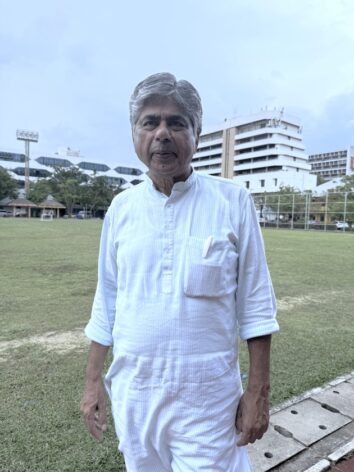
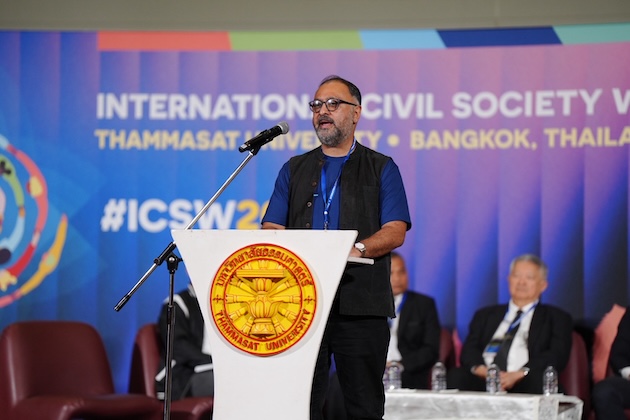
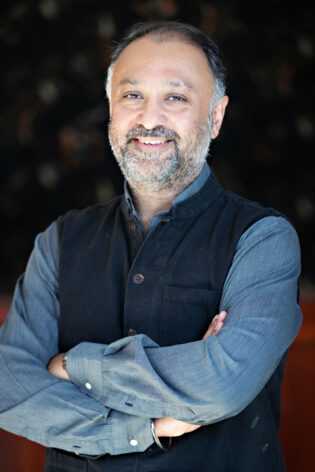
Rajagopal P.V. at the International Civil Society Week (ICSW2025) in Bangkok. Credit: Zofeen Ebrahim/IPS

Rajagopal P.V. at the International Civil Society Week (ICSW2025) in Bangkok. Credit: Zofeen Ebrahim/IPS

BANGKOK, Nov 4 2025 (IPS) – “If nations can have defense ministries, why not peace ministries?” asks Rajagopal PV, the soft-spoken yet formidable founder of Ekta Parishad. “We are told to see issues through a gender lens—why not a peace lens? Why can’t we imagine a business model rooted in non-violence or an education system that teaches peace?”


Founded in 1989, Ekta Parishad—literally Forum for Unity—is a vast people’s movement of more than 250,000 landless poor, now recognized as one of India’s largest and most disciplined grassroots forces for justice.

To Rajagopal, these aren’t utopian dreams—they’re blueprints for a possible world.

Over the decades, Ekta Parishad has secured land rights for nearly half a million families, trained over 10,000 grassroots leaders, protected forests and water bodies, and helped shape key land reform laws and policies in India.

All this has been achieved not through anger, but through disciplined, nonviolent marches that stretch across hundreds of kilometers. Along the way, many leaders have walked beside him—among them, the current Prime Minister of Armenia.

In an age marked by deep disorder—where wealth concentrates in few hands, poverty spreads, and the planet itself trembles under human greed—the 77-year-old Gandhian remains unshaken in his belief that peace alone can redeem humanity.

“We must rescue peace from the clutches of poverty and all its evils,” he told IPS on the sidelines of the International Civil Society Week, standing on the football ground of Bangkok’s Thammasat University.

“And it can be done,” he insists—and his life is proof. In 1969, the centenary year of Mahatma Gandhi’s birth, the Government of India launched a unique exhibition on wheels, a ten-coach train carrying Gandhi’s life and message across the nation. Rajagopal was part of the team that curated and travelled with it.

“For an entire year, we journeyed from state to state. Thousands of schoolchildren would gather at railway platforms, their faces lit with curiosity, waiting to meet Gandhi through our displays,” he recalls.

Yet somewhere along those long railway tracks, Rajagopal began to feel that displaying Gandhi’s ideals wasn’t enough. “The exhibition was beautiful,” he says, “but what was the use of preaching non-violence if we couldn’t live it, breathe it, and bring it to life?”

That realization led him to one of the most daring experiments in peacebuilding India had ever seen—negotiating with the feared bandits of the Chambal valley. “It was 1970,” he recalls. “We moved cautiously, first meeting villagers on the periphery to build trust. Once we had their confidence, we sent word to the dacoits: we wanted to talk. With the government’s consent, we ventured into what we called a ‘peace zone’—often by night, walking for hours through deep ravines—to meet men the world only knew as outlaws.”

The dialogues continued for four years. Eventually, as many as 570 bandits laid down their arms before a photograph of Mahatma Gandhi—a sight India had never seen before. The government, in turn, promised they would not face the death penalty and would receive land and livestock to rebuild their lives. Rehabilitation took another four painstaking years, but it was a victory of conscience over fear.

“They didn’t just surrender their weapons—they surrendered their anger,” Rajagopal says quietly. “There was real repentance, and that takes time—but it lasts.” His commitment came at a cost. At his ashram—a spiritual retreat he had founded—he was threatened, beaten, and ordered to abandon his peace efforts. He talked them through to accepting his presence.

“Today that same region is heaven,” he smiles, his eyes crinkling with memory. “Fifty years ago, people trembled at sunset—terrified of the bandits. Today, you can travel at 2:00 pm in the night, where fear ruled once.”

The mass surrender may have looked like a triumph for the state, but Rajagopal urges people to look deeper. “It’s the invisible violence—poverty, injustice, and oppression—that breeds the visible one: dacoities, kidnappings, and killings,” he explains.

Though Rajagopal and his companions had ended one form of violence, the deeper, quieter kind—born of poverty and neglect—still festered. Until that was confronted, he knew, peace would remain incomplete.

Years of working alongside the poor had taught him one truth: non-violence needs structure. If India’s Indigenous and landless communities were to be heard, they had to be organized.

“We began training young people from dozens of villages,” he says. “They went door to door, teaching others not only about their rights—especially the right to land—but also how to claim them peacefully.”

With that foundation, a five-year plan took shape. Each village home chose one member to take part. Every day, the family set aside one rupee and a fistful of rice—a humble but powerful act of commitment.

They even created a “playbook” of possible scenarios—how to stay calm under provocation, how to respond to setbacks, and how to practice non-violence in thought and action. “In one of our marches, a truck ran over three of our people, killing them,” he recalls softly. “There was grief, but no retaliation. Instead, they sat in silence and meditated. That was our true test.”

In 2006, 500 marchers walked 350 kilometers from Gwalior to Delhi, demanding land rights. Nothing changed. But they didn’t stop.

A year later, in 2007, 25,000 people—many barefoot—set out again on the national highway. “Imagine that sight,” Rajagopal says, eyes gleaming. “Twenty-five thousand people walking for a month, powered only by hope.”

The march displayed not just India’s poverty but also its power—the quiet power of the poor united. It was among the most disciplined mobilizations the country had ever seen. “There was one leader for every hundred people,” Rajagopal explains. “We walked by day and slept on the highway by night. Those in charge of cooking went ahead each morning so that by sundown, a single meal was ready for all.”

In a later march, Rajagopal recalls, the government sent a large police force. “I was worried,” he admits. “I called the authorities to tell them this was a non-violent protest—we didn’t need protection. The officer replied, ‘They’re not there for you; they’re here to learn how disciplined movements should be.’”

Along the route, villages greeted them like family—offering bags of rice, water, and prayers. “There was never a shortage of food,” Rajagopal smiles. “When your cause is just, the world feeds you.”

By the time the march reached Delhi, the government announced a new land reform policy and housing rights and agreed to enact the Forest Rights Act.

The government dispersed the marchers with hollow promises and the reforms never happened.

So Ekta Parishad planned an even larger march—a Jan Satyagraha of 100,000 people in 2012.

“Halfway through, the government came running.”

Rajagopal’s face lights up as he recalls the event. “They agreed to our ten-point agenda and signed it in front of the people. That moment was historic—governments almost never do that; the Indian government certainly never does it!”

The agreement included land and housing rights, a national task force on land reform, the prime minister’s oversight of policy implementation, and fast-track courts to resolve land disputes.

Today, because of these long, barefoot marches, more than three million Indigenous people in India now have legal rights to land and housing. The struggle also gave birth to India’s Land Acquisition, Rehabilitation, and Resettlement Act—a landmark in people’s movements.

“The Act also safeguards fertile land,” Rajagopal explains. “Before the government can acquire any area, a social impact study must be done. And if farmland is taken, the owners receive four times its value in compensation.”

“The purpose of our marches,” Rajagopal says, “is not to fight the government, but to win it over. The government is not the enemy; injustice is. We must stand on the same side of the problem.”

For Rajagopal, peace is not a sentiment but a system—something that must be built, brick by brick, through dialogue and respect. “Non-violence,” he says, “isn’t passive. It’s active patience—listening, accepting differences, never policing thought.” The same principle, he believes, can heal families, neighborhoods, nations—and the world itself.

His next mission is to create a Youth Peace Force, ready to enter conflict zones and resolve disputes through dialogue. He has also launched the Peace Builders Forum, or Peace7, uniting seven countries—South Africa, Japan, Costa Rica, Switzerland, Canada, India, and Armenia. His dream is to expand it to Peace20, where, as he smiles, “wealth will never be a criterion for membership.”

IPS UN Bureau Report


Defending Democracy in a “Topsy-Turvy” World

Active Citizens, Africa, Asia-Pacific, Civil Society, Democracy, Development & Aid, Editors’ Choice, Featured, Green Economy, Headlines, Human Rights, Humanitarian Emergencies, Middle East & North Africa, Press Freedom, Sustainable Development Goals, TerraViva United Nations

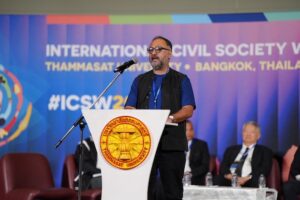
Secretary General of CIVICUS, Mandeep Tiwana, at International Civil Society Week 2025. Credit: Civicus

Secretary General of CIVICUS, Mandeep Tiwana, at International Civil Society Week 2025. Credit: Civicus

BANGKOK, Nov 1 2025 (IPS) – It is a bleak global moment—with civil society actors battling assassinations, imprisonment, fabricated charges, and funding cuts to pro-democracy movements in a world gripped by inequality, climate chaos, and rising authoritarianism. Yet, the mood at Bangkok’s Thammasat University was anything but defeated.


Once the site of the 1976 massacre, where pro-democracy students were brutally crushed, the campus—a “hallowed ground” for civil society actors—echoed with renewed voices calling for defending democracy in what Secretary General of CIVICUS, Mandeep Tiwana, described as a “topsy-turvy world” with rising authoritarianism—a poignant reminder that even in places scarred by repression, the struggle for civic space endures.

“Let it resonate,” said Ichal Supriadi, Secretary General, Asian Democracy Network. “Democracy must be defended together,” adding that it was the “shared strength” that confronts authoritarianism.

Despite the hopeful spirit at Thammasat University, where the International Civil Society Week (ICSW) is underway, the conversations often turned to sobering realities. Dr. Gothom Arya of the Asian Cultural Forum on Development and the Peace and Culture Foundation reminded participants that civic freedoms are being curtailed across much of the world.

Citing alarming figures, he spoke bluntly of the global imbalance in priorities—noting how military expenditure continues to soar even as civic space shrinks. He pointedly referred to the United States’ Ministry of Defense as the “Ministry of War,” comparing its USD 968 billion military budget with China’s USD 3 billion and noting that spending on the war in Ukraine had increased tenfold in just three years—a stark illustration of global priorities. “This is where we are with respect to peace and war,” he said gloomily.

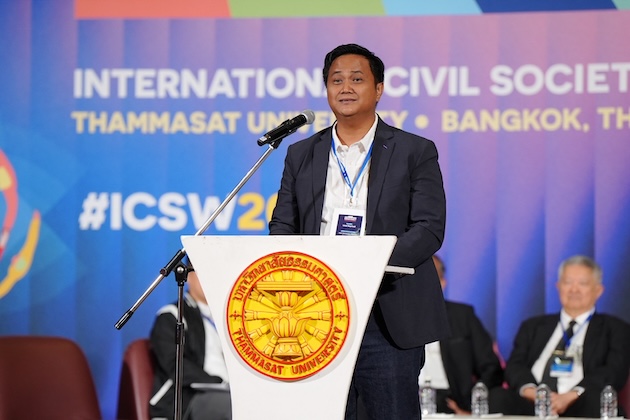
Ichal Supriadi, Secretary General, Asian Democracy Network. Credit: Civicus

Ichal Supriadi, Secretary General, Asian Democracy Network. Credit: Civicus

At another session, similar reflections set the tone for a broader critique of global power dynamics. Walden Bello, a former senator and peace activist from the Philippines, argued that the United States—especially under the Trump administration—had abandoned even the pretense of a free-market system, replacing it with what he called “overt monopolistic hegemony.” American imperialism, he said, “graduated away from camouflage attempts and is now unapologetic in demanding that the world bend to its wishes.”

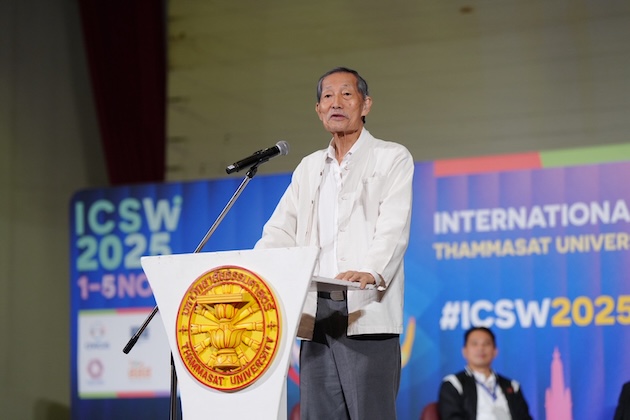
Dr. Gothom Arya of the Asian Cultural Forum on Development and the Peace and Culture Foundation. Credit: Civicus

Dr. Gothom Arya of the Asian Cultural Forum on Development and the Peace and Culture Foundation. Credit: Civicus

Dr. Pervez Hoodbhoy, a Pakistani physicist and author, echoed the sentiment, expressing outrage at his own country’s leadership. He condemned Pakistan’s decision to nominate a “psychopath, habitual liar, and aggressive warmonger” for the Nobel Peace Prize, saying that the leadership had “no right to barter away minerals and rare earth materials to an American dictator” without public consent.

Hoodbhoy urged the international community to intervene and restart peace talks between Pakistan and India—two nuclear-armed neighbors perpetually teetering on the edge of renewed conflict.

But at no point during the day did the focus shift away from the ongoing humanitarian crises. Arya reminded the audience of the tragic loss of civilian lives in Gaza, the devastating fighting in Sudan that had led to widespread malnutrition, and the global inequality worsened by climate inaction. “Because some big countries refused to follow the Paris Agreement ten years ago,” he warned, “the rest of the world will suffer the consequences.”

That grim reality was brought into even sharper relief by Dr. Mustafa Barghouthi, a Palestinian physician and politician, who delivered a harrowing account of Gaza’s devastation. He said that through the use of  American-supplied weapons, Israel had killed an estimated 12 percent of Gaza’s population, destroyed every hospital and university, and left nearly 10,000 bodies buried beneath the rubble.

“Even as these crises unfolded across the world, the conference demonstrated that civil society continues to persevere, as nearly 1,000 people from more than 75 organizations overcame travel bans and visa hurdles to gather at Thammasat University, sharing strategies, solidarity, and hope through over 120 sessions.

Among them was a delegation whose presence carried the weight of an entire nation’s silenced hopes—Hamrah, believed to be the only Afghan civil society group at ICSW.

“Our participation is important at a time when much of the world has turned its gaze away from Afghanistan,” Timor Sharan, co-founder and programme director of the HAMRAH Initiative, told IPS.

“It is vital to remind the global community that Afghan civil society has not disappeared; it’s fighting and holding the line.”

Through networks like HAMRAH, he said, activists, educators, and defenders have continued secret and online schools, documented abuses, and amplified those silenced under the Taliban rule. “Our presence here is both a statement of resilience and a call for solidarity.”

“Visibility matters,” pointed out Riska Carolina, an Indonesian woman and LGBTIQ+ rights advocate working with ASEAN SOGIE Caucus (ASC). “What’s even more powerful is being visible together.”

“It was special because it brought together movements—Dalit, Indigenous, feminist, disability, and queer—that rarely share the same space, creating room for intersectional democracy to take shape,” said Carolina, whose work focuses on regional advocacy for LGBTQIA+ rights within Southeast Asia’s political and human rights frameworks, especially the ASEAN system, which she said has historically been “slow to recognize issues of sexuality and gender diversity.”

“We work to make sure that SOGIESC (Sexual Orientation, Gender Identity and Expression, and Sex Characteristics) inclusion is not just seen as a niche issue, but as a core part of democracy, governance, and human rights. That means engaging governments, civil society, and regional bodies to ensure queer people’s participation, safety, and dignity is part of how we measure democratic progress.”

She said the ICSW provided ASC with a chance to make “visible” the connection between civic space, democracy, and queer liberation and to remind people that democracy is not only about elections but also about “who is able to live freely and who remains silenced by law or stigma.”

Away from the main sessions, civil society leaders gathered for a candid huddle—part reflection, part reckoning—to examine their role in an era when their space to act was shrinking.

“The dialogue surfaced some tough but necessary questions,” he said. They asked themselves: ‘Have we grasped the full scale of the challenges we face?’ ‘Are our responses strong enough?’ ‘Are we expecting anti-rights forces to respect our rules and values?’ ‘Are we reacting instead of setting the agenda? And are we allies—or accomplices—of those risking everything for justice?’

But if there was one thing crystal clear to everyone present, it was that civil society must stand united, not fragmented, to defend democracy.

IPS UN Bureau Report

  Source

As Civil Society Is Silenced, Corruption and Inequality Rise

Active Citizens, Asia-Pacific, Civil Society, Climate Change, Climate Change Justice, Conferences, COP30, Democracy, Editors’ Choice, Environment, Featured, Global, Headlines, Human Rights, Press Freedom, Sustainable Development Goals, TerraViva United Nations

Civil Society

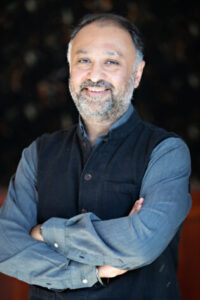
Mandeep Tiwana, Secretary General, CIVICUS Global Alliance. Credit: CIVICUS

Mandeep Tiwana, Secretary General, CIVICUS Global Alliance. Credit: CIVICUS

BULAWAYO & BANGKOK, Oct 31 2025 (IPS) – From the streets of Bangkok to power corridors in Washington, the civil society space for dissent is fast shrinking. Authoritarian regimes are silencing opposition but indirectly fueling corruption and widening inequality, according to a leading global civil society alliance.


The warning is from Mandeep Tiwana, Secretary General of CIVICUS Global Alliance, who points to a troubling trend: civil society is increasingly considered a threat to those in power.

That is a sobering assessment from CIVICUS, which reports that a wave of repression by authoritarian regimes is directly fueling corruption and exploding inequality.

“The quality of democracy on hand around the world is very poor at the moment,” Tiwana tells IPS in an exclusive interview. “That is why civil society organizations are seen as a threat by authoritative leaders and the negative impact of attacking civil society means there is a rise in corruption, there is less inclusion, there is less transparency in public life and more inequality in society.”

His comments come ahead of the 16th International Civil Society Week (ICSW) from 1–5 November 2025 convened by CIVICUS and the Asia Democracy Network. The ICSW will bring together more than 1,300 delegates comprising activists, civil society groups, academics, and human rights advocates to empower citizen action and build powerful alliances. ICSW pays tribute to activists, movements, and civil society achieving significant progress, defending civic freedoms, and showing remarkable resilience despite the many challenges.

The ICSW takes place against a bleak backdrop. According to the CIVICUS Monitor, a research partnership between CIVICUS and over 20 organizations tracking civic freedoms, civil society is under attack in 116 of 198 countries and territories. The fundamental freedoms of expression, association, and peaceful assembly face significant deterrents worldwide.

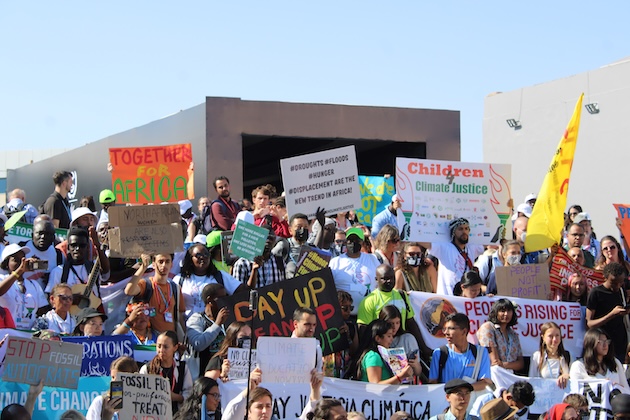
Protests at COP27 in Egypt. Mandeep Tiwana, Secretary General of CIVICUS Global Alliance, is hopeful that COP30, in Belém, Brazil, will be more inclusive. Credit: Busani Bafana/IPS

Protests at COP27 in Egypt. Mandeep Tiwana, Secretary General of CIVICUS Global Alliance, is hopeful that COP30, in Belém, Brazil, will be more inclusive. Credit: Busani Bafana/IPS

“It is becoming increasingly dangerous to be a civil society activist and to be the leader of a civil society organization,” Tiwana tells IPS. “Many organizations have been defunded because governments don’t like what they do to ensure transparency or because they speak out against some very powerful people. It is a challenging environment for civil society.”

Research by CIVICUS categorizes civic freedom in five dimensions: open, narrowed, obstructed, repressed, and closed. Alarmingly, over 70 percent of the world’s population now lives in countries rated in the two worst categories: ‘repressed’ and ‘closed.’

“This marks a regression in democratic values, rights, and accountability,” Tiwana noted, adding that even in the remaining 30% of nations, restrictions on civic freedoms remain.

Repression Tools in Tow

The ICSW, being held under the theme ‘Celebrating citizen action: reimagining democracy, rights, and inclusion for today’s world,’ convenes against this backdrop.

Multifaceted tools are used by governments to stifle dissent. Governments are introducing laws to block civil society organizations from receiving international funding while simultaneously restricting domestic resources. Besides, laws have also been enacted in some countries to restrict the independence of civil society organizations that scrutinize governments and promote transparency.

For civil society activists, the consequences are sobering.

“If you speak truth to power, uncover high-level corruption and try to seek transformative change in society, whether it’s on gender equality or inclusion of minorities you  can be subjected to severe forms of persecution,” Tiwana explained. “This includes stigmatization, intimidation,  imprisonment for long periods, physical attacks, and death.”

Multilateralism Tumbles, Unilateralism Rises

Tiwana said there is an increasing breakdown in multilateralism and respect for international laws from which civil society draws its rights.

This erosion of civic space is reflected in the breakdown of the international system. Tiwana identified a surge in unilateralism and a disregard for the international laws that have historically safeguarded the rights of civil society.

“If you look at what’s happening around the world, whether with regard to conflicts in Palestine, in the Congo, in Sudan, in Myanmar, in Ukraine, in Cameroon, and elsewhere, governments are not respecting international norms,” he observed, remarking that authoritarian regimes were abusing the sovereignty of other countries, ignoring the Geneva conventions, and legalizing attacks on civilians, torturing and persecuting civilians.

This collapse of multilateralism has enabled a form of transactional diplomacy, where narrowly defined national interests trump human rights. Powerful states now collude to manipulate public policy, enhancing their wealth and power. When civil society attempts to expose these corrupt relationships, it becomes a target.

“They are colluding to game public policy to suit their interests and to enhance their wealth.  The offshoot of this is that civil society is attacked when it tries to expose these corrupt relationships,” said Tiwana, expressing concern  about the rise in state capture by oligarchs who now own vast swathes of the media and technology landscapes.

Citing countries like China and Rwanda, which, while they have different ways of functioning, Tiwana said both are powerful authoritarian states engaging in transactional diplomacy and are opposed to the civil society’s power to hold them to account.

The election of Donald Trump as US President in 2025 has shattered the foundation of the US as a democracy, Tiwana noted. The country no longer supports democratic values internationally and is at home with  attacks on the media and defunding of civil society.

The action by the US has negative impacts, as some leaders around the world are taking their cue from Trump in muzzling civil society and media freedoms, he said, pointing to how the US has created common cause with authoritarian governments in El Salvador, Israel,  Argentina, and Hungary.

The fight Goes On

Despite facing repression and threats, civil society continues to resist authoritarian regimes. From massive street protests against corruption in Nepal, and Guatemala  to pro-democracy movements that have removed  governments in Bangladesh  and Madagascar,

“People need to have courage to stand up for what they believe and to speak out when their neighbors are persecuted,” Tiwana told IPS. “People still need to continue to speak the truth and come out in the streets in peaceful protest against the injustice that is happening. They should not lose hope.”

On the curtailing of civil society participation in climate change negotiations, Tiwana said the upcoming COP30 in Brazil offered hope. The host government believes in democratic values and including civil society at the table.

“Past COPs have been held in petro states—Azerbaijan, the United Arab Emirates and Egypt—which are all authoritarian states where civil society has been attacked, crushed, and persecuted,” he said. “We are hopeful that there will be greater inclusion of voices and the commitments that will be made to reduce emissions will be ambitious but the question is really going to be after the COP and if those commitments will be from governments that really don’t care about civil society demands or about the well-being of their people.”

Young people, Tiwana said, have shown the way. Movements like Fridays for Future  and the Black Lives Matter have demonstrated the power of solidarity and unified action.

But, given the massive protests, has this resistance led to change of a similar scale?

“Unfortunately, we are seeing a rise in military dictatorships around the world,” Tiwana admitted, attributing this to a fraying appetite by the international community to uphold human rights and democratic values.

“Conflict, environmental degradation, extreme wealth accumulation, and high-level corruption are interlinked because it’s people who want to possess more than they need.”

Tiwana illustrated what he means by global priorities.

“We have USD 2.7 trillion in military spending year-on-year nowadays, whereas 700 million people go to bed hungry every night.”

“As civil society, we are trying to expose these corrupt relationships that exist. So the fight for equality, the struggle to create better, more peaceful, more just societies—something CIVICUS supports very much—are some of the conversations that we will be looking to have at the International Civil Society Week.”

IPS UN Bureau Report

  Source

Trump In Asia, U.S. Military In Caribbean, Shutdown Week 4

President Trump’s Asia trip kicks off with peace deal between Cambodia and Thailand and a trade framework with China, before meeting with President Xi Jinping on Thursday. The massive U.S. military build up in the Caribbean waters off the coast of Venezuela is causing concern from Caracas to the U.S. Congress, Venezuelan troops conduct drills on their beaches this weekend. And federal workers face growing financial strain as the government shutdown threatens holiday travel and food benefits.

Want more comprehensive analysis of the most important news of the day, plus a little fun? Subscribe to the Up First newsletter.

<

p class=”readrate”>Today’s episode of Up First was edited by Dana Farrington, Tara Neil, Kelsey Snell, Mohamad ElBardicy and Alice Woelfle .

<

p class=”readrate”>

<

p class=”readrate”>It was produced by Ziad Buchh, Ben Abrams and Christopher Thomas

<

p class=”readrate”>

<

p class=”readrate”>We get engineering support from Neisha Heinis. And our technical director is Carleigh Strange.

Learn more about sponsor message choices: podcastchoices.com/adchoices

NPR Privacy Policy


Discover more from The Maravi Post

Subscribe to get the latest posts sent to your email.

The Maravi Post

Thailand’s ‘Humanitarian Corridor’ for Myanmar Faces Pushback

Armed Conflicts, Asia-Pacific, Civil Society, Development & Aid, Editors’ Choice, Featured, Headlines, Human Rights, Humanitarian Emergencies, Migration & Refugees, Sustainable Development Goals, TerraViva United Nations

Migration & Refugees

A Myanmar girl, displaced by war, sells cigarettes through the razor-wired border with Thailand near the frontier town of Mae Sot. Thailand is bracing for another influx of refugees. Credit: William Webb/lPS

A Myanmar girl, displaced by war, sells cigarettes through the razor-wired border with Thailand near the frontier town of Mae Sot. Thailand is bracing for another influx of refugees. Credit: William Webb/lPS

MAE SOT, Thailand, Mar 13 2024 (IPS) – The Maung family is rebuilding their lives in a foreign land. A freshly painted signboard with a play on the word Revolution declares their small restaurant is open for business, and breakfast features traditional Myanmar mohinga—rice noodles and fish soup.


Three years ago, the family of four was prospering in the central Myanmar city of Mandalay but suddenly everything changed. The military seized back power from the newly elected government, and thousands of people took to the streets in protest, including the Maungs. A brutal crackdown ensued across Myanmar, the father was arrested and their two restaurants seized.

Since the 2021 coup, the UN estimates some 2.4 million more people have been displaced by conflict across Myanmar, while 78,000 civilian properties, including homes, hospitals, schools, and places of worship, have been burnt or destroyed by the military.

The Maung family was wise to leave Myanmar when they could, and fortunate to survive the hazardous journey eastwards towards the border with Thailand. After spending a year in a border camp for IDPs run by the military wing of the Karen National Union (KNU) in eastern Kayin State, the family managed to cross into the Thai frontier town of Mae Sot to start afresh, even if they exist in a grey zone of legality alongside tens of thousands of others.

More waves of refugees are following in their footsteps.

“We have 750,000 IDPs in our territory,” said a senior official of the KNU, which has been waging the world’s longest civil war against successive Myanmar regimes since 1949. “A year ago, there were 500,000 to 600,000. Numbers are rising because the military is deliberately targeting civilians,” he told IPS in Mae Sot, asking not to be named.

Myanmar refugees in Thailand pick out clothes piled in the street that have been donated in the border town of Mae Sot. Credit: William Webb/IPS

Myanmar refugees in Thailand pick out clothes piled in the street that have been donated in the border town of Mae Sot. Credit: William Webb/IPS

Against this background and wanting to preempt an influx, Thailand’s new coalition government announced its intention last month to open up a ‘humanitarian corridor’ into Myanmar to funnel aid to IDPs and keep them well away from the border.

Thailand’s military—the real arbiter of power in these border regions and holding sway over two parties in the coalition—is haunted by the spectre of past and present examples of chaos through conflict. In the 1980s, Thailand reluctantly hosted several hundred thousand Cambodian refugees, including remnants of the genocidal Khmer Rouge regime, on its eastern borders. Today it looks west and sees Bangladesh struggling to contain in camps some one million Rohingya refugees forced out of Myanmar in what the UN special rapporteur on human rights called a genocidal campaign by the Myanmar military.

But beyond the ‘humanitarian’ aspect, what has caused anger within the various groups fighting the Myanmar military as well as rights activists, is Thailand’s own admission that its humanitarian corridor proposal is aimed at drawing the regime’s State Administration Council (SAC) into a dialogue that would lead to a negotiated settlement with Myanmar’s diverse resistance forces.

Neither the KNU nor the parallel National Unity Government set up by ousted Myanmar lawmakers after the coup were consulted by Thailand, which received a green light from the Association of Southeast Asian Nations (ASEAN).

Under Thailand’s initiative, aid would be delivered initially to 20,000 IDPs by the Thai Red Cross and the Myanmar Red Cross (whose senior administrators are former military officers) and monitored by ASEAN’s Coordinating Centre for Humanitarian Assistance on Disaster Management, where the Myanmar junta also has a presence.

“Aid is used everywhere in the world as a political entry point,” the KNU official commented. “This is not a pure humanitarian issue. They want to bring the SAC out of isolation. This is very problematic for us.”

A senior NUG official, also based in Thailand, was similarly concerned by the political intentions behind the proposal.  “It’s a desperate measure by ASEAN seeking a semblance of negotiated peace and dialogue,” he told IPS.

The official doubted it would get off the ground in its present form without the support of the Karen forces that control large areas of Kayin State, nor without the full backing of the US.

The US values its long-held strategic ties with Thailand and its military, and Thai Foreign Minister Parnpree Bahiddha-Nukara returned from Washington last month, declaring that he had secured complete US support for the initiative, although the US public statement appeared more cautious.

Human rights activists and humanitarian workers on the Thai-Myanmar border remain highly sceptical of the initiative, denouncing it as a “weaponization of aid”.

Thailand, they note, has never officially recognized the refugee status of nearly 100,000 people living in nine UNHCR camps along the Thai-Myanmar border since the 1990s.

“This is not about providing humanitarian aid to the people of Myanmar. It is about giving a new lifeline to the junta to re-engage with ASEAN and everybody else,” commented Paul Greening, a former UN senior staff officer and now independent consultant in Mae Sot.

“Neighbours and other international actors, including the US and China, do not want the junta to fall. They do not want the junta to win but they do not want it to fall either. This is why they all want a ‘negotiated settlement’,” he said.

Igor Blazevic, a senior adviser at the Prague Civil Society Centre who previously worked in Myanmar, said a “carrot” was being held out to the Myanmar regime at a time when it was “seriously weakened and shaken” after losing large areas of territory to resistance forces both in Rakhine State in the west and in Shan State close to China.

“A political aim behind the ‘humanitarian initiative’ is the intention to treat genocidal power-usurpers in uniform as the inevitable and unavoidable key factor in Myanmar’s ‘stability’ and with combination of soft pressure and humanitarian incentives, try to force everybody else to surrender, in a soft way, to ongoing military dominance in politics and the economy,” Blazevic wrote in a commentary.

With the UN warning that nearly two million people in Myanmar are expected to fall into the “highest category of needs severity (catastrophic)” this year, the resistance is aware that they will come under intense international pressure not to reject the Thai initiative.

Recent developments indicate Thailand may rethink its proposal, however. It has opened channels with the KNU and the NUG to discuss their involvement in facilitating aid deliveries through Myanmar civil society organisations independent of the regime. Word has it that the Myanmar Red Cross is not that keen to be directly involved, knowing it is too close to the regime to be able to safely deliver aid to those who have suffered atrocities at its hands.

For the Maung family and their small eatery in Mae Sot, a dream would be to return to Mandalay and Myanmar in peace. But they have little hope of such an outcome, nor do they really want to remain in Thailand, along with over two million other Myanmar workers, classified as migrants, not refugees.

For the moment, life revolves around navigating Thailand’s complex and often corrupt system to secure papers that would give them a degree of legitimacy and enable them to move beyond Mae Sot and surrounding Tak Province. A possible lifeline is an ethnic Chinese branch of their family with members in Taiwan.

“Taiwan could be our future,” says the elder of two daughters, who still dreams of going to university. “I can learn Chinese,” she says, in excellent English.

IPS UN Bureau Report

  Source