The Nairobi Summit – Towards a Watershed Moment

Africa, Civil Society, Conferences, Crime & Justice, Development & Aid, Economy & Trade, Education, Featured, Gender, Gender Violence, Global, Headlines, Health, Human Rights, Inequity, TerraViva United Nations, Women’s Health

Opinion

NAIROBI, Kenya, Aug 8 2019 (IPS) – In 2019 a female scientist created an algorithm that gave the world the first ever images of a black hole. Working with a team of astronomers, physicists, mathematicians and engineers, a young woman led the development of a computer program that in her own words enabled them to “achieve something once thought impossible.”

Photo: Heshimi Kenya

During this same year, over 200 million women in developing countries will not have access to effective methods of contraception to delay or avoid pregnancy. Approximately 830 women a day will die during pregnancy or childbirth from preventable causes. And sexual and gender based violence including harmful practices like early marriage and female genital mutilation, will still plague millions of girls and young women. Girls and women denied basic human rights and robbed of their potential to achieve the impossible.

In 1994, the visionary Programme of Action was agreed to by 179 governments at the International Conference on Population and Development (ICPD) in Cairo, Egypt. The Programme of Action recognized that reproductive health and rights, as well as women’s empowerment and gender equality, are cornerstones of healthy robust societies that promote the well-being of populations and economic and social development of nations. Since ICPD, governments, civil society, youth networks have all worked towards decreasing maternal deaths, eliminating harmful practices and promoting gender equality.

The global community is now gearing up to mark 25 years since the historic ICPD through the Nairobi Summit on the International Conference on Population and Development, ICPD25 which will be held from 12-14 November 2019 under the theme “Accelerating the Promise”.

I am proud that my country Kenya, will be hosting this important Summit, which is aimed at mobilizing the political will, financial commitment and community support we need to fully realize the ICPD Programme of Action.

Indeed, by the time we leave Nairobi, we must ensure that everyone has agreed to play their part in reaching zero unmet need for family planning information and services, zero preventable maternal deaths, and zero sexual and gender-based violence and harmful practices against girls and women. Evidence shows that the benefits that would accrue from fulfilling the ICDP agenda would be far reaching in transforming lives and improving the wellbeing of families, communities, and nations.
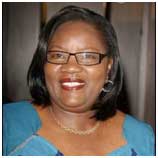
Dr. Ida Odinga, EGH

In Kenya, significant progress in health care has been made with Universal Health Coverage(UHC) a top priority for the Government. Thanks to the leadership, passion and commitment of the First Lady of Kenya, Ms Margret Kenyatta through her Beyond Zero campaign there has been a significant drop in maternal and child mortality. We have to now go for zero deaths. Reproductive, maternal, neonatal, child and adolescent health is key to achieving UHC.

High rates of teenage pregnancy, take girls out of school and compromises their health. Young people face stark challenges in employment as 1,000,000 people enter a labor force that can only absorb 150,000 new entrants. Access to health services and information, school retention and quality education will help these young girls stay in school and lead healthy lives. These are among the issues that the Summit will address.

However, in order for the Nairobi Summit to be a game changer, we need to speak for those that can’t speak, speak for those who are not heard and to add our voices to those who continue to work for sexual and reproductive rights for all. We must reaffirm our commitments to the ICPD goals and Agenda 2030. We must absorb the lessons learned over the last 25 years and do better.

For Kenya, the Nairobi Summit provides a platform to showcase our Big Four Development Agenda aimed at accelerating socioeconomic transformation and economic growth by intensifying investments and programme actions on: affordable housing, food security, universal healthcare and manufacturing.

I am delighted that my country is partnering with UNFPA and the Government of Denmark to host the Nairobi Summit and reaffirm the global commitment to ICPD. This is a watershed moment as we are a mere 10 years away from our commitment to fulfill the SDGs.

I look forward to seeing all the participants in Nairobi and hope everyone will follow the proceedings of the Nairobi Summit and learn how we can all play a role in bringing about change and keeping the promise of ICPD. Ensuring that all women and girls can reach for the stars and achieve the impossible.

Dr. Ida Odinga, EGH is spouse of Rt Hon. (Eng.) Raila Odinga and a passionate campaigner of women’s rights.
  Source

The Amazon Seeks Alternatives that Could Revolutionise Energy Production

Civil Society, Conferences, Development & Aid, Economy & Trade, Editors’ Choice, Energy, Environment, Featured, Green Economy, Headlines, Human Rights, Indigenous Rights, Integration and Development Brazilian-style, Latin America & the Caribbean, Projects, Regional Categories, TerraViva United Nations

Energy

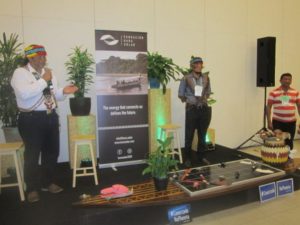
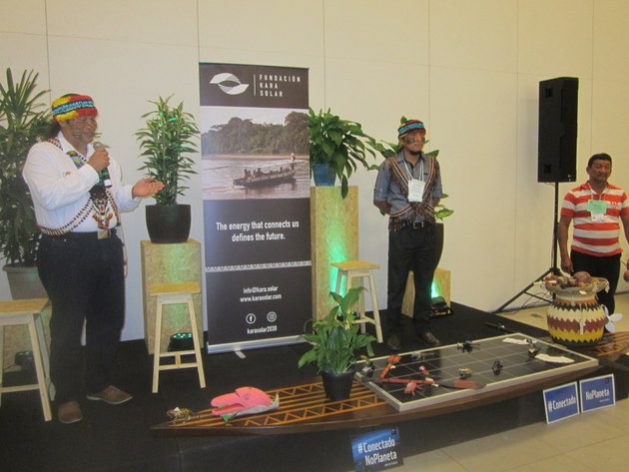
Milton Callera (holding the microphone) and Nantu Canelos, members of the indigenous Achuar community, explain how the two solar boats built to transport their people on the Amazon rivers of Ecuador work. The project is from the Kara Solar Foundation, which is promoting an alliance to "solarise" river transport in the Amazon rainforest. Credit: Mario Osava/IPS

Milton Callera (holding the microphone) and Nantu Canelos, members of the indigenous Achuar community, explain how the two solar boats built to transport their people on the Amazon rivers of Ecuador work. The project is from the Kara Solar Foundation, which is promoting an alliance to “solarise” river transport in the Amazon rainforest. Credit: Mario Osava/IPS

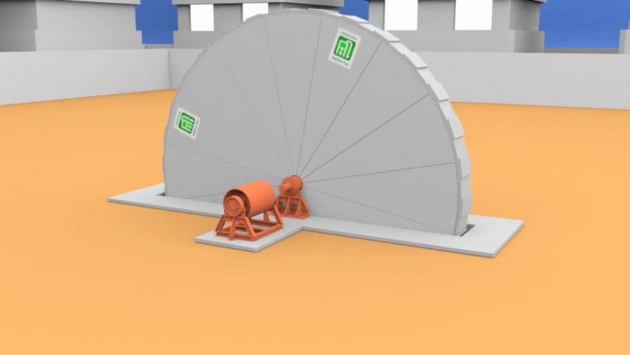
MANAUS, Brazil, Apr 5 2019 (IPS) – A large steel wheel, 14 meters in diameter and 1.3 meters wide, could be the energy solution of the near future, generating 3.5 megawatts – enough to supply a city of 30,000 people, according to a company in the capital city of the state of Amazonas in northwest Brazil.


An internal fluid, which expands through a chemical reaction in contact with an ink, drives the rotation that produces electricity without interruption for at least five years, say executives at Eletro Roda, a company in the city of Manaus that is marketing the invention and is building its first demonstration unit.

“Installation of the unit costs less than half that of an equivalent solar power plant and occupies an area of just 200 square meters, compared to 50,000 square meters for solar and 5,000 square meters for wind power,” Fernando Lindoso, the director of the company in which he is a partner, told IPS.

In other words, in the space occupied by a wind power plant that generates 3.5 megawatts (MW), 25 electro-wheels could be installed, multiplying the generating capacity by a factor of 25.

In addition, it has the advantage of stable generation, “free of the intermittency of other sources,” said Lindoso, who estimated the cost of each 3.5 MW unit at around five million dollars, a price that is reduced for social projects.

There are interested parties in Japan, India and other countries in Asia, as well as in European and Middle Eastern countries, based on earlier prototypes that never made it to market, he said.

There will be a smaller version, generating one MW, “30 percent cheaper”, of identical dimensions, but with three tons of the fluid that is biodegradable, instead of the four used in the other model.

This was one of the alternatives presented at the Fair and Symposium on Energy Solutions for Communities in the Amazon, which brought together more than 500 participants and 39 companies and institutions in Manaus Mar. 25-28.

“My favorite is the solar boat, a good example of how to find solutions,” said Sam Passmore, director of the Environmental Programme at the U.S.-based Charles Stewart Mott Foundation, one of the meeting’s eight international sponsors.

A large metal wheel that can be taken apart in order to facilitate transport produces electricity by rotating driven by an internal fluid, which is expanded by a chemical reaction. Producing 3.5 megawatts, the generator to be sold by Eletro Roda could produce a steady supply of electricity on just 200 square meters of space. Credit: Courtesy of Eletro Roda

A large metal wheel that can be taken apart in order to facilitate transport produces electricity by rotating driven by an internal fluid, which is expanded by a chemical reaction. Producing 3.5 megawatts, the generator to be sold by Eletro Roda could produce a steady supply of electricity on just 200 square meters of space. Credit: Courtesy of Eletro Roda

An alliance for solar-powered transportation in the Amazon is propose by the Kara Solar Foundation, of the indigenous Achuar people of Ecuador, who since 2017 have built two 18-passenger boats powered by electricity from a rooftop made of photovoltaic panels.

Kara means dream in the Achuar language and it is about maintaining the sustainable culture of river transport, as opposed to “the roads that threaten our territory, presented as if they represented development,” project coordinator Nantu Canelos told IPS during the fair.

“We want to build 300, 400 solar boats,” said Milton Callera, technical director of the Coordinating Committee of Indigenous Organisations of the Amazon Basin (Coica).

Riverside dwellers and indigenous people in Brazil are also seeking to “solarise” their boats, especially the small ones, dedicated to fishing and the transportation of a few people. The problem is where to put the solar panels on the so-called “flying boats”, without slowing them down.

The discussions at the symposium, however, focused on the need to universalise energy. “There are still 500,000 people, or 100,000 families, without access to electricity in Brazil’s Amazon region,” according to Paulo Cerqueira, coordinator of Social Policies at the Ministry of Mines and Energy.

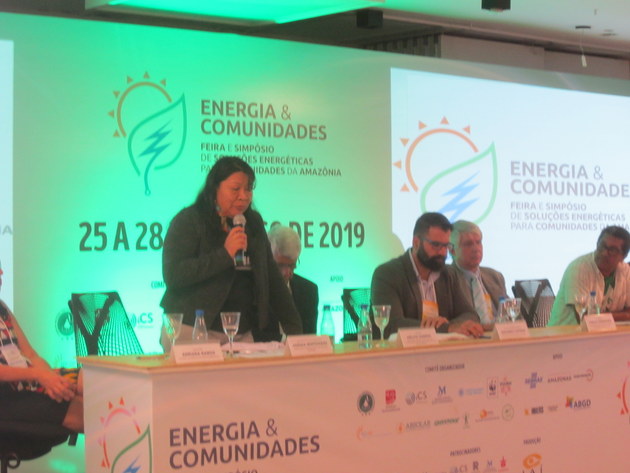
Attorney Joenia Wapichana, the first indigenous woman to hold a seat in Brazil's Chamber of Deputies, speaks at the opening of the Symposium on Energy Solutions for Communities in the Amazon, in the city of Manaus. She is from Roraima, the state with a high indigenous population in northwest Brazil that is suffering a serious energy crisis due to the interruption of supplies from neighboring Venezuela. Credit: Mario Osava/IPS

Attorney Joenia Wapichana, the first indigenous woman to hold a seat in Brazil’s Chamber of Deputies, speaks at the opening of the Symposium on Energy Solutions for Communities in the Amazon, in the city of Manaus. She is from Roraima, the state with a high indigenous population in northwest Brazil that is suffering a serious energy crisis due to the interruption of supplies from neighboring Venezuela. Credit: Mario Osava/IPS

The Light for All Programme, launched in 2003, benefited more than 16 million people, according to the ministry, in this country of 208 million people. But so far, isolated and remote communities, not reached by the power grid, have been excluded.

There are also millions of families who do have electricity, but are outside the National Integrated System, including the entire state of Roraima, in the northeast, with 580,000 inhabitants, on the border with Venezuela, from where it received most of its electricity until the supply crisis that erupted in March in the neighboring country.

Isolated communities in the state receive electricity mainly from diesel- or other petroleum-fueled generators.

The slogan for such cases is to replace costly, slow and unreliable transportation fueled by fossil fuels on the Amazon rainforest rivers, and to prioritise clean sources of energy. Solar power is presented as the most feasible solution, since the Amazon rainforest is not windy.

The exception is Roraima, where the state´s numerous indigenous people are studying the adoption of wind farms to help defend themselves from the impacts of the Venezuelan crisis.

Autonomous solar generation projects are mushrooming in the Amazon, in indigenous villages and riverbank settlements, sometimes funded by non-governmental institutions and international assistance, such as the German Agency for International Cooperation (GIZ) and the Rainforest Foundation of Norway.

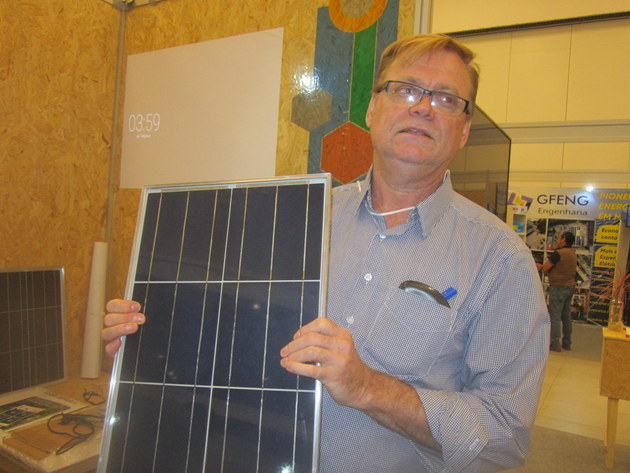
Willi Seilert, from the I9SOL Institute, explains how his solar panels are manufactured, during the Fair and Symposium on Energy Solutions for Amazonia, held in Manaus. He has a project to disseminate a thousand small solar panel factories in Brazil, in order to make photovoltaic generation cheaper in poor communities. Credit: Mario Osava/IPS

Willi Seilert, from the I9SOL Institute, explains how his solar panels are manufactured, during the Fair and Symposium on Energy Solutions for Amazonia, held in Manaus. He has a project to disseminate a thousand small solar panel factories in Brazil, in order to make photovoltaic generation cheaper in poor communities. Credit: Mario Osava/IPS

As a result, companies such as Fabortec Solar, which installs photovoltaic systems and sells equipment, focused on designing and offering off-grid projects, incorporating batteries and equipment that ensure operation and maintenance by the users themselves.

“The Amazon is a great market for those who don’t mind long trips and can work in places that are difficult to access,” a company technician told IPS.

The expansion of solar energy in many parts of Brazil, not only in the Amazon, prompted Willi Seilert to design a plan to promote 1,000 solar panel micro-factories throughout the country.

This could make the product cheaper and facilitate access by poor families and communities to solar energy, in addition to training, employing and generating income for nearly 20,000 people in the country, he estimated.

That’s why he founded the I9SOL Institute, where the “9” stands for innovation.

A 50-square-meter office, at least 10 people trained by two instructors, a glass-top table, an oven and a few tools are enough to produce small solar panels, he told IPS.

“The main obstacle is the import of photovoltaic cells, which Brazil does not produce and which has to pay too high a tariff, because of a strange legal measure adopted in 2012,” he lamented.

In addition to this, there are two industrial processes for processing silicon, and “the rest is packaging work that trained people can do without difficulty,” he said, before pointing out that this continues to be the case in China and India, which provides employment for millions of workers, especially women.

The project is to be launched in Teófilo Otoni, a city of 140,000 people in the southeastern state of Minas Gerais, whose mayor plans to employ prisoners nearing release in the solar industry, Seilert said.

There are more energy alternatives in the Amazonian region. Experiments with the use of oil from the babassu (Attalea speciosa) palm tree abundant in the Amazon and neighboring areas, and from andiroba (Carapa guianensis), a tree with oilseeds, for electricity generation were presented at the symposium.

Railton de Lima, the inventor of the Eletro Roda, which he called a “voluntary engine for mechanical energy generation,” also developed a system for converting urban waste into charcoal briquettes to generate electricity, making it easier to recycle metals.

This technology is already used in several Brazilian cities, including Manaus. Of Lima’s 28 inventions, more than half are already being used in the market, and others are being developed for energy purposes.

Creativity, which helps to seek more suitable alternatives, is also found in poor communities.

“The idea of the right to energy is powerful” and stimulates solutions, said Passmore of the Mott Foundation. In the same sense, the diversity of peoples and communities represented at the Manaus meeting was “a very positive factor,” he concluded.


Innovative Sustainable Business: A Three Trillion-Dollar Opportunity that UN Environment Wants People to Develop

Africa, Climate Change, Conferences, Economy & Trade, Editors’ Choice, Environment, Featured, Global, Green Economy, Headlines, IPS UN: Inside the Glasshouse, Natural Resources, Regional Categories, Sustainability, TerraViva United Nations, Trade & Investment

Environment

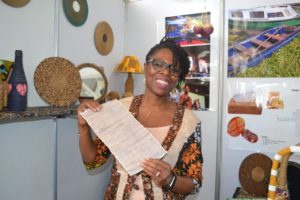
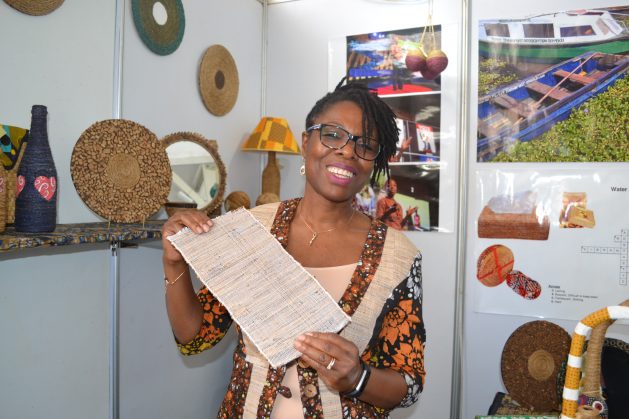
Achenyo Idachaba-Obaro, the founder of Mitimeth, a social enterprise that has trained hundreds of women on how to make popular handicrafts from water hyacinth. Credit: Isaiah Esipisu/IPS

NAIROBI, Mar 12 2019 (IPS) – In the East African region, communities around the continent’s largest water body, Lake Victoria, regard the water hyacinth as a great menace that clogs the lake and hampers their fishing activities. But in Lagos, Nigeria, some groups of women have learned how to convert the invasive weed into a resource, providing them with the raw material needed to make handicrafts.


“Our biggest challenge right now is the market where these women can sell their finished products from the water hyacinth,” said Achenyo Idachaba-Obaro, the founder of Mitimeth, a social enterprise that has trained hundreds of women on how to make popular handicrafts from water hyacinth.

Dressed in a blouse partly made of fabric from water hyacinth and buttons made from a coconut shell at the ongoing United Nations Environment Assembly (UNEA) in Nairobi, Kenya, Idachaba-Obaro showcased several products made from the aquatic weed ranging from boutique dresses, unique multipurpose baskets, vases, stationery, wall decor, and dining ware, among others.

“All these items are a product of handcrafts by women whom we have trained, and they are now able to generate extra income from a weed that is seen as a menace to many other people worldwide,” she told IPS.

So far, over 350 women, comprising mostly of widows but who also include students and teachers, from riparian rural communities have been trained on how to make finished products from water hyacinth, and they all sell them locally.

“Whenever we have a ready market, we always call on them to make water hyacinth ropes for us, which is the first stage of developing any water hyacinth fabric,” said Idachaba-Obaro.

In the past few months for example, a team of 70 women were able to make ropes which earned them 1.4 million Naira (3,880 dollars). “It has become a big business in Nigeria where everybody wants to be involved,” she said.

Her exhibition was one of the 42 technologies and innovative solutions from around the world that formed the 2019 Sustainable Innovation Expo at the UNEA conference in Nairobi, which is being held Mar. 8-15.
To move such innovations forward through research and to later upscale them, Joyce Msuya, the U.N. Environment Acting Executive Director and Assistant Secretary-General of the U.N. urged countries to provide enabling environments for both innovators and researchers.

“Innovation will be the heartbeat of the transformation we want and this cannot happen by itself. Policies and incentives to spur innovation and sustainable consumption and production must be backed by efforts to build implementation capacity,” she told the more than 4,000 delegates from 170 countries during the official opening of the assembly in Nairobi.

According to Siim Kisler, the Minister of Environment in Estonia and the UNEA President, there is need to find innovative solutions for environmental challenges through different approaches to sustainable consumption and production, inspiring nations, private sector players and individuals.

The Expo is the U.N. Environment Assembly’s solution-based platform for engaging innovators using exhibitions that reveal the latest technologies, panel discussions, and networking opportunities.

Other innovative techniques showcased at the expo include ‘Timbeter’ a digital (mobile app) timber measurement solution that uses a smart phone for accurate log detection.

“With this app on your smart phone, you only need to point the phone camera to say a lorry full of timber, and it will accurately give you the total number of logs on the truck, and circumference measurement of each of the logs,” Anna-Greta Tsahkna the Co-founder of the Estonian-based Timbeter told IPS.

So far, the technology has been embraced in Thailand, Brazil, South Africa, Russia and Chile where companies are using it to share measurements with contractors and clients. They use it to count logs, the log diameter and density in less than 3 minutes. It is an important tool in eradicating illegal logging.

Apart from another exhibition by a Canadian company that uses shipping containers to create affordable and sustainable housing, Brazilian experts from a company called Votorantim were showcasing a technique where they extract DNA from different forest species to analyse their chemical makeup.

“This makes it easy for users to know which type of trees, plants, grass or anything within the biodiversity they should target based on what they want to extract for medicines, cosmetics, perfumes among others,” said Frineia Rezente, the Executive Manager of Votorantim, said.

According to a statement by U.N. Environment, innovative sustainable business represents a trillion-dollar opportunity that can bring value to people and the environment.