Moving From Trauma to Healing: Practicing Self-Care in Refugee Camps

Aid, Armed Conflicts, Asia-Pacific, Children on the Frontline, Civil Society, Development & Aid, Editors’ Choice, Education, Featured, Headlines, Human Rights, Migration & Refugees, Sustainable Development Goals, TerraViva United Nations

Migration & Refugees

A young child in Cox’s Bazar engages with her peers at one of BRAC’s Humanitarian Play Labs. CREDIT: BRAC

A young child in Cox’s Bazar engages with her peers at one of BRAC’s Humanitarian Play Labs. CREDIT: BRAC

NEW YORK, Aug 21 2023 (IPS) – A Rohingya woman tells a forum of peer counselors the story of her divorce. A survivor of domestic abuse, she has started a new life alone with her daughter. She has weathered a storm of neighbors telling her she was the problem. Now, she provides the support she didn’t have to other women like her.


Similar scenes occur across refugee camps in Cox’s Bazar. Here, BRAC, an international NGO based in Bangladesh, has developed a program to train counselors who can provide mental health services to Rohingya refugees. This includes 200 community members who have begun to practice the psychosocial skills they’ve learned in their own lives.

A Growing Need for Support

Over 900,000 Rohingya have fled to Cox’s Bazar since massive-scale violence against Rohingya in Myanmar’s Rakhine State began in 2017, the UN Refugee Agency reports. The prolonged exposure of the ethnic minority group to persecution and displacement has likely increased the refugees’ vulnerability to an array of mental health issues, a 2019 systematic review found. Their struggles include post-traumatic stress disorder, depression, and gender-based violence.

Around the world, there is growing attention to the importance of socio-emotional learning as a skill to help people in areas of crisis cope with challenges. Educators are often tasked not only with providing traditional academic instruction but with building resilience in children. They are asked to create a sense of normalcy in environments that are anything but normal.
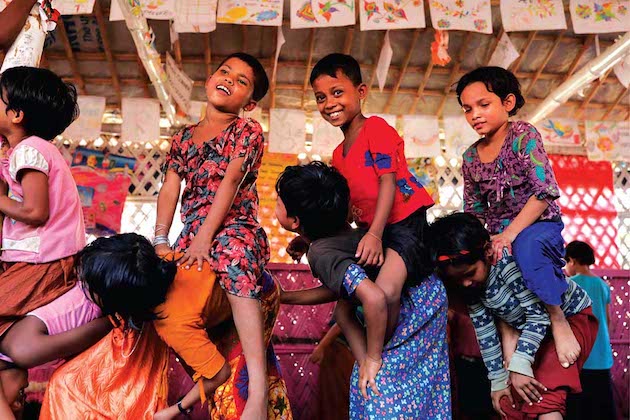
The teaching the children need is much more than about reading, writing, and math; but about giving young children a safe space to practice socio-emotional skills. CREDIT: BRAC

“It’s about not only teaching [kids] how to read and how to do mathematics … in these settings, kids and teachers themselves have the need for psychosocial support,” Ramya Vivekanandan, the senior education specialist at the Global Partnership for Education, said.

Teachers, caregivers, and frontline mental health providers are overburdened, Vivekanandan explains. They lack adequate pay, working conditions, and professional development. As they try to support the growing number of people in crisis, who will support them?

For some counselors in Cox’s Bazar, the answer is each other.

Community Care

Even when resources are available, stigmas around mental health can prevent support from being received. Taifur Islam, a Bangladeshi psychologist responsible for mental health training and supervision at BRAC, says people in the communities he works with are rarely taught to identify their feelings. When you are struggling to access basic needs, Islam explains, it is easy to forget that emotional well-being can improve productivity. If a person seeks help, they may be labeled ‘crazy.’

Training people to take care of their own communities can be a powerful way to overcome stigma in a culturally relevant way.

BRAC’s Humanitarian Play Labs were established in 2017 to give Rohingya children a safe space to practice socio-emotional skills through play. Erum Mariam, the executive director of the BRAC Institute of Educational Development, explains that each play lab is tailored to fit the community it serves. Rohingya children now rhyme, chant, and dance in 304 Humanitarian Play Labs across the camps in Cox’s Bazar.

“We discovered the Rohingya culture through the children. And the whole model is based on knowing the culture,” Mariam said.

‘Play leaders’ are recruited from the camps and trained in play pedagogy. Mariam watched Rohingya women who had never worked before embracing their new roles. As they covered the ceilings of their play spaces with rainbows of flowers – the kind of tapestry that would hang from their homes in Myanmar – Mariam realized that a new kind of social capital could be earned by nurturing joy. Traditional play didn’t just help uprooted children shape their sense of identity – it was also healing for the community.

If a play leader notices a child is withdrawn or restless, they can refer the child to a ‘para counselor’ who has been trained by BRAC’s psychologists to address the mental health needs of children and their family members. Almost half of the 469 para counselors in Cox’s Bazar are recruited from the Rohingya community, while the rest come from around Bangladesh. Most para counselors are women.

Many para counselors are uniquely positioned to empathize with the people they serve as they go door to door, building awareness. This is crucial because it creates a bottom-up system of care without prescribing what well-being should look like, Chris Henderson, a specialist on education in emergencies, says.

At the same time, by supporting others, mental health providers are learning to take care of themselves.

Learning by Doing
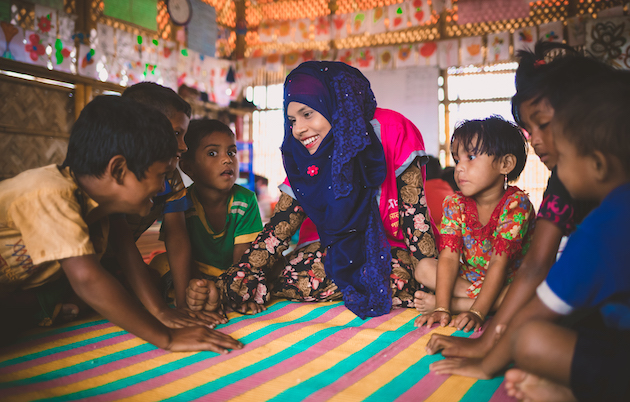
A play leader engages the children in the session. Humanitarian professionals encourage frontline teachers, caretakers, and counselors to actualize their own ideas for improvement. CREDIT: BRAC

A play leader engages the children in the session. Humanitarian professionals encourage frontline teachers, caregivers, and counselors to actualize their own ideas for improvement. CREDIT: BRAC

For months, Suchitra Rani watched violence against Rohingya people every time she turned on the news. When she was recruited by BRAC to become a para counselor in Cox’s Bazar, she saw an opportunity to make a difference. Alongside fellow trainees, Rani, a social worker originally from Magura, poured over new words she learned in the foreign Rohingya dialect and worked to find her place in the community.

Rani tested what she had learned about the value of psychosocial support and cultural sensitivity when she met a 15-year-old Rohingya girl too scared to tell her single mother she was pregnant. Terrified of bringing shame to the family, the girl had an abortion at home. As the young woman spiraled into depression, Rani felt herself slipping into her own fears of inadequacy.

It took time for Rani to convince the girl to open up to her mother. Talking through feelings of guilt slowly led to acceptance. As they worked to heal fractured family bonds, Rani began to feel surer of herself, too.

Now, the Rohingya community calls Rani a “sister of peace.” Rani says she has become confident in her ability to use the socio-emotional skills she’s learned to both help others and resolve problems in her personal life.

Throughout the program, para counselors have changed the way they communicate their feelings and felt empowered to create more empathetic environments.

Islam recounts a 26-year-old Rohingya refugee’s perilous journey to Cox’s Bazar: In Myanmar, the woman’s husband was killed in front of her. One of her two young children drowned during a river crossing as they fled the country. She arrived at the camp as a single mother without a support network. Only once she had the support of others willing to listen could she speak openly.

Islam remembers counselors telling the woman about the importance of self-care: “If you actually take care of yourself, then you can take care of your child also.”

Toward Empowerment 

According to Henderson, evidence shows that one of the best ways to support someone is to give them a role to help others. In places where there may be a stigma against prioritizing ‘self-care,’ people with their own post-crisis trauma are willing to learn well-being skills to help children.

A collection of teacher stories collected by the Inter-agency Network for Education in Emergencies reveals a similar pattern. Teachers in crisis areas around the world say the socio-emotional skills they learned to help students helped them reduce stress in their own lives, too.

Henderson suggests that the best way international agencies can promote trauma support is by holding up a mirror to the strength already shown by refugee communities like the Rohingya.

Instead of seeing what they lack, Henderson encourages humanitarian professionals to help give frontline teachers, caregivers, and counselors the agency to actualize their own ideas for improvement. Empowered community leaders empower the young people they work with, who, in turn, learn to empower each other. This creates “systems where everyone sees their position of leadership as supporting the next person’s leadership and resilience.”

At the end of her para counselor training, the Rohingya domestic abuse survivor said she wasn’t sure what she would do with the skills she’d learned for working through trauma, Islam remembers. But she did say she wished they were skills she had known before. According to Islam, she is now one of their best para counselors.

“The training is not only to serve the community; that training is something that can actually change your life,” Islam says. It’s why he became a psychologist.

IPS UN Bureau Report

  Source

Afghan Girls, Women Deprived of Education, Find Hope in Africa

Shabana Basij-Rasikh, co-founder and President of SOLA, speaks at the Women Deliver conference in Rwanda. Credit: Aimable Twahirwa/ IPS

Shabana Basij-Rasikh, co-founder and President of SOLA, speaks at the Women Deliver conference in Rwanda. Credit: Aimable Twahirwa/IPS

By Aimable Twahirwa
KIGALI, Aug 1 2023 (IPS)

When providing education to her small group of Afghan girls, who had been studying at a boarding school back home, became tenuous, Shabana Basij-Rasikh, relocated them to Rwanda.


She had set up a pioneering school under the project SOLA, the Afghan word for peace, and a short form for School of Leadership Afghanistan. But as the Taliban swept to power in August 2021, she closed the doors of the school, destroyed any school records which could help identify the girls, and on August 25, relocated 250 members of the SOLA community, including the student body and graduates from the programme, totally more than 100 girls, to Rwanda.

Basij-Rasikh, co-founder and SOLA’s President said a major challenge had been the lack of resources and capacity to teach Afghan girls after the return of the Taliban deprived right to education of girls in secondary schools and above.

As the Taliban swept back into power in Afghanistan in the summer of 2021, Shabana Basij-Rasikh, the founder of the nation’s only all-girls boarding school, initially ran the school out of a former principal’s living room. But that soon became untenable.

Speaking on the sidelines of The Women Deliver 2023 Conference (WD2023), which took place in Kigali from 17-20 July 2023, Basij-Rasikh, who completed her undergraduate studies in the United States, explained that when Kabul fell under the control of the Taliban, she managed within a short time to evacuate the entire school community to Rwanda.

“Although we managed to move the school to a safe country, it is still embarrassing and shameful for me since Afghanistan is the only country in the world where women and girls’ access to education has been suspended,” she said.

Initially, SOLA started as a scholarship program where Afghan youth would be identified and could access quality education abroad and, later on, go back to their home country as highly-skilled Afghans in whichever profession they chose.

“When the US announced that they were to withdraw their troops in Afghanistan, it created a lot of anxiety among young Afghans who were in the West hoping to return to the country.”

Basij-Rasikh regrets that some of her former students, who were able to leave Afghanistan after the Taliban’s return, are still struggling to continue their education overseas.

“We wish to see many Afghan girls return to schools,” she said, explaining that the migration status of the students in many countries restricted their access to education.

Since the school opened last year’s admissions season, Shabana Basij-Rasikh and her team have been inviting Afghan girls worldwide to apply and join the rest in Rwanda. Last year they enrolled 27 girls in their first intake.

“The major challenge is that there are several hundreds of thousands of girls who want to join our campus, but space is limited, and so places are being granted on merit and need,” Shabana told IPS.

Shabana argues investing in girls’ education is a smart investment; she is convinced that the current situation in Afghanistan must and should not be accepted or supported by any country around the world.

On September 18, 2021, a month after taking over the country, the Taliban ordered the reopening of only boys’ secondary schools. A few months later, in March 2022, according to human rights organizations, the Taliban again pledged to reopen all schools, but they officially closed girls’ secondary schools.

“These girls deserve the opportunity to realize their full potential, and the international community has an important role to play,” Shabana said.

UNESCO’s latest figures show that 2,5 million or 80 percent of school-aged Afghan girls and women are out of school.  The order suspending university education for women, announced in December last year, affects more than 100,000 students attending government and private institutions, according to the UN agency.

On the sidelines of the Women Deliver Conference 2023, Senegalese President Macky Sall pledged that his government would offer 100 scholarships for women who have seen their right to education decimated under Taliban rule in Afghanistan to pursue their university degrees in Senegal.

Rwanda is one of several African countries that agreed to temporarily host evacuated Afghans.

Sall, who was reacting to the concerns raised by Basij-Rasikhat, said his Government was ready to give chance to Afghan girls to pursue their studies.

So far, SOLA school has received 2,000 applications across 20 countries where some Afghans are living.

In 2022, it received 180 applications from Afghans living in 10 countries, but only 27 girls were admitted.

“That explains how families in Afghanistan are ready to support the girls in moving abroad to pursue their education,” Shabana said.

“Boarding schools that allow Afghan girls to study and live together are the best way to promote their education.”

IPS UN Bureau Report



!function(d,s,id){var js,fjs=d.getElementsByTagName(s)[0],p=/^http:/.test(d.location)?’http’:’https’;if(!d.getElementById(id)){js=d.createElement(s);js.id=id;js.src=p+’://platform.twitter.com/widgets.js’;fjs.parentNode.insertBefore(js,fjs);}}(document, ‘script’, ‘twitter-wjs’);  

Financing Biggest Hurdle to Providing Children with Quality Education in Crisis Situations – ECW

ECW’s Yasmine Sherif and Graham Lang walk with UNHCR partners through Borota, where thousands of new refugees, most of them women, and children, have arrived after fleeing the conflict in Sudan. Credit: ECW

ECW’s Yasmine Sherif and Graham Lang walk with UNHCR partners through Borota, where thousands of new refugees, most of them women, and children, have arrived after fleeing the conflict in Sudan. Credit: ECW

By Naureen Hossain
UNITED NATIONS, Jul 20 2023 (IPS)

If you want lasting peace, the best investment you can make is in education, said Education Cannot Wait’s Executive Director Yasmine Sherif in an exclusive interview with IPS.


“(This will) make children and adolescents literate, learn critical thinking, address trauma and psycho-social challenges from being victims of a conflict or crisis, develop their potential, and become financially independent,” Sherif said, adding that these were critical skills to participate in good governance of their countries in the future.

She was speaking to IPS ahead of her participation in the ECOSOC High-Level Political Forum side event “Ensuring Education Continuity: The Roles of Education in Emergencies, Protracted Crises and Building Peace” at the UN Headquarters in New York.

Education is the answer to breaking the vicious circle of violence, conflict, and crisis – while this often is associated with war and conflict, the same applies to climate change.

“If the next generation that is today suffering from climate-induced disasters are not educated, do not understand or have an awareness of how to treat mother earth, and do not have the knowledge or skills to mitigate or prevent risks in the future, the negative impact of climate-induced disasters will only escalate.”

Unfortunately, conflicts and climate risks increasingly combine to multiply vulnerability, she said – and instead of declining, the number of children who need urgent support is increasing.

“Today, 224 million crisis-affected children do not receive a quality, continuous education. More than half of these children – 127 million – may have access to something that resembles a classroom, but they are not learning anything. They are not achieving the minimum proficiencies outlined in the Sustainable Development Goals (SDG4).”

Sherif stressed the crucial linkage between education and protection for children in crisis-affected countries and explained how protection is a core component of the holistic package of education ECW is supporting together with its partners.

“On the legal side, we advocate for the respect of the international humanitarian law, national human rights law, and the National Refugee Law, and for an end to impunity for those who violate these,” said Sherif. “We also call for additional countries to adopt the Safe Schools Declaration, and actively support its implementation at the national level.”

To prevent violence around and in schools, practical measures are included to ensure the children are safe.

“It’s important to ensure safe transport to and from the school. And that would, of course, bring a sense of safety to the parents, who may not be willing to send the girls to school because of that. You ensure the infrastructure of the school provides protection. You may need wards around the school so that nobody can walk into the school and abduct a girl.”

ECW funding also includes protections to prevent sexual and psychological violence.

“All the funding that we invest requires giving protection a priority. And that is essential wherever you operate or invest funding in a country of affected by armed conflict; you need to ensure protection is prioritized.”

Sherif said that in countries like Afghanistan, where the Taliban have banned girls from attending secondary school and upwards, ECW works with local partners to support non-formal education.

“There is a lot of work at the community level, with local authorities allowing ECW’s investments in civil society and UN agencies to continue to operate. So community-based schooling is pretty much (being) run now, where we are investing at the community level,” she said, and while it may not be ideal, it does work.

Likewise, non-formal learning centers have been set up in Cox’s Bazar, where the Rohingya refugees live after fleeing violence, discrimination, and persecution in Myanmar.

“Our aim is for every child to be able to access national education systems, but sometimes it is not possible politically or physically due to the dangers of the conflict. So we also support our partners to establish non-formal learning centers until another more sustainable solution can be found.”

During the Covid-19 pandemic, ECW’s partners were innovative in ensuring education continued – with remote learning programmes such as radio and TV-based education, where IT connections were available through phones and WhatsApp with learning kits and tools.

“Home-based, going from door-to-door, that was how it was done during COVID. There was some creativity and innovation. It is possible. It is not ideal, but it is possible.”

Sherif said ECW had developed a proven model to bring quality education to every child – even in the most challenging crisis-affected contexts of war and conflicts – but that the biggest hindrance is the financing.

“If we had the financing, we could reach the 224 million (children) immediately. So financing is the big hindrance today. While peace is the number one (solution), if peace is not possible, education cannot wait.”

“If financing for education is provided in crisis and climate disasters, ECW can reach 20 million children and adolescents in the coming four years. And that requires about another USD700 million for Education Cannot Wait between today and 2026. Just USD 700 million is a small amount when you consider the return on investment you get when you invest in human potential.”

IPS UN Bureau Report


!function(d,s,id){var js,fjs=d.getElementsByTagName(s)[0],p=/^http:/.test(d.location)?’http’:’https’;if(!d.getElementById(id)){js=d.createElement(s);js.id=id;js.src=p+’://platform.twitter.com/widgets.js’;fjs.parentNode.insertBefore(js,fjs);}}(document, ‘script’, ‘twitter-wjs’);  

Source

Hong Kong’s Lights of Freedom Extinguished

Asia-Pacific, Civil Society, Crime & Justice, Democracy, Education, Featured, Headlines, Press Freedom, TerraViva United Nations

Opinion

Credit: Yan Zhao/AFP via Getty Images

LONDON, Jun 9 2023 (IPS) – Nothing was more predictable than repression. Merely for holding candles and flowers, people were taken away by Hong Kong’s police.

The occasion was the anniversary of the Tiananmen Square Massacre, 4 June 1989. Hong Kong was until recently home to mass annual vigils where thousands gathered to keep alive the memory of that day. But that’s all gone now in the crackdown that followed large-scale protests for democracy that erupted in 2019.


Hong Kong’s authorities are evidently determined to erase any form of acknowledgement that the massacre ever happened. Memorials and artworks commemorating it have been removed. Books that mention the tragedy have disappeared from libraries. Shops selling the LED candles commonly used to mark the occasion were visited by the authorities in the run up to this year’s anniversary.

The organisation behind the vigil, the Hong Kong Alliance in Support of Patriotic Movements in China, closed itself down in 2021 following a police investigation. Several of its leaders were jailed in March.

Instead of hosting the usual vigil, this year Hong Kong’s Victoria Park was home to a carnival celebrating Chinese rule. People wanting to mark the occasion had to do so in private.

This is only the tip of the iceberg. People are mourning not only the many who died on 4 June 1989 but also the Hong Kong vanishing before their eyes.

Further than ever away from democracy

When Hong Kong was handed over to China by the UK in 1997, China agreed to maintain the country’s distinct political and economic structures for the next 50 years, under the banner of ‘one country, two systems’.

Hong Kong’s Basic Law guaranteed civic rights, including freedoms of association, peaceful assembly and expression. China committed to move towards universal suffrage for the election of Hong Kong’s Chief Executive, the head of government.

But following the democracy protests that burst out in 2019, China has unilaterally torn up that agreement. Three years ago, the government passed the National Security Law, a sweeping piece of legislation that criminalises criticism of the authorities. It’s been used alongside existing laws, such as the law on sedition, to jail leaders of the democracy movement.

China never made good on its promise of universal suffrage. It’s gone in the opposite direction. Current Chief Executive John Lee – who as security chief led the violent crackdown on democracy protests – was chosen last year by a hand-picked 1,500-member Election Committee, which duly endorsed him as the sole candidate.

The Legislative Council, Hong Kong’s parliament, had already been neutered. The number of directly elected seats has been slashed and people are disqualified from standing if they question China’s sovereignty over Hong Kong.

Now the District Councils are in the firing line. When the last elections for the municipal bodies were held, in the thick of democracy protests in November 2019, pro-democracy parties triumphed.

Such a result is now impossible. In 2021, a law was passed requiring all district councillors to swear an oath of allegiance affirming their ‘patriotism’ for China. Most of the pro-democracy candidates elected in 2019 were disqualified or resigned.

Now when new district councillors are chosen in November, only 20 per cent of seats will be directly elected. The authorities will fill the rest with their supporters, all vetted to ensure their ‘patriotism’. Little wonder that the Civic Party, one of Hong Kong’s leading pro-democracy parties, recently announced it was closing down.

A hollowed-out Hong Kong

Hong Kong was once a country where people felt safe to protest. It had a flourishing media and publishing industry. Now journalists are criminalised and key independent media have shut down.

Civil society organisations and trade unions have done the same. The remaining organisations are scattered, practising self-censorship. Protests continue to be heavily restricted: this year a planned International Women’s Day march was cancelled after police threats.

People continue to try to find ways to express dissent, but any small gesture can attract the state’s ire. The death of Queen Elizabeth II gave people an opportunity to use public mourning to express at with the regression since handover. But when a vigil was held during the Queen’s funeral, a harmonica player was arrested for daring to play the tune Glory to Hong Kong, associated with the democracy protests.

Last year five speech therapists were convicted of producing ‘seditious publications’. Their crime was to produce children’s books in which sheep defend their villages from wolves. This was taken to be an allegory of China’s control of Hong Kong.

Everyday repression is making Hong Kong a hollowed-out country, its population falling. Some schools face closure due to falling student numbers. Many have fled, not wanting their children to grow up in a country where education is indoctrination. The curriculum has been reworked to teach students loyalty rather than independent thought. Many teachers are leaving the country or taking early retirement.

With the legal system facing increasing interference and political pressure, lawyers are also among those fleeing.

A key test will be the trial of Jimmy Lai, former media owner and democracy campaigner. He’s already been found guilty on numerous counts. His newspaper, Apple Daily, once Hong Kong’s most widely read pro-democracy paper, shut down in 2021. He faces trial under the National Security Law, which could mean a life sentence.

The judges who will try Lai have been handpicked by John Lee. Meanwhile the authorities have tried to prevent Lai’s defence lawyer, UK barrister Tim Owen, representing him in court. In March they passed a law giving Lee the power to ban foreign lawyers working on national security cases. It isn’t looking promising.

Lai is one of Hong Kong’s 1,508 political prisoners. Even as the population shrinks, the imprisoned population just keeps getting bigger. The candles that commemorate the Tiananmen Square Massacre and the yearning for democracy will continue to flare around the world in exile – but those lights are being extinguished in Hong Kong.

Andrew Firmin is CIVICUS Editor-in-Chief, co-director and writer for CIVICUS Lens and co-author of the State of Civil Society Report.

  Source

The Privilege of Making a Choice

By Yasmine Sherif
NEW YORK, May 8 2023 (IPS)

A civilian student named Saber was caught in the crossfire in Khartoum. He had two choices: either flee and lose everything; or die. But within a moment his option to choose was violently denied: he died.


As a result of the brutal internal armed conflict in Sudan right now, UNHCR projects that 860,000 people will flee across the borders as refugees and returnees into the Central African Republic, Chad, Egypt, Ethiopia, Eritrea and South Sudan. About 50% will be children and adolescents below 18.

Will they arrive alive? They can’t choose. They can only hope.

Making it worse, none of the neighboring countries has the financial and structural capacity to manage such influx, and yet they too, have no choice.

Indeed, an enormous international response will be required to support the Refugee Response Plan developed by 134 partners, including UN agencies, national and international NGOs and civil society groups, and launched on 4 May 2023.

Fleeing children and adolescents will need immediate psycho-social support and mental health care to cope with the stress and trauma of the conflict and perilous escape. They will need school meals. They will need water and sanitation. They will need protection. In the deep despair of their young lives, they will need a sense of normalcy and hope for their future. They need it now and a rapid response to establishing education can meet these needs.

Or to paraphrase ECW’s new Global Champion, the world-renowned journalist, Folly Bah Thibault – who reaffirms the need for speed and quality: the humanitarian-development nexus in action – in her high-level interview in this month’s ECW Newsletter, “We need to deliver with humanitarian speed and development depth.”

The choice is ours.

ECW is now traveling to the region to support host-governments, UN and civil society colleagues who jointly produced the Refugee Response Plan and who are on the ground working day and night in difficult circumstances. ECW will provide support both through an initial First Emergency Response investment and through our global advocacy.

We all have a choice to act now. Our choice is not between losing everything or die. Our choice is between action or inaction. Between humanity and indifference.

Prior to the breakout of the internal armed conflict in Sudan, Samiya*, a 17-year-old refugee student, wrote in her recent Postcard From the Edge: “Education is our future dream. Education is one of the most important factors to progress in life. Through education, people can thrive in their lives; they can also develop their skills and improve their life quality.”

We can help make Samya’s dream come true at the hardest, darkest moment of her life. Samiya does not have that choice. Only, we have that choice. Let us recognize it for what it is: as a privilege or blessing of choosing responsibility and humanity.

Yasmine Sherif is Director of Education Cannot Wait.

IPS UN Bureau


!function(d,s,id){var js,fjs=d.getElementsByTagName(s)[0],p=/^http:/.test(d.location)?’http’:’https’;if(!d.getElementById(id)){js=d.createElement(s);js.id=id;js.src=p+’://platform.twitter.com/widgets.js’;fjs.parentNode.insertBefore(js,fjs);}}(document, ‘script’, ‘twitter-wjs’);  

Source

Global Solidarity Needed to Address Taliban’s Attacks on Women’s Rights

Matiullah Wesa worked with community and tribal leaders in remote areas in Afghanistan to advocate for education and bring learning closer to communities.

By David Kode
JOHANNESBURG, Apr 19 2023 (IPS)

Matiullah Wesa’s crime was to try to ensure young people got an education in Afghanistan. His recent forceful abduction by the Taliban offers the latest stark reminder that global solidarity and coherent action from the international community are needed to prevent the complete loss of the rights of women and girls in Afghanistan.


Matiullah has been at the forefront of advocating for access to education as a co-founder and leader of Pen Path. For more than a decade, Pen Path has worked with community and tribal leaders in remote areas in Afghanistan to advocate for education and bring learning closer to communities. It works to enlighten communities about the importance of education, particularly girl’s and women’s education, organises book donations, runs mobile libraries in remote areas and reopens schools closed by years of conflict and insecurity. Pen Path has reopened over 100 schools, distributed more than 1.5 million items of stationery and provided education facilities for 110,000 children – 66,000 of them girls. This is what Matiullah is being punished for.

The abduction of Matiullah and many others advocating for the rights of education point to a concerted effort by the Taliban to try to restrict women’s and girls’ access to education and silence those advocating for education and an inclusive society.

There are sadly many other instances. In November 2022 around 60 Taliban members stormed a press conference organised to announce the formation of Afghan Women Movement for Equality. They arrested conference participants and deleted all images from their phones.

Immediately after taking power in August 2021, the Taliban instructed women to stay at home and avoid travelling. In December 2022, the Ministry of Higher Education announced it had suspended university education for women until further notice. Taliban officials argued that female students did not wear proper clothing on campus and announced it was enforcing gender segregation in schools. These decisions have been accompanied by others that force thousands of female workers to stay at home and prevent women and girls entering public spaces such as parks.

In December 2022 the Taliban banned women from working for international and national civil society organisations. This was a move that could only be counter-productive, since women play a vital role in providing essential services that people need. Banning women from working for civil society organisations affects millions in dire need of humanitarian assistance and services to women and children, as well as further increasing unemployment. The Taliban urged organisations to suspend female staff under the pretence that workers did not adhere to the regime’s strict dress code.

Most recently, women have been banned from working for United Nations agencies that are operating in Afghanistan. The United Nations may have to pull out.

It has taken just months for the Taliban to reverse the gains made over the years before their return that saw Afghan women claim visibility in public life and work such roles as broadcasters, doctors and judges.

Women in Afghanistan are fighting but can’t succeed alone

These restrictions on women’s rights should be seen in the context of the closing of civic space and attacks on other fundamental rights. As a result, Afghanistan’s civic space rating was recently downgraded to closed, the worst category, by the CIVICUS Monitor, a research partnership that tracks civic space conditions in 197 countries.

Despite the ongoing restrictions against women, the brave women of Afghanistan refuse to back down. They continue to organise what protests they can against restrictions and women human rights defenders continue to advocate for the rights of all women and girls to access education and participate in decision-making processes.

When women protest against restrictions, they risk harassment, physical and psychological torture and detentions. Some have been forcefully abducted from their homes. In January 2022, Taliban gunmen raided the homes of women human rights defenders Parwana Ibrahimkhel and Tamana Zaryab and abducted them.

No society can reach its real potential without the participation of women. The international community must double its efforts to support women and girls in Afghanistan. States should respond proactively to the United Nations 2023 appeal for Afghanistan. Aid should however be made conditional on guarantees to uphold the fundamental rights of women and girls. The international community should accompany aid with a strategy to build a more inclusive and open society.

Not to do so would be to abandon the likes of Matiullah Wesa, the many others like him penalised for standing up for education and rights, and the women of girls of Afghanistan being forced into silence.

David Kode is the Advocacy and Campaigns Lead at CIVICUS, the global civil society alliance.


!function(d,s,id){var js,fjs=d.getElementsByTagName(s)[0],p=/^http:/.test(d.location)?’http’:’https’;if(!d.getElementById(id)){js=d.createElement(s);js.id=id;js.src=p+’://platform.twitter.com/widgets.js’;fjs.parentNode.insertBefore(js,fjs);}}(document, ‘script’, ‘twitter-wjs’);  

Source