Education Cannot Wait Executive Director Yasmine Sherif Statement on the 7-Year Anniversary of the Rohingya Crisis
A Rohingya refugee, Jannat is back in school and dreams of being a doctor. Credit: Save The Children Bangladesh/Rubina Hoque Alee
NEW YORK, Aug 26 2024 – Seven years ago, a brutal campaign of violence, rape and terror against the Rohingya people ignited in Myanmar’s Rakhine State. Villages were burned to the ground, families were murdered, massive human rights violations were reported, and around 700,000 people – half of them children – fled their homes to seek refuge in Bangladesh.
Today, Bangladesh’s Cox’s Bazar hosts the largest refugee camp in the world with close to a million children, women and men living in makeshift settlements. The crisis is an abomination for humanity. And while the Government of Bangladesh and other strategic partners are supporting the response, the resources are severely strained and access to essential services is scarce.
As the global fund for education in emergencies and protracted crises within the United Nations, Education Cannot Wait (ECW), along with its strategic donor partners, government, UN agencies and civil society, has supported holistic education opportunities for both Rohingya and host community children in Bangladesh since November 2017. The more than US$50 million in funding, delivered through a consortium of partners – including government counterparts, PLAN International, Save the Children, UNESCO, UNHCR, UNICEF and other local partners – has reached over 325,000 girls and boys with quality education. Over the years, the programmes have provided learning materials for close to 190,000 children, financial support to over 1,700 teachers, and rehabilitated over 1,400 classrooms and temporary learning spaces.
In response to the COVID-19 pandemic, fires in the refugee camp and other pressing emergencies, the programming in Bangladesh was quickly adapted, and over 100,000 girls and boys were able to take part in remote education programmes during the height of the pandemic.
For refugee girls like Jannat, these investments mean nutritious school meals, integrated learning opportunities, catch-up classes, and security and solace in a world gone mad.
We must not forget Jannat and the hundreds of thousands of Rohingya girls like her that only yearn to learn in safety and freedom. Our investment in their education is an investment in peace, enlightenment and security across the region. Above all, it is an investment in the Rohingya people’s rights and other persecuted groups that face human rights abuses and attacks the world over.
Despite strong support from donors – as shown in this powerful joint statement by Japan, Norway, Sweden, Switzerland and the United States following their visit to the refugee camps in Cox’s Bazar in May of this year – the Rohingya crisis is fast-becoming a forgotten crisis.
The Rohingya Humanitarian Crisis Joint Response Plan 2024 calls for a total of US$852 million in funding, including US$68 million for education. To date, only US$287 million has been mobilized toward the plan. More concerning still, only 12.8% has been mobilized towards the education response, according to OCHA’s Financial Tracking Service. What we need to realize is that our investments in education are investments in health, food security and skills development. Taken together with other actions, it forms a cornerstone upon which all the other Sustainable Development Goals can be achieved.
As we commemorate seven years of persecution and attack, we must demand that perpetrators are held accountable for human rights violations, we must establish conditions conducive for a safe return of the Rohingya to their native lands, and we must enforce the rule of law and expect humanity for the people whose lives have been ripped apart by this brutal crisis.
Join ECW and our partners in urgently mobilizing additional resources to provide Rohingya girls and boys – and other children caught in emergencies and protracted crises worldwide – with the promise of a quality education. They deserve no less.
Tackling the Planetary Emergency: Supporting a Declaration of Planetary Emergency at the UN General Assembly and the Convening of a Planetary Emergency Platform
NEW YORK, Aug 26 2024 (IPS) – The world is facing a triple planetary crisis of climate change, pollution, and biodiversity loss.
Climate change continues to pose an existential threat to humanity, with recent science estimating that we have possibly less than six years left to change course and rapidly reduce greenhouse gas emissions to have a chance of avoiding the worst of the climate crisis.
Pollution is crippling air and water quality, exacerbating the inequality between wealthy and low-and middle-income countries. Biodiversity loss has the potential to collapse our food and water supply chains, putting further pressure on some of the most vulnerable countries in the world to manage the ever-growing risk of poverty, hunger, and harm to human health.
We also have scientific evidence that six of the nine core Planetary Boundaries have been crossed, posing a catastrophic danger to the Earth’s overarching ecosystem.
With this in mind, the Climate Governance Commission, supported by the Earth governance smart coalition Mobilizing an Earth Governance Alliance (MEGA), seeks to assist in catalyzing the implementation of critical reforms to global governance institutions for the effective management of the triple planetary crisis.
Probably the most significant and fundamental reform that could be established quickly and effectively would be a Declaration by the UN General Assembly of a Planetary Emergency and the convening of a Planetary Emergency Platform to facilitate global cooperation to address the emergency.
Adopting a Planetary Emergency Declaration would ensure that policy actions to protect the environment – especially the climate – would be elevated to top priority in global, national and local decision-making, requiring concerted action by all sectors of government, similar to the way that other critical emergencies are addressed.
Convening the Planetary Emergency Platform would help facilitate the development of cooperative plans for urgent action at all levels of governance on specific goals such as, for example, a global, fast-track de-carbonization package. The fact that we are indeed in a serious planetary emergency justifies and indeed requires an approach that can sufficiently address such an emergency.
Why declare a Planetary Emergency?
An emergency occurs when risks (impact X probability) are unacceptably high, and when time is a serious constraint. As identified by MEGA and the Climate Governance Commission based upon the best available science, we are at such a juncture. Consequently, with scientific evidence continuing to mount depicting the grave circumstances humanity finds itself in, the UN General Assembly, with the support of climate-vulnerable countries, should consider responding in kind, declaring a planetary emergency recognising this fundamental shift toward an emergency footing and moving quickly to convene an emergency platform to reflect these circumstances and facilitate urgent, coordinated action, with linked national emergency plans.
The growing urgency for declaring a planetary emergency stems from a history of a fragmented multilateral planetary policy system, that lacks a coordinated and ambitious response at the speed and scale required. Climate change to date has been treated as a peripheral issue dealt with primarily within a two-week framework every year at the climate COPs (Conference of the Parties), leading to a lack of effective cooperation between different aspects of the multilateral system and its domestic counterparts. Further, climate change solutions have not been adequately linked to mitigating pollution and biodiversity loss.
This siloed approach to handling the crisis as just another social and economic issue, rather than the interlinked and existential threat that it poses to society, illustrates how unequipped current governance structures are to handle this all-encompassing and systemic issue.
Consequently, global governance at present lacks the preparation and resilience necessary for current and future global shocks caused by the planetary emergency (e.g. extreme weather events, potential collapse of food supply chains, major economic crises, among other shock events).
However, this emergency also opens the door for the UN General Assembly and broader multilateral system to reconsider its framing of its approach and identify new governance mechanisms to address current gaps in the system. Governments and policymakers are now presented with an opportunity for transformation – to create a sustainable governance framework that facilitates the safe operation of humanity within its Planetary Boundaries.
Climate change, pollution, and biodiversity loss and its related ecological, social, and economic problems are global issues, and thus require a whole-of-system approach to provide global solutions.
By recognizing that the world is in a state of acute distress through the Declaration of a Planetary Emergency at the UN General Assembly and thereby convening a Planetary Emergency Platform to coordinate a response to this emergency, policymakers would be provided with a framework needed to transcend current political divides to effectively address the challenges we face.
What would a Declaration of a Planetary Emergency at the UN General Assembly achieve?
We have already seen regional, national, and local climate emergency declarations issued across 2359 jurisdictions (as of August 2024). Such declarations by themselves have limited impact due to the global nature of this emergency. However, they demonstrate a keen interest in responding to the triple planetary crisis within an emergency framework, providing a core foundation for multilateral cooperation.
A Planetary Emergency Declaration would be science-led and action-focused, helping to elevate global planetary policy by connecting and elevating the existing declarations and filling the gaps in our current governance framework. Activating, focusing, and coordinating existing capacities at the UN through a Declaration of this kind could form a crucial aspect in ensuring that the Declaration is not merely a reflection of well-intended aspirations, but that it provides a solid basis for building effective, cooperative action.
A Planetary Emergency Declaration could build off and connect to its predecessors’ efforts and acknowledge all inter-connected risks associated with the triple planetary crisis in order to facilitate a global green transition. This would in turn allow for the Declaration to stimulate, support and facilitate cooperation and implementation of planetary policy at multilateral, national, and subnational levels.
The Declaration could seek primarily to achieve three things at the outset.
Firstly, as noted above, it could place the multilateral system on an acknowledged emergency footing, allowing for more ambitious action at all levels of governance, and reducing the current barriers to planetary progress.
Secondly, a Declaration could open the door for more effective emergency governance platforms including in particular the convening of a Planetary Emergency Platform, in line with the broader proposal of the UN Secretary General that emergency platforms be convened to strengthen the response to complex global shocks.
A Planetary Emergency Platform, using the Declaration as its basis, could be tasked with coordinating, defragmenting, and harmonizing the international community’s response to the triple planetary crisis. This would, in turn, speed up much needed solutions to the crisis, including, for example, the unlocking of greater climate finance and increased protection of crucial global commons under threat from human activity, from the Amazon to the High Seas.
A Platform of this kind would also be capable of developing a Planetary Emergency Plan, which could outline and bring into effect these desired outcomes, as well as assist with monitoring the implementation of the Declaration.
Finally, a Declaration of Planetary Emergency would allow for scientific concepts like Planetary Boundaries to become more familiar and integrated into our global policy responses, as well as creating vital opportunities to bridge the gap between planetary science and policy.
The Declaration could seek to ensure policymakers have greater impetus to take emergency action to protect these Planetary Boundaries, helping to generate political support and reduce geopolitical barriers to progress.
A Planetary Emergency Declaration at the UN General Assembly could serve as a crucial next step toward remedying the – to date – dysfunctional and inadequate nature of our response to the triple planetary crisis and convene a Planetary Emergency Platform as a key governance mechanism to facilitate the cooperation required between national and subnational entities to ensure effective and equitable planetary action.
Working with climate-vulnerable states, and global experts, the Climate Governance Commission and Mobilizing an Earth Governance Alliance will offer support to build a coalition to advance this Declaration at the UN General Assembly and accelerate our shared efforts to capably and effectively manage the global environment.
Eoin Jackson is Chief of Staff and Legal Fellow at the Climate Governance Commission and Co-Convenor of the Earth Governance ImPACT Coalition; Nina Malekyazdi is a Summer Intern at the Climate Governance Commission and a graduate in International Relations of the University of British Columbia
Source: Mobilizing an Earth Governance Alliance (MEGA)
MEGA is a coalition of civil society organizations working in cooperation with like-minded governments, legislators, experts, private sector actors and other stakeholders to strengthen existing environmental governance mechanisms and establish additional mechanisms. MEGA is led by the Climate Governance Commission and World Federalist Movement-Institute for Global Policy (co-hosts) in cooperation with 28 co-sponsoring organizations.
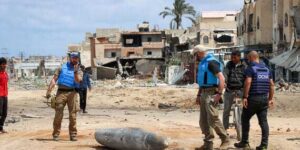
A UN team inspects an unexploded 1,000-pound bomb lying on a main road in Khan Younis. Credit: OCHA/Themba Linden
SAN FRANCISCO, USA, Aug 21 2024 (IPS) – An observation from George Orwell — “those who control the present, control the past and those who control the past control the future” — is acutely relevant to how President Biden talked about Gaza during his speech at the Democratic convention Monday night.
His words fit into a messaging template now in its eleventh month, depicting the U.S. government as tirelessly seeking peace, while supplying the weapons and bombs that have enabled Israel’s continual slaughter of civilians.
“We’ll keep working, to bring hostages home, and end the war in Gaza, and bring peace and security to the Middle East,” Biden told the cheering delegates. “As you know, I wrote a peace treaty for Gaza. A few days ago, I put forward a proposal that brought us closer to doing that than we’ve done since October 7th.”
It was a journey into an alternative universe of political guile from a president who just six days earlier had approved sending $20 billion worth of more weapons to Israel. Yet the Biden delegates in the convention hall responded with a crescendo of roaring admiration.
Applause swelled as Biden continued: “We’re working around-the-clock, my secretary of state, to prevent a wider war and reunite hostages with their families, and surge humanitarian health and food assistance into Gaza now, to end the civilian suffering of the Palestinian people and finally, finally, finally deliver a ceasefire and end this war.”
In Chicago’s United Center, the president basked in adulation while claiming to be a peacemaker despite a record of literally making possible the methodical massacres of tens of thousands of Palestinian civilians.
Orwell would have understood. A political reflex has been in motion from top U.S. leaders, claiming to be peace seekers while aiding and abetting the slaughter. Normalizing deception about the past sets a pattern for perpetrating such deception in the future.
And so, working inside the paradigm that Orwell described, Biden exerts control over the present, strives to control narratives about the past, and seeks to make it all seem normal, prefiguring the future.
The eagerness of delegates to cheer for Biden’s mendaciously absurd narrative about his administration’s policies toward Gaza was in a broader context — the convention’s lovefest for the lame-duck president.
Hours before the convention opened, Peter Beinart released a short video essay anticipating the fervent adulation. “I just don’t think when you’re analyzing a presidency or a person, you sequester what’s happened in Gaza,” he said.
“I mean, if you’re a liberal-minded person, you believe that genocide is just about the worst thing that a country can do, and it’s just about the worst thing that your country can do if your country is arming a genocide.”
Beinart continued: “And it’s really not that controversial anymore that this qualifies as a genocide. I read the academic writing on this. I don’t see any genuine scholars of human rights international law who are saying it’s not indeed there. . . . If you’re gonna say something about Joe Biden, the president, Joe Biden, the man, you have to factor in what Joe Biden, the president, Joe Biden, the man, has done, vis-a-vis Gaza.
It’s central to his legacy. It’s central to his character. And if you don’t, then you’re saying that Palestinian lives just don’t matter, or at least they don’t matter this particular day, and I think that’s inhumane. I don’t think we can ever say that some group of people’s lives simply don’t matter because it’s inconvenient for us to talk about them at a particular moment.”
Underscoring the grotesque moral obtuseness from the convention stage was the joyful display of generations as the president praised and embraced his offspring. Joe Biden walked off stage holding the hand of his cute little grandson, a precious child no more precious than any one of the many thousands of children the president has helped Israel to kill.
Norman Solomon is the national director of RootsAction.org and executive director of the Institute for Public Accuracy. He is the author of many books including War Made Easy. His latest book, War Made Invisible: How America Hides the Human Toll of Its Military Machine, was published in 2023 by The New Press.
UNITED NATIONS, Aug 19 2024 (IPS) – Back in August 2003, the United Nations faced one of its violent tragedies when a terrorist attack on the UN headquarters in the Iraqi capital of Baghdad claimed the lives of 22 people.
Among those killed was Sergio Vieira de Mello of Brazil, the UN envoy in Iraq and High Commissioner for Human Rights, who had a long and distinguished UN career stretching over 30 years.
As the UN commemorated World Humanitarian Day on August 19, it continues to be confronted with rising death tolls among both its humanitarian workers and peacekeepers worldwide.
The commemorative day was established by the General Assembly in 2008 after the 2003 bomb attack in Baghdad.
At last count, at least 254 aid workers have been killed since the current 10-month-old war began in Gaza on Oct. 7 last year, and about 188 worked for UNRWA, the UN agency for Palestinian refugees.
According to the UN, “2023 was the deadliest year on record for humanitarian workers and 2024 is on track to be even worse”.
In a statement ahead of World Humanitarian Day, Dennis Francis, President of the193-member General Assembly said aid organizations – from all over the world – have united to call for the protection of civilians and humanitarian personnel, as well as to ensure their safe and unhindered access, including across conflict lines.
Footage of destruction of Al-Shifa hospital in Gaza, following an Israeli siege. The World Health Organization (WHO) reiterated that hospitals must be respected and protected; they must not be used as battlefields. Credit: UN News
Attacks on humanitarian workers and humanitarian assets must stop, as well as on civilians and civilian infrastructure, he said.
Besides the UN and its agencies, some of the world’s humanitarian organizations in war zones include Doctors Without Borders, CARE International, Save the Children and the International Committee of the Red Cross and the Red Crescent.
Last April, seven members from World Central Kitchen (WCK) were killed in an Israeli air strike in Gaza. The WCK said its team was traveling in a deconflicted zone in two armored cars branded with the WCK logo and a soft skin vehicle.
Despite coordinating movements with the Israeli Defense Force (IDF), the convoy was hit as it was leaving the Deir al-Balah warehouse, where the team had unloaded more than 100 tons of humanitarian food aid brought to Gaza on the maritime route.
“This is not only an attack against WCK, this is an attack on humanitarian organizations showing up in most dire situations where food is being used as a weapon of war. This is unforgivable,” said WCK CEO Erin Gore.
The seven killed were from Australia, Poland, United Kingdom, a dual citizen of the U.S. and Canada, and Palestine.
“I am heartbroken and appalled that we—World Central Kitchen and the world—lost beautiful lives because of a targeted attack by the IDF. The love they had for feeding people, the determination they embodied to show that humanity rises above all, and the impact they made in countless lives will forever be remembered and cherished,” said Gore.
According to the UN Office for the Coordination of Humanitarian Affairs (OCHA), more than half of the 2023 deaths were recorded in the first three months – October to December – of the hostilities in Gaza, mostly as a result of airstrikes.
Extreme levels of violence in Sudan and South Sudan have also contributed to the tragic death toll, both in 2023 and in 2024. In all these conflicts, most of the casualties are among national staff. Many humanitarian workers also continue to be detained in Yemen.
“The normalization of violence against aid workers and the lack of accountability are unacceptable, unconscionable and enormously harmful for aid operations everywhere,” said Joyce Msuya, Acting Under-Secretary-General for Humanitarian Affairs and Emergency Relief Coordinator.
“Today, we reiterate our demand that people in power act to end violations against civilians and the impunity with which these heinous attacks are committed.”
On this World Humanitarian Day, aid workers and those supporting their efforts around the globe have organized events to stand in solidarity and spotlight the horrifying toll of armed conflicts, including on humanitarian staff, she said.
In addition, a joint letter from leaders of humanitarian organizations will be sent to the Member States of the UN General Assembly asking the international community to end attacks on civilians, protect all aid workers, and hold perpetrators to account.
Everyone can add their voice by joining and amplifying the digital campaign using the hashtag #ActforHumanity.
Meanwhile, UN peacekeeping is considered virtually humanitarian—but with a military angle– in conflict ridden countries and war zones where they are also vulnerable to attacks.
At least 11 United Nations personnel — seven military personnel and four civilians — were killed in deliberate attacks in 2023, the United Nations Staff Union Standing Committee on the Security and Independence of the International Civil Service pointed out.
And 32 UN peacekeeping personnel — 28 military and four police, including one woman police officer — were killed in deliberate attacks in 2022, the United Nations Staff Union said.
For the ninth year in a row, the United Nations Multidimensional Integrated Stabilization Mission in Mali (MINUSMA) was the deadliest for peacekeepers with 14 fatalities, followed by 13 fatalities in the United Nations Organization Stabilization Mission in the Democratic Republic of the Congo (MONUSCO), four fatalities in the United Nations Multidimensional Integrated Stabilization Mission in the Central African Republic (MINUSCA) and one fatality in the United Nations Interim Force in Lebanon (UNIFIL).
The figures for preceding years are as follows: 2021 (25 killed); 2020 (15 killed); 2019 (28 killed); 2018 (34 killed); 2017 (71 killed); 2016 (32 killed); 2015 (51 killed); 2014 (61 killed); 2013 (58 killed); 2012 (37 killed); 2011 (35 killed); and 2010 (15 killed).
Roderic Grigson, who was with the UN Emergency Force (UNEF II) on the Egyptian- Israeli border, told IPS the duties of a peacekeeper are extremely hazardous.
“Our job as peacekeepers was to insert ourselves between two warring forces and keep them apart while peace negotiations were conducted at the UN HQ in New York or elsewhere”
Sometimes, he said, those negotiations took years to happen. “The environment we worked in was often a recent warzone, scattered with unexploded shells and mines and the detritus of war.”
“The opposing forces always considered the UN peacekeepers suspicious, and we had to work hard to earn their trust. When travelling through the front lines into the buffer zone, you had to keep your wits about you”.
“We were never alone and were always in touch with headquarters over UHF radios in the clearly marked UN vehicles,” said Grigson, currently a book coach based in Melbourne, who teaches, mentors and supports writers. while running a publishing house for authors who wish to self-publish their stories.
From personal experience, he said, “I can state that I have been shot at several times, had to wear a helmet and body armour while I was working, and have experienced shelling by the two opposing forces who wished to make a point during the ongoing negotiations.”
One of my colleagues was killed while driving the daily mail truck when the road was mined overnight, said Grigson,
ROME, Aug 15 2024 (IPS) – Corinne Fleischer, WFP’s regional director for the Middle East, North Africa and Eastern Europe, describes Gaza as “a terrible situation getting worse.” Over the past two weeks, 21 United Nations World Food Programme (WFP) food distribution points have been closed under evacuation orders.
“UNRWA says that 86% of the Strip is under an evacuation order,” she says on a video call from her office in Cairo. Fleischer visited the enclave in July.“ 2 million people are crammed into 14% of the territory.”
Despite Immense Challenges, WFP Continues to Assist Gazans
With continuous evacuation orders forcing WFP to uproot food distribution sites, precise targeting of the most vulnerable groups becomes challenging. We provide ready-to-eat food, hot meals and nutrition support to breastfeeding women and small children.
Mohammed was severely injured in the conflict but all efforts to evacuate him for medical treatment failed. His family fully depends on food from WFP to survive.
“We support partners in almost 80 kitchens, where they cook meals, pack and distribute them to people in camps,” Fleischer explains. She previously visited Gaza last December. “Then, it was really about how do we bring food in – that’s still very much the case,” she says. “Now, at least we have a dedicated WFP operation on the ground.” Our main accomplishment? “We have helped prevent full-scale famine from happening,” she says.
There are currently nearly 500,000 people at IPC5/Catastrophe, the highest grade of food insecurity on the global standard for measuring food insecurity – down from 1.1 million people earlier this year.
Fleischer is keen to highlight the positive impacts of humanitarian supplies making it through.“Right now, we don’t bring enough food into Gaza,” she says. “We don’t bring in what we plan for the month because we don’t have enough crossing points open. We need all the crossings open and at full capacity.”
“Operations are super complicated,” Fleischer says. “We work in a war zone. Roads are destroyed. We are waiting hours at checkpoints for green lights to move.”
WFP, she stresses, also works to support the wider humanitarian community. “We are leading the Logistics Cluster (the interagency coordination mechanism) and supporting partners to bring in their goods through the Jordan corridor. We are receiving their goods in the north at the Zikim crossing point. We’re helping them in Kerem Shalom. So, of course, we’re helping with fuel supplies too.”
Nowhere Is Safe in Gaza
“Gazans cannot get out, and they’re asking to get out,” Fleischer says. “They’re beyond exhausted. There is no space – one makeshift tent after the other up to the sea. Streets are teeming with people.” Meanwhile, the breakdown of sewage systems, lack of water and waste management means diseases, such as Hepatitis A which is spreading among children, are allowed to fester.
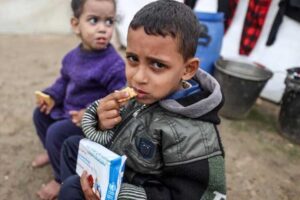
Children eat fortified biscuits from WFP at a makeshift camp in southern Gaza.
“We are lucky that nothing has happened to our amazing staff – more than 200 UNRWA staff have been killed,” she says. “That is not acceptable.” She adds: “We have amazing security officers who advise management on which risks to avoid, so that we can stay and do our work safely and families can access our assistance safely. But the risks are high. Very high. We have bullets close to our convoys. We’re there repairing roads. We’re there moving with our trucks. We’re there reaching people. And it’s very dangerous.”
On the path to recovery, the private sector has a role to play, says Fleischer – take the reopening of shops. “If you think of a lifeline, of hope, or a sense of normalcy, it’s surely when the staple bread is back in the market,” she says of bakeries that have reopened with WFP support. “Bakeries need wheat flour, they need yeast, and diesel too – and that’s where we come in.”
High Prices Keep Basic Foods Out of Reach for Most Gazans
In the south of Gaza, “basic food items are slowly re-emerging in food markets. You can actually find vegetables, fruits in the markets but because prices are high, they remain out of reach for most,” she says “And in any case, people don’t have cash. There are no jobs. Even our own staff tell us, ‘We have a salary, but we can’t access cash’.”
Fleischer is keen for humanitarian efforts to reach a stage where people “stop eating things they have been eating for the past nine months” – to diversify diets heavily dependent on canned food (provided by WFP) and whatever people can get their hands on.
“This level of destruction I’ve never seen.”
Fleischer’s biggest fear for Gaza is “that there is no end to this [war]. That we continue with ever less space for the people who already have nowhere to go back to. Even if they moved back to the north, where could they go?”
“Everything is flattened. There are no homes, it’s all destroyed. We need a long ceasefire that leads to peace so we can operate.”
After the Rafah incursion, many people returned to Khan Younis but there’s no means of living in the area. There are no homes left. Credit: WFP
Fleischer, who has served with WFP in Syria and Sudan’s Darfur Region, adds: “This level of destruction I’ve never seen. Hospitals and clinics are destroyed, food processing plants are destroyed. Everything is destroyed.”
Yet, “There is this never-give-up attitude from the people, from the families we serve,“ she says. “I can’t believe children still run to you and laugh with you. They probably see in us hope that there will be an end to all this – a sign they are not forgotten.”
This story originally appeared on WFP’s Stories on August 8, 2024 and was written by the WFP Editorial Team.
United Nations Assistant Secretary-General and UNDP Crisis Bureau Director, Shoko Noda
UNITED NATIONS, Aug 13 2024 (IPS) – Thirteen years since becoming an independent state, South Sudan faces profound humanitarian challenges. South Sudan’s first Independence Day was imbued with a great sense of hope.
I remember crowds cheering in the streets, waving the country’s new flag high. Thirteen years later, the youngest nation in the world, barely into its adolescence, faces profound challenges.
At the heart of South Sudan’s challenges lies a humanitarian crisis of staggering proportions. Given seven million of the country’s 12.4 million people are projected to experience crisis-level hunger this year, and nine million are in dire need of humanitarian assistance, the gravity of the situation cannot be overstated.
One in ten lack access to electricity. Seventy percent can’t access basic healthcare. These are fundamental human rights that the vast majority of people are deprived of.
I saw South Sudan’s dire humanitarian situation firsthand when I visited the country in March. I met women and children displaced by conflict – some for the second time in their lives – in a transit centre in Malakal, the capital of Upper Nile state. They had nothing and were fully reliant on aid. Their plight still lingers in my mind and heart.
As it marks its 13th independence anniversary, South Sudan finds itself at a pivotal moment in its nation-building journey.
Humanitarian aid alone cannot untangle the intricate web of challenges facing South Sudan. A holistic approach is required—one that lays the groundwork for self-sufficiency, peace and sustainable development.
With the constitutional-making process underway and elections on the horizon, the efforts we make today will shape the trajectory of the country for generations to come. We must bolster institutions, foster stability and empower the youth—the driving force behind the nation’s aspirations for progress and prosperity.
Humanitarian aid alone cannot untangle the intricate web of challenges facing South Sudan. A holistic approach is required—one that lays the groundwork for self-sufficiency, peace and sustainable development.
Central to this is the empowerment of women and girls, who face disproportionate challenges and vulnerabilities in the face of conflict, displacement and climate change. Gender-based violence (GBV), child marriage and maternal mortality rates are alarmingly high, underscoring the urgent need for targeted interventions that prioritize the rights and dignity of women and girls.
When I visited Malakal, I met with young women whose stories painted a vivid story to me on the barriers they face on a daily basis—from fearing for their safety to feeling unable to speak out about their hopes and aspirations, or being denied work opportunities.
It should not be this way.
Our team on the ground is working hard to improve the lives of women and girls in South Sudan. I was impressed by courts in Juba, set up with UNDP support, that focus on addressing violence against women. We are also working to ensure women’s inclusion in peacebuilding processes, promote gender equality and create opportunities for women and youth to thrive.
But so much more needs to be done.
With 75 percent of the population comprising young people, they represent both South Sudan’s greatest challenge and its most promising asset. Neglecting to invest in the youth equates to neglecting the future of the country itself—a risk we cannot afford to take.
Their voices must be heard, their aspirations nurtured and their potential unleashed.
South Sudan is at a crossroads.
With the right support, the country has the potential to create a future defined by hope, greater prosperity and stability for all. The alternative is a deepening of an already profound and protracted crisis.
South Sudan cannot navigate this path alone. It requires the support that transcends its borders to overcome the myriad challenges it faces. Increased development cooperation—the kind that helps people break the cycle of crisis and build safer, more stable, resilient, and sustainable lives—is urgently needed.
My hope is to return in 10 years and see the families I met at the Malakal transit centre peacefully settled, their children grown and thriving, with stable livelihoods and access to all the services they need to sustain them and nurture their hopes and aspirations for the future.
This is what development looks like.
Shoko Noda is United Nations Assistant Secretary-General and UNDP Crisis Bureau Director
Source: Africa Renewal, a United Nations digital magazine that covers Africa’s economic, social and political developments—plus the challenges the continent faces and the solutions to these by Africans themselves, including with the support of the United Nations and international community.