Myanmar: Military Junta Gets a Free Pass

Cover photo by Reuters/Stringer via Gallo Images

By Andrew Firmin
LONDON, Jun 23 2023 (IPS)

The violence keeps coming in Myanmar, under military rule since February 2021. The junta stands accused of war crimes and crimes against humanity, with evidence of systematic use of killings, rape, torture and other gross human rights violations in its attempt to suppress forces demanding a return to democracy.


Even humanitarian aid is restricted. Recently the junta refused to allow in aid organisations trying to provide food, water and medicines to people left in desperate need by a devastating cyclone. It’s far from the first time it’s blocked aid.

Crises like this demand an international response. But largely standing on the sidelines while this happens is the regional intergovernmental body, the Association of Southeast Asian Nations (ASEAN). Its recent summit, held in Indonesia in May, failed to produce any progress.

ASEAN’s inaction

ASEAN’s response to the coup was to issue a text, the Five-Point Consensus (5PC), in April 2021. This called for the immediate cessation of violence and constructive dialogue between all parties. ASEAN agreed to provide humanitarian help, appoint a special envoy and visit Myanmar to meet with all parties.

Civil society criticised this agreement because it recognised the role of the junta and failed to make any mention of the need to restore democracy. And the unmitigated violence and human rights violations are the clearest possible sign that the 5PC isn’t working – but ASEAN sticks to it. At its May summit, ASEAN states reiterated their support for the plan.

A major challenge is that most ASEAN states have no interest in democracy. All 10 have heavily restricted civic space. As well as Myanmar, civic space is closed in Cambodia, Laos and Vietnam.

It wouldn’t suit such states to have a thriving democracy on their doorstep, which could only bring greater domestic and international pressure to follow suit. States that repress human rights at home typically carry the same approach into international organisations, working to limit their ability to uphold human rights commitments and scrutinise violations.

Continuing emphasis on the 5PC hasn’t masked divisions among ASEAN states. Some appear to think they can engage with the junta and at least persuade it to moderate its violence – although reality makes this increasingly untenable. But others, particularly Cambodia – a one-party state led by the same prime minister since 1998 – seem intent on legitimising the junta.

Variable pressure has come from ASEAN’s chair, which rotates annually and appoints the special envoy. Under the last two, Brunei Darussalam – a sultanate that last held an election in 1965 – and Cambodia, little happened. Brunei never visited the country after being refused permission to meet with democratic leaders, while Cambodia’s prime minister, Hun Sen, visited Myanmar last year. The first post-coup visit to Myanmar by a head of government, this could only be construed as conferring legitimacy.

Indonesia, the current chair, hasn’t appointed a special envoy, instead setting up an office headed by the foreign minister. So far it appears to be taking a soft approach of quiet diplomacy rather than public action.

Thailand, currently led by a pro-military government, is also evidently happy to engage with the junta. While junta representatives remain banned from ASEAN summits, Thailand has broken ranks and invited ASEAN foreign ministers, including from Myanmar, to hold talks about reintegrating the junta’s leaders. A government that itself came to power through a coup but should now step aside after an election where it was thoroughly defeated looks to be attempting to bolster the legitimacy of military rule.

ASEAN states seem unable to move beyond the 5PC even as they undermine it. But the fact that they’re formally sticking with it enables the wider international community to stand back, on the basis of respecting regional leadership and the 5PC.

The UN Security Council finally adopted a resolution on Myanmar in December 2022. This called for an immediate end to the violence, the release of all political prisoners and unhindered humanitarian access. But its language didn’t go far enough in condemning systematic human rights violations and continued to emphasise the 5PC. It failed to impose sanctions such as an arms embargo or to refer Myanmar to the International Criminal Court (ICC).

Civil society in Myanmar and the region is urging ASEAN to go further. Many have joined together to develop a five-point agenda that goes beyond the 5PC. It calls for a strategy to end military violence through sanctions, an arms embargo and a referral of Myanmar to the ICC. It demands ASEAN engages beyond the junta, and particularly with democratic forces including the National Unity Government – the democratic government in exile. It urges a strengthening of the special envoy role and a pivoting of humanitarian aid to local responders rather than the junta. ASEAN needs to take this on board.

A fork in the road

ASEAN’s current plan is a recipe for continuing military violence, increasingly legitimised by its neighbours’ acceptance. Ceremonial elections could offer further fuel for this.

The junta once promised to hold elections by August, but in February, on the coup’s second anniversary, it extended the state of emergency for another six months. If and when those elections finally happen, there’s no hope of them being free or fair. In March, the junta dissolved some 40 political parties, including the ousted ruling party, the National League for Democracy.

The only purpose of any eventual fake election will be to give the junta a legitimising veneer to present as a sign of progress – and some ASEAN states may be prepared to buy this. This shouldn’t be allowed. ASEAN needs to listen to the voices of civil society calling for it to get its act together – and stick together – in holding the junta to account. If it doesn’t, it will keep failing not only Myanmar’s people, but all in the region who reasonably expect that fundamental human rights should be respected and those who kill, rape and torture should face justice.

Andrew Firmin is CIVICUS Editor-in-Chief, co-director and writer for CIVICUS Lens and co-author of the State of Civil Society Report.


!function(d,s,id){var js,fjs=d.getElementsByTagName(s)[0],p=/^http:/.test(d.location)?’http’:’https’;if(!d.getElementById(id)){js=d.createElement(s);js.id=id;js.src=p+’://platform.twitter.com/widgets.js’;fjs.parentNode.insertBefore(js,fjs);}}(document, ‘script’, ‘twitter-wjs’);  

Source

Global Community Celebrates Medical Innovations and Milestones Since Defining Leprosy Discovery 150 Years Ago

Yohei Sasakawa, WHO’s Goodwill Ambassador for Leprosy Elimination, speaks at the two-day Bergen International Conference on Hansen’s Disease. The conference coincided with the 150th anniversary of the discovery of Mycobacterium leprae by Norwegian doctor Gerhard Armauer Hansen. Credit: Thor Brødreskift/Sasakawa Leprosy (Hansen’s Disease) Initiative

Yohei Sasakawa, WHO’s Goodwill Ambassador for Leprosy Elimination, speaks at the two-day Bergen International Conference on Hansen’s Disease. The conference coincided with the 150th anniversary of the discovery of Mycobacterium leprae by Norwegian doctor Gerhard Armauer Hansen. Credit: Thor Brødreskift/Sasakawa Leprosy (Hansen’s Disease) Initiative

By Joyce Chimbi
NAIROBI, Jun 22 2023 (IPS)

The 1873 discovery of Mycobacterium leprae, the causative agent of leprosy by Norwegian doctor Gerhard Armauer Hansen, remains one of the greatest paradigm shifts in medical history, a true revolution.


“Before the great discovery, even in the days when communication and transportation technologies were not as developed as today, leprosy was detested by the entire world. Leprosy was believed to be a divine punishment or a hereditary disease; once affected, patients were segregated to remote areas and islands for life,” says Yohei Sasakawa, WHO’s Goodwill Ambassador for Leprosy Elimination.

Sasakawa, who also serves as chairperson of The Nippon Foundation, spoke during a two-day conference in Bergen, Norway, to commemorate the 1873 discovery. In attendance were over 200 people, including medical, human rights, and historical preservation experts, researchers, NGOs, and organizations of persons affected by the disease.

The Bergen International Conference on Hansen’s Disease, held on June 21 and 22, 2023, was organized by the Sasakawa Leprosy (Hansen’s Disease) Initiative and the University of Bergen. It focused on medical efforts against leprosy, human rights, and dignity issues and preserving the history of leprosy for the lessons it can teach future generations. All three are pillars of the Sasakawa Leprosy (Hansen’s Disease) Initiative’s activities for a world free of leprosy and the discrimination it causes, in line with the UN’s Resolution on Elimination of discrimination against persons affected by leprosy and their family members.

In his speech to delegates, Sasakawa acknowledged the extraordinary advances made by medical professionals since Dr Hansen’s discovery that leprosy was neither a curse nor a punishment from God but a chronic disease caused by a bacillus.

With the 1873 discovery, leprosy went from being a mythological divine disease shrouded in mystery to something one could observe and explain—although it would take more than half a century before a cure was found.

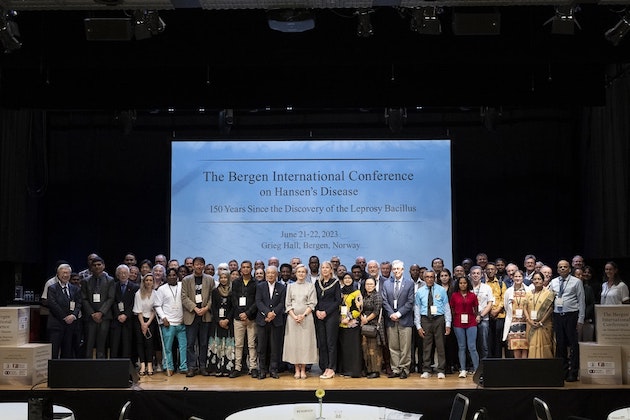
Delegates at the Bergen International Conference on Hansen’s Disease held on June 21 and 22, 2023. The conference was organized by Sasakawa Leprosy (Hansen’s Disease) Initiative and the University of Bergen. Credit: Thor Brødreskift/Sasakawa Leprosy (Hansen’s Disease) Initiative

Delegates at the Bergen International Conference on Hansen’s Disease held on June 21 and 22, 2023. The conference was organized by the Sasakawa Leprosy (Hansen’s Disease) Initiative and the University of Bergen. Credit: Thor Brødreskift/Sasakawa Leprosy (Hansen’s Disease) Initiative

Margareth Hagen, Rector, University of Bergen, said there was a clear shift in the scientific discourse about leprosy before and after the discovery.

Sasakawa said the journey towards a cure started with a single anti-leprosy drug to more effective drug regimens and, ultimately, a recommendation from WHO’s medical team that leprosy patients receive drug regimens consisting of multiple drugs.

“A single anti-leprosy drug tended to increase drug resistance. Since the development of multi-drug therapy, with early detection and treatment, leprosy has become totally curable. About 60 million patients have been cured over the last 40 years,” he said.

Abbi Patrix, the great-grandson of Dr Hansen, now responsible for his great grandfather’s history, spoke about the man behind the science in a session titled, ‘My grandfather, my mother, the documents and me.’

Patrix, a European performance storyteller, talked about the day his mother, the only direct descendant of Dr Hansen at the time, learned that leprosy was named Hansen’s disease after her grandfather.

She was moved and wondered why? His mother was informed that Dr Hansen’s discovery had put a name to a disease that had confounded scientists and society alike and that labeling it ‘Hansen’s disease’ meant freedom for those afflicted because a cure could now be found.

The conference venue was, therefore, a recognition of his renowned great-grandfather because he was born in Bergen, and this was the site for his landmark 1873 discovery at only 32 years of age.

WHO Director-General Dr Tedros Adhanom Ghebreyesus told the audience: “WHO was born halfway between 1873 and today, 75 years ago. Much progress has been made since the two major milestones in the fight against leprosy. But much remains to be done toward our shared goals of zero disease, zero disability, and zero discrimination. Cases of leprosy have decreased significantly in recent decades, but more effort is needed to recover from the health system disruptions of the COVID-19 pandemic and move further ahead.”

Ghebreyesus said the WHO was committed to supporting countries in their bid to eliminate leprosy in line with the roadmap for neglected tropical disease for 2021 to 2030.

“So far, 49 countries have eliminated at least one neglected tropical disease, including Human African trypanosomiasis, rabies, and trachoma. With your support and those of our global partners, we can achieve that goal for leprosy too.”

Other dignitaries who spoke at the conference include United Nations High Commissioner for Human Rights Volker Türk, who said the conference celebrated medical innovations over the last 150 years.

“But when leprosy was eliminated as a global public health problem in 2000, it did not mean that the disease disappeared. Over 250,000 people suffer from leprosy every year, 15,000 of them are children. The actual figures are likely far higher,” he emphasized.

“Around three to four million people who have already been cured still bear varying degrees of impairment. The burden of leprosy is heaviest in countries with the greatest inequality, poverty, and marginalization.”

Türk further said that to better the lives of people affected by leprosy, “We need to address the physical symptoms, but we also need social and behavioral measures to address stigma and discrimination. We need comprehensive strategies with access to quality care, education, and social protection,” and told participants that “together we can make a real difference in ending leprosy, which causes immense preventable and unjustifiable suffering for thousands of people.”

Against this backdrop, Sasakawa stressed that further action is needed to combat stigma and discrimination, pointing out that as many as 130 discriminatory laws against leprosy are still in place in more than 20 countries.

“When respect for human rights is a must, it is unacceptable to leave such a large-scale and serious human rights violation unaddressed,” he said.

As the curtain fell on the Bergen conference of a remarkable journey to end leprosy over the last 150 years, Dr Takahiro Nanri, executive director of Sasakawa Health Foundation, noted that this was the third international conference that the foundation has helped to organize since launching its “Don’t Forget Leprosy” campaign in 2021 to help to ensure that the disease and those affected by it are not overlooked amid the coronavirus pandemic.

“Our purpose in organizing these conferences is to make the world aware that there are still many people who have Hansen’s disease and its consequences; to build momentum for collaboration toward the realization of a leprosy-free world; and to provide a setting for both formal and informal exchanges that can be a catalyst for innovative solutions that we as a foundation are ready to support,” he said.

IPS UN Bureau Report


!function(d,s,id){var js,fjs=d.getElementsByTagName(s)[0],p=/^http:/.test(d.location)?’http’:’https’;if(!d.getElementById(id)){js=d.createElement(s);js.id=id;js.src=p+’://platform.twitter.com/widgets.js’;fjs.parentNode.insertBefore(js,fjs);}}(document, ‘script’, ‘twitter-wjs’);  

Source

Human Rights Defenders in Exile Safety Imperiled by Host Countries’ Declining Civil Rights

Irene Grace says human rights defenders hiding in Kenya fear harassment and intimidation due to a decline in civic rights. Credit: Joyce Chimbi/IPS

Irene Grace says human rights defenders hiding in Kenya fear harassment and intimidation due to a decline in civic rights. Credit: Joyce Chimbi/IPS

By Joyce Chimbi
NAIROBI, Jun 20 2023 (IPS)

While leaving one’s country and becoming a refugee is a last resort, it is a decision that many, like Steve Kitsa, have had to make. As conflict becomes increasingly protracted in many African countries, many others will take this step.


“In a matter of life and death, I fled the Democratic Republic of Congo (DRC) five years ago and left my elderly mother behind. One day we were seated in a group of young men, chatting and enjoying the morning sun, when a lone gunman in uniform approached us and started firing away unprovoked. Such incidences had become too common in the eastern region, and some of my friends were killed,” Kitsa tells IPS.

Kenya hosts one of the largest refugee populations in Africa. Kitsa is one of more than 520,000 registered refugees and asylum seekers. But human rights defender Irene Grace, who fled Uganda two years ago, says the number is much higher because borders are porous.

Nevertheless, official records show that about 287,000 refugees come from Somalia, 142,000 from South Sudan, 50,000 from DRC, and 32,000 from Ethiopia; many live in Dadaab and Kakuma camps.

Others, like Kitsa, have found their way into the urban centers of Nairobi, Kisumu, Mombasa, and Eldoret. Outdated statistics from 2017 indicate that more than 67,267 refugees live in Nairobi.

“There is a lot of exploitation because we need the locals to survive. Along the highways, you will find many young men hawking peanuts. You can tell they are from DRC because of the kind of Swahili they speak. They sell these peanuts under the hot sun, all day, every day, in exchange for a plate of food and somewhere to sleep as the profits go to the host. Most of us are desperate to go to France,” he explains.

Irene Grace fled Uganda for promoting the rights of the LGBTQI community as the country clamped down on their rights. As the government-endorsed crackdown against the community intensified, so did threats against her life.

“The issue of human rights defenders in exile is one aspect of the refugee situation that is hardly ever talked about. The risk is very high because you are under an alias in a foreign country, and if murdered, you are likely to remain unidentified for a long time, and it might take years to connect the dots. The question of who bears the duty of protection for us remains unanswered,” Grace says.

Her fears and concerns reflect the 2022 report findings by the global civil society alliance, CIVICUS, and the Kenya Human Rights Commission (KHRC), highlighting the decline in civil rights in Kenya. According to the report, the government was using excessive force to quieten dissent.

Kenya was placed on the CIVICUS Monitor’s human rights ‘Watchlist’ in June 2022. The Watchlist highlights countries with a recent and steady decline in civic freedoms, including the rights of free speech and peaceful assembly.

Kenya was rated Obstructed by the CIVICUS Monitor. There are 42 countries in the world with this rating. The rating is typically given to countries where power holders heavily contest civic space and impose a combination of legal and practical constraints on the full enjoyment of fundamental rights.

In 2021, Front Line Defenders released a report accusing the governments of Uganda and Kenya of giving the South Sudanese National Security Service (NSS) intelligence agency the freedom to target refugee human rights workers who fled the country.

“It is very difficult to continue with activism in such a hostile environment, on top of the many other challenges confronting us, such as a lack of documentation and access to services. Some of us left our families behind, exposed and unprotected. Over the eight years, I have lived in Kenya, I have received many threatening calls from South Sudan, but I know the information of my whereabouts came from within this country,” Deng G, an activist from South Sudan, tells IPS.

“Our situation worsens when local activists are targeted. In exile, you must connect with local networks to survive and continue with your activism. I am aware of activists in Kenya currently being held without trial for protesting against the high cost of living.”

KHRC continues to express concerns over the misuse of laws to undermine peaceful protest and recently responded with speed when five activists from the Social Justice Center, a Nairobi-based grassroots group, were arrested during a peaceful protest against the controversial Finance Bill 2023.

A pre-independence Public Order Act requires activists to notify authorities of protests at least three days in advance. Police have mistakenly understood the provision as a requirement for protests to be approved or denied, using it as an excuse to deem protests ‘unpermitted.’ Even though the right to peaceful assembly is guaranteed in Kenya’s constitution, it is continually undermined, says CIVICUS and KHRC.

Irene Grace says ongoing hostilities have derailed efforts to promote the safety and security of LGBTQI asylum seekers and refugees in the Kakuma Refugee Camp complex in northwestern Kenya whose lives are at risk. She says they are experiencing discrimination, and physical and sexual violence, among other forms of human rights violations.

“I am unable to travel there to determine how we can mobilize and improve their safety, working hand in hand with grassroots activists in Kenya. There are corrupt security officers, and once they discover you are hiding in the country, you become a target. They want you to pay them to turn a blind eye as you go on with your activities,” she says.

Kitsa says the issue of bribes is a most pressing challenge for many refugees seeking to integrate with the locals.

“They usually threaten to send you to the refugee camps despite having refugee documentation allowing you to live among the locals. They can create many problems for you.”

Against this backdrop, Irene Grace says activism is being suppressed from multiple angles, and human rights activists, local and those operating from exile, must now go back to the drawing board to find safer, impactful ways to speak truth to power and take the powers that be head-on.
IPS UN Bureau Report


!function(d,s,id){var js,fjs=d.getElementsByTagName(s)[0],p=/^http:/.test(d.location)?’http’:’https’;if(!d.getElementById(id)){js=d.createElement(s);js.id=id;js.src=p+’://platform.twitter.com/widgets.js’;fjs.parentNode.insertBefore(js,fjs);}}(document, ‘script’, ‘twitter-wjs’);  

Excerpt:

Home Away From Home is the theme of World Refugee Day 2023. However, for many, including human rights activists who have fled their homes, a decline in civil rights in their host countries means their lives are often endangered and their activism curtailed. Source

UN Cybercrime Convention: Could the Cure Be Worse than the Disease?

Civil Society, Crime & Justice, Featured, Global, Headlines, Human Rights, TerraViva United Nations

Opinion

Credit: CIVICUS

MONTEVIDEO, Uruguay, Jun 16 2023 (IPS) – If you’ve never heard of the Cybercrime Convention, you’re not alone. And if you’re wondering whether an international treaty to tackle cybercrime is a good idea, you’re in good company too.


Negotiations have been underway for more than three years: the latest negotiating session was held in April, and a multi-stakeholder consultation has just concluded. A sixth session is scheduled to take place in August, with a draft text expected to be approved by February 2024, to be put to a vote at the UN General Assembly (UNGA) later next year. But civil society sees some big pitfalls ahead.

Controversial beginnings

In December 2019, the UNGA voted to start negotiating a cybercrime treaty. The resolution was sponsored by Russia and co-sponsored by several of the world’s most repressive regimes, which already had national cybercrime laws they use to stifle legitimate dissent under the pretence of combatting a variety of vaguely defined online crimes such as insulting the authorities, spreading ‘fake news’ and extremism.

Tackling cybercrime certainly requires some kind of international cooperation. But this doesn’t necessarily need a new treaty. Experts have pointed out that the real problem may be the lack of enforcement of current international agreements, particularly the 2001 Council of Europe’s Budapest Convention.

When Russia’s resolution was put to a vote, the European Union, many states and human rights organisations urged the UNGA to reject it. But once the resolution passed, they engaged with the process, trying to prevent the worst possible outcome – a treaty lacking human rights safeguards that could be used as a repressive tool.

The December 2019 resolution set up an ad hoc committee (AHC), open to the participation of all UN member states plus observers, including civil society. At its first meeting to set procedural rules in mid-2021, Brazil’s proposal that a two-thirds majority vote be needed for decision-making – when consensus can’t be achieved – was accepted, instead of the simple majority favoured by Russia. A list of stakeholders was approved, including civil society organisations (CSOs), academic institutions and private sector representatives.

Another key procedural decision was made in February 2022: intersessional consultations were to be held between negotiating sessions to solicit input from stakeholders, including human rights CSOs. These consultations have given CSOs the chance to make presentations and participate in discussions with states.

Human rights concerns

Several CSOs are trying to use the space to influence the treaty process, including as part of broader coalitions. Given what’s at stake, in advance of the first negotiating session, around 130 CSOs and experts urged the AHC to embed human rights safeguards in the treaty.

One of the challenges it that, as early as the first negotiating session, it became apparent there wasn’t a clear definition of what constitutes a cybercrime and which cybercrimes should be regulated by the treaty. There’s still no clarity.

The UN identifies two main types of cybercrimes: cyber-dependent crimes such as network intrusion and malware distribution, which can only be committed through the use of information and communications technologies (ICTs), and cyber-enabled crimes, which can be facilitated by ICTs but can be committed without them, such as drug trafficking and the illegal distribution of counterfeit goods.

Throughout the negotiation process there’s been disagreement about whether the treaty should focus on a limited set of cyber-dependent crimes, or address a variety of cyber-enabled crimes. These, human rights groups warn, include various content-related offences that could be invoked to repress freedom of expression.

These concerns have been highlighted by the Office of the UN High Commissioner for Human Rights, which has emphasised that the treaty shouldn’t include offences related to the content of online expression and should clearly and explicitly reference binding international human rights agreements to ensure it’s applied in line with universal human rights principles.

A second major disagreement concerns the scope and conditions for international cooperation. If not clearly defined, cooperation arrangements could result in violations of privacy and data protection provisions. In the absence of the principle of dual criminality – where extradition can only apply to an action that constitutes a crime in both the country making an extradition request and the one receiving it – state authorities could be made to investigate activities that aren’t crimes in their own countries. They could effectively become enforcers of repression.

Civil society has pushed for recognition of a set of principles on the application of human rights to communications surveillance. According to these, dual criminality should prevail, and where laws differ, the one with the higher level of rights protections should be applied. It must be ensured that states don’t use mutual assistance agreements and foreign cooperation requests to circumvent domestic legal restrictions.

An uncertain future

Following the third multistakeholder consultation held in November 2022, the AHC released a negotiating draft. In the fourth negotiating session in January 2023, civil society’s major concerns focused on the long and growing number of criminal offences listed in the draft, many of them content-related.

It’s unclear how the AHC intends to bridge current deep divides to produce the ‘zero draft’ it’s expected to share in the next few weeks. If it complies with the deadline by leaving contentious issues undecided, the next session, scheduled for August, may bring a shift from consensus-building to voting – unless states decide to give themselves some extra time.

As of today, the process could still conclude on time, or with a limited extension, following a forced vote on a harmful treaty that lacks consensus and therefore fails to enter into effect, or does so for a limited number of states. Or it could be repeatedly postponed and fade away. Civil society engaged in the process may well think such a development wouldn’t be so bad: better no agreement than one that gives repressive states stronger tools to stifle dissent.

Inés M. Pousadela is CIVICUS Senior Research Specialist, co-director and writer for CIVICUS Lens and co-author of the State of Civil Society Report.

  Source

Climate Change Gets Its Day in Court

Asia-Pacific, Civil Society, Climate Action, Climate Change, Development & Aid, Environment, Featured, Global, Headlines, Human Rights, TerraViva United Nations

Opinion

Credit: Save the Children Vanuatu/Facebook

MONTEVIDEO, Uruguay, May 25 2023 (IPS) – As a matter of global justice, the climate crisis has rightfully made its way to the world’s highest court.

On 29 March 2023, the United Nations General Assembly (UNGA) unanimously adopted a resolution asking the International Court of Justice (ICJ) to issue an advisory opinion on the obligations of states on climate change. The initiative was led by the Pacific Island state of Vanuatu, one of several at risk of disappearing under rising sea levels. It was co-sponsored by 132 states and actively supported by networks of grassroots youth groups from the Pacific and around the world.


Civil society’s campaign

In 2019, a group of law students from the University of the South Pacific formed Pacific Islands Students Fighting Climate Change (PISFCC), a regional organisation with national chapters in Fiji, the Solomon Islands, Tonga and Vanuatu. PISFCC advocated with the Pacific Island Forum – the key regional body – to put the call for an ICJ opinion on its agenda. The government of Vanuatu announced it would seek this in September 2021, and Pacific civil society organisations (CSOs) formed an alliance – the Alliance for a Climate Justice Advisory Opinion – that has since grown to include CSOs and many others from around the world, including UN Special Rapporteurs and global experts.

The campaign made heavy use of social media, with people sharing their stories on the impacts of climate change and emphasising the importance of an ICJ opinion to help support calls for climate action, including climate litigation. It organised globally, sharing a toolkit used by activists around the world, and took to the streets locally. In Vanuatu, where it all started, children demonstrated in September 2022 to call attention to the impacts of climate change as their country’s single greatest development threat and express support for the call for an ICJ opinion.

In the run-up to the UNGA session that adopted the historic resolution, thousands of CSOs from around the world supported a letter calling for governments to back the vote.

[embedded content]

The ICJ’s role

The ICJ is made up of 15 judges elected by the UNGA and UN Security Council. It settles legal disputes between states and provides advisory opinions on legal questions referred to it by other parts of the UN system.

The questions posed to the ICJ aim to clarify the obligations of states under international law to protect the climate system and environment from human-induced greenhouse gas emissions. They also ask about the legal responsibilities of states that have caused significant environmental harm towards other states, particularly small islands, and towards current and future generations.

To provide its advisory opinion, the ICJ will have to interpret states’ obligations as outlined in the 1992 UN Framework Convention on Climate Change and the 2015 Paris Agreement as well as the Universal Declaration of Human Rights and a variety of international covenants and treaties. It may consider previous UNGA resolutions on climate change, such as the recent one recognising access to a clean, healthy and sustainable environment as a universal human right, and other resolutions by the UN Human Rights Council and reports by the Office of the UN High Commissioner of Human Rights and its independent human rights experts. It may also take into account decisions by UN treaty bodies and its own jurisprudence on climate and environmental matters.

Next steps

According to its statute, the ICJ can seek written statements from states or international organisations likely to have relevant information on the issue at hand. On 20 April, it communicated its decision to treat the UN and all its member states as ‘likely to be able to furnish information on the questions submitted to the Court’ and gave them six months to submit written statements, after which they will have three months to make written comments on statements made by other states or organisations.

Civil society doesn’t have any right to submit formal statements, so climate activists are urging as many people as possible to advocate towards their governments to make strong submissions that will lead to a progressive ICJ opinion. After submissions close, the ICJ is likely to take several months to deliberate, so its opinion may be expected at some point in 2024, likely towards the end of the year.

Advisory opinions aren’t binding. They don’t impose obligations on states. But they shape the global understanding of states’ obligations under international law and can motivate states to show their compliance with rising standards. An ICJ opinion could positively influence climate negotiations, pushing forward long-delayed initiatives on funding for loss and damage. It could encourage states to make more ambitious pledges to cut greenhouse gas emissions. It might also help raise awareness of the particular risks faced by small island states and provide arguments in favour of stronger climate action, helping climate advocates gain ground within governments.

A progressive advisory opinion could also help support domestic climate litigation: research shows that domestic courts are increasingly inclined to cite ICJ opinions and other sources of international law, including when it comes to determining climate issues.

The risk can’t be ruled out of a disappointing ICJ opinion merely reiterating the content of existing climate treaties without making any progress on states’ obligations. But climate activists find reasons to expect much more: many see this as a unique opportunity, brought about by their own persistent efforts, to advance climate justice and push for action that meets the scale of the crisis.

Inés M. Pousadela is CIVICUS Senior Research Specialist, co-director and writer for CIVICUS Lens and co-author of the State of Civil Society Report.

  Source

Chile: New Constitution in the Hands of the Far Right

Credit: Martín Bernetti/AFP via Getty Images

By Inés M. Pousadela
MONTEVIDEO, Uruguay, May 19 2023 (IPS)

On 7 May, Chileans went to the polls to choose a Constitutional Council that will produce a new constitution to replace the one bequeathed by the Pinochet dictatorship – and handed control to a far-right party that never wanted a constitution-making process in the first place.


This is the second attempt at constitutional change in two years. The first process was the most open and inclusive in Chile’s history. The resulting constitutional text, ambitious and progressive, was widely rejected in a referendum. It’s now far from certain that this latest, far less inclusive process will result in a new constitution that is accepted and adopted – and there’s a possibility that any new constitution could be worse than the one it replaces.

A long and winding road

Chile’s constitution-making process was born out of mass protests that erupted in October 2019, under the neoliberal administration of Sebastián Piñera. Protests only subsided when the leaders of major parties agreed to hold a referendum to ask people whether they wanted a new constitution and, if so, how it should be drafted.

In the vote in October 2020, almost 80 per cent of voters backed constitutional change, with a new constitution to be drafted by a directly elected Constitutional Assembly. In May 2021, the Constitutional Assembly was elected, with an innovative mechanism to ensure gender parity and reserved seats for Indigenous peoples. Amid great expectations, the plural and diverse body started a one-year journey towards a new constitution.

Pushed by the same winds of change, in December 2021 Chile elected its youngest and most unconventional president ever: former student protester Gabriel Boric. But things soon turned sideways, and support for the Constitutional Assembly – often criticised as made up of unskilled amateurs – declined steadily along with support for the new government.

In September 2022, a referendum resulted in an overwhelming rejection of the draft constitution. Although very progressive in its focus on gender and Indigenous rights, a common criticism was that the proposed constitution failed to offer much to advance basic social rights in a country characterised by heavy economic inequality and poor public services. Disinformation was also rife during the campaign.

The second attempt kicked off in January 2023, with Congress passing a law laying out a new process with a much more traditional format. Instead of the large number of independent representatives involved before, this handed control back to political parties. The timeframe was shortened, the assembly made smaller and the previous blank slate replaced by a series of agreed principles. The task of producing the first draft is in the hands of a Commission of Experts, with a technical body, the Technical Admissibility Committee, guarding compliance with a series of agreed principles. One of the few things that remained from the previous process was gender parity.

Starting in March, the Commission of Experts was given three months to produce a new draft, to be submitted to the Constitutional Council for debate and approval. A referendum will be held in December to either ratify or reject the new constitution.

Rise of the far right

Compared with the 2021 election for the Constitutional Convention, the election for the Constitutional Council was characterised by low levels of public engagement. A survey published in mid-April found that 48 per cent of respondents had little or no interest in the election and 62 per cent had little or no confidence in the constitution-making process. Polls also showed increasing dissatisfaction with the government: in late 2022, approval rates had plummeted to 27 per cent. This made an anti-government protest vote likely.

While the 2021 campaign focused on inequality, this time the focus was on rising crime, economic hardship and irregular migration, pivoting to security issues. The party that most strongly reflected and instrumentalised these concerns came out the winner.

The far-right Republican Party, led by defeated presidential candidate José Antonio Kast, received 35.4 per cent of the votes, winning 23 seats on the 50-member council. The government-backed Unity for Chile came second, with 28.6 per cent and 16 seats. The traditional right-wing alliance Safe Chile took 21 per cent of the vote and got 11 seats. No seats were won by the populist People’s Party and the centrist All for Chile alliance, led by the Christian Democratic Party. The political centre has vanished, with polarisation on the rise.

 
What to expect

The Expert Commission will deliver its draft proposal on 6 June and the Constitutional Council will then have five months to work on it, approving decisions with the votes of three-fifths of its members – meaning 31 votes will be needed to make decisions, and 21 will be enough to block them. This gives veto power to the Republican Party – and if it manages to work with the traditional right wing, they will be able to define the new constitution’s contents.

 
The chances of the new draft constitution being better than the old one are slim. In the best-case scenario, only cosmetic changes will be introduced. In the worst, an even more regressive text will result.

People will have the final say on 17 December. If they ratify the proposed text, Chile will adopt a constitution that is, at best, not much different from the existing one. If they reject it, Chileans will be stuck with the old constitution that many rose up against in 2019. Either way, a once-in-a-generation opportunity to expand the recognition of rights will have been lost, and it will fall on civil society to keep pushing for the recognition and protection of human rights.

Inés M. Pousadela is CIVICUS Senior Research Specialist, co-director and writer for CIVICUS Lens and co-author of the State of Civil Society Report.


!function(d,s,id){var js,fjs=d.getElementsByTagName(s)[0],p=/^http:/.test(d.location)?’http’:’https’;if(!d.getElementById(id)){js=d.createElement(s);js.id=id;js.src=p+’://platform.twitter.com/widgets.js’;fjs.parentNode.insertBefore(js,fjs);}}(document, ‘script’, ‘twitter-wjs’);  
Source