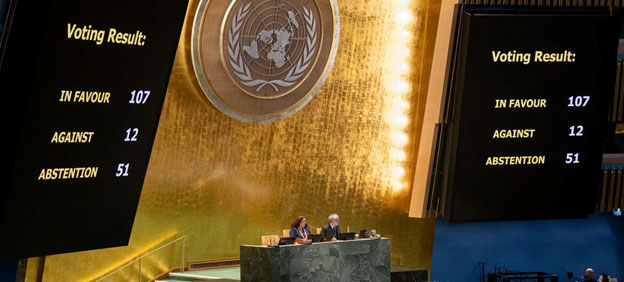
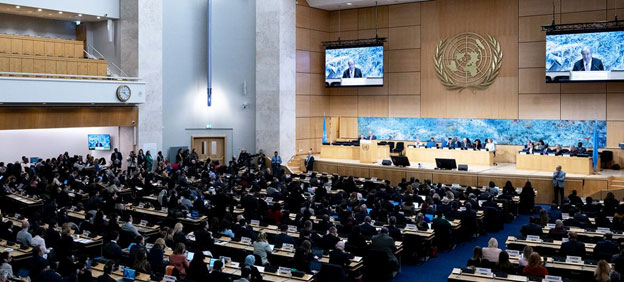
Result of the General Assembly vote on the draft resolution “Support for lasting peace in Ukraine” adopted during the emergency special session. 24 February 2026
Four years after Russia launched its full-scale invasion of Ukraine, the UN is marked the day with high-level debate and renewed calls to end the war – including in the General Assembly which passed a resolution reaffirming its strong commitment to the sovereignty, independence and territorial integrity of Ukraine. Credit: UN Photo/Manuel Elías
GENEVA, Feb 25 2026 (IPS) – After surviving the harshest winter in a decade, millions of displaced Ukrainians are confronting a growing crisis marked by hardship and ongoing attacks as peace prospects remain distant.
Inside Ukraine, repeated attacks on housing, energy systems and essential services throughout the winter left millions without heating or electricity for prolonged periods. While temperatures are slowly rising, the damage remains. An estimated 10.8 million people inside the country need humanitarian assistance in 2026, and 3.7 million are internally displaced.
At the same time, 5.9 million Ukrainians remain refugees abroad. Across Europe, host countries have provided protection and opportunities at an unprecedented scale, giving refugees access to education, healthcare and employment. This has helped millions regain stability and contribute to host communities.
As the war continues, however, more is needed to support refugees from a displacement crisis with no clear end. Alongside Temporary Protection, States should explore options for alternative arrangements for longer stay. These can bring stability for the most vulnerable in particular, for whom return may not be immediately possible even after the war.
Evidence shows that meaningful inclusion delivers results and refugees significantly boost host country economies. In Poland, analysis by UNHCR and Deloitte showed that Ukrainian refugees’ net impact amounted to 2.7 per cent of the Polish GDP, in 2024. With increased language training and wider recognition of credentials, access to decent work and self-reliance can improve for refugees across the region.
Inside Ukraine, communities continue to repair homes, restore services and rebuild livelihoods, with the support of UNHCR and NGO partners. But after four years of war, resilience has limits. Sustained humanitarian assistance remains essential, alongside scaled-up recovery and reconstruction support to prevent further displacement and enable safe conditions for return.
When conditions allow, gradual and voluntary returns will be critical for Ukraine’s recovery. UNHCR is working with the Government and partners to restore people’s documents, support rehabilitation of social infrastructure and repair war-damaged homes. UNHCR also works with partners to analyse refugees’ intentions, forecast return movements and support Ukraine’s recovery planning.
Since the start of the full-scale war, UNHCR and partners have supported 10 million people with emergency aid, protection services and psychosocial support. In 2026, UNHCR plans to assist a further 2 million people inside the country, subject to sufficient funding. Across the region, UNHCR and partners are supporting 1.7 million refugees and the States hosting them, with a focus on inclusion and self-reliance.
As winter fades, the humanitarian crisis does not. We must support the people of Ukraine with humanitarian relief and recovery inside the country, and with safety and self-reliance abroad.
Philippe Leclerc is UNHCR’s Regional Director for Europe and Regional Refugee Coordinator for the Ukraine Situation
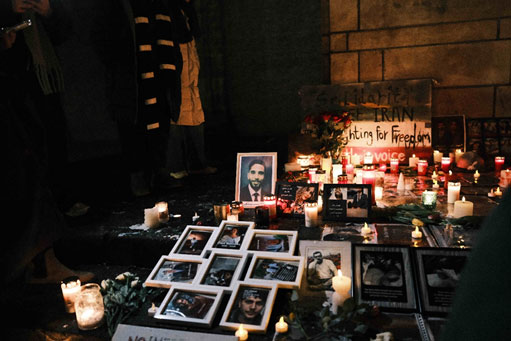
Credit: Georgios Kostomitsopoulos/NurPhoto via Getty Images
MONTEVIDEO, Uruguay, Feb 24 2026 (IPS) – The Islamic Republic of Iran has put down another uprising, with a ferocity that makes previous crackdowns seem restrained. The theocratic regime has survived, but it has done so by substituting violence for the economic security it cannot provide and the political legitimacy it no longer has. Its show of force is also an admission of weakness.
The protests that began on 28 December were triggered by a specific event — the collapse of the rial to a record low — but rooted in years of accumulated grievances. The second half of 2025 alone saw at least 471 labour protests across 69 Iranian cities. Inflation stood at 49.4 per cent. The 12-day war with Israel in June sent the Tehran Stock Exchange down around 40 per cent and cost many people their jobs. The United Nations Security Council reimposed sanctions in September. The government cut fuel subsidies in November and slashed exchange-rate subsidies in December. Over 40 per cent of Iranian households now live below the poverty line and around half the population consume fewer than the recommended 2,100 calories per day.
It was this collapse that brought typically conservative bazaar merchants onto the streets. Within two weeks, the protests had spread to all of Iran’s 31 provinces, drawing in the urban middle class, working-class communities and people from rural provinces who had historically been among the regime’s most reliable supporters. What began as an economic stoppage rapidly became political defiance. For the millions who joined the striking merchants, the plummeting currency and rising cost of food were not market failures; they were proof of the regime’s corruption and ineptitude. Generation Z played a central role, demanding not reform but profound change. Lethal repression provided further confirmation the system was beyond reform.
The state’s response evolved. Initially it offered token economic concessions alongside its usual crowd control violence such as batons and teargas. When it became clear that a widespread movement with political demands had taken hold, it shifted to total attrition. On 8 January, authorities imposed a near-total internet shutdown and authorised security forces to use military-grade weapons against crowds. The Islamic Revolutionary Guard Corps (IRGC) – a parallel military structure, major political force and economic empire with a direct stake in the regime’s survival – spearheaded the crackdown, with its affiliated Basij paramilitary networks playing a central role in street-level violence.
The casualty figures were deliberately obscured by the internet blackout, but all evidence points in the same direction. Hengaw Organisation for Human Rights reported that at least 3,000 civilians — including 44 children — were killed in the first 17 days. Iran Human Rights, citing Ministry of Health sources, documented a minimum of 3,379 deaths across 15 provinces. The US-based Human Rights Activists News Agency reported around 7,000 verified fatalities by mid-February, with 12,000 further cases under review. Time magazine cited hospital records suggesting the toll may have reached 30,000. Even the lowest of these figures vastly eclipses the 537 deaths recorded during the 2022-2023 Woman, Life, Freedom protests. Supreme Leader Ali Khamenei’s concession that ‘several thousand’ had been killed confirmed the order of magnitude.
By 16 January the streets had been cleared, but a quieter repressive campaign continued, with nighttime raids, enforced disappearances and mass detentions in unofficial holding sites outside the legal system, targeting not only protesters but also doctors who treated the wounded, lawyers who provided legal assistance, bystanders who helped and people who posted supportive statements online. Authorities have detained over 50,000 people. Revolutionary Courts have fast-tracked mass indictments through summary trials, often conducted online and lasting mere minutes, with defendants denied independent legal counsel and confessions extracted under torture. Eighteen-year-old Saleh Mohammadi, whose retracted confession was obtained after interrogators broke bones in his hand, has been sentenced to be publicly hanged at the site of his alleged crime. Dozens more face imminent execution.
The regime has, for now, held: its security forces have not fractured, there have been no significant elite defections, and the IRGC has maintained its capacity for suppression. But it rules over a country with a wrecked economy, a battered nuclear programme, weakened regional proxies and a population that has run out of reasons to comply. Each protest cycle has required a higher threshold of state violence to suppress, a sign the regime has no other tool left.
What prevents weakness from becoming collapse is the absence of any alternative. The international response briefly suggested external pressure might tell – but did not. Donald Trump told Iranian protesters that ‘help is on its way’. The European Union listed the IRGC as a terrorist organisation. The UK imposed fresh sanctions. The Iranian diaspora held at least 168 protests across 30 countries. But the international noise simply enabled the regime to spread the narrative that the uprising was foreign-directed.
The exiled opposition is fragmented along ethnic, ideological and generational lines, seemingly more consumed by internal rivalries than the task of converting widespread discontent into sustained political pressure. Inside Iran, the most credible opposition voices — Nobel laureate Narges Mohammadi, reformist politician Mostafa Tajzadeh and veteran leader Mir Hossein Mousavi — are imprisoned or cut off from public life.
A weakened regime facing a leaderless opposition can endure, but what it cannot do is reverse its decay. Violence may clear the streets, but it cannot rebuild the economy, restore trust or give Iran’s young people a reason to stay. The regime has bought time, at an ever-rising price, but the crisis it’s suppressed isn’t going away.
UN Secretary-General António Guterres speaks at the opening of the 61st session of the Human Rights Council at the Palais des Nations, in Geneva. Meanwhile, Volker Turk, UN High Commissioner for Human Rights, addresses (below) at the opening of the High-level segment of the Human Rights Council. Credit: UN Photo/Violaine Martin
GENEVA, Feb 24 2026 (IPS) – A fierce competition for power, control and resources is playing out on the world stage at a rate and intensity unseen for the past 80 years.
People are feeling unmoored, anxious and insecure. The gears of global power are shifting; the consequences are not clear. Some are signalling the end of the world order as we know it.
But today, I want to talk about another world order. One that is organised from the ground up, and that is unshakeable. A foundational system of how people relate to each other, based on our inherent worth, our hopes, and our common values.
I am referring to people’s pursuit of dignity, equality, and justice. This quest is innate to what makes us human: to be free, to be heard, and to have our basic needs met.
And it is a strong counterbalance to the top-down, autocratic trends we see today. The use of force to resolve disputes between and within countries is becoming normalized.
Inflammatory threats against sovereign nations are thrown about, with no regard to the fire they could ignite. The laws of war are being brutally violated.
Mass civilian suffering – from Sudan, to Gaza, to Ukraine, to Myanmar – is unfolding before our eyes. In Sudan, there needs to be accountability for all violations by all parties – notably, the war crimes and possible crimes against humanity committed by the Rapid Support Forces in El Fasher. Such atrocities must not be repeated in Kordofan or elsewhere. All those with influence need to act urgently to put an end to this senseless war.
The situation in Gaza remains catastrophic. Palestinians are still dying from Israeli fire, cold, hunger, and treatable diseases. The aid allowed in is not enough to meet the massive needs. There are concerns over ethnic cleansing in both Gaza and the West Bank, where Israel is accelerating efforts to consolidate unlawful annexation. Any sustainable solution must be based on two states living side by side in equal dignity and rights, in line with UN resolutions and international law.
Tomorrow marks four years since Russia’s full-scale invasion of Ukraine. Four interminable and agonizing years. Civilian casualties have soared, and Russia’s systematic attacks on Ukraine’s energy and water infrastructure could amount to international crimes. The fighting needs to end, and I urge a focus on human rights and justice in any ceasefire or peace agreement.
In Myanmar, five years after the military coup, the awful conflict is claiming even more civilian lives, and the humanitarian situation continues to deteriorate. The recent elections staged by the military have only deepened people’s despair.
Across most violent conflicts today, journalists, health and aid workers are targeted, in blatant violation of international law. These actions must not be allowed to harden into the new normal.
States need to be persistent objectors to violations of the law – by pursuing accountability, and by clearly denouncing these egregious crimes with consistency, and without exception.
Meanwhile, violence and tensions are resurging in some countries, including South Sudan and Ethiopia. And authorities in Iran have violently repressed mass protests with lethal force, killing thousands.
I will provide more detail on these and other country situations in my global update later this week. Developments around the world point to a deeply worrying trend: domination and supremacy are making a comeback.
If we listen to the rhetoric of some leaders, what lurks behind it is a belief that they are above the law, and above the UN Charter. They claim exceptional status, exceptional danger or exceptional moral judgement to pursue their own agenda at any cost. And why wouldn’t they try, when they are unlikely to face consequences?
They build and sustain systems that perpetuate inequalities within and between countries. Some weaponise their economic leverage. They spread disinformation to distract, silence and marginalize.
A tight clique of tech tycoons controls an outsize proportion of global information flows, distorting public debate, markets, and even governance systems. Corporate and state interests ravage our environment, robbing the riches of the earth for their own gain.
But at the same time, people are not watching all this from the sidelines. They are activating their power, from the ground up. Women and young people especially are leading these movements.
They are claiming their right to basic living conditions, to fair pay, to bodily autonomy, to self-determination, to be heard, to vote freely, and many other rights. From Nepal to Madagascar, from Serbia to Peru and beyond, people are demanding equality and denouncing corruption.
Neighbours and communities are standing up for each other – sometimes even risking their lives. People are protesting war and injustice in places far from home, expressing solidarity and pressuring their governments to act.
They see human rights as a practical force for good – and they are right. Human rights are anathema to supremacy: they are a direct challenge to those who seek and cling to power. That is what makes human rights radical, and that is what gives them force.
They are universal, timeless, and indestructible.
Human rights didn’t magically appear with the Universal Declaration on 10 December 1948. People have been seeking freedom and equality long before these principles were codified in national or international agreements.
In the late 1700s, enslaved people in modern-day Haiti rose up against colonial rule, in the name of racial equality. The American and French revolutions challenged unaccountable authority. The Abolitionist movement was a rejection of the Transatlantic slave trade – the most brutal system of subjugation.
In the early 1900s, women joined together to demand the right to vote. The fight for gender equality continues. After the bloodshed of two World Wars and the Holocaust, the UN Charter reasserted faith in fundamental human rights, and in the dignity and worth of the human person.
The 20th century then ushered in a period of decolonization, which reaffirmed the right to self-determination. People mobilized to end racial segregation, for labour rights, and to protect the rights of LGBT people.
Mothers marched together to seek justice for their disappeared children, from Argentina to Sri Lanka to Syria. And young people raised their voices for climate justice.
Human rights are the thread that runs through all these movements. And we do not take their achievements for granted. Tyranny will seize any chance and exploit any opening. We must keep standing up for human rights, in solidarity with each other.
When we come together, we wield more power than any autocrat or tech billionaire. The struggle for human rights can never be derailed by the whims of a handful of leaders with reactionary, supremacist agendas.
While some States are weakening the multilateral system, we need bolder and more joined-up responses.
First, this means calling out violations of international law, regardless of the perpetrators. Too often, denouncing violations by one party is labelled as siding with the enemy. In reality, it is upholding universality, and the pursuit of justice for all.
The alternative – selective, fragmented responses – weakens international law and hurts us all. The entire human rights ecosystem is designed to promote universality and ensure consistency. This includes the tools mandated by this Council. I condemn all attacks against them.
Second, we need stronger commitment to accountability. This includes strengthening the International Criminal Court and encouraging national prosecutions under the principle of universal jurisdiction. We need to increase the cost of breaking international law.
Third, let’s forge coalitions to champion what unites us, and uphold equality, dignity, and justice for all. We must protect the diversity of the human family and demonstrate what we gain by standing together.
In the coming weeks, we will set in motion a Global Alliance for Human Rights to capture the energy and commitment that is palpable everywhere.
This will be a cross-regional, multi-stakeholder coalition of States, businesses, cities, philanthropists, scientists, artists, philosophers, young people and civil society.
It will confront top-down domination with grassroots solidarity and support. It will represent the quiet majority, who want a different world. Human rights are not political currency, and they are not up for grabs.
Our future depends on our joint commitment to defend every person’s rights, every time, everywhere.
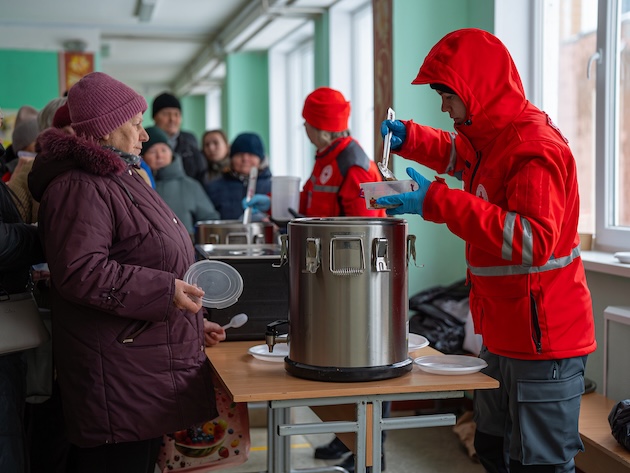
Ukrainian Red Cross teams have delivered over 3,300 hot meals to Kyiv residents at support points around the city. Credit: Red Cross
BRATISLAVA, Feb 24 2026 (IPS) – “We have a saying here in Ukraine now – ‘young people meet at their friends’ funerals rather than at weddings.’ It’s sad, but very true.”
As Russia’s full-scale invasion of her country moves into its fifth year, Iryna Yakova, 29, is looking back at how her life has changed over the past four years.
Speaking from Lviv, the western Ukrainian city where she lives, she tells IPS that her “values and attitude towards life” have changed. “Material things become unimportant when your loved ones or friends are in danger,” she says. She has also developed a keen sense of her national identity and an empathy for the suffering of her fellow Ukrainians.
“During the full-scale invasion, I realised that all of Ukraine is my home. I cry for people who were killed by a missile in Kyiv while they were sleeping at night. Even though I didn’t know them, it hurts me because they are Ukrainians. It also pains me to see children growing up without their parents because their parents are at the front. The war has intensified my sense of empathy and belonging.”
Her mental health has suffered. She says anxiety is ever-present in her life.
But what she returns to often as she answers questions about how her life is today compared to before the war is the loss she, and others, have experienced.
“What I miss most [from my life before the full-scale invasion] are the people who have been killed in the war. I have lost friends, acquaintances, and relatives. Nothing compares to human loss. The hardest thing I have had to deal with during this war is going to the funerals of friends — people you used to go to parties with, travel with, study with,” she says.
The human cost of Russia’s full-scale invasion of Ukraine has been enormous – Ukraine’s government does not officially give figures for military casualties, but it has been estimated they could be up to 600,000 (Russian military casualties are thought to be more than twice that amount).
But the scale of civilian casualties has been huge, too. According to UN bodies, more than 15,000 civilians have been killed and over 41,000 injured in Ukraine since the start of the invasion on February 24, 2022.
Worryingly, as Ukraine marks the fourth anniversary of the start of the war, research suggests there has been a sharp increase in civilian casualties over the last year.
Data from Action on Armed Violence (AOAV), released earlier this month, showed civilian casualties in Ukraine increased by 26 percent in 2025 compared with 2024, despite there being a 6 percent drop in the number of injurious explosive weapon incidents recorded nationwide.
In Kyiv, response efforts continue amid attacks on energy infrastructure and severe cold. The Ukrainian Red Cross is supporting warming centres around the clock, providing people with a safe place to warm up, receive assistance, and feel cared for during difficult conditions. Credit: Red Cross
The group said its data showed a worrying shift in the character of the conflict – the average number of civilians killed or injured per incident in Ukraine rose 33 percent over the year, with a total of 2,248 civilians reported killed (an 11 percent rise) and 12,493 injured (a 28 percent rise) by explosive violence.
This suggests that explosive weapons are being used by Russia in Ukraine in ways that generate greater civilian impact, whether through more drone strikes, heavier munitions, specific targeting choices of populated areas, or repeated strikes on urban infrastructure, the group said.
Nearly seven in ten civilian casualties recorded in AOAV data occurred in residential neighbourhoods, up from just over four in ten in 2024.
Niamh Gillen, a researcher at AOAV, told IPS it was impossible to definitively say that Russian forces were deliberately targeting Ukrainian civilians, but that “the data speaks for itself.”
“It shows that civilian areas are being attacked, that the attacks are occurring within civilian areas like hospitals, schools, cities, towns. In general, in areas where civilians are heavily concentrated, like cities and towns, villages, anywhere like that, if you’re using an explosive weapon with wide area impacts, then you’re likely to harm more civilians,” she said.
On top of the deaths and destruction Russian attacks have caused, they have also led to massive displacement. It is thought that at least 3.4 million people are internally displaced in the country. This has put massive pressure not just on the displaced themselves, but also on host communities and services.
People’s physical health has deteriorated in such conditions – the World Health Organisation (WHO) has said that more than two-thirds of the population have reported a worsening of their health since the start of the invasion.
But the harm caused by these attacks is far from just physical. Mental health professionals in the country, as well as international bodies including the WHO, have warned of a mental health crisis in Ukraine, with possibly up to 10 million people suffering with mental health problems.
IPS spoke to scores of people in cities and towns across Ukraine about how the war had affected their mental health. Many spoke of experiencing anxiety, sometimes permanently to some level, which could be intensified at any moment by the frequent sound of air raid sirens warning of an attack, or for those closer to frontlines, the sounds of explosions and bombings.
“What affects my mental health on a daily basis are the constant nighttime drone and missile attacks. Because of them, it is impossible to relax or get proper rest, as reaching a shelter for safety is essential, even at night,” Mihail*, a teenager who lives in the Kyiv region, told IPS.
The situation for many Ukrainians has acutely worsened this winter. In what has been one of the coldest winters the country has seen for many years, Russian forces have repeatedly attacked Ukraine’s energy infrastructure, resulting in massive, widespread power outages. Thermal heating facilities have also been destroyed in targeted attacks.
As temperatures have plunged to as low as minus 30 degrees Celsius on some occasions, millions of people have been left freezing in their homes.
Jaime Wah, Deputy Head of Delegation with the International Federation of Red Cross and Red Crescent Societies (IFRC) in Ukraine, said people were suffering desperately in the cold.
“Some nights have been very unbearable. There is no escape from the cold. When you leave your apartment, it’s cold. Sometimes people have been joking that it’s warmer inside a fridge than inside their apartment. I’ve been here for over four years now, and it’s been the worst winter,” she told IPS.
Humanitarian organisations, including the Ukrainian Red Cross, and state emergency services have set up emergency heating points in cities and towns where people can keep warm, recharge devices and get food.
But Wah said while this has become a humanitarian crisis, it is one of just many crises Ukrainians are battling.
“In frontline regions, there are communities that are under evacuation orders, and some communities have essentially had most of their resources cut off. Family ties are quite strained – mental health needs are also immense, not only in the frontline regions but across Ukraine,” she said.
“There are lots of repairs to homes that are needed, not to mention the energy crisis, which is a humanitarian crisis… with no heating and no electricity, just the day-to-day things – just even heating your food becomes a problem. A lot of families are having to spend more time outside their homes, having to spend more money. On top of that, the cost of living has increased. These are some of the real, tangible situations that people in Ukraine are facing now,” she added.
Amid these problems, many Ukrainians admit that they are exhausted after four years of war.
But among the many people IPS spoke to on the eve of the fourth anniversary of the war, there was a widespread, although certainly not universal, determination to not give up.
“I feel a sense of responsibility. I do not have the right to give up, because many people have died so that I could have the chance to live. Of course, there is exhaustion, but, unlike those in the military, a civilian like me has time to rest and reset,” said Iryna.
For many, such resilience is born out of a desire not just for them and their country to survive what they see as Russia’s attempt to destroy them as an independent state and nation, but also a hope that, ultimately, there will be some justice served for what has been done to them.
The Russian military and authorities have repeatedly been accused of war crimes, crimes against humanity, breaches of international humanitarian law, as well as genocide, during the invasion of Ukraine.
The sheer volume of alleged crimes – at least 180,000 war crimes have been registered by Ukraine’s Prosecutor General – and the constraints of documenting, investigating and prosecuting during an ongoing conflict mean that bringing those behind them to justice was never expected to be easy. Only over 100 people have been prosecuted in Ukraine so far for crimes during the invasion.
But there are fears that international bodies such as the International Criminal Court (ICC), which has issued an arrest warrant for, among others, Russian President Vladimir Putin over alleged war crimes, could be rendered increasingly toothless in their ability to ever prosecute major figures who ordered such crimes because world leaders, such as US President Donald Trump, are no longer interested in upholding international justice for war crimes.
“I truly hope that the war will end very soon and that all war criminals will be brought to justice. However, what I see happening right now is the opposite: while institutions like the UN are unable to punish Russia, people are starting to forget about its war crimes. Countries are gradually lifting sanctions,” said Mihail.
“For example, Russian athletes are going to be able to take part in the Paralympics this year. As a result, people who committed war crimes just months or years ago can now take part in one of the world’s biggest sporting events. So we need to act – by refusing to normalise aggression, keeping sanctions firm and, most importantly, remembering about war.”
Others, though, are more hopeful.
“There is no doubt among Ukrainians that war criminals can be brought to justice,” Oleh Martynenko, an expert at the Ukrainian NGO Center for Civil Liberties, which documents war crimes, told IPS.
“This is evidenced by the participation of Ukrainians in international missions and courts where war criminals have been convicted. Also, thanks to the European Union, Ukrainians are building their own criminal prosecution systems, which provide for the arrest and imprisonment of Russian war criminals in accordance with UN international standards,” he said.
Regardless of these concerns and the other problems Ukrainians are facing as the full-scale invasion goes into its fifth year, some are looking to the future with a degree of hope.
“I feel a mix of determination, resilience, anger, and hope of victory,” Tetiana, a nurse in the Dnipropetrovsk region, who asked not to be identified for security reasons, told IPS. “Glory to Ukraine!” she added.
NEW YORK, Feb 23 2026 (IPS) – Trump’s immigration policy is destroying America’s greatness Immigrants are the backbone of America’s greatness— powering its economy, enriching its culture, and advancing its global leadership. Yet under the guise of making America great again, Trump’s exclusionary, racist policies are dismantling that very foundation, stifling innovation and tarnishing the nation’s moral standing.
To understand the magnitude and importance of immigrants in the US, and the need for continued immigration, the following clearly shows how deeply they sustain our workforce, drive innovation, and secure America’s competitive edge on the global stage.
The Current State of Immigration
Over 1 million farmworkers in the United States are undocumented, including approximately 40 percent of crop farmworkers. Immigrants account for roughly 70 percent of all US farmworkers, making them indispensable to the agricultural labor force and underscoring how dependent American food production is on this workforce.
We are already witnessing the impacts of immigration crackdowns on the US farm industry. In California’s Central Valley, a majority of farmworkers stopped showing up after intensive ICE raids in July 2025, leaving crops rotting in the fields due to a lack of available workers. This has resulted in substantial financial losses, food waste, reduced farm revenues, and rising food prices.
Beyond agriculture, immigrants from Latin America and other regions are heavily represented in construction, hospitality, and food processing; they account for approximately 33 percent of meat processing and over 80 percent of food manufacturing workers.
In the leisure and hospitality sector, immigrants account for roughly 18 percent of workers; in traveler accommodations (i.e., hotels) alone, over 30 percent of workers are immigrants.
STEM Workforce
According to the National Science Foundation, foreign-born workers account for approximately 22 percent of the US’ STEM workforce. Among science and engineering occupations with doctorates, about 43 percent are foreign-born; in the doctorate-level fields of computer and mathematical sciences, this share exceeds 55 percent.
Roughly 30 percent of full-time science and engineering faculty at US universities are foreign-born, disproportionately present at research-intensive institutions.
Denying admission of scientists from countries such as India and China, Mexico and Argentina would result in serious talent shortages in key STEM fields. Moreover, inventors and entrepreneurs account for a disproportionately large share of US patents, high-growth startups, and advanced-degree STEM workers.
Thus, losing foreign-born scholars would undermine research, reduce innovation, slow scientific progress, and erode US technological and economic competitiveness.
Research on immigrant entrepreneurship indicates that immigrants are heavily overrepresented among founders of new firms, including high-tech firms and “unicorn” startups, which amplifies the long-term damage that restrictive policies toward non-European scientists would inflict.
Immigrants in the US military
In 2017, about 190,000 foreign-born individuals were on active duty, representing roughly 4.5 percent of all active-duty service members. As of 2024, approximately 8,000 non-citizens enlist each year. As of 2022, there were about 731,000 foreign-born veterans—around 4.5 percent of the total veteran population.
Historically and today, foreign-born soldiers have played key roles in every major US conflict, dating back to the Revolutionary War, and mmigrants have received more than 20 percent of all Medals of Honor, underscoring the depth of their contribution to national defense.
Reagan’s Honoring of Immigrants
Perhaps no one could express the vital importance of immigrants to the US, and how they made America the land of opportunity that embodied the very promise that has made America exceptional, like President Reagan in his final speech to the nation:
“Since this is the last speech that I will give as president, I think it’s fitting to leave one final thought, an observation about a country which I love. It was best stated in a letter I received recently. A man wrote me and said: ‘You can go to live in France, but you cannot become a Frenchman. You can go to live in Germany, Turkey, or Japan, but you cannot become a German, a Turk, or a Japanese. But anyone, from any corner of the Earth, can come to live in America and become an American.’
“Yes, the torch of Lady Liberty symbolizes our freedom and represents our heritage, the compact with our parents, our grandparents, and our ancestors. It is that lady who gives us our great and special place in the world. For it’s the great life force of each generation of new Americans that guarantee that America’s triumph shall continue unsurpassed into the next century and beyond. Other countries may seek to compete with us, but in one vital area, as a beacon of freedom and opportunity that draws the people of the world, no country on Earth comes close.
“This, I believe, is one of the most important sources of America’s greatness. We lead the world because, unique among nations, we draw our people—our strength—from every country and every corner of the world. And by doing so, we continuously renew and enrich our nation. While other countries cling to the stale past, here in America, we breathe life into dreams. We create the future, and the world follows us into tomorrow.
“Thanks to each wave of new arrivals to this land of opportunity, we’re a nation forever young, forever bursting with energy and new ideas, and always on the cutting edge, always leading the world to the next frontier. This quality is vital to our future as a nation. If we ever closed the door to new Americans, our leadership in the world would soon be lost.”
How did we fall from President Reagan’s recognition of immigrants’ nobility to Trump’s dehumanizing claim that “they are eating the dogs…they are eating the cats…They’re eating—they are eating the pets…” In that stark descent, we see the horrific moral cost of abandoning truth for political expediency.
Immigrants have been the lifeblood of the American experiment. To close our door to immigrants is to close the door to the very engine of American vitality. If we open our borders, welcoming all regardless of ethnicity, race or faith, we unleash our greatest strength—a nation reborn, limitless in its capacity to dream and achieve the impossible.
Dr. Alon Ben-Meir is a retired professor of international relations, most recently at the Center for Global Affairs at NYU. He taught courses on international negotiation and Middle Eastern studies.
A red panda – labelled ‘endangered’ by the IUCN – at an animal sanctuary in the Indian state of West Bengal. As biodiversity loss accelerates, UNCBD is asking countries to take greater action to protect it. Credit: Stella Paul/IPS
ROME & NEW DELHI, Feb 23 2026 (IPS) – Governments meeting in Rome last week acknowledged that global efforts to protect nature are still not moving fast enough, even as biodiversity loss continues to affect ecosystems, livelihoods, and economies worldwide.
The warning came as the sixth meeting of the Subsidiary Body on Implementation (SBI-6) under the Convention on Biological Diversity (CBD) concluded after four days of negotiations focused on how countries are putting global biodiversity commitments into practice.
Held at the headquarters of the Food and Agriculture Organization of the United Nations (FAO), the meeting is the first major checkpoint in a year of intensive talks leading to the United Nations Biodiversity Conference (COP17) in October in Yerevan, Armenia. There, governments will carry out the first global review of progress under the Kunming-Montreal Global Biodiversity Framework.
From Promises to Practice
At the centre of discussions in Rome was the challenge of turning global promises into action on the ground. The Kunming-Montreal Global Biodiversity Framework (KMGBF), adopted in 2022, sets out 23 targets to be achieved by 2030, including protecting and restoring ecosystems, reducing pollution, cutting harmful subsidies, and ensuring fair sharing of benefits from genetic resources.
While most governments have formally endorsed the framework, SBI-6 revealed that implementation remains uneven. Negotiators worked through recommendations on biodiversity finance, national planning, gender equality, capacity-building, international cooperation, and access and benefit-sharing. Many of these were adopted without brackets, suggesting broad agreement.
“This has been a long week for all,” said Clarissa Souza Della Nina, Chair of the meeting, as she closed the afternoon plenary and announced that delegates would meet again in the evening. She noted that turning global ambitions into real action on the ground requires strong systems and institutions, and that this is not an easy process.
“The conclusion of SBI-6 marks an important early milestone in a very demanding year,” said Souza Della Nina, highlighting the efforts made by countries to work together and find common ground.
But behind the consensus language, discussions repeatedly returned to the same concern: global ambition is not yet being matched by national action.
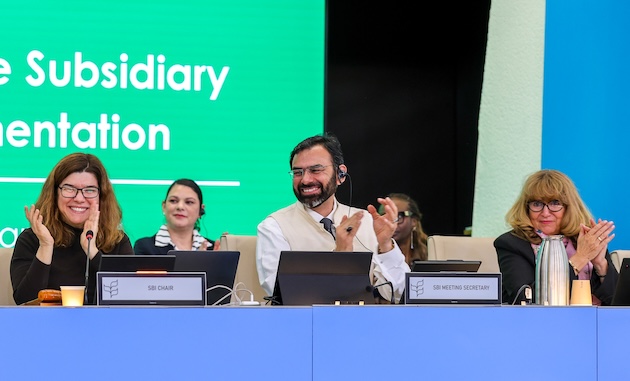
SBI 6 Chair Clarissa Souza Della Nina, Brazil; Asad Naqvi, SBI 6 Secretary; and CBD Executive Secretary Astrid Schomaker celebrate the first conference room paper being approved. Credit: IISD/ENB, Mike Muzurakis
National Plans Show Mixed Progress
A key input to the Rome meeting was an analysis by the CBD Secretariat of national biodiversity strategies and targets submitted so far. These national plans are the main way countries translate the global framework into domestic policies.
The analysis covered 51 National Biodiversity Strategies and Action Plans (NBSAPs) and 130 sets of national targets. It found that while progress is being made, many plans fall short of the scale of change required.
About 75 percent of Parties have submitted national targets, but fewer have updated their full national strategies. Even among submitted plans, several global targets are only partially addressed. Social and economic aspects of biodiversity loss — including links to livelihoods, equity, and development — tend to receive less attention than conservation measures.
“These findings show clearly where we stand,” said Astrid Schomaker, Executive Secretary of the CBD. “They also show that countries still have the opportunity to raise ambition and speed up action before the global review.”
The first global review of progress under the KMGBF will take place at COP17. A major source of information for that review will be the seventh National Reports, which countries are required to submit by 28 February 2026.
By the end of SBI-6, the European Union, Lesotho, Uganda, and Switzerland had submitted their reports. Several other countries said they were close to completion, while others cited difficulties related to limited staff, technical challenges, or delays in accessing funds.
Delegates stressed that timely reporting is essential, not only for transparency but also to ensure that the global review reflects the realities faced by countries at different levels of development.
Gender and Inclusion Lag Behind
Another issue that drew attention in Rome was the limited integration of gender equality into biodiversity action. Under the global framework, countries have committed to ensuring the full and meaningful participation of women and girls, including those from indigenous peoples and local communities.
Yet the Secretariat’s analysis showed that only around 40 percent of national targets refer to gender-related issues, and only about 20 percent address women’s rights to land and natural resources. Even fewer countries reported involving women’s organisations in the preparation of national biodiversity plans.
For many participants, this gap was a reminder that biodiversity loss is not only an environmental issue but also a social one.
“Without addressing inequality, we will not succeed in protecting nature,” said Gillian Guthrie, a delegate from Jamaica, during the discussions, urging governments still updating their plans to take a more inclusive approach.
Money and Capacity Remain Major Hurdles
Financing biodiversity action was another recurring theme. Although the most detailed negotiations on biodiversity finance are scheduled for later this year, talks in Rome were informed by new studies on funding needs, the relationship between debt and biodiversity spending, and opportunities to better align biodiversity and climate finance.
Developing countries repeatedly pointed to limited financial resources, lack of access to technology, and institutional constraints as barriers to implementation. These challenges were reflected in the meeting itself, where several delegations consisted of a single representative struggling to follow multiple negotiating tracks.
The CBD Secretariat thanked donor countries that contributed to a special trust fund to support participation and called on others to do the same. Without broader support, delegates warned, global biodiversity decision-making risks leaving some voices unheard.
A decisive year ahead
The recommendations adopted at SBI-6 will now be forwarded to COP17, where governments will assess whether collective action so far is enough to meet the biodiversity targets set for 2030.
For many participants, the Rome meeting served as both a progress report and a warning. While cooperation is improving and more countries are engaging with the global framework, biodiversity loss continues to affect food systems, health, and economic stability, particularly in the Global South.
As delegates left Rome, the message was clear: the coming months will be critical. Whether the world can move from commitments to meaningful action will be tested in Yerevan, Armenia — and the stakes, many warned, could not be higher.
Below are some of the highlights of the 4-day meeting:
The sixth meeting of the Subsidiary Body (SBI-6) on Implementation under the Convention on Biological Diversity began the first global review of how countries are acting to protect nature.
An official analysis of national biodiversity plans showed progress but also revealed wide gaps between global goals and what many countries have committed to do at home.
Around three-quarters of countries have submitted national biodiversity targets, but far fewer have updated full national strategies or addressed social and economic aspects of biodiversity loss.
Gender equality and the participation of women, Indigenous Peoples, and local communities remain weak in many national plans, despite being central to the global biodiversity agreement.
Developing countries highlighted ongoing challenges linked to limited funding, lack of technical capacity, and difficulty accessing resources needed to implement biodiversity actions.
The outcomes from Rome will shape how global progress on biodiversity is measured and reviewed, setting the tone for accountability and action in the run-up to 2030.