MONTEVIDEO, Uruguay, Aug 29 2023 (IPS) – On 20 August, Guatemala witnessed a rare event: despite numerous attempts to stop it, the will of the majority prevailed. Democracy was at a dramatic crossroads, but voters got their say, and said it clearly: the country needs dramatic change and needs it now.
Bernardo Arévalo, leader of the progressive Movimiento Semilla (Seed Movement), born out of 2015 anti-corruption protests, is now Guatemala’s president-elect. All-night street celebrations erupted as early results were announced. It was a once-in-a-lifetime occurrence: politics bringing joy rather than disappointment to Guatemalans.
But renewed attempts to prevent change can be expected. What Guatemalans expect from Arévalo is a morally competent government that will bring about genuine democracy – a government looking out for the public rather than self-serving elites. The unprecedented seriousness of Arévalo’s promise is reflected in the fear his rise has fuelled among the beneficiaries of the current authoritarian kleptocracy.
A blatant manipulation of judicial institutions after the first round of voting on 25 June failed to prevent Arévalo competing in the runoff – but now the attempt is to stop his inauguration. Following the runoff, the Public Prosecutor made yet another attempt to have Semilla suspended.
The stakes are so high that an attempt to stop change by force can’t ruled out. An assassination plot involving state and non-state forces came to light days before the runoff.
For security reasons, Arévalo couldn’t address the crowds celebrating on election night. On 24 August, the Inter-American Commission on Human Rights granted precautionary measures to Arévalo and vice-president-elect Karin Herrera, giving the state 15 days to report back on the adoption of additional measures – both already have state-issued security – to protect their physical integrity.
Guatemalans are counting the days to the inauguration of their new government, scheduled for 14 January 2024. But their hope is mingled with uncertainty and fear.
An election surprise and its aftermath
The collective mood on 20 August couldn’t have been more different from that on 25 June, when first place in the first round went to invalid votes.
The run-up to the June vote had been marked by further deterioration of civic space and the restriction of the choice on offer through the disqualification of several contenders, including the candidate first in the polls, conservative business leader Carlos Pineda Soa. But Arévalo wasn’t on the radar of opinion polls and no one saw him coming. In a very fragmented vote, his 12 per cent put him in the runoff. The frontrunner, with 16 per cent, was a political insider, former first lady Sandra Torres of the National Unity of Hope (UNE).
The establishment rightfully feared Arévalo because he didn’t seem the kind they could easily bring into the fold. A progressive academic and a member of Congress since 2020, he promised to bring back the numerous justice officials in exile and resume the fight against corruption ended by his predecessors.
The fact that he could become Guatemala’s next president made the 25 June election results an instant object of contention. Nine parties, including UNE, submitted complaints about supposed ‘irregularities’ that had gone undetected by all international observers. Their supporters converged outside the Supreme Electoral Tribunal (TSE).
In what was denounced as an attempted ‘electoral coup’, the Constitutional Court ordered a recount and instructed the TSE to suspend certification of results. The TSE eventually endorsed the results two weeks later, on 12 July.
But in the meantime, the Attorney General, an official under US corruption sanctions, spearheaded an onslaught of judicial harassment against Arévalo. She launched an investigation of Semilla for alleged registration irregularities and had its offices raided. She twice ordered raids on TSE offices too. And just as the TSE announced Torres and Arévalo as the runoff competitors, she ordered Semilla’s suspension. The Constitutional Court however blocked this order.
Citizens defend democracy
The European Union and the Organization of American States, both of which had observation missions, took a strong stance. Domestic condemnation of the attempt to twist the results was also voiced by groups ranging from leading business associations to Indigenous authorities. But the starring role was played by citizens who spent weeks on the alert to ensure that Arévalo wasn’t kicked out of the runoff.
Large-scale peaceful demonstrations were repeatedly held in Guatemala City and departmental capitals, overwhelmingly led by young people. They were vocally nonpartisan, making clear that they were marching not for Arévalo or Semilla, but for the future of democracy.
On election day, this translated into a clear victory for the change candidate: Arévalo took 58 per cent of the vote, compared to Torres’s 37.2 per cent. The election saw strong participation by young, educated, urban voters, many voting for the first time.
An uncertain future
Once he takes office Arévalo will face a tough time fulfilling his promises, not least because the June election produced a highly fragmented Congress in which Semilla will have only 23 of 160 seats.
But the urgent question now is what lengths deeply entrenched elites will go to to try and stop Arévalo taking office. Torres hasn’t conceded defeat. Instead, she’s cried foul and accused the five TSE magistrates of ‘breach of duties and abuse of authority’.
Meanwhile the Attorney General and her right-hand man, a prosecutor who has made a career of protecting the powerful and persecuting the press, continue the ‘investigation’ through which they seek to shut Semilla down. People have responded by continuing to demonstrate outside the Attorney General’s office demanding her resignation.
Guatemala is living a unique moment, an opportunity that many didn’t think they’d ever see. But it’s also an uncertain time. Guatemala must walk carefully into the future, one step at a time, resisting the onslaught, judicial or otherwise, to get the president-elect to Inauguration Day.
People have made it clear they’re ready to take to the streets in numbers to defend what they’ve achieved. And they’ll need to both support and hold to account the new government for the mission it’s been entrusted with: that of restoring the substance of democracy.
A young girl in school uniform and covered in veil walks alone in the empty corridor of Tajrobawai girls primary and secondary school seen on September 16, 2021 in Herat, Afghanistan. The Taliban has forbidden girls at high school level to attend schools throughout Afghanistan. Credit: Kaveh Kazemi/Getty Images
KUALA LUMPUR / JOHANNESBURG, Aug 28 2023 (IPS) – His name is Matiullah Wesa, a girls education campaigner who now symbolises the “war” waged by the Taliban against the education and empowerment of women and girls. Exactly two years since the Taliban took over, Afghanistan is on a downward trajectory and unfortunately, global attention that was drawn by families chasing planes to flee a few days after the Taliban assumed control of the government has waned over the last two years.
Any improvements made in advancing human rights, especially the rights of women and access to education have been quickly reversed and replaced with severe restrictions that have almost completely wiped away the rights of women in almost all sectors and spheres of life. In a brazen move that provided a clear indication to the international community that the Taliban had an anti-human rights agenda, human rights defenders and members of their families have been harassed, detained and attacked in their homes while Afghanistan’s independent human rights commission was dissolved and its premises confiscated. In the absence of any internal human rights mechanism, the Taliban are only accountable to themselves and act with utmost impunity.
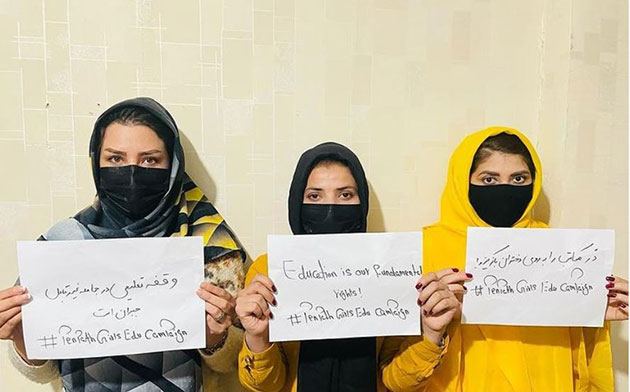
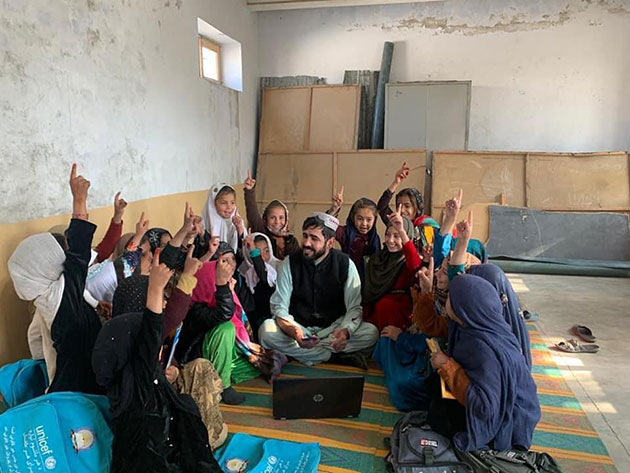
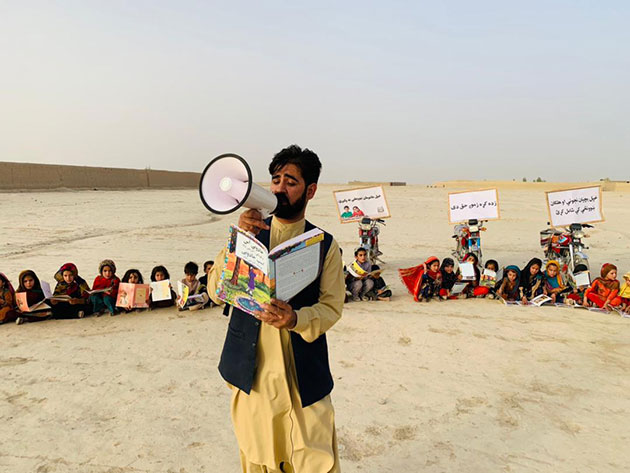
Matiullah was arrested in March 2023 for his dedication to provide education to girls particularly in rural areas. Through his organisation – PenPath which he founded in 2009, he campaigned for the right to education for girls, working with tribal leaders to provide mobile libraries to ensure girls have access to education. Penpath has successfully reopened 100 schools (including those closed for more than a decade due to war and the Taliban’s restrictions on education) in 16 provinces.
Matiullah Wesa, Afghan educational activist, reads to students in Afghanistan. Photo courtesy of Matiullah Wesa/PenPath
In an interview with CIVICUS, a year before he was arbitrarily arrested, Matiullah pointed out that they had provided education facilities for about 110000 children, about 60% were girls and distributed 1.5 million stationary and collected 34000 books through its book donation campaigns. His continued detention means, at best this much needed support provided to communities has been scaled back substantively and at worse has almost completely stopped. Yet, Matiullah is just one among hundreds who have worked tirelessly to improve the lives of Afghans over the years and are unable to do so either because they are in detention, have fled the country to avoid reprisals or have been forced to self censor.
The de facto Taliban regime has over the last two years institutionalised restrictions against women, dismissed women in public service, prevented girls from attending school and university and in December 2022, banned women from working with NGOs and aid agencies. It followed this decision exactly four months later by banning women from working for the UN in Afghanistan – as they had been exempted from the previous ban.
Through the Directorate for Intelligence, the regime monitors and targets women activists on social media and those identified as protest leaders. Others who participate in protests are identified through pictures posted on social media and through interrogations and arrested. On 11 February 2023, women’s rights activist and founder of the social movement – the Takhar Women’s Protest Movement – Parisa Mobarez, was arrested together with her brother in Takhar province and physically assaulted before they were released.
Matiullah Wesa, Afghan educational activist, reads to students in Afghanistan. Photo courtesy of Matiullah Wesa/PenPath
A day after, activist Nargis Sadat was arrested for protesting against the restrictions on women’s right to work and education and released after two months. In response to an announcement by the Taliban regime that it would close beauty salons, women protesters converged at the Shar-e Naw district in Kabul on 19 July, displaying protest signs with calls for ‘bread,’ ‘work’ and ‘justice.’ The women protesters were rounded up as security forces fired shots into the air and physically assaulted some of the women using electric stun guns.
The above restrictions are happening in a context of an ever increasing humanitarian crises exacerbated by growing social and economic challenges. Human rights groups report that the number of people living in poverty has increased to 97%, an increase of about 47% over the last three years and that more than half of the population – about 28 million people urgently need humanitarian assistance. The restrictions placed on women in government ministries and the ban on women from working for NGOs have a devastating impact on the families of these women and communities including women and children who have benefited from services provided. In addition, most women have literally been confined to their homes as they are banned from gyms, swimming pools and public parks.
Afghan women are fighting back
Despite the reprisals from the Taliban and threats of violence and arrests, Afghan women continue to mobilise to keep the face they face on the agenda of the international community. The resilience of these brave Afghan women and their sustained protests continue to shed light on the state of human rights in Afghanistan, especially at a time when the international community seems to have moved on to other crises. As women protesters, journalists and human rights defenders and families face increased attacks, protests have been moved indoors and online. Some of the protesters continue to cover their faces to avoid reprisals while others remain unveiled to encourage others.
Photo courtesy of PenPath
What can be done?
The current situation is especially tricky for many international actors and though the Taliban craves for international recognition to boast its legitimacy, members of the international community including the European Union, United Kingdom and India who engage with the Taliban as well as humanitarian organisations and civil society groups should respect the wishes of Afghans and not provide any form of formal recognition to the de facto regime. They should also support Afghan women rights activists in exile.
Millions of Afghans will continue to need humanitarian assistance for the foreseeable future and ongoing and future dialogues to negotiate for space and access through humanitarian corridors should be premised on respect for human rights and lifting of current restrictions on women and girls.
At the level of the United Nations, the UN Security Council Resolution on Afghanistan which accused the Taliban of violating human rights and the appointment of a Special Rapporteur on the situation of human rights in Afghanistan are important steps in the right direction but nearly not enough. The Security Council should continue to prioritise Afghanistan and push for accountability mechanisms inside of Afghanistan which would serve as some kind of a deterrent and a check on impunity. Lastly, there is a need for an intra-Afghan dialogue that is inclusive and should be led by a neutral party.
Josef Benedict is a researcher covering the Asia Pacific region for the CIVICUS Monitor. Malaysia. David Kode is the advocacy and campaigns lead for CIVICUS. South Africa
In the Bosque de Niebla, located in the department of Antioquia in northwestern Colombia, biodiversity bonds have emerged to push for protection of the ecosystem from threats such as deforestation and rising temperatures. But these instruments are still very green in Latin America. CREDIT: Courtesy of Terraso
MEXICO CITY, Aug 28 2023 (IPS) – Located in northwestern Colombia, the Bosque de Niebla is home to 154 species of plants, 120 bird species, 21 species of mammals, 16 water springs and five hectares of wetlands.
Forming part of the Cuchilla Jardín-Támesis Integrated Management District in the department of Antioquia, the ecosystem provides water and climate regulation to the entire northwestern region of the country.
“Not all ecosystem services are the same, it has to be a very judicious system. And there have to be local regulations, from green taxonomies (classification of activities) to regulations. Therein lies the dilemma of where the sector has to go.” — Lía González
For this reason, an innovative financing scheme, biodiversity bonds, seeks to strengthen the protection of this area for 30 years, in the face of threats such as deforestation, drought and rising temperatures due to the climate crisis.
Private Colombian investor Terraso and Spanish carbon offset seller ClimateTrade, a climate solutions company that utilizes blockchain technology to facilitate large-scale decarbonization efforts through innovation, created voluntary biodiversity bonds for the Bosque de Niebla in May 2022.
Habitat banks are areas where conservation initiatives are aggregated and ecosystem preservation, enhancement or restoration actions are implemented to generate quantifiable biodiversity gains.
Each biodiversity credit represents 10 square meters of threatened, conserved or restored land. Technical, financial and legal guarantees will sustain the project for at least 30 years. Each bond, worth 30 dollars, corresponds to 30 years of conservation and/or restoration.
But the scheme raises concerns about the commercialization of wildlife and the pursuit of profit over ecological benefits.
“Other non-integrated values have to do with social, ethical principles that have developed around nature. We have bought ourselves an image as a factory of resources at the service of people and we have discarded the role of nature and society through a relationship of care and reciprocity,” she told IPS from the northern Mexican city of San Luis Potosí.
Unlike offsets for environmental damage due to infrastructure projects, biodiversity credits are an economic instrument that can be used to finance actions that result in measurable positive outcomes through the issuance and sale of biodiversity units.
The buyers of biodiversity bonds gain in reputational aspects, by promoting the restoration and protection of ecosystems, and obtain funds by reselling the bonds, as it is a voluntary market.
These are different from carbon credits, where companies and individuals can buy the reduced emissions credits in what is known as the voluntary carbon market, to offset their polluting emissions: each one represents the elimination of one metric ton of carbon from the atmosphere.
For the carbon dioxide equivalent trapped and stored in ecosystems such as forests, project owners can issue certificates for sale in national and international markets to national and international corporations and individuals who want to reduce their polluting emissions.
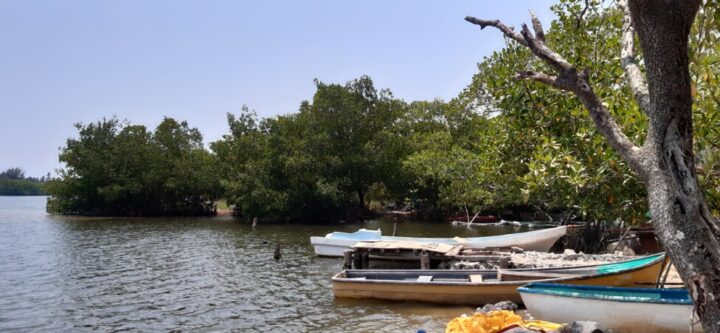
Mangroves, such as these in the municipality of Paraíso in the southeastern Mexican state of Tabasco, are candidates for biodiversity bonds because of the services they provide and the need to protect them, like other ecosystems. But these credits still need international standards, verification and monitoring guidelines, as well as tangible results. CREDIT: Emilio Godoy / IPS
On hold
In Honduras, a project similar to the Colombian one is advancing in Cusuco National Park, in the northwestern department of Cortés.
In the 22,200-hectare forest, decreed in 1987, the international alliance of environmental organizations rePlanet seeks the conservation of 1,883 hectares in 25 years in the face of threats such as deforestation and the risk to 24 species.
The project could issue bonds this year.
Lía González, director for Latin America of the Belgian social impact investment firm Incofin, said the instrument involves several challenges, such as monetization, assigning value to the blocks of land, the creation of standards for measurement, verification, monitoring and issuance, as well as the involvement of the communities.
“Not all ecosystem services are the same, it has to be a very judicious system. And there have to be local regulations, from green taxonomies (classification of activities) to regulations. Therein lies the dilemma of where the sector has to go,” she told IPS from Bogotá.
The executive stressed that the scheme should avoid the carbon credits model and learn from its mistakes, such as inaccurate calculation of carbon sequestration and violations of community rights.
In 2022, Incofin’s portfolio covered 111 clients in 14 Latin American countries for a total of 400 million dollars in segments such as sustainable agriculture and microfinance. In Colombia, it supported eight clients and totaled 44.3 million dollars.
The company focuses on medium-term investments, so that beneficiaries have an additional source of income within the area being protected or restored.
Colombia and Honduras are the countries that have moved forward with these instruments, because they have regulations and several financial instruments related to biodiversity, although bonds are still a rarity.
In this regard, the Organisation for Economic Co-operation and Development (OECD), which groups the world’s 38 most developed economies, noted in its 2021 report “Tracking Economic Instruments and Finance for Biodiversity” that, despite the progress made, the substantial potential depends on increasing the use and ambition of biodiversity-relevant economic instruments.
In its Sixth National Biodiversity Report 2020, Honduras recognized the need to improve the monetary and non-monetary valuation of environmental services.
Financing schemes are essential to the development of the United Nations Decade on Ecosystem Restoration 2021-2030, adopted by the U.N. General Assembly in 2019, which seeks to prevent, halt and reverse the degradation of terrestrial and marine ecosystems, to eradicate poverty, combat climate change and prevent the mass extinction of species.
Moving towards a take-off?
In order for it to be successful, the mechanism requires integrity of the projects and the inclusion of all stakeholders, according to the World Economic Forum, dedicated to multinational business lobbying.
The Colombian Bosque de Niebla initiative has already placed 62,063 credits and has 61,773 available.
The investor Terraso has seven other habitat banks in various areas of Colombia that could generate more bonds.
Balvanera warned of perverse incentives that could undermine protection.
“If we think about financial schemes, the link should not only be transactional. There must be involvement of different stakeholders who collectively identify the mechanism that promotes conservation, respects the vision of care and maintains the livelihoods of the inhabitants of these areas,” she said.
The academic argued that “this generates a circular system that connects forest protection, water care, food production and sustainable consumption.”
For her part, González was open to analyzing these investments.
“Water could be a viable focus for climate resilience and its impact on the region’s climate. We are interested in learning about monetization and that additional sources of income can benefit protection processes, so that it is complementary to what we do,” she said.
Last December, the 15th Conference of the Parties (COP15) to the Convention on Biological Diversity (CBD) adopted the Kunming-Montreal Global Biodiversity Framework, which includes cumulative biodiversity funding of at least 200 billion dollars by 2030 from public and private sources.
One of its goals is to encourage innovative schemes such as payment for environmental services, green bonds, offsets, biodiversity credits and benefit-sharing mechanisms that include environmental and social safeguards.
To meet these objectives, the 196 States Parties to the CBD created the Global Biodiversity Framework Fund, which is managed by the Global Environment Facility and whose governing council was approved in June in Brazil.
In addition, the agreement includes the complete or partial restoration of at least 30 percent of degraded terrestrial and marine ecosystems by 2030, as well as the reduction of the loss of areas of high biological importance to almost zero.
Anti-government protest in Sri Lanka on April 13, 2022. Credit: Wikipedia
WASHINGTON DC, Aug 25 2023 (IPS) – Sri Lanka has been faced with an unprecedented political and economic crisis since the beginning of 2022.
The dominant narrative attributes the crisis to the confluence of the COVID-19 pandemic, the Ukraine conflict, China’s ‘debt trap diplomacy’ and – most importantly – the corruption and mismanagement of the ruling Rajapaksa family.
Western mainstream media celebrated the so-called aragalaya (struggle, in Sinhala) protest movement that led to the ouster of the Rajapaksas and upholds the IMF bail-out as the only solution to the dire economic situation.
The aragalaya protests emerged from genuine economic grievances, but failed to develop an analysis beyond the ‘Gota, Go Home’ demand for Gotabaya Rajapaksa to resign. Influenced by local and external interests with their own agendas, the protestors exhibited little-to-no awareness or critique of the global political economy and the financial system at the root of the country’s crisis.
In 2022, the United Nations Conference on Trade and Development (UNCTAD) reported that 60 percent of low-income countries and 30 percent of emerging market economies are ‘in or near debt distress.’ While the details differ from country to country, the historical patterns of subordination that have given rise to global crises are the same.
The Sri Lankan crisis is an illustrative example of convergent global debt, food, fuel and energy crises facing much of the world. It is corporate media bias and narrative control that deflects from this analysis.
The island’s severe debt and economic crisis must be seen in a broader global context as the culmination of several centuries of colonial and neo-colonial developments, and the disastrous and inevitably self-destructive capitalist paradigm of endless growth and profit. Debt is not “a straightforward number but a social relation embedded in unequal power relations, discourses and moralities…and…institutionalized power.”.
Colonialism and Neocolonialism
The development of export agriculture and the import of food and other essentials under British colonialism turned Sri Lanka into a dependent ‘peripheral’ unit of the global capitalist economy.
Adopting ideologies of modernization and development and theories of comparative advantage, the capitalist imperative integrated self-sustaining indigenous, peasant, and regional economies into the growing global economy, through the appropriation of land, natural resources, and labor for export production.
Monocultural agriculture, mining, and other export-based production disturbed traditional patterns of crop rotation and small-scale subsistence production that were more harmonious with the regional ecosystems and cycles of nature.
Plantation development contributed to deforestation, loss of biodiversity and animal habitats. While a small local elite prospered through their collaboration with colonialism, most people became poor, indebted, and dependent on the vagaries of the global market for their sustenance.
Although colonized countries including Sri Lanka gained political independence following World War II, unequal exchange continued under neo-colonialism. Terms of trade disadvantaged the ‘Third World’ with their labor, resources and exports grossly undervalued and imports overvalued.
The dynamic is better understood as poorer countries being over-exploited rather than under-developed. Rising populations combined with corruption and inefficiency of local governments gave rise to endemic foreign exchange shortages and economic crises in Sri Lanka and many other countries.
The debt relief and aid given by the IMF, the World Bank and bilateral institutions from the Global North have been mere band-aids to keep the ex-colonial countries tethered to the global financial and economic structures. Post-independent Sri Lanka went to the IMF 16 times before the current 2023 bail-out which seeks to further perpetuate the county’s cycle of debt dependence.
The transfer of financial and resource wealth from poor countries in the global South to the rich countries in the North is not a new phenomenon. It has been an enduring feature throughout centuries of both classical and neo-colonialism. Between 1980 and 2017, developing countries paid out over $4.2 trillion solely in interest payments, dwarfing the financial aid they received from the developed countries during that period.
Currently, international financial institutions – notably the IMF and the World Bank – remain outside political and legal control without even ‘elementary accountability’. As critics from the Global South point out, “The overwhelming power of financial institutions makes a mockery of any serious effort for democratization and addressing the deteriorating socioeconomic living conditions of the people in Sri Lanka and elsewhere in the Global South.”
Financialization and Debt
Corporate and financial deregulation which accompanied the rise of neoliberalism starting in the 1970s has given rise to financialization, and the increasing importance of finance capital. As more and more aspects of social and planetary life are commoditized and subjected to digitalization and financial speculation, the real value of nature and human activity are further lost.
As a 2022 United Nations Report points out; food prices are soaring today not due to a problem with supply and demand but due to price speculation in highly financialized commodity markets.
A handful of the largest asset management companies, notably BlackRock (currently worth USD $ 10 trillion) control very large shares in companies operating in practically all the major sectors of the global economy: banking, technology, media, defense, energy, pharmaceuticals, food, agribusiness including seeds, and agrochemicals.
Financial liberalization advanced when interest rates dropped in the richer countries after the global 2008 financial crisis. Developing countries were encouraged to borrow from private international capital markets through International Sovereign Bonds (ISBs) which come with high interest rates and short maturation periods.
Although details are not available to the public, BlackRock is reportedly the biggest ISB creditor of Sri Lanka. Most of Sri Lanka’s foreign debt is ISBs, with over 80% of Sri Lanka’s debt owed to western creditors, and not – as projected in the mainstream narrative – to China.
IMF debt financing requires countries to meet its familiar structural adjustment conditions: privatization of state-owned enterprises (SOEs), cutbacks of social safety nets and labor rights, increased export production, decreased import substitution and alignment of local economic policy with US and other Western interests.
These are the same aims as classical colonialism, they are just better hidden in the more complex modern system and language of global finance, diplomacy and aid.
A vast array of policies exacting these aims are well under way in Sri Lanka, including the sale of state-owned energy, telecommunications and transportation enterprises to foreign owners, with grave implications for Sri Lanka’s economic independence, sovereignty, national security and the wellbeing of her people and the environment.
The IMF approach does not address long-term needs for bioregionalism, sustainable development, local autonomy and welfare. A small vulnerable country such as Sri Lanka cannot change the trajectory of global capitalist development on its own.
Regional and global solidarity and social movements are necessary to challenge the deranged global financial and economic system that is at the root of the current crisis.
Global South Resistance
Since the 1970s, major collaborative projects have been initiated by developing countries and the UNCTAD to develop a multilateral legal framework for sovereign debt restructuring. Yet they are futile in the face of the powerful opposition of creditors and the protection given to them by wealthy countries and their multilateral institutions, and the UN has failed to uphold commitment and implement a debt restructuring mechanism.
Sri Lanka was a global leader in efforts to create a New International Economic Order, the Non-Aligned Movement and the Indian Ocean as a Zone of Peace in the 1960s and 70s. In the early years of their political independence, countries throughout Asia, Africa and Latin America sought to forge their own paths of economic and political development, independent of both capitalism and communism and the Cold War.
These included African socialist projects such as Tanzania’s Ujamma, import substitution programs in Latin America and left-wing nationalism and decolonization efforts in Sri Lanka and many other countries.
Almost without exception, these nationalist efforts failed, not only due to internal corruption and mismanagement but also due to persistent external pressure and intervention. Massive efforts have been taken by the Global North to stop the Global South from moving out of the established world order.
A case in point is the nationalization of oil companies owned by western countries in Sri Lanka in 1961 and the backlash against the left-nationalist Sri Lankan government which dared to take such a bold move.
The western response included the 1962 Hickenlooper Amendment passed in the U.S. Senate stopping foreign aid to Sri Lanka and to “any country expropriating American property without compensation.” As a result, Sri Lanka lost its credit worthiness, the domestic economic situation worsened, and the left-nationalist government lost the 1965 elections (with some covert US election support).
Observing those developments, political economist Richard Stuart Olsen wrote: “…the coerciveness of economic sanctions against a dependent, vulnerable country resides in the fact that an economic downturn can be induced and intensified from the outside, with the resulting development of politically explosive ‘relative deprivation’…”
These observations resonate with Sri Lanka’s current repetition of the same vicious cycle: an externally dependent export-import economy; worsening terms of trade; foreign exchange shortage; policy mismanagement; external political pressure; debt crisis; shortages of food, fuel and other essentials; mass suffering; and political turmoil.
Geopolitical Rivalry
Sri Lanka’s present economic crisis – the worst since the country’s political independence from the British – must be seen in the context of the accelerating neocolonial geopolitical conflict between China and the USA in the Indian Ocean. Many other countries across the world are also caught in the neocolonial superpower competition to control their natural resources and strategic locations.
There is much speculation as to whether the debt default on April 12, 2022 and political destabilization in Sri Lanka were ‘staged’ or intentionally precipitated to further the US’s ‘Pivot to Asia’ policy, the Indo-Pacific Strategy and the Quadrilateral Alliance (USA, India, Australia and Japan) in its competition to confront China’s $1 trillion Belt and Road Initiative and counter China’s presence in Sri Lanka.
It is widely recognized in Sri Lanka that ‘The policy of neutrality is the best defence Sri Lanka has to deter global powers from attempting to get control of Sri Lanka because of its strategic location.’ Although President Gotabaya Rajapaksa claimed to pursue a ‘neutral’ foreign policy, the Rajapaksas were seen as closer to China than the west. After Prime Minister Mahinda Rajapaksa and President Gotabaya Rajapaksa were forced to resign, Ranil Wickramasinghe – a politician who was resoundingly rejected in the previous elections by the electorate but is a close ally of the west – was appointed as President in an undemocratic transition of power.
To what extent were Sri Lanka and her people victims of an externally manipulated ‘shock doctrine’ and a regime change operation, sold to the world as internal disintegration caused by local corruption and incapability?
While it is not possible to provide definitive answers to these issues, it is necessary to consider the available credible evidence and the geopolitics of debt and economic crises in Sri Lanka and the world at large.
Paradigm Shift
As the locus of global power shifts from the west and a multipolar world arises, new multilateral partnerships are emerging for development financing, such as the New Development Bank (NDB) – formerly referred to as the BRICS (Brazil, Russia, India, China and South Africa) Development Bank – as alternatives to the Bretton Woods and other western dominated institutions.
However, given controversial projects, such as China’s Port City and India’s Adani Company investments in Sri Lanka as well as their projects elsewhere, it is necessary to ask if the BRICS represent a genuine alternative to the prevailing political-economic model based on domination, profit and power?
Dominant political power in our era is about propaganda, control of narratives and exploiting ignorance and fear. In the face of worsening environmental and social collapse across the world, there is a practical need for a fundamental questioning of the values, assumptions and misrepresentations of the dominant neoliberal model and its manifestations in Sri Lanka and the world.
At the root of the crisis, we face is a disconnect between the exponential growth of the profit-driven economy and a lack of development in human consciousness, i.e., in morality, empathy, and wisdom.
Ultimately, dualism, domination and the unregulated market paradigm need to be questioned to find a balanced path of human development, based on interdependence, partnership and ecological consciousness. Such a path of development would uphold the ethical principles necessary for long-term survival: rational use of natural resources, appropriate use of technology, balanced consumption, equitable distribution of wealth, and livelihoods for all.
This article is derived from the author’s new book: Asoka Bandarage, CRISIS IN SRI LANKA AND THE WORLD: COLONIAL AND NEOLIBERAL ORIGINS: ECOLOGICAL AND COLLECTIVE ALTERNATIVES (Berlin: De Gruyter,2023) https://www.degruyter.com/document/isbn/9783111203454/html?lang=en]
UNITED NATIONS, Aug 25 2023 (IPS) – A coalition of civil society organizations, (CSOs), including climate activists, anti-poverty campaigners and celebrity chefs, are among those calling for an emergency meeting of world leaders on the global food crisis during the UN General Assembly (UNGA) sessions in New York next month.
With 735 million people going hungry, 122 million more than before the COVID-19 pandemic, the organizers of the ‘Elephant in the Room’ campaign say the food crisis is being overlooked by world leaders, with devastating consequences.
An open letter to world leaders, signed by supporters, including climate activist Vanessa Nakate, award-winning farming advocate Wangari Kuria, musician and philanthropist Octopizzo, SDG Advocate Richard Curtis, and US celebrity chef Andrew Zimmern, says the food crisis is being ignored – “a victim of siloed approaches as it’s so multidimensional”.
The letter calls for a massive joined-up response at the highest levels of government. “You know there is a global food crisis. You are ignoring it in your budgets. You do not address it enough with the media. It is not high on your agenda for the G20, UNGA or COP28. And so, it remains an elephant in the room.” (an obvious problem that people do not want to talk about.)
“As leaders, you have allowed this emergency to unfold. The solutions to end the food crisis exist. It is your responsibility to lead the world out of disasters, not compound them.”
Launched by Hungry for Action, the campaign is supported by over 40 organizations including Save the Children, the ONE Campaign and Global Citizen and is coordinated by the SDG2 Advocacy Hub.
The plea for a summit of world leaders on the global food crisis coincides with three unprecedented high-level political meetings in September: the Sustainable Development Goals (SDG) Summit on September 18-19; a high-level dialogue on Financing for Development (FfD) on September 20; and a Summit of the Future on September 21.
Danielle Nierenberg, President and Founder, Food Tank told IPS the world is facing multiple emergencies–the climate crisis, the public health crisis, the biodiversity loss crisis, and the hunger crisis.
To address these challenges, she said, “we need urgent action–not by 2030–but today. I am thankful for the efforts of activists and advocates who are pushing for change.”
“But we need policymakers to treat these crises like the emergency they are and push for positive transformation of how we produce and consume food at UNGA. We can’t wait any longer.”
Joseph Chamie, a former director of the UN Population Division, and an independent consulting demographer, told IPS there is no question about an increasing and worrisome global food crisis.
“About one billion people, or nearly 12 percent of the world’s population, face severe levels of food insecurity with 735 million people going hungry,” he said.
There is plenty of food in the world. While the world’s population has doubled from 4 to 8 billion over the past fifty years, global food production has more than tripled, said Chamie, who served as the Deputy Secretary-General for the 1994 International Conference on population and development and has worked in various regions of the world.
There is a consensus on the causes of the global food crisis, he argued.
Among the major causes of the global food crisis, he singled out “armed conflict and violence; climate change with extreme weather events and emergencies; poverty and economic shocks with soaring prices for fertilizer”.
He pointed out that there is much that can be done to address the global food crisis.
“World leaders need to adopt policies, provide additional funds and take action to address the major factors creating the global food crisis. The major media outlets need to do more to inform the world community about the global food crisis”.
There are no reasons, he said, for delays in addressing the global food crisis. “It is necessary and appropriate to convene an emergency meeting of world leaders on the global food crisis at the UN General Assembly in New York next month.”
Countries, international agencies and responsible others need to act today to address the global food crisis, not in some distant future.
“Hungry people, especially children, can’t eat excuses, they need food today,” said Chamie, the author of numerous publications on population issues, including his recent book, “Population Levels, Trends, and Differentials“.
Meanwhile, the Hungry for Action campaign says the global food crisis is caused by a combination of conflict, climate change, rising food prices and the punishing debt burdens faced by many poorer countries, 21 of which now face catastrophic levels of debt distress and food insecurity.
“Admitting the scope of the problem is the first step towards solving it,” said Rev. Eugene Cho, president and CEO of the U.S.-based Christian anti-hunger organization Bread for the World.
“Several countries, including the U.S., have acknowledged there is a problem and taken steps to address it. That is a good start. But it is not enough to get us out of the crisis. The global food and malnutrition crisis is a climate crisis, a conflict crisis, and a rising costs crisis: it demands a powerful and unified global response.”
This year’s UN appeals for emergency assistance are only just over a quarter funded, much lower than for the last global food crisis in 2008, and yet there are twice as many additional people going hungry compared to 2008 levels.
“There is nothing inevitable about children dying because they don’t have enough to eat, just as there is nothing inevitable about families in rich countries queuing for food banks,” said climate activist, Vanessa Nakate.
“There is nothing inevitable about a food system that cannot withstand shocks from climate change or conflict. There is enough food in the world for everyone.”
“During the last major global food crisis, following the 2008 economic crash, we saw world leaders coming together at the G8 summit in L’Aquila, Italy, to make bold commitments,” said David McNair, Executive Director for Policy at the One Campaign
“This year, as we live through a so-called ‘polycrisis’, the food crisis seems to be getting lost, a victim of a siloed approach to tackling the world’s problems.”
According to the campaign, action to tackle the global food crisis should focus on three key elements: saving lives, building resilience of affected communities to withstand climate and food price shocks, and securing the future by reform of the global food system to make it more sustainable and equitable.
Solutions world leaders should progress at an emergency meeting include:
• Fully funding the UN’s $55bn humanitarian appeals and doubling climate adaptation funding for lower income countries, while also cancelling their debts and reforming the multilateral financial system to unlock vital funds. • Investing in the smallholder farmers, health workers and communities on the frontlines of the food crisis, including through social protection programmes. • Fixing the broken global food system by supporting more sustainable farming, diversifying crops, improving nutrition and access to a healthy diet, and reducing food waste.
These measures would break the cycle of crisis and could save the world billions at the same time, campaigners said.
KUALA LUMPUR, Malaysia, Aug 24 2023 (IPS) – International governance arrangements are in trouble. Condemned as ‘dysfunctional’ by some, multilateral agreements have been discarded or ignored by the powerful except when useful to protect their interests or provide legitimacy.
Economic multilateralism under siege Undoubtedly, many multilateral arrangements have become less appropriate. At their heart is the United Nations (UN) system, conceived in the last year of US President Franklin Delano Roosevelt’s presidency and World War Two.
Jomo Kwame Sundaram
The 1944 UN conference at Bretton Woods sought to build the foundations for the post-war economic order. The International Monetary Fund (IMF) would create conditions for lasting growth and stability, with the World Bank financing post-war reconstruction and post-colonial development.
The Bretton Woods agreement allowed the US Federal Reserve Bank (Fed) to issue dollars, as if backed by gold. In 1971, President Richard Nixon repudiated the US’s Bretton Woods obligations. With US military and ‘soft’ power, widespread acceptance of the dollar since has effectively extended the Fed’s ‘exorbitant privilege’.
This unilateral repudiation of US commitments has been a precursor of the fate of some other multilateral arrangements. Most were US-designed, some in consultation with allies. Most key privileges of the global North – especially the US – continue, while duties and obligations are ignored if deemed inconvenient.
The International Trade Organization (ITO) was to be the third leg of the post-war multilateral economic order, later reaffirmed by the 1948 Havana Charter. Despite post-war world hegemony, the ITO was rejected by the protectionist US Congress.
The General Agreement on Tariffs and Trade (GATT) became the compromise substitute. Recognizing the diversity of national economic capacities and capabilities, GATT did not impose a ‘one-size-fits-all’ requirement on all participants.
But lessons from such successful flexible precedents were ignored in creating the World Trade Organization (WTO) from 1995. The WTO has imposed onerous new obligations such as the all-or-nothing ‘single commitment’ requirement and the Agreement on Trade-related Intellectual Property Rights (TRIPS).
Overcoming marginalization In September 2021, the UN Secretary-General (SG) issued Our Common Agenda, with new international governance proposals. Besides its new status quo bias, the proposals fall short of what is needed in terms of both scope and ambition.
Problematically, it legitimizes and seeks to consolidate already diffuse institutional responsibilities, further weakening UN inter-governmental leadership. This would legitimize international governance infiltration by multi-stakeholder partnerships run by private business interests.
The last six decades have seen often glacially slow changes to improve UN-led gradual – mainly due to the recalcitrance of the privileged and powerful. These have changed Member State and civil society participation, with mixed effects.
Fairer institutions and arrangements – agreed to after inclusive inter-governmental negotiations – have been replaced by multi-stakeholder processes. These are typically not accountable to Member States, let alone their publics.
Such biases and other problems of ostensibly multilateral processes and practices have eroded public trust and confidence in multilateralism, especially the UN system.
Multi-stakeholder processes – involving transnational corporate interests – may expedite decision-making, even implementation. But the most authoritative study so far found little evidence of net improvements, especially for the already marginalized.
New multi-stakeholder governance – without meaningful prior approval by relevant inter-governmental bodies – undoubtedly strengthens executive authority and autonomy. But such initiatives have also undermined legitimacy and public trust, with few net gains.
All too often, new multi-stakeholder arrangements with private parties have been made without Member State approval, even if retrospectively due to exigencies. Unsurprisingly, many in developing countries have become alienated from and suspicious of those acting in the name of multilateral institutions and processes.
Hence, many in the global South have been disinclined to cooperate with the SG’s efforts to resuscitate, reinvent and repurpose undoubtedly defunct inter-governmental institutions and processes.
Way forward? But the SG report has also made some important proposals deserving careful consideration. It is correct in recognizing the long overdue need to reform existing governance arrangements to adapt the multilateral system to current and future needs and requirements.
This reform opportunity is now at risk due to the lack of Member State support, participation and legitimacy. Inclusive consultative processes – involving state and non-state actors – must strive for broadly acceptable pragmatic solutions. These should be adopted and implemented via inter-governmental processes.
Undoubtedly, multilateralism and the UN system have experienced growing marginalization after the first Cold War ended. The UN has been slowly, but surely superseded by NATO and the Organization for Economic Cooperation and Development (OECD), led by the G7 group of the biggest rich economies.
The UN’s second SG, Dag Hammarskjold – who had worked for the OECD’s predecessor – warned the international community, especially developing countries, of the dangers posed by the rich nations’ club. This became evident when the rich blocked and pre-empted the UN from leading on international tax cooperation.
Seeking quick fixes, ‘clever’ advisers or consultants may have persuaded the SG to embrace corporate-dominated multi-stakeholder partnerships contravening UN norms. More recent SG initiatives may suggest his frustration with the failure of that approach.
After the problematic and controversial record of such processes and events in recent years, the SG can still rise to contemporary challenges and strengthen multilateralism by changing course. By restoring the effectiveness and legitimacy of multilateralism, the UN will not only be fit, but also essential for humanity’s future.