Blog

Latest News from the Malawi Diaspora

35th Annual Africa in April: A year of renewal and rebirth

The annual parade that helps propel the Africa in April Cultural Awareness Festival returned in 2021 after a pandemic-forced absence. (TSD Archives)

The highly anticipated Africa in April Cultural Awareness Festival (AIA) 2022 has in store some spectacular sights and sounds, according to directors, David and Yvonne Acey.

“This is our 35th year,” said David Acey, executive director. “We can hardly believe it has been 35 years. The time has flown by. We hit a snag in 2020 COVID-19 pandemic restrictions shut everything down.

“But all that is behind us now. This is our year of rebirth and renewal. It will be a more colorful, more joyful experience because everything is open again.”

<img data-attachment-id="316601" data-permalink="https://tri-statedefender.com/35th-annual-africa-in-april-a-year-of-renewal-and-rebirth/04/17/14aceys/" data-orig-file="http://www.malawidiaspora.com/wp-content/uploads/2022/04/35th-annual-africa-in-april-a-year-of-renewal-and-rebirth-1.jpg" data-orig-size="729,525" data-comments-opened="0" data-image-meta="{"aperture":"0","credit":"","camera":"","caption":"","created_timestamp":"0","copyright":"","focal_length":"0","iso":"0","shutter_speed":"0","title":"","orientation":"1"}" data-image-title="14aceys" data-image-description data-image-caption="

David Acey and Yvonne Acey have shepherded the Africa in April International Cultural Awareness Festival for 35 years, serving as ambassadors throughout the year at multiple events. (TSD Archives)

” data-medium-file=”http://www.malawidiaspora.com/wp-content/uploads/2022/04/35th-annual-africa-in-april-a-year-of-renewal-and-rebirth-8.jpg” data-large-file=”http://www.malawidiaspora.com/wp-content/uploads/2022/04/35th-annual-africa-in-april-a-year-of-renewal-and-rebirth-1.jpg” class=”size-full wp-image-316601″ src=”http://www.malawidiaspora.com/wp-content/uploads/2022/04/35th-annual-africa-in-april-a-year-of-renewal-and-rebirth-1.jpg” alt width=”729″ height=”525″ srcset=”http://www.malawidiaspora.com/wp-content/uploads/2022/04/35th-annual-africa-in-april-a-year-of-renewal-and-rebirth-1.jpg 729w, http://www.malawidiaspora.com/wp-content/uploads/2022/04/35th-annual-africa-in-april-a-year-of-renewal-and-rebirth-8.jpg 300w, http://www.malawidiaspora.com/wp-content/uploads/2022/04/35th-annual-africa-in-april-a-year-of-renewal-and-rebirth-9.jpg 696w, http://www.malawidiaspora.com/wp-content/uploads/2022/04/35th-annual-africa-in-april-a-year-of-renewal-and-rebirth-10.jpg 583w” sizes=”(max-width: 729px) 100vw, 729px”>

David Acey and Yvonne Acey have shepherded the Africa in April Cultural Awareness Festival for 35 years, serving as ambassadors throughout the year at multiple events. (TSD Archives)

The Aceys wanted to create a festival that would celebrate an African country each year. Not only an educational experience, but the event was designed to teach African Americans about their “countries of origin.”

The couple envisioned strengthening the bond between “us and our homeland.

“We are so thrilled about what the festival has become,” said David Acey. “People call from all over the country, and they come to Memphis from other countries — Germany, Switzerland, England. Pandemic restrictions have lifted, and this 35th festival is our renaissance, a year of renewal.”

Slated from Wednesday through Sunday, April 20-25, 2022, the 35th Africa in April Cultural Awareness Festival will honor the Republic of Malawi.

<img data-attachment-id="316602" data-permalink="https://tri-statedefender.com/35th-annual-africa-in-april-a-year-of-renewal-and-rebirth/04/17/malawi/" data-orig-file="http://www.malawidiaspora.com/wp-content/uploads/2022/04/35th-annual-africa-in-april-a-year-of-renewal-and-rebirth-2.jpg" data-orig-size="1010,964" data-comments-opened="0" data-image-meta="{"aperture":"0","credit":"","camera":"","caption":"","created_timestamp":"0","copyright":"","focal_length":"0","iso":"0","shutter_speed":"0","title":"","orientation":"1"}" data-image-title="Malawi" data-image-description data-image-caption="

Located in southeastern Africa, Malawi’d capital is Lilongwe, which is located Malawi’s on the Lilongwe River of the landlocked nation.

” data-medium-file=”http://www.malawidiaspora.com/wp-content/uploads/2022/04/35th-annual-africa-in-april-a-year-of-renewal-and-rebirth-11.jpg” data-large-file=”http://www.malawidiaspora.com/wp-content/uploads/2022/04/35th-annual-africa-in-april-a-year-of-renewal-and-rebirth-2.jpg” loading=”lazy” class=”size-full wp-image-316602″ src=”http://www.malawidiaspora.com/wp-content/uploads/2022/04/35th-annual-africa-in-april-a-year-of-renewal-and-rebirth-2.jpg” alt width=”1010″ height=”964″ srcset=”http://www.malawidiaspora.com/wp-content/uploads/2022/04/35th-annual-africa-in-april-a-year-of-renewal-and-rebirth-2.jpg 1010w, http://www.malawidiaspora.com/wp-content/uploads/2022/04/35th-annual-africa-in-april-a-year-of-renewal-and-rebirth-11.jpg 300w, http://www.malawidiaspora.com/wp-content/uploads/2022/04/35th-annual-africa-in-april-a-year-of-renewal-and-rebirth-12.jpg 768w, http://www.malawidiaspora.com/wp-content/uploads/2022/04/35th-annual-africa-in-april-a-year-of-renewal-and-rebirth-13.jpg 696w, http://www.malawidiaspora.com/wp-content/uploads/2022/04/35th-annual-africa-in-april-a-year-of-renewal-and-rebirth-14.jpg 440w, http://www.malawidiaspora.com/wp-content/uploads/2022/04/35th-annual-africa-in-april-a-year-of-renewal-and-rebirth-15.jpg 880w” sizes=”(max-width: 1010px) 100vw, 1010px”>

Located in southeastern Africa, Malawi’s capital is Lilongwe, which is located on the Lilongwe River of the landlocked nation.

Malawi is a country of nearly 46,000 sq. mi., with about 19.5 million in population. It has been dubbed “The Warm Heart of Africa” because of the friendliness of its people. English is the official language, although other Africa dialects are used in various regions.

Malawi is bordered by Zambia on the west, Tanzania on the north and northeast, and Mozambique to the east, south, and southwest.

“This year, we wanted to honor a country we had never honored before and one that is little known to most of us,” said Yvonne Acey, associate executive director.

“Malawi is largely under-developed, rural country that depends largely on agriculture. But the culture is rich in dance and mask-making. We hope that bringing attention to Malawi this year will help open up more economic opportunities for its people.”

<img data-attachment-id="316603" data-permalink="https://tri-statedefender.com/35th-annual-africa-in-april-a-year-of-renewal-and-rebirth/04/17/malawi-flag-png-large/" data-orig-file="http://www.malawidiaspora.com/wp-content/uploads/2022/04/35th-annual-africa-in-april-a-year-of-renewal-and-rebirth-3.jpg" data-orig-size="1000,667" data-comments-opened="0" data-image-meta="{"aperture":"0","credit":"","camera":"","caption":"","created_timestamp":"0","copyright":"","focal_length":"0","iso":"0","shutter_speed":"0","title":"","orientation":"0"}" data-image-title="malawi-flag-png-large" data-image-description data-image-caption="

The flag of Malaŵi. Officially the Republic of Malawi, the African nation was formerly known as Nyasaland. It has an estimated population of 19,431,566 (as of January 2021). The name Malawi comes from the Maravi, an old name for the Chewa people who inhabit the area. The country is nicknamed “The Warm Heart of Africa” because of the friendliness of its people.

” data-medium-file=”http://www.malawidiaspora.com/wp-content/uploads/2022/04/35th-annual-africa-in-april-a-year-of-renewal-and-rebirth-16.jpg” data-large-file=”http://www.malawidiaspora.com/wp-content/uploads/2022/04/35th-annual-africa-in-april-a-year-of-renewal-and-rebirth-3.jpg” loading=”lazy” class=”size-full wp-image-316603″ src=”http://www.malawidiaspora.com/wp-content/uploads/2022/04/35th-annual-africa-in-april-a-year-of-renewal-and-rebirth-3.jpg” alt width=”1000″ height=”667″ srcset=”http://www.malawidiaspora.com/wp-content/uploads/2022/04/35th-annual-africa-in-april-a-year-of-renewal-and-rebirth-3.jpg 1000w, http://www.malawidiaspora.com/wp-content/uploads/2022/04/35th-annual-africa-in-april-a-year-of-renewal-and-rebirth-16.jpg 300w, http://www.malawidiaspora.com/wp-content/uploads/2022/04/35th-annual-africa-in-april-a-year-of-renewal-and-rebirth-17.jpg 768w, http://www.malawidiaspora.com/wp-content/uploads/2022/04/35th-annual-africa-in-april-a-year-of-renewal-and-rebirth-18.jpg 696w, http://www.malawidiaspora.com/wp-content/uploads/2022/04/35th-annual-africa-in-april-a-year-of-renewal-and-rebirth-19.jpg 630w” sizes=”(max-width: 1000px) 100vw, 1000px”>

The flag of Malaŵi. Officially the Republic of Malawi, the African nation was formerly known as Nyasaland. It has an estimated population of 19,431,566 (as of January 2021). The name Malawi comes from the Maravi, an old name for the Chewa people who inhabit the area. The country is nicknamed “The Warm Heart of Africa” because of the friendliness of its people.

David Acey said presenting the festival this year in its rightfully designated month of April is “thrilling.” Last year, COVID-19 restrictions prompted the festival’s move to August.

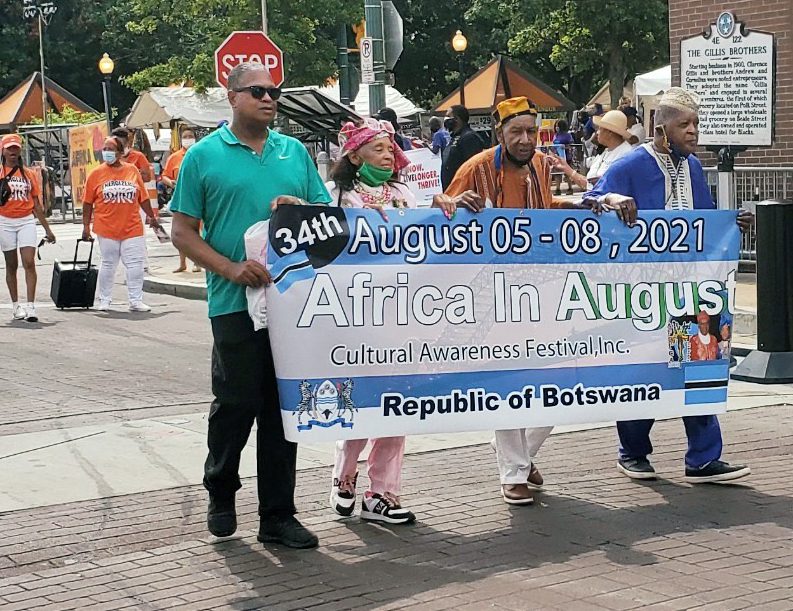
“Last year, we were Africa in April in August,” said David Acey. “We honored the Republic of Botswana. We decided to have the festival in 2021 because I just couldn’t cancel the festival two years in a row.

“This year, 2022, the pandemic is finally past, and everything is open again. Definitely, this is our renaissance after a very long and dark night.”

On Wednesday afternoon, the festival will kick off with the traditional International Entrepreneur’s Luncheon at the Holiday Inn-University of Memphis, 3700 Central Ave., 11:30 a.m. to 1 p.m.

Friday is “Children and Seniors Day & Parade,” which begins at 10 a.m. The parade will come down world-famous Beale Street and wind its way to the historic Robert R. Church Park at 4th and Beale Streets. Vendors and activities will be staged and situated throughout the park from 8 a.m. until 11 p.m., with emphasis on children and seniors.

Saturday in Church Park, vendors and activities will be set up from 8 a.m. until 12 midnight. Saturday is Health, Wellness & Community Day.

Sunday is International Music Day in Church Park, from 8 a.m. until 8 p.m. A day-long schedule of music groups and spectacles will celebrate a wide variety of music, from gospel to jazz, and everything in between. 

“As always, we invite people of every race and culture to come out and enjoy the festival,” said David Acey.

“Each year, there are unique experiences in store for those who attend. We expect this 35th festival to be extra special. All are welcome.”


Source

Patrick Lyoya escaped violence in Congo for the ‘safe haven’ of the US. Then police killed him.

  • About 4.6 million, or one in 10, Black people living in American are immigrants, according to a January report from Pew Research Center.
  • Although they are only 7% of the non-citizen population, Black immigrants make up 20% of deportations on criminal grounds, according to a 2018 Black Alliance for Just Immigration report.

When the Lyoya family arrived in the United States in 2014 after facing years of war and persecution in the Democratic Republic of Congo, the refugees thought they had finally made it.

They were living in Malawi when they won asylum to live in the U.S., part of a growing number of refugees from Congo in Michigan.

“They told us that in America, there’s peace, there’s safety, you’re not going to see killing anymore, that it was basically a safe haven,” Dorcas Lyoya said in Congolese during an interview with the Detroit Free Press, part of the USA TODAY Network, through a translator. 

But last week, her first-born son, Patrick Lyoya, was fatally shot in the back of the head by a police officer after a struggle, an incident that has outraged civil rights advocates and led to protests in Grand Rapids, Michigan.

Patrick Lyoya was killed after struggling with a police officer during a traffic stop.

WHAT WE KNOW:Patrick Lyoya killed after struggle with officer during Grand Rapids traffic stop

Lyoya’s death and others like it can rattle the sense of security of Black immigrants and refugees who came to the U.S. to escape violence only to find themselves vulnerable to the same brutality and racism African Americans encounter from police as well as the additional specter of federal immigration authorities, immigration advocates told USA TODAY.

“It’s shocking to Black migrants who have this vision of the United States as the land of the free and the home of the brave,” said Nana Gyamfi, executive director of the Black Alliance for Just Immigration. “There’s a notion that police here are going to be different.”

Patrick Lyoya’s death brings fear in growing Black immigrant community

About 4.6 million, or one in 10, Black people living in American are immigrants and that number is projected to double by 2060, according to a January report from Pew Research Center. The Black immigrant population is racially and ethnically diverse, but in the last decade Africans have become one of the fastest growing segments through refugee admissions and the diversity visa lottery program, according to the Migration Policy Institute.

Although refugee admissions hit a record low in 2021, over the past two fiscal years people from the Congo became the the largest group of refugees to settle in Michigan, according to data from the U.S. State Department. 

Grand Rapids is home to the largest Congolese refugee population in the state thanks to employment opportunities as well as family and social connections like churches, said Chris Cavanaugh, director of Samaritas’ New American Resettlement program in West Michigan.

‘OUR COMMUNITY DESERVES ANSWERS’:Michigan police release video of fatal shooting of Patrick Lyoya after traffic stop in Grand Rapids

Samaritas helps refugees meet many of their immediate needs and offers a cultural orientation on what it means to live life in America, he said. But they didn’t talk much about the racial implications of being Black in America until George Floyd’s murder sparked a nationwide racial justice protest movement in 2020, which Cavanaugh said a number of Congolese refugees joined.

In the wake of Lyoya’s death, Cavanaugh said Samaritas is hoping to support refugee communities by providing resources to help them access services in their native language including during interactions with law enforcement.

“Certainly the Congolese community is feeling some fear, kind of scared over what happened and I would say rightfully so,” Cavanaugh said. “Those maybe who have much less English skills are just more apprehensive about getting pulled over or how they’re supposed to respond in certain situations.”

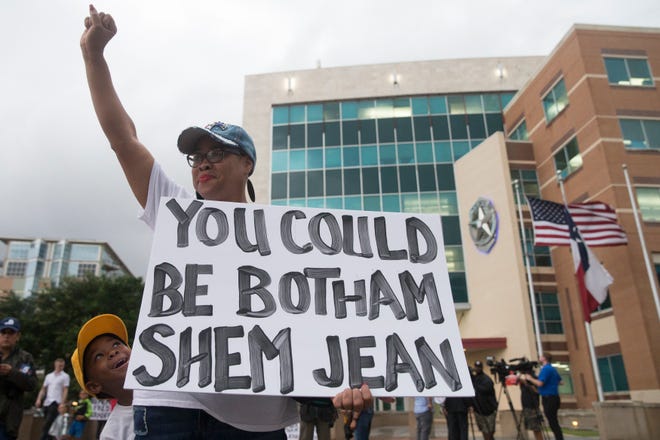
Dr. Pamela Grayson raises her fist as "Young King" Solomon Grayson, 6, peaks behind her sign during a Mothers Against Police Brutality candlelight vigil for Botham Jean at the Jack Evans Police Headquarters on Friday, Sept. 7, 2018, in Dallas.

A history of violence, from Amadou Diallo in 1999 to Botham Jean in 2018

Many Black immigrants and refugees are surprised when they encounter violence from both police and immigration officials, said Gyamfi.

“We have to deal with the violence that police inflict on us because we’re Black,” Gyamfi said. “And then the additional violence that then often is inflicted on us by ICE in this immigration enforcement system because of our migrant status.”

But Black migrants have long been subjected to the same racism and brutality that disproportionately affects Black Americans.

‘I’M LEAVING, AND I’M JUST NOT COMING BACK’:Fed up with racism, Black Americans head overseas

Protests broke out for several weeks in 1999 after Guinean immigrant Amadou Diallo was killed by four white police officers in New York City who said they thought his wallet was a gun. All four officers were acquitted of second-degree murder charges. That same year Patrick Dorismond, a 26-year-old Haitian American, was killed by police sparking another wave of protests in New York. 

In 2016, prosecutors declined to charge a suburban San Diego police officer for fatally shooting 38-year-old Alfred Olango, who arrived in the United States as a refugee from Uganda in 1991. Then, Amber Guyger, a former Dallas police officer, was convicted of murder for the 2018 killing of Botham Jean, a native of the Caribbean island of St. Lucia. 

‘Double-barreled racism’ embedded in immigration laws, law enforcement

Black immigrants are also disproportionately detained and deported by Immigration and Customs Enforcement, said Bill Ong Hing, a law and migration studies professor at the University of San Francisco.

“Embedded in the immigration laws are these anti-Black aspects beginning with the visa system,” Hing said. “They face this double-barreled racism when it comes to law enforcement.”

Although they are only 7% of the non-citizen population, Black immigrants make up 20% of those deported on criminal grounds, according to a 2018 report from the Black Alliance for Just Immigration.

Even minor offenses can trigger deportation proceedings, which can make common interactions with police like traffic stops more tense. Black drivers in Michigan are more likely to be pulled over, searched and arrested by troopers, a study of 2020 traffic stops found.

OPINION:Police should stop making minor traffic stops that too often turn into major tragedies

“The way that most Black migrants end up getting deported is through contact with the police,” Gyamfi said. “There is an awareness that this can happen and there is a lot of anxiety around any type of police contact.”

Hing, founder of the Immigrant Legal Resource Center, said more immigration advocacy organizations began paying attention to this issue in the wake of Floyd’s death. Personal experiences of racism and high-profile cases like Lyoya’s have also started to shift the way Black migrants view themselves.

“They may start out seeing themselves as different from African Americans, but realize that the mainstream, including the police, treat them like any other Black person which is not good,” he said.

Contributing: The Associated Press

Contact Breaking News Reporter N’dea Yancey-Bragg at nyanceybra@gannett.com or follow her on Twitter @NdeaYanceyBragg

Source

In the new Wakanda cookbook, Black Panther food lore comes to life

Braised Kale and Tomatoes

Active time:25 mins

Total time:35 mins

Servings:4

Active time:25 mins

Total time:35 mins

Servings:4

The fictional worlds spun in many TV shows, movies and video games can feel as real and as meaningful to fans as places with actual Zip codes. Think of Hogwarts, the magic-filled, honey-lit boarding school in the world of Harry Potter books and movies; the faraway galaxy of “Star Wars”; or even the lovably quirky small town of Stars Hollow in “Gilmore Girls.”

Wakanda, the wealthy, technologically advanced, mountain-ringed land of the “Black Panther” comics and blockbuster 2018 movie, though, occupies an even more rarefied role. It’s not just the setting for the action in a beloved franchise; it has become a symbol of African greatness, a mythical place that feels like an actual homeland to many people, and not just to comics geeks with posters of King T’Challa on their bedroom walls.

This week, the mythical country is seeing its culture expand with “The Official Wakanda Cookbook,” a collection of recipes sanctioned by “Black Panther” publisher Marvel.

“I definitely felt a combination of pressure and pride,” says Nyanyika Banda, the freelance writer and chef who created the cookbook. “The lore of Black Panther and what Wakanda means now socially is so important, not just for Black Americans but to people of African descent around the world.”

Banda, who has long been a student of the foodways of the African diaspora, developed both the 70-plus recipes and the story-within-the-story of the cookbook: It’s written from the perspective of a young woman who is plucked from her mother’s stall in the capital city’s marketplace to become the royal chef to King T’Challa, a woman who — like Banda — was influenced by the elder women in her family.

Aside from the challenges posed by satisfying an avid fan base and respecting a cultural touchstone, Banda faced another, more practical task. Often, a cookbook author writing about a region of the world is concerned about staying true to the dishes, the ingredients, the people and the history of the land. But what does it mean to be faithful to something that doesn’t actually exist?

Scale this recipe and get a printer-friendly, desktop version here.

Banda says that before signing on to the project, they had seen the movie but hadn’t read many of the comics. And so they delved in and also explored the deep well of fan-fueled websites, seeking to understand the characters and the landscape of Wakanda. Food doesn’t figure prominently in the comics or in the movie, so some creativity was in order.

Some ideas came more easily. Wakanda has a lake, Banda notes, so fish recipes would work. Produce and ingredients available in sub-Saharan Africa (where Wakanda is located, according to the comics), such as cassava, mangoes and goat (you can substitute lamb, Banda instructs), figure prominently. Vegetable dishes are also featured — in a recipe for eggplant and herbs, the narrator notes that “many Wakandans eat a predominantly vegetarian diet,” perhaps a reference to the moment depicted in the movie in which the tribal leader M’Baku threatens to feed a CIA agent to his children, before revealing the threat is just a joke. “I’m kidding,” he says. “We’re vegetarians.”

An important part of the kingdom’s story is that it is incredibly technically advanced, so Banda wanted a few recipes that incorporated gadgets, such as a sous vide machine or a dehydrator, to represent that.

One such dish, a smoked mushroom jerky, was inspired by the Dora Milaje, Wakanda’s elite team of female warriors. “I imagined it would be something that would be fueling but that would carry well,” Banda says.

Jennifer Simms, Banda’s editor at Insight Editions, the publisher of the Wakanda cookbooks as well as dozens of other pop-culture spinoff cookbooks, says that from the outset, she didn’t want to create a cookbook that was generically “African.” “We wanted to make sure we weren’t trying to represent Africa as having one food culture,” she says.

To create a cuisine that is fictional, yet feels specific, Banda drew not just on studies of African foodways, but on family recipes. One dish, braised kale with tomatoes, was cribbed directly from the last meal Banda cooked with their aunt, who, like Banda’s father, was born in Malawi. “We talked and laughed, and it was a special moment,” says Banda, whose aunt died in 2020. “I thought of her a lot while I was writing this.”

One of the trickier conditions imposed by the Black Panther narrative was that Wakanda, unlike many other African nations, was never colonized — according to its lore, it had long remained hidden from the rest of the world to protect itself, and the valuable metal it contained, from outsiders. And so Banda had to find storylines to explain Western influences.

Visits to Wakanda by Captain America explained a simple trout dish and an iced coffee laced with cocoa. Travels to New York by the narrator character, the fictional palace chef, explain a pasta dish. And the current king, T’Challa, was educated in America and Europe under an assumed name, and some dishes are described as being food he discovered while abroad.

Banda and Simms worked closely with the team at Marvel when developing the dishes and the stories around them. “We would talk about whether or not they felt like it would be a part of Wakanda,” Banda says. “I wanted there to be integrity within the dish, but also have integrity in terms of storytelling.”

Banda developed the recipes while staying with their 90-year-old grandmother in Amherst, Mass., during the pandemic. And all along, they considered how important the Black Panther story was to its most devoted admirers. “I was never not thinking about Black Panther fans, hoping they would see the time and thought that went into this,” Banda says.

Black Panther fans aren’t the only cooks that publishing houses are thinking about these days. The Wakanda cookbook is part of a growing trend of pop-culture cookbooks, based on popular franchises with loyal fan bases. Insight Editions CEO Raoul Goff said he first saw the potential for the genre after the success of a 2016 “World of Warcraft” cookbook based on the popular online role-playing game.

Since then, the publisher has produced dozens of titles tied to games such as “The Elder Scrolls” and “Street Fighter,” plus movies and TV, including “Star Wars,” “Friends,” “Downton Abbey,” and forthcoming cookbooks on “Seinfeld” and “Emily in Paris.”

Goff sees these books as more than just the present you give your game-obsessed nephew or Crawley fangirl friend for Christmas. Cooking, he says, helps fans connect with the stories and characters they love in a way that no T-shirt could. “It’s another aspect of getting immersed in that world, whatever it is,” he says.

Are there any shows for which he couldn’t imagine a cookbook spinoff? Maybe “The Walking Dead,” this reporter suggests? Surely there’s nothing appetizing about struggling to stay alive after a zombie apocalypse.

He laughs. “We’ve done that one,” he says. “It was a cookbook and survival guide. Fans loved it.”

“‘Okay, what about ‘Dexter?’ I challenge him, throwing out the name of the show whose serial-killer title character spends his evenings carving up human flesh.

There’s a pause, but Goff isn’t wiling to concede, entirely. “Dexter,” he says, “would be a tough one.”

Braised Kale and Tomatoes

Want to save this recipe? Click the bookmark icon below the serving size at the top of this page, then go to My Reading List in your washingtonpost.com user profile.

Scale this recipe and get a printer-friendly, desktop version here.

Storage notes: Refrigerate for up to 3 days.

Ingredients

  • 2 tablespoons olive oil
  • 1 small yellow onion (about 5 ounces), halved and sliced
  • 5 cloves garlic, minced or grated
  • 2 vine-ripe tomatoes, diced
  • 1 teaspoon ground cumin
  • 1 tablespoon paprika
  • Fine salt
  • Freshly cracked black pepper
  • 8 cups curly kale, stemmed and chopped
  • 1 cup low-salt vegetable broth

In a large, heavy-bottomed pot or Dutch oven over medium heat, heat the oil until shimmering. Add the onion and garlic and cook, stirring, until the onions are translucent and the garlic is just starting to brown, about 4 minutes. Stir in the tomatoes, cumin and paprika, and lightly season with salt and pepper.

Add the kale a handful at a time, stirring occasionally and waiting for it to wilt before adding more. Once all the kale has been added, pour in the stock.

Bring to a simmer, cover and heat for 15 minutes, adjusting the heat as needed to keep it at a simmer. Taste and add more salt and/or pepper, as needed.

Remove from the heat and serve family style or divide among the bowls.

Nutrition Information

Per serving (3/4 cup)

Calories: 163; Total Fat: 8 g; Saturated Fat: 1 g; Cholesterol: 0 mg; Sodium: 172 mg; Carbohydrates: 22 g; Dietary Fiber: 7 g; Sugar: 6 g; Protein: 6 g

This analysis is an estimate based on available ingredients and this preparation. It should not substitute for a dietitian’s or nutritionist’s advice.

Adapted from “Marvel’s Black Panther: The Official Wakanda Cookbook” by Nyanyika Banda (Insight Editions, 2022).

Tested by Alexis Sargent; email questions to voraciously@washpost.com.

Scale this recipe and get a printer-friendly, desktop version here.

Browse our Recipe Finder for more than 9,700 Post-tested recipes.

Did you make this recipe? Take a photo and tag us on Instagram with #eatvoraciously.

Loading…

Source

China’s Entry into the Muslim World

Civil Society, Democracy, Editors’ Choice, Featured, Global, Global Governance, Headlines, IPS UN: Inside the Glasshouse, Peace, Religion, TerraViva United Nations

Opinion

ISLAMABAD, Pakistan, Apr 7 2022 (IPS) – The retrenchment of American power in the Middle East and the larger Muslim world, coupled with the war in Ukraine, has provided a geopolitical breather for China. Beijing is effectively deploying this to make strategic inroads into the region, given this vacuum and focus on Europe.


The recent invitation to Chinese Foreign Minister Wang Yi to address the Organisation of Islamic Cooperation (OIC) conference in Islamabad is a ‘historic first,’ and a significant breakthrough for Chinese diplomacy. For the first time, the foreign minister of the Peoples Republic of China was invited to address the most representative platform of the 57-member body representing the 1.5 billion Muslims.

During his speech at the OIC conference in Islamabad on the 22nd March 2022, Foreign Minister Wang Yi talked about the “long standing relationship between China and the Muslim world” and reaffirmed that China would continue supporting Muslim countries in their quest for political independence and economic development.

Historically, China has always been etched in the Muslim consciousness as a country with a great civilisation based on knowledge, learning and development. For example, there is a famous saying of the Holy Prophet Mohammad (Peace Be Upon Him), 1,400 years ago, which urged Muslims to “seek knowledge, even if you have to go to China,” implying that although China was physically far away from Arabia, it was a land of learning.

Soon after the end of the Cold War in the 1990s, a professor of the prestigious American university Harvard, Prof. Samuel Huntington, talked of a ‘clash of civilisations’ in which he implied that Western civilization would be at odds with both the Islamic and the Confucian civilisations. Interestingly, he also talked of a united front of the Islamic and Confucian civilisations.

During his speech at the conference on Dialogue among Civilisations, held in Beijing in May 2019, Chinese President Xi Jinping mentioned the contribution of the Islamic civilisation to “enrich the Chinese civilisation” and also referred to the Holy Mosque in Makkah (Mecca) as well as the travels to China of the Muslim explorer, Ibn Batuta, who wrote favourably on China and the Chinese people.

China has a longstanding relationship with the Muslim world. After the Chinese revolution in 1949, Pakistan was the first country in the Muslim world to recognise the People’s Republic of China in May 1950. The first institutional interaction between China and the Muslim countries took place at the 1955 Afro-Asian Summit in Bandung, Indonesia.

It was hosted by the world’s largest Muslim country, Indonesia and Pakistan and China were among the countries attending this historic summit. China shares a border with 14 countries, five of which are members of the OIC and none of these have border disputes with China.

In January 1965, when the Palestine Liberation Organisation (PLO), was formed, China was among the first countries who recognised it. And in the 1960s and early 70s, China also provided material support and aid to various Muslim countries that were facing economic and political pressures, including Pakistan, Nigeria, Indonesia, South Yemen and Egypt.

As a permanent member of the United Nations Security Council, China also has been in the forefront of countries that have a proactive approach to the Muslim world. China, for example, presented a Middle East peace plan and it was unveiled during visits to China in May 2013 by the President of the Palestinian Authority, Mehmood Abbas, and the Prime Minister of Israel, Benjamin Netanyahu.

During his meeting with the two leaders, President Xi Jinping presented the 4-point peace plan that called for an independent Palestine State alongside Israel, based on the 1967 borders, with East Jerusalem as its capital. While recognising Israel’s right to exist in security, the Chinese peace plan also called for an end to building Jewish settlements in the occupied territories of Palestine, cessation of violence against civilians and termination of the Israel blockade of Gaza.

The peace plan also called for resolving the issue of Palestinian prisoners in Israeli jails and sought more humanitarian assistance for the Palestinians, while underlining that these are “necessary for the resumption of peace talks between Israel and Palestinian Authority.”

China also has been principled on the issue of Syria urging an end to both interference in Syrian affairs and an end to the Syrian civil war. In January 2022, China invited Syria to be part of the Belt & Road Initiative (BRI).

China today is the largest importer of crude oil in the world and almost 50% of that oil comes from the Muslim countries of the Middle East, especially Saudi Arabia, Iran and the UAE. Saudi Arabia has also invited President Xi Jinping to visit the Kingdom and there have been media reports that China and Saudi Arabia are engaged in discussions to have their oil trade done partially in Yuan or the RMB, the Chinese currency.

Defence cooperation between China and the Muslim world is also expanding and the Chinese advanced jetfighter J10C is now in use in countries like Pakistan and the UAE. In January 2022, China and Iran signed a comprehensive Strategic Accord which will run for 25 years, worth well over $400 billion dollars.

The centre piece of China’s relationship with the Muslim world today is the BRI. Interestingly, the BRI was launched in two phases by President Xi Jinping, with two important speeches in two different Muslim countries. In September 2013, during the speech in Astana, capital of Kazakhstan, President Xi Jinping announced the launch of the Silk Road Economic Belt.

During another speech in Jakarta, capital of Indonesia, in November 2013, President Xi Jinping announced the launch of the Maritime Silk Road, both pillars of the BRI. And during his speech at the OIC conference on the 22nd March, Foreign Minister Wang Yi said that “China is investing over 400 billion dollars in nearly 600 projects across the Muslim world under the BRI.”

He underlined that “China is ready to work with Islamic countries to promote a multi-polar world, democracy in international relations and diversity of human civilisation, and make unremitting efforts to build a community with a shared future for mankind”. On the issue of Palestine and Kashmir, Wang Yi said that “China shares the same aspirations as the OIC, seeking a comprehensive and just settlement of these disputes.”

Another example of close ties between China and the Muslim world was the February 2022 Beijing Winter Olympics, where a majority of Muslim countries like Pakistan, Egypt, Saudi Arabia, UAE and Qatar had a high level of representation, despite the boycott called by certain Western countries. Also, only last week, on the 30th March, China hosted an important conference, the Meeting of Foreign Ministers of Afghanistan’s Neighboring Countries, which was well attended.

China has also received support from Muslim countries on the issue of Xinjiang at the UN Human Rights Council. In fact, in July 2019, when a group of 22 nations led by the West sent a letter to the UN Human Rights Council criticising China on Xinjiang, not a single Muslim country was a signatory of that letter, while another group of 37 countries submitted a letter on the same issue defending Chinese policies.

These countries included all the six Gulf countries plus Pakistan, Algeria, Syria, Egypt, Eritrea, Nigeria, Somalia, and Sudan — all Muslim countries.

Given the changing geopolitical scenario, where there is a shift in the global balance of economic and political power, away from West and toward the East, followed by calls for a New Cold War, China’s thrust for cooperation and connectivity, given the common threat of the Coronavirus pandemic and the need for connectivity through BRI, has a broad resonance in the Muslim world.

The Muslim countries see their relations with China as a strategic bond to promote stability, security and economic development in the Muslim world and the BRI has become the principal vehicle in the promotion of such an approach.

In the coming years, China’s partnership with the Muslim world is likely to be strengthened, given the mutuality of interests and the convergence of worldviews in upholding a world order based on International Law, the UN Charter and the Five Principles of Peaceful Coexistence.

Ironically, thirty years after enunciating the Huntington thesis on the ‘clash of civilisations,’ which talked of the Islamic and Confucian Civilisations co-existence with each other but possible confrontation with Western Civilisation, recent developments may be pointers to a self-fulfilling prophecy!

Source: Wall Street International MagazineTop of Form/OTHER NEWS
https://wsimag.com/economy-and-politics/69117-chinas-entry-into-the-muslim-world

Chairman of the Senate Defence Committee Pakistani, Senator Mushahid Hussain was Bureau Chief in Islamabad of Inter Press Service (IPS) during 1987-1997 & later in 2014. He launched the first Public Hearings on Environment & Climate Change in the Pakistan Parliament. As Senator, he chairs the Senate Sub Committee on ‘Green and Clean Islamabad’ which has launched a campaign to ban plastic use in the Pakistani capital.

IPS UN Bureau

  Source

Indian Agriculture Towards 2030

Asia-Pacific, Biodiversity, Civil Society, Climate Change, Combating Desertification and Drought, Environment, Food and Agriculture, Food Security and Nutrition, Food Sustainability, Headlines, Natural Resources, TerraViva United Nations, Trade & Investment, Water & Sanitation

Opinion

KATHMANDU, Nepal, Apr 4 2022 (IPS) – India began its journey as an independent nation in 1947 with fresh memory of the Bengal Famine of 1943 which claimed 1.5 to 3 million lives. Against this backdrop, the First Five Year Plan (1951-56) prioritized agriculture which, however, shifted to heavily industrialization in the second Plan.


Shyam Khadka

The mid-1960s was a difficult time when consecutive droughts hit food production and India had to import about 11 million metric ton (MMT) of wheat per year – about 15% of its domestic food grain production – under US Public Law 480. With the availability of high yielding miracle seeds of wheat and rice accompanied by increasing use of chemical fertilisers, provision of minimum support price (MSP) for rice and wheat, expansion in irrigated area, and gradual mechanization of farms, Indian agri-food system fortunately took a definitive positive turn beginning late 1960s. As a result, India has become the largest producer of milk (187.7 MMT in 2019-20) and cotton (37.5 million bales in 2019-20) and the second largest producer of rice (117.5 MMT in 2019-20) and wheat (106.2 MMT in 2019-20), fruits (97.97 MMT in 2018-19) and vegetables (183.17 MMT in 2018-19). India today is not only food self-sufficient but also a net exporter of agricultural produce. In short, the success of Indian agriculture in last six decades has been nothing less than spectacular.

The success, however, has come with significant costs. The resource intensification that the Green Revolution requires has adversely affected natural resources and environment. India pumped 245 million cubic meters – about 25 percent of total groundwater withdrawn globally – for irrigation in 2011. As a result, ground water in 1,034 blocks (16% of total blocks) are over-exploited. Worse, ground water table has become critical in 4% and semi-critical in 10% of the blocks. Similarly, some 37% of land area in the country (120.4 mn ha) is affected by various types of land degradation. Subsidy policy-induced non-judicious use of fertilizers has led to the chemicalization of soil and pollution of water through leaching and run-off. Despite abundant supply of food grains, in 2020 41.7% of under-5 children suffered from stunting. India is home to 208.6 million – or over a quarter – of world’s undernourished people. Other challenges that Indian agriculture faces today include uneven regional growth, rising fiscal constraints, mounting and unsustainable level of subsidies, small holding size and further fragmentation of holdings and accompanying land tenurial issues, and low resource use efficiency, particularly of water. These factors act as serious impediments for sustained agricultural growth and farmers’ livelihoods.

Amidst the success and emerging challenges NITI Aayog, the apex public policy think tank of the Government of India and the Food and Agricultural Organization of the United Nations (FAO) decided to facilitate a national dialogue among key stakeholders including government agencies, academia, civil society organisations, farmers, private sector, international organizations, media and others to articulate a vision for 2030 and pathways for the remandating of agriculture in India. To this end, 10 thematic papers were commissioned from distinguished professionals. A 3-day national dialogue entitled, ‘Indian Agriculture Towards 2030: Pathways for enhancing Farmers’ Income, Nutritional Security and Sustainable Food and Farm Systems” was held in January 2021. NITI Aayog and FAO have now come up with a publication with the same title (Chand, R., Joshi, P, and Khadka, S., Editors (2022), Springer).

In addition to the challenges enumerated above the books also deals with issues of climate change and its impact on agricultural production and farmers’ incomes and the strategies to mitigate such change; growing incidence of pests, pandemics, and transboundary diseases and threat to biosecurity affecting agricultural production; and alternative farming systems for transformative and sustainable agroecology and biodiverse future. The role of science, technology and innovation is identified as key to sustainable and resilient agriculture. Similarly, role of structural reforms and governance are discussed in detail and the role of price policies, market reforms and institutions are being highlighted for an efficient, inclusive and sustainable agriculture.

The National Dialogue identified pathways for transformation with emphasis on remandating Indian agriculture in a way that makes it more productive, efficient, resilient, resource conserving, nutrition centered and globally focused. These transformational outcomes are to be achieved by focusing on following pathways:

    • Increasing investment in agriculture, first to reverse the declining trend and then achieving ‘efficient’ growth rather than growth alone, increased adoption of improved technology, reorienting agricultural science, technology and innovations, applying digital solutions and artificial intelligence, better use of information and communication technology, application of One Health concept;
    • Making Indian agriculture globally-focused, shifting attention from self-sufficiency to adding value through increased processing and achieving a high rate of export growth
    • Enhancing the efficiency of the water and other resources, mainly by correcting distorted water pricing, adopting water conserving technologies and agro-ecological approach, changes in the cropping pattern, and reversing neglect of rainfed areas;
    • Making agriculture climate resilient, by adopting several no-regret technological and institutional options as well as by undertaking more targeted research, use of big data analytics, and adoption of a science-based and green growth approach;
    • Tackling nutrition and food safety, by diversifying diet, reducing post-harvest losses, encouraging bio-fortifications, empowering women, enforcing food safety standards, improving water sanitation and hygiene, and promoting food safety awareness and nutrition education;
    • Focusing sharply on innovations, incentives and institutions that contribute to enhance productivity, enhance resilience to climate change, incentivize water and energy conservation, and by adopting more conducive regulatory environment such as for exploiting ground water; and
    • Adopting appropriate policies and improving governance such as by reducing distortion caused by the MSP, accelerating rural infrastructure creation, ensuring greater engagement of the state governments, enhancing access to credit and extension services, and expansion of contract farming.

As emphasised by Honourable M. Venkaiah Naidu, Vice-President of India in his foreword, the book ‘provides a sound basis for reflection because they distil important lessons and present an array of policy options for the government to choose from’.

Shyam Khadka is a former senior official of the Food and Agriculture Organization of the United Nations who served as representative in India (2015-18) and was Senior Portfolio Manager in United Nations International Fund for Agricultural Development (1997-2014). An international development professional, Khadka works on policies, programs and projects that aim at developing agriculture, ensuring food security, and reducing poverty globally.

IPS UN Bureau

  Source

In Sri Lanka, Rajapaksas on the Ropes

Asia-Pacific, Civil Society, Crime & Justice, Featured, Headlines, Human Rights, Humanitarian Emergencies, TerraViva United Nations

Opinion

There were widespread reports over the weekend of hundreds of demonstrators demanding the resignation of the family-run Rajapaksa government. Credit: Sunday Times, Sri Lanka

LONDON, Apr 4 2022 (IPS) – With the economy in freefall and basics such as food and fuel in dangerously short supply, there is mounting public anger against a failing and desperate government in Sri Lanka.


‘O tempora, O mores,’ said the Roman orator Cicero in a plaintive cry, denouncing the political and social norms of Rome in 70 BC.

Unlike the Romans, the people of Sri Lanka have not left it to politicians or orators to berate what they perceive as their rudderless rulers. They have taken on the task themselves, going into the streets to decry their government in words more telling and malignant than any Cicero might have employed.

They watch as their once ‘Resplendent Isle’ hurtles downhill while confused rulers try desperately to halt its economic and social collapse.

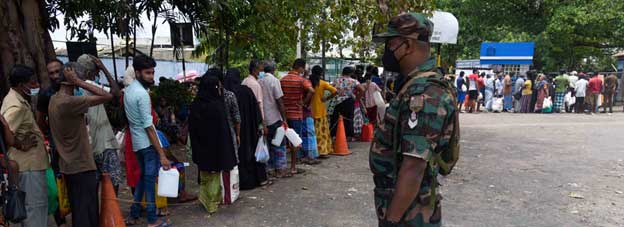
Never in the history of modern Sri Lanka have its citizens queued up for hours to purchase one or two cylinders of cooking gas or a few litres of petrol or kerosene, while a wide range of other shortages continue to plague the country.

If in Ukraine civilians are dying because of the indiscriminate and inconsiderate shelling and bombing by Russian forces, in Sri Lanka they are dying on their feet, some having waited for pre-dawn hours for gas or kerosene to cook what little food they could muster to feed hungry families.

As I write this in late March, reports are pouring in of four people from different parts of the country dying within 48 hours. That is not surprising at a time when the Covid pandemic still persists.

But these four died while waiting in gas or petrol queues, three of then possibly of exhaustion after standing for many hours, and the fourth of stab wounds during an altercation at a filling station.

Today, history is being made. But it is not in the manner the country’s rulers –the powerful Rajapaksa family from Sri Lanka’s south, whose political antecedents go back to the 1930s–ever expected.

Today, the wheel of political fortune has inexorably turned.

It was over a decade ago that two of the Rajapaksa brothers, Mahinda and Gotabaya, were hailed as national heroes for their roles in defeating the dreaded Tamil Tiger separatists in May 2009, after a war that lasted nearly three decades.

Mahinda was then Sri Lanka’s president and Gotabaya his defence secretary.

In April 2019, a couple of days after jihadist terrorists suicide-bombed three churches and three luxury hotels on Easter Sunday, killing some 270 locals and foreigners and wounding another 500, Gotabaya Rajapaksa announced his presidential ambitions.

Politically untested, the former military officer promised enhanced national security, peace, political stability, economic recovery and preservation of Sri Lanka’s 2500-year Buddhist heritage.

In November that year he won the presidential election with 6.9 million votes and in August 2020 Mahinda Rajapaksa led the Sri Lanka People’s Party (SLPP) to victory at the parliamentary election with a near two-thirds majority.

But today, the wheel of political fortune has inexorably turned. Last month in a Gallup-style opinion poll conducted by a local think tank, Veritḗ Research found that only 10 per cent of those queried said they approved of the current government.

Rudderless Rulers

Such is public antipathy that long queues of people spending hours to buy a packet or two of powdered milk booed the president as he passed by.

Some days later busloads of women, led by a former MP whose politician father was shot dead by a rival, who was convicted of murder, sentenced to death but then pardoned by President Gotabaya last year and given a state job, demonstrated outside the president’s private residence.

Teachers, health workers and other trade union-led employees have gone on strike at various times. Farmers have taken to the streets, protesting against the overnight ban last May of chemical fertiliser that saw some rice fields and other agricultural land abandoned and export-earning tea and rubber plantations affected.

Over the past months effigies of the Agriculture Minister have been burnt and posters of the Rajapaksas (four of the brothers are cabinet ministers and so is Mahinda’s eldest son) have been torn or otherwise defaced in blatant displays of public anger and lack of faith in a government that has failed to provide uninterrupted supplies of basics such as electricity, gas, petrol and kerosene, and essential foods and medicines.

It has been said that even the dead have no peace. Some crematoriums have stopped functioning unless they can be certain of continuous electricity.

Outages lasting several hours have often brought factories to a halt. Thermal power stations and other power providers cannot operate continuously for lack of fuel and coal.

Fast depleting foreign reserves have forced the government to slash imports of food, fuel, diesel and gas, compelling many restaurants, bakeries and wayside eateries, as well as other enterprises, to close or restrict their business.

Meanwhile, prices of food and domestic essentials and transport costs have skyrocketed, driving many families, particularly daily wage earners, into penury and starvation.

With foreign reserves at the end of February down to a perilous US$ 2.3 billion and some $7 billion in sovereign debt and loan repayments due this year – including a $1 billion repayment in July – the Rajapaksas turned from their traditional friend and ally China, which that has extended financial help over the years, to neighbouring nations.

A currency swap was arranged with Bangladesh, and last month Finance Minister Basil Rajapaksa flew to New Delhi for meetings with Prime Minister Narendra Modi, External Affairs Minister S. Jaishankar and Finance Minister Nirmala Sitharaman, urging help to rescue Colombo from its foreign exchange crisis.

Never in the history of modern Sri Lanka have its citizens queued for hours to buy fuel

New Delhi extended a $1 billion credit facility to enable the purchase of food, medicines and other essentials. This brought Indian assistance this year to $1.4 billion, which included a $400 million currency swap, besides another half a billion-dollar line of credit for essential fuel imports, and the deferring of a $500 million loan and.

Meanwhile China is considering another $2.5 billion in fresh assistance, China’s ambassador to Sri Lanka stated while turning down the deferment of a loan.

Even as Sri Lanka turns to Asia’s two leading powers, both vying for larger footprints in Sri Lanka, with its strategic location in the Indian Ocean, Colombo has finally turned to the IMF for belated assistance due to internal dissension in the ruling coalition.

President Rajapaksa recently sacked two ministers from minor coalition partners for criticising government policy and attacking Finance Minister Basil Rajapaksa, who has dual Sri Lankan-US citizenship, for bending backwards to satisfy American interests.

Some other state ministers have resigned or been removed as internal squabbles begin to take a toll on stability in the 11-party coalition.

With the economy in tatters and mounting public wrath against President Gotabaya Rajapaksa, with calls of ‘Gota Go Home’, he summoned an all-party conference late last month in the hope of showing a friendly face and seeking solutions to the country’s economic catastrophe.

While some minority Tamil parties which had long sought a meeting with the president and some other parties attended, two of the leading opposition parties, which recently launched anti-government demonstrations, boycotted the conference.

It started on a sour note, with many-time prime minister Ranil Wickremesinghe putting the Governor of the Central Bank Nivard Cabraal in his place for unwanted political remarks, for which President Rajapaksa apologised to Mr Wickremesinghe.

To the average Sri Lankan who has witnessed such conferences over the years, including ones to bring racial peace to a divided country, they are an exercise in political waffling and time-wasting.

With Sri Lanka’s biggest national celebration, the Sinhala and Tamil New Year, in mid-April, the working and middle-class families now struggling to survive wonder whether there will be anything to celebrate. Even if families can get together for the traditional meals, will they be able to cook them for lack of gas and kerosene?

Will this April be the cruellest month?

Source: Asian Affairs, London

Neville de Silva is a veteran Sri Lankan journalist who held senior roles in Hong Kong at The Standard and worked in London for Gemini News Service. He has been a correspondent for foreign media, including the New York Times and Le Monde. More recently, he was Sri Lanka’s deputy high commissioner in London

IPS UN Bureau

  Source

RSS
Follow by Email