UN Must Reclaim Multilateral Governance from Pretenders

Civil Society, Development & Aid, Economy & Trade, Global, Headlines, IPS UN: Inside the Glasshouse, TerraViva United Nations, Trade & Investment

Opinion

KUALA LUMPUR, Malaysia, Aug 24 2023 (IPS) – International governance arrangements are in trouble. Condemned as ‘dysfunctional’ by some, multilateral agreements have been discarded or ignored by the powerful except when useful to protect their interests or provide legitimacy.


Economic multilateralism under siege
Undoubtedly, many multilateral arrangements have become less appropriate. At their heart is the United Nations (UN) system, conceived in the last year of US President Franklin Delano Roosevelt’s presidency and World War Two.

Jomo Kwame Sundaram

The 1944 UN conference at Bretton Woods sought to build the foundations for the post-war economic order. The International Monetary Fund (IMF) would create conditions for lasting growth and stability, with the World Bank financing post-war reconstruction and post-colonial development.

The Bretton Woods agreement allowed the US Federal Reserve Bank (Fed) to issue dollars, as if backed by gold. In 1971, President Richard Nixon repudiated the US’s Bretton Woods obligations. With US military and ‘soft’ power, widespread acceptance of the dollar since has effectively extended the Fed’s ‘exorbitant privilege’.

This unilateral repudiation of US commitments has been a precursor of the fate of some other multilateral arrangements. Most were US-designed, some in consultation with allies. Most key privileges of the global North – especially the US – continue, while duties and obligations are ignored if deemed inconvenient.

The International Trade Organization (ITO) was to be the third leg of the post-war multilateral economic order, later reaffirmed by the 1948 Havana Charter. Despite post-war world hegemony, the ITO was rejected by the protectionist US Congress.

The General Agreement on Tariffs and Trade (GATT) became the compromise substitute. Recognizing the diversity of national economic capacities and capabilities, GATT did not impose a ‘one-size-fits-all’ requirement on all participants.

But lessons from such successful flexible precedents were ignored in creating the World Trade Organization (WTO) from 1995. The WTO has imposed onerous new obligations such as the all-or-nothing ‘single commitment’ requirement and the Agreement on Trade-related Intellectual Property Rights (TRIPS).

Overcoming marginalization
In September 2021, the UN Secretary-General (SG) issued Our Common Agenda, with new international governance proposals. Besides its new status quo bias, the proposals fall short of what is needed in terms of both scope and ambition.

Problematically, it legitimizes and seeks to consolidate already diffuse institutional responsibilities, further weakening UN inter-governmental leadership. This would legitimize international governance infiltration by multi-stakeholder partnerships run by private business interests.

The last six decades have seen often glacially slow changes to improve UN-led gradual – mainly due to the recalcitrance of the privileged and powerful. These have changed Member State and civil society participation, with mixed effects.

Fairer institutions and arrangements – agreed to after inclusive inter-governmental negotiations – have been replaced by multi-stakeholder processes. These are typically not accountable to Member States, let alone their publics.

Such biases and other problems of ostensibly multilateral processes and practices have eroded public trust and confidence in multilateralism, especially the UN system.

Multi-stakeholder processes – involving transnational corporate interests – may expedite decision-making, even implementation. But the most authoritative study so far found little evidence of net improvements, especially for the already marginalized.

New multi-stakeholder governance – without meaningful prior approval by relevant inter-governmental bodies – undoubtedly strengthens executive authority and autonomy. But such initiatives have also undermined legitimacy and public trust, with few net gains.

All too often, new multi-stakeholder arrangements with private parties have been made without Member State approval, even if retrospectively due to exigencies.
Unsurprisingly, many in developing countries have become alienated from and suspicious of those acting in the name of multilateral institutions and processes.

Hence, many in the global South have been disinclined to cooperate with the SG’s efforts to resuscitate, reinvent and repurpose undoubtedly defunct inter-governmental institutions and processes.

Way forward?
But the SG report has also made some important proposals deserving careful consideration. It is correct in recognizing the long overdue need to reform existing governance arrangements to adapt the multilateral system to current and future needs and requirements.

This reform opportunity is now at risk due to the lack of Member State support, participation and legitimacy. Inclusive consultative processes – involving state and non-state actors – must strive for broadly acceptable pragmatic solutions. These should be adopted and implemented via inter-governmental processes.

Undoubtedly, multilateralism and the UN system have experienced growing marginalization after the first Cold War ended. The UN has been slowly, but surely superseded by NATO and the Organization for Economic Cooperation and Development (OECD), led by the G7 group of the biggest rich economies.

The UN’s second SG, Dag Hammarskjold – who had worked for the OECD’s predecessor – warned the international community, especially developing countries, of the dangers posed by the rich nations’ club. This became evident when the rich blocked and pre-empted the UN from leading on international tax cooperation.

Seeking quick fixes, ‘clever’ advisers or consultants may have persuaded the SG to embrace corporate-dominated multi-stakeholder partnerships contravening UN norms. More recent SG initiatives may suggest his frustration with the failure of that approach.

After the problematic and controversial record of such processes and events in recent years, the SG can still rise to contemporary challenges and strengthen multilateralism by changing course. By restoring the effectiveness and legitimacy of multilateralism, the UN will not only be fit, but also essential for humanity’s future.

IPS UN Bureau

  Source

Moving From Trauma to Healing: Practicing Self-Care in Refugee Camps

Aid, Armed Conflicts, Asia-Pacific, Children on the Frontline, Civil Society, Development & Aid, Editors’ Choice, Education, Featured, Headlines, Human Rights, Migration & Refugees, Sustainable Development Goals, TerraViva United Nations

Migration & Refugees

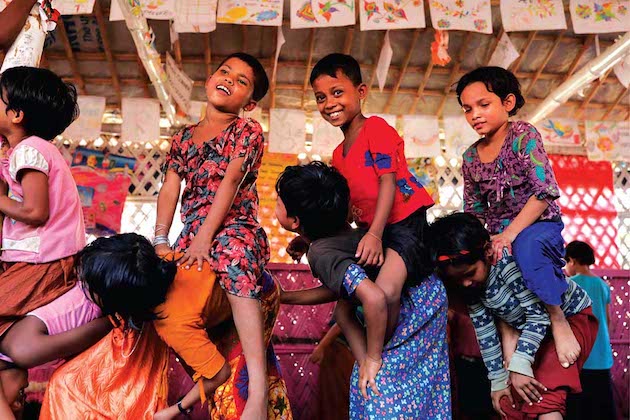
A young child in Cox’s Bazar engages with her peers at one of BRAC’s Humanitarian Play Labs. CREDIT: BRAC

A young child in Cox’s Bazar engages with her peers at one of BRAC’s Humanitarian Play Labs. CREDIT: BRAC

NEW YORK, Aug 21 2023 (IPS) – A Rohingya woman tells a forum of peer counselors the story of her divorce. A survivor of domestic abuse, she has started a new life alone with her daughter. She has weathered a storm of neighbors telling her she was the problem. Now, she provides the support she didn’t have to other women like her.


Similar scenes occur across refugee camps in Cox’s Bazar. Here, BRAC, an international NGO based in Bangladesh, has developed a program to train counselors who can provide mental health services to Rohingya refugees. This includes 200 community members who have begun to practice the psychosocial skills they’ve learned in their own lives.

A Growing Need for Support

Over 900,000 Rohingya have fled to Cox’s Bazar since massive-scale violence against Rohingya in Myanmar’s Rakhine State began in 2017, the UN Refugee Agency reports. The prolonged exposure of the ethnic minority group to persecution and displacement has likely increased the refugees’ vulnerability to an array of mental health issues, a 2019 systematic review found. Their struggles include post-traumatic stress disorder, depression, and gender-based violence.

Around the world, there is growing attention to the importance of socio-emotional learning as a skill to help people in areas of crisis cope with challenges. Educators are often tasked not only with providing traditional academic instruction but with building resilience in children. They are asked to create a sense of normalcy in environments that are anything but normal.

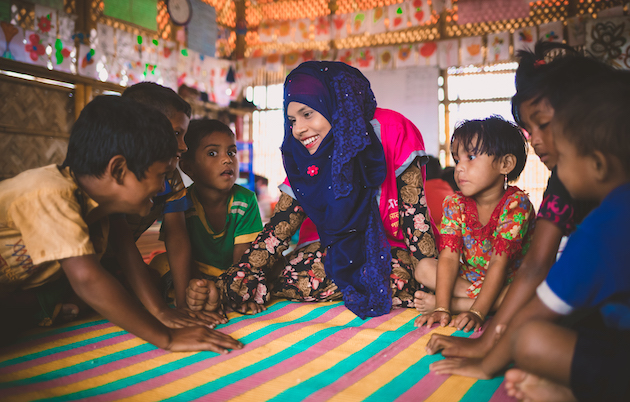
The teaching the children need is much more than about reading, writing, and math; but about giving young children a safe space to practice socio-emotional skills. CREDIT: BRAC

“It’s about not only teaching [kids] how to read and how to do mathematics … in these settings, kids and teachers themselves have the need for psychosocial support,” Ramya Vivekanandan, the senior education specialist at the Global Partnership for Education, said.

Teachers, caregivers, and frontline mental health providers are overburdened, Vivekanandan explains. They lack adequate pay, working conditions, and professional development. As they try to support the growing number of people in crisis, who will support them?

For some counselors in Cox’s Bazar, the answer is each other.

Community Care

Even when resources are available, stigmas around mental health can prevent support from being received. Taifur Islam, a Bangladeshi psychologist responsible for mental health training and supervision at BRAC, says people in the communities he works with are rarely taught to identify their feelings. When you are struggling to access basic needs, Islam explains, it is easy to forget that emotional well-being can improve productivity. If a person seeks help, they may be labeled ‘crazy.’

Training people to take care of their own communities can be a powerful way to overcome stigma in a culturally relevant way.

BRAC’s Humanitarian Play Labs were established in 2017 to give Rohingya children a safe space to practice socio-emotional skills through play. Erum Mariam, the executive director of the BRAC Institute of Educational Development, explains that each play lab is tailored to fit the community it serves. Rohingya children now rhyme, chant, and dance in 304 Humanitarian Play Labs across the camps in Cox’s Bazar.

“We discovered the Rohingya culture through the children. And the whole model is based on knowing the culture,” Mariam said.

‘Play leaders’ are recruited from the camps and trained in play pedagogy. Mariam watched Rohingya women who had never worked before embracing their new roles. As they covered the ceilings of their play spaces with rainbows of flowers – the kind of tapestry that would hang from their homes in Myanmar – Mariam realized that a new kind of social capital could be earned by nurturing joy. Traditional play didn’t just help uprooted children shape their sense of identity – it was also healing for the community.

If a play leader notices a child is withdrawn or restless, they can refer the child to a ‘para counselor’ who has been trained by BRAC’s psychologists to address the mental health needs of children and their family members. Almost half of the 469 para counselors in Cox’s Bazar are recruited from the Rohingya community, while the rest come from around Bangladesh. Most para counselors are women.

Many para counselors are uniquely positioned to empathize with the people they serve as they go door to door, building awareness. This is crucial because it creates a bottom-up system of care without prescribing what well-being should look like, Chris Henderson, a specialist on education in emergencies, says.

At the same time, by supporting others, mental health providers are learning to take care of themselves.

Learning by Doing

A play leader engages the children in the session. Humanitarian professionals encourage frontline teachers, caretakers, and counselors to actualize their own ideas for improvement. CREDIT: BRAC

A play leader engages the children in the session. Humanitarian professionals encourage frontline teachers, caregivers, and counselors to actualize their own ideas for improvement. CREDIT: BRAC

For months, Suchitra Rani watched violence against Rohingya people every time she turned on the news. When she was recruited by BRAC to become a para counselor in Cox’s Bazar, she saw an opportunity to make a difference. Alongside fellow trainees, Rani, a social worker originally from Magura, poured over new words she learned in the foreign Rohingya dialect and worked to find her place in the community.

Rani tested what she had learned about the value of psychosocial support and cultural sensitivity when she met a 15-year-old Rohingya girl too scared to tell her single mother she was pregnant. Terrified of bringing shame to the family, the girl had an abortion at home. As the young woman spiraled into depression, Rani felt herself slipping into her own fears of inadequacy.

It took time for Rani to convince the girl to open up to her mother. Talking through feelings of guilt slowly led to acceptance. As they worked to heal fractured family bonds, Rani began to feel surer of herself, too.

Now, the Rohingya community calls Rani a “sister of peace.” Rani says she has become confident in her ability to use the socio-emotional skills she’s learned to both help others and resolve problems in her personal life.

Throughout the program, para counselors have changed the way they communicate their feelings and felt empowered to create more empathetic environments.

Islam recounts a 26-year-old Rohingya refugee’s perilous journey to Cox’s Bazar: In Myanmar, the woman’s husband was killed in front of her. One of her two young children drowned during a river crossing as they fled the country. She arrived at the camp as a single mother without a support network. Only once she had the support of others willing to listen could she speak openly.

Islam remembers counselors telling the woman about the importance of self-care: “If you actually take care of yourself, then you can take care of your child also.”

Toward Empowerment 

According to Henderson, evidence shows that one of the best ways to support someone is to give them a role to help others. In places where there may be a stigma against prioritizing ‘self-care,’ people with their own post-crisis trauma are willing to learn well-being skills to help children.

A collection of teacher stories collected by the Inter-agency Network for Education in Emergencies reveals a similar pattern. Teachers in crisis areas around the world say the socio-emotional skills they learned to help students helped them reduce stress in their own lives, too.

Henderson suggests that the best way international agencies can promote trauma support is by holding up a mirror to the strength already shown by refugee communities like the Rohingya.

Instead of seeing what they lack, Henderson encourages humanitarian professionals to help give frontline teachers, caregivers, and counselors the agency to actualize their own ideas for improvement. Empowered community leaders empower the young people they work with, who, in turn, learn to empower each other. This creates “systems where everyone sees their position of leadership as supporting the next person’s leadership and resilience.”

At the end of her para counselor training, the Rohingya domestic abuse survivor said she wasn’t sure what she would do with the skills she’d learned for working through trauma, Islam remembers. But she did say she wished they were skills she had known before. According to Islam, she is now one of their best para counselors.

“The training is not only to serve the community; that training is something that can actually change your life,” Islam says. It’s why he became a psychologist.

IPS UN Bureau Report

  Source

Senegal: Democracy in the Balance?

Africa, Civil Society, Crime & Justice, Economy & Trade, Featured, Gender, Headlines, Human Rights, Labour, Press Freedom, TerraViva United Nations

Opinion

Credit: Zohra Bensemra/Reuters via Gallo Images

LONDON, Aug 18 2023 (IPS) – Civic space is deteriorating in Senegal ahead of next February’s presidential election. Recent protests have been met with lethal violence and internet and social media restrictions. Senegal’s democracy will soon face a key test, and whether it passes will depend largely on whether civic space is respected.


Political conflict

Recent protests have revolved around the populist opposition politician Ousmane Sonko. Sonko came third in the 2019 presidential election and has grown to be the biggest thorn in President Macky Sall’s side. He’s won support from many young people who see the political elite as corrupt, out of touch and unwilling to tackle major social and economic problems such as the country’s high youth unemployment. He’s also been the subject of a recent criminal conviction that his supporters insist is politically motivated.

On 1 June, Sonko was sentenced to two years in jail for ‘corrupting youth’. This resulted from his arrest on rape charges in March 2021. Although he was cleared of the most serious charges – something women’s rights advocates have expressed concern about – his conviction likely makes him ineligible to stand in the next presidential election.

Sonko’s arrest in March 2021 triggered protests in which 14 people died. His conviction set off a second wave of protests. Sonko was arrested again on 28 July on protest-related charges, including insurrection. A few days later, the government dissolved his party, Pastef. It’s the first such ban since Senegal achieved independence in 1960.

All of this gave fresh impetus to Sonko’s supporters, who accuse the government of instrumentalising the judiciary and criminal justice system to stop a credible political threat.

Repressive reaction

The latest wave of protests saw instances of violence, including stone-throwing, tyre burning and looting. The state responded with lethal force. According to civil society estimates, since March 2021 over 30 people have been killed, more than 600 injured and over 700 detained.

In response to the recent protests, the army was deployed in the capital, Dakar. Live ammunition was used and armed people dressed in civilian clothes, evidently embedded with security forces, violently attacked protesters.

Journalists were harassed and arrested while covering protests. Recent years have seen a rise in verbal and physical attacks on journalists, along with legal action to try to silence them. Several journalists were arrested in relation to their reporting on Sonko’s prosecution. Investigative journalist Pape Alé Niang has been jailed three times in less than one year.

The government also limited internet access and TV coverage. TV station Walf TV was suspended over its protest coverage. On 1 June, social media access was restricted and on 4 June mobile internet was shut down for several days. In August, TikTok access was blocked. Restrictions harmed both freedom of expression and livelihoods, since many small traders rely on mobile data for transactions.

Third-term tussle

A major driver of protests and Sonko’s campaign was speculation that Sall might be tempted to seek a third presidential term. The constitution appeared to be clear on the two-term limit, but Sall’s supporters claimed constitutional amendments in 2016 had reset the count. Thousands mobilised in Dakar on 12 May, organised by a coalition of over 170 civil society groups and opposition parties, to demand that Sall respect the two-term limit.

On 3 July, Sall finally announced that he wasn’t running again. But it hasn’t ended suspicion that the ruling Alliance for the Republic (APR) party will go to any lengths stay in power, including using the state’s levers to weaken the opposition.

There’s precedent here: ahead of the Sall’s re-election in 2019, two prominent opposition politicians who might have presented a serious challenge were excluded. In both cases, barely weeks before the election the Constitutional Council ruled them ineligible due to prior convictions on corruption charges that were widely believed to have been politically motivated.

That Sonko and Pastef might have stood a chance in 2024 was suggested by the results of votes in 2022. In local elections, the APR lost control of Dakar and Sonko was elected mayor of Ziguinchor city. And then in parliamentary elections, the APR lost 43 of its 125 seats and Pastef finished second, claiming 56 seats, leaving no party with a majority.

Reputation on the line

Senegal long enjoyed an international reputation for being a relatively stable and democratic country in a region that’s experienced numerous democratic setbacks. With West African countries such as Burkina Faso, Guinea, Mali and now Niger under military control, and others like Togo holding deeply flawed elections, Senegal stood out. It’s held several free elections with changes of power.

The country’s active and youthful civil society and relatively free media have played a huge part in sustaining democracy. When President Abdoulaye Wade sought an unconstitutional third term in 2012, social movements mobilised. The Y’en a marre (‘I’m fed up’) movement got out the youth vote to oust Wade in favour of Sall. Wade himself rode a similar youth wave in 2000. So Sall and his party are surely aware of the power of social movements and the youth vote.

A small step forward was taken recently when parliament voted to allow the two opposition candidates who’d been blocked in 2019 to stand in 2024. But the government needs to do much more to show its commitment to democratic rules.

Upholding protest rights would be a good start. The repeated use of violence and detention of protesters points to a systemic problem. No one has been held to account for killings and other rights violations. It’s high time for accountability.

Media freedoms need to be respected and people detained for exercising their civic freedoms must be released. For Senegal to live up to its reputation, Sall should strive to enter history as the president who kept democracy alive – not the one who buried it.

Andrew Firmin is CIVICUS Editor-in-Chief, co-director and writer for CIVICUS Lens and co-author of the State of Civil Society Report.

  Source

Empowering Women in Assam: Livestock Farming Brings Economic Relief Post-COVID

Aid, Asia-Pacific, Civil Society, Development & Aid, Editors’ Choice, Featured, Food and Agriculture, Food Security and Nutrition, Food Sustainability, Headlines, Humanitarian Emergencies, Poverty & SDGs, Sustainable Development Goals, TerraViva United Nations

Food and Agriculture

Goat rearing is contributing to economic independence and improved livelihoods of women thanks to a post-COVID-19 empowerment project. CREDIT: Umar Manzoor Shah/IPS

Goat rearing is contributing to economic independence and improved livelihoods of women thanks to a post-COVID-19 empowerment project. CREDIT: Umar Manzoor Shah/IPS

MILONPUR, INDIA, Aug 8 2023 (IPS) – Seema Devi is a 39-year-old woman hailing from India’s northeastern state of Assam. She lives in a village called Milonpur, a small hamlet with no more than 1 000 inhabitants. While most men from the village, including Devi’s husband, move to cities and towns in search of work, women are left behind to take care of the house and kids.


Devi says that after the COVID-19 lockdown in India in the year 2020, the family income drastically plummeted. As most of the factories were shut for months, the workers, including Devi’s husband, were jobless. Even after the lockdown ended and workers were called back to the factories, the wages dipped.

“Earlier my husband would earn no less than Rs 10 000 a month (125 USD), and after the lockdown, it wasn’t more than a mere 6 000 rupees (70 USD). My children and I would suffer for the want of basic needs like medicine and clothing, but at the same time, I was considerate of the situation and helplessness of my husband,” Devi told IPS.

However, there were few alternatives available at home that could have mitigated Devi’s predicament. With the small area of ancestral land used for cultivation, the change in weather patterns caused her family and several households in the village to reap losses.

However, in 2021, a non-government organization visited the hamlet to assess the situation in the post-COVID scenario. The villagers told the team about how most of the men in the village go out to cities and towns in search of livelihood and work as labourers in factories and that their wages have come down due to economic distress in the country.

After hectic deliberations, about ten self-help groups of women were created. They trained in livestock farming and how this venture could be turned into a profitable business.

The women were initially reluctant because they were unaware of how to make livestock farming profitable. They would ask the members of the charitable organisation questions like, “What if it fails to yield desired results? What if some terrible disease affects the animals, and what if the livestock wouldn’t generate any income for them?”

Wilson Kandulna, who was the senior member of the team, told IPS that experts were called in to train the women about cattle rearing and how timely vaccinations, proper feed, and care could make livestock farming profitable and mitigate their basic living costs. “At first, we provided ten goat kids to each women’s group and made them aware of the dos and don’ts of this kind of farming. They were quick to learn and grasped easily whatever was taught to them,” Wilson said.

He added that these women were living in economic distress due to the limited income of their husbands and were desperately anxious about the scarcity of proper education for children and other daily needs.

Devi says that as soon as she got the goat kids, she acquired basic training in feeding them properly and taking them for vaccinations to the nearby government veterinary hospital.

“Two years have passed, and now we have hundreds of goats as they reproduce quickly, and we are now able to earn a good income. During the first few months, there were issues like feeding problems, proper shelter during monsoons and summers, and how and when we should take them out for grazing. As time passed and we learned the skills, we have become very trained goat rearers,” Devi said.

Renuka, another woman in the self-help group, told IPS that for the past year, they have been continuously getting demands for goat milk from the main towns. “People know about the health benefits of goat milk. They know it is organic without any preservatives, and that is the reason we have a very high demand for it. We sell it at a good price, and at times, demand surpasses the supply,” Renuka said.

For Devi, livestock farming has been no less than a blessing. She says she earns more than five thousand rupees a month (about 60 USD) and has been able to cover daily household expenses all by herself. “I no longer rely on my husband for household expenses. I take care of it all by myself. My husband, too, is relieved, and things are getting back on track,” Devi said, smiling.

Kalpana, a 32-year-old member of the group, says the goats have increased in number, and last year, several of them were sold in the market at a good price.

“The profits were shared by the group members. Earlier, women in this village were entirely dependent on their husbands for covering their basic expenses. Now, they are economically self-reliant. They take good care of the house and of themselves,” Kalpana told IPS News.

Note: Names of some of the women have been changed on their request.

IPS UN Bureau Report

  Source

Cambodia’s Election a Blatant Farce

Credit: Tang Chhin Sothy/AFP via Getty Images

By Inés M. Pousadela
MONTEVIDEO, Uruguay, Aug 4 2023 (IPS)

The title shouldn’t fool you: Cambodian Prime Minister Hun Sen is one of the world’s longest-ruling autocrats. A political survivor, this former military commander had been bolted to his chair since 1985, presiding over what he turned into a de facto one-party system – and now apparently a dynastic regime.


On 23 July, running virtually unopposed, Hun Sen’s Cambodian People’s Party (CPP) took 82 per cent of the vote, winning almost all seats. The only party that could have offered a challenge, the Candlelight Party, had been banned on a technicality in May.

Following the proclamation of his ‘landslide victory‘, Hun Sen finally announced his retirement, handing over his position to his eldest son, Hun Manet. Manet had already been endorsed by the CPP. Winning a parliamentary seat, which he just did, was all he had to do to become eligible. To ensure dynastic succession faced no obstacle, a constitutional amendment passed in August 2022 allows the ruling party to appoint the prime minister without parliamentary approval.

Hun Sen isn’t going away: he’ll remain CPP chair and a member of parliament, be appointed to other positions and stay at the helm of his family’s extensive business empire.

A slippery slope towards autocracy

Hun Sen came to power in a world that no longer exists. He managed to cling onto power as everything around him changed.

He fought as a soldier in the Cambodian Civil War before defecting to Vietnam, taking several government positions under the 1980s Vietnamese government of occupation. He was appointed prime minister in 1985, and when 1993 elections resulted in a hung parliament, Hun Sen refused to concede defeat. Negotiations resulted in a coalition government in which he served as joint prime minister, until he orchestrated a coup to take sole control in 1997. At the head of the CPP, he has won every election since.

In 2013 his power was threatened. A new opposition party, the Cambodia National Rescue Party (CNRP), offered a credible challenge. The CPP got its lowest share of votes and seats since 1998. Despite obvious fraud, the CNRP came dangerously close to defeating Hun Sen.

In the years that followed, Hun Sen made sure no one would challenge him again. In 2015, the CNRP’s leader Sam Rainsy was summarily ousted from the National Assembly and stripped of parliamentary immunity. A warrant was issued for his arrest, pushing him into exile. He was then barred from returning to Cambodia, and in 2017 convicted for ‘defaming’ Hun Sen. His successor at the head of the CNRP, Kem Sokha, soon faced persecution too.

In November 2017, the Supreme Court ordered the dissolution of the CNRP and imposed a five-year political ban on 118 opposition members.

As a result, the only parties that eventually ran on a supposedly opposition platform in 2018 were small parties manufactured by government allies to give the impression of competition. In the run-up to the vote, the CPP-dominated National Election Committee (NEC) threatened to prosecute anybody who urged a boycott and warned voters that criticising the CPP wasn’t allowed. What resulted was a parliament without a single dissenting voice.

There was no let off after the election, with mass arrests and mass trials of former CNRP members and civil society activists becoming commonplace. Rainsy was sentenced in absentia to life imprisonment, and Sokha was given 27 years for ‘treason’. At least 39 opposition politicians are behind bars, and many more have left Cambodia.

But as the CNRP faded, the torch passed to the Candlelight Party. In June 2022 local elections, Candlelight proved that Hun Sen was right to be afraid: in an extremely repressive context, it still took over 20 per cent of the vote. And sure enough, in May 2023 the NEC disqualified Candlelight from the July election.

Civic space under assault

Political repression has been accompanied by tightening civic space restrictions.

The crackdown on independent media, underway since 2017, intensified in the run-up to the latest electoral farce. In March 2022, the government stripped three digital media outlets of their licences after they published stories on government corruption. In February 2023, Hun Sen ordered the closure of Voice of Democracy, one of the few remaining independent media outlets, after it published a story about Manet. Severe restrictions weigh on foreign media groups, some of which have been forced out of the country.

In contrast, government-owned and pro-government media organisations are able to operate freely. Major media groups are run by magnates close to the ruling family. One media conglomerate is headed by Hun Sen’s eldest daughter. As a result, most information available to Cambodians comes through the filter of power. Most media work to disseminate state-issued disinformation and discredit independent voices as agents of propaganda.

The right to protest is heavily restricted. Gatherings by banned opposition parties are prohibited and demonstrations by political groups, labour unions, social movements and essentially anyone mobilising on issues the government doesn’t want raised are routinely dispersed by security forces, often violently. Protesters are subjected to threats, intimidation, arbitrary arrests and detention, and further criminalisation.

As if leaving people with no choice wasn’t enough, Hun Sen also mounted a scare campaign to force them to vote, since a low turnout would undermine the credibility of the outcome. People were threatened with repercussions if they attempted to boycott the election or spoil ballot papers. The election law was hastily amended to make this a crime.

Experience gives little ground to hope that repression will let up rather than intensify following the election. There’s also no reason to expect that Manet, long groomed for succession, will take a different path from his still-powerful predecessor. The very least the international community should do is to call out the charade of an election for what it was and refuse to buy the Cambodian regime’s whitewashing attempt.

Inés M. Pousadela is CIVICUS Senior Research Specialist, co-director and writer for CIVICUS Lens and co-author of the State of Civil Society Report.


!function(d,s,id){var js,fjs=d.getElementsByTagName(s)[0],p=/^http:/.test(d.location)?’http’:’https’;if(!d.getElementById(id)){js=d.createElement(s);js.id=id;js.src=p+’://platform.twitter.com/widgets.js’;fjs.parentNode.insertBefore(js,fjs);}}(document, ‘script’, ‘twitter-wjs’);  

Source

How Nigeria’s Legal System is Failing to Safeguard Widows’ Rights

Nigerian law protects widows, but the reality they face is quite different.

Nigerian law protects widows, but the reality they face is quite different.

By Promise Eze
SOKOTO, NIGERIA, Aug 3 2023 (IPS)

In February this year, Chichi Okonkwo not only lost her husband but was stripped of everything they owned together. Her husband was severely injured in a car accident about a month earlier. Despite being rushed to a hospital in Enugu, where they resided, he succumbed to his injuries weeks later. To compound her grief, Okonkwo’s late husband’s male siblings forcibly entered her home in the city a few hours after his passing, confiscating her husband’s land documents, car, money, clothes, and marriage certificate.


In the wake of these heart-wrenching events, Okonkwo was left with nothing but her six children. The eldest is just 18.

“They took everything my husband and I owned and forcibly evicted me and my children from our home,” laments Okonkwo. “They heartlessly claimed that, as a widow, I had no rights to any of my late husband’s possessions.”

Okonkwo’s children are now out of school because she was a housewife who depended on her husband’s income and is now left with nothing. She revealed that her late husband’s siblings, who seized and were aware of his bank PIN, callously left her with a mere 1 000 naira (approximately USD 2) out of the 2 million naira ($2,600) he had in his account.

Okonkwo said her husband’s relatives swore to drag her to court to challenge her rights, but she cannot afford a lawyer due to her financial situation.

In Nigeria, there are around 15 million widows.

Unfortunately, widows in the country often face the denial of their basic human rights due to traditional and cultural practices rooted in patriarchal beliefs.

According to The World Bank, “In much of Africa, marriage is the sole basis for women’s access to social and economic rights, and these are lost upon divorce or widowhood.”

In a country like Nigeria, where men dominate the economic and political systems, women are often expected to be submissive. The challenges women face are particularly amplified when they become widows, creating a doubly marginalized subgroup. Moreover, this vulnerable position sometimes exposes widows to dehumanizing rituals and harmful practices.

These harmful practices include mourning rites that involve widows sleeping with their deceased husbands’ corpses, shaving of widows’ heads, seclusion, wearing black or white clothes, and being forced to sleep and sit on the floor or mat. Additionally, some widows are coerced into marrying other members of the deceased husband’s family.

Despite laws granting women the right to inherit their husbands’ assets, many widows can still not claim their rightful share of land and property.

Efforts to combat these practices, such as the Violence Against Persons Prohibition Act (VAPP) enacted in 2015, have faced challenges in implementation and adoption by all states. According to the law, offenders are subject to a 500,000 naira ($648) fine or two years in prison. But arrests and prosecution of offenders are rare. And gender-based violence has persisted, which includes violence towards widows.

The enforcement of laws against offenders has been hindered by religious and cultural norms that promote silence and suppression of victimization cases. Victims often face threats or pressure from family members, community, or religious leaders whenever they try to report incidents to law enforcement.

Like Okonkwo, Sarah Temidayo’s life took a tragic turn when she lost her husband of four years to lung cancer in 2019. However, her grief was compounded by the actions of her husband’s relatives, who invaded her home in Lagos mere hours after his passing, intent on claiming everything that belonged to him. They even went so far as to take her wedding gown, certificates, and her then-five-year-old daughter’s clothes. Devastated and without recourse, Temitope sought justice through the legal system, but her efforts have yielded no results.

“I did not pick a pin out of my house. I had to start my life all over again,” she says.

Unfortunately, the nightmare did not end there for Temidayo. She was subjected to constant threats from her husband’s mother, who continued to torment her and accuse her of killing her son through witchcraft. These threats escalated to a terrifying climax when assassins attacked her at a bus stop in March 2021. She managed to survive, albeit with six bullets lodged in her leg. Despite reporting the incident to the police, no investigation was conducted, leaving her feeling abandoned by the system meant to protect her.

According to Ifeoma Oguejiofor, a legal practitioner in Southeast Nigeria, widows face challenges in seeking justice due to the understaffed courts, which can cause delays in the resolution of cases. Additionally, the financial burden of hiring a lawyer becomes a significant obstacle for many widows, making it difficult to access proper legal representation to handle their cases.

“There is a significant difference between the laws written in books and the actual pursuit of justice. According to the law, a surviving spouse, whether in a traditional marriage, a long period of cohabitation, or a marriage registered under the act, is entitled to inherit the estate of their deceased spouse. However, achieving justice through the legal system is often a prolonged and costly process, particularly for widows who have already lost a substantial portion of their assets to their husband’s relatives,” she explains.

“It’s high time the government, traditional rulers, and religious clerics enforce laws to protect widows in Nigeria. No woman should be discriminated against because she lost her husband,” says Hope Nwakwesi, the founder of Almanah Hope Foundation, a non-governmental organization focused on supporting Nigerian widows.

Nwakwesi, a widow who lost her police husband in 1994, endured distressing cultural rites, including having her hair shaved and wearing a mourning dress for a year. She faced further hardships as her relatives forcibly took her property, and she was expelled from her workplace and home in the police barracks. Despite seeking help, many, including police officers who offered assistance, demanded sexual favors in return.

Now, Nwakwesi is advocating for a bill in Nigeria’s legislative chamber. The bill aims to eradicate repressive cultural practices against widows and safeguard their fundamental human rights.

“My goal is to get the bill I’m fighting for approved and signed into law by the Senate. The current Violence Against Persons Prohibition Law is too vague and lacks specific clauses for protecting the rights of widows. Once the new bill becomes law, those who discriminate against widows will face arrest and prosecution by law enforcement agencies,” says Nwakwesi.

Abiola Akiyode-Afolabi, a civil rights activist and founding director of Women Advocates Research and Documentation Centre, noted that “For the government to protect widows effectively, they should review and update existing laws related to widows’ rights to ensure they are comprehensive, enforceable, and in line with international human rights standards.”

“Merely having laws in place is not enough; the government must ensure their effective implementation at all levels of the justice system. This requires training and sensitizing law enforcement officials, judges, and legal practitioners on the rights of widows and the importance of protecting them,” she adds.

IPS UN Bureau Report


!function(d,s,id){var js,fjs=d.getElementsByTagName(s)[0],p=/^http:/.test(d.location)?’http’:’https’;if(!d.getElementById(id)){js=d.createElement(s);js.id=id;js.src=p+’://platform.twitter.com/widgets.js’;fjs.parentNode.insertBefore(js,fjs);}}(document, ‘script’, ‘twitter-wjs’);  

Source