Kerala Covid-19 Response Model for Emulation

Asia-Pacific, Civil Society, Development & Aid, Economy & Trade, Featured, Global, Headlines, Health, Humanitarian Emergencies, TerraViva United Nations

Opinion

SYDNEY and KUALA LUMPUR, Apr 9 2020 (IPS) – Within weeks, the Covid-19 epidemic was classified by the World Health Organization (WHO) as an epidemic of international significance, triggering a pre-agreed WHO response. By the end of the first week of April, more than 1.3 million people had been confirmed as infected, with over 65,000 deaths across the world.

Anis Chowdhury

Many governments of developing, especially poor countries are unsure what to do, fearing the likely economic consequences of the ‘lockdowns’ increasingly adopted by Western economies. Indeed, lockdowns may shut down businesses relying on daily turnover and eliminate incomes for daily rated workers.

Meanwhile, most East Asian and some other governments have acted early to trace, test, isolate and treat the infected without lockdowns. Yet, most measures recommended have been criticized as beyond the means of the most vulnerable societies and populations.

Early action crucial
Early measures have required ‘physical distancing’ and other precautionary measures — at work, at home and in the community, at relatively low cost. People also need to be prepared to live differently for a long time to come as part of a ‘new normal’, at least until everyone can be effectively vaccinated.

‘All of government’ approaches are urgently needed everywhere to provide effective leadership to ‘whole of society’ efforts to contain the spread of viral infections. While this is no conventional war, only whole of society mobilization efforts can help mitigate major economic disruption and damage.

This should not only involve public health and police authorities, typically those empowered by draconian lockdowns. But repressive measures are unlikely to secure needed public support for effective enforcement and implementation, and adoption of needed behavioural and cultural changes.

Health authorities must provide publics with much better understanding of the threats faced and the rationale for policy responses to secure compliance. Public appreciation of the challenges involved is crucial for policy compliance and effective implementation.

Physical distancing, social solidarity
Kerala state in southwestern India, with a population of 35 million, has become “a model state in the fight against Covid-19”. Its Left Front-led government was among the first to introduce precautionary state-wide measures against the novel coronavirus threat.

Through appropriate and effective early actions, it has successfully slowed the spread of infection in the state, largely by promoting physical distancing and mainly sanitary precautionary, measures, and providing better protection for health staff well before the hugely disruptive and draconian lockdown imposed in India in late March.
Jomo Kwame Sundaram

The Kerala state government invited religious leaders, local bodies and civil society organizations to participate in policy design and implementation, considering its specific socio-economic conditions, including urban slum environments.

It has communicated effectively in different languages to educate all, including migrants, and to prevent stigmatization of those infected, even opposing the term ‘social distancing’, which has caste connotations, with ‘physical distancing and social solidarity’.

Returning migrants
Despite Kerala’s long-standing achievements in education, health and science, highly educated Keralans tend to migrate to work out of state, if not abroad, seeking more lucrative employment. The state was still recovering from the devastating floods and nipah virus epidemic of 2018 when tens of thousands began returning after losing jobs in the Middle East.

Kerala is also the destination for a large number of Indian internal migrants. With the nationwide lockdown, non-residents, equivalent to almost 5% of Kerala’s population, have returned, causing a surge of new infections.

Such unusually high movements of people have made the state more vulnerable. Despite some controversy, the state appears to have handled the migrant issue very well, especially compared to other state governments and the central government.

There has also been a close connection between Kerala and Wuhan, a popular educational hub offering affordable quality medical and other courses; the first three positive Covid-19 cases detected in India involved returned university students in Wuhan.

The state health department promptly went into action, setting up a coordination centre on 26 January. Recognizing there was no time to be lost, the Kerala state government set up mechanisms to identify, test, isolate and treat those infected, quickly earning an excellent reputation.

Less disruptive, less costly, more effective
Some key features of Kerala’s response, undertaken by a government with very limited fiscal resources, are hence instructive.

*All-of-government approach: involving a range of relevant state government ministries and agencies to design measures to improve consistency, coordination and communication, and to avoid confusion.

*Whole-of-society approach: wide community consultations, including experts, to find the most locally appropriate modes of limiting infections, along with means to monitor and enforce them.

*Social mobilization: communities were provided essential epidemiological information to understand the threat and related issues, ensure compliance with prescribed precautionary measures, and avoid panic.

*No one left behind: adequate supply of essential commodities, particularly food and medicines, has been ensured, especially to protect the most vulnerable sections of society.

To make things worse, Kerala has been discriminated against by the central government’s disaster relief fund on specious grounds. The largely agricultural state has modest fiscal resources of its own as state governments in India have limited fiscal rights and resources.

Credible leadership
The Kerala government has set up 18 committees and holds daily evening meetings to evaluate the situation, issuing media updates about those quarantined, tested and hospitalized .

At these meetings, the state Health Minister and Chief Minister calmly explain what is going on, including what the government is doing. They thus provide credible leadership on the difficult issues involved, securing strong public participation for its mass campaign of containment.

Kerala’s approach has proven less disruptive, less costly and more effective than most others. After recording its first COVID-19 case on January 30, its infection and death rates have been kept relatively low despite much more tracing and testing.
  Source

Martin Khor, Third Worldist

Civil Society, Climate Change, Economy & Trade, Global, Headlines, Poverty & SDGs

Opinion

PENANG, Apr 3 2020 (IPS) – Martin Khor Kok Peng passed away just after the end of the first quarter of 2020. He leaves behind an unusually rich legacy. Atypically for people mainly working in the worldideas, he was also a very practical and pragmatic activist who successfully built and sustained several important initiatives which will live on after him.


Martin Khor

Martin was widely well known,both in Malaysia and internationally,and will be remembered for his commitment to a variety of causes perhaps best summed up by the concept of sustainable development, adopted by world leadersat Rio in 1992, and reaffirmed in Johannesburg in 2002, Rio again in 2012 and, most recently, through the Sustainable Development Goals declared in 2015.

Born in 1951, Martin’s passing,less than a year after the demise of his mentor and close collaborator, the nonagenarian Mahathir contemporary, S M Mohammed Idris, suggests the end of an era, not only in Malaysia, but also beyond.

Already there are many pronouncements about the end of the Third World, of the solidarity of the global South, and most recently, about the related demise of multilateralism, especially as it was transformed in the 1970s when the United Nations committed to a New International Economic Order, thanks to the G77 caucus of developing countries at the UN.

Paths not taken
Reflecting on Martin’s career path, one cannot but be struck by the choices he made, and by paths not taken. Leaving his hometown of Penang, Martin wasa pre-university classmate of current Prime Minister Lee Hsien Loong in Singapore, before going to Cambridge together.

Later, after a few months in Singapore’s civil service during 1974-1975, which almost surely would have led him to a cabinet position in Lee’s cabinet, Martin ‘broke his bond’ to return to Malaysia to start teaching for a pittance at the Science University of Malaysia (USM).

From there, he began his lifelong engagement with the Consumers Association of Penang (CAP) and Friends of the Earth, Malaysia (SAM), collaborating closely with Haji Idris, to wage efforts to protect Penang, and later the countryagainst ecological and other disasters in the name of development.

From local to global
Followingan international civil society solidarity conference in 1984,Third World Network (TWN) was born and rapidly developed by Martin to promote collective solidarity to protectdeveloping countries’ national interests as the global South came under siege with the neoliberal ascendance of the 1980s.

The South Summit in Kuala Lumpur in 1986 established the South Commission worked under former Indian Prime Minister Manmohan Singh which recommended establishing the South Centre as an intergovernmental policy research and analysis institution for developing countries headquartered in Geneva and chaired by Tanzanian President Julius Nyerere. Years later, Martin took over the South Centre in 2009, strengthening its finances, capacities and impact, by creatively mobilizing resources.

The personal is political
Martin’s widow, Meenakshi Raman was a victim of Malaysian political repression in 1987. But without personal rancour, Martin worked closely with the Mahathir and subsequent Malaysian administrations, especially on internationalcauses, includingtrade, intellectual property, biopiracy and climate change.

Martin touched many, inspiring all by his tireless commitment. He was often more than happy for others to getcredit for his discreet efforts behind the scenes with relevant research and skilled drafting. His persistence was legendary, but everyone knew his efforts were not for personal gain.

Martin waswell known for his indefatigable energy and meticulousness in preparing policy and advocacy briefs on many key matters of concern to developing countries, often working late into the night as necessary. This reputation gained him access to many government and other leaders.

  Source

Harness Youth to Change World’s Future

Biodiversity, Climate Change, Conferences, Development & Aid, Economy & Trade, Environment, Featured, Gender, Global, Green Economy, Headlines, Human Rights, Inequity, Natural Resources, TerraViva United Nations, Trade & Investment, Women & Climate Change

Women bear the brunt of climate change disasters. Credit: Women Deliver

NEW YORK, Mar 31 2020 (IPS) – Vanessa Nakate of Uganda may have been cropped out of a photograph taken at the World Economic Forum, but she along with Swedish activist Greta Thunberg have made the climate crisis centre stage.


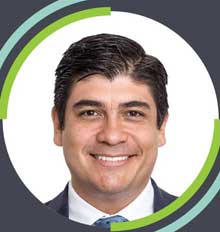
Women Deliver Young Leader Jyotir Nisha discusses with Costa Rican President Carlos Alvarado Quesada on how to harness young people to overcome gender inequality and address climate change in a recent wide-ranging interview.

Quesada says key strategies to designing policy to fight climate change require unconventional decision-making to address challenges like climate change, biodiversity loss, the fourth industrial revolution, and inequality.

“These are intertwined factors that can hinder development if unattended but, if tackled, they could potentially accelerate progress and wellbeing for all,” he says.

“And, of course, this is a task that young leaders are able to handle and produce the timely answers that are necessary.”

Bringing in her experience in the non-profit sector, Nisha says training girls and women in up-cycling plastic waste to produce handmade goods has assisted them to contribute to their family income and their empowerment in the community. The question is, how can this be broadened.

Quesada says women, in particular young women, are leading the way.

Costa Rican President Carlos Alvarado Quesada. Credit: Women Deliver

“From cooperative seed banks, to early warning networks, from solar engineers to women politicians carving a path of sustainable policymaking. They are at the forefront of forest conservation, sustainable use of resources, and community enhancement, and restoration of landscapes and forest ecosystems,” he says.

However, women’s roles are often underestimated, unrecognised, and unpaid.

“Women and girls with access to technology have already begun developing innovative tools to reduce emissions by targeting sustainable consumption and production practices, including food waste, community waste management, energy efficiency, and sustainable fashion.”

The solutions exist, but much more is needed.

“It takes a whole-of-society approach for collaboration and cooperation on a bigger and enhanced scale.”

The President suggests that the way investments are made could be fundamental to ensure a flow of finance to the communities, including women, and youth. This will, he believes, provide “a stable source of funding for businesses and services that contribute to the solution of social or environmental challenges.”

The impact of this will be partnerships between traditional sources of finance, like international cooperation and development banks, and new partners, like philanthropy, hedge funds, or pension funds.

“And what better than young people giving the thrust that all this requires?”

Nisha says she was pleased to see the massive mobilisation of young people at the inaugural Climate Action Summit last year. The summit had little good news for climate change with concerns raised that the accelerating rise in sea level, melting ice would have on socio-economic development, health, displacement, food security and ecosystems. However, beyond taking to the streets, they also need to hold decision-makers accountable.

“In the last months we have witnessed the irruption of massive mobilisations in different parts of the world, lead mostly by young people. This would seem surprising for a generation that has been accused several times of passivity, indifference, and individualism,” Quesada says. “I truly believe that, as long as these demands are channelled through democratic and pacifist means, they are extremely important to set a bar and a standard of responsibility for us, decision-makers — who are, by the way, more and more often, young people.”

He adds that world leaders owe them explanations of the decisions made.

“We must also have the wisdom to pay attention to these demands and take into account their opinions and proposals to reach agreements that have the legitimacy of consensus-building.”

However, Nisha notes, while campaigns like the Deliver for Good campaign is working across sectors reports at COP25, and the recent World Economic Forum (Davos), “climate change continues to threaten progress made toward gender equality across every measure of development.”

At WEF Global Gender Gap Report 2020 showed that it would take more than a lifetime, 99.5 years in 2019 for gender parity across health, education, work and politics to be achieved.

Quesada says the climate catastrophe “demands that policymakers and practitioners renew commitments to sustainable development — at the heart of which is, and must continue to be, advancing gender equality and women’s empowerment, and realising women’s rights as a pre-requisite for sustainable development.”

Costa Rica, he says, has been recognised internationally on two significant areas: the respect of human rights and environmental protection.

“The present Administration has taken these objectives a step further by paying particular attention to women’s rights, inclusion, and diversity, and including them as part of our core policy principles and our everyday practices,” he says. “We expect to increase women’s integration into productive processes and achieve women’s economic empowerment through specific policies linked to our long-term development strategy — the Decarbonization Plan — allowing the transformational changes our society needs.

However, the critical question, Nisha says, is: “What can world leaders and governments do today to ensure young people have a seat at the decision-making table?”

Quesada is confident that young people will be part of the solution.

“The challenges we are facing today are unprecedented precisely because previous generations did not have to face situations such as biodiversity loss, global warming, or the emergence of artificial intelligence and technology. Thus, we need new answers and solutions from Twenty-First Century people, and those should and will be put forward by the youth,” he says.

The importance of youth involvement was recently highlighted too at the meeting of African Leaders for Nutrition in Addis Ababa. African Development Bank (AfDB) President Akinwumi Adesina said Africa should invest in skills development for the youth so the continent’s entrepreneurs can leverage emerging technologies to transform Africa’s food system to generate new jobs. This is especially urgent as the population on the continent is expected to double to 2.5 billion people in 40 years putting pressure on governments to deliver more food and jobs in addition to better livelihoods.

In a recent interview with IPS International Institute for Tropical Agriculture (IITA) Director General, Nteranya Sanginga, explained that this change is neither easy or necessarily something all leadership has taken on board.

“Our legacy is starting a programme to change the mindset of the youth in agriculture. Unfortunately (with) our governments that is where you have to go and change mindsets completely. Most probably 90 per cent of our leaders consider agriculture as a social activity basically for them its (seen as a) pain, penury. They proclaim that agriculture is a priority in resolving our problems, but we are not investing in it. We need that mindset completely changed.”

Quesada is unequivocal that this attitude needs to change.

“My advice to world leaders is to have the humility to listen to the people and to allow more inclusive and participatory decision-making. And to the young people, I can only encourage them to own their future, and to act accordingly, with vision, courage, and determination.”


COVID-19 in the Time of Insecurity

Civil Society, Crime & Justice, Development & Aid, Economy & Trade, Education, Featured, Gender, Global, Headlines, Health, Human Rights, Humanitarian Emergencies, Inequity, TerraViva United Nations

Opinion

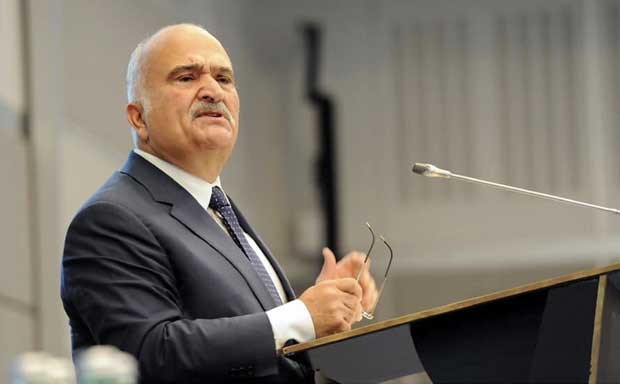
HRH Prince El Hassan bin Talal

AMMAN, Jordan, Mar 26 2020 (IPS) – Humankind has outlived multiple pandemics in the course of world history. The kingdoms and states of Central and Western Europe abolished the institution of serfdom once it had become clear that medieval rule in the aftermath of devastating pestilence would founder without ending the dependency and servitude that characterized the Dark Ages. The vulnerability of entire nations to the risk of total collapse in the absence of widespread access to the most basic healthcare in the Spanish Flu spurred governments to build the public health systems that have made the progress and development of the last hundred years possible. If the past is prologue, then continuity and survival command that we change.


We have more often than not banded together in the face of all kinds of threats. In all its ramifications, COVID-19 threatens to push our social, political and economic structures to the brink. Disease, recession and fright can rapidly overwhelm states and societies. Each coming day will bring increasing challenges that can only be met by caring for the sick, minimizing the impact of shutdowns on lives and livelihoods, securing the delivery of adequate water, food and energy supplies, and racing for a cure. Success – as in an asymmetric conflict – rests on resilience. To contain the socio-political and socio-economic fallout from the crisis, policymaking efforts should center on human dignity and welfare as the bedrock of national and international security.

The most vulnerable members of society in some parts of our world are those on the front lines of the crisis: the doctors, nurses, care-givers, pharmacists, sanitation workers, farmers, supermarket cashiers and truck drivers whose courage, sacrifice and dedication will see us through the next 12 to 18 months of expected lockdowns. In the absence of state support, what will happen to the hundreds of thousands of people who have already been laid off, while millions more face looming hardship as the numbers of layoffs grow? Some will continue to ignore the vulnerable and marginalized, those who have least access to humanitarian assistance, while others will continue to exploit them. The calls for social distancing have grown louder and more frequent over the last couple of days, and as we begin to separate from one other we must remember our humanitarian duty to each another.

Security, far from being individual, is collective and global. The current crisis calls for transcendent thinking between politicians on both sides of the aisle. Grey areas in politics in which zero-sum games and the perverse logic of mutually assured destruction proliferate will not protect and promote human dignity and welfare. Conservatives and reformers must now move beyond the tournaments and arm-twisting of politics. The logic of mutually assured survival cannot accept grey areas. If conflict resolution transcends political beliefs, nationality, ethnicity, gender, and religion, then human dignity and welfare is the benchmark of the humanitarian commitment to life.

Reliable brokers in the management of this crisis and other crises do exist as in the International Committee of the Red Cross and Médecins Sans Frontières. Corporate social responsibility requires developing a public platform of health facts so that people-to-people conversations and consultations can be promoted through civil society, the media and educational institutions. We cannot cherry-pick energy and climate change without talking about health or education and human dignity. Migrants and refugees must be an integral part of the national response for halting the spread of the novel coronavirus. The United Nations Economic and Social Commission for West Asia reports that 55 million people, in West Asia region, require some sort of humanitarian assistance and that the vulnerability of displaced women and girls is especially heightened in a pandemic. Post-conflict insecurity – whether in countries ravaged by war or across the urban centers and countrysides of advanced economies overwhelmed by disease – can only be addressed in the careful terrain mapping of humanitarian access. Yemen, Syria, Gaza and Libya are frighteningly vulnerable to the onslaught of epidemics – what will peace uncover there when the wars end?

Regional insecurity is heightened in the absence of cooperation, but the multilateral system is not at a loss in facing an existential crisis. European solidarity has been sharply damaged by the onset of widespread disease although China is performing through the swift and effective action that has come to the aid of the people and government of Italy. Multilateralism today can only be revisited with a focus on the interdisciplinary priorities of the twenty-first century that include addressing the need for a Law of Peace. We draw humanitarian concessions from the law of war in times of conflict, but have no recourse to legal instruments that can secure the dignity and welfare of all in times of peace.

The current crisis is as much a global health crisis as it is a crisis of the globalization that has come to undermine the foundations of modern society with its rampant inequality and rising injustice and which threatens the very survival of our species with climate change. The planet that we share with other organisms is fragile and prone to crises. A resolution to our predicament will take nothing short of extending the ethic of human solidarity beyond the contours of our immediate response to the outbreak of COVID-19. Real success lies not in the taming of a pathogen or in re-discovering the value of compassion, respect and generosity, but in institutionalizing these values in the days, weeks and months ahead.

  Source

Preserving World’s Biodiversity: Negotiations Convene at FAO Headquarters

Biodiversity, Civil Society, Climate Change, Conferences, Economy & Trade, Environment, Featured, Food & Agriculture, Gender, Global, Headlines, Indigenous Rights, Natural Resources, TerraViva United Nations

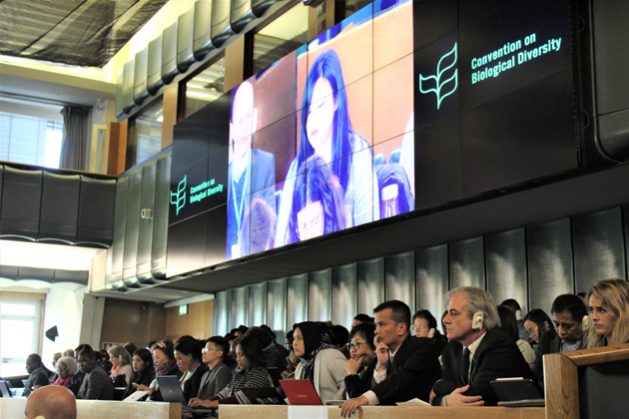
Delegates gather at FAO headquarters to advance negotiations of the post-2020 global biodiversity framework. Credit: Maged Srour/IPS

ROME, Feb 24 2020 (IPS) – “The world out there is watching and waiting for results,” Elizabeth Maruma Mrema warns while talking to IPS regarding the preservation of biodiversity of our planet.


The acting Executive Secretary of the Secretariat of the Convention on Biological Diversity, is referring to a worrying report[1] released by the Food and Agriculture Organization (FAO) which paints a grim picture of the planet.

“Many key components of biodiversity for food and agriculture at genetic, species and ecosystem levels are in decline and evidence suggests that the proportion of livestock breeds at risk of extinction is increasing,” the report says.

The FAO also warns that “nearly a third of fish stocks are overfished, and a third of freshwater fish species assessed are considered threatened”.

These are just some of the critical issues being debated during the open-ended working group on the post-2020 biodiversity framework. This round of negotiations is taking place at FAO headquarters from 24 to 29 February. In the run-up to October’s historic UN Biodiversity Conference, government officials, experts and activists from around the world gathered today at FAO headquarters, Rome, to forge ahead with negotiations. This round of talks was supposed to take place in Kunming, China, on the same dates. Due to the ongoing situation following the outbreak of the novel coronavirus 2019 (COVID-19), it was moved to Rome, Italy.

Background

The fourteenth meeting of the Conference of Parties (COP) to the Convention on Biological Diversity (CBD) had its meeting in Sharm el-Sheikh, Egypt, in 2018. It was here that the working group on the post-2020 global biodiversity framework was appointed. The working group’s mandate was to prepare the text of a framework that would guide the work of the Convention after the year 2020. At the working group’s first meeting held in Nairobi in August 2019, the Open-ended Working Group (WG2020) requested the Co-Chairs and the Executive Secretary to prepare a zero-draft text of the post-2020 global biodiversity framework. This framework is under consideration at its second meeting, which is currently taking place in Rome. The aim of the second meeting of the Working Group is to significantly advance the negotiation of the post-2020 global biodiversity framework, discussing the different aspects of the whole ambitious project.

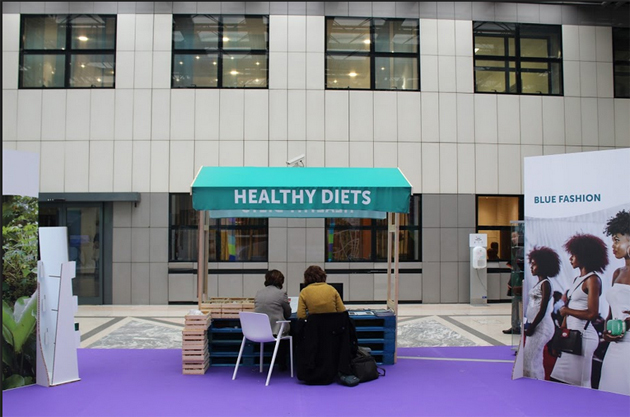
‘Healthy Diets’ was among the proposed initiatives during the first day of the six-day event at FAO headquarters. The initiative emphasised the importance of ‘geographical indications’ for biodiversity, with examples and experiences from Africa and Eastern Europe. Credit: Maged Srour/IPS

Negotiations in Rome: Promoting a bi-directional approach

In the coming days, the working groups will be divided on a regional basis. They will discuss a wide variety of concerns including biodiversity, food, agriculture and fishing systems, to the importance of promoting an approach that leaves no one outside of this circuit. Civil society, the private sector, indigenous people, local communities, women and youth are all represented to create a functional framework for the whole society and at all levels. Many organisations, like Bioversity International, supported by a host of international agencies, have submitted research reports on biodiversity and food systems. It has also made representations on alternative models for access and benefit-sharing rules, practices and impacts in the Post-2020 Global Biodiversity Framework.

The voice of indigenous people

Key to the discussions is the role of indigenous people in biodiversity and Aslak Holmberg, the representative of the indigenous people, is convinced that policymakers can learn from these groups.

“There is a key message we want to share with other groups here during these negotiations,” he told IPS. “Indigenous peoples and local communities’ management of natural resources is (in fact) conserving biodiversity. (This is) because these management practices are built on a balanced relationship with the respective environment.

“Biological and cultural diversity are linked, and by this, I mean that (for indigenous communities) culture plays a fundamental role in the process of preserving biodiversity: it is in our culture to use our areas in a sustainable way. That is the message we want to share with others”.

The voice of the business sector

Representatives of the private sector too, in particular of the business world, wish to be part of the framework that will result from the negotiations and officially approved in October, in China.
Eva Zabey, Executive Director of the Business for Nature Coalition, told IPS she was grateful to the CBD secretariat for giving business and opportunity to engage and contribute to the zero draft of the post-2020 framework.

This coalition is a unique global group of influential business and conservation organisations participating in the negotiations.

“Forward-thinking businesses are starting to change the way they operate, based on their understanding of the value of nature – but this is still the exception, not the norm,” she told IPS.
“Therefore,” said Zabey, “Political leadership is needed now to transform our economic and financial systems in a way that places nature at the heart of global decision-making. It needs to create a level playing field and a stable operating environment for business.”

Zabey is looking forward to an ambitious post-2020 framework which will facilitate businesses’ involvement and create and positive “policy-business feedback loop,” she said.

Perspectives

Audrey Azoulay, United Nations Educational, Scientific and Cultural Organization (UNESCO) Director-General, perfectly summarised urgency at the negotiation.

Commenting on the global assessment report, she said: “The present generations have the responsibility to bequeath to future generations a planet that is not irreversibly damaged by human activity.”

“Our local, indigenous and scientific knowledge are proving that we have solutions and so no more excuses: we must live on earth differently”.

Zabey echoes Azouley. She said entrepreneurs are increasingly aware that the profit-sustainability ‘conflict’ is no longer feasible or conceivable.

“Companies planning on being successful in the future are starting to realise that financial performance is irrelevant on a dead planet.’

[1] http://www.fao.org/3/CA3129EN/ca3129en.pdf


2020 Is the Decade of Action & It Has to Be a Sprint

Africa, Armed Conflicts, Climate Change, Conferences, Crime & Justice, Development & Aid, Economy & Trade, Featured, Gender, Global, Headlines, Human Rights, Labour, Peace, Poverty & SDGs, Sustainability, TerraViva United Nations, Trade & Investment

Opinion

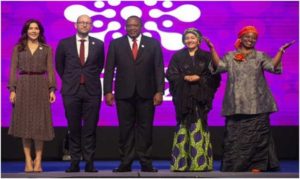
Hosted by the governments of Kenya, Denmark and UNFPA, world leaders gather for the 3-day Nairobi Summit on ICPD25 to advance sexual, reproductive health & rights for all. November 12, 2019. Photo Courtesy: Redhouse Public Relations

NAIROBI, Kenya, Dec 31 2019 (IPS) – Happy New Year, Kenya. 2020 marks a decade of action towards the realization of the Sustainable Development Goals by 2030.

Peace and development are inextricably linked, with each making the achievement of the other far more likely. This puts the conflict-prevention and development work of the UN at the heart of the agenda in East Africa, but in a multi-agency and programme environment, making meaningful progress is challenging.


Aware of this, the UN began a process of structural reforms led by the UN Secretary-General António Guterres who made reforms of the United Nations, a priority at the very beginning of his term in January 2017. The aim being to deliver better results through cooperation, collaboration and integration. 2019 was the year that the impact of these reforms became real and nowhere more than in the peace, conflict-prevention and development pillars of the UN’s work.

At the country level, that shift towards a nimble, 21st century UN challenges deeply entrenched practices and operations. In a country team with over 23 individual agencies, funds and programmes, the reform process can be complicated, even messy.

To the credit of the Kenya country team, we overcame the challenges of ceding long-held agency interests for the collective good and achieved some ground-breaking milestones in our partnership with governments, civic organizations and the private sector.

The most outstanding was our venturing out to confront challenges that transcend borders. East Africa faces major threats to peace and development across multiple fronts, and respective UN country teams have, in a remarkable show of teamwork, sought to harmonize their responses to these threats. Internecine border conflicts and the effects of climate change together make a formidable challenge that brought together UN teams from Kenya and Uganda, in a pact that seeks to bring sustainable development to the Karamoja triangle.

This pact follows from another successful regional collaboration project on the Kenya-Ethiopia border where communities accustomed to recurrent hostilities are now reaching out to each other to find solutions to common socio-economic challenges.

We believe that our regional surge towards prevention, peacemaking and diplomacy will have a particular impact on the youth, who suffer an enduring sense of being neglected and ignored. This narrative is a breeding ground for extremism and radicalization, so addressing such concerns was a key point of deliberation during last July’s African Regional High-Level Conference on Counter-Terrorism and the Prevention of Violent Extremism in Nairobi.

The same regional approach was behind the initiative by Kenya, Uganda, Tanzania, Ethiopia and Somalia to sign the Declaration and Action Plan to End Cross-border FGM in April 2019. This was the first time multiple countries had come together to tackle this pernicious cross-border crime.

But there remain many in the region still left behind by development, and we continue to stand up for them through our UN Development Assistance Framework 2018-2022. The framework’s gender equality and rights focus is unmistakable, because in too many communities, the simple fact of being born female shatters one’s chances of living in full human dignity.

Our focus on giving a leg-up to those left farthest behind has attracted a positive response from our partners in national and county governments. By staying in lockstep with national priorities on issues such as health, agriculture and housing, the common thread of messages from our partners is that we are staying effective and responsive to the ambitions of Kenyans.

As 2020 beckons, the decade of action starts and it has to be a sprint to deliver on the SDGs, the UN team in Kenya is rolling up its sleeves with greater urgency, ambition and innovation. We will enhance regional cooperation and private-public partnerships as we work with the Government towards lifting millions of the citizens of this region out of poverty and upholding their human rights.

We are re-imagining ways of delivering development in ways such as the co-creation of an SDG innovation lab between the Government of Kenya, the Centre for Effective Global Action at the University of California in Berkeley, the Rockefeller Foundation, and the UN. The SDG Lab will kick off with support for the delivery of Kenya’s Big Four agenda by harnessing, big data, technology and innovation to achieve scale and impact.

As a UN country team, we got off the blocks in 2019 in pursuit of UN Deputy Secretary General Amina Mohammed’s challenge to “flip the orthodoxy” for the repositioning of the UN. We have dared to go beyond the typical and will do whatever it takes to respond effectively to the challenges faced by Kenya’s people, now and in the future.

Siddharth Chatterjee is the United Nations Resident Coordinator in Kenya.