Evaluation Finds Food Systems Programs Deliver Results but Warns of Missed Transformation Chances

Asia-Pacific, Climate Change, Conferences, Development & Aid, Economy & Trade, Environment, Featured, Food and Agriculture, Food Systems, Global, Headlines, Sustainable Development Goals, TerraViva United Nations
Food Systems

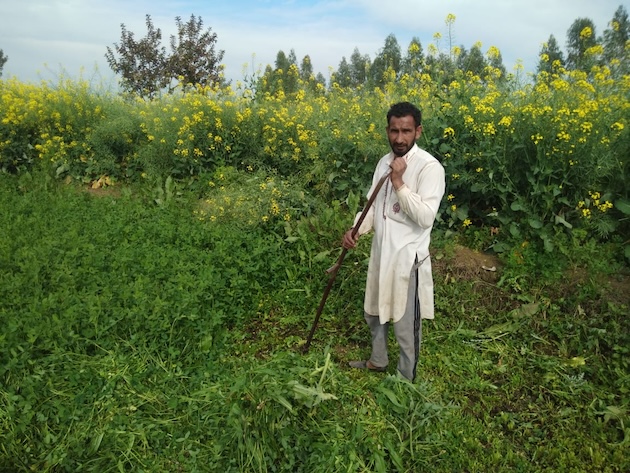
The Global Environment Facility’s food systems program found that its programs are highly relevant to global efforts to curb deforestation, land degradation, biodiversity loss and greenhouse gas emissions from agriculture, fisheries, and commodity supply chains. Pictured here is a farmer in Kashmir's frontier hamlet of RS Pura bordering Pakistan, farmers in this region have been affected by both climate change and conflict. Credit: Umar Manzoor Shah/IPS

The Global Environment Facility’s food systems program found that its programs are highly relevant to global efforts to curb deforestation, land degradation, biodiversity loss and greenhouse gas emissions from agriculture, fisheries, and commodity supply chains. Pictured here is a farmer in Kashmir’s frontier hamlet of RS Pura bordering Pakistan, farmers in this region have been affected by both climate change and conflict. Credit: Umar Manzoor Shah/IPS

WASHINGTON, D.C & SRINAGAR, Nov 21 2025 (IPS) – A new independent evaluation of the Global Environment Facility’s food systems programs says they are delivering strong environmental and livelihood gains in many countries but warns that a narrow focus on farm production, weak political analysis, and shrinking coordination budgets are holding back deeper transformation.


The Evaluation of GEF Food Systems Programs, prepared by the GEF Independent Evaluation Office for the 70th GEF Council in December 2025, reviews five major programs from GEF 6 to GEF 8. Together they cover 84 projects in 32 countries, backed by about USD 822 million in GEF finance and more than USD 6 billion in co-financing.

The report finds that the programs are highly relevant to global efforts to curb deforestation, land degradation, biodiversity loss and greenhouse gas emissions from agriculture, fisheries and commodity supply chains. They also respond to growing pressure on food systems as the world’s population rises and millions still lack access to healthy diets.

“Food systems are major drivers of global forest and biodiversity loss, land degradation, water pollution and greenhouse gas emissions,” the report notes. It says GEF funding has helped countries design more integrated approaches that connect environmental goals with farming, fisheries and rural development.

Results Most Visible at Community Level

During a webinar to launch the report, Fabrizio Mario Dante Felloni, Deputy Director of the Independent Evaluation Office, said the team had used a systemic lens, looking at the whole food system rather than isolated projects. The evaluation drew on document reviews, geospatial analyses, surveys, interviews, and case studies in Ghana, Indonesia, Peru, and Tanzania.

Felloni said the programs mark a clear shift from earlier, more fragmented efforts. They try to connect ministries and sectors that often work in isolation. “Because it was a food system, looking at the different sectors involved” was central to the design, he explained during the presentation.

The evaluation confirms that GEF food systems projects address several environmental pressures at once. Most initiatives target land and soil degradation, deforestation and biodiversity loss, often through better land use planning, sustainable farming practices, and stronger governance of coastal fisheries. Many projects also seek to link environmental gains with better incomes, skills for women and youth, and improved food security.

Results are most visible at the community level. The report highlights gains in biodiversity, improved land management and reduced emissions when farmers have adopted climate-smart or ecosystem-friendly practices. Socioeconomic benefits include higher yields and incomes, new skills for women, and greater youth engagement in agriculture.

At a meso level, some projects are improving value chains through better market access, traceability and basic processing support. At the macro level, the evaluation records progress on policies and governance, including multi-stakeholder platforms, land use and marine planning, and early steps toward aligning national and local policies.

Yet the evaluation also finds clear gaps. While more than 90 percent of projects focus on the production stage, only about 40 percent look seriously at postharvest issues such as storage, processing, transport and markets. Very few tackle food loss, waste or dietary change, even though these are critical for shifting entire food systems.

“Despite having an ambition to look at the food system and value chains, there was still a production-focused type of approach,” Felloni said. Environmental drivers and biophysical issues receive strong attention in design, but only 40 percent of projects examine the political context, and around 30 percent look closely at socioeconomic drivers.

That limited attention to political economy and social dynamics restricts transformational potential, the report argues. It notes that many designs assume that coordination and platforms will naturally lead to policy alignment, without fully analyzing power relations, trade offs or vested interests.

‘Coordination Budgets Are Shrinking’

Jessica Kyle of ICF, who led parts of the evaluation, told the webinar that private sector engagement has been a “key feature” of the food systems programs. Around two-thirds of country projects include some engagement with businesses, from public private partnerships and capacity building to support for national commodity platforms. At the global level, partners such as the International Finance Corporation have mobilized significant private finance for sustainable commodities.

However, she said scaling these efforts remains difficult. Fragmented supply chains, often weak regulatory incentives for sustainability, and unclear business cases are some of the challenges. Programs have also struggled to link global work on standards and finance with activities in country projects.

On the program approach itself, Kyle said the evaluation found real added value. Stronger program governance, shared design frameworks and knowledge pathways have improved the coherence of activities and allowed influence to extend beyond individual project boundaries. The programs have generated many knowledge products, trainings and learning events and have increasingly shifted from broad global exchanges to more targeted regional and commodity-focused dialogues.

Even so, the report finds “relatively limited evidence” that countries are applying this knowledge in a systematic way. Timing is one reason. In some cases, guidance arrived before projects were ready to use it. In others, knowledge products were not tailored to local needs, or project teams were reluctant to adjust activities mid-course.

To address this, the evaluation calls for stronger “country docking” so that global coordination projects can provide support when countries actually need it and in forms they can absorb. It also urges more participatory processes to identify country demands for technical assistance and learning.

A recurring concern is that coordination budgets are shrinking, even as the scope of programs widens. Coordination funding fell from about 10 percent of total program cost in GEF 6 food systems programs to around 7 percent in GEF 8, even though the number of countries and commodities grew. The report warns that this gap risks undermining the entire programmatic promise, since meaningful integration and tailored support require time, travel and staff.

The Catalytic Capital

Speaking for the GEF Secretariat, Peter Mbanda Umunay, thematic lead for food systems and land use, welcomed the evaluation and said many of its findings were already shaping the design of GEF 8 and early thinking on GEF 9. He described it as “one of the less contentious evaluations,” noting that the Secretariat agreed with most points.

Umunay traced the evolution from the first Integrated Approach Pilots in 2015, focused on resilient food systems in sub-Saharan Africa and commodity supply chains, to the FOLUR Impact Program in GEF 7 and the Food Systems Integrated Program in GEF 8. Over time, he said, the Secretariat has tried to tighten links between global coordination platforms and country projects and to use limited GEF funds more strategically as catalytic capital.

He highlighted efforts to promote “country docking” so that information and technical support flow more clearly between global hubs and national projects. The aim is to empower coordination platforms with enough resources and authority to structure strong connections with governments.

On private finance, Umunay said the evaluation had reinforced the case for using GEF resources to unlock much larger flows. By using GEF grants to de-risk investments or support blended finance, he argued, programs can shift perceptions that agriculture and land use are too risky for private investors and bring in both large companies and small and medium enterprises.

He also accepted the criticism that programs focus too much on production and not enough on postharvest value chains. This, he said, is now being addressed in GEF 8 and in plans for GEF 9, including through work on processing, storage, school meal schemes and nutrition outcomes, which can also bring in more ministries and strengthen policy coherence.

The evaluation ends with four main recommendations. It calls on the GEF to sharpen the focus of food systems programs and consider phasing them across replenishment periods so that countries can move from readiness and pilots to larger-scale investments over longer time frames. It urges a broader focus beyond production, especially on value chain integration and demand-side measures, where this can secure environmental and social gains.

The report also recommends deeper analysis of political economy and behavior change at design and during implementation and stronger country docking to turn knowledge and global services into real changes on the ground.

Umunay said the Secretariat had already prepared a management response and would use the findings to strengthen current and future programs. He stressed that the GEF remains country-driven. Governments must see these programs as supporting their priorities, from climate plans and food security strategies to rural development.

“We have been very successful in some countries that have continuously applied this program all across,” he told participants. “We will continue to do that, and this evaluation is eye-opening for the next steps.”

IPS UN Bureau Report
 

Recipes with a Taste of Sustainable Development on the Coast of El Salvador

Biodiversity, Civil Society, Development & Aid, Economy & Trade, Editors’ Choice, Energy, Environment, Featured, Food & Agriculture, Global Governance, Green Economy, Headlines, Integration and Development Brazilian-style, IPS UN: Inside the Glasshouse, Latin America & the Caribbean, Poverty & SDGs, Projects, Regional Categories, Special Report, TerraViva United Nations

Environment

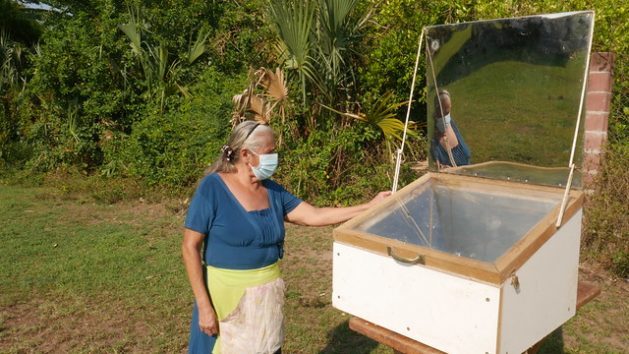
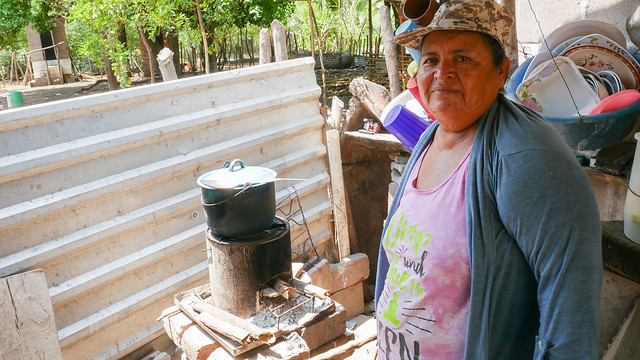
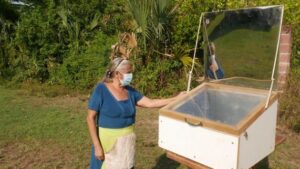
María Luz Rodríguez stands next to her solar oven where she cooked lasagna in the village of El Salamar in San Luis La Herradura municipality. In this region in southern El Salvador, an effort is being made to implement environmental actions to ensure the sustainable use of natural resources. CREDIT: Edgardo Ayala/ IPS

María Luz Rodríguez stands next to her solar oven where she cooked lasagna in the village of El Salamar in San Luis La Herradura municipality. In this region in southern El Salvador, an effort is being made to implement environmental actions to ensure the sustainable use of natural resources. CREDIT: Edgardo Ayala/ IPS

SAN LUIS LA HERRADURA, El Salvador, Mar 31 2021 (IPS) – Salvadoran villager Maria Luz Rodriguez placed the cheese on top of the lasagna she was cooking outdoors, put the pan in her solar oven and glanced at the midday sun to be sure there was enough energy for cooking.


“Hopefully it won’t get too cloudy later,” Maria Luz, 78, told IPS. She then checked the thermometer inside the oven to see if it had reached 150 degrees Celsius, the ideal temperature to start baking.

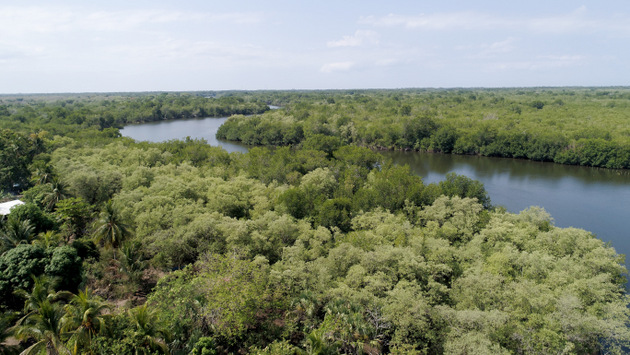
She lives in El Salamar, a coastal village of 95 families located in San Luis La Herradura, a municipality in the central department of La Paz which is home to some 30,000 people on the edge of an impressive ecosystem: the mangroves and bodies of water that make up the Estero de Jaltepeque, a natural reserve whose watershed covers 934 square kilometres.

After several minutes the cheese began to melt, a clear sign that things were going well inside the solar oven, which is simply a box with a lid that functions as a mirror, directing sunlight into the interior, which is covered with metal sheets.

“I like to cook lasagna on special occasions,” Maria Luz said with a smile.

After Tropical Storm Stan hit Central America in 2005, a small emergency fund reached El Salamar two years later, which eventually became the start of a much more ambitious sustainable development project that ended up including more than 600 families.

Solar ovens and energy-efficient cookstoves emerged as an important component of the programme.

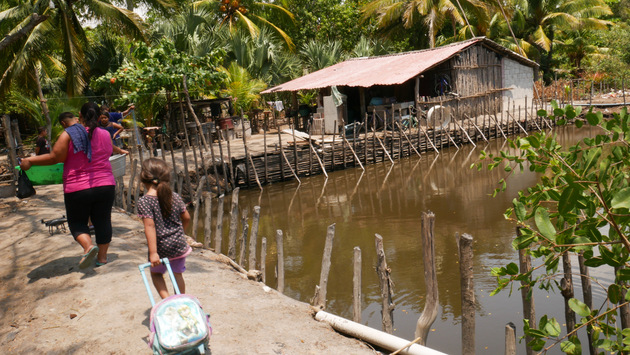
Aerial view of Estero de Jaltepeque, in San Luis La Herradura, a municipality on the Pacific coast in southern El Salvador where a sustainable development programme is being carried out in local communities, including the use of solar stoves and sustainable fishing and agriculture techniques. CREDIT: Edgardo Ayala /IPS

Aerial view of Estero de Jaltepeque, in San Luis La Herradura, a municipality on the Pacific coast in southern El Salvador where a sustainable development programme is being carried out in local communities, including the use of solar stoves and sustainable fishing and agriculture techniques. CREDIT: Edgardo Ayala /IPS

The project was financed by the Global Environment Facility‘s (GEF) Small Grants Programme, and El Salamar was later joined by other villages, bringing the total number to 18. The overall investment was more than 400,000 dollars.

In addition to solar ovens and high-energy rocket stoves, work was done on mangrove reforestation and sustainable management of fishing and agriculture, among other measures. Agriculture and fishing are the main activities in these villages, in addition to seasonal work during the sugarcane harvest.

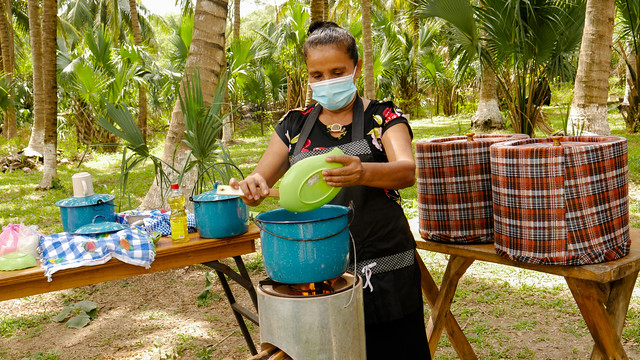
While María Luz made the lasagna, her daughter, María del Carmen Rodríguez, 49, was cooking two other dishes: bean soup with vegetables and beef, and rice – not in a solar oven but on one of the rocket stoves.

This stove is a circular structure 25 centimetres high and about 30 centimetres in diameter, whose base has an opening in which a small metal grill is inserted to hold twigs no more than 15 centimetres long, which come from the gliridicia (Gliricidia sepium) tree. This promotes the use of living fences that provide firewood, to avoid damaging the mangroves.

The stove maintains a good flame with very little wood, due to its high energy efficiency, unlike traditional cookstoves, which require several logs to prepare each meal and produce smoke that is harmful to health.

María del Carmen Rodríguez cooks rice on a rocket stove using a few twigs from a tree species that emits less CO2 than mangroves, whose sustainability is also preserved thanks to the use of the tree. Many families in the community of El Salamar have benefited from this energy-efficient technology, as well as other initiatives promoted along the Pacific coast in southern El Salvador. CREDIT: Edgardo Ayala /IPS

María del Carmen Rodríguez cooks rice on a rocket stove using a few twigs from a tree species that emits less CO2 than mangroves, whose sustainability is also preserved thanks to the use of the tree. Many families in the community of El Salamar have benefited from this energy-efficient technology, as well as other initiatives promoted along the Pacific coast in southern El Salvador. CREDIT: Edgardo Ayala /IPS

The rocket stove can cook anything, but it is designed to work with another complementary mechanism for maximum energy efficiency.

Once the stews or soups have reached boiling point, they are placed inside the “magic” stove: a circular box about 36 centimetres in diameter made of polystyrene or durapax, as it is known locally, a material that retains heat.

The food is left there, covered, to finish cooking with the steam from the hot pot, like a kind of steamer.

“The nice thing about this is that you can do other things while the soup is cooking by itself in the magic stove,” explained María del Carmen, a homemaker who has five children.

The technology for both stoves was brought to these coastal villages by a team of Chileans financed by the Chile Fund against Hunger and Poverty, established in 2006 by the government of that South American country and the United Nations Development Programme (UNDP) to promote South-South cooperation.

The Chileans taught a group of young people from several of these communities how to make the components of the rocket stoves, which are made from clay, cement and a commercial sealant or glue.

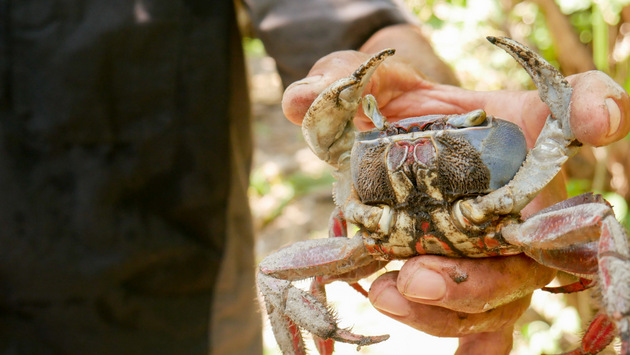
The blue crab is one of the species raised in nurseries by people in the Estero de Jaltepeque region in southern El Salvador, as part of an environmental sustainability project in the area financed by the Global Environment Facility’s Small Grants Programme. CREDIT: Edgardo Ayala/IPS

The blue crab is one of the species raised in nurseries by people in the Estero de Jaltepeque region in southern El Salvador, as part of an environmental sustainability project in the area financed by the Global Environment Facility’s Small Grants Programme. CREDIT: Edgardo Ayala/IPS

The use of these stoves “has reduced carbon dioxide (CO2) emissions by at least 50 percent compared to traditional stoves,” Juan René Guzmán, coordinator of the GEF’s Small Grants Programme in El Salvador, told IPS.

Some 150 families use rocket stoves and magic stoves in 10 of the villages that were part of the project, which ended in 2017.

“People were given their cooking kits, and in return they had to help plant mangroves, or collect plastic, not burn garbage, etc. But not everyone was willing to work for the environment,” Claudia Trinidad, 26, a native of El Salamar and a senior studying business administration – online due to the COVID pandemic – at the Lutheran University of El Salvador, told IPS.

Those who worked on the mangrove reforestation generated hours of labour, which were counted as more than 800,000 dollars in matching funds provided by the communities.

In the project area, 500 hectares of mangroves have been preserved or restored, and sustainable practices have been implemented on 300 hectares of marine and land ecosystems.

Petrona Cañénguez shows how she cooks bean soup on an energy-efficient rocket stove in an outside room of her home in the hamlet of San Sebastián El Chingo, one of the beneficiaries of a sustainable development programme in the municipality of San Luis La Herradura, on El Salvador's southern coast. CREDIT: Edgardo Ayala /IPS

Petrona Cañénguez shows how she cooks bean soup on an energy-efficient rocket stove in an outside room of her home in the hamlet of San Sebastián El Chingo, one of the beneficiaries of a sustainable development programme in the municipality of San Luis La Herradura, on El Salvador’s southern coast. CREDIT: Edgardo Ayala /IPS

Petrona Cañénguez, from the town of San Sebastián El Chingo, was among the people who participated in the work. She was also cooking bean soup for lunch on her rocket stove when IPS visited her home during a tour of the area.

“I like the stove because you feel less heat when you are preparing food, plus it’s very economical, just a few twigs and that’s it,” said Petrona, 59.

The bean soup, a staple dish in El Salvador, would be ready in an hour, she said. She used just under one kilo of beans, and the soup would feed her and her four children for about five days.

However, she used only the rocket stove, without the magic stove, more out of habit than anything else. “We always have gliridicia twigs on hand,” she said, which make it easy to use the stove.

Although the solar oven offers the cleanest solution, few people still have theirs, IPS found.

This is due to the fact that the wood they were built with was not of the best quality and the coastal weather conditions and moths soon took their toll.

Maria Luz is one of the few people who still uses hers, not only to cook lasagna, but for a wide variety of recipes, such as orange bread.

However, the project is not only about stoves and ovens.

 Some families living in coastal villages in the municipality of San Luis La Herradura have dug ponds for sustainable fishing, which was of great help to the local population during the COVID-19 lockdown in this coastal area of southern El Salvador. CREDIT: Edgardo Ayala /IPS

Some families living in coastal villages in the municipality of San Luis La Herradura have dug ponds for sustainable fishing, which was of great help to the local population during the COVID-19 lockdown in this coastal area of southern El Salvador. CREDIT: Edgardo Ayala /IPS

The beneficiary families also received cayucos (flat-bottomed boats smaller than canoes) and fishing nets, plus support for setting up nurseries for blue crabs and mollusks native to the area, as part of the fishing component with a focus on sustainability in this region on the shores of the Pacific Ocean.

Several families have dug ponds that fill up with water from the estuary at high tide, where they raise fish that provide them with food in times of scarcity, such as during the lockdown declared in the country in March 2020 to curb the spread of coronavirus.

The project also promoted the planting of corn and beans with native seeds, as well as other crops – tomatoes, cucumbers, cushaw squash and radishes – using organic fertiliser and herbicides.

The president of the Local Development Committee of San Luis La Herradura, Daniel Mercado, told IPS that during the COVID-19 health emergency people in the area resorted to bartering to stock up on the food they needed.

“If one community had tomatoes and another had fish, we traded, we learned to survive, to coexist,” Daniel said. “It was like the communism of the early Christians.”

  Source