15 Years After the Civil War Ended, Sri Lanka Faces Another Crucial Election

Armed Conflicts, Asia-Pacific, Civil Society, Crime & Justice, Development & Aid, Featured, Headlines, Human Rights, Humanitarian Emergencies, International Justice, Sustainable Development Goals, TerraViva United Nations

Democracy

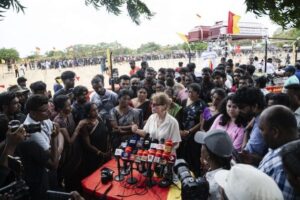
Agnes Callamard, Secretary General of Amnesty International, addresses the media and the community at the site of the Mullivaikal massacre. She says justice is overdue for the families of those killed and disappeared during the Sri Lankan civil war. Credit: Johan Mikaelsson/IPS

Agnes Callamard, Secretary General of Amnesty International, addresses the media and the community at the site of the Mullivaikal massacre. She says justice is overdue for the families of those killed and disappeared during the Sri Lankan civil war. Credit: Johan Mikaelsson/IPS

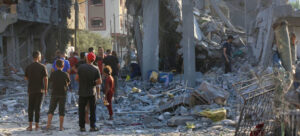
MULLIVAIKAL, Sri Lanka , Sep 16 2024 (IPS) – Thousands of Tamils are heading to Mullivaikal on the northeast coast of Sri Lanka, many of whom were here 15 years ago and still live in the region. They are there, May 18, to commemorate the massacre of civilians in a ‘no fire zone’ during the final stages of the civil war.


This was the last day of the bloody civil war, which raged mainly in the northern and eastern parts of the island since 1983. The Liberation Tigers of Tamil Eelam (LTTE) guerrillas had finally surrendered to the Sri Lankan government. The aftermath continues to rock the island.

The ethnic conflict between the island nation’s majority Sinhalese population and the minority Tamils (who were in the majority in the north and east) had escalated after 1948 when the country gained independence from Britain, the last in the line of colonial powers.

The whole island suffered during the war. Sri Lankan Tamils have been through a lot, especially those who lived in the war-torn north. Everyone who came to the beach on this day of remembrance wants to honor the memory of loved ones who fell victim and the blood that was spilled in the sand.

“Everyone here has a family member or relative who didn’t make it,” explains the teacher Shanmuganathan, who has stopped with his motorcycle by the road where porridge made from rice, the only thing that was available to eat in the war zone, is being offered before Memorial Day.

The war has left its mark. He shows scars from shrapnel and tells us that he lost his wife in the final stages of the war. He has continued to work and is involved in a teacher’s union.
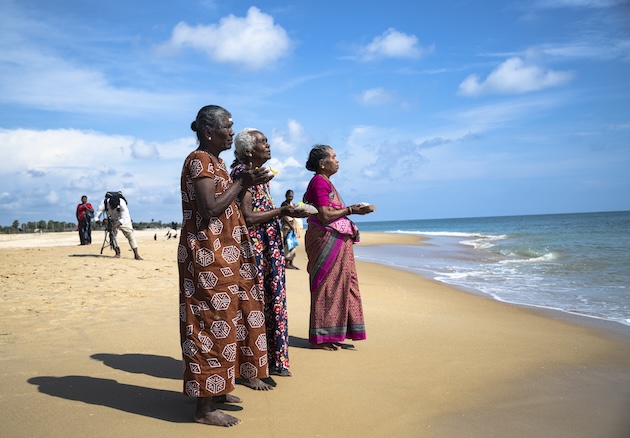
Women pray during the commemoration of the Mullivaikal massacre. Thousands died in no fire zones in the final days of the war. Credit: Johan Mikaelsson/IPS

Women pray during the commemoration of the Mullivaikal massacre. Thousands died in no fire zones in the final days of the war. Credit: Johan Mikaelsson/IPS

Internationally, the calls to investigate targeted bombings of civilians, mass executions of surrendering Tiger soldiers and leaders, widespread sexual violence and other torture are no longer as loud. Many of those who protested and demanded to know what happened to missing relatives have died without receiving any response from the government.

When war crimes are discussed, the government side highlights that the terrorist-branded LTTE carried out acts of terror against civilian targets in the south and that Tamils in the north were used as human shields.

The peace process that began in 2002 with a ceasefire and peace talks led by the Norwegian government and facilitator Erik Solheim stalled and the ceasefire agreement was torn apart by the parties. Sri Lankan government forces in 2008 launched a final offensive to capture the parts then still controlled by the LTTE, which had been fighting for a separate Tamil state in the northern and eastern parts of the island.

In early 2009, the Tigers abandoned their main stronghold, the town of Kilinochchi. The areas under guerrilla control were shrinking ever faster. Tiger leader Velupillai Prabhakaran did not listen to calls to lay down arms and surrender. Eventually, a narrow coastal strip remained, with several hundred thousand civilians and the remnants of the guerrilla movement pressed together and under fire from land, sea, and air.

For Remembrance Day, a school in the town of Puthukkudiyiruppu is organizing a poetry competition. One of the participants, Kamsaini, now 24, wants to share her experiences with the schoolchildren, who were born after the war.

“The generations after me know nothing about the pain I felt these days. We had neither food nor water and I lost several family members; some died, and my sister is missing,” explains Kamsaini.

In place under the hot sun in Mullivaikal is Agnes Callamard, Secretary General of Amnesty International. During her stay on the island, she has met President Ranil Wickremesinghe, who opened up for the visit, which was not a given. When the Rajapaksa brothers ruled the country (2005-2015, 2019-2022), the government allowed the military and police to prevent Tamils from observing commemorations linked to the war.

One reason why Callamard and Amnesty International want to be there is that she does not want Sri Lanka to “fall off the agenda,” which could happen if the main actor within the United Nations, the Office of the High Commissioner for Human Rights in Geneva, does not succeed with the latest in a series of resolutions on Sri Lanka voted through in the UN Human Rights Council.

She sees the issue of the war in Sri Lanka as a crucial test for the international community. A 30-year-long civil war must not be swept under the carpet, she believes

“Every time we fail to create justice, we all, including the international community, get a wound. We’re here because we don’t want that to happen. We feel the determination of many people in Sri Lanka and civil society, both Tamils and Sinhalese and a range of actors who are committed to seeing justice delivered,” says Callamard.

In this way, it represents a defining moment for the United Nations. Callamard is critical of the UN Security Council, which “has not taken a single step for Sri Lanka.”

Amnesty International advocates, as do a number of states, that the latest resolution must be implemented.

“Just a lot of ‘blah, blah, blah,’ something for the eyes, investments in so-called institutions and nothing, nothing, nothing. Fifteen years. Come on!” she urges.

Even on the island, there are far too many who have done nothing at all.

“The point is that the government in power must step forward, the political parties must step forward, the parliament must step forward, the religious leaders must step forward, cultural leaders must step forward. It should be an issue that everyone rallies around. The problem is that governments are being replaced. So it’s not good enough. Everyone must take their responsibility,” says Callamard.

In Mullivaikal, many people share memories. James Confucius, a Catholic priest, tells how he and a group of people barely made it out of the war zone alive.

“We waved a white flag, and we went in the direction of the soldiers to surrender, but then they shot at us, so we had to turn back,” he says.

They waited in a sand bunker and finally got another opportunity. The soldiers they encountered believed that an injured woman in the group was a Tiger soldier, because she had short hair. The priest pleaded and said she needed hospital treatment, but the soldiers said the woman had to stay.

The group had to move on and when they had gone only a short distance, they heard a shot.

“I turned around and saw that the woman had been shot,” says Confucius.

In total, roughly 300,000 people got out of the war zone. An estimate that has often been used is a death toll of 40,000 civilians in the final stages of the war alone. Tamils state higher numbers, while Sri Lankan authorities write low death tolls, including in the 2010 report by the Lessons Learned and Reconciliation Commission (LLRC), appointed by the government.

The then sitting president, Mahinda Rajapaksa, had previously said that “not a single Tamil civilian has been killed by the military.”

Experts have dismissed the statement as absurd. While the majority of Tamil politicians still refer to “genocide,” the issue of death tolls rarely receives the same attention as it did in the years after the civil war.

The UN Human Rights Council has voted through a number of non-binding resolutions that Sri Lanka is expected to follow, but no real action on the problem has been taken in Sri Lanka. There is also nothing to suggest that this will happen.

None of the main candidates in the presidential election on September 21 have highlighted truth-seeking, the rule of international law, regional power-sharing and reconciliation—what the UN is asking for. The economy is in focus, the nation and the citizens, and all candidates want to stop corruption.

The agreement that the government reached with the International Monetary Fund (IMF), is also being discussed. It was negotiated by President Ranil Wickremesinghe, who is not elected by the people but took over by a vote in Parliament after Gotabaya Rajapaksa resigned and fled the country as a result of the April-July 2022 Aragalya (meaning struggle in Sinhalese) protest movement. Before that, Rajapaksa had appointed Wickremesinghe as Prime Minister.

At the Ministry of Defense (MOD) on the outskirts of the capital Colombo, soldiers and officers move inside the compound, which is surrounded by high walls. For some, the Vesak holiday awaits when the full moon approaches. The armed forces also marked the end of the war and Victory Day, but more quietly than in previous years.

Colonel Nalin Herath is the MOD media spokesperson. Right now, work is being done to adapt the forces to actual needs. Herath says they will shrink to 100,000 by 2030. Many who were previously employed in the military have faced unemployment as civilians.

An urgent issue is trying to bring home hundreds of ex-soldiers who were lured by middlemen to go to Russia to work for Russia’s army. Most are said to have received promises not to take part in battle, which hasn’t been the case.

“We should not have mercenaries in war; it violates international law,” says Nalin Herath.

Some have also fought and died on Ukraine’s side. Herath emphasizes that Sri Lanka is neutral, adheres to non-alignment, and does not want to comment on whether it is worse to fight for Russia, which is waging an illegal war of invasion and committing war crimes.

Close to 20 men from Sri Lanka, who were on the Russian side of the front in June, were confirmed dead. An unknown number of men have surrendered to Ukrainian forces. Hundreds of former soldiers have not been heard from for a long time, which emerged after the Ministry of Defense in April-May opened a telephone line where relatives can call.

Sri Lankans who have become Russian citizens can effectively be stuck in a death trap, as the Sri Lankan government became aware after a delegation traveled to Moscow in June to discuss the matter with the Russian counterpart. It was explained that the Sri Lankans who became Russian citizens are now under Russian law.

As a spokesperson for a military organization, Herath talks about a general goal.

“War means destruction. Both parties suffer. This should not be an era of war. As a soldier, I want to see a peaceful world. The smartest thing would be to avoid the wars,” he states.

He highlights international humanitarian law, which he teaches, both in Sri Lanka and internationally. He mentions the good the Sri Lankan military has done. After the war, minefields were cleared, land was returned and soldiers donated blood to the hospitals.

But he cannot comment on Amnesty International’s statement. Political leaders are responsible for handling this. He nevertheless states:

“Violations occur in all wars. Here we are dealing with isolated cases,” he adds.

Consensus still lingers.

IPS UN Bureau Report

  Source

International Day of Democracy

Civil Society, Democracy, Human Rights, Multimedia, Video

Sep 14 2024 –  
Democracy is as much a process as a goal.

For the ideal of Democracy to be enjoyed by everyone, it requires participation and support.

The international community, national governing bodies, civil society, and individuals – all have a part to play.


By upholding free speech, civil liberties, and the rule of law.

By ensuring institutions are accountable.

By protecting and promoting human rights.

This is especially crucial in a year where more than 50 countries are holding elections.

Half the global population will be casting ballots hoping for a better future.

Yet, these fundamental rights are under attack around the world.

Freedoms are being eroded.

Civic space and civil discourse are diminishing.

Polarization is intensifying and mistrust is growing.

This year’s International Day of Democracy focuses on Artificial Intelligence as a tool for good governance.

Left unchecked, the dangers of AI could have serious implications for democracy, peace and stability.

We have already witnessed the proliferation of misinformation and disinformation.

We are now subjected to the spread of deepfakes – a catalyst for division and hate.

Yet, AI has the potential to promote and enhance full and active public participation, equality, security, and human development.

It can boost education on democratic processes.

It can help shape inclusive civic spaces where people have a say in decisions. And it can hold decision-makers to account.

It is critical to ensure effective governance of AI at all levels – including internationally.

The message is clear: AI must serve humanity equitably and safely.

On this International Day of Democracy, let’s keep working to build a more inclusive, just, and equal world.

[embedded content]

  Source

25TH Anniversary Message to the UN: Prioritize the Culture of Peace in its Leadership Agenda

Civil Society, Democracy, Education, Featured, Global, Global Governance, Headlines, Human Rights, IPS UN: Inside the Glasshouse, Peace, TerraViva United Nations

Opinion

NEW YORK, Sep 13 2024 (IPS) – This opinion piece is being published exactly on the date when twenty-five years ago today the UN took its most forward-looking stride in ensuring a peaceful planet for all of us since the signing of the Charter of the United Nations in 1945.


The UN Charter arose out of the ashes of the Second World War and the UN Declaration and the Programme of Action on a Culture of Peace emerged in the aftermath of the long-drawn Cold War.

On this very day, the United Nations adopted by consensus and without reservation a monumental document on the Culture of Peace that transcends boundaries, cultures, societies, and nations.

Arduous journey

It was an honour for me to Chair the nine-month long open-ended negotiations that led to the agreement on that historic norm-setting document which is considered as one of the most significant legacies of the United Nations that would endure generations.

I introduced the agreed text of that document (A/RES/53/243) on behalf of all Member States for adoption by the Assembly with its President Didier Opertti of Uruguay chairing the meeting. Through this landmark adoption, the General Assembly laid down humanity’s charter for the new approaching millennium.

Ambassador Anwarul K. Chowdhury

This document explains, outlines, and defines everything that the international community has agreed on as the focus of the culture of peace. I would always treasure and cherish the opportunity to lead the process in its adoption and in its subsequent advocacy.

For me this has been a realization of my personal commitment to peace and my humble contribution to humanity. For more than two and a half decades, my focus has been on advancing the culture of peace and I have continued to devote considerable time, energy, and effort to do that.

It has been a long, arduous journey – a journey ridden curiously with both obstacles and indifference. Since July 1997, when I took the initiative to write to our much-loved and highly respected Secretary-General Kofi Annan to create a separate item of agenda of the General Assembly, the path and progress of the culture of peace at UN have been uneven to say the least. For being a part of this journey, I pay tribute to Bangladeshi diplomats who have been true co-travellers.

My life’s experience has taught me to value peace and equality as the essential components of our existence. They unleash the positive forces of good that are so needed for human progress. It is essential to remember that the culture of peace requires a change of our hearts, change of our mindset.

The objective of the culture of peace is the empowerment of people. We should not isolate peace as something separate. It is important to realize that the absence of peace takes away the opportunities that we need to better ourselves, to prepare ourselves, to empower ourselves to face the challenges of our lives, individually and collectively.

Transformation is the essence

The essence of the culture of peace is its message of self-transformation and its message of inclusiveness, of global solidarity, of the oneness of humanity. These elements—individual and global, individual to global—constitute the way forward for the culture of peace.

‘Transformation’ is of the most essential relevance here. The Programme of Action identifies eight specific areas which encourage actions at all levels – the individual, the family, the community, the national, the regional and, of course, the global levels.

Though the Declaration and Programme of Action is an agreement among nations, governments, civil society, media, and individuals are all identified in this document as key actors.

The culture of peace begins with each one of us – unless we are ready to integrate peace and non-violence as part of our daily existence, we cannot expect our communities, our nations, our planet to be peaceful. We should be prepared and confident in resolving the challenges of our lives in a non-aggressive manner. In today’s world, more so, the humanity’s creed should be based on inner oneness and outer diversity.

Enhancing Member States engagement

To accord an enhanced profile to the concept of the culture of peace, since 2012, successive UN General Assembly Presidents convened an annual UN High Level Forum on The Culture of Peace to provide an inclusive, participatory platform for UN Member States, civil society, media, private sector and other interested parties to exchange ideas on the implementation of the Declaration and Programme of Action.

Since 2012, when the first UN High Level Forum was convened by the President of the 66th Session of the General Assembly Ambassador Nassir Al-Nasser, the UNGA mandated this annual Forum as “an opportunity for renewing the commitments to strengthen further the global movement for the culture of peace.”

At the global level, the Global Movement for The Culture of Peace (GMCoP), a coalition of civil society organizations, have been spearheading advocacy initiatives effectively since 2011 as well as in organizing the annual High-Level Forums on The Culture of Peace convened by the President of UN General Assembly.

Peace and Culture of Peace

Many treat peace and culture of peace synonymously. When we speak of peace, we expect others namely politicians, diplomats, or other practitioners to take the initiative while when we speak of the culture of peace, we know that initial action begins with each one of us.

SDGs and the Culture of Peace

The UN General Assembly decided on the culture of peace before the Millennium Development Goals. SDGs came 15 years later. Many would recall that Goal 16 – the so-called peace goal – was almost dropped when the developing countries wanted to include a reference to the culture of peace.

A compromise excluded it so that the negotiated Goal 16 could be agreed without it. Bangladesh brought the reference to the culture of peace in Goal 4 in its target 4.7 which identified culture of peace and non-violence as well as global citizenship in educational context.

All eight areas of action in the culture of peace programme are reflected in various SDGs. I can however say with pride that the Culture of Peace would outlast the SDGs and make more deep-rooted and longer-lasting contribution to a sustainable and peaceful planet of ours when the UN observes the 30th anniversary of The Culture of Peace.

Let me end by outlining the three integrated mainstream for the coming years bolstering the global movement for the culture of peace.

Education for global citizenship

Number one: education. All educational institutions need to offer opportunities that prepare the students not only to live fulfilling lives but also to be responsible and productive citizens of the world. This should more appropriately be called “education for global citizenship”. If our minds could be likened to a computer, then education provides the software with which to “reboot” our priorities and actions for transition from force to reason, from conflict to dialogue.

Equality of women’s participation

Number two: women. As I always say emphatically –
“Without peace, development cannot be realized, without development, peace is not achievable, but without women, neither peace nor development is possible.”

Youth and children

And number three: youth and children. It is essential to recognize the empowerment of young people as a major element in building the culture of peace. Young people of today should embrace the culture of peace in a way that can not only shape their lives but can also shape the future of the world.

For this, I believe that early childhood affords a window of opportunity for us to sow the seeds of transition to the culture of peace from an early life.

Way forward

As former Secretary-General of the United Nations and Nobel Peace laureate Kofi Annan had profoundly said, “Over the years we have come to realize that it is not enough to send peacekeeping forces to separate warring parties. It is not enough to engage in peace-building efforts after societies have been ravaged by conflict. It is not enough to conduct preventive diplomacy. All of this is essential work, but we want enduring results. We need, in short, the culture of peace.”

How do we build and promote the culture of peace? To turn the culture of peace into a global, universal movement, the most crucial element that is needed is for every one of us to be a true believer in peace and non-violence. A lot can be achieved in promoting the culture of peace through individual resolve and action.

By immersing ourselves in a culture that supports and promotes peace, individual efforts will–over time–combine and unite, and peace, security and sustainability will emerge. This is the only way we shall achieve a just and sustainable peace in the world.

The culture of peace is not a quick fix. It is a movement, not a revolution.

The seed of peace exists in all of us. It must be nurtured, cared for and promoted by us all to flourish. Peace cannot be imposed from outside – it must be realized from within.

Ambassador Anwarul K. Chowdhury, is Former Permanent Representative of Bangladesh to the UN; President of the UN Security Council (2000 and 2001); Senior Special Adviser to UN General Assembly President (2011-2012) and Former Under-Secretary-General and High Representative of the UN.

IPS UN Bureau

  Source

The Deadly US Weapons of Civilian Destruction

Armed Conflicts, Civil Society, Democracy, Featured, Global Governance, Headlines, Human Rights, IPS UN: Inside the Glasshouse, Middle East & North Africa, Peace, TerraViva United Nations

Much of the Gaza Strip has been destroyed in the conflict. Credit: UNRWA

UNITED NATIONS, Sep 13 2024 (IPS) – As the devastating 11-month-old conflict in Gaza keeps escalating, with over 41,000 mostly civilian killings, and more than 92,000 Palestinians injured –in retaliation for the 1,200 killings inside Israel last October– the Israelis continue to defy the United States which maintains its uninterrupted flow of heavy weapons to Tel Aviv.


There are two hardcore lessons in this conflict. Perhaps Israel should realize that you cannot continue biting the hand that feeds you while the Biden administration should realize that you cannot continue to feed the mouth that bites you.

The world’s weapons of mass destruction (WMDs) are categorized mostly as nuclear, chemical, biological and radiological weapons. But the US-supplied missiles and 2,000-pound bombs dropped on Gaza are best described as weapons of civilian destruction (WCDs) which have also reduced cities to rubble.

On September 11, the New York Times ran a story on the latest killings of civilians, titled “Israel Kills Gazans as its Air Power Hits a Humanitarian Zone”

The Times quoted Trevor Ball, a former US army explosive ordnance-disposal technician, as identifying a fragment found at the most recent bombing in Gaza as “the tail section of a SPICE-2000 kit, a precision guided kit used with 2,000-pound bombs.

If Israel is accused of genocide and war crimes, where does the US fit in as the major supplier of arms that are killing all these civilians?

And, on August 13, as the civilian killings continued unabated, the Biden Administration formally notified Congress of its plan to authorize the sale of a staggering list of arms to Israel including:

An $18.8 billion sale of 50 F-15 fighter jets and related equipment;
A $774 million sale of up to 32,739 120mm tank cartridges and related equipment;
A $583 million sale of Family of Medium Tactical Vehicles (FMTV)s and related equipment;
A $102 million sale of 30 Advanced Medium Range Air-to-Air Missiles (AMRAAM) and related equipment; and, A $61 million sale of 50,000 M933A1 120mm High Explosive mortar cartridges and related equipment.

In June 2024, Reuters reported that the Administration had transferred at least 14,000 MK-84 2,000-pound bombs, 6,500 500-pound bombs, 3,000 Hellfire precision-guided air-to-ground missiles, 1,000 bunker-buster bombs, 2,600 air-dropped small-diameter bombs, and other munitions.

Dr Ramzy Baroud, a journalist and Editor of The Palestine Chronicle, told IPS “for Israel to commit its genocide against Palestinians in Gaza, it requires a large and steady supply of weapons. Most of these weapons come from the United States.”

“In fact, over 11 months of Israeli genocide and following numerous reports by international organizations, we know precisely how US bunker busters and other weapons and munitions intended for mass killings have been used,” he pointed out.

Yet, despite all of this, the US continues to give Israel all the bombs and rockets necessary to inflict most deadly violence against Palestinians, including those sheltered in displacement camps, at UN schools, at hospitals, and other areas that are intended to be ‘safe zones’.

But American support for Israel cannot be confined to that of weapon supplies, Dr Baroud said, because Washington remains Israel’s strongest backer and defender at international institutions, including the UN Security Council. This blind and unconditional support has emboldened Israel to carry on with the most despicable genocide against an innocent and besieged nation.

Even Biden’s so-called ‘ceasefire proposal’ last May was supposedly communicated on behalf of Israel, then, oddly rejected also on behalf of Israel.

There can be no other interpretation of this: the genocide of the Palestinians in Gaza is carried out jointly by Israel and the United States, said Dr Baroud, a Non-resident Senior Research Fellow at the Center for Islam and Global Affairs (CIGA). www.ramzybaroud.net

According to a Cable News Network (CNN) report early this week US Secretary of State Anthony Blinken has called for “fundamental changes” to the way Israeli forces operate in the occupied West Bank after the killing of American activist Aysenur Ezgi Eygi at a protest last week.

US President Joe Biden condemned Eygi’s killing on Wednesday. ““I am outraged and deeply saddened by the death of Aysenur Eygi,” Biden said in a statement, adding that the shooting “is totally unacceptable.”

Biden called for “full accountability” for her death after Israel “has acknowledged its responsibility.” Israel, he added, “must do more to ensure that incidents like this never happen again.”

As an old Middle East saying goes: The dogs bark but the caravan moves on.

Is this a reflection of the unrestrained power of the Israeli lobby in the US Congress, which one-time Republican US presidential candidate Pat Buchanan, called “Israeli-occupied territory”? Does this now include the White House?

Unfortunately, there will be no accountability for the killing of the American-Turkish activist, Dr Baroud pointed out. “We know this for a fact because there has never been a precedent in history in which the US has held Israel accountable for anything”.

The family of American activist Rachel Corrie, who was deliberately run over by an Israeli army bulldozer, knows exactly how frivolous the US use of language in this kind of situation can be.

The US speaks of “accountability”, “responsibility”, “full investigations”, yet ultimately accepts the Israeli narrative as the truth. More recently, the US has used similar language following the murder of Palestinian journalist Shireen Abu Akleh, before circling back to accepting the Israeli story that her killing was not deliberate and was not part of a larger policy to target civilians.

Infuriatingly, but still unsurprisingly, the US is using the above language at a time when over 41,000 Palestinians have been confirmed killed in Gaza, with thousands more missing and tens of thousands wounded, he said.

Not only no such accountability has been achieved or even called for, but the US continues to give Israel the very murder weapon so that it may continue its genocide against Palestinian civilians, said Dr Baroud.

Meanwhile, UN Secretary-General Antonio Guterres condemned the death of at least 18 people, including children, women, and six UNRWA staff, in Israeli airstrikes that hit a school serving as a shelter in Nuseirat on 11 September.

This incident raises the number of UNRWA staff killed in this conflict to 220. The IDF stated that they had targeted a command-and-control center in the compound. This incident must be independently and thoroughly investigated to ensure accountability.

The continued lack of effective protection for civilians in Gaza is unconscionable. Civilians and the infrastructure they rely on must be protected and the essential needs of civilians met. The Secretary-General calls upon all parties to refrain from using schools, shelters, or the areas around them for military purposes. All parties to the conflict have the obligation to comply with international humanitarian law at all times.

The Secretary-General also reiterated his call for an immediate ceasefire and the immediate and unconditional release of all hostages. This horrific violence must stop, he declared.

According to an October 2023 report from the US State Department’s Bureau of Political-Military Affairs, steadfast support for Israel’s security has been a cornerstone of American foreign policy for every U.S. Administration since the presidency of Harry S. Truman.

Since its founding in 1948, the United States has provided Israel with over $130 billion in bilateral assistance focused on addressing new and complex security threats, bridging Israel’s capability gaps through security assistance and cooperation, increasing interoperability through joint exercises, and helping Israel maintain its Qualitative Military Edge (QME).

This assistance has helped transform the Israel Defense Forces into “one of the world’s most capable, effective militaries and turned the Israeli military industry and technology sector into one of the largest exporters of military capabilities worldwide”.

Israel has also been designated as a U.S. Major Non-NATO Ally under U.S. law. This status provides foreign partners with certain benefits in the areas of defense trade and security cooperation and is a powerful symbol of their close relationship with the United States.

Thalif Deen, Senior Editor, UN Bureau, Inter Press Service (IPS) news agency, is a former Director, Foreign Military Markets at Defense Marketing Services; Senior Defense Analyst at Forecast International; military editor Middle East/Africa at Jane’s Information Group, USA; and one-time UN correspondent for Jane’s Defense Weekly, London.

IPS UN Bureau Report

  Source

A UN 2.0 Needs Robust People’s Civil Society Participation

Armed Conflicts, Civil Society, Climate Change, Conferences, Democracy, Economy & Trade, Environment, Featured, Global, Headlines, Human Rights, TerraViva United Nations

Opinion

Credit: United Nations

NEW YORK, Sep 13 2024 (IPS) – A cascade of crises endangers our world. Wars conducted without rules, governance devoid of democratic principles, surge in discrimination against women and excluded groups, accelerating climate change, greed-induced environmental degradation and unconscionable economic deprivation in an age of excess are threatening to roll back decades of human progress made by the international community.


This September’s UN Summit of the Future presents a rare opportunity to address these challenges through greater participation in UN decision making. World leaders are convening later this month in New York to agree a Pact for the Future, expected to lay the blueprint for international cooperation in the 21st century.

But civil society’s efforts to ensure an outcome document fit for today’s needs are coming up against diplomatic posturing between powerful states intent on preserving the status quo.

State-centric decisions

The world has changed dramatically since the UN was established in 1945, when a large swathe of humanity was still under colonial yoke. Since then, significant strides have been made to advance democratic governance around the world. Yet decision-making processes at the UN remain stubbornly state-centric, privileging a handful of powerful states that control decisions and key appointments.

Civil society has presented the Pact of the Future’s co-facilitators, the governments of Germany and Namibia, with several innovative proposals to enable meaningful participation and people-centred decision-making at the UN. Proposals include a parliamentary assembly representative of the world’s peoples, a world citizen’s initiative to enable people to bring issues of transnational importance to the UN and the appointment of a civil society or people’s envoy to drive the UN’s outreach to communities around the world. However, these forward-looking proposals have found no traction in various drafts of the Pact, which is being criticised for lacking ambition and specificity.

It’s no surprise that diplomatic negotiations on the Pact between country representatives are being bogged down by arguments over language. As a result of diplomatic wrangling, the draft’s provisions are mostly generic and repetitive.

This is unfortunate, as civil society representatives have spent considerable time and energy over the course of the past year in engaging with Summit of the Future processes. Despite tight deadlines, civil society organisations came together at short notice to submit comprehensive recommendations on the Pact’s successive drafts. Hundreds of civil society delegates participated at considerable expense in the much-anticipated Civil Society Conference in Nairobi, designed to gather inputs to feed into the Summit outcomes.

Overall, the gains made so far have been few. These include broad commitments to reform the UN Security Council and international financial institutions. A significantly positive aspect of the Pact’s draft is a commitment to strengthen the UN’s human rights pillar; many of us in civil society rely on this to raise concerns about egregious violations. However, deep-seated tensions among member states in New York have led to the regrettable removal of references to human rights defenders, who play a crucial role in protecting and promoting human rights. This is evident in the recent Revision 3 draft of the Pact released on 27 August.

Strengthening human rights

Tellingly, the human rights pillar receives roughly five per cent of the UN’s regular budget, forcing any new initiatives to rely on underfunded voluntary contributions. This needs to change. The human rights pillar needs to be strengthened. Doing so would help make each of the three UN’s pillars – the others being peace and security and sustainable development – more strongly connected and mutually reinforcing.

To strengthen the human rights pillar, we outline five priority areas for action.

First, substantial resources should be allocated to the UN’s independent thematic and country-focused human rights experts, who enhance civil society’s impact but are forced to get by on shoestring budgets. Due to limited funding from the UN, the experts are compelled to rely on voluntary contributions to support their vital activities.

Second, an accessible and transparently managed pooled fund should be created to enable better participation by civil society in UN meetings. Many smaller civil society organisations, particularly from the global south, find it extremely challenging to cover the costs of participation in key UN arenas.

Third, accountability measures should be strengthened to ensure follow-up in cases of reprisals against people for engaging with UN human rights mechanisms. The UN’s latest reprisals report shows that reprisals have taken place against over 150 individuals in more than 30 states. This needs to be addressed immediately.

Fourth, the UN’s investigative capacities in relation to war crimes, crimes against humanity and genocide should be strengthened to ensure justice for victims. The need for this has been made tragically clear by the resurgence of authoritarian rule and military dictatorships around the world, coupled with egregious rights violations in conflicts in the Occupied Palestinian Territories, Myanmar, Sudan, Ukraine, Yemen and others.

Finally, the human rights pillar can be supported by ensuring implementation of the UN’s guidance note on civic space. This urges the protection of civil society personnel and human rights defenders from intimidation and reprisals, the facilitation of meaningful and safe participation in governance processes and the promotion of laws and policies to support these goals.

The role human rights defenders and civil society activists play in ensuring peaceful resolution of conflicts, addressing gender-based violence and promoting economic justice – among many other vital issues – is crucial. In calling to strengthen the human rights pillar, the Pact’s pen holders recognise the importance of human rights approaches. They must extend this recognition to include people’s and civil society participation. Failing to do so will result in a missed opportunity to create a transformative UN 2.0 that places people and rights at the centre.

Jesselina Rana is UN advisor at CIVICUS, the global civil society alliance. Mandeep Tiwana is chief of evidence and engagement at CIVICUS plus representative to the UN in New York.


Small Glacial Lakes’ Mass Destruction in the Himalayan Community

Active Citizens, Asia-Pacific, Climate Action, Climate Change, Climate Change Justice, COP29, Development & Aid, Editors’ Choice, Environment, Featured, Headlines, Human Rights, Natural Resources, Sustainable Development Goals, TerraViva United Nations

Climate Change

Before and after the flood: Thame village in the Mt. Everest region (Khumbu region) in Nepal-before the flood. This village is home to world renowned climbers like Kami Rita Sherpa. On August 16 a flash flood caused by the glacial lake outburst swept away the most of Thame village. Credits: Khumbu Pasang Lhamu Rural Municipality

Before and after the flood: Thame village in the Mt. Everest region (Khumbu region) in Nepal-before the flood. This village is home to world renowned climbers like Kami Rita Sherpa. On August 16 a flash flood caused by the glacial lake outburst swept away the most of Thame village. Credits: Khumbu Pasang Lhamu Rural Municipality

KATHMANDU, Sep 10 2024 (IPS) – Small glacial lakes can cause destruction, which may impact the livelihoods of entire communities. Now this is the harsh reality that the community of Thame village in the Mt. Everest region of Nepal now faces as they rebuild after the August 16 disaster.


On that day a devastating flood struck Thame, a Sherpa village in the Khumbu region, damaging houses, local businesses, a school, a health facility, and the community’s means of livelihood. 

“Thame is one of the main villages that is important in terms of trekking attraction, and the flood swept away the entire village. That will definitely impact our livelihood,” said Pashang Sherpa, “Even though I am not from that village, I have been working as a trekking guide for the last 15 years, and villages like Thame are crucial to us.”

An assessment of the damage by the local government-Khumbu Pasang Lhamu Rural Municipality in the Solukhumbu district-reports that at least 18 properties have been destroyed, including seven homes, five hotels, one school, and one health post.

“Given the difficult geographical terrain, reconstruction efforts will be costly, and the local government’s budget will not be enough. That’s why we appeal for help from individuals and institutional sectors,” the rural municipality stated in an appeal for assistance.

What Exactly Happened

A view of glacial lake after the flood. Credit: Khumbu Pasang Lhamu Rural Municipality

A view of glacial lake after the flood. Credit: Khumbu Pasang Lhamu Rural Municipality

Initially, the cause was unclear, but now things are becoming clearer: Thame village was hit by a flash flood caused by a glacial lake outburst. Thyanbo glacial lake, located upstream of Thame, burst, sending floodwaters mixed with sediment down to the village.

“It was the result of more than one event—ice/snow melt or an avalanche caused spills from one glacial lake, which then triggered an outburst flood from the lower Thyanbo glacial lake,” said Dr. Arun Bhakta Shrestha, Senior Climate Change Specialist at ICIMOD. “It’s not that both lakes burst, but rather that the overflow or spill of water from one lake caused the other lake to outburst.”

Leading up to the flood, multiple weather-related factors were at play. Recent rainfall and rising temperatures likely contributed to ice/snow melt, which in turn led to the outburst. According to the Department of Hydrology and Meteorology (DHM), the area received relatively high rainfall in the week leading up to the event, and temperatures were also relatively high.

“That may have caused ice/snow melt or an avalanche at the upper lake, and the spilled water caused erosion, which ultimately triggered the lower lake to burst,” DHM said in a statement.

Experts are saying that this flood is the latest example of the causal impact of climate change and the level of impact that can be seen at the local level. Tenzing Chogyal Sherpa, ICIMOD’s Cryosphere Analyst—who also belongs to the mountain Sherpa community and is from the Khumbu region—views this event as both personal and a stark reminder of the climate crisis.

Tenzing Chogyal Sherpa, ICIMOD’s Cryosphere Analyst, comment on X. Credit: X

ICIMOD’s Cryosphere Analyst, Tenzing Chogyal Sherpa’s comment on X tells of the ‘heartbreaking reality’ of the flood. Credit: X

“Seeing the ancestral homes of Sherpa families in ruins was just numbing,” he wrote on X (formerly Twitter). “Every disaster tests our resilience, but it also strengthens it. We, the mountain community, will emerge united and determined to protect our homes and way of life. Now, more than ever, we must raise our voices to the global community. Our stories and struggles need to be heard.”

Small Glacial Lakes Are Also Dangerous 

According to satellite image assessments, the lake’s size was approximately 0.05 square kilometers just a few hours before the breach. “This lake was not on the list of potentially dangerous lakes that may cause GLOFs, and it wasn’t that big either. There are thousands of lakes like that,” Shrestha says. “This means even small lakes can cause vast destruction, and our river corridors are not safe.”

There are several lakes upstream of Thame, and satellite images show that these lakes’ sizes are constantly growing. However, they are not listed as potentially dangerous glacial lakes (PDGLs) like the nearby Tsho Rolpa. A glacial lake inventory report published in 2020 identified 47 PDGLs within the Koshi, Gandaki, and Karnali river basins of Nepal (21 in Nepal), the Tibet Autonomous Region of China (25 in China), and India (one in India).

This report identified other small lakes in the region, but they were not listed as PDGLs; there are more than 3,624 lakes in total. The report indicates that there are 2,214 lakes smaller than 0.02 square kilometers in size and 759 lakes ranging from 0.02 to 0.05 square kilometers in size.

“Yes, lakes are getting bigger day by day because of snowmelt and glacier retreat. But these small lakes are also dangerous when it comes to the destruction they may cause to downstream communities,” Shrestha said.

He argues that it’s time to integrate potential danger into development plans and disaster risk reduction (DRR) mechanisms so that disasters like the one in Thame can be avoided. The Thame flood occurred in the afternoon, allowing locals to move to safety, which prevented human casualties. But if it had happened at night, the situation could have been much worse.

“We are getting multiple wake-up calls, but we haven’t woken up yet,” Shrestha said. “We need to consider glacial lake-related events from a watershed perspective, not from the viewpoint of individual lakes. A multi-hazard preparedness approach is needed to avoid larger destruction because there are thousands of lakes above the communities.”

IPS UN Bureau Report

  Source