Nicaragua: An Opportunity for Democratic Solidarity

By Inés M. Pousadela
MONTEVIDEO, Uruguay, Feb 22 2023 (IPS)

On 9 February, Nicaragua’s dictator, Daniel Ortega, unexpectedly ordered the release of 222 political prisoners, including several former presidential candidates, opposition party leaders, journalists, priests, diplomats, businesspeople and former government supporters branded as enemies for expressing mild public criticism.


Also released were several members and leaders of civil society organisations (CSOs) and social movements, including student activists and environmental, peasant and Indigenous rights defenders. Some had been arrested on trumped-up charges for taking part in mass protests in 2018 and stuck in prison for more than four years.

But the Ortega regime didn’t simply let them go – it put them on a charter flight to the USA and before their plane had even landed permanently stripped them of their Nicaraguan nationality and their civil and political rights. The government made clear it wasn’t recognising their innocence; it was only commuting their sentences.

The rise of a police state

Ever since being re-elected in a blatantly fraudulent election in November 2021, Ortega has sought to make up for his lack of democratic legitimacy by establishing a police state. The regime effectively outlawed all civil society and independent media, closing more than 3,000 CSOs and 55 media outlets. It subverted the judicial system to falsely accuse, convict and imprison hundreds of critics and intimidate everyone else into compliance.

Political prisoners have been treated with purposeful cruelty, as though they’re enemy hostages – kept in isolation, either in the dark or under permanent bright lighting, given insufficient food and refused medical care, subjected to constant interrogations, denied legal counsel and allowed only irregular visits by family members, if at all. Psychological torture has been a constant, and many have been also subjected to physical torture.

The release of some prisoners hasn’t signalled any improvement in conditions or move towards democracy, as made clear by the treatment experienced by one political prisoner, Catholic bishop Rolando Álvarez, who refused to board the plane to the USA.

In retaliation for his refusal to leave the country, his trial date was brought forward and held immediately, in the absence of any procedural safeguards. It predictably resulted in a 26-year sentence. Álvarez was immediately sent to prison, where he remains alongside dozens of others.

Stripped of citizenship

The constitutional amendment stripping the 222 released political prisoners of their citizenship states that ‘traitors to the homeland shall lose the status of Nicaraguan nationals’ – even though the constitution establishes that no national can be deprived of their nationality.

It was an illegal act on top of another illegal act. No one can be deported from their own country: what the regime called a deportation was a banishment, something against both domestic law and international human rights standards.

On 15 February, the regime doubled down: it stripped 94 more people of their nationality. Those newly declared stateless included prominent political dissidents, civil society activists, journalists and the writers Gioconda Belli and Sergio Ramírez, both of whom had held government positions in the 1980s. Most of the 94 were already living in exile. They were declared ‘fugitives from justice’.

Mixed reactions

By rendering 326 people stateless, the Nicaraguan dictatorship fuelled instant international solidarity. On 10 February, the Spanish government offered the 222 just-released prisoners Spanish citizenship – an offer many are bound to accept. On 17 February, more than 500 writers around the world rallied around Belli and Ramírez and denounced the closure of civic space in Nicaragua.

In Argentina, the Roundtable on Human Rights, Democracy and Society sent an open letter to President Alberto Fernández to request he offer Argentinian nationality to all Nicaraguans stripped of theirs.

But Argentina, alongside most of Latin America, has looked the other way. Its silence suggests that democratic consensus across the region is more fragile and superficial than might be hoped, with willingness to condemn rights violations depending on the ideological leanings of those who carry them out.

Currently all the region’s big democracies – Argentina, Brazil, Chile, Colombia and Mexico – have governments that define themselves as left-wing. But only one of their presidents, Chile’s Gabriel Boric, has consistently criticised Nicaragua’s authoritarian turn. In response to the latest developments he tweeted a personal message of solidarity with those affected, calling Ortega a dictator. The rest have either issued mild official statements or simply remained silent.

Now what?

The Nicaraguan government insisted that releasing the prisoners was its own decision. The fact it was accompanied by further violations of released prisoners’ rights was meant as a demonstration of power.

But the move looks like it was made in the expectation of receiving something in return. The Nicaraguan government has long demanded that US sanctions be lifted; at a time when one of its closest ideological allies, Russia, is unable to provide any significant support, Nicaragua needs the USA more than ever. But the US government has always said the release of political prisoners must be the first step towards negotiations.

Given this, the unilateral surrender of people it considers dangerous conspirators to the state it proclaims is its worst enemy doesn’t seem much like a show of force. And if it isn’t, then it’s a valuable advocacy opportunity. The international community must push for the restoration of civic space and the return of free, fair and competitive elections. The first step should be to support the hundreds who’ve been expelled from their own country, as the future builders of democracy in Nicaragua.

Inés M. Pousadela is CIVICUS Senior Research Specialist, co-director and writer for CIVICUS Lens and co-author of the State of Civil Society Report.


!function(d,s,id){var js,fjs=d.getElementsByTagName(s)[0],p=/^http:/.test(d.location)?’http’:’https’;if(!d.getElementById(id)){js=d.createElement(s);js.id=id;js.src=p+’://platform.twitter.com/widgets.js’;fjs.parentNode.insertBefore(js,fjs);}}(document, ‘script’, ‘twitter-wjs’);  

Source

Venezuela: The End of Civil Society as We Know It?

Civil Society, Crime & Justice, Featured, Gender Violence, Headlines, Human Rights, Latin America & the Caribbean, TerraViva United Nations

Opinion

MONTEVIDEO, Uruguay, Feb 16 2023 (IPS) – In late January, the UN High Commissioner for Human Rights, Volker Türk, finished an official visit to Venezuela. He said he’d found a fragmented society in great need of bridging its divides and encouraged the government to take the lead in listening to civil society concerns and responding to victims of rights violations.


But Venezuelan civil society had hoped for more. Two days before his arrival, the National Assembly, Venezuela’s congress, had approved the first reading of a law aimed at further restricting and criminalising civil society work. International civil society urged the High Commissioner to call for the bill to be shelved. Many found the UN’s response disappointing.

Another turn of the screw

The bill imposes further restrictions on civil society organisations (CSOs). If it becomes law, CSOs will have to hand over lists of members, staff, assets and donors. They’ll be obliged to provide detailed data about their activities, funding sources and use of financial resources – the kind of information that has already been used to persecute and criminalise CSOs and activists. Similar legislation has been used in Nicaragua to shut down hundreds of CSOs and arrest opposition leaders, journalists and human rights defenders.

The law will ban CSOs from conducting ‘political activities’, an expression that lacks clear definition. It could easily be interpreted as prohibiting human rights work and scrutiny of the government. There’s every chance the law will be used against human rights organisations that cooperate with international human rights mechanisms. This would endanger civil society’s efforts to document the human rights situation, which produces vital inputs for the UN’s human rights system and the International Criminal Court, which has an ongoing case against Venezuela.

The law-making process has been shrouded in secrecy: the draft bill wasn’t made publicly available and wasn’t discussed at the National Assembly before being approved. The initiative was immediately denounced as a tool to control, restrict and potentially shut down CSOs and criminally prosecute their leaders and staff. If implemented, it could mean the end of civil society as we know it in Venezuela.

The UN and Venezuela

The previous High Commissioner, Michelle Bachelet, visited Venezuela in September 2019. She was criticised for taking a cautious approach. Moreover, most of the commitments in the agreement the government signed with her were never fulfilled.

Following that visit, the UN Human Rights Council established the Independent International Fact-Finding Mission on the Bolivarian Republic of Venezuela (FFMV), tasked with investigating alleged human rights violations. In September 2022, the FFMV issued a report detailing the involvement of Venezuela’s intelligence agencies in repressing dissent, including by committing human rights violations such as torture and sexual violence.

But intimidation only grew as Türk’s visit approached, with some protest leaders put under surveillance, followed and detained.

Venezuelan CSOs called for a more energetic approach, but Türk followed his predecessor’s footsteps. His visit was characterised by secrecy and brevity, particularly in terms of the time dedicated to engaging with civil society.

Bachelet’s agreement with the government had included the presence of a two-person UN team to monitor the human rights situation and provide assistance and advice. This has now been extended for two years, but the details haven’t been made public.

Civil society activists have continued to work closely with the UN field office and wouldn’t want to risk its presence in the country, so to some extent they understand Türk’s caution in dealing with the Venezuelan government. But they also view his visit as a missed opportunity.

Türk’s statement to the media at the end of his visit was very much focused on the political and economic crises and healing divisions in society, with human rights ‘challenges’ occupying third place on his list of major concerns.

Alerta Venezuela, a Colombia-based human rights group, recognised the references Türk made to ‘new issues’ – such as the need for Venezuela to sign the Escazú Agreement on environmental rights and decriminalise abortion – alongside ongoing human rights violations such as extrajudicial executions, arbitrary arrests and torture. But it criticised crucial omissions and the UN’s apparent willingness to take government data at face value.

On the anti-NGO bill, the High Commissioner said he’d asked the government to take into account his comments but didn’t provide any information about their content, so it isn’t clear whether he advocated for amendments to a law that can only remain deeply flawed or for it to be shelved – which is what civil society wanted him to do.

The Venezuelan government has all along paid only lip service to cooperation with the UN and hasn’t kept its promises. Repression is only going to intensify in the run-up to the presidential election scheduled for 2024. Any strategy that involves trusting the government and hoping it will change its position seems doomed to failure.

High-level human rights advocacy needed

More energetic criticism came from the independent and less politically constrained FFMV, which expressed ‘deep concerns’ about the potential implications of the draft NGO law for civic and democratic space.

That is the stance civil society would like the High Commissioner for Human Rights to have taken. They want the office holder to be a human rights champion standing independent of states and unafraid of causing a stir.

Türk is only five months into his four-year term. Civil society will keep doing its best to engage, in the hope that the UN High Commissioner for Human Rights can become the human rights advocate the world – and Venezuela – need.

Inés M. Pousadela is CIVICUS Senior Research Specialist, co-director and writer for CIVICUS Lens and co-author of the State of Civil Society Report.

  Source

Pact Protecting Environmentalists Suffers Threats in Mexico

Active Citizens, Civil Society, Conservation, Editors’ Choice, Environment, Global Governance, Headlines, Human Rights, Indigenous Rights, Latin America & the Caribbean, Regional Categories

Environment

A mining waste deposit in the center of the municipality of Topia, in the northern Mexican state of Durango, threatens the air, water and people’s health. The Escazú Agreement, In force since 2021, guarantees access to environmental information and justice in Latin American countries, as well as public participation in decision-making on these issues. CREDIT: Emilio Godoy/IPS

A mining waste deposit in the center of the municipality of Topia, in the northern Mexican state of Durango, threatens the air, water and people’s health. The Escazú Agreement,
In force since 2021, guarantees access to environmental information and justice in Latin American countries, as well as public participation in decision-making on these issues. CREDIT: Emilio Godoy/IPS

MEXICO CITY, Feb 7 2023 (IPS) – In the municipality of Papantla, in the southeastern Mexican state of Veracruz, the non-governmental Regional Coordinator of Solidarity Action in Defense of the Huasteca-Totonacapan Territory (Corason) works with local communities on empowering organizations, advocacy capacity in policies and litigation strategies.


“This participation with organizations that work at the national level and have the capacity to influence not only the legal field is important,” Corason coordinator Alejandra Jiménez told IPS from Papantla. “They are able to bring injunctions, and this is how they have managed to block mining projects, for example.”

“Up to now, the Escazú Agreement is dead letter, that is the history of many laws in Mexico. Environmentalists have clearly suffered from violence, and let’s not even mention access to information, where there have even been setbacks.” — Alejandra Jiménez

She was referring to the collaboration between locally-based civil society organizations and others of national scope.

Since its creation in 2015, Corason has supported local organizations in their fight against the extraction of shale gas through hydraulic fracturing or fracking, a highly polluting technique that uses large volumes of water and chemicals, in Veracruz and Puebla, as well as mining and hydroelectric plants in Puebla.

Cases like this abound in Mexico, as they do throughout Latin America, a particularly dangerous region for environmentalists.

Activists agreed on the challenges involved in enforcing the Regional Agreement on Access to Information, Public Participation and Justice in Environmental Matters in Latin America and the Caribbean, known as the Escazú Agreement, seen as a tool to mitigate dangers faced by human rights defenders in environmental matters.

A case that has been in the hands of Mexico’s Supreme Court since August 2021 is currently addressing the power of organizations to express their disagreement with environmental decisions and will outline the future of environmental activism in this Latin American country of some 130 million people, and of the enforcement of the Escazú Agreement.

The origin of the case lies in two opposing rulings by Mexican courts in 2019 and 2020, in which one recognized the power of organizations and the other rejected that power. As a result, the case went to the Supreme Court, which must reach a decision to settle the contradiction.

In August 2022 and again on Jan. 25 this year, the Supreme Court postponed its own verdict, which poses a legal threat to the megaprojects promoted by the government of President Andrés Manuel López Obrador, a staunch defender of the country’s oil industry.

Gustavo Ampugnani, general director of Greenpeace Mexico, said the case was an alert to the Escazú Agreement, and that it should not represent a setback for the defense of the environment.

“The significance lies in the risks involved in a wrong decision by the Supreme Court on how to resolve this existing contradiction. If the Court decides that the legal creation of an environmental organization is not enough and that other elements are required, it would limit citizen participation and access to justice,” he told IPS.

Environmentalists are waiting for their Godot in the form of the novel agreement, to which Brazil and Costa Rica do not yet belong, to improve their protection.

The treaty, in force since April 2021 and which takes its name from the Costa Rican city where it was signed, guarantees access to environmental information and justice, as well as public participation in environmental decision-making. It thus protects environmentalists and defenders of local land.

Mexico’s foreign ministry, which represented this country in negotiating the agreement, has identified a legislative route to reform laws that make its application possible and promote the integration of a multisectoral group with that same purpose.

Escazú has been undermined in Mexico by López Obrador’s constant attacks against defenders of the environment, whom he calls “pseudo-environmentalists” and “conservatives” for criticizing his policies, which they describe as anti-environmental and extractivist.

For this reason, a group of organizations and activists requested in a letter to the foreign ministry, released on Feb. 2, details of the progress in the creation of inter-institutional roundtables, selection of indicators, creation of protection mechanisms, and training of officials, including courts, while demanding transparency, inclusion and equity in the process.

Activists from the southern Mexican state of Puebla protest the activities of a water bottling company, on Apr.19, 2021. Environmentalists face serious threats in Mexico, where the Escazú Agreement, which since 2021 provides guarantees to these activists in Latin American countries, has not been applied. CREDIT: Emilio Godoy/IPS

Activists from the southern Mexican state of Puebla protest the activities of a water bottling company, on Apr.19, 2021. Environmentalists face serious threats in Mexico, where the Escazú Agreement, which since 2021 provides guarantees to these activists in Latin American countries, has not been applied. CREDIT: Emilio Godoy/IPS

High risk

In 2021, there were 200 murders of environmentalists around the world, a slight decrease from 227 the previous year, according to a report by the London-based non-governmental organization Global Witness.

Latin America led these crimes, accounting for 157 of the killings, with a slight decline from 165 the previous year. Mexico topped the list with 54 murders, compared to 30 in 2020. Colombia ranked second despite the drop in cases: 33, down from 65 in 2020, followed by Brazil (26 vs. 20), Honduras (eight vs. 17) and Nicaragua (13 vs. 12).

The attacks targeted people involved in opposition to logging, mining, large-scale agribusiness and dams, and more than 40 percent of the victims were indigenous people.

In Mexico there are currently some 600 ongoing environmental conflicts without a solution from the government, according to estimates by the Ministry of Environment and Natural Resources.

The most recent case was the Jan. 15 disappearance of lawyer Ricardo Lagunes and indigenous activist Antonio Díaz, an opponent of mining in the western state of Michoacán, which the United Nations High Commissioner for Human Rights has demanded be urgently clarified.

One year after it came into force, the Escazú Agreement is facing major challenges, especially in countries such as Brazil, Colombia, Guatemala, Honduras, Mexico and Nicaragua, where environmentalists face particular risks.

Olimpia Castillo, coordinator of the non-governmental organization Communication and Environmental Education, said the context sends out a warning.

“It is a very interesting round, because article 10 (of the agreement) refers to highlighting the participation of the organizations. That article could be violated, which would mean a major limitation. These are things that as a country we are going to have to face up to,” the activist, who participated in the negotiation of the agreement as a representative of civil society, told IPS.

In Mexico, compliance with the agreement has already faced hurdles, such as the November 2021 decree by which López Obrador declared his megaprojects “priority works for national security”, thus guaranteeing provisional permits, in contravention of the treaty.

Dispute resolution

Activists are already planning what to do if the Supreme Court hands down a negative verdict: they will turn to the Escazú Agreement dispute resolution mechanism – although the signatory countries have not actually designed it yet.

“We would consider turning to the treaty to resolve the issue. Environmental activism is highly dangerous. But that should not set aside the right of organizations to intervene in decisions. Activists and organizations must be given tools to use regional agreements, because what is happening in the country is very serious,” said Greenpeace’s Ampugnani.

Castillo’s organization is working to raise awareness about the agreement. “If no one knows it exists and that they are obliged to comply with it, how do we make them do it? There are still informative processes in which an application has not yet received a response. We have to demand compliance. There are conditions to apply the agreement. But we need political will to comply with it and to get the word out about it,” she said.

Corason’s Jiménez questioned whether the treaty was up-to-date. “Up to now, the Escazú Agreement is dead letter, that is the history of many laws in Mexico. Environmentalists have clearly suffered from violence, and let’s not even mention access to information, where there have even been setbacks. There is an environment that hinders progress,” she said.

In her view, it is not in the interest of governments to apply the agreement, because it requires participation, information and protection in environmental issues.

In March 2022, the first meeting of the Conference of the Parties to the Escazú Agreement took place, which focused on its operational issues and other aspects that the countries will have to hash out before the next summit is held in 2024.

The Supreme Court, which has not yet set a date for handing down its ruling, is caught between going against the government if it favors environmental organizations or hindering respect for the agreement. For now, the treaty is as far from land as Mexico City is from Escazú: about 1,925 kilometers.

  Source

Solar Energy Useless Without Good Batteries in Brazil’s Amazon Jungle

Active Citizens, Civil Society, Climate Action, Climate Change, Development & Aid, Economy & Trade, Editors’ Choice, Energy, Environment, Green Economy, Headlines, Human Rights, Indigenous Rights, Integration and Development Brazilian-style, Latin America & the Caribbean, Projects, Regional Categories

Energy

Solar panels with a capacity to generate 30 kilowatts no longer work in the Darora Community of the Macuxi people, an indigenous group from Roraima, a state in the far north of Brazil. The batteries only worked for a month before they were damaged because they could not withstand the charge. CREDIT: Boa Vista City Hall

Solar panels with a capacity to generate 30 kilowatts no longer work in the Darora Community of the Macuxi people, an indigenous group from Roraima, a state in the far north of Brazil. The batteries only worked for a month before they were damaged because they could not withstand the charge. CREDIT: Boa Vista City Hall

BOA VISTA, Brazil, Jan 25 2023 (IPS) – “Our electric power is of bad quality, it ruins electrical appliances,” complained Jesus Mota, 63. “In other places it works well, not here. Just because we are indigenous,” protested his wife, Adélia Augusto da Silva, of the same age.


The Darora Community of the Macuxi indigenous people illustrates the struggle for electricity by towns and isolated villages in the Amazon rainforest. Most get it from generators that run on diesel, a fuel that is polluting and expensive since it is transported from far away, by boats that travel on rivers for days.

Located 88 kilometers from the city of Boa Vista, capital of the state of Roraima, in the far north of Brazil, Darora celebrated the inauguration of its solar power plant, installed by the municipal government, in March 2017. It represented modernity in the form of a clean, stable source of energy.

A 600-meter network of poles and cables made it possible to light up the “center” of the community and to distribute electricity to its 48 families.

But “it only lasted a month, the batteries broke down,” Tuxaua (chief) Lindomar da Silva Homero, 43, a school bus driver, told IPS during a visit to the community. The village had to go back to the noisy and unreliable diesel generator, which only supplies a few hours of electricity a day.

“The solar panels were left here, useless. We want to reactivate them, it would be really good. We need more powerful batteries, like the ones they put in the bus terminal in Boa Vista.” — Lindomar da Silva Homero

Fortunately, about four months later, the Boa Vista electricity distribution company laid its cables to Darora, making it part of its grid.

“The solar panels were left here, useless. We want to reactivate them, it would be really good. We need more powerful batteries, like the ones they put in the bus terminal in Boa Vista,” said Homero, referring to one of the many solar plants that the city government installed in the capital.

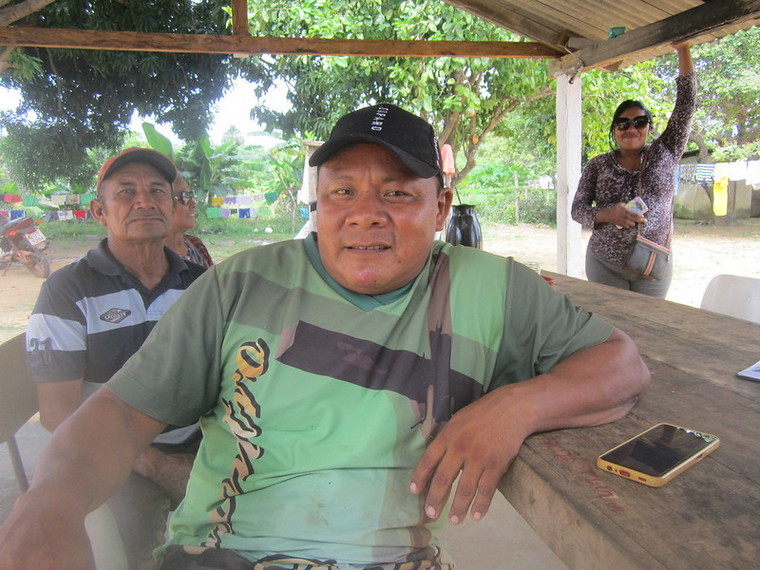
Tuxaua (chief) Lindomar Homero of the Darora Community is calling for new adequate batteries to reactivate the solar power plant, because the electricity they receive from the national grid is too expensive for the local indigenous people. Behind him stands his predecessor, former tuxaua Jesus Mota. CREDIT: Mario Osava/IPS

Tuxaua (chief) Lindomar Homero of the Darora Community is calling for new adequate batteries to reactivate the solar power plant, because the electricity they receive from the national grid is too expensive for the local indigenous people. Behind him stands his predecessor, former tuxaua Jesus Mota. CREDIT: Mario Osava/IPS

Expensive energy

But indigenous people can’t afford the electricity from the distributor Roraima Energía, he said. On average, each family pays between 100 and 150 reais (20 to 30 dollars) a month, he estimated.

Besides, there are unpleasant surprises. “My November bill climbed to 649 reais” (130 dollars), without any explanation,” Homero complained. The solar energy was free.

“If you don’t pay, they cut off your power,” said Mota, who was tuxaua from 1990 to 2020.”In addition, the electricity from the grid fails a lot,” which is why the equipment is damaged.

Apart from the unreliable supply and frequent blackouts, there is not enough energy for the irrigation of agriculture, the community’s main source of income. “We can do it with diesel pumps, but it’s expensive; selling watermelons at the current price does not cover the cost,” he said.

“In 2022, it rained a lot, but there are dry summers that require irrigation for our corn, bean, squash, potato, and cassava crops. The energy we receive is not enough to operate the pump,” said Mota.

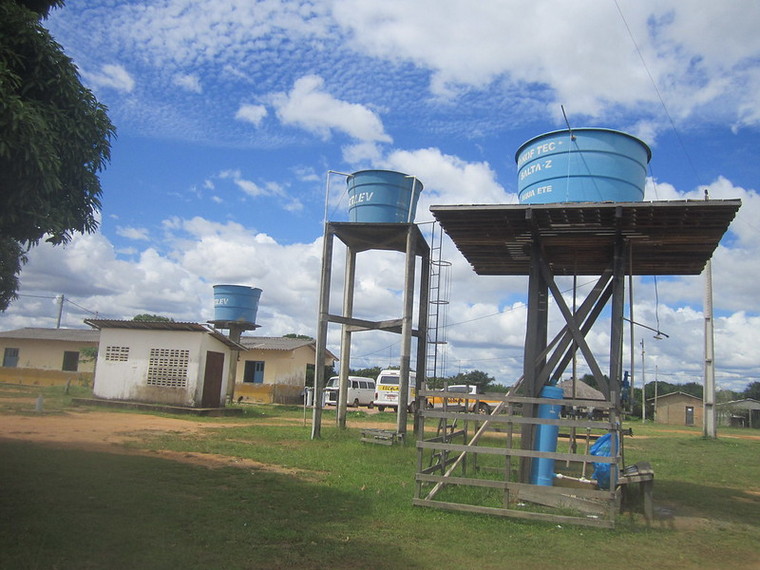
A photo of the three water tanks in the village of Darora, one of which holds water that is made potable by chemical treatment. The largest and longest building is the secondary school that serves the Macuxi indigenous community that lives in Roraima, in northern Brazil. CREDIT: Mario Osava/IPS

A photo of the three water tanks in the village of Darora, one of which holds water that is made potable by chemical treatment. The largest and longest building is the secondary school that serves the Macuxi indigenous community that lives in Roraima, in northern Brazil. CREDIT: Mario Osava/IPS

Achilles’ heel

Batteries still apparently limit the efficiency of solar energy in isolated or autonomous off-grid systems, with which the government and various private initiatives are attempting to make the supply of electricity universal and replace diesel generators.

Homero said that some of the Darora families who live outside the “center” of the village and have solar panels also had problems with the batteries.

Besides the 48 families in the village “center” there are 18 rural families, bringing the community’s total population to 265.

A solar plant was also installed in another community made up of 22 indigenous families of the Warao people, immigrants from Venezuela, called Warao a Janoko, 30 kilometers from Boa Vista.

But of the plant’s eight batteries, two have already stopped working after only a few months of use. And electricity is only guaranteed until 8:00 p.m.

“Batteries have gotten a lot better in the last decade, but they are still the weak link in solar power,” Aurelio Souza, a consultant who specializes in this question, told IPS from the city of São Paulo. “Poor sizing and the low quality of electronic charging control equipment aggravate this situation and reduce the useful life of the batteries.”

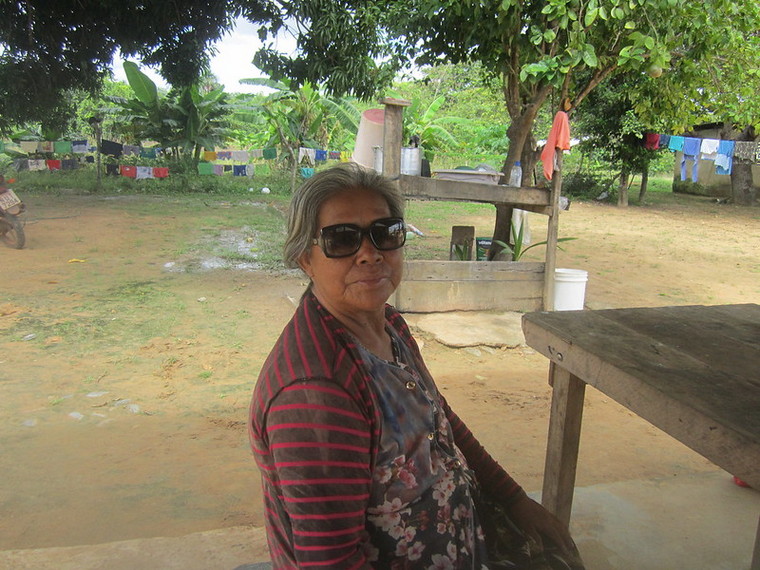
The low quality of the electricity supplied to Darora is due to the discrimination suffered by indigenous people, according to Adélia Augusto da Silva. The water they used to drink was also dirty and caused illnesses, especially in children, until the indigenous health service began to chemically treat their drinking water. CREDIT: Mario Osava/IPS

The low quality of the electricity supplied to Darora is due to the discrimination suffered by indigenous people, according to Adélia Augusto da Silva. The water they used to drink was also dirty and caused illnesses, especially in children, until the indigenous health service began to chemically treat their drinking water. CREDIT: Mario Osava/IPS

In Brazil’s Amazon jungle, close to a million people live without electricity, according to the Institute of Energy and the Environment, a non-governmental organization based in São Paulo. More precisely, its 2019 study identified 990,103 people in that situation.

Another three million inhabitants of the region, including the 650,000 people in Roraima, are outside the National Interconnected Electricity System. Their energy therefore depends mostly on diesel fuel transported from other regions, at a cost that affects all Brazilians.

The government decided to subsidize this fossil fuel so that the cost of electricity is not prohibitive in the Amazon region.

This subsidy is paid by other consumers, which contributes to making Brazilian electricity one of the most expensive in the world, despite the low cost of its main source, hydropower, which accounts for about 60 of the country’s electricity.

Solar energy became a viable alternative as the parts became cheaper. Initiatives to bring electricity to remote communities and reduce diesel consumption mushroomed.

But in remote plants outside the reach of the grid, good batteries are needed to store energy for the nighttime hours.

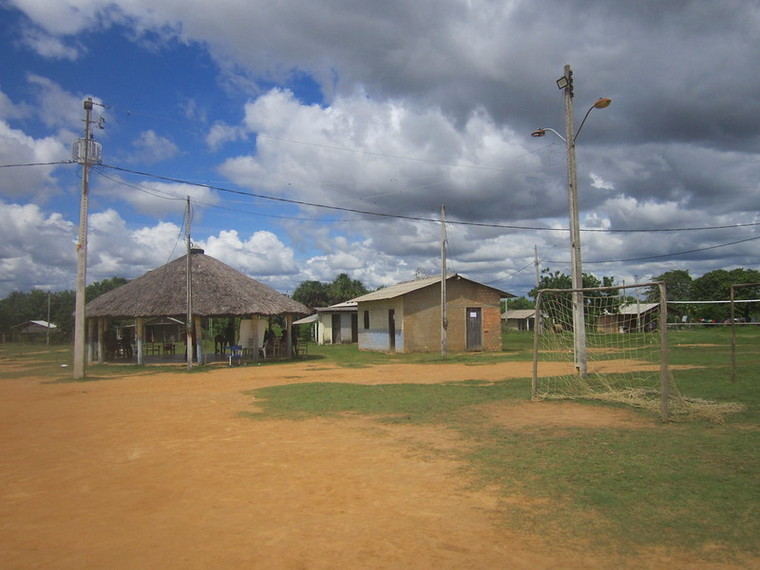
Part of the so-called "downtown" in Darora, which has lamp posts, houses, a soccer field and a shed where the community meets. A larger community center is needed, says the leader of the Macuxi village located near Boa Vista, the capital of the northern Brazilian state of Roraima. CREDIT: Mario Osava/IPS

Part of the so-called “downtown” in Darora, which has lamp posts, houses, a soccer field and a shed where the community meets. A larger community center is needed, says
the leader of the Macuxi village located near Boa Vista, the capital of the northern Brazilian state of Roraima. CREDIT: Mario Osava/IPS

A unique case

Darora is not a typical case. It is part of the municipality of Boa Vista, which has a population of 437,000 inhabitants and good resources, it is close to a paved road and is within a savannah ecosystem called “lavrado”.

It is at the southern end of the São Marcos indigenous territory, where many Macuxi indigenous people live but fewer than in Raposa Serra do Sol, Roraima’s other large native reserve. According to the Special Secretariat for Indigenous Health (Sesai), there were 33,603 Macuxi Indians living in Roraima in 2014.

The Macuxi people also live in the neighboring country of Guyana, where there are a similar number to that of Roraima. Their language is part of the Karib family.

Although there are no large forests in the surrounding area, Darora takes its name from a tree, which offers “very resistant wood that is good for building houses,” Homero explained.

The community emerged in 1944, founded by a patriarch who lived to be 93 years old and attracted other Macuxi people to the area.

The progress they have made especially stands out in the secondary school in the village “center”, which currently has 89 students and 32 employees, “all from Darora, except for three teachers from outside,” Homero said proudly.

A new, larger elementary and middle school for students in the first to ninth grades was built a few years ago about 500 meters from the community.

Water used to be a serious problem. “We drank dirty, red water, children died of diarrhea. But now we have good, treated water,” said Adélia da Silva.

“We dug three artesian wells, but the water was useless, it was salty. The solution was brought by a Sesai technician, who used a chemical substance to make the water from the lagoon drinkable,” Homero said.

The community has three elevated water tanks, two for water used for bathing and cleaning and one for drinking water. There are no more health problems caused by water, the tuxaua said.

His current concern is to find new sources of income for the community. Tourism is one alternative. “We have the Tacutu river beach 300 meters away, great fruit production, handicrafts and typical local gastronomy based on corn and cassava,” he said, listing attractions for visitors.

  Source

Deportees Start Businesses to Overcome Unemployment in El Salvador

Active Citizens, Civil Society, Economy & Trade, Editors’ Choice, Featured, Headlines, Human Rights, Labour, Latin America & the Caribbean, Migration & Refugees, Regional Categories, TerraViva United Nations

Migration & Refugees

Oscar Sosa cooks roast chicken and pork on an artisanal grill set up outside his small restaurant, Comedor Espresso, in the eastern Salvadoran city of San Francisco Gotera. Like many of the returnees, especially from the United States, he set up his own business, given the unemployment he found on his return to El Salvador. More than 10,000 people were deported to this Central American country between January and August 2022. CREDIT: Edgardo Ayala/IPS

Oscar Sosa cooks roast chicken and pork on an artisanal grill set up outside his small restaurant, Comedor Espresso, in the eastern Salvadoran city of San Francisco Gotera. Like many of the returnees, especially from the United States, he set up his own business, given the unemployment he found on his return to El Salvador. More than 10,000 people were deported to this Central American country between January and August 2022. CREDIT: Edgardo Ayala/IPS

SAN FRANCISCO GOTERA, El Salvador, Jan 10 2023 (IPS) – While grilling several portions of chicken and pork, Salvadoran cook Oscar Sosa said he was proud that through his own efforts he had managed to set up a small food business after he was deported back to El Salvador from the United States.


This has allowed him to generate an income in a country where unemployment affects 6.3 percent of the economically active population.

“Little by little we grew and now we also have catering services for events,” Sosa told IPS, as he turned the chicken and pork over with tongs on a small circular grill.

The grill is located outside the premises, so that the smoke won’t bother the customers eating inside.

It’s not easy, he said, to return home and to not be able to find a job. That is why he decided to start his own business, Comedor Espresso, in the center of San Francisco Gotera, a city in the department of Morazán in eastern El Salvador.

“You come back wanting to work and there aren’t any opportunities. The first thing they see in you is your age; when you’re over 35, they don’t hire you.” — Patricia López

In this Central American country of 6.7 million people, “comedores” are small, generally precarious, neighborhood restaurants where inexpensive, homemade meals are prepared.

Sosa’s, although very small, was clean and tidy, and even had air conditioning, when IPS visited it on Dec. 19.

Skills and capacity abound, but opportunities are scarce

Sosa, 35, is one of thousands of people deported from the United States every year.

He left in 2005 and was sent back in 2014. He worked for eight years as a cook at a Mexican restaurant in the city of Pensacola, in the southeastern state of Florida.

A total of 10,399 people were deported to this country between January and August 2022, which represents an increase of 221 percent compared to the same period in 2021, according to figures from the International Organization for Migration.

The flow of undocumented Salvadoran migrants, especially to the United States, intensified in the 1980s, due to the 1980-1992 civil war in El Salvador that left some 75,000 dead and around 8,000 forcibly disappeared.

At the end of the war, people continued to leave, for economic reasons and also because of the high levels of violent crime in the country.

An estimated 3.1 million Salvadorans live outside the country, 88 percent of them in the United States. And 50 percent of the Salvadorans in the U.S. are undocumented.

Despite the problem of unemployment, Sosa was not discouraged when he returned to his country.

“I feel that we are already growing, we have five employees, the business is registered in the Ministry of Finance, in the Ministry of Health, and I’m paying taxes,” he said.

Obviously, not all deportees have the support, especially financial, needed to set up their own business.

The stigma of deportation weighs heavily on them: there is a widespread perception that if they were deported it is because they were involved in some type of crime in the United States.

A government survey, conducted between November 2020 and June 2021, found that 50 percent of the deportees manage to open a business, 18 percent live off their savings, their partner’s income or support from their family, and 16 percent have part-time or full-time jobs.

In addition, seven percent live on remittances sent home to them, two percent receive income from property rentals, dividends or bank interests, and seven percent checked “other” or did not answer.

Apart from some government initiatives and non-governmental organizations that provide training and funds for start-ups, returnees have faced the specter of unemployment for decades.

Many return empty-handed and owe debts to the people smugglers who they hired to get into the United States as undocumented migrants.

In the case of Sosa, his brothers supported him to set up Comedor Espresso.

He also received a small grant of 700 dollars to purchase kitchen equipment.

The money came from a program financed with 87,000 dollars by the Salvadoran community abroad, through the Salvadoran Foreign Ministry.

The initiative, launched in 2019, aims to generate opportunities for returnees in four municipalities in eastern El Salvador, including San Francisco Gotera.

This region was chosen because most of the deportees reside here, according to Carlos Díaz, coordinator of the program on behalf of the San Francisco Gotera mayor’s office.

But the demand for support and resources exceeds supply.

“There was a database of approximately 350 returnees in Gotera, but there was only money for 55,” Díaz told IPS.

More than 200 people benefited in the four municipalities.

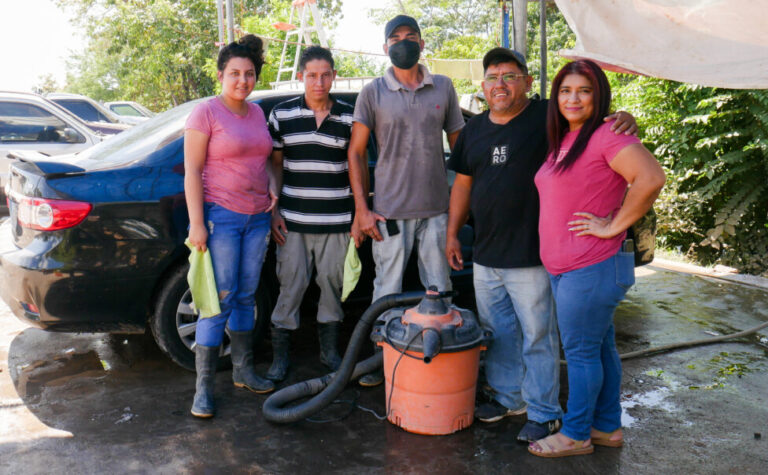
David Aguilar and Patricia López (right) set up their own business, El Tuco King Carwash, after they decided to return to El Salvador. Their business is located in the eastern part of the country, a region where more than 50 percent of returnees live. CREDIT: Edgardo Ayala/IPS

David Aguilar and Patricia López (right) set up their own business, El Tuco King Carwash, after they decided to return to El Salvador. Their business is located in the eastern part of the country, a region where more than 50 percent of returnees live. CREDIT: Edgardo Ayala/IPS

Hope despite a tough situation

Out of necessity, David Aguilar and Patricia López, 52 and 42, respectively, also set up their own business, in their case a car wash, after deciding to return to El Salvador. It’s called Tuco King Carwash.

Like Sosa, they are from San Francisco Gotera. Aguilar left the country in November 2005 and López three months later, in February 2006.

They made the risky journey to try to give their young daughter – six months old at the time, and today 17 years old – a better future.

One leg of the trip was by sea, on the Pacific Ocean off the coast of Mexico.

“I spent 12 hours at sea, in a boat carrying about 20 people, who were all undocumented like me,” Aguilar said.

He added: “The only thing they gave us as lifesavers were a few plastic containers, in case the boat capsized.”

It was in Houston, in the state of Texas, that Aguilar found work in a car paint shop. The experience has been useful to him back in El Salvador, because in addition to washing cars, he offers paint jobs and other related services.

Aguilar and López were not deported; they decided to return because her father died in 2011. They came back in 2012, without having seen many of their dreams come true.

“You come back wanting to work and there aren’t any opportunities. The first thing they see in you is your age; when you’re over 35, they don’t hire you,” López said.

Before embarking on the trip to the United States, she had finished her degree as a primary school teacher, in 2005. But she never worked as a teacher because she left the following year.

“When I returned I applied to various teaching positions, but no one ever hired me,” she said.

Today, their carwash business, set up in 2014, is doing well, albeit with difficulties, because the couple have found that there is too much competition.

But they do not lose hope that they will succeed.

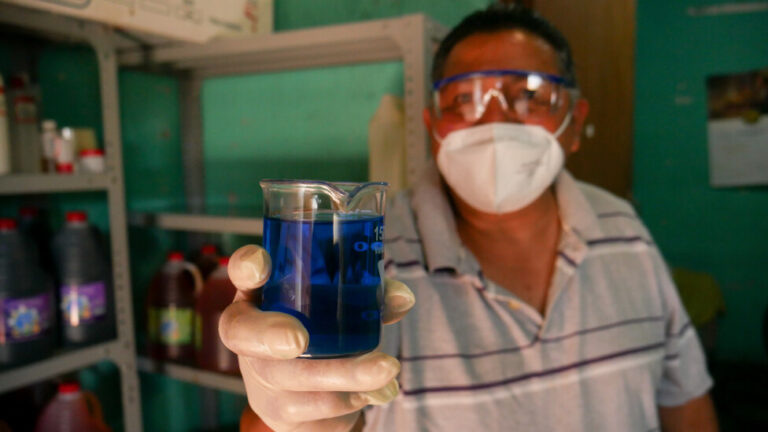
Former Salvadoran guerrilla David Henríquez, deported from the United States in 2019, shows the quality of the disinfectant he has just produced in his small artisanal workshop in San Salvador. With no chance of finding formal employment after deportation, he worked hard to set up his disinfectant business to generate an income. CREDIT: Edgardo Ayala/IPS

Former Salvadoran guerrilla David Henríquez, deported from the United States in 2019, shows the quality of the disinfectant he has just produced in his small artisanal workshop in San Salvador. With no chance of finding formal employment after deportation, he worked hard to set up his disinfectant business to generate an income. CREDIT: Edgardo Ayala/IPS

An ex-guerrilla chemist

David Henríquez, a 62-year-old former guerrilla fighter, was deported in 2019.

During the civil war, Henríquez was a combatant of the then insurgent Farabundo Martí National Liberation Front (FMLN), but when peace came he decided to emigrate to the United States in 2003 as an undocumented immigrant.

With no hope of finding a formal sector job here, he began to make cleaning products, a skill he learned in the United States.

In the 12 years that he lived there, he worked for two years at the Sherwin Williams plant, a global manufacturer of paints and other chemicals.

“It was there that I began to discover the world of chemical compositions and aromas,” Henríquez told IPS during a visit to his small workshop in the Belén neighborhood of San Salvador, the capital.

Henríquez was producing a 14-gallon (53-liter) batch of blue disinfectant with the scent of baby powder. He also makes disinfectant smelling like cinnamon and lavender, among others. His business is called El Dave de los aromas.

His production process is still artisanal, although he would know how to produce disinfectant with high-tech machinery, if he had it, he said, “as I did at Sherwin Williams.”

He used a baby bottle to measure out the 3.5 ounces (104 milliliters) of nonylphenol, the main chemical component, used to produce 14 gallons.

Henríquez dissolved other chemicals in powder, to get the color and the aroma, and the product was ready.

He produces about 400 gallons a month, 1,514 liters, at a price of 3.50 dollars each.

“The important thing is to have discipline, work hard, to shine with your own effort,” he said.

  Source

Biodiversity Agreement Historic But Difficult to Implement

Biodiversity, Civil Society, Climate Action, Climate Change, Climate Change Finance, Conferences, Development & Aid, Editors’ Choice, Environment, Featured, Global, Global Governance, Headlines, IPS UN: Inside the Glasshouse, Latin America & the Caribbean, Regional Categories, Sustainable Development Goals

Biodiversity

Government delegations celebrate the close of the historic negotiation at COP15 of the New Global Framework on Biodiversity in the early hours of the morning on Monday Dec. 19, at the Palais des Congrès in Montreal, Canada. CREDIT: Mike Muzurakis/IISD

MONTREAL, Dec 19 2022 (IPS) – The pillar coral (Dendrogyra cylindrus), which takes its name from its shape, is found throughout the Caribbean Sea, but its population has declined by more than 80 percent since 1990. As a result, the International Union for Conservation of Nature (IUCN) has listed it as “critically endangered” due to the effects of the human-induced climate crisis.


Its fate now depends on the new Kunming-Montreal Global Framework on Biodiversity, which was agreed by the 15th Conference of the Parties (COP15) to the Convention on Biological Diversity (CBD) on Monday Dec. 19, at the end of the summit held since Dec. 7 at the Palais des Congrès in Montreal.

Now, the world’s countries must translate the results into national biodiversity strategies, to comply with the new accord. In this regard, David Ainsworth, spokesman for the CBD, in force since 1993 and based in Montreal, announced the creation of a global accelerator for the drafting of national plans, with the support of U.N. agencies.

COP15 of the Convention on Biological Diversity approved a new program to protect the world's natural heritage for the next 10 years during the summit held in the Canadian city of Montreal. The picture shows a statue of a polar bear, whose species is threatened by melting ice and habitat loss, on a street in Montreal. CREDIT: Emilio Godoy/IPS

COP15 of the Convention on Biological Diversity approved a new program to protect the world’s natural heritage for the next 10 years during the summit held in the Canadian city of Montreal. The picture shows a statue of a polar bear, whose species is threatened by melting ice and habitat loss, on a street in Montreal. CREDIT: Emilio Godoy/IPS

The menu of agreements

COP15, whose theme was “Ecological Civilization: Building a shared future for all life on earth”, approved four objectives on improving the status of biodiversity, reducing species extinction, fair and appropriate sharing of benefits from access to and use of genetic resources, and means of implementation of the agreement.

In addition, the plenary of the summit, which brought together some 15,000 people representing governments, non-governmental organizations, academia, international bodies and companies, agreed on 23 goals within the Global Framework, for the conservation and management of 30 percent of terrestrial areas and 30 percent of marine areas by 2030, in what is known in U.N. jargon as the 30×30.

This includes the complete or partial restoration of at least 30 percent of degraded terrestrial and marine ecosystems, as well as the reduction of the loss of areas of high biological importance to almost zero.

Likewise, the agreement reached by the 196 States Parties at COP15 includes the halving of food waste, the elimination or reform of at least 500 billion dollars a year in subsidies harmful to biodiversity, and at least 200 billion dollars in funding for biodiversity by 2030 from public and private sources.

It also endorsed increasing financial transfers from countries of the industrialized North to nations of the developing South by at least 20 billion dollars by 2025 and 30 billion dollars by 2030, and the voluntary publication by companies for monitoring, evaluation and disclosure of the impact of their activities on biodiversity.

The Global Environment Facility (GEF) will manage a new fund, whose operation will be defined by the countries over the next two years.

With regard to digital sequence information (DSI) on genetic resources, the Global Framework stipulates the establishment of a multilateral fund for benefit-sharing between providers and users of genetic resources and states that governments will define the final figure at COP16 in Turkey in 2024.

The Global Framework also contains gender and youth perspectives, two strong demands of the process that was initially scheduled to end in the city of Kunming, China, in 2020. But because that country was unable to host mass meetings due to its zero-tolerance policy towards COVID-19, a first virtual chapter was held there and another later in person, and the final one now took place in Montreal.

The states parties are required to report at least every five years on their national compliance with the Global Framework. The CBD will include national information submitted in February 2026 and June 2029 in its status and trend reports.

With some differences, civil society organizations and indigenous peoples gave a nod to the Global Framework, but issued warnings. Viviana Figueroa, representative of the International Indigenous Forum on Biodiversity, and Simone Lovera, policy director of the Global Forest Coalition, applauded the agreement in conversations with IPS, while pointing out its risks.

“It’s a good step forward, because it recognizes the role of indigenous peoples, the use of biodiversity and the role of traditional knowledge,” said Figueroa, an Omaguaca indigenous lawyer from Argentina whose organization brings together indigenous groups from around the world to present their positions at international environmental meetings.

“It has been a long process, to which native peoples have contributed and have made proposals. The most important aspects that we proposed have been recognized and we hope to work together with the countries,” she added.

But, she remarked, “the most important thing will be the implementation.”

Goal C and targets one, three, five, nine, 13, 21 and 22 of the Global Framework relate to respect for the rights of native and local communities.

Lovera, whose organization brings together NGOs and indigenous groups, said the accord “recognizes the rights of indigenous peoples and local communities, and of women. It also includes a recommendation to withdraw subsidies and reduce public and private investments in destructive activities, such as large-scale cattle ranching and oil palm monoculture.”

But indigenous and human rights organizations have questioned the 30×30 approach on the grounds that it undermines ancestral rights, blocks access to aboriginal territories, and requires consultation and unpressured, informed consent for protected areas prior to any decision on the future of those areas.

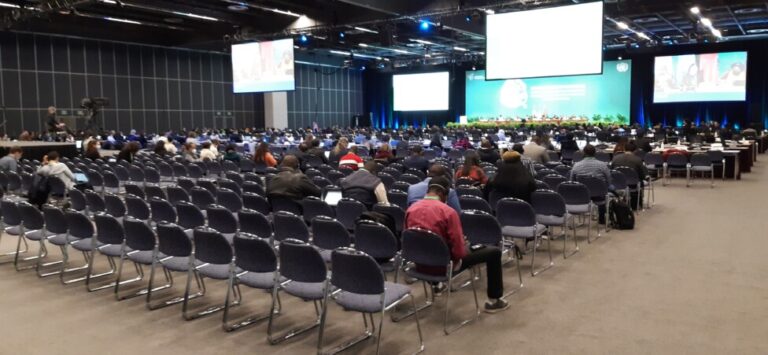
Discussions at the Convention on Biological Diversity summit intensified in the last few days of COP15 and ran late into the night, as in this session on health and biodiversity. But in the end, agreement was reached on a new Global Framework on Biodiversity, which will be binding on the 196 states parties. CREDIT: IISD/ENB

Discussions at the Convention on Biological Diversity summit intensified in the last few days of COP15 and ran late into the night, as in this session on health and biodiversity. But in the end, agreement was reached on a new Global Framework on Biodiversity, which will be binding on the 196 states parties. CREDIT: IISD/ENB

Major challenge

While the Global Framework has indicators and monitoring mechanisms and is legally binding, it has no actual teeth, and the precedent of the failed Aichi Targets casts a shadow over its future, especially with the world’s poor track record on international agreements.

The Aichi Biodiversity Targets, adopted in 2010 in that Japanese city during the CBD’s COP10 and which its 196 states parties failed to meet in 2020, included the creation of terrestrial and marine protected areas; the fight against pollution and invasive species; respect for indigenous knowledge; and the restoration of damaged ecosystems.

Several estimates put the amount needed to protect biological heritage at 700 billion dollars, which means there is still an enormous gap to be closed.

In more than 30 years, the GEF has disbursed over 22 billion dollars and helped transfer another 120 billion dollars to more than 5,000 regional and national projects. For the new period starting in 2023, the fund is counting on some five billion dollars in financing.

In addition, the Small Grants Program has supported around 27,000 community initiatives in developing countries.

“There is little public funding, more is needed,” Lovera said. “It’s sad that they say the private sector must fund biodiversity. In indigenous territories money is needed. They can do much more than governments with less money. Direct support can be more effective and they will meet the commitments.”

The activist also criticized the use of offsets, a mechanism whereby one area can be destroyed and another can be restored elsewhere – already used in countries such as Chile, Colombia and Mexico.

“This system allows us to destroy 70 percent of the planet while preserving the other 30 percent,” Lovera said. “It is madness. For indigenous peoples and local communities, it is very negative, because they lose their own biodiversity and the compensation is of no use to them, because it happens somewhere else.”

Figueroa said institutions that already manage funds could create direct mechanisms for indigenous peoples, as is the case with the Small Grants Program.

Of the 609 commitments that organizations, companies and individuals have already made voluntarily at COP15, 303 are aimed at the conservation and restoration of terrestrial ecosystems, 188 at alliances, and 159 at adaptation to climate change and reduction of polluting emissions.

The summit also coincided with the 10th Meeting of the Conference of the Parties to the Cartagena Protocol on Biosafety and the 4th Meeting of the Conference of the Parties to the Nagoya Protocol on Access to Genetic Resources and the Fair and Equitable Sharing of Benefits from their Utilization, both components of the CBD.

Images of the planet’s sixth mass extinction reflect the size of the challenge. More than a quarter of some 150,000 species on the IUCN Red List are threatened with extinction.

The “Living Planet Report 2022: Building a nature-positive society”, prepared by the WWF and the Institute of Zoology in London, shows that Latin America and the Caribbean has experienced the largest decline in monitored wildlife populations worldwide, with an average decline of 94 percent between 1970 and 2018.

With a decade to act, each passing day represents more biological wealth lost.

IPS produced this article with support from InternewsEarth Journalism Network.