NEW YORK, Feb 15 2023 (IPS) – United Nations member states agreed to fully fund UN human rights mechanisms that China, Russia, and their allies had sought to defund in the 2023 budget. This should set a precedent for UN human rights funding in the future.
Human Rights Watch has warned for years about China and Russia-led efforts to slash funding for UN human rights work, which was aimed at undermining decisions by the UN Human Rights Council, General Assembly, and Security Council.
During the General Assembly’s budget negotiations in late 2022, China, Russia and allies proposed a resolution to defund human rights investigations in Sri Lanka, Iran, Venezuela, Russia, Ukraine, Nicaragua, North Korea, Belarus, Syria, and Eritrea. Ethiopia proposed a resolution to defund an investigation of war crimes and abuses in Ethiopia itself.
All these efforts failed. The Czech Republic, as European Union president, countered by proposing full funding for human rights mechanisms at the level proposed by Secretary-General António Guterres. The resolution passed by a sizable majority.
The Advisory Committee is supposed to be an independent body of experts, but in recent years, its “experts” from countries like China and Russia have been pushing their governments’ anti-human rights agendas and advocating for sharp cuts in funding for human rights work, with no good reasons.
Due to divisions between Western countries and developing states, the standard UN funding compromise had become accepting the non-binding Advisory Committee recommendations. For example, if its recommendations had been adopted, the staff and budget for the Iran commission of inquiry would have been cut in half.
UN member countries should treat the successful UN budget outcome as a blueprint for the future. The job of the Fifth Committee – which oversees UN budget matters – is to allocate resources, not question mandates approved by UN legislative bodies.
They should also reform or replace the Advisory Committee on Administrative and Budgetary Questions with an advisory body staffed by genuinely independent experts, not diplomats doing the bidding of their governments.
Meanwhile, UN delegations should build on this success and ensure reliable full funding for all UN human rights mandates.
Louis Charbonneau is UN Director Human Rights Watch
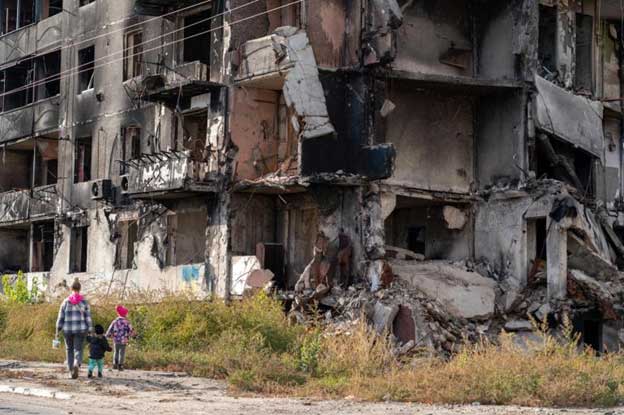
A family walks past a heavily damaged building in Borodianka, Ukraine. Multiple threats are converging to leave families reeling. But putting children at the centre of the response can help shape a brighter future. Credit: UNICEF/UN0765276/Filippov
UNITED NATIONS, Feb 14 2023 (IPS) – The year 2022 was incredibly difficult for people around the world. We were confronted by a series of major crises, including a continuing pandemic, a major war in Europe, an energy crisis, rising inflation and food insecurity.
These events hit children particularly hard, compounding the already severe impacts of the COVID-19 pandemic. Millions of children had to flee their homes because of conflict or extreme weather events. At the same time, child malnutrition and the number of children in need of humanitarian assistance rose.
The war in Ukraine, for example, has led to higher food and energy prices, which in turn has contributed to rising global hunger and inflation. Efforts to address inflation through rising interest rates in the US have driven up the value of the dollar against other currencies, making developing countries’ imports, debt repayments and their ability to access external financing more difficult.
As we look to 2023, it’s clear that the polycrisis is likely to continue shaping children’s lives. The effects of these intertwined and far-reaching trends will be difficult to untangle, and solutions will be difficult to find as policymakers struggle to keep up with multiple urgent needs.
The situation is particularly dire in economically developing countries. Higher food and energy prices have contributed to a rise in global hunger and malnourishment, with children among the most affected.
The polycrisis is also limiting access to healthcare for many children, making it harder for them to receive treatment and routine vaccinations. Recovery from learning losses caused by the closure of schools will be slow and felt for years to come, while the shift to remote learning has left children from low-income families facing the greatest challenges in catching up.
At the same time, the combination of higher financing needs, soaring inflation and a tighter fiscal outlook will widen the education financing gap needed to achieve the Sustainable Development Goals.
Climate change, too, is also a part of this polycrisis, with visible effects, including devastating floods in Pakistan and droughts in East Africa, making it harder for children to access education, food and healthcare, and causing widespread displacement of populations.
All these factors have led UNICEF to estimate that 300 million children will be in need of humanitarian assistance this year. This staggering number highlights the urgency for international organizations and governments to step in and provide assistance.
But the polycrisis doesn’t have to lead to further instability or, ultimately, systemic breakdown. Some of the stresses we saw in 2022 have already weakened, and new opportunities may arise to alleviate the situation.
For example, food and oil prices have dropped from their peaks, and good harvests in some countries may help to lower global food prices. Fortunately, we know there are solutions and strategies that work.
One potential solution is to increase investment in social protection programmes, such as cash transfers and food assistance, which can help alleviate the immediate economic impacts of the polycrisis on families. These programmes can also help to build resilience and reduce vulnerabilities.
The establishment of learning recovery programmes will help tackle the learning losses and prevent children from falling further behind. And early prevention, detection and treatment plans for severe child malnutrition have been effective in reducing child wasting.
Ultimately, a coordinated and collective effort is needed to protect the rights and well-being of children. This includes not only providing immediate assistance but also addressing the underlying causes of the polycrisis and building resilience for the future.
This cannot be achieved without a more coordinated and collective effort from international organizations and governments to help mitigate the effects of the polycrisis and protect children’s futures.
And, crucially, we must listen to children and young people themselves so that we can understand the future they want to build and live in. In fact, we followed this approach when we were assessing trends for ‘Prospects for Children in the Polycrisis’, asking young people from across the world age 16 to 29 to give us their views on some of the challenges their generation faces.
It’s critical that we take action to protect the most vulnerable among us. The future may be uncertain, but by working together we can help to build a better future for our children.
Jasmina Byrne is Chief of Foresight and Policy, UNICEF Innocenti – Global Office of Research and Foresight.
UNITED NATIONS, Feb 13 2023 (IPS) – As the toll in last week’s earthquakes in Turkey and Syria exceeds a staggering 28,000 people dead and more than 78,000 injured–and counting– the United Nations is in an emergency-footing struggling to provide humanitarian aid, along with several international humanitarian organizations.
The devastated cities in both countries—by an earthquake described as one of the world’s top 10 deadliest in history at a magnitude of 7.8— are urgently in need of food, water, medicine, clothes and shelter—even as after-shocks have triggered the collapse of additional buildings with a new search for more survivors in a doomed scenario.
But the flow of aid is being hindered by several factors, including power politics, sanctions and limited border crossings in a 12-year long civil war in conflict-ridden Syria.
Asked about these limitations, UN Secretary-General Antonio Guterres told reporters last week: “This is the moment of unity, not to politicize or to divide, but it is obvious that we need massive support, and so I would be of course very happy if the Security Council could reach a consensus to allow for more crossings to be used, as we need also to increase our capacity to deliver on crossline operations into Idlib from Damascus.”
Over the years, Russia and China, two veto-wielding permanent members of the Security Council, have remained supportive of Syrian President Bashar al-Assad, while the remaining three permanent members, the US, UK and France, have been critical of Assad’s authoritarian regime accused of war crimes and use of chemical weapons.
But the humanitarian crisis in Syria is not likely to change the power politics in a divided Security Council.
Louis Charbonneau, United Nations Director at Human Rights Watch, told IPS: “We hope the UN Security Council moves quickly and Russia won’t block expansion of cross-border aid, as the secretary-general has requested.”
But Security Council approval, he pointed out, is not a legal prerequisite to conduct cross-border aid operations into Syria. Cooperation from de facto authorities on both sides of any border, in line with humanitarian law obligations, is.
“If the Security Council is deadlocked, and the UN determines it’s feasible and safe, the UN should push ahead to address the crisis and help victims,” he declared.
The White Helmets, a civil society organization which has been operating in opposition-held areas in Syria, was critical of the slow movement of aid.
“Had international rescue teams come into Syria in the first hours, or even the second day, there was a big hope that these people who were under the ruins could have been brought out alive”, Mohamed al—Shibli of the White helmets was quoted as saying.
At his press briefing, Guterres said: the first United Nations convoy crossed into northern Syria through the Bab al-Hawa crossing, and it included 6 trucks carrying shelter and other desperately needed relief supplies. “More help is on the way, but much more, much more is needed.”
But the New York Times ran a hard-hitting story February 10 under the headline: “UN Aid Trickles into Syria, but Residents say it is too Little, too Late”.
Still, the UN and its agencies have responded with all the means at their disposal, including assistance from the International Organization for Migration (IOM), the World Food Programme (WFP), the UN children’s agency UNICEF, the World Health Organization (WHO), the UN Population Fund (UNFPA), among others, and a task force led by the Emergency Relief Coordinator Martin Griffiths.
After his arrival in the Syrian capital February 12, United Nations Special Envoy for Syria Geir O. Pedersen told reporters the earthquake was “one of the biggest humanitarian or natural disasters that we have seen recently”.
While expressing his condolences, he said: “And I think, you know, when we see the images, the heartbreaking images, we really feel the suffering. But we’re also seeing a lot of heroism, you see, you know, individuals, civilians, humanitarians trying to save lives, and it is this effort that we need to support.”
He assured that “the UN humanitarian family will do whatever they can to reach out to everyone that needs support. So, we are trying to mobilize whatever support there is. We are reaching out to countries, we are mobilizing funding, and we’re trying to tell everyone to put politics aside because this is a time to unite behind a common effort to support the Syrian people”.
Still, Pendersen said: “We need all the access we can have, crossline, cross-border and we need more resources. So, I’m in close touch with the UN humanitarian family, we’re working together to try to mobilize this support and that of course is my key message during this visit to Syria.
The issue of access was also raised by the US Ambassador to the UN Linda Thomas-Greenfield who said last week that she spoke with Presidents of InterAction and the International Rescue Committee, who both underscored the dire situation on the ground as humanitarian workers and first responders attempt to save lives while also facing personal tragedy.
She also spoke with representatives of Save the Children, CARE, and the White Helmets, who described the urgent need for shelter, clean water, and cash assistance, as well as increased access into Syria to allow local NGOs to deliver life-saving aid.
Ambassador Thomas-Greenfield voiced U.S. support for additional cross-border access points from Türkiye into northwest Syria to facilitate deliveries of earthquake-specific aid. She commended the search and rescue efforts by the White Helmets, which have saved thousands of people from collapsed buildings in northern Syria.
So far, the UN has released about $50 million from its emergency fund. But it is making a “Flash Appeal” for more funds from the international community.
Asked how much was needed, UN Spokesperson Stephane Dujarric said February 9: “We are trying to figure out how much. We’re still doing the needs assessment and I would also encourage – the public can also give through on the OCHA (Office for the Coordination of Humanitarian Affairs) website, the UN Foundation websites. There are ways for people, for the public to give to the appeal,” he said.
Meanwhile, the crisis in Turkey has also been tainted with domestic politics. The slow or belated response has been blamed on the Turkish government led by President Recep Tayyip Erdogan, up for re-election on May 14.
Kemal Kilicdaroglu, the leader of the opposition party and a potential presidential candidate, was quoted as saying: “It is the ruling party that has not prepared the country for an earthquake for 20 years”.
A mining waste deposit in the center of the municipality of Topia, in the northern Mexican state of Durango, threatens the air, water and people’s health. The Escazú Agreement,
In force since 2021, guarantees access to environmental information and justice in Latin American countries, as well as public participation in decision-making on these issues. CREDIT: Emilio Godoy/IPS
MEXICO CITY, Feb 7 2023 (IPS) – In the municipality of Papantla, in the southeastern Mexican state of Veracruz, the non-governmental Regional Coordinator of Solidarity Action in Defense of the Huasteca-Totonacapan Territory (Corason) works with local communities on empowering organizations, advocacy capacity in policies and litigation strategies.
“This participation with organizations that work at the national level and have the capacity to influence not only the legal field is important,” Corason coordinator Alejandra Jiménez told IPS from Papantla. “They are able to bring injunctions, and this is how they have managed to block mining projects, for example.”
“Up to now, the Escazú Agreement is dead letter, that is the history of many laws in Mexico. Environmentalists have clearly suffered from violence, and let’s not even mention access to information, where there have even been setbacks.” — Alejandra Jiménez
She was referring to the collaboration between locally-based civil society organizations and others of national scope.
Since its creation in 2015, Corason has supported local organizations in their fight against the extraction of shale gas through hydraulic fracturing or fracking, a highly polluting technique that uses large volumes of water and chemicals, in Veracruz and Puebla, as well as mining and hydroelectric plants in Puebla.
Cases like this abound in Mexico, as they do throughout Latin America, a particularly dangerous region for environmentalists.
A case that has been in the hands of Mexico’s Supreme Court since August 2021 is currently addressing the power of organizations to express their disagreement with environmental decisions and will outline the future of environmental activism in this Latin American country of some 130 million people, and of the enforcement of the Escazú Agreement.
The origin of the case lies in two opposing rulings by Mexican courts in 2019 and 2020, in which one recognized the power of organizations and the other rejected that power. As a result, the case went to the Supreme Court, which must reach a decision to settle the contradiction.
In August 2022 and again on Jan. 25 this year, the Supreme Court postponed its own verdict, which poses a legal threat to the megaprojects promoted by the government of President Andrés Manuel López Obrador, a staunch defender of the country’s oil industry.
Gustavo Ampugnani, general director of Greenpeace Mexico, said the case was an alert to the Escazú Agreement, and that it should not represent a setback for the defense of the environment.
“The significance lies in the risks involved in a wrong decision by the Supreme Court on how to resolve this existing contradiction. If the Court decides that the legal creation of an environmental organization is not enough and that other elements are required, it would limit citizen participation and access to justice,” he told IPS.
Environmentalists are waiting for their Godot in the form of the novel agreement, to which Brazil and Costa Rica do not yet belong, to improve their protection.
The treaty, in force since April 2021 and which takes its name from the Costa Rican city where it was signed, guarantees access to environmental information and justice, as well as public participation in environmental decision-making. It thus protects environmentalists and defenders of local land.
Mexico’s foreign ministry, which represented this country in negotiating the agreement, has identified a legislative route to reform laws that make its application possible and promote the integration of a multisectoral group with that same purpose.
Escazú has been undermined in Mexico by López Obrador’s constant attacks against defenders of the environment, whom he calls “pseudo-environmentalists” and “conservatives” for criticizing his policies, which they describe as anti-environmental and extractivist.
For this reason, a group of organizations and activists requested in a letter to the foreign ministry, released on Feb. 2, details of the progress in the creation of inter-institutional roundtables, selection of indicators, creation of protection mechanisms, and training of officials, including courts, while demanding transparency, inclusion and equity in the process.
Activists from the southern Mexican state of Puebla protest the activities of a water bottling company, on Apr.19, 2021. Environmentalists face serious threats in Mexico, where the Escazú Agreement, which since 2021 provides guarantees to these activists in Latin American countries, has not been applied. CREDIT: Emilio Godoy/IPS
High risk
In 2021, there were 200 murders of environmentalists around the world, a slight decrease from 227 the previous year, according to a report by the London-based non-governmental organization Global Witness.
Latin America led these crimes, accounting for 157 of the killings, with a slight decline from 165 the previous year. Mexico topped the list with 54 murders, compared to 30 in 2020. Colombia ranked second despite the drop in cases: 33, down from 65 in 2020, followed by Brazil (26 vs. 20), Honduras (eight vs. 17) and Nicaragua (13 vs. 12).
The attacks targeted people involved in opposition to logging, mining, large-scale agribusiness and dams, and more than 40 percent of the victims were indigenous people.
In Mexico there are currently some 600 ongoing environmental conflicts without a solution from the government, according to estimates by the Ministry of Environment and Natural Resources.
The most recent case was the Jan. 15 disappearance of lawyer Ricardo Lagunes and indigenous activist Antonio Díaz, an opponent of mining in the western state of Michoacán, which the United Nations High Commissioner for Human Rights has demanded be urgently clarified.
One year after it came into force, the Escazú Agreement is facing major challenges, especially in countries such as Brazil, Colombia, Guatemala, Honduras, Mexico and Nicaragua, where environmentalists face particular risks.
“It is a very interesting round, because article 10 (of the agreement) refers to highlighting the participation of the organizations. That article could be violated, which would mean a major limitation. These are things that as a country we are going to have to face up to,” the activist, who participated in the negotiation of the agreement as a representative of civil society, told IPS.
In Mexico, compliance with the agreement has already faced hurdles, such as the November 2021 decree by which López Obrador declared his megaprojects “priority works for national security”, thus guaranteeing provisional permits, in contravention of the treaty.
Dispute resolution
Activists are already planning what to do if the Supreme Court hands down a negative verdict: they will turn to the Escazú Agreement dispute resolution mechanism – although the signatory countries have not actually designed it yet.
“We would consider turning to the treaty to resolve the issue. Environmental activism is highly dangerous. But that should not set aside the right of organizations to intervene in decisions. Activists and organizations must be given tools to use regional agreements, because what is happening in the country is very serious,” said Greenpeace’s Ampugnani.
Castillo’s organization is working to raise awareness about the agreement. “If no one knows it exists and that they are obliged to comply with it, how do we make them do it? There are still informative processes in which an application has not yet received a response. We have to demand compliance. There are conditions to apply the agreement. But we need political will to comply with it and to get the word out about it,” she said.
Corason’s Jiménez questioned whether the treaty was up-to-date. “Up to now, the Escazú Agreement is dead letter, that is the history of many laws in Mexico. Environmentalists have clearly suffered from violence, and let’s not even mention access to information, where there have even been setbacks. There is an environment that hinders progress,” she said.
In her view, it is not in the interest of governments to apply the agreement, because it requires participation, information and protection in environmental issues.
In March 2022, the first meeting of the Conference of the Parties to the Escazú Agreement took place, which focused on its operational issues and other aspects that the countries will have to hash out before the next summit is held in 2024.
The Supreme Court, which has not yet set a date for handing down its ruling, is caught between going against the government if it favors environmental organizations or hindering respect for the agreement. For now, the treaty is as far from land as Mexico City is from Escazú: about 1,925 kilometers.
Food insecurity in Sri Lanka has increased dramatically due to two consecutive seasons of poor harvests, foreign exchange shortages, and reduced household purchasing power. Amidst Sri Lanka’s worst economic crisis since independence, the UN revised its joint Humanitarian Needs and Priorities (HNP) Plan, appealing for more life-saving assistance to aid 3.4 million people. November 2022 Credit: UNICEF/Chameera Laknath
LONDON, Feb 3 2023 (IPS) – On February 4, Sri Lanka commemorates 75 years of Independence. But it will not be the extravaganza of the past years, the minaturised imitations of the grand displays on Moscow’s Red Square or China’s Tiananmen Square.
Still, a critical question has been reverberating in the community ever since the government announced a scaled down celebration to commemorate 75 years since Britain relinquished power in 1948.
After defaulting on the country’s debt servicing last April for the first time in its post-independence history and being forced to resort to massive printing of money to meet state expenditure, does Sri Lanka need to celebrate independence day this year however downsized it would be?
Particularly so, when President Ranil Wickremesinghe’s government itself claims Sri Lanka is struggling economically and it would take years to recover from its current chaos created by leaders who inexorably pushed it to the tip of the abyss with stupid economic policies, wasteful expenditure and wide- scale corruption and fraud.
While imposing unbearable new taxes and other restrictions on the daily lives of the people, driving them further into penury with school children going without meals, fainting in their classrooms and in need of medical treatment which itself is becoming scarce, the country’s leaders don’t seem short of resources for celebrations.
Even the country’s diplomatic missions will be holding their annual independence day celebrations as the invitation I received indicated, feasting their countrymen as best as they could.
Yet over the last couple of months the government has been selling the story that it has no funds to pay for the Local Government elections due in March. A strange enough claim after President Ranil Wickremesinghe, in one of his other roles as finance minister, presenting the budget for 2023 last November allocated funds for the election and parliament, which oversees public expenditure, approved it.
Now, the very persons who allocated money just three months ago claim to lack funds for a constitutionally required election. Punning on the old Harry Belafonte calypso, there is a hole in the budget, said some wag on social media.
It is this contradiction in government conduct that an already enraged people find inexcusable. Having got rid of one elected president– Gotabaya Rajapaksa– who surreptitiously fled the country last July when mounting peoples’ protests demanded the Rajapaksa clan quit the government, they find themselves confronted with what Sri Lankans have come to see as a Rajapaksa clone– and now derisively call him Ranil Rajapaksa– thrust into the presidency to keep the family’s political fires alight.
The Roman poet Juvenal dismissively called the delusionary performances staged by the Roman emperors of the time to distract their discontented citizenry, “panem et circensus”- bread and circuses.
Bread, like some other essentials, might be scarce or priced beyond the reach of many of its 22 million people. A few months back, the UN agency UNICEF reported that 5.7 million Sri Lankans including 2.3 million children, are in need of humanitarian assistance and the numbers are likely to rise in the coming days.
But the country’s leaders are not beyond performing their own circus acts. A few days back President Wickremesinghe appointed two more cabinet ministers bringing the total to 22.
Within hours Sri Lankans with their innate sense of humour were on social media branding the new cabinet “Ali Baba and the 22” with the doors to the cabinet still open for more acolytes chosen not for integrity and competence but loyalty.
Before the two new ministers fattened the cabinet, splicing off the portfolios of two existing ministers, President Wickremesinghe a couple of months ago appointed 37 state ministers leaving room for three more.
Sri Lanka’s bloated ministerial ranks would surely be one of the largest in today’s parliamentary democracies. Not only is it large in numbers but the perks offered to ministers and state ministers is stunningly staggering–salaries, free housing, several expensive vehicles with fuel, free utilities such as electricity, water, telephones up to a point, several personal staff with paid salaries, armed personal security with escort vehicles, a special allowance for each day they attend parliament, state pension after five years and other facilities not generally known.
While the government is prepared to splash state funds on bolstering party cadres and lickspittle who have creamed off state assets, in the last couple of months it has been using every ruse in the books-and some which are not in them- trying to deprive the people of their constitutional right to the franchise, by blocking the Local Government elections due shortly.
This election, last held in 2018, is for 340 municipal councils, urban councils and village bodies is scheduled for March 9—the date set by the independent Election Commission last month.
But as the day for the election, as constitutionally required, neared, the attempts to stymie it began with grandees of President Ranil Wickremesinghe’s United National Party (UNP) and the Rajapaksa clan-run Sri Lanka Podujana Peramuna (SLPP) that is propping up Wickremesinghe with its parliamentary majority, asserting that economic recovery must precede elections.
Ministers and even state officials were trotting out excuses that there was no money to fund elections, expecting the populace to have forgotten the budgetary allocation passed by parliament a few months back.
As this was being written, internationally-known legal academic and former foreign minister Prof GL Peiris was telling the media the government had made seven attempts to try and stop the election including an affidavit to the Supreme Court filed by the secretary to the finance ministry claiming the state of the economy precluded holding elections right now.
The latest ruse was a law called the Election Expenses Bill to control spending for elections hurriedly passed by parliament. If, as Justice Minister Wijeyadasa Rajapaksa said, this proposal has been hanging fire for years, why the rush now, the opposition and anxious voters asked.
Like the opposition, the public too smelled a rotten rat. It was seen as another attempt to derail the elections by calling for the provisions of the bill be incorporated which would call for more time.
Despite all the public bravura, both the Rajapaksa-controlled SLPP and Wickremesinghe-led UNP which was swept into oblivion at the 2020 general elections, fear that given the mood of the country which rose in mass protests for some seven months last year leading to the resignation of President Rajapaksa and three of his brothers from the cabinet, they would suffer ignominious defeat.
Especially so the UNP which lost every single seat including that of party leader Wickremesinghe who managed to creep back into parliament one year later through a clause in the electoral law.
Not only would a poor electoral performance by the SLPP and UNP which have now joined hands make governance difficult and troublesome, it would also strengthen public opposition both to the Rajapaksas and President Wickremesinghe who many argue-and rightly so-as a leader rejected by the country two years ago and lacking a popular mandate to rule the country.
So what one sees now is a symbiotic relationship between the executive headed by Wickremesinghe and the legislature controlled by the Rajapaksas, running the country and using outdated laws- some dating back to British times- to beat back public dissent, employing the security forces to trample on the constitutionally guaranteed freedoms of the people- free speech and expression, of association and assembly and peaceful protest.
It also raises issues about the independence of the Attorney-General and some of the independent institutions set up under the constitution which are believed to have come under pressure during the Wickremesinghe presidency.
With two arms of the state- the executive and legislature under the control of the Wickremesinghe-Rajapaksa- led cabal and backed by the security forces as recent event have shown, Sri Lanka’s increasingly beleaguered populace can only rely for justice on the third arm of the state- an independent judiciary.
Over the years the judiciary has, now and then, been under pressure from dictatorial leaders who have not been averse to tamper with justice and the judicial process, sometimes denying impartial, independent judges their rightful place as chief justice or appointing friends or those amenable to the judiciary.
But two recent judgements by the Supreme Court have resurrected public faith that the judiciary could be relied on to safeguard the constitution and the peoples’ constitutional and human rights against state abuse of the law and the battering and brutality by the security forces.
A few months back the government tried to push through a “Bureau of Rehabilitation Bill” ostensibly to help treat and rehabilitate drug addicts and other drug users. Under cover of that it hoped to incarcerate political dissidents, activists and others which state security would identify those they do not like as ‘trouble makers’.
So, it included among those to be included under the law “ex-combatants, members of violent groups, violent extremist person and any other person or group of persons”.
The Supreme Court saw through this as an attempt to round up any person the authorities considered a political nuisance and hold them without recourse to the law. The court struck down the clause.
Holding that the Bill as a whole violated the constitution, it said it could be acceptable if certain clauses were amended. One of the clauses it found repugnant was the one cited above which the court wanted deleted, leaving rehabilitation open only to drug dependent persons and those identified by law as in need of rehabilitation.
In mid-January the Supreme Court delivered a landmark verdict which held former president Maithripala Sirisena, secretary of the defence ministry, police chief and top- ranking intelligence officers, of dereliction of duty and “failure to act” when valid and clear intelligence was passed on by foreign sources of an impending terrorist attacks by Islamic extremists on churches on Easter Sunday in 2019.
Some 270 persons including foreigners were killed and several hundred wounded in these attacks on churches and Colombo hotels.
Since these were civil cases, President Sirisena was fined 100 million rupees and the others lesser amounts. Sirisena as a former president was no longer entitled to immunity, a lesson for other former and future presidents that they too are liable to civil and criminal action such as corruption and human rights violations once they cease to hold office.
These judicial judgments bring some hope to the people that the citadels of power are vulnerable and could be breached by a strong and upright judiciary, the only institution now left to protect and uphold the country’s democratic traditions and norms.
If the judiciary is badgered, the last resort is too bloody to contemplate.
Neville de Silva is a veteran Sri Lankan journalist who held senior roles in Hong Kong at The Standard and worked in London for Gemini News Service. He has been a correspondent for the foreign media including the New York Times and Le Monde. More recently he was Sri Lanka’s Deputy High Commissioner in London.
Solar panels with a capacity to generate 30 kilowatts no longer work in the Darora Community of the Macuxi people, an indigenous group from Roraima, a state in the far north of Brazil. The batteries only worked for a month before they were damaged because they could not withstand the charge. CREDIT: Boa Vista City Hall
BOA VISTA, Brazil, Jan 25 2023 (IPS) – “Our electric power is of bad quality, it ruins electrical appliances,” complained Jesus Mota, 63. “In other places it works well, not here. Just because we are indigenous,” protested his wife, Adélia Augusto da Silva, of the same age.
The Darora Community of the Macuxi indigenous people illustrates the struggle for electricity by towns and isolated villages in the Amazon rainforest. Most get it from generators that run on diesel, a fuel that is polluting and expensive since it is transported from far away, by boats that travel on rivers for days.
Located 88 kilometers from the city of Boa Vista, capital of the state of Roraima, in the far north of Brazil, Darora celebrated the inauguration of its solar power plant, installed by the municipal government, in March 2017. It represented modernity in the form of a clean, stable source of energy.
A 600-meter network of poles and cables made it possible to light up the “center” of the community and to distribute electricity to its 48 families.
But “it only lasted a month, the batteries broke down,” Tuxaua (chief) Lindomar da Silva Homero, 43, a school bus driver, told IPS during a visit to the community. The village had to go back to the noisy and unreliable diesel generator, which only supplies a few hours of electricity a day.
“The solar panels were left here, useless. We want to reactivate them, it would be really good. We need more powerful batteries, like the ones they put in the bus terminal in Boa Vista.” — Lindomar da Silva Homero
Fortunately, about four months later, the Boa Vista electricity distribution company laid its cables to Darora, making it part of its grid.
“The solar panels were left here, useless. We want to reactivate them, it would be really good. We need more powerful batteries, like the ones they put in the bus terminal in Boa Vista,” said Homero, referring to one of the many solar plants that the city government installed in the capital.
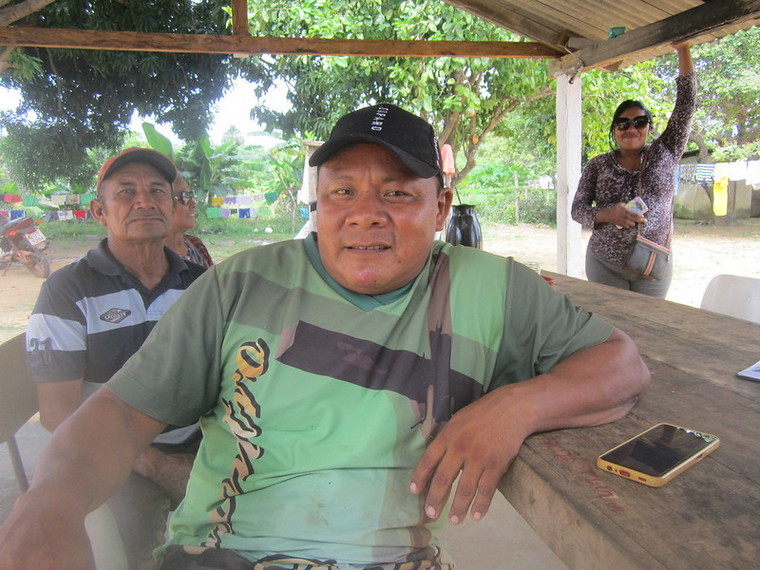
Tuxaua (chief) Lindomar Homero of the Darora Community is calling for new adequate batteries to reactivate the solar power plant, because the electricity they receive from the national grid is too expensive for the local indigenous people. Behind him stands his predecessor, former tuxaua Jesus Mota. CREDIT: Mario Osava/IPS
Expensive energy
But indigenous people can’t afford the electricity from the distributor Roraima Energía, he said. On average, each family pays between 100 and 150 reais (20 to 30 dollars) a month, he estimated.
Besides, there are unpleasant surprises. “My November bill climbed to 649 reais” (130 dollars), without any explanation,” Homero complained. The solar energy was free.
“If you don’t pay, they cut off your power,” said Mota, who was tuxaua from 1990 to 2020.”In addition, the electricity from the grid fails a lot,” which is why the equipment is damaged.
Apart from the unreliable supply and frequent blackouts, there is not enough energy for the irrigation of agriculture, the community’s main source of income. “We can do it with diesel pumps, but it’s expensive; selling watermelons at the current price does not cover the cost,” he said.
“In 2022, it rained a lot, but there are dry summers that require irrigation for our corn, bean, squash, potato, and cassava crops. The energy we receive is not enough to operate the pump,” said Mota.
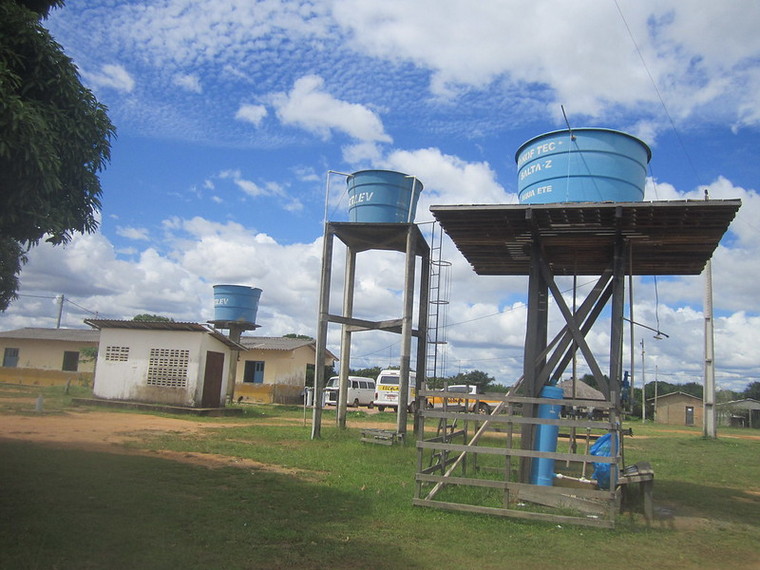
A photo of the three water tanks in the village of Darora, one of which holds water that is made potable by chemical treatment. The largest and longest building is the secondary school that serves the Macuxi indigenous community that lives in Roraima, in northern Brazil. CREDIT: Mario Osava/IPS
Achilles’ heel
Batteries still apparently limit the efficiency of solar energy in isolated or autonomous off-grid systems, with which the government and various private initiatives are attempting to make the supply of electricity universal and replace diesel generators.
Homero said that some of the Darora families who live outside the “center” of the village and have solar panels also had problems with the batteries.
Besides the 48 families in the village “center” there are 18 rural families, bringing the community’s total population to 265.
A solar plant was also installed in another community made up of 22 indigenous families of the Warao people, immigrants from Venezuela, called Warao a Janoko, 30 kilometers from Boa Vista.
But of the plant’s eight batteries, two have already stopped working after only a few months of use. And electricity is only guaranteed until 8:00 p.m.
“Batteries have gotten a lot better in the last decade, but they are still the weak link in solar power,” Aurelio Souza, a consultant who specializes in this question, told IPS from the city of São Paulo. “Poor sizing and the low quality of electronic charging control equipment aggravate this situation and reduce the useful life of the batteries.”
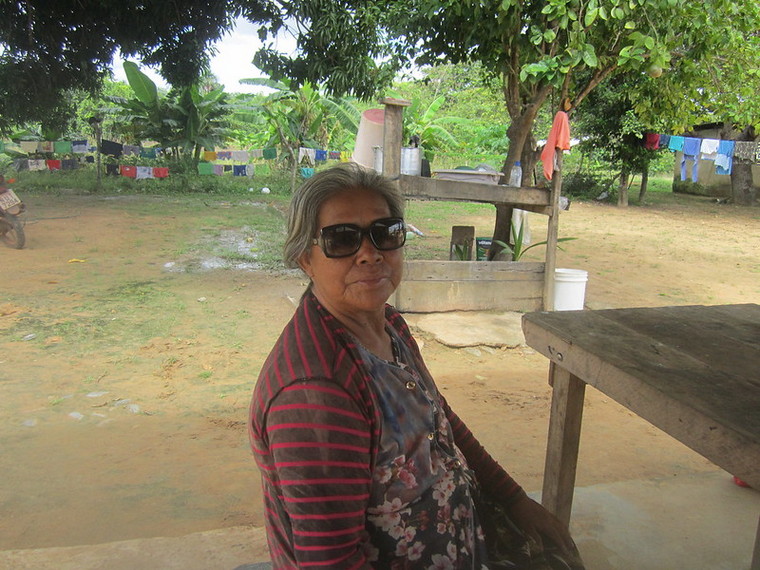
The low quality of the electricity supplied to Darora is due to the discrimination suffered by indigenous people, according to Adélia Augusto da Silva. The water they used to drink was also dirty and caused illnesses, especially in children, until the indigenous health service began to chemically treat their drinking water. CREDIT: Mario Osava/IPS
In Brazil’s Amazon jungle, close to a million people live without electricity, according to the Institute of Energy and the Environment, a non-governmental organization based in São Paulo. More precisely, its 2019 study identified 990,103 people in that situation.
Another three million inhabitants of the region, including the 650,000 people in Roraima, are outside the National Interconnected Electricity System. Their energy therefore depends mostly on diesel fuel transported from other regions, at a cost that affects all Brazilians.
The government decided to subsidize this fossil fuel so that the cost of electricity is not prohibitive in the Amazon region.
This subsidy is paid by other consumers, which contributes to making Brazilian electricity one of the most expensive in the world, despite the low cost of its main source, hydropower, which accounts for about 60 of the country’s electricity.
Solar energy became a viable alternative as the parts became cheaper. Initiatives to bring electricity to remote communities and reduce diesel consumption mushroomed.
But in remote plants outside the reach of the grid, good batteries are needed to store energy for the nighttime hours.
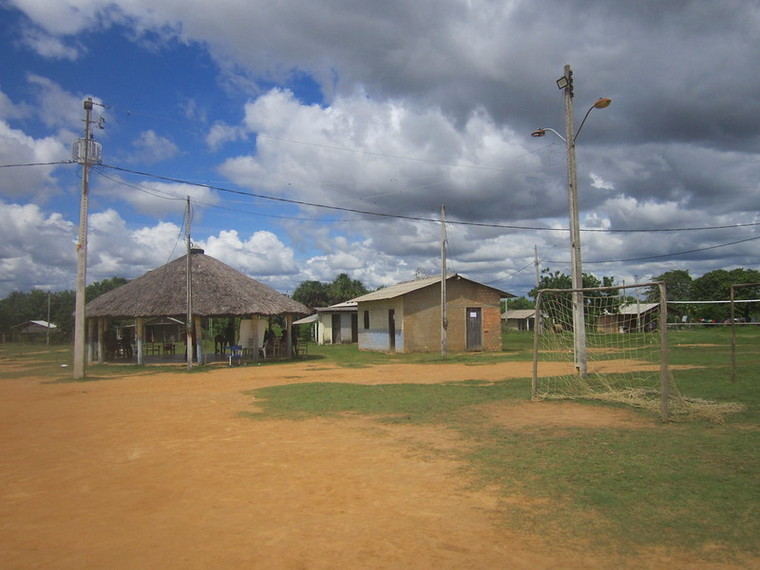
Part of the so-called “downtown” in Darora, which has lamp posts, houses, a soccer field and a shed where the community meets. A larger community center is needed, says the leader of the Macuxi village located near Boa Vista, the capital of the northern Brazilian state of Roraima. CREDIT: Mario Osava/IPS
A unique case
Darora is not a typical case. It is part of the municipality of Boa Vista, which has a population of 437,000 inhabitants and good resources, it is close to a paved road and is within a savannah ecosystem called “lavrado”.
It is at the southern end of the São Marcos indigenous territory, where many Macuxi indigenous people live but fewer than in Raposa Serra do Sol, Roraima’s other large native reserve. According to the Special Secretariat for Indigenous Health (Sesai), there were 33,603 Macuxi Indians living in Roraima in 2014.
The Macuxi people also live in the neighboring country of Guyana, where there are a similar number to that of Roraima. Their language is part of the Karib family.
Although there are no large forests in the surrounding area, Darora takes its name from a tree, which offers “very resistant wood that is good for building houses,” Homero explained.
The community emerged in 1944, founded by a patriarch who lived to be 93 years old and attracted other Macuxi people to the area.
The progress they have made especially stands out in the secondary school in the village “center”, which currently has 89 students and 32 employees, “all from Darora, except for three teachers from outside,” Homero said proudly.
A new, larger elementary and middle school for students in the first to ninth grades was built a few years ago about 500 meters from the community.
Water used to be a serious problem. “We drank dirty, red water, children died of diarrhea. But now we have good, treated water,” said Adélia da Silva.
“We dug three artesian wells, but the water was useless, it was salty. The solution was brought by a Sesai technician, who used a chemical substance to make the water from the lagoon drinkable,” Homero said.
The community has three elevated water tanks, two for water used for bathing and cleaning and one for drinking water. There are no more health problems caused by water, the tuxaua said.
His current concern is to find new sources of income for the community. Tourism is one alternative. “We have the Tacutu river beach 300 meters away, great fruit production, handicrafts and typical local gastronomy based on corn and cassava,” he said, listing attractions for visitors.