From Algorithms to Accountability: What Global AI Governance Should Look Like

Artificial Intelligence, Civil Society, Featured, Global, Global Governance, Headlines, Human Rights, International Justice, IPS UN: Inside the Glasshouse, TerraViva United Nations

Opinion

The International Telecommunication Union (ITU) is a specialized agency of the United Nations. Credit: ITU/Rowan Farrell

 
Artificial intelligence holds vast potential but poses grave risks, if left unregulated, UN Secretary-General António Guterres told the Security Council on September 24.

ABUJA, Nigeria, Oct 14 2025 (IPS) Recent research from Stanford’s Institute for Human-Centered AI warns that bias in artificial intelligence remains deeply rooted even in models designed to avoid it and can worsen as models grow. From bias in hiring of men over women for leadership roles, to misclassification of darker-skinned individuals as criminals, the stakes are high.


Yet it’s simply not attainable for annual dialogues and multilateral processes as recently provisioned for in Resolution A/RES/79/325 for the UN to keep up to pace with AI technological developments and the cost of this is high.

Hence for accountability purposes and to increase the cost of failure, why not give Tech Companies whose operations are now state-like, participatory roles at the UNGA?

When AI Gets It Wrong: 2024’s Most Telling Cases

In one of the most significant AI discrimination cases moving through the courts, the plaintiff alleges that Workday’s popular artificial intelligence (AI)-based applicant recommendation system violated federal antidiscrimination laws because it had a disparate impact on job applicants based on race, age, and disability.

Judge Rita F. Lin of the US District Court for the Northern District of California ruled in July 2024 that Workday could be an agent of the employers using its tools, which subjects it to liability under federal anti-discrimination laws. This landmark decision means that AI vendors, not just employers, can be held directly responsible for discriminatory outcomes.

In another case, the University of Washington researchers found significant racial, gender, and intersectional bias in how three state-of-the-art large language models ranked resumes. The models favored white-associated names over equally qualified candidates with names associated with other racial groups.

In 2024, a University of Washington study investigated gender and racial bias in resume-screening AI tools. The researchers tested a large language model’s responses to identical resumes, varying only the names to suggest different racial and gender identities.

The financial impact is staggering.

A 2024 DataRobot survey of over 350 companies revealed: 62% lost revenue due to AI systems that made biased decisions, proving that discriminatory AI isn’t just a moral failure—it’s a business disaster. It’s too soon for an innovation to result in such losses.

Time is running out.

A 2024 Stanford analysis of vision-language models found that increasing training data from 400 million to 2 billion images made larger models up to 69% more likely to label Black and Latino men as criminals. In large language models, implicit bias testing showed consistent stereotypes: women were more often linked to humanities over STEM, men were favored for leadership roles, and negative terms were disproportionately associated with Black individuals.

The UN needs to take action now before these predictions turn into reality. And frankly, the UN cannot keep up with the pace of these developments.

What the UN Can—and Must—Do

To prevent AI discrimination, the UN must lead by example and work with governments, tech companies, and civil society to establish global guardrails for ethical AI.

Here’s what that could look like:

Working with Tech Companies: Technology companies have become the new states and should be treated as such. They should be invited to the UN table and granted participatory privileges that both ensure and enforce accountability.

This would help guarantee that the pace of technological development—and its impacts—is self-reported before UN-appointed Scientific Panels reconvene. As many experts have noted, the intervals between these annual convenings are already long enough for major innovations to slip past oversight.

Developing Clear Guidelines: The UN should push for global standards on ethical AI, building on UNESCO’s Recommendation and OHCHR’s findings. These should include rules for inclusive data collection, transparency, and human oversight.

Promoting Inclusive Participation: The people building and regulating AI must reflect the diversity of the world. The UN should set up a Global South AI Equity Fund to provide resources for local experts to review and assess tools such as LinkedIn’s NFC passport verification.

Working with Africa’s Smart Africa Alliance, the goal would be to create standards together that make sure AI is designed to benefit communities that have been hit hardest by biased systems. This means including voices from the Global South, women, people of color, and other underrepresented groups in AI policy conversations.

Requiring Human Rights Impact Assessments: Just like we assess the environmental impact of new projects, we should assess the human rights impact of new AI systems—before they are rolled out.

Holding Developers Accountable: When AI systems cause harm, there must be accountability. This includes legal remedies for those who are unfairly treated by AI. The UN should create an AI Accountability Tribunal within the Office of the High Commissioner for Human Rights to look into cases where AI systems cause discrimination.

This tribunal should have the authority to issue penalties, such as suspending UN partnerships with companies that violate these standards, including cases like Workday.

Support Digital Literacy and Rights Education: Policy makers and citizens need to understand how AI works and how it might impact their rights. The UN can help promote digital literacy globally so that people can push back against unfair systems.

Lastly, there has to be Mandates for intersectional or Multiple Discriminations Audits: AI systems should be required to go through intersectional audits that check for combined biases, such as those linked to race, disability, and gender. The UN should also provide funding to organizations to create open-source audit tools that can be used worldwide.

The Road Ahead

AI is not inherently good or bad. It is a tool, and like any tool, its impact depends on how we use it. If we are not careful, AI could lengthen problem-solving time, deepen existing inequalities, and create new forms of discrimination that are harder to detect and harder to fix.

But if we take action now—if we put human rights at the center of AI development—we can build systems that uplift, rather than exclude.

The UN General Assembly meetings may have concluded for this year, the era of ethical AI has not. The United Nations remains the organization with the credibility, the platform, and the moral duty to lead this charge. The future of AI—and the future of human dignity—may depend on it.

Chimdi Chukwukere is an advocate for digital justice. His work explores the intersection of technology, governance, Big Tech, sovereignty and social justice. He holds a Masters in Diplomacy and International Relations from Seton Hall University and has been published at Inter Press Service, Politics Today, International Policy Digest, and the Diplomatic Envoy.

IPS UN Bureau
  Source

‘No Solution Will Work If the Institutions Responsible for Abuses Remain in Charge of Implementing It’

Active Citizens, Civil Society, Crime & Justice, Featured, Headlines, Human Rights, Latin America & the Caribbean, TerraViva United Nations

Oct 13 2025 (IPS) –  
CIVICUS discusses enforced disappearances in Mexico with a member of the International Network of Associations of Missing Persons.

The crisis of disappearances in Mexico has reached alarming proportions, with over 52,000 unidentified bodies in morgues and mass graves. On 1 July, the Mexican Congress approved controversial changes to the General Law on Disappearances, which promise to modernise the search process through a national biometric system, but which human rights organisations and victims’ groups claim could establish an unprecedented system of mass surveillance.


What are the main changes and how will they affect searches?
The changes seek to strengthen the mechanisms for searching for, locating and identifying missing persons. The main innovations include the creation of a National Investigation File Database and a Single Identity Platform that will integrate various databases. The revised law also provides for the strengthening of the Unique Population Registry Code (CURP) through the incorporation of biometric data such as iris scans, photographs and fingerprints.

The law obliges authorities and individuals to provide information useful for search processes and incorporates new institutions such as the National Guard and the Ministry of Security into the National Search System. It also increases the penalties for the crime of enforced disappearance.

The new system aims to ensure faster and more efficient searches through technology and inter-institutional coordination. It also provides for the use of satellite imagery and advanced identification technologies, under the coordination of the National Search System.

What risks are posed by the authorities’ access to biometric data?

There are serious concerns that the changes give security and justice institutions, including prosecutors’ offices, the National Guard and the National Intelligence Centre, immediate and unrestricted access to public and private databases, including those containing biometric information. The official argument is that this will speed up searches.

However, civil society warns that the Single Identity Platform and the biometric CURP could become instruments of mass surveillance. It is feared the authorities could misuse the information and, instead of helping to find missing persons, use it to help control the population, putting the rights to privacy and security at risk.

How have victims’ groups reacted?

Victims’ collectives have rejected the reform as opaque and rushed. They complain that, although round table discussions were organised, these were merely symbolic and their proposals were not taken into account.

The families of missing persons argue the changes focus on technological solutions that don’t address the underlying structural problems of corruption, cronyism, organised crime and impunity. But no technological solution will work as long as the institutions responsible for abuses and cover-ups remain in charge of implementing it.

This law runs the risk of repeating the mistakes of the 2017 General Law on Enforced Disappearances. That was an important step forward, as it criminalised the offence, created a national search system and sought to guarantee the participation of families in locating and identifying missing persons. Unfortunately, it was never properly implemented. There are fears this new law, in the absence of effective enforcement mechanisms, will only deepen frustration and perpetuate impunity.

What alternatives do victims’ groups propose?

Their demands go beyond legislative changes: they demand truth and justice through thorough investigations, the prosecution of those responsible in state institutions and organised crime groups and an effective search in the field, with the coordination and active participation of victims’ groups.

The collectives also stress the urgency of identifying the over 52,000 unnamed people in morgues and mass graves, and are calling for the creation of an Extraordinary Forensic Identification Mechanism. And they demand real protection for those searching for their relatives, who continue to face threats and attacks.

Above all, they demand an end to impunity through the dismantling of the networks of corruption and collusion between authorities and organised crime. As one local activist summed it up, at the end of the day, without a genuine National Plan for Missing Persons, none of this will work. Each state also needs its own plan. Otherwise, we will remain in the same situation: without results, without reports and without answers about our disappeared.

GET IN TOUCH
Website
Facebook

SEE ALSO
Mexico’s judicial elections consolidate ruling party power CIVICUS Lens 23.Jun.2025
The disappeared: Mexico’s industrial-scale human rights crisis CIVICUS Lens 22.Apr.2025
‘The discovery of the torture centre exposed the state’s complicity with organised crime’ CIVICUS Lens | Interview with Anna Karolina Chimiak 09.Apr.2025

  Source

UN Conference Recommits to Solidarity With Rohingyas, People of Myanmar

Armed Conflicts, Asia-Pacific, Civil Society, Development & Aid, Featured, Headlines, Human Rights, IPS UN: Inside the Glasshouse, Migration & Refugees, Religion, Sustainable Development Goals, TerraViva United Nations, Youth

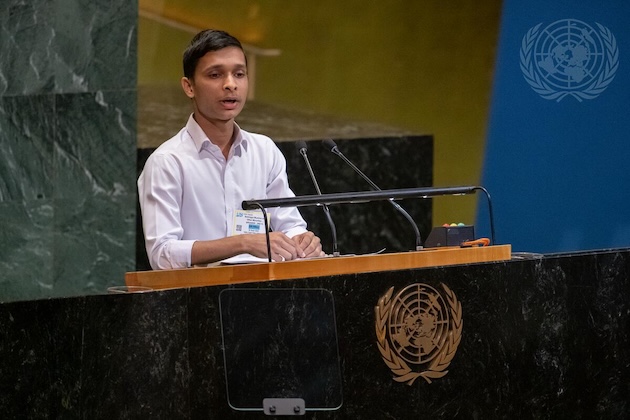
Maung Sawyeddollah, Founder of the Rohingya Students Network, addresses the high-level conference of the General Assembly on the situation of Rohingya Muslims and other minorities in Myanmar Credit: UN Photo/Manuel Elías

Maung Sawyeddollah, Founder of the Rohingya Students Network, addresses the high-level conference of the General Assembly on the situation of Rohingya Muslims and other minorities in Myanmar Credit: UN Photo/Manuel Elías

UNITED NATIONS, Oct 1 2025 (IPS) – The international community convened for a high-level meeting at UN Headquarters, this time to mobilize political support for the ongoing issue of the persecution of the Rohingya Muslims and other minorities in Myanmar.


On Tuesday September 30, representatives from Rohingya advocacy groups, the UN system and member states convened at the General Assembly to address the ongoing challenges facing Rohingya Muslims and the broader context of the political and humanitarian situation in Myanmar.

UN President of the General Assembly Annalena Baerbock remarked that the conference was an opportunity to listen to stakeholders, notably civil society representatives with experience on the ground.

“Rohingya need the support of the international community, not just in words but in action,” she said.

Baerbock added there was an “urgent need for strengthened international solidarity and increased support,” and to make efforts to reach a political solution with unequivocal participation from the Rohingyas.

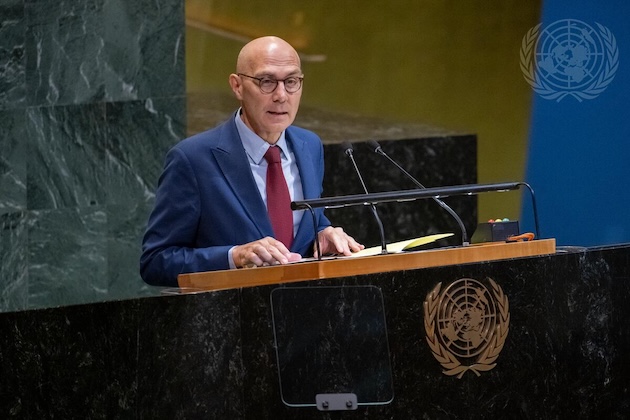
“The violence, the extreme deprivation and the massive violations of human rights have fueled a crisis of grave international concern. The international community must honor its responsibilities and act. We stand in solidarity with the Rohingya and all the people of Myanmar in their hour of greatest need,” said UN Human Rights Commissioner Volker Türk.

In the eight years since over 750,000 Rohingyas fled persecution and crossed the border into Bangladesh, the international community has had to deal with one of the most intense refugee situations in living memory. Attendees at the conference spoke on addressing the root causes that led to this protracted crisis—systematic oppression and persecution at the hands of Myanmar’s authorities and unrest in Rakhine State.

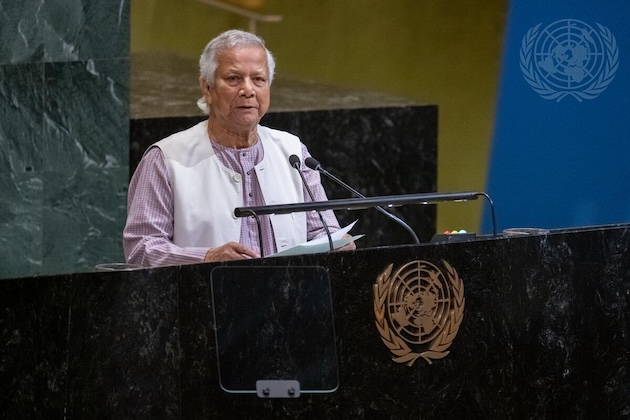
Muhammad Yunus, Chief Adviser of the interim Government of Bangladesh, addresses the high-level conference of the situation of Rohingya Muslims and other minorities in Myanmar. Credit: UN Photo/Manuel Elias

Muhammad Yunus, Chief Adviser of the interim Government of Bangladesh, addresses the high-level conference on the situation of Rohingya Muslims and other minorities in Myanmar. Credit: UN Photo/Manuel Elias

The military junta’s ascension in 2021 has only led to further unrest and instability in Myanmar and has made the likelihood of safe and sustained return far more precarious. Their persecution has only intensified as the Rohingya communities still residing in Rakhine find themselves caught in the middle of conflicts between the junta and other militant groups, including the Arakan Army.

At the opening of the conference, Rohingya refugee activists remarked that the systemic oppression predates the current crisis. “This is a historic occasion for Myanmar. But it is long overdue. Our people have suffered enough. For ethnic minorities—from Kachin to Rohingya—the suffering has spanned decades,” said Wai Wai Nu, founder and executive director of the Women’s Peace Network.

“It has already been more than eight years since the Rohingya Genocide was exposed. Where is the justice for the Rohingyas?” asked Maung Sawyeddollah, founder of the Rohingya Student Network.

For the United Nations, the Rohingya refugee crisis represents the dramatic impact of funding shortfalls on their humanitarian operations. UN Secretary-General António Guterres once said during his visit to the refugee camps in Bangladesh back in April that “Cox’s Bazar is Ground Zero for the impact of budget cuts”.

Funding cuts to agencies like UNICEF and the World Food Programme (WFP) have undermined their capacity to reach people in need. WFP has warned that their food assistance in the refugee camps will run out in two months unless they receive more funding. Yet as of now, the 2025 Rohingya Refugee Response Plan of USD 934.5 million is only funded at 38 percent.

Volker Türk, United Nations High Commissioner for Human Rights, addresses the high-level conference of the General Assembly on the situation of Rohingya Muslims and other minorities in Myanmar. Credit: UN Photo/Manuel Elias

Volker Türk, United Nations High Commissioner for Human Rights, addresses the high-level conference of the General Assembly on the situation of Rohingya Muslims and other minorities in Myanmar. Credit: UN Photo/Manuel Elias

“The humanitarian response in Bangladesh remains chronically underfunded, including in key areas like food and cooking fuel. The prospects for funding next year are grim. Unless further resources are forthcoming, despite the needs, we will be forced to make more cuts while striving to minimize the risk of losing lives: children dying of malnutrition or people dying at sea as more refugees embark on dangerous boat journeys,” said Filippo Grandi, UN High Commissioner for Refugees.

As the host country of over 1 million refugees since 2017, Bangladesh has borne the brunt of the situation. Chief Advisor Muhammad Yunus said that the country faces its own development challenges and systemic issues with crime, poverty and unemployment, and has struggled to support the refugee population even with the help of aid organizations. He made a call to pursue repatriations, the strategy to ensure the safe return of Rohingyas to Rakhine.

“As funding declines, the only peaceful option is to begin their repatriation. This will entail far fewer resources than continuing their international protection. The Rohingya have consistently pronounced their desire to go back home,” said Yunus. “The world cannot keep the Rohingya waiting any longer from returning home.”

Along with the UN, Myanmar and Bangladesh, neighboring and host countries also have a role to play. Regional blocs like the Association of Southeast Asian Nations (ASEAN) are also crucial  in supporting the Rohingya population as well as leading dialogues with other stakeholders across the region.

“In my engagements with Myanmar stakeholders, I have emphasized that peace in Myanmar will remain elusive until inclusive dialogue between all Myanmar stakeholders takes place,” said Othman Hashim, the special envoy of the ASEAN Chair on Myanmar. “For actions within Myanmar, the crucial first step is stopping the hostilities and violence. Prolonged violence will only exacerbate the misery of the people of Myanmar, Rohingya and other minorities included.”

“Countries hosting refugees need sustained support. Cooperation with UNODC [UN Office of Drugs and Crime], UNHCR, and IOM [International Organization for Migration] must be deepened,” said Sugiono, Indonesia’s foreign minister.

Supporting the Rohingya beyond emergency and humanitarian needs would also require investing resources in education and employment opportunities. Involved parties were encouraged to support resettlement policies that would help communities secure livelihoods in  the long-term, or to extend opportunities for longterm work, like in Thailand where they recently granted long-staying refugees the right to work legally in the country.

“Any initiative for the Rohingya without Rohingya in the camp, from decision making to nation-building is unsustainable and unjust. The UN must mobilize resources to empower Rohingya. We are not only victims; we have the potential to make a difference,” said Sawyeddollah.

As one of the few Rohingya representatives present that had previous lived in the camps in Cox’s Bazaar, Sawyeddollah described the challenges he faced in pursuing higher education when he applied to over 150 universities worldwide but did not get into any of them. He got into New York University with a scholarship, the first Rohingya refugee to attend. He reiterated that universities had the capacity to offer scholarships to Rohingya students, citing the example of the Asian University of Women (AUW) in Chittagong, Bangladesh, where it has been offering scholarships to Rohingya girls since at least 2018.

The conference called for actionable measures that would address several key areas in the Rohingya refugee situation. This includes scaling up funding for humanitarian aid in Bangladesh and Myanmar, and notably, pursuing justice and accountability under international law. Türk and other UN officials reiterated that resolving the instability and political tensions in Myanmar is crucial to resolving the refugee crisis.

Kyaw Moe Tun, Permanent Representative of the Republic of the Union of Myanmar to the UN, blamed the military junta for the country’s current state and called for member states to refuse supporting the junta politically or financially. “We can yield results only by acting together to end the military dictatorship, its unlawful coup, and its culture of impunity. At a time when human rights, justice and humanity are under critical attack, please help in our genuine endeavour to build a federal democratic union that rooted in these very principles.”
IPS UN Bureau Report

  Source

UNGA80: Lies Spread Faster Than Facts

Crime & Justice, Featured, Freedom of Expression, Global, Headlines, Multimedia, Press Freedom, TerraViva United Nations, Video

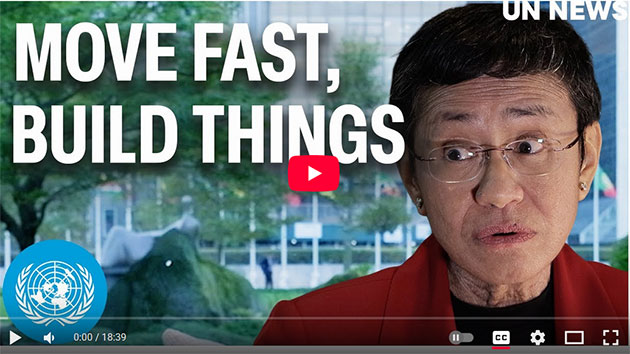
NEW YORK, Sep 30 2025 (IPS) – DANGER – WARNING – ALARM: Nobel Peace Prize Laureate Maria Ressa is warning that lies are being weaponized deliberately to manipulate people around the world. Big, profit-oriented, and technology-enabled companies are now disregarding or trampling over the sanctity and veracity of facts and information to speed up disinformation, (using AI) in ways that quickly erase truth and leave people manipulated.


Even democratic elections are getting manipulated to the extent that some 72 per cent of the world is now living under illiberal or authoritarian regimes that have been “democratically” elected. Journalism, fact-checking, and public trust are under attack from this deliberate subversion of information integrity.

Enjoy this interview I conducted with Ms Ressa, (produced, directed and edited by my UN News and Media colleagues, Paulina Kubiak and Alban Mendes De Leon).

[embedded content]

Ben Malor is the Chief Editor, UN Dailies, at UN News.

  Source

New Report Investigates Violence Against Women and Girls Through Surrogacy, Sparks Global Dialogue

Active Citizens, Civil Society, Development & Aid, Editors’ Choice, Featured, Gender, Gender Violence, Global, Headlines, Health, IPS UN: Inside the Glasshouse, Sustainable Development Goals, TerraViva United Nations, Women’s Health

United Nations Special Rapporteur Reem Alsalem recently released her report on violence against women and girls with a focus on surrogacy, one of the most controversial topics in the medical field.

United Nations Special Rapporteur Reem Alsalem. Credit: UN Photo/Loey Felipe

United Nations Special Rapporteur Reem Alsalem. Credit: UN Photo/Loey Felipe

UNITED NATIONS, Sep 19 2025 (IPS) – A United Nations report calling for the global abolition of surrogacy has sparked intense debate among experts, with critics arguing that blanket bans could harm the very women the policy aims to protect.


Reem Alsalem, the United Nations Special Rapporteur on violence against women and girls, issued a report on violence against women and girls with a specific focus on surrogacy as a form of exploitation. The report, officially titled “The different manifestations of violence against women and girls in the context of surrogacy,” was published on July 14, 2025, and is slated for discussion at the upcoming UN General Assembly session in October.

The report calls surrogacy “direct and exploitative use of a woman’s bodily and reproductive functions for the benefit of others, often resulting in long-lasting harm and in exploitative circumstances.”

It further delves into the danger of surrogacy business models, in particular, which embrace the ambiguity of international law to churn a profit, often at the expense of both the surrogate and the prospective family. Alsalem recommends the abolition of surrogacy and asks member states to “work towards adopting an international legally binding instrument prohibiting all forms of surrogacy.”

One of the largest problems with surrogacy today, according to Senior Lecturer at Swinburne University Jutharat Attawet, is a lack of comprehensive education and legal standards around the practice. This results in social alienation and false conceptions, which worsen exploitation of people who participate in surrogacy—they are not provided adequate resources

Attawet, who specializes in surrogacy healthcare and domestic policy, considers surrogacy itself a beneficial tool for nontraditional family building. However, she acknowledges the steps it has to take to ensure autonomy and respect for surrogates.

Attawet’s research, cited in Alsalem’s report, shows that approximately 1 percent of babies born in Australia are from surrogates, so although the number has doubled over the past decade, doctors are not familiar with the process. Furthermore, legislation is primarily top-down rather than region- or area-specific. Since doctors in places like Australia are “intimidated by the language” surrounding surrogacy due to minimal education, they are less willing to openly engage with the procedures. This pushes families to seek surrogates elsewhere, where laws are less stringent and doctors more comfortable with the procedures.

Another incentive for overseas surrogacy, Attawet says, is lack of national support for surrogacy. Since it does not fulfill the criteria of most healthcare insurance plans, prospective parents often seek a more affordable surrogacy birth internationally. This further contributes to the exploitation both she and Alsalem note in their respective research—international surrogacy is much more difficult to regulate between different countries’ laws and often primarily harms the surrogate and the child, who is less likely to know their birth mother from an international surrogacy.

Alsalem criticized the practice of international surrogacy as an exploitative technique to perpetuate wealth inequality between different countries, but many experts argue that the job is one of the few accessible, well-paying jobs for child-bearing people who need to care for their family full-time. Polina Vlasenko, a researcher whose work was also cited in Alsalem’s report, explained to IPS that international surrogacy in Ukraine and the Republic of Georgia “is the type of job you can combine with having a kid and being a full-time caretaker of your kid… it still benefits women.”

Vlasenko elaborated, saying that most workers in the surrogacy industry, including intermediaries and clinicians, were women who had some sort of pre-existing connection to the process—often being former surrogates. To ban surrogacy entirely, Vlasenko argues, would merely harm women in all facets of the industry rather than resolving wealth gaps. She said, “this inequality is much deeper than services of surrogacy.”

Social worker and professor at Ohio State University Sharvari Karandikar similarly opposes the Special Rapporteur’s recommendation of abolition. In an interview with IPS, Karandikar explained that “in countries like India, it’s really hard to implement policies in a uniform way, and I think that one needs to have proper oversight of medical professionals and how they’re engaging in surrogate arrangements and medical tourism. Blanket bans do not work.”

She emphasized the dangers of surrogacy without regulation, saying it would only do more harm.

Instead, Karandikar advocates for “the safety, the better communication, more education, more informed choice and decision, more safeguards, better treatment options, and long-term health coverage for women who engage in surrogacy” as “a wonderful way to speak about women’s choices, decisions and their health instead of penalizing anyone.”

However, in order for the global conversation surrounding surrogacy to center around female agency, experts like Vlasenko say the perception of surrogates needs to change. She said, “sex work is not seen as violence or exploitation when it’s done for free… it’s the same with childbirth… surrogate mothers are taking the only work that, in their situation, allows them to fulfill certain responsibilities like childcare and income generation. They think that they’re agents in this process, but society sees them as victims.”

Ultimately, the surrogacy debate reflects broader questions about women’s autonomy, economic inequality and reproductive rights. As Vlasenko noted, addressing the “much deeper inequality” that pushes women to surrogacy may prove more effective than focusing solely on limiting the practice itself.

IPS UN Bureau Report

  Source

Loss and Damage at COP30: Indigenous Leaders Challenge Top-Down Finance Models

Active Citizens, Civil Society, Climate Action, Climate Change, Climate Change Finance, Climate Change Justice, Conferences, COP29, COP30, Editors’ Choice, Featured, Headlines, Human Rights, Humanitarian Emergencies, Indigenous Rights, International Justice, Sustainable Development Goals, TerraViva United Nations

Indigenous Rights

Indigenous activists continue to fight for a seat at the table in solving climate change, asking for self-determination and financial agency.

Activists demand loss and damage reparations outside the hall where the COP29 negotiators were concluding their negotiations. Credit: UN Climate Change/Kiara Worth

Activists demand loss and damage reparations outside the hall where the COP29 negotiators were concluding their negotiations. Credit: UN Climate Change/Kiara Worth

UNITED NATIONS, Sep 17 2025 (IPS) – As climate-induced disasters continue to devastate the Global South, nations are steadily mounting pressure at the United Nations for wealthier countries to deliver on long-promised climate reparations through the Loss and Damage Fund. For Indigenous peoples, whose territories are often the most ecologically intact yet most damaged by climate change, these negotiations define survival, sovereignty and recognition as rights-holders in global climate governance.


After the fund’s operationalization at the 29th Conference of the Parties to the United Nations Framework Convention on Climate Change (COP29) in Baku last fall, developing countries say that the pledges so far—approximately USD 741 million—fall drastically short of the trillions needed to recover from climate devastation.

This low number is acutely felt in Indigenous communities, whose local economies rely on thriving ecosystems.

“A lot of rich biodiversity, carbon sinks and the most preserved parts of the world are within indigenous territories,” said Paul Belisario, Global Coordinator for the Secretariat of the International Indigenous Peoples Movement for Self-Determination and Liberation (IPMSDL), in an interview with IPS. “Without recognizing Indigenous people’s right to take care of it, to govern it and to live in it so that their traditional knowledge will flourish, we cannot fully address the climate crisis.”

UN Secretary-General António Guterres echoed this sentiment in Baku, saying, “The creation of the Loss and Damage Fund is a victory for developing countries, for multilateralism and for justice.  But its initial capitalization of USD 700 million doesn’t come close to righting the wrong inflicted on the vulnerable.”

These “wrongs,” Indigenous leaders argue, must include the exclusion of traditional and tribal knowledge in decision-making. In light of pushback to make climate action a legal responsibility rather than a political agreement, many are hopeful that COP30 will yield a more successful negotiation for adequate compensation.

The call for action is led by coalition blocs including the Alliance of Small Island States (AOSIS) and G77, an alliance of developing countries with China as its primary political and financial supporter. Both alliances represent the countries most vulnerable to climate-related natural disasters. G77 was particularly vocal during COP29, where their rejection of the deal was backed by a number of climate and civil society organizations who criticized the negotiating text for giving developed countries too much leeway to shirk their climate finance obligations.

For Indigenous groups, this criticism stems from concerns that funding will not successfully reach their communities due to bureaucracy or geographical and political isolation.

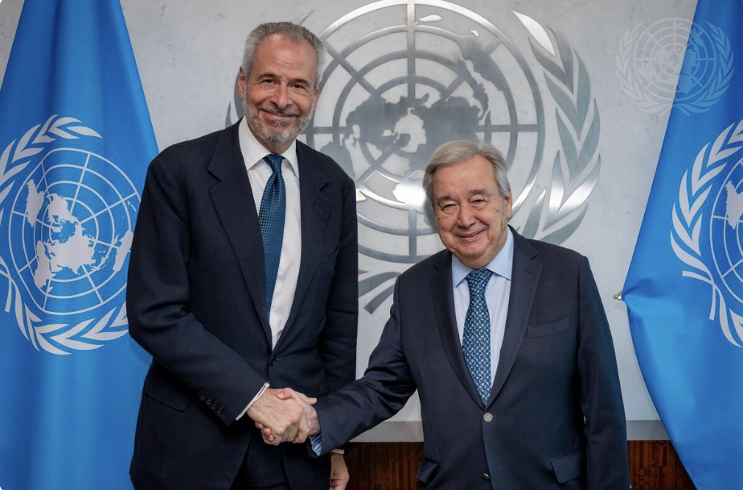
Secretary-General António Guterres meets with André Aranha Corrêa do Lago, President-designate of COP 30, the 2025 UN Climate Change Conference, which will be held in Belém, Brazil. Credit: UN Photo

Secretary-General António Guterres meets with André Aranha Corrêa do Lago, President-designate of COP 30, the 2025 UN Climate Change Conference, which will be held in Belém, Brazil. Credit: UN Photo

Janene Yazzie, director of policy and advocacy at the NDN Collective, spoke about the importance of Indigenous involvement in funding distributions, saying, “What we’re advocating for is to ensure that these mechanisms… are accessible to Indigenous Peoples, uphold the rights of Indigenous Peoples, and can be utilized towards solutions and responses that are designed and prioritized by Indigenous Peoples.”

Last year, countries eventually settled on mobilizing USD 300 billion annually by 2035 to developing countries for climate finance—far below the USD 1 trillion experts say is the minimum for effective mitigation and adaptation. The financial commitment is voluntary, meaning that countries can withdraw without consequence and no protections exist to ensure the money is distributed with regard for Indigenous governance systems.

The Forest Stewardship Council (FSC) Indigenous Foundation noted that groups without formal land titles could be excluded entirely, despite their role in stewarding biodiverse landscapes.

However, a recent International Court of Justice (ICJ) report has created new legal pathways. The court placed stringent obligations on states to prevent significant climate harm and tackle climate change, stating that failure to do so triggers legal responsibility. Scientific evidence can link emissions to specific countries, allowing those affected by climate change to seek legal action, which could include getting money back, restoring land, improving infrastructure, or receiving compensation for financial losses.

Indigenous activists at COP29. Credit: UN Climate Change/ Kiara Worth

Indigenous activists at COP29. Credit: UN Climate Change/Kiara Worth

This legal opinion opens new pathways for seeking restitution—not only in money but also in land recovery, infrastructure for adaptation, and guarantees of political participation.

This legal shift comes at a crucial time. In April 2025, thousands of Indigenous Brazilians marched in the capital ahead of COP30 in Belém, demanding land rights and decision-making influence. Meanwhile, the National Organization of the Indigenous Peoples of the Colombian Amazon (OPIAC) also issued a statement about the summit for Deforestation of the Amazon. They outline an action plan to end deforestation, strengthen land rights and phase out oil and gas exploration.

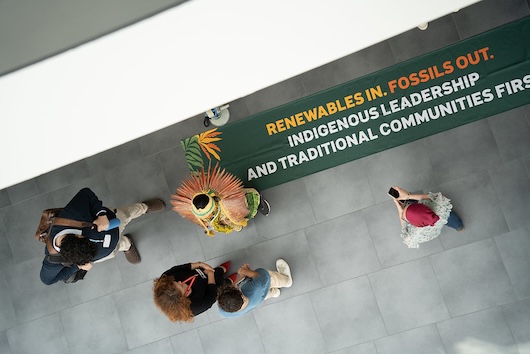
After indigenous groups were denied a co-presidency for COP30, Conference President André Corrêa do Lago pledged to establish a “Circle of Indigenous Leadership” within the conference. Many leaders found the arrangement insufficient—the FSC Indigenous Foundation called instead for “co-governance models where Indigenous Peoples are not just consulted but are leading and shaping climate action.”

Indigenous people make their message clear during COP29. Credit: Photo- UN Climate Change/Lara Murillo

Indigenous people make their message clear during COP29. Credit: UN Climate Change/Lara Murillo

Other groups were more explicitly critical. The Indigenous Climate Action co-authored a statement at the end of COP29 saying, “There is nothing to celebrate here today… While we urgently need direct and equitable access to climate finance for adaptation, mitigation and loss and damage across all seven socio-cultural regions… we reject the financial colonization that comes from loans and any other financial mechanisms that perpetuate indebtedness of nations that have contributed the least to climate change yet bear the brunt of its tragedies.”

Belisario frames the funding question as a matter of justice rather than charity.

“This funding is not just corporate social responsibility or compensation,” he told IPS. “This is historical justice.”

However, without Indigenous influence in the distribution of money from the Loss and Damage Fund, it remains unclear how effective this aid will be in combating climate change based on Indigenous knowledge and science. Many activists advocate for more localized approaches to climate action.

Belisario acknowledges the limitations of international negotiations.

“It’s been a running joke that we will negotiate until COP100, and we might not have that long. What we would really like to get out of COP30 is to meet many communities to discuss the common problems and make them realize that this COP is just a part of how we would like to solve our climate crisis,” he said. “We really believe that more radical ways to enact accountability and responsibility will start with movements in people’s own countries, in their own localities.”

As the FSC Indigenous Foundation concluded, “Indigenous Peoples must lead the design, management, and oversight of financial mechanisms that affect their lands, lives, and futures. Climate justice will only be possible when Indigenous Peoples are recognized as rights-holders and partners in decision-making.”

IPS UN Bureau Report