Brazil: A Step Forward for Indigenous Peoples’ Rights

Civil Society, Climate Change, Environment, Featured, Headlines, Human Rights, Indigenous Rights, Latin America & the Caribbean, TerraViva United Nations

Opinion

Credit: Evaristo Sa/AFP via Getty Images

MONTEVIDEO, Uruguay, Oct 24 2023 (IPS) – Brazil’s Supreme Court has delivered a long-awaited ruling upholding Brazilian Indigenous peoples’ claims to their traditional land. It did so by rejecting the ‘Temporal Framework’ principle, which only allowed for the demarcation and titling of lands physically occupied by the Indigenous groups who claimed them by 5 October 1988, when the current constitution was adopted. This excluded the numerous Indigenous communities who’d been violently expelled from their ancestral lands before then, including under military dictatorship between 1964 and 1985.


The case was brought in relation to a land dispute in the state of Santa Catarina, but the ruling applies to hundreds of similar situations throughout Brazil.

This was also good news for the climate. Brazil is home to 60 per cent of the Amazon rainforest, a key climate stabiliser due to the enormous amount of carbon it stores and the water it releases into the atmosphere. Most of Brazil’s roughly 800 Indigenous territories – over 300 of which are yet to be officially demarcated – are in the Amazon. And there are no better guardians of the rainforest than Indigenous peoples: when they fend off deforestation, they protect their livelihoods and ways of life. The best-preserved areas of the Amazon are those legally recognised and protected as Indigenous lands.

But there’s been a sting in the tale: politicians backed by the powerful agribusiness lobby have passed legislation to enshrine the Temporal Framework, blatantly ignoring the court ruling.

A tug of war

The Supreme Court victory came after a long struggle. Hundreds of Indigenous mobilisations over several years called for the rejection of the Temporal Framework.

Powerful agribusiness interests presented the Temporal Framework as the proper way of regulating article 231 of the constitution in a way that provides the legal security rural producers need to continue to operate. Indigenous rights groups denounced it as a clear attempt to make theft of Indigenous lands legal. Regional and international human rights mechanisms sided with them: the Inter-American Commission on Human Rights and the United Nations (UN) Special Rapporteur on the rights of Indigenous Peoples warned that the framework contradicted universal and Inter-American human rights standards.

In their 21 September decision, nine of the Supreme Court’s 11 members ruled the Temporal Framework to be unconstitutional. With a track record of agribusiness-friendly rulings, the two judges who backed it had been appointed by former far-right president Jair Bolsonaro, and one of them had also been Bolsonaro’s justice minister.

As the Supreme Court held its hearings and deliberations, political change took hold. Bolsonaro had vowed ‘not to cede one centimetre more of land’ to Indigenous peoples, and the process of land demarcation had remained stalled for years. But in April 2023, President Lula da Silva, in power since January, signed decrees recognising six new Indigenous territories and promised to approve all pending cases before the end of his term in 2026, a promise consistent with the commitment to achieve zero deforestation by 2030. The recognition of two additional reserves in September came alongside news that deforestation in the Brazilian Amazon had fallen by 66 per cent in August compared to the same month in 2022.

Agribusiness fights back

But the agribusiness lobby didn’t simply accept its fate. The powerful ruralist congressional caucus introduced a bill to enshrine the Temporal Framework principle into law, which the Chamber of Deputies quickly passed on 30 May. The vote was accompanied by protests, with Indigenous groups blocking a major highway. They faced the police with their ceremonial bows and arrows and were dispersed with water cannon and teargas.

The Temporal Framework bill continued its course through Congress even after the Supreme Court’s decision. On 27 September, with 43 votes for and 21 against, the Senate approved it as a matter of ‘urgency’, rejecting the substance of the Supreme Court ruling and claiming that in issuing it the court had ‘usurped’ legislative powers.

The Articulation of Indigenous Peoples of Brazil’s (APIB) assessment was that, as well as upholding the Temporal Framework, the bill sought to open the door to commodity production and infrastructure construction in Indigenous lands, among other serious violations of Indigenous rights. For these reasons, Indigenous groups called this the ‘Indigenous Genocide Bill’.

The struggle goes on

As the 20 October deadline for President Lula to either sign or veto the bill approached, a campaign led by Indigenous congresswoman Célia Xakriabá collected almost a million signatures backing her call for a total veto. Along with other civil society groups, APIB sent an urgent appeal to the UN requesting support to urge Lula to veto the bill.

On 19 October the Federal Public Prosecutor’s Office said Lula should veto the bill on the basis that it’s unconstitutional. On the same day, however, senior government sources informed that there wouldn’t be a total veto, but a ‘very large’ partial one. And indeed, the next day it was announced that Lula had partially vetoed the bill. According to a government spokesperson, all the clauses that constituted attacks on Indigenous rights and went against the Constitution were vetoed, while the ones that remained would serve to improve the land demarcation process, making it more transparent.

Even if the part of the bill that wasn’t vetoed doesn’t undermine the Supreme Court ruling, the issue is far from settled. The veto now needs to be analysed at a congressional session on a date yet to be determined. And the agribusiness lobby won’t back down easily. Many politicians own land overlapping Indigenous territories, and many more received campaigns funding from farmers who occupy Indigenous lands.

While further moves by the right-leaning Congress can’t be ruled out, the Supreme Court ruling also has some problems. The most blatant concerns the acknowledgment that there must be ‘fair compensation’ for non-Indigenous people occupying Indigenous lands they acquired ‘in good faith’ before the state considered them to be Indigenous territory. Indigenous groups contend that, while there might be a very small number of such cases, in a context of increasing violence against Indigenous communities, the compensation proposal would reward and further incentivise illegal invasions.

But beneath the surface of political squabbles, deeper changes are taking place that point to a movement that is growing stronger and better equipped to defend Indigenous peoples’ rights.

The 2022 census showed a 90-per-cent increase, from 896,917 to 1.69 million, in the number of Brazilians identifying as Indigenous compared to the census 12 years before. There was no demographic boom behind these numbers – just longstanding work by the Indigenous movement to increase visibility and respect for Indigenous identities. People who’d long ignored and denied their heritage to protect themselves from racism are now reclaiming their Indigenous identities. Not even the violent anti-Indigenous stance of the Bolsonaro administration could reverse this.

Today the Brazilian Indigenous movement is stronger than ever. President Lula owes his election to positioning himself as an alternative to his anti-rights, climate-denying predecessor. He now has the opportunity to reaffirm his commitment to respecting Indigenous peoples’ rights while tackling the climate crisis.

Inés M. Pousadela is CIVICUS Senior Research Specialist, co-director and writer for CIVICUS Lens and co-author of the State of Civil Society Report.

  Source

UN Chief Urged to Create Civil Society Envoy

Civil Society, Democracy, Featured, Global, Headlines, Human Rights, IPS UN: Inside the Glasshouse, Sustainable Development Goals, TerraViva United Nations

The high-level segment of the UN General Assembly in late September 2021 was attended by more than 100 world leaders and over a thousand delegates from 193 countries —despite the UN’s pandemic lockdown. But Civil Society Organizations (CSOs) were banned from the Secretariat building. Credit: UN Photo / Mark Garten

UNITED NATIONS, Oct 16 2023 (IPS) – When the United Nations commemorated the 75th anniversary of the UN Charter back in 2020, Secretary-General Antonio Guterres paid a supreme compliment to Civil Society Organizations (CSOs).


The CSOs, he pointed out, were a vital voice in the San Francisco Conference (where the UN was inaugurated). “You have been with us across the decades, in refugee camps, in conference rooms, and in mobilizing communities in streets and town squares across the world.”

“You are our allies in upholding human rights and battling racism. You are indispensable partners in forging peace, pushing for climate action, advancing gender equality, delivering life-saving humanitarian aid and controlling the spread of deadly weapons”.

And the world’s framework for shared progress, the Sustainable Development Goals (SDGs), is unthinkable without you’, he declared.

But in reality, CSOs are occasionally treated as second class citizens, with hundreds of CSOs armed with U.N. credentials, routinely barred from the United Nations, specifically when world leaders arrive to address the high-level segment of the General Assembly sessions in September.

The annual ritual where civil society is treated as political and social outcasts has always triggered strong protests. The United Nations justifies the restriction primarily for “security reasons”.

A coalition of CSOs– including Access Now, Action for Sustainable Development, Amnesty International, CIVICUS, Civil Society in Development (CISU), Democracy Without Borders, Forus, Global Focus, Greenpeace International, Human Rights Watch, Oxfam International, TAP Network, and UNA-UK— is now proposing the creation of a Special UN Civil Society Envoy to protect, advance and represent the interests of these Organizations.

Credit: United Nations

In a letter to Guterres, the coalition points out the disparity in access for civil society delegates viz. UN staff and members of government delegations who face no such restrictions stand as a critical reminder of the hurdles faced by accredited civil society representatives who travel great distances to contribute their perspectives at the UN.

“It is also a missed opportunity for civil society delegates to engage in key negotiations inside the UN headquarters and for policymakers to benefit from their critical and expert voices buttressed by lived experience in advancing the principles enshrined in the UN Charter,” the letter says.

Considering this recurring disparity, the letter adds, “we believe it’s vital to correct this injustice promptly to ensure opportunities for all stakeholders to contribute to discussions of global consequences”.

“This issue once again underscores the necessity for civil society to have a dedicated champion within the UN system, in the form of a Civil Society Envoy, who can help promote best practices in civil society participation across the UN and foster outreach by the UN to civil society groups worldwide, particularly those facing challenges in accessing the UN.”

“We would also like to express our support for the revision of modalities to ensure meaningful civil society participation at all stages of UN meetings and processes as well as Unmute Civil Society recommendations supported by 52 states and over 300 civil society organizations from around the world”.

“We believe that addressing the above concerns could lead to significant strides in advancing the ideal of a more inclusive, equitable, and effective UN in the spirit of ‘We the Peoples.’ “

Mandeep Tiwana, Chief Officer, Evidence and Engagement, at CIVICUS told IPS civil society representatives have long complained about asymmetries across UN agencies and offices in engaging civil society and have called for a champion within the UN system to drive best practices and harmonise efforts.

One such medium, he said, could be the appointment of a Civil Society Envoy along the lines of the UN Youth Envoy and Tech Envoy to drive key engagements.

Notably, a Civil Society Envoy could foster better inclusion of civil society and people’s voices in UN decision-making at the time when the UN is having to grapple with multiple crises and assertion of national interests by states to the detriment of international agreements and standards, he pointed out.

Five reasons why it’s time for a Civil Society Envoy:

    1. Without stronger civil society participation, the SDGs will not get back on track. The UN’s own assessment laments the lack of progress on the SDGs. We desperately need stronger civil society involvement to drive innovations in public policy, effectively deliver services that ‘leave no one behind’ and to spur transparency, accountability and participation. A Civil Society Envoy can catalyse crucial partnerships between the UN, civil society and governments.

    2. Civil society can help rebalance narratives that undermine the rules based international order. With conflicts, human rights abuses, economic inequality, nationalist populism and authoritarianism rife, the spirit of multilateralism enshrined in the UN Charter is at breaking point. Civil society representatives with their focus on finding global solutions grounded in human rights values and the needs of the excluded can help resolve impasses caused by governments pursuing narrow self-interests.

    3. A civil society envoy can help overcome UNGA restrictions on citizen participation and create better pathways to engage the UN. As it does every year, this September the UN suspended annual and temporary passes issued to accredited NGOs during UNGA effectively barring most civil society representatives from participating. Further, civil society access to the UN agencies and offices remains inconsistent. Reform minded UN leaders and states that support civil society can prioritise the appointment of an envoy for improved access.

    4. More equitable representation. The few civil society organizations who enjoy access to UNGA heavily skew toward groups based in the Global North who have the resources to invest in staff representation in New York, or the right passports to enter key UN locations easily. A UN civil society envoy would lead the UN’s outreach to civil society across the globe and particularly in underserved regions. Moreover, a civil society envoy could help ensure more diverse and equitable representation of civil society at UN meetings where decisions are taken.

    5. A civil society envoy is possible. Getting anything done at the UN requires adhering to what is politically feasible. A civil society special envoy is within reach. The Unmute Civil Society initiative to enable meaningful participation at the UN is supported by 52 states and over 300 civil society organizations. It includes among other things a call for civil society day at the UN and the appointment of a UN envoy.

Recent UN Special Envoys include:

IPS UN Bureau Report

  Source

Housing in Cuba, a Problem with no Solution in Sight

Civil Society, Development & Aid, Economy & Trade, Editors’ Choice, Featured, Headlines, Latin America & the Caribbean, Population, Poverty & SDGs, Regional Categories, TerraViva United Nations

Development & Aid

A "for sale" sign seen outside a house in Centro Habana. As you walk along the streets of the Cuban capital, you see a variety of "for sale" signs on a number of houses. The same is true in cities and towns in Cuba's 168 municipalities. CREDIT: Jorge Luis Baños / IPS

A “for sale” sign seen outside a house in Centro Habana. As you walk along the streets of the Cuban capital, you see a variety of “for sale” signs on a number of houses. The same is true in cities and towns in Cuba’s 168 municipalities. CREDIT: Jorge Luis Baños / IPS

HAVANA, Oct 16 2023 (IPS) – To emigrate to the United States and fulfill her hopes for a better life, Ana Iraida sold almost all of her belongings, including the apartment that, until her departure, saved her from the uncertainty of living in rented housing in Cuba, a country with an unresolved housing crisis.


“I inherited the apartment in Havana from my maternal grandmother, who passed away in 2015. It was small, but comfortable. I sold it for 6,000 dollars to pay for my documents, paperwork and airfare,” the philologist, who like the rest of the people interviewed preferred not to give her last name, told IPS.

“It is difficult to sell, because many people want to emigrate, and they are practically ‘giving away’ the houses. But at the same time hard currency is scarce and a person with thousands of dollars prefers to use them to leave the country.” — Elisa

From Houston, Texas in the U.S., where she now lives, the young woman said that, thanks to loans from friends, “I raised another 4,000 dollars. I got to Nicaragua in December 2022 and from there I continued by land to the U.S. border.”

Ana Iraida said she feels “fortunate” to have had a home that was “furnished and in good condition,” with which she covered her expenses. She said that others “have a more difficult time because they do not have a home of their own.”

In the last two years, emigration from Cuba has skyrocketed amidst the deterioration of the domestic economic situation, fueled by the COVID-19 pandemic, the tightening of the U.S. embargo, partial dollarization of the economy, the fall in the purchasing power of wages and pensions, shortages of essential products and inflation.

Errors and delays in the implementation of reforms to modernize the country and the ineffective monetary system implemented in January 2021 have also played a role.

In this country of 11 million people, in 2022 the exodus led some 250,000 people to the United States alone, the main receiving nation of migrants from this Caribbean island nation, from which it is separated by just 90 miles of sea.

To stem the wave of immigration, on Jan. 5 the U.S. government extended to nationals of Cuba, Nicaragua and Haiti a humanitarian temporary residency permit program, known as “parole”, similar to the one implemented in October 2022 for Venezuelans and previously for other nationalities.

As of the end of August, more than 47,000 Cubans had obtained the humanitarian permit, of whom 45,000 had already immigrated, according to U.S. Customs and Border Protection.

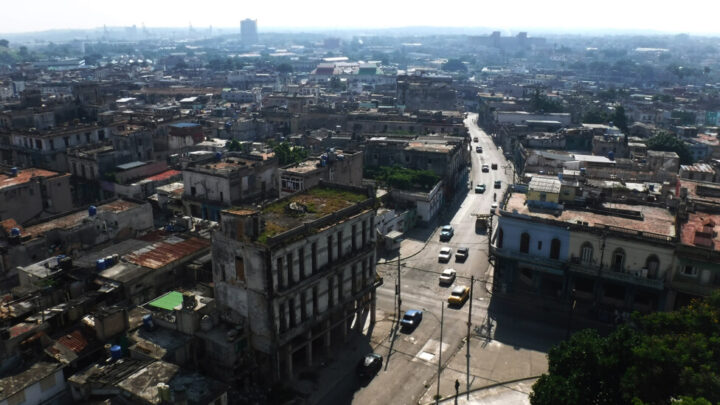
A view of Havana from Cerro, one of its 15 municipalities. This city of 2.2 million inhabitants, the biggest in the country, has the largest housing deficit in Cuba, exceeding 800,000 housing units. CREDIT: Jorge Luis Baños / IPS

A view of Havana from Cerro, one of its 15 municipalities. This city of 2.2 million inhabitants, the biggest in the country, has the largest housing deficit in Cuba, exceeding 800,000 housing units. CREDIT: Jorge Luis Baños / IPS

One of the requirements for the temporary residency permit is to have sponsors who are U.S. citizens or hold some other legal status, in addition to having the financial resources to support the beneficiary or beneficiaries.

Swapping or selling parole

Owning your own home can also be an opportunity allowing whole families to move abroad.

“People are swapping houses for parole status. A few weeks ago I facilitated the exchange of a house for five parole permits to the United States. And in another case, with a residence in Miramar (a wealthy neighborhood in western Havana), nine people were the beneficiaries,” said Damian, a historian who privately engages in buying and selling, for which he charges a commission.

Damián explained to IPS that “residents in the United States ask for 10,000 to 12,000 dollars to provide a guarantee for parole status. The number of people they give a guarantee for depends on the value of the house. When the process is completed, the property is sold to a relative or friend of that person in Cuba.”

Walking through the streets in the Cuban capital, the most varied signs reading “for sale” can be seen on crumbling or remodeled buildings. The same is true in other cities and towns of the country’s 168 municipalities.

On online sites and Facebook groups for buying and selling activities, there is a proliferation of advertisements with photos and information about the properties, such as the number of rooms, the presence of a landline telephone line or an electrical installation that allows the connection of 110 and 220 volt equipment.

Some negotiate the price with or without furniture, others negotiate with buyers who pay cash in hand, or who pay in dollars, euros or make the deposit abroad.

“It is difficult to sell, because many people want to emigrate, and they are practically ‘giving away’ the houses. But at the same time hard currency is scarce and a person with thousands of dollars prefers to use them to leave the country,” said Elisa, a lawyer who told IPS she is interested in settling with her husband and son in Spain.

She said she has been trying to sell her apartment in La Vibora, another Havana neighborhood, for a year. “I can’t find a buyer, not even now that I dropped the price to 10,000 dollars, half the initial price, and it’s furnished,” she complained.

In Cuba’s informal real estate market, offers range from 2,000 dollars or less to a million dollars. The lowest of these figures is far from the average monthly salary, equivalent to 16.50 dollars on the black market.

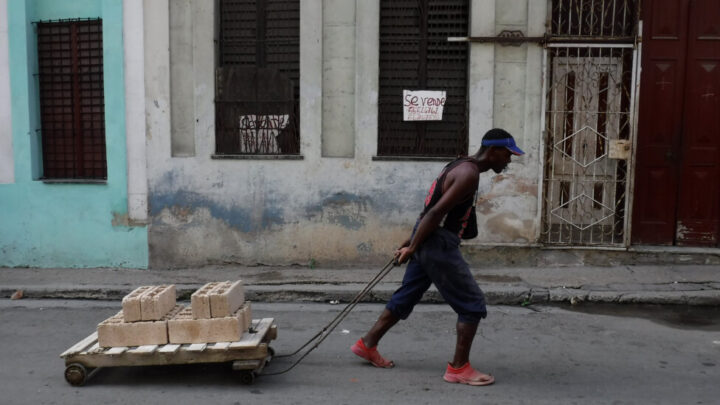
A man pulls a cart loaded with building blocks past a house for sale in the municipality of Centro Habana. In view of the government's diminished construction capacity and the decline of funds for housing, since 2010 the government authorized the free sale of various materials for construction, repairs, remodeling and expansion. CREDIT: Jorge Luis Baños / IPS

A man pulls a cart loaded with building blocks past a house for sale in the municipality of Centro Habana. In view of the government’s diminished construction capacity and the decline of funds for housing, since 2010 the government authorized the free sale of various materials for construction, repairs, remodeling and expansion. CREDIT: Jorge Luis Baños / IPS

Hurdles despite the reforms

Now, Cubans can sell their properties even to move away from the country, a situation very different from 15 years ago, when only swaps of houses between two or more owners were possible. Homes could only be sold to the government, and they were confiscated if the people living there emigrated.

Under laws passed in the early years after the 1959 revolution, most citizens became homeowners.

The Urban Reform Law of 1960 turned housing properties over to those who lived in them, prohibited their sale or lease, and abolished private construction and mortgages.

After decades of prohibitions, in October 2011 the 1988 General Housing Law was amended and the doors were opened to free purchase and sale between Cuban citizens and even foreign residents, endorsed before notaries and with the payment of taxes.

The law also eliminated certain formalities and official regulations on swaps.

Prior to the restitution of the right of ownership of residential units, in 2010 the government approved permits allowing people to build, repair or expand their own homes.

In view of the government’s reduced capacity for construction and the decline in housing funds in that same year, the free sale of cement, sand, gravel, cement blocks and corrugated iron bars was also authorized, which until then had been exclusively centrally allocated or sold in convertible pesos (CUC, a now defunct currency equivalent to the dollar).

The authorities promoted the granting of subsidies to vulnerable families, especially those affected by hurricanes, and micro-credits to build, expand or remodel homes.

These measures helped drive a boom in private construction and repairs.

As in other areas marked by the scarcity of materials, red tape and unequal purchasing power, the granting of housing and sale of materials is not exempt from corruption, theft and poor quality work, which has given rise to repeated complaints from the public.

There is still a housing deficit of more than 800,000 homes, while one third of Cuba’s 3.9 million homes are in fair or poor condition.

The largest deficits are concentrated in Havana, a city of 2.2 million inhabitants, as well as in Holguín, Santiago de Cuba and Camagüey, the other three most populated cities.

In 2019, a Housing Policy was launched, aimed at eliminating the housing shortage within a decade, based on the incentive of local production of construction materials and recyclable inputs, in addition to the contribution from the government and the centrally planned economy.

But the policy has run into hurdles as a result of the economic crisis, and multiple factors such as delays in paperwork and procedures, loss of material resources, unfinished subsidies and financial resources tied up in the banks.

The shortage of foreign currency and insufficient investment stand in the way of increasing production and incorporating equipment to boost construction capacity and sustainability.

Official data show that in 2022, more than 195 million dollars were dedicated to business services, real estate and rental activity, including hotel construction, which represented almost 33 percent of investment in the sector.

On the other hand, only 8.5 million dollars were allocated to housing construction, or 1.4 percent of the total, according to the government’s National Statistics and Information Office (ONEI).

Since 2019, 127,345 housing units were completed and 106,332 were remodeled or repaired, said Vivian Rodriguez, general director of Housing of the Ministry of Construction, during the most recent session of the Council of Ministers, on Oct. 1.

The authorities acknowledged that compliance with the year’s plan of 30,000 new units is under threat. Maintaining this pace would mean eliminating the housing deficit in more than 28 years.

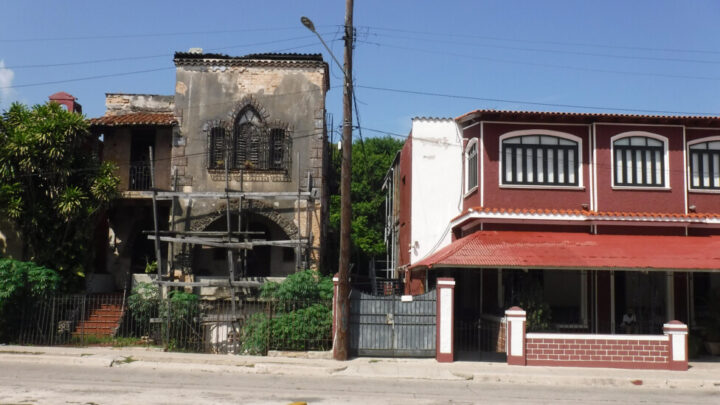
A rundown house stands next to a newly remodeled home on a street in the municipality of Playa, Havana. A third of Cuba's 3.9 million homes are considered to be in fair and poor condition. CREDIT: Jorge Luis Baños / IPS

A rundown house stands next to a newly remodeled home on a street in the municipality of Playa, Havana. A third of Cuba’s 3.9 million homes are considered to be in fair and poor condition. CREDIT: Jorge Luis Baños / IPS

No immediate solution

The lack of housing and the deterioration of existing homes continue without a viable solution in the short or medium term.

On many occasions, people of different generations are forced to live together in small homes, many of which are in a state of disrepair, putting a significant number of families at risk.

Access to housing has also been identified as a factor in the low birth and fertility rates that Cuba has been experiencing for decades.

There is also a problem after tropical cyclones and heavy rains, when centuries-old buildings that have never been remodeled or repaired collapse, or those vulnerable to strong winds are left roofless.

The private practice of professions such as architecture is also not allowed, and although since September 2021 the government has authorized the incorporation of micro, small and medium-sized companies, some of which specialize in the construction and repair of real estate, they still encounter obstacles to their practice.

“There could be many solutions, but in my opinion an essential one is that building materials must be available and at affordable prices; or that houses can be sold to workers so they can pay for them on credit. Otherwise, families will continue to be overcrowded, roofs and walls will collapse on us, or we will grow old without a place of our own,” Orlando, a prep school teacher living in Havana, told IPS.

  Source

Maldives Election: What Now for Civil Society?

Asia-Pacific, Civil Society, Crime & Justice, Featured, Gender, Headlines, Human Rights, LGBTQ, Press Freedom, TerraViva United Nations

Opinion

Credit: Mohamed Afrah/AFP via Getty Images

LONDON, Oct 12 2023 (IPS) – Ahead of the presidential election, Solih faced accusations of irregularities in his party’s primary vote, in which he defeated former president Mohamed Nasheed. The Electoral Commission was accused of making it harder for rival parties to stand, including the Democrats, a breakaway party Naheed formed after the primary vote. The ruling party also appeared to be instrumentalising public media and state resources in its favour. Solih’s political alliances with conservative religious parties were in the spotlight, including with the Adhaalath Party, which has taken an increasingly intolerant stance on women’s and LGBTQI+ rights.


Big beasts battle for influence

If the two candidates seemed similar in their attitudes towards civil society, they stood on opposite sides of a geopolitical divide. In recent years Maldives, a chain of small Indian Ocean islands with a population of around half a million, has become a major site of contestation in the battle for supremacy between China and India. The location is seen as strategic, not least for control of shipping routes, vital for the transport of oil from the Gulf to China.

Civic space under pressure

Solih quickly conceded defeat and thanked voters for playing their part in a democratic and peaceful process. It’s far from rare for incumbents to lose in Maldives: there’s been a change at every election since the first multiparty vote in 2008. But there are concerns that Muizzu will follow the same course as former president Abdulla Yameen, leader of his party, the People’s National Congress.

Yameen, in office from 2013 to 2018, wanted to run again, but the Supreme Court barred him because he’s serving an 11-year jail sentence for corruption and money-laundering. Critics question the extent to which Muizzu will be his own person or a proxy for Yameen. Perhaps there’s a clue in the fact that Yameen has already been moved from jail to house arrest on Muizzu’s request.

The question matters because the human rights situation sharply deteriorated under Yameen’s presidency. The 2018 election was preceded by the declaration of a state of emergency enabling a crackdown on civil society, the media, the judiciary and the political opposition. Judges and politicians were jailed. Protests were routinely banned and violently dispersed. Independent media websites were blocked and journalists subjected to physical attacks.

Ultimately, Yameen was roundly defeated by a united opposition who capitalised on widespread alarm at the state of human rights. Some positive developments followed, including repeal of a criminal defamation law. But many challenges for civil society remained and hopes of significant progress were largely disappointed.

A restrictive protest law stayed in effect and parliament rejected changing it in 2020. Police violence towards protesters continued, as did impunity. Civil society groups were still smeared and vilified if they criticised the government. Activists have been subjected to smears, harassment, threats and violence from hardline conservative religious groups. Women’s rights activists have been particularly targeted.

In 2019, a prominent civil society organisation, the Maldivian Democracy Group, was deregistered and had its funds seized following pressure from religious groups after it published a report on violent extremism. It now operates from exile.

Ahead of the presidential election, Solih faced accusations of irregularities in his party’s primary vote, in which he defeated former president Mohamed Nasheed. The Electoral Commission was accused of making it harder for rival parties to stand, including the Democrats, a breakaway party Naheed formed after the primary vote. The ruling party also appeared to be instrumentalising public media and state resources in its favour. Solih’s political alliances with conservative religious parties were in the spotlight, including with the Adhaalath Party, which has taken an increasingly intolerant stance on women’s and LGBTQI+ rights.

Big beasts battle for influence

If the two candidates seemed similar in their attitudes towards civil society, they stood on opposite sides of a geopolitical divide. In recent years Maldives, a chain of small Indian Ocean islands with a population of around half a million, has become a major site of contestation in the battle for supremacy between China and India. The location is seen as strategic, not least for control of shipping routes, vital for the transport of oil from the Gulf to China.

India has historically had close connections with Maldives, something strongly supported by Solih. But Muizzu, like his predecessor Yameen, seems firmly in the China camp. Under Yameen, Maldives was a recipient of Chinese support to develop infrastructure under its Belt and Road Initiative, epitomised in the 1.4 km China-Maldives Friendship Bridge.

India has come to be a big issue in Maldivian politics. Under Solih, India established a small military presence in Maldives, mostly involved in providing air support for medical evacuations from isolated islands. But the development of a new India-funded harbour prompted accusations that the government was secretly planning to give India’s military a permanent base.

This sparked opposition protests calling for the Indian military to be expelled. Protests faced heavy restriction, with many protesters arrested. In 2022, Solih issued a decree deeming the protests a threat to national security and ordering them to stop. This high-handed move only further legitimised protesters’ grievances.

Muizzu’s campaign sought to centre the debate on foreign interference and Maldives’ sovereignty. He used his victory rally to reiterate his promise that foreign soldiers will be expelled.

In practice, the new administration is likely to mean a change of emphasis rather than an absolute switch. Maldives will still need to trade with both much bigger economies and likely look to play them off against each other, while India will seek to maintain relations, hoping that the political pendulum will swing its way again.

Time to break with the past

International relations were far from the only issue. Economic strife and the high cost of living – a common issue in recent elections around the world – was a major concern. And some people likely switched votes out of unhappiness with Solih’s failure to fulfil his 2018 promises to challenge impunity for killings by extremists and make inroads on corruption, and to open up civic space.

Neither India, where civic freedoms are deteriorating, nor China, which stamps down on all forms of dissent, will have any interest in whether the Maldives government respects the space for civil society. But there’s surely an opportunity here for Muizzu to prove he’ll stand on his own feet by breaking with both the dismal human rights approach of Yameen and the increasingly compromised positions of Solih. He can carve out his own direction by committing to respecting and working with civil society, including by letting it scrutinise and give feedback on the big development decisions he may soon be taking in concert with China.

Andrew Firmin is CIVICUS Editor-in-Chief, co-director and writer for CIVICUS Lens and co-author of the State of Civil Society Report.

  Source

Mexico on the Rights Path

Civil Society, Featured, Gender, Headlines, Health, Human Rights, Latin America & the Caribbean, TerraViva United Nations, Women’s Health

Opinion

Crerdit: Silvana Flores/AFP via Getty Images

MONTEVIDEO, Uruguay, Oct 10 2023 (IPS) – Mexico’s Supreme Court recently declared abortion bans unconstitutional, effectively decriminalising abortion throughout the vast federal country, so far characterised by a legislative patchwork.

The ruling came in response to a lawsuit filed by a civil society organisation, Information Group on Reproductive Choice. It forces the Federal Congress to repeal the Federal Penal Code articles that criminalise abortion. Effective immediately, those seeking abortions and those providing them can no longer be punished for doing so. The ruling also enshrines the right to access abortion procedures in all institutions of the federal health system network, even in states where the crime of abortion remains on the books.


Global trends

Mexico is part of a global, long-term trend of progress in sexual and reproductive rights. According to the Center for Reproductive Rights, the vast majority of countries that have changed their national abortion laws over the past couple of decades have made them less restrictive. Only four countries have gone the other way: El Salvador, Nicaragua, Poland and the USA.

Several Latin American countries have been swept by the ‘green tide’ that originated in Argentina, increasingly liberalising abortion laws. Before the 2010s, abortion was legal in only one Latin American country, Cuba. It was legalised in Uruguay in 2012, and eight years later in Argentina. Colombia decriminalised abortion in February 2022, and other countries, such as Chile and Ecuador, have since made it legal on limited grounds, notably when pregnancy is a result of rape – which women’s rights organisations see as a milestone on the road to full legalisation.

Globally, abortion is currently legal on request in 75 countries, often until 12 weeks into pregnancy. Around a dozen more allow it for broad socio-economic reasons. Many more permit it for specific reasons such as health grounds or to save a pregnant person’s life.

But abortion remains banned under any circumstances in 24 countries, and overall 40 per cent of women of reproductive age live under restrictive abortion laws. These restrictions have a significant impact on women: it’s estimated that unsafe abortions costs the lives of 39,000 women and girls every year.

A legislative patchwork

The trend towards decriminalisation in Mexico kicked off in 2007 in Mexico City, and it took 12 years for another state, Oaxaca, to follow its lead. Change accelerated in recent years, with Hidalgo and Veracruz legalising abortion in 2021.

In September 2021, the federal Supreme Court issued its first-ever decision on abortion rights, unanimously recognising a constitutional right to safe, legal and free abortion services within a ‘short period’ early in pregnancy, and on specific grounds later. The ruling came in response to a lawsuit against the state of Coahuila, which imposed prison terms of up to three years for voluntary abortion.

Although this ruling only applied to Coahuila, it had a wider impact: judges in other states were no longer able to sentence anyone for the crime of voluntary abortion in the early stages of pregnancy.

Two days after this judgment, the Supreme Court addressed another lawsuit concerning the state of Sinaloa, issuing a ruling that declared it unconstitutional for state laws to redefine the legal concept of personhood by protecting ‘human life from conception’. And soon after, it declared invalid the principle of conscientious objection for medical practitioners in the General Health Law. A couple of months earlier it had ruled unconstitutional the time limits set by some states for abortions in cases of rape.

By the time of the Coahuila ruling, only four federal entities allowed abortion on demand up to 12 weeks. But several have changed their laws since, and by the time of the latest Supreme Court ruling, abortion on demand was already legal in 12 of Mexico’s 32 states. All states also allowed abortions for pregnancies resulting from rape, most allowed abortion when necessary to save a pregnant person’s life, and several allowed it in cases of risks to a pregnant person’s health or severe congenital foetal abnormalities.

Regional experience however suggests that making abortion conditional on exceptional grounds that must be proven tends to result in denial of access. Additionally, in Mexico, access by particularly vulnerable women has often been restricted through resistance in bureaucracies and medical institutions, even in states where abortion is legal.

Now Congress has until the end of its current session, which runs until 15 December, to amend the Penal Code clauses that criminalise abortion. But even after this, abortion will continue to be a state-level crime in 20 states. This means that abortion complaints will continue to be filed in those states. In most cases judges will ultimately have to dismiss the charges – but women will continue to be subjected to unnecessary barriers and uncertainty. For this reason, the women’s rights movement is pushing locally for decriminalisation in every Mexican state.

Effective access the next struggle

Mexican women’s rights groups are getting ready for what promises to be a long battle for effective access. They feel confident, for now, that thanks to decades of hard work public opinion is on their side. But they know that, while there may be less up-front resistance than before, there are still powerful forces against change. Resistance manifests in the imposition of barriers to prevent effective access to what is now recognised as a right, particularly for people from the most excluded groups in society.

Denial of access can take many forms: long waiting times, the need for multiple doctors’ appointments and parental or marital consent, disinformation and the extension of conscientious objection from individual health personnel to entire institutions.

Sexual and reproductive health, including abortion procedures, is basic healthcare and should be easily accessible to all. Mexican feminists know this, and will continue fighting to change both policy and minds so nobody is denied access to their rights.

Inés M. Pousadela is CIVICUS Senior Research Specialist, co-director and writer for CIVICUS Lens and co-author of the State of Civil Society Report.
  Source

Open Migration Flows and Closed-Up Houses in Venezuela

Civil Society, Development & Aid, Economy & Trade, Editors’ Choice, Featured, Financial Crisis, Headlines, Human Rights, Humanitarian Emergencies, Latin America & the Caribbean, Migration & Refugees, Population, Poverty & SDGs, Regional Categories, TerraViva United Nations

Migration & Refugees

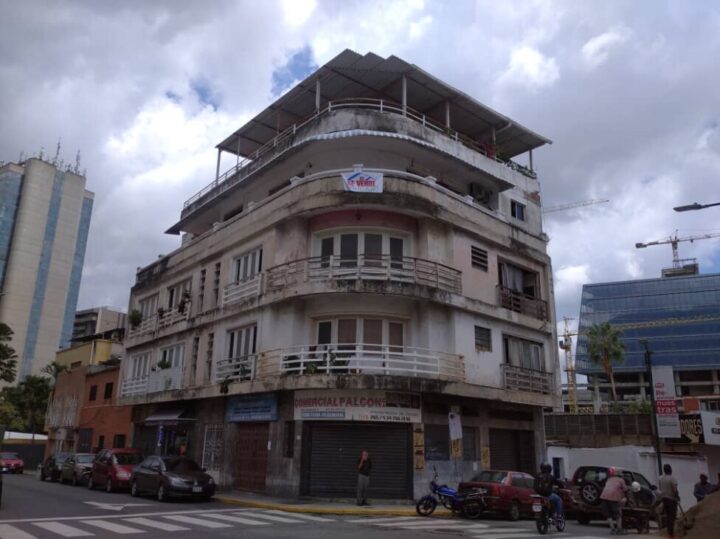
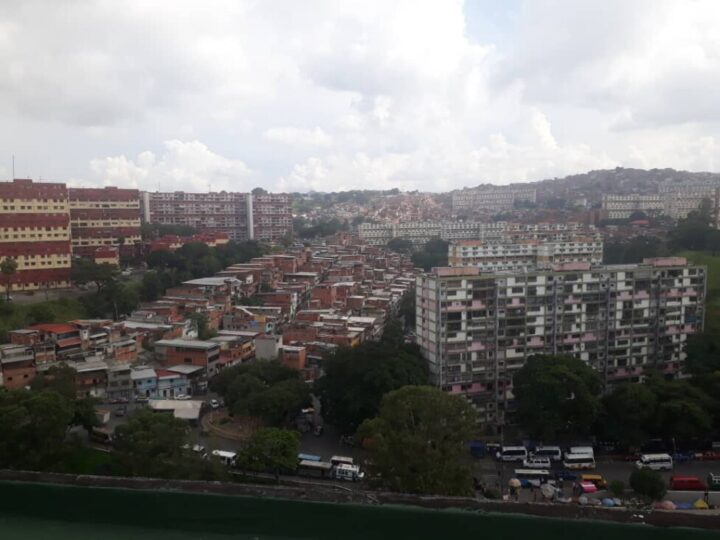
A view of Caracas from the south side of the narrow valley where it sits, dotted with houses and residential buildings where full occupancy was the norm until a few years ago. As a result of the massive migration of young people and adults, more and more homes are left unoccupied or inhabited only by the elderly and young children. CREDIT: Humberto Márquez / IPS

A view of Caracas from the south side of the narrow valley where it sits, dotted with houses and residential buildings where full occupancy was the norm until a few years ago. As a result of the massive migration of young people and adults, more and more homes are left unoccupied or inhabited only by the elderly and young children. CREDIT: Humberto Márquez / IPS

CARACAS, Oct 4 2023 (IPS) – Gladys swore she would not cry in front of her small children, but she still had to wipe away a couple of tears when she turned her head and looked, perhaps for the last time, at her dream house on Margarita Island in Venezuela, from where she migrated, driven by a lack of income and by fear.


“It hurts to leave your own home, the most precious material asset for a family like ours (she works in administration, her husband is a mechanic, and they have two boys), but we lost our jobs and were robbed in broad daylight in the middle of the city. That led us to decide to emigrate,” she told IPS from Miami, Florida in the U.S.

Due to the economic, social and political crisis, which gave rise to a complex humanitarian emergency, 7.7 million Venezuelans, according to United Nations agencies, have migrated from this country, the vast majority in the last decade, and the flow is not slowing down, especially to other countries in the region.

“It hurts to leave your own home, the most precious material asset for a family like ours, but we lost our jobs and were robbed in broad daylight in the middle of the city. That led us to decide to emigrate.” — Gladys

The family of Gladys, who like other people who talked to IPS preferred not to give her last name, tried their luck in Colombia, Panama and Spain, before finally settling in the United States, “and the worry about the house followed us like a shadow, but fortunately we made a deal with an enterprising young man who takes care of it, improves it and pays a modest rent.”

There are thousands like her. Migrants try not to leave their homes empty and abandoned, because they could lose them. For this reason, since most migrants are adults in their most productive age and young people, relatives of other ages remain in the homes, giving Venezuela the appearance of being a country of elderly people and children.

“I have to close up my home,” said Juan Manuel Flores, from San Antonio de Los Altos, a satellite city of Caracas with many middle class houses. “The neighbors will take care of it. It took us more than five years to build it and it cost between 150,000 and 200,000 dollars. Now I can’t get more than 60,000 dollars for it. We are not just going to give it away for that price.”

Flores, a teacher at a school where he earns less than 200 dollars a month, is preparing to travel to Spain, where his wife and adult daughters have gone ahead of him. “I will return to Venezuela when the country and its economy improve, and housing prices will rise again,” he told IPS, although without much conviction.

Solitude eats away at houses and buildings even in sought-after areas of the residential and commercial municipality of Chacao, in eastern Caracas. The real estate and construction market is suffering in Venezuela from the general economic crisis and in particular from the oversupply of housing created by those leaving the country. CREDIT: Humberto Márquez / IPS

Solitude eats away at houses and buildings even in sought-after areas of the residential and commercial municipality of Chacao, in eastern Caracas. The real estate and construction market is suffering in Venezuela from the general economic crisis and in particular from the oversupply of housing created by those leaving the country. CREDIT: Humberto Márquez / IPS

Why not rent out their house? “Because the laws and the authorities always favor the tenant, and if they have children it is impossible to get them out when the lease is up, whether they pay the rent or not, and they end up staying in the house for years,” said Nancy, a pastry chef, also from San Antonio, who left a niece in charge of her apartment when she moved to Brazil last year.

A survey of migrants in Colombia, Ecuador and Peru, released in October 2022 by the Interagency Coordination Platform for Refugees and Migrants in Venezuela (R4V), led by United Nations agencies, showed that only 23 percent considered the homes they left behind in their country to be safe.

Selling is also not an option in most cases, because the magnitude of the exodus over the last decade has so depressed demand that the most that can be obtained for a property is 15 or 20 percent of the value it had 15 years ago, if you are lucky. So selling a home even if you want to is a long, difficult process that provides meager results.

Those who have no other choice say that they are not selling their home but “giving it away” for whatever they can get, with great regret, mostly to internal migrants from other parts of the country, who “take refuge” in Caracas because outside the capital there are recurrent power outages, and scarcity of water and fuel, in addition to other shortages.

“Real estate deteriorates, ceases to serve those who need it and remains an important asset that produces nothing for the owner, for example a migrant who needs to pay rent as soon as they arrive in another country,” Roberto Orta, president of the Venezuelan Real Estate Chamber, told IPS.

The businessman said “this is an issue that, we have proposed, should be addressed with political will in order to reform the laws that constrain the real estate market, to benefit both landlords and tenants. Up to 250,000 homes could be freed up in five years.”

A view of the working-class neighborhood of 23 de Enero on the west side of Caracas. In low-income barrios, closed, empty houses are almost non-existent, as those who decide to emigrate look for relatives to move in, to avoid the risk of the homes being invaded or robbed. CREDIT: Humberto Márquez / IPS

A view of the working-class neighborhood of 23 de Enero on the west side of Caracas. In low-income barrios, closed, empty houses are almost non-existent, as those who decide to emigrate look for relatives to move in, to avoid the risk of the homes being invaded or robbed. CREDIT: Humberto Márquez / IPS

A trade is born

In the residential buildings located in Caracas and other cities, closing up an apartment and moving outside the country is not the same as leaving a house abandoned to solitude and neglect, because the neighbors, for their own safety and in order to pay the common expenses, keep watch and take care to prevent strangers from occupying the empty apartments.

But houses, especially middle-class homes, are an attractive and easy target for crime and even for people who want to occupy them by de facto means. That is why a new profession has appeared: the home caretaker.

“I have taken care of three houses in housing developments in the southeast (of Caracas), it’s the way I make ends meet,” said Daniel, who also works as a self-employed gardener. “I would go to one house twice a week, three times a week to another, and every day to another.”

He explains that in the last house “the owners were Portuguese business owners who went away and left three dogs. I would go to a pet food store to pick up the food, feed the dogs, check around the house and that was it.”

Family friends of the owners have now taken charge of the dogs and Daniel no longer receives payment for taking care of them. “I don’t have an account in dollars, I was paid through a restaurant friend of the owners, who does have an offshore account,” he said.

To pay for caretakers from abroad, intermediaries are indispensable, since in Venezuela, whose currency has been made nearly worthless by the economic crisis, there is a de facto dollarization, without agreement from the U.S. authorities, who also use sanctions to block the transactions of government bodies.

Daniel is saving up to join one of the groups forming in Antímano, the working-class neighborhood where he lives in the southwest of the capital, to migrate as well. He said that “I didn’t leave a few weeks ago because I hadn’t sold my motorcycle yet, otherwise right now I would be in the Darien,” the dangerous jungle between Colombia and Panama that thousands of migrants cross every day.

A more successful caretaker is Arturo, who is in charge of two houses with large living rooms, corridors, yards, a swimming pool and parking area. He is paid a modest fee to care for and maintain the homes, but is authorized to rent them out for social gatherings and parties.

“In both cases the owners are people with good incomes, they left with their children to study abroad and plan to return in a few years if conditions in the country change. They would like to find their homes as they left them,” he said.

When he rents out the property for a day or a night, guests can use the yards, swimming pool and even awnings, tables and chairs. But Arturo closes off access to the more private parts of the house and hires assistants to watch out for damages or disturbances. “I live well, I keep up the houses and each one brings me about 3,000 dollars in profits per month,” Arturo said.

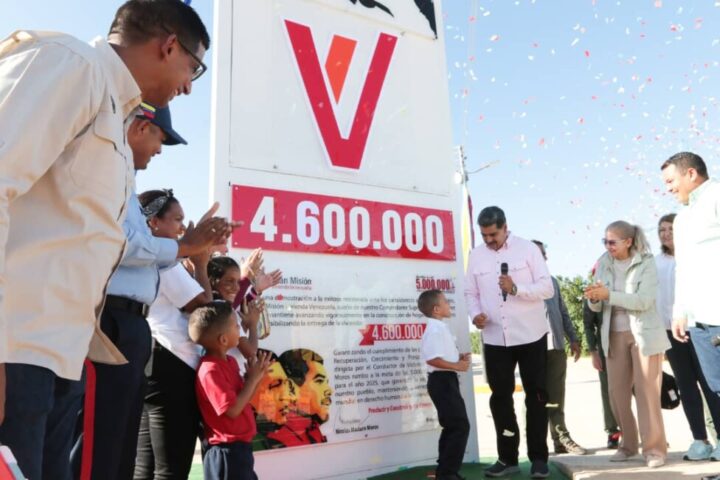
President Nicolás Maduro delivers a batch of houses in the northwestern state of Falcón, which form part of the 4.6 million homes that the government claims to have built and provided to Venezuelan families since 2013. The figure is questioned by organizations dedicated to monitoring economic and social rights. CREDIT: Minhvi

President Nicolás Maduro delivers a batch of houses in the northwestern state of Falcón, which form part of the 4.6 million homes that the government claims to have built and provided to Venezuelan families since 2013. The figure is questioned by organizations dedicated to monitoring economic and social rights. CREDIT: Minhvi

No empty houses in the shantytowns

In the shantytowns of the cities and towns of this country – which has a population of 33.7 million according to government figures and 28 million according to university studies – the situation is different and there are hardly any empty or unoccupied houses.

“In the shantytowns, no house is left empty. The very next day someone can invade it, occupy it, or take what is left inside by those who left, furniture or household goods. Someone stays in charge, the grandfather or in-laws, a trusted neighbor, or a relative is brought from the interior of the country,” explained Alejandra, from the Gramoven area.

She lives in a shantytown of informally constructed dwellings in the northwest of Caracas, similar to the ones that cover most of the many hills and hollows occupied by the capital’s most disadvantaged inhabitants.

“Many people leave, the young people emigrate, my children want to leave through the Darien jungle. But nobody leaves their house empty. If you do, you lose it,” Alejandra said.

In Santa Bárbara del Zulia, on the hot plains south of western Lake Maracaibo, “the situation is the same,” Julio, a bricklayer who migrated to Colombia for four years and has returned to care for his elderly parents, told IPS.

“You can’t leave your house alone in these towns,” said Julio. “When my parents went to Maracaibo and Caracas for medical treatment, they went and came back quickly, because the Community Council warned them not to leave their house empty for too long, because they would not be able to ward off people who wanted to occupy it.”

The Community Councils are committees set up by the government to represent and manage community affairs – such as the distribution of bags of subsidized food to poor families – and they channel decisions by the government.

“But people are leaving anyway. It’s something that won’t stop as long as people here earn only a pittance and can’t even eat properly (the minimum wage and official pensions in Venezuela are equivalent to four dollars a month). People care about their houses, but food has to come first,” said Julio.

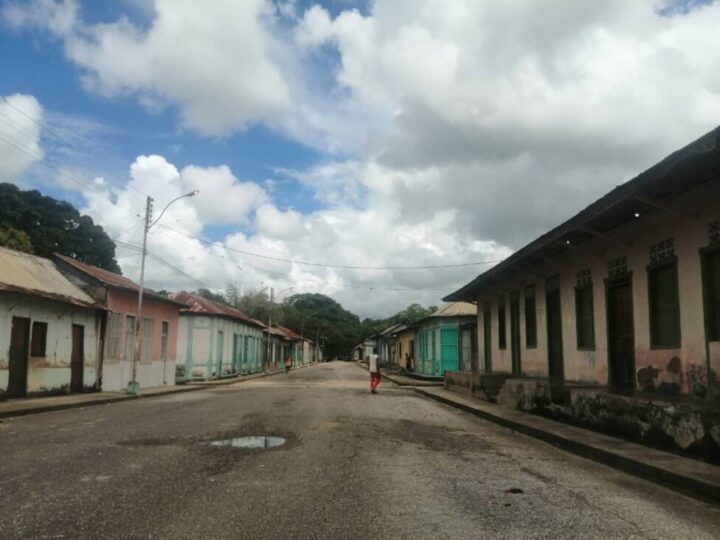
View of a row of houses practically abandoned by most of their inhabitants in a town in eastern Venezuela. Migration from the countryside and small towns to large cities and oil producing areas marked the 20th century in Venezuela. And today, migration from this country mainly to other Latin American nations has become a regional crisis. CREDIT: VV

View of a row of houses practically abandoned by most of their inhabitants in a town in eastern Venezuela. Migration from the countryside and small towns to large cities and oil producing areas marked the 20th century in Venezuela. And today, migration from this country mainly to other Latin American nations has become a regional crisis. CREDIT: VV

A matter for the government and the business community

While the plight of people leaving their homes continues to drag on, the government of President Nicolás Maduro announces more or less twice a year the construction of hundreds of thousands of new homes, in a program initiated by his late predecessor Hugo Chávez (1999-2013), called “Venezuela’s Great Housing Mission”.

According to official figures, since 2011, 4.6 million homes have been built and delivered by the Mission, mostly residential complexes to which the president goes to personally hand over the keys of one or more houses to their new inhabitants.

In accordance with the Mission, the occupants are tenants, not owners, so they cannot sell the homes. If they leave, the home can be reassigned to new tenants. To avoid this, those who choose to move to another city or country first look for relatives who can move into the house, and thus keep it.

However, the official figures on the number of homes built is not borne out by anecdotal evidence, to judge by the myriad of informal self-built houses still occupied in the slums, and by reports from business and civil society organizations.

The Chamber of Construction reports that the sector has decreased 96 percent in the last 10 years, and that its members employ 20,000 workers, down from 1.2 million in better times, while cement companies are working at 10 percent of their capacity and the steel industry at seven percent.

The civil society organization Provea, which specializes in the study of economic, social and cultural rights, has compared and contrasted the figures of the Housing Mission – which have not been audited, according to Provea – with independent studies, and reached the conclusion that the government has built and delivered only 130,856 housing units in 10 years.

In 1955 the Venezuelan writer Miguel Otero Silva (1908-1985) published his famous novel “Casas Muertas” (Dead Houses), describing the decline of Ortiz, a town in the central plains, caused by the loss of its population due to malaria and emigration to the big cities and oil production centers.

The flow of Venezuelan emigration in this century has not been enough to turn this into a country of dead houses. But its many closed doors bear witness to a collapse that has pushed millions of its inhabitants abroad, as do the small number of lights that are lit at night in the buildings of Caracas and other cities.

  Source