Solomon Islands: A Change More in Style than Substance

Asia-Pacific, Civil Society, Crime & Justice, Democracy, Economy & Trade, Featured, Global, Headlines, Human Rights, Press Freedom, TerraViva United Nations

Opinion

Credit: Saeed Khan/AFP via Getty Images

LONDON, May 16 2024 (IPS) – There’s change at the top in Solomon Islands – but civil society will be watching closely to see whether that means a government that’s grown hostile will start doing things differently.


Jeremiah Manele is the new prime minister, emerging from negotiations that followed April’s general election. He’s part of OUR Party, led by outgoing four-time prime minister Manasseh Sogavare. The party came first, winning 15 of 50 constituencies, but several incumbents who stood for it lost their parliamentary seats, and Sogavare only narrowly held his. Weakened, Sogavare stood aside to allow Manele to prevail as the consensus candidate of the post-election coalition his party stitched together.

China in the spotlight

Voters had to wait to have their say. The election was supposed to be held in 2023 but the government postponed it. It claimed it couldn’t afford to hold the election and host the Pacific Games in the same year, and temporarily suspended constitutional provisions through a parliamentary vote. The opposition accused Sogavare of a power grab and questioned his commitment to democracy.

Political debate in recent years has been dominated by the government’s relations with China, a major funder of the 2023 Pacific Games. Sogavare pivoted towards China shortly after becoming prime minister for the fourth time in 2019. Until then, Solomon Islands was among the small number of states that still recognised Taiwan instead of China. The move was controversial, made with no consultation after an election in which it hadn’t been an issue.

Sogavare then signed a series of agreements with China, including a highly secretive security cooperation deal. For civil society, this raised the concern that Solomon Islands police could be trained in the same repressive techniques used in China, and Chinese security forces could be deployed if unrest broke out. The country has experienced several bouts of conflict, including ethnic unrest and violent protests started by young unemployed men, with some violence targeting people of Chinese origin. Such conflict followed controversial post-2019 election manoeuvres that returned Sogavare to power, and surged again in 2021 over the government’s relations with China. Sogavare blamed ‘foreign powers’ for the 2021 unrest.

China is making extensive economic diplomacy efforts to encourage states to switch allegiance and has developed a keen interest in Pacific Island nations, long neglected by western powers. Its efforts are paying off, with Kiribati and Nauru also abandoning Taiwan in recent years. The Pacific Islands cover a vast oceanic territory, and a major Chinese foreign policy objective is to break up the island chains it sees as encircling it and constraining its reach. It’s long been suspected of coveting a naval base in Solomon Islands.

Further, while the populations may be small, each state has an equal vote in the United Nations, and the more allies China has, the more it can shield itself from criticism of its many human rights violations.

China didn’t just help pay for the Games. It provides direct funding to pro-government members of parliament, and has been accused of outrightly trying to bribe politicians. Daniel Suidani, a strong opponent of deals with China, claims to have been offered bribes to change his position. Suidani was premier of Malaita Province, until 2023, when he was ousted in a no-confidence vote following the central government’s apparent intervention. Police then used teargas against protesters who supported him.

China’s attempts to exert influence extend to the media. Last year, it was reported that the Solomon Star newspaper had received funding from the Chinese state in return for agreeing to publish pro-China content.

Disinformation favourable to China also circulated during the campaign. A Russian state-owned news agency falsely reported that the US government was planning what it called an ‘electoral coup’, a lie repeated by the Chinese Communist Party’s Global Times newspaper. During the campaign, Sogavare also doubled down on his support for China, heaping praise on its political system and suggesting that democracy might open the door to same-sex marriage, which he portrayed as incompatible with his country’s values.

At the same time as China’s media influence has grown, the Solomon Islands government has gained a reputation for attacking media freedoms. It took full control of the public broadcaster, the Solomon Islands Broadcasting Corporation, giving itself the power to directly appoint the broadcaster’s board, and made an attempt to vet all of its news and current affairs programmes, which it dropped after backlash. Following an investigation of relations with China by Australia’s public broadcaster, the government threatened to bar foreign journalists from entering the country if they run stories it deems ‘disrespectful’, accusing media of spreading ‘anti-China sentiments’.

Following criticism, the government also threatened to investigate civil society and accused civil society organisations of fraudulently receiving funds. It’s clear that the other side of the coin of closer relations with China has been growing hostility towards dissent.

Looking forward

China was far from the only issue in the campaign, and many voters emphasised everyday concerns such as the cost of living, the state of education, healthcare and roads, and the economy. Some criticised politicians for spending too much time talking about foreign policy – and will be judging the new government by how much progress it makes on these domestic issues.

The good news is that the vote appears to have been competitive, and so far there’s been no repeat of the post-election violence seen after the 2019 vote. That’s surely a positive to build on.

But Sogavare isn’t gone from politics, taking a new position as finance minister. Meanwhile, Manele, foreign minister in the old government and viewed as another pro-China figure, is unlikely to take a new foreign policy direction. But there’s some hope, at least for civil society, that he’ll be a less polarising and more conciliatory politician than Sogavare. The first test will be how the new government handles its relations with civil society and the media. The government should prove it isn’t in China’s pocket by respecting civic freedoms.

Andrew Firmin is CIVICUS Editor-in-Chief, co-director and writer for CIVICUS Lens and co-author of the State of Civil Society Report.

  Source

Working to Keep Náhuat, the Language of the Pipil People, from Vanishing in El Salvador

Civil Society, Development & Aid, Editors’ Choice, Education, Featured, Headlines, Human Rights, Indigenous Rights, Latin America & the Caribbean, Population, Regional Categories

Indigenous Rights

Elena López (left), one of two teachers who teach Náhuat to children in Nahuizalco, in western El Salvador, leads one of the morning's learning practices, in which the children, walking in circles, sing songs in the language of their ancestors, the Pipil people. CREDIT: Edgardo Ayala / IPS

Elena López (left), one of two teachers who teach Náhuat to children in Nahuizalco, in western El Salvador, leads one of the morning’s learning practices, in which the children, walking in circles, sing songs in the language of their ancestors, the Pipil people. CREDIT: Edgardo Ayala / IPS

NAHUIZALCO, El Salvador , May 6 2024 (IPS) – A group of children participating in an immersion program in Náhuat, the language of the Pipil people and the only remaining pre-Hispanic language in El Salvador, are the last hope that the language will not die out.


“This effort aims to keep Náhuat alive and that is why we focus on the children, for them to continue and preserve this important part of our culture,” Elena López told IPS during a short snack break for the preschoolers she teaches.

“This effort aims to keep Náhuat alive and that is why we focus on the children, for them to continue and preserve this important part of our culture.” — Elena López

López is part of the Náhuat Cuna project, which since 2010 has sought to preserve and revive the endangered indigenous language through early immersion. She is one of two teachers who teach it to children between the ages of three and five at a preschool center in Nahuizalco, a municipality in the department of Sonsonate in western El Salvador.

At risk of disappearing

“When a language dies, the basis of indigenous cultures and territories becomes extinct with it,” says the report Revitalization of Indigenous Languages, according to which the 500 Amerindian languages still spoken in Latin America are all in a situation of greater or lesser threat or risk.

In Mesoamerica, which includes Mexico, Guatemala, Belize, Honduras, El Salvador, Nicaragua and Costa Rica, 75 indigenous languages are spoken, says the study by the Fund for the Development of the Indigenous Peoples of Latin America and the Caribbean (FILAC).

With the exception of Mexico, Guatemala is the most linguistically diverse in this group of countries, with 24 native languages. The most widely spoken is K’iche’, of Mayan origin, and the least is Xinca, of unknown origin.

Brazil is the most ethnically and linguistically diverse country in Latin America, with between 241 and 256 indigenous peoples and between 150 and 186 languages.

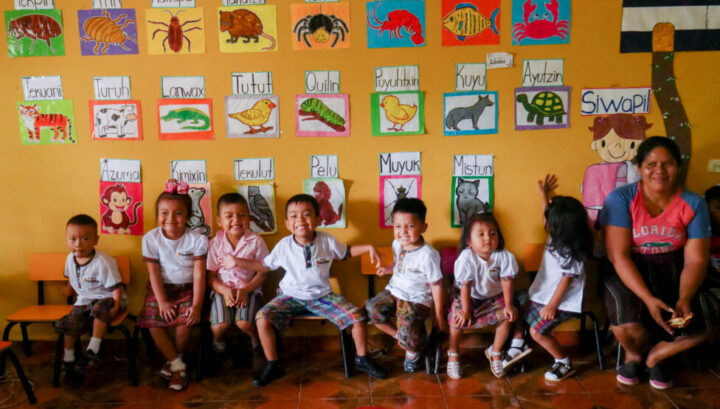
A picture of some of the children learning Náhuat in the town of Nahuizalco, in western El Salvador, through an early language immersion program, in an effort by Don Bosco University to keep the endangered language alive. Teacher Elsa Cortez sits next to them. CREDIT: Edgardo Ayala / IPS

A picture of some of the children learning Náhuat in the town of Nahuizalco, in western El Salvador, through an early language immersion program, in an effort by Don Bosco University to keep the endangered language alive. Teacher Elsa Cortez sits next to them. CREDIT: Edgardo Ayala / IPS

Around 25 percent of these languages are at risk of extinction unless something is urgently done, the report warns. It is estimated that Latin America is home to more than 50 million people who self-identify as indigenous.

“These languages are losing their usage value…families are increasingly interrupting the natural intergenerational transmission of the languages of their elders, and a slow but sure process of moving towards the hegemonic language is observed, with speakers making Spanish or Portuguese their predominant language of use,” the report states.

The causes of the danger of the disappearance of these Amerindian languages are varied, the report points out, such as the interruption of intergenerational transmission, when the language is no longer passed on from generation to generation.

And that is exactly what the Náhuat Cuna project aims to revert by focusing on young children, who can learn from Náhuat speakers who did receive the language from their parents and grandparents and speak it fluently.

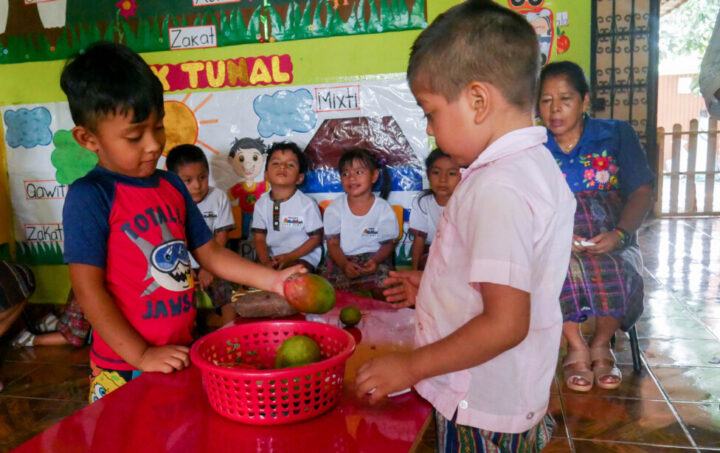
Two children pretend to purchase and sell fruits and vegetables speaking in Náhuat, as part of the teaching exercises at Náhuat Cuna in western El Salvador, a preschool for new generations of Salvadorans to learn the nearly extinct Amerindian language. CREDIT: Edgardo Ayala /IPS

Two boys pretend to purchase and sell fruits and vegetables speaking in Náhuat, as part of the teaching exercises at Náhuat Cuna in western El Salvador, a preschool for new generations of Salvadorans to learn the nearly extinct Amerindian language. CREDIT: Edgardo Ayala /IPS

López is one of these people. She belongs to the last generation of speakers who acquired it naturally, as a mother tongue, speaking it from a very young age with her parents and grandparents, in her native Santo Domingo de Guzmán, also in the department of Sonsonate.

“That’s how I was born and grew up, speaking it at home. And we never stopped speaking it, among my sisters and brothers, but not with people outside the house, because they discriminated against us, they treated us as Indians but in a derogatory way, but we never stopped speaking it,” said Lopez, 65.

Indeed, for reasons of racism and classism, indigenous populations have been marked by rejection and contempt not only from the political and economic elites, but also by the rest of the mestizo or mixed-race population, which resulted from the mixture of indigenous people with the Spaniards who started arriving in Latin America in the sixteenth century.

“They have always looked down on us, they have discriminated against us,” Elsa Cortez, 43, the other teacher at the Nahuizalco Náhuat Cuna, told IPS.

And she added: “I feel satisfied and proud, at my age it is a luxury to teach our little ones.”

Both López and Cortez said they were grateful that the project hired them as teachers, since they had no prior teaching experience, and in a context in which discrimination and social rejection, in addition to ageism, make it more difficult to find formal employment.

Before joining the project, Cortez worked full time making comales, which are circular clay griddles that are placed over a wood fire to cook corn tortillas. She also sold baked goods, and continues to bake bread on weekends.

López also worked making comales and preparing local dishes, which she sold in her neighborhood. Now she prefers to rest on the weekends.

All is not lost

When IPS visited the Náhuat Cuna preschool in Nahuizalco, the three-year-olds were performing an exercise: they stood in front of the rest of the class of about ten children and introduced themselves by saying their first name, last name and other basic greetings in Náhuat.

Later they identified, in Náhuat, pictures of animals and elements of nature, such as “mistun” (cat), “qawit” (tree) and “xutxit” (flower). The students started their first year in the center in February, and will spend two years there.

The five-year-olds are the most advanced. Together, the two groups totaled about twenty children.

Jorge Lemus  (blue shirt), director of El Salvador’s Náhuat/Pipil Language Revitalization Program and the driving force behind the Náhuat Cuna project, which teaches the language to children between the ages of three and five, is photographed with indigenous women of the Pipil people in Nahuizalco in western El Salvador. CREDIT: Don Bosco University

At the end of their time at the Cuna, they will go to regular school in Spanish, with the risk that they will forget what they have learned. However, to keep them connected to the language, the project offers Saturday courses where they begin to learn grammar and how to write the language.

There is a group of 15 teenagers, mostly girls, who started at the beginning of the project and speak the language fluently, and some even teach it online.

The initiative is promoted by the Don Bosco University of El Salvador, and supported by the municipalities where they operate, in Nahuizalco and Santo Domingo de Guzmán. The Santa Catarina Masahuat branch will also be reopened soon.

Santo Domingo de Guzmán is home to 99 percent of the country’s few Náhuat speakers, who number around 60 people, Jorge Lemus, director of El Salvador’s Náhuat/Pipil Language Revitalization Program and main promoter of the Náhuat Cuna project, told IPS.

“In three decades I have seen how Náhuat has been in decline, and how the people who speak it have been dying out,” stressed Lemus, who is also a professor and researcher of linguistics at the School of Languages and Education at Don Bosco University, run by the Salesian Catholic order.

According to the academic, the last three indigenous languages in El Salvador in the 20th century were Lenca, Cacaopera and Náhuat, but the first two disappeared by the middle of that century, and only the last one survives.

“The only one that has survived is Náhuat, but barely, as there are perhaps just 60 speakers of the language. When I started working on this there were about 200 and the number continues to shrink,” said Lemus.

The only way to keep the language alive, he said, is for a new generation to pick it up. But it will not be adults, who could learn it as a second language but will continue speaking Spanish; it must be a group of children who can learn it as native speakers.

The expert clarified that, although they come from the same linguistic trunk, the Náhuat spoken in El Salvador is not the same as the Nahuatl spoken in Mexico, and in fact the spelling is different.

In Mexico, Nahuatl has more than one million speakers in the Central Valley, he said.

In El Salvador, in 1932, the Pipil people stopped speaking their language in public for fear of being killed by the government forces of General Maximiliano Hernández, who that year brutally cracked down on an indigenous and peasant uprising demanding better living conditions.

At that time, society was dominated by aristocratic families dedicated to coffee cultivation, whose production system plunged a large part of Salvadorans, especially peasants and indigenous people, into poverty.

Lemus argued that for a language to make a decisive comeback and become a vehicle for everyday communication would require a titanic effort by the State, similar to the revival of the Basque language in Spain, Maori in New Zealand or even Israel’s resuscitation of Hebrew, which was already a dead language.

But that is not going to happen in El Salvador, he said.

“The most realistic thing we want to achieve is to keep the language from disappearing, and for the new generation of Náhuat-speaking people to grow and multiply. If we have 60 speakers now, in a few years we will hopefully still have 50 or 60 speakers, from this new generation, and they will keep it alive in the communities and continue speaking it,” he said.

For her part, López wants to continue working towards this goal in order to leave the country her legacy.

Speaking in Náhuat, the preschool teacher said: “I really like teaching this language because I don’t want it to die, I want the children to learn and speak it when I am dead.”

  Source

Civil Society Scores LGBTQI+ Rights Victory in Dominica

Civil Society, Crime & Justice, Featured, Gender Violence, Headlines, Health, Human Rights, Latin America & the Caribbean, LGBTQ, TerraViva United Nations

Opinion

MONTEVIDEO, Uruguay, May 6 2024 (IPS) – On 22 April, Dominica’s High Court struck down two sections of the country’s Sexual Offences Act that criminalised consensual same-sex relations, finding them unconstitutional. This made Dominica the sixth country in the Commonwealth Caribbean – and the fourth in the Eastern Caribbean – to decriminalise same-sex relations through the courts, and the first in 2024.


Similar decisions were made in Antigua and Barbuda, St Kitts and Nevis and Barbados in 2022 – but progress then threatened to stall. Change in Dominica revives the hopes of LGBTQI+ activists in the five remaining English-speaking Caribbean states – Grenada, Guyana, Jamaica, St Lucia and St Vincent and the Grenadines – that still criminalise same-sex relations. Sooner than later, one of will be next. A small island has made a big difference.

Winds of change

The criminalisation of consensual gay sex in the Anglophone Caribbean dates back to the British colonial era. All former British colonies in the region inherited identical criminal laws against homosexuality targeting either LGBTQI+ people in general or gay men in particular. They typically retained them after independence and through subsequent criminal law reforms.

That’s what happened in Dominica, which became independent in 1978. Its 1998 Sexual Offences Act retained criminal provisions dating back to the 1860s. Section 16 of that law made sex between adult men, described as ‘buggery’, punishable with up to 10 years’ imprisonment and possible compulsory psychiatric confinement.

The offence listed in section 14, ‘gross indecency’, was initially punishable by up to five years in jail if committed by two same-sex adults. A 2016 amendment increased the penalty to 12 years.

As in other Caribbean countries with similar provisions, prosecutions for these crimes have been rare in recent decades, and have never resulted in a conviction. But they’ve been effective in stigmatising LGBTQI+ people, legitimising social prejudice and hate speech, enabling violence, including by police, obstructing access to essential social services, particularly healthcare, and denying people the full protection of the law.

Change has begun only in the past decade, but it’s been rapid. Bans on same-sex relations were overturned by the courts in Belize in 2016 and Trinidad and Tobago in 2018. More soon followed.

The legal case

In July 2019, an unnamed gay man identified as ‘BG’ filed a legal case challenging sections 14 and 16 of the Sexual Offences Act. The defendants named in the complaint were the Attorney General, the Bishop of Dominica’s capital Roseau, the Anglican Church and the Methodist Church. The Dominica Association of Evangelical Churches was also listed as an interested party.

The lawsuit was supported by Minority Rights Dominica (MiRiDom), the country’s main LGBTQI+ advocacy group, and three international allies: the Canadian HIV/AIDS Legal Network, the University of Toronto’s International Human Rights Program and Lawyers Without Borders. The law was challenged as discriminatory and an enabler of violence against LGBTQI+ people.

The High Court heard the case in September 2022, and on 22 April 2024, Justice Kimberly Cenac-Phulgence issued a ruling setting out the reasons why sections 14 and 16 violated the applicant’s constitutional rights to liberty, freedom of expression and privacy, and were therefore null and void.

The backlash

LGBTQI+ advocates around the world welcomed the court ruling, as did UNAIDS – the United Nations agency leading the global effort to end HIV/AIDS. But resistance wasn’t long in coming.

Religious institutions, which hold a lot of influence in Dominica, were quick to decry gains in LGBTQI+ rights as losses in moral values. The day after the ruling was announced, Dominica’s Catholic Church published a statement reaffirming its position that sex should only take place within a heterosexual marriage and, while expressing compassion towards LGBTQI+ people, reiterated its belief in the centrality of traditional marriage and family. The Seventh-day Adventists expressed alarm about the potential of the court ruling to lead to same-sex unions and marriages. Some faith leaders voiced outright bigoty, with one prominent figure calling sexual acts between persons of the same sex an ‘abomination’.

The road ahead

Having decriminalised same-sex relations, Dominica is now ranked 116th out of 198 countries on Equaldex’s Equality Index, which rates countries according to their LGBTQI+ friendliness. There’s clearly much work to be done. Outstanding issues include protection against discrimination in employment and housing, marriage equality and adoption rights. LGBTQI+ activists will also continue to push for the recognition of non-binary genders, the legalisation of gender change and the prohibition of conversion therapy.

The Equality Index makes clear that, as in all the Caribbean countries that have recently decriminalised same-sex relations, changes to laws remain far ahead of social attitudes, with considerable public homophobia. As the instant conservative reactions to the court ruling suggest, changing laws and policies isn’t nearly enough. Shifting social attitudes must now be a top priority.

Dominican LGBTQI+ activists know this, which is why they’ve been working to challenge prejudice and foster understanding since long before launching their legal challenge – and why they see the court victory as not the end of a journey but a stepping stone to further change.

The challenge for Dominica’s LGBTQI+ civil society is to replace the vicious circle of legal prohibition, which has reinforced social stigma, with a virtuous one in which legal progress normalises the presence and social acceptance of LGBTQI+ people, which in turn enables effective access to legally enshrined rights.

But they’ll take heart from being part of a broader regional and global trend. While working to ensure rights are realised domestically, they’ll also offer a powerful example that change can result to the circa 64 countries around the world that still criminalise gay sex, including the five holdouts in the Commonwealth Caribbean. More progress will come.

Inés M. Pousadela CIVICUS Senior Research Specialist, co-director and writer for CIVICUS Lens and co-author of the State of Civil Society Report.
  Source

Media Freedom Declining Across Europe, With Implications for Rule of Law

Democracy, Editors’ Choice, Europe, Featured, Freedom of Expression, Headlines, Human Rights, Press Freedom, Sustainable Development Goals, TerraViva United Nations

Press Freedom

World Press Freedom Day 2024

Protestors gathered in Bratislava on May 2, 2024 to protest against changes to the public broadcaster, RTVS. The placard in the picture reads: RTVS on a flat-screen TV; STVR about a flat earth. Credit: Ed Holt/IPS

Protestors gathered in Bratislava on May 2, 2024 to protest against changes to the public broadcaster, RTVS. The placard in the picture reads: RTVS on a flat-screen TV; STVR about a flat earth. Credit: Ed Holt/IPS

BRATISLAVA, May 3 2024 (IPS) – A new report has warned media freedom in the EU is close to “breaking point” in many states amid rising authoritarianism across the continent.


In its latest annual report covering 2023, the Berlin-based Civil Liberties Union for Europe (Liberties) highlighted widespread threats, intimidation and violence against journalists and attacks on the independence of public broadcasters in the EU, with roll backs in media freedom down to “deliberate harm or neglect by national governments”.

The group says its research confirms a continuation of alarming trends seen in the previous year, including heavy media ownership concentration, insufficient ownership transparency rules, and threats to the independence and finances of public service media,

And it warns the decline in media freedom seen in a number of EU member states has the potential to pose a direct threat to democracy.

“Media freedom is falling across Europe, and what we see, not just in Europe but in many places around the world, is that where media freedom declines, the rule of law declines too,” Eva Simon, Senior Advocacy Officer at Liberties, told IPS.

The Slovak Radio building in Bratislava, part of the RTVS public broadcaster. Credit: Ed Holt/IPS

The Slovak Radio building in Bratislava, part of the RTVS public broadcaster. Credit: Ed Holt/IPS

The Liberties report, compiled with 37 rights groups in 19 countries, comes as other media freedom watchdogs and rights groups warn of growing  concentration of media ownership, lack of ownership transparency, surveillance and violence against journalists in EU countries, government capture of public broadcasters, and rising restrictions on freedom of expression.

Press freedom watchdog Reporters Without Borders (RSF) released its annual World Press Freedom Index today (April 3, 2024), warning that politicians in some EU countries are trying to crack down on independent journalism. They single out a number of leaders as being “at the forefront of this dangerous trend,” including Hungary’s pro-Kremlin prime minister, Viktor Orban, and his counterpart in Slovakia, Robert Fico.

It also highlights concerns for press freedom in other places, such as Malta, Greece, and Italy, pointing out that in the latter—which fell in the Index’s rankings this year—a member of the ruling parliamentary coalition is trying to acquire the second biggest news agency (AGI), raising fears for future independence of media.

“One of the main themes of this year is that the institutions that should be protecting media freedom, for example, governments, have been undermining it,” Pavol Szalai, head of the EU/Balkans desk at RSF, told IPS.

Like Liberties, RSF has cited particular concern about media freedom in Hungary and Slovakia among EU states.

Media freedom has been on the decline in Hungary for more than a decade, as autocratic leader Orban has, critics say, steadily cracked down on independent journalism. His party, Fidesz, has de facto control of 80 percent of the country’s media, and while independent media outlets still exist, their sustainable funding is under threat as state advertising is funneled to pro-government outlets.

The government’s effective control of Hungary’s public broadcaster is another major concern.

“Capturing public broadcasters limits access to information and that can have a huge impact on formulating political opinions and then how people vote,” said Simon.

Hungary is also suspected of having arbitrarily monitored journalists using the controversial Pegasus software.

RSF and Liberties both say their worry is not just what is happening to media freedom in Hungary, but that what Orban has done has provided a blueprint for other autocratic leaders to follow.

“Leaders in Europe are being inspired by Orban in his war against independent media. Just look at Fico in Slovakia, who has declared war on independent media,” said Szalai.

For years, Fico has repeatedly attacked and denigrated independent media and journalists.

In 2018, investigative journalist Jan Kuciak—who had been looking into alleged corruption by people close to Fico’s government— and his fiancée Martina Kusnirova were murdered. Critics said Fico’s rhetoric against journalists had contributed to creating an atmosphere in society that allowed those behind the killings to believe they could act with impunity.

Independent journalists continue to face harassment and abuse from Smer MPs today.

Since being elected Prime Minister for the fourth time last autumn, Fico and the governing coalition led by his Smer party have continued their attacks. They also refuse to communicate with critical media, claiming they are biased.

It has also approved legislation—which is expected to be passed in parliament within weeks—that will see the country’s public broadcaster, RTVS, completely overhauled and, critics say, effectively under the control of the government.

“If the bill is passed and signed into law in its current form, RTVS will become a mouthpiece for government propaganda,” said Szalai.

The government has rejected criticism over the bill and argued changes to RTVS are necessary because it is no longer objective, is persistently critical of the government, and is not fulfilling its remit as a public broadcaster to provide balanced and objective information and a plurality of opinions. A senior official at the Slovak Culture Ministry who is among the favorites to take over as head of the public broadcaster in its new form has since suggested that people who support the flat-earth theory should be invited onto shows to air their opinions on the broadcaster.

The bill has led to public protests and threats of a mass strike from current RTVS employees.

However, against this grim backdrop, media watchdogs say new EU legislation provides hope for an improvement in media freedom.

The recently-passed European Media Freedom Act (EMFA), which takes full effect across the EU in August next year,  will, among others, ban governments from pursuing journalists to reveal their sources by deploying spyware, force media to disclose full ownership information, introduce transparency measures for state advertising, and checks on media concentration. It also provides a mechanism to prevent very big online platforms from arbitrarily restricting press freedom.

Another key measure in the legislation is that it enshrines the editorial independence of public service media, setting out that leaders and board members of public media organizations be selected through “transparent and non-discriminatory procedures for sufficiently long terms of office.”

“It is a good law that creates a very important base [for ensuring media freedom], which can be built on in the future. More safeguards [to media freedom] could be added to it in the future,” said Simon.

Szalai agreed, highlighting that the legislation was legally binding for member states. He admitted it had some shortcomings—for example, under some exceptions, journalists could be forced to reveal sources—but emphasized that it would take precedence over any national legislation, “and so governments cannot ignore it or try to get around it.”

But its implementation will be down to individual governments and authorities—something, that media freedom organizations have said must be closely watched.

A new EU body, the European Board for Media Services, is to be set up to oversee the implementation of the laws.

“It is important to make sure that the forces attacking media freedom are held back by this law. It will be up to the European Commission to hold governments to account on its implementation, and the Commission needs to consider press freedom as a priority after the European Parliament elections [in June] and to check on the EMFA’s implementation and take measures against any countries that violate it,” said Szalai.

IPS UN Bureau Report

IPS UN Bureau, IPS UN Bureau Report,

  Source

Transgender Health Rights Boosted by Hospitals’ ‘Separate Room’ Policy

Asia-Pacific, Civil Society, Development & Aid, Featured, Gender, Gender Identity, Headlines, Health, Human Rights, Humanitarian Emergencies, LGBTQ, Sustainable Development Goals, TerraViva United Nations

Health

The community frequently targets transgender people. Now they are able to welcome new measures that mean they will be able to safely access health care. Credit: Yusufzai Ashfaq/IPS

The community frequently targets transgender people. Now they are able to welcome new measures that mean they will be able to safely access health care. Credit: Yusufzai Ashfaq/IPS

PESHAWAR, Pakistan, Apr 30 2024 (IPS) – Transgender people and civil society organizations have welcomed the decision of the chief minister in Khyber Pakhtunkhwa, Pakistan, to allocate separate rooms in hospitals for the transgender community so they can avail themselves of uninterrupted healthcare.


“We demand that all provinces follow suit and announce facilities for more than 500,000 transgender people in the country,” Farzana Shah, president of the Khyber Pakhtunkhwa (KP) Transgender Association, told IPS.

On April 6, KP Chief Minister Ali Amin Khan Gandapur announced separate rooms for transgender persons in public hospitals after complaints that they aren’t getting admissions because they face violence in the facilities.

“In the last year, about 47 transgender people have died because of violence, and 90 have been injured. Many injured transgender people die due to delayed treatment. In most cases, we can’t get healthcare at hospitals,” Shah, 40, said.

The Chief Minister’s directives to reserve rooms have received a positive response.

Members of a delegation of transgender people who recently met him quoted Gandapur as saying, “Provision of better health facilities to transgender persons in the province is our priority. We will help the underprivileged community.”

Arzoo Khan, a social activist, is overwhelmed.

“In all 38 district-level hospitals, we now have a separate room. Previously, the hospitals denied admission to our colleagues,” Khan said.

“The problem we face is that most transgender people have been deserted by their families because of social repercussions. People look down on transgender people.”

“We don’t have anyone to help us; therefore, the government’s support is a highly welcome step,” Khan said.

In addition to the allocation of space, the government also provided land for a separate graveyard for transgender people.

Civil society activist Jamal Khan said that there are several instances when the local communities have denied the burial of eunuchs because they don’t consider them Muslims.

“They earn their livelihoods through dancing at marriage parties and on other festive occasions where they have social acceptability,” he said. “The allocation of separate hospitals’ rooms and land for graveyards are really commendable measures that will lead to the protection and respect of transpeople.”

Transgender people are often deprived of last rituals, like giving them baths and performing their funerals after deaths.

Sobia Khan, another leader, said they are deeply vulnerable and subject to abuse and violent attacks, despite being a cheap source of entertainment.

“Some transgender people also have HIV/AIDS and other potentially fatal diseases for which they need continuous medication,” Sobia said.

The attitude of the police towards the group was also bad, she added

“More often than not, police beat up our members; they pull them by their collars and drag them into the streets.”

Khan claimed that her parents have been excluding her for the past ten years.

“Peshawar, the capital of KP, is home to 9,000 transgender persons; most of them have lost connections with their families and they were regarded as sinners and hence ditched by near and dear ones,” Sobia said.

Where the group was targeted by violence, the perpetrators were seldom brought to justice, which emboldens others to mistreat transgender people.

“Sexual harassment of trans people is a common sight. Everyone thinks that we are sex workers, which is untrue because we only dance. Many are raped,” she said.

Police officer Rahim Shah told IPS that many transgender people were invited to marriage parties where they danced for money.

Shah claimed that upon their return from the performance at night, robbers targeted them and killed or injured those who attempted to resist.

“In cases of murder or transgender injuries, their family members don’t come to receive dead bodies for burial or look after the wounded in hospitals,” he said. Their problems are complex, as they neither enjoyed respect in the community nor in their families.

Sumaira Shah, 29, narrates her ordeal after running away from home.

“My family was staunchly opposed to dancing and my father and brothers used to beat me every day, forcing me to quit dancing as it was a source of dishonoring the family but it was my fashion,” she said.

“Sick of daily taunts and beatings, I ran away from my native Swat district to Peshawar when I was just 14,” she said. Since then, I haven’t seen any of my relatives. Shah said she welcomed the hospital room policy.

“A month ago, a hospital in Peshawar sent me back home with some medicines despite having a high fever,” she said.

She said, “People frequently threaten me when I decline their offer for sex relations, and I’m afraid because many of our seniors have died at the hands of gangsters when they didn’t comply with their demand for illicit relations.”

Social rights activist Pervez Ahmed appreciates the government’s new initiatives.

He claimed that this was the first time the government had made an effort to safeguard the health of those who had lost their parents’ support and faced harsh rejection from the community.

Ahmed said that the government has already included transgender people in a free health insurance program, under which they can avail themselves of USD 12,000 per year.

IPS UN Bureau Report

  Source

Conditions Worsen for Belarus Migrants Stuck in ‘Death Zone’ on EU Border

Aid, Civil Society, Editors’ Choice, Europe, Featured, Headlines, Human Rights, Humanitarian Emergencies, Migration & Refugees, Sustainable Development Goals, TerraViva United Nations

Migration & Refugees

Aid agencies say that refugees caught on the Polish and Belarus borders are subject to brutal pushbacks. Graphic: IPS

Aid agencies say that refugees caught on the Polish and Belarus borders are subject to brutal pushbacks. Graphic: IPS

BRATISLAVA, Apr 25 2024 (IPS) – As the refugee crisis on the Belarus/EU borders approaches its fourth year, a crackdown on activism in Belarus is worsening the situation for migrants stuck in a “death zone” as they attempt to leave the country.

Groups working with refugees say the repression of NGOs in Belarus has led to many organizations stopping their aid work for migrants, leaving them with limited or no humanitarian help.


And although international organizations are operating in the country providing some services to refugees, NGOs fear it is not enough.

“There have been elevated levels of violence [against refugees from border guards] since the start of this crisis. But what has got worse is that before there were more people willing to help these refugees in Belarus, but now there is pretty much no one there helping as activism can be punished criminally in the country,” Enira Bronitskaya, human rights activist at Belarussian NGO Human Constanta, which was forced to pull out of the country and now operates from Poland, told IPS.

Since the start of the refugee crisis on the Belarus/EU border in the summer of 2021, rights groups have spoken out over brutal refugee ‘pushbacks’ by guards on both sides of the border.

Some have accused Minsk of manufacturing the crisis as a response to EU sanctions. They say Belarusian authorities actively organize, encourage, and even force migrants to attempt crossings over the border, but at the same time sanction violent and degrading treatment of those same migrants by border guards.

But others have also raised issue with what they say are equally violent and inhumane methods used by EU border guards in Poland, Latvia and Lithuania against those same migrants, as well as systematic breaches of their rights to claim asylum.

“These people are subjected to numerous forms of violence, both by Belarusian and Polish border guards. We’ve seen bruises, black eyes, knocked-out teeth after blows, kicks or hits with the back of rifles, irritation of skin and eyes after being sprayed with pepper gas, and teeth marks after dog bites,” Bartek Rumienczyk of the Polish NGO We Are Monitoring (WAM), which helps migrants who arrive in Poland from Belarus, told IPS.

“We also tell people they are entitled to ask for international protection in Poland, but in practice, these pleas are often ignored by border guards. We have witnessed numerous situations when people were asking for asylum in our presence and still they were pushed back to Belarus,” he added

These practices leave people stranded between the two borders in terrible conditions. Some aid workers describe it as a “death zone”.

“Refugees who manage to make it over [into the EU] talk about the ‘death zone’ between fences on the EU border and razor wires on the Belarus side and border guards who will not let them back into Belarus. They are therefore stuck there,” Joanna Ladomirska, Medical Coordinator for Medecins sans Frontieres (MSF) in Poland, told IPS.

“This death zone runs all along the Belarus/EU border, and it is huge—maybe tens of thousands of square kilometers—and no one knows how many people might have died there, or might be there needing treatment. My worry is that no one has access to this zone—not NGOs, no one,” she added.

At least 94 people have been known to have died in the border area since the start of the crisis, according to Human Constanta’s research, although it is thought many more may have also lost their lives.

Those that do manage to cross the border are invariably injured, some seriously. Exhaustion, hypothermia, and gastrointestinal affections because migrants have been forced to drink water from swamps or rivers are common, while almost a third of them have trench foot, and many have suffered serious injuries from razor- and barbed-wire fences. Some have also had to have parts of their limbs amputated due to frostbite, according to aid groups providing medical care to them.

Although both international and local organizations continue to work to help migrants on the EU side of the border, this is much more limited on the Belarusian side, say those working directly with migrants.

Since mass protests following his re-election in 2020, autocratic Belarusian President Alexander Lukashenko has implemented a sweeping crackdown on dissent. This has seen, among others, widespread prosecutions of workers in civil society.

Many NGOs, including some that had previously helped migrants, have been forced to close, leaving only a handful of major international organizations to do what they can for migrants.

However, questions have been raised about how effective their operations are.

“There are international organizations like the ICRC that are working with the Red Cross, but the Belarus Red Cross is only handing out food parcels in certain areas; it’s not a regular, stable supply,” said Bronitskaya.

“Basically, there is no one there giving [the migrants] the help they need. It is very possible there will be even more deaths than before,” she added.

But it is not just those stuck between the borders who are struggling to get help.

Anyone who fails to get into the EU and finds themselves back in Belarus is classed as an irregular migrant, is unable to access healthcare or benefits, and cannot legally work.

Many quickly find themselves in poverty, living in constant fear of being discovered by immigration authorities, and vulnerable to exploitation. Some aid workers told IPS they had heard of migrants in Minsk and other Belarussian cities forced to turn to prostitution to pay to support themselves.

Facing such problems, many decide they have little choice but to attempt the crossing again despite the risks.

Aid organizations and global rights groups say governments in EU countries and in Minsk must adhere to their obligations to protect the rights of these migrants.

“It’s not the best approach to the situation if the EU makes it difficult or impossible to cross its border by building walls or putting up legal barriers, nor is it good if Belarus creates a situation where people are stranded,” Normal Sitali, Medical Operations Manager for Medecins sans Frontieres (MSF) in Belarus, told IPS.

“There must be unhindered access to the border area for independent humanitarian organizations and for international and civil society organizations to respond to the dire situation there. Governments need to look at ensuring access to healthcare for these people so that international organizations do not need to provide and pay for it; they also need to look at legal protections for them; and they need to examine how these people can be ensured the space and protection to claim their rights as individuals while in transit,” he added.

MSF, which helped thousands of migrants during the crisis, last year stopped providing services to them after deciding migrants’ medical needs were outweighed by their need for protection and legal support, which MSF says can only be provided by dedicated organisations with specific expertise.

But some doubt the situation will improve any time soon with political relations between Belarus and the EU badly strained.

“Governments need to do something but the political situation makes things complicated. EU governments will not negotiate with Lukashenko because of the repressions going on in Belarus. Unless there is some significant change, nothing is going to get better,” said Bronitskaya.

However, others are hopeful of change.

Officials in Poland’s new government, which came to power in December last year, have claimed the number of pushbacks has fallen under the new administration and said a new border and migration policy is being drawn up that would treat the protection of human rights as a priority. Plans are also being put in place for the border forces to set up special search and rescue groups to stop humanitarian crises at the country’s borders, they have said.

“As a European country, [Poland] should respect European human rights laws and provide people with access to safety. You don’t need to negotiate with the Belarus regime to do that,” Ladomirska told IPS.

“I hope that with the new Polish government, something might change. We’re talking to them; change is feasible, and with the new government, there is an opportunity for that change.”

IPS UN Bureau Report

  Source