Martin Luther King’s Message Shook the Powerful: Vital People can Hear it Today

Civil Society, Democracy, Featured, Global, Headlines, Human Rights, IPS UN: Inside the Glasshouse, TerraViva United Nations

Opinion

Dr. Martin Luther King and Mrs. King are greeted by Ralph Bunche on a visit to the United Nations in 1964. Credit: UN Photo

 
Ralph Bunche received the 1950 Nobel Peace Prize for his late 1940s work as a United Nations mediator in the Palestine conflict. He called himself ‘an incurable optimist’. Bunche was the first African American and person of color to be so honored in the history of the prize.

ROME, Jan 9 2024 (IPS) – All through this week, leading up to January 15th, the world will commemorate Martin Luther King. In a world as wounded as ours is today, the lessons of his life’s work offer a vital opportunity for healing.


But the opportunity to hear his message continues to be obstructed: too many of the soundbites of TV pundits and the tweets of politicians are, once again, not distilling the insights of Dr King, but are serving instead to obscure a library of wisdom behind wall-to-wall repetition of the same few lines, extracted from their context, of one speech.

This is not a mistake, it is a tactic, and we owe it not only to the legacy of Dr King but to the future of our world to ensure that his authentic message is shared.

The true message of Martin Luther King is not a saccharine call for quietude or acceptance, but an insistence on being, as he put it, “maladjusted to injustice.” It represents not an idle optimism that things will get better but a determined commitment to collective action as the only route to progress.

When Dr King said “the arc of the moral universe is long, but it bends towards justice”, he didn’t mean this process is automatic; as he noted, “social progress never rolls in on wheels of inevitability; it comes through the tireless efforts of people.”

And he was clear that advancement of progress requires the coming together of mass movements, “organizing our strength into compelling power so that government cannot elude our demands.”
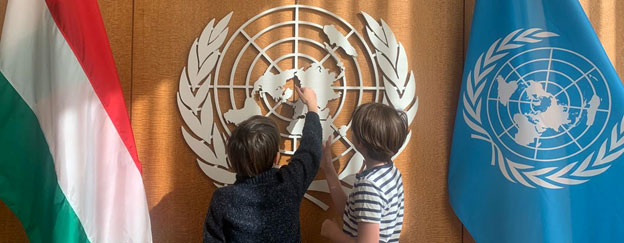
Children from a dozen countries met with the President of the General Assembly and toured the United Nations on a federal holiday in the United States honouring the late civil rights leader and Nobel Peace Prize laureate, Martin Luther King Jr. 17 January 2023. Credit: Paulina Kubiak, United Nations

Justice, Dr King taught, is never given, it is only ever won. This always involves having the courage to confront power. Indeed, he noted, the greatest stumbling block to progress is not the implacable opponent but those who claim to support change but are “more devoted to order than justice.” As he put it, “frankly I have yet to engage in a direct action movement that was ‘well-timed’ in the view of those who have not suffered unduly; this ‘wait!’ has almost always meant ‘never.’”

When the civil rights movement’s 1962 Operation Breadbasket challenged companies to increase the share of profits going to black workers and communities, it was only after the movement showed that they could successfully organize a boycott that those companies, in Dr King’s words, “the next day were talking nice, were very humble, and [later] we signed the agreement.” As he noted when challenged by “moderates” who asked why he needed to organize, “we have not made a single gain without determined pressure…freedom is never voluntarily given by the oppressor, it must be demanded by the oppressed.”

Advancing progress, he emphasized, involves challenging public opinion too. Organizers cannot be mere “thermometers” who “record popular opinion” but need to be “thermostats” who work to “transform the mores of society”. In 1966, for example, a Gallup Opinion poll showed that Dr King was viewed unfavourably by 63 per cent of Americans, but by 2011 that figure had fallen to only four per cent.

Often, people read the current consensus view back into history and assume that Dr King was always a mainstream figure, and imagine, falsely, that change comes from people and movements who don’t ever offend anyone.

Dr King’s vision of justice was a full one. It called not only for the scrapping of segregation, but for taking on “the triple prong sickness of racism, excessive materialism and militarism.” He challenged the “economic conditions that take necessities from the many to give luxuries to the few” and noted that “true compassion is more than flinging a coin to a beggar, it understands that an edifice which produces beggars, needs restructuring.”

He spoke out against war not only for having “left youth maimed and mutilated” but for having also “impaired the United Nations, exacerbated the hatreds between continents, frustrated development, contributed to the forces of reaction, and strengthened the military-industrial complex.”

He noted how “speaking out against war has not gone without criticisms, there are those who tell me that I should stick with civil rights, and stay in my place.” But he insisted that he would “keep these issues mixed because they are mixed. We must see that justice is indivisible, injustice anywhere is a threat to justice everywhere.”

When I went to Dr King’s memorial in Atlanta I did so to pay my respects at his tomb. But arriving at the King Center I found a vibrant hub of practical learning, at which activists and organizers working for justice were revisiting Dr King’s work and writings not as history that is past but as a set of tools to help understand, and act, in the present.

Together, we reflected not only on his profoundly radical philosophy, but also on his strategies and tactics for advancing transformational change. Conversations with Dr King’s inspirational daughter, Bernice, were focused not on her father’s work alone; instead, she asked us what changes we were working for, and how we were working to advance them.

This year, on 10th January, the King Center is hosting a Global Summit, a series of practical conversations accessible to everyone, for free, online. I’m honoured to be panelist. It is open for sign ups here.

“Those who love peace,” noted Dr King, “must learn to organize as effectively as those who love war.” And he even guided us how.

Ben Phillips is the author of How to Fight Inequality, Communications Director of UNAIDS, and a panelist at the King Center Global Summit on 10th January.

IPS UN Bureau

  Source

Fear as Russian Anti-LGBT Law Comes into Effect

Civil Society, Crime & Justice, Democracy, Editors’ Choice, Europe, Featured, Freedom of Expression, Gender, Headlines, Human Rights, LGBTQ, TerraViva United Nations

Human Rights

The Russian Supreme Court ruling making the “international LGBT movement” an extremist organization will come into effect on January 9, 2024. Graphic: IPS

The Russian Supreme Court ruling making the “international LGBT movement” an extremist organization will come into effect on January 9, 2024. Graphic: IPS

BRATISLAVA, Jan 3 2024 (IPS) – “This is what you get after ten years of state propaganda and brainwashing,” says Anatolii*.

The Moscow-based LGBT rights activist’s ire is directed at a recent ruling by Russia’s Supreme Court declaring the “international LGBT movement” an extremist organization.


Details of the ruling, made on November 30 after a closed hearing, have yet to be made public—it will not be enforced until January 9, 2024, and until then, no one is likely to be any the wiser about its practical implementation, says Anatolii.

But its vagueness—critics point out that no “international LGBT movement” exists as an organization—has already fueled fears that it could lead to the arbitrary prosecution of anyone involved in any activities supporting the LGBT community.

And the potential punishments for such support are draconian, with participating in or financing an extremist organization carrying a maximum 12-year prison sentence under Russian law.

In the weeks since the ruling was announced, fear has spread among LGBT people.

“Russian queers are really scared,” Anatolii tells IPS.

But while fearful, many see it as the latest, if potentially the most drastic, act in a decade-long campaign by the Kremlin to marginalise and vilify the LGBT community in the country through legislation and political rhetoric.

The first legislative attack on the community came in 2013, not long after Vladimir Putin had returned to power as President, when a law came into effect banning “the propaganda of non-traditional sexual relations” to anyone under the age of 18.

This was followed by increasingly homophobic political discourse, and Kremlin campaigns—prominently backed by the country’s powerful Orthodox Church—promoting ‘traditional family values’ in society and casting LGBT activism as a product of the degenerate West and a threat to Russian identity.

Then in 2022, the ban on “LGBT propaganda” was extended to cover all public information or activities supporting LGBT rights or displaying non-heterosexual orientation and implicitly linked the LGBT community with paedophilia—the law refers to the “propaganda of nontraditional sexual relations and/or preferences, paedophilia, and sex change.”

A ban on same sex marriage has also been written into the constitution; authorities have labelled a number of LGBT organizations as “foreign agents,” stigmatizing them and forcing them to adhere to a set of funding and bureaucratic requirements that can be liquidating, and earlier this year a law was passed banning transgender people officially or medically changing their gender.

With each new piece of pernicious legislation, and an accompanying rise in intensity and normalization of homophobic hate speech from politicians, the LGBT community has suffered, its members say.

“The Supreme Court ruling is just a continuation of Russia’s homophobic policies. The amount of physical violence against LGBT people has been growing in Russia for 10 years. After each such law, it intensifies even more noticeably,” Yaroslav Rasputin, editor at the Russian-language LGBT website www.parniplus.com, told IPS.

“We expect homophobes will feel justified in attacking LGBT people [after the ruling], both through cyberbullying and physical assaults,” he added.

Members of the LGBT community and rights campaigners who spoke to IPS said there was a desperate fear among many LGBT people now. While the threat of physical violence was often felt as being very real, there was also a crippling concern over the uncertainty many would now face in their daily activities.

Many do not know what will constitute “support” for the LGBT community. Some are trawling through years of social media records, deleting any possible positive references to LGBT or reposted messages on the topic for fear of the information being used against them by authorities.

And there are worries that simply being openly gay could somehow be interpreted as extremism.

Lawyers who have advised LGBT people and groups in the past say that it will be much easier for security forces to initiate and prosecute cases of extremism than propaganda, as the latter is more difficult to prove.

“Although the government says these ‘repressions’ concern only political activists, in reality this is not the case. We know this from previous homophobic laws. Sometimes people spontaneously get caught for who they are. No one knows when it will be safe to come out and when not,” said Rasputin.

Anatolii said the organisation he works for has been inundated with calls from people “in panic and despair” over the ruling, many of whom are looking for help to leave the country.

LGBT groups outside Russia have also reported a huge uptick in calls from people trying to find safe passage to other countries.

“We have seen a dramatic increase in the number of people contacting us, perhaps three or four times more. LGBT people in Russia are really worried about the ruling; they don’t know what might be defined as extremist,” Aleksandr Kochekovskii from the Berlin-based organisation Quarteera e. V, which helps LGBT refugees and migrants to arrive and find their way around Germany, told IPS.

“Unfortunately, a lot of people will leave Russia because of this ruling because they feel in danger. There is a ubiquitous psychological pressure on LGBT people in Russia now,” he added.

Even some openly gay figures in Russia have publicly acknowledged that LGBT people may be forced to flee the country.

“This is real repression. There is panic in Russia’s LGBT community. People are emigrating urgently. The actual word we’re using is evacuation. We’re having to evacuate from our own country. It’s terrible,” Sergei Troshin, a gay municipal deputy in St Petersburg, told the BBC.

But others warn the Kremlin may be looking to use the ruling to crack down on the community as a whole as much as individuals.

“At this point, the state’s main goal is to erase the LGBT community from society and [the country’s] history,” Mikhail*, a Russian LGBT activist who recently left the country and now works for a pan-European NGO campaigning for minority health rights, told IPS. “It is hard to imagine how many organisations defending the rights of LGBT people will be able to exist in Russia any more since such support is [considered to be] advocating terrorism,” he added.

Some such organisations have already decided to close in the wake of the ruling. The Russian LGBT Sports Federation announced it had stopped its activities, and one of the most prominent LGBT groups in the country, Delo, which provided legal assistance to people in the community, also closed following the court decision.

But other mainstays of the LGBT community are also shutting their doors. The owners of one of the oldest gay clubs in Russia, “Central Station” in St Petersburg, said they had been forced to close the club after the site’s owners refused to rent to them. Its closure came as other gay clubs and bars in Moscow were raided by police just 24 hours after the Supreme Court ruling. People’s names taken, and ID documents copied.

Although police said the raids were part of anti-drug operations, LGBT activists said they could see the true purpose behind them.

“The state has made it very clear that it is ready to use the apparatus of force against LGBT people in Russia,” said Mikhail.

But the ruling is also expected to have effects for LGBT people beyond their interactions with other individuals or groups within the community.

Accessing specific healthcare services, for instance, seems likely to become more difficult.  Some practitioners, such as psychiatrists and psychologists, have until now openly indicated their services as LGBT-friendly. But according to some Russian media reports, it is thought many will no longer be able or willing to do so, and that others may simply stop providing their services to LGBT people altogether out of fear of repercussions.

Experts warn that without qualified help, the risks of suicide, PTSD, and the development of other mental disorders will rise, especially among children, something that was seen after the first law banning the promotion of LGBT to minors was passed in 2013.

International rights groups have condemned the court ruling and urged other countries to provide a safe haven for those forced to flee Russia and to support Russian LGBT activists working both inside and outside the country.

Whatever the effects of the law eventually are once it is fully implemented, it looks unlikely there will be any improvement for the LGBT community in the near future.

Activists predict anti-LGBT political rhetoric will probably only intensify as President Putin looks to cement support among voters ahead of elections in March, and as the Kremlin tries to draw the public’s attention away from the country’s problems, not least those connected to the war raging in Ukraine.

“It’s easier to create an artificial enemy than to struggle with the real problems the war has caused. The LGBT+ community in Russia is a kind of collective scapegoat, taking a punch and feeling the people’s wrath,” said Anatolii.

Others say that as the war drags on, repression of the LGBT community may start being repeated among other minority groups.

“Everything the Kremlin does in Russia is an attempt to divert people’s attention from the war. ‘Othering’ is typical for all dictatorial regimes. I am quite sure that soon [the Kremlin] will start targeting other groups like migrants and foreigners,” Nikolay Lunchenkov, LGBT Health Coordinator for the Eurasian Coalition on Health, Rights, Gender, and Sexual Diversity NGO, which works with the LGBT community in Russia, told IPS.

Note: *Names have been changed for safety reasons.

IPS UN Bureau Report

  Source

Amidst a Horrendous 2023, Civil Society is Fighting Back Society

Armed Conflicts, Biodiversity, Civil Society, Climate Change, Climate Change Justice, COP28, Economy & Trade, Education, Environment, Featured, Global, Green Economy, Headlines, Health, Human Rights, TerraViva United Nations

Opinion

TORONTO, Canada, Dec 22 2023 (IPS) – The year 2023 has brought so much tragedy, with incomprehensible loss of lives, whether from wars or devastating ‘natural’ disasters, while our planet has seen yet more records broken as our climate catastrophe worsens.

And so as the clock ticks towards the (mostly western) New Year, readers are traditionally subjected by media outlets like ours to the ‘yearender’ – usually a roundup of main events over the previous 12 months, one horror often overshadowed by the next.


Farhana Haque Rahman

So forgive us if for 2023 IPS takes a somewhat different approach, highlighting how humanity can do better, and how the big depressing picture should not obscure the myriad small but positive steps being taken out there.

COP28, the global climate conference held this month in Dubai, could neatly fit the ‘big depressing’ category. Hosted by a petrostate with nearly 100,000 people registered to attend, many of them lobbyists for fossil fuels and other polluters, it would be natural to address its outcomes with scepticism.

However, while Yamide Dagnet, Director for Climate Justice at the Open Society Foundations, described COP28 as “imperfect”, she said it also marked “an important and unprecedented step forward in our ‘course correction’ for a just transition towards resilient and greener economies.”

UN climate chief Simon Stiell acknowledged shortcomings in the compromise resolutions on fossil fuels and the level of funding for the Loss and Damages Fund. But the outcome, he said, was also the “beginning of the end” for the fossil fuel era.

Imperfect as it was and still based on old structures, COP28 hinted at the possible: a planetary approach to governance where common interests spanning climate, biodiversity and the whole health of Earth outweigh and supersede the current dominant global system of rule by nation states.

As we have tragically witnessed in 2023, the existing system – as vividly reflected in the repetitive stalemate among the five veto-bearing members of the UN Security Council – is failing to find resolution to the major conflicts of this year, Russia-Ukraine and Israel-Gaza. Not to mention older and half-forgotten conflicts in places like Myanmar (18.6 million people in need of humanitarian aid) and in eastern Democratic Republic of Congo (seven million displaced).

The unrestrained destruction of Gaza and the disproportionate killings of over 17,000, (now the death toll is “at least 20,000 people” according to Palestinian officials) mostly civilians– in retaliation for 1,200 killings by Hamas and 120 hostages in captivity– have left the Palestinians in a state of deep isolation and weighed down by a feeling of being deserted by the world at large.

The United Nations and the international community have remained helpless– with UN resolutions having no impact– while American pleas for restrained aerial bombings continue to be ignored by the Israelis in an act of defiance, wrote IPS senior journalist Thalif Deen.

The hegemony of the nation-state system is surely not going to disappear soon but – without wanting to sound too idealistic — its foundations are being chipped away by civil society where interdependence prevails over the divide and rule of the existing order. And so for a few examples encountered in our reporting:

CIVICUS Lens, standing for social justice and rooted in the global south, offers analysis of major events from a civil society perspective, such as its report on the security crisis gripping Haiti casting doubt over the viability of an international plan to dispatch a Kenya-led police contingent.

Education Cannot Wait, a global fund for education in emergencies and protracted crises, lobbied at COP28 for a $150 million appeal to support school-aged children facing climate shocks, such as the devastating drought in Somalia and Ethiopia, and floods in Pakistan where many of the 26,000 schools hit in 2022 remain closed.

Leprosy, an ancient but curable disease, had been pegged back in terms of new case numbers but the onset of the COVID-19 pandemic in 2020 made it harder for patients to get treatment and for new cases to be reported. Groups such as the Sasakawa Health Foundation are redoubling efforts to promote early detection and treatment.

With 80 percent of the world’s poorest living closer to the epicenters of climate-induced disasters, civil society is hammering at the doors of global institutions to address the challenges of adaptation and mitigation.

Lobbying on the sidelines of COP28 in Dubai was activist Joshua Amponsem, co-director of the Youth Climate Justice Fund who questioned why weather-resilient housing was not yet a reality in Mozambique’s coastal regions despite the increasing ferocity of tropical cyclones.

“My key message is really simple. The clock is ticking for food security in Africa,” Dr Simeon Ehui told IPS as the newly appointed Director General of the International Institute of Tropical Agriculture which works with partners across sub-Saharan Africa to tackle hunger, poverty and natural resource degradation.

Dr Alvaro Lario, President of the International Fund for Agricultural Development (IFAD), which has received record-breaking pledges in support of its largest ever replenishment, warns that under current trends 575 million people will still be living in extreme poverty in 2030.

“Hunger remains a political issue, mostly caused by poverty, inequality, conflict, corruption and overall lack of access to food and resources. In a world of plenty, which produces enough food to feed everyone, how can there be hundreds of millions going hungry?” he asked.

Empowering communities in a bid to protect and rejuvenate the ecosystems of Pacific communities is the aim of the Unlocking Blue Pacific Prosperity conservation effort launched at COP28 by Palau’s President Surangel Whipps who noted that the world was not on track to meet any of the 17 sustainable development goals or climate goals by 2030.

A scientist with a life-long career studying coral reefs, David Obura was appointed this year as the new chair of IPBES, the Intergovernmental Science-Policy Platform on Biodiversity and Ecosystem Services (IPBES).

We really have reached planetary limits and I think interest in oceans is rising because we have very dramatically reached the limits of land,” says Dr Obura, “What the world needs to understand is how strongly nature and natural systems, even when highly altered such as agricultural systems, support people and economies very tangibly. It’s the same with the ocean.”

An ocean-first approach to the fight against climate change is also the pillar of a Dalhousie University research program, Transforming Climate Action, launched last May and funded by the Canadian government. Traditional knowledges of Indigenous People will be a focus.

As Max Roser, an economist making academic research accessible to all, reminds us: for more people to devote their energy to making progress tackling large global problems, we should ensure that more people know that it is possible.

Focusing on the efforts of civil society and projecting hope amidst all the heartbreak of 2023 might come across as futile and wasted, but in its coverage IPS will continue to highlight efforts and successes, big and small, that deserve to be celebrated.

Farhana Haque Rahman is the Executive Director of IPS Inter Press Service Noram and Senior Vice President of IPS; she served as the elected Director General of IPS from 2015 to 2019. A journalist and communications expert who lived and worked in Africa, Asia, Europe and North America, she is a former senior official of the United Nations Food and Agriculture Organization FAO and the International Fund for Agricultural Development IFAD.

IPS UN Bureau

  Source

Latvia: A Vital First Step Towards Marriage Equality

Civil Society, Europe, Featured, Gender, Gender Identity, Headlines, Human Rights, LGBTQ, TerraViva United Nations

Opinion

Credit: Ilmars Znotins/AFP via Getty Images

MONTEVIDEO, Uruguay, Dec 12 2023 (IPS) – Last month the Saeima, Latvia’s parliament, passed a package of eight laws recognising same-sex civil unions and associated rights. The new legislation came in response to a 2020 Constitutional Court ruling that established that same-sex couples have a constitutional right to the benefits and legal protections afforded to married opposite-sex couples.


Equal marriage rights are still a long way away, and civil unions are only a first step in the right direction. But in one of Europe’s most restrictive countries for LGBTQI+ rights, activists view it as a significant shift, achieved after numerous attempts over more than two decades. Anti-rights forces agree, and they’re not going to let it happen quietly. They’ve already responded with an attempt to stop the new law being adopted by campaigning for a referendum.

The breakthrough

The first registered partnership bill was submitted by the National Human Rights Office in 1999 but rejected by parliament’s Human Rights and Public Affairs Committee and never debated. Initiatives accelerated in the mid-2010s but were all rejected – the latest attempts coming in 2020 and 2022.

On 29 October 2020, a popular initiative calling for the passage of a civil union law that had gathered more than 10,000 signatures was voted down by parliament. Campaigners immediately started a new initiative for the ‘legal protection of all families’, which attracted over 23,000 signatures – but that too was rejected by parliament in December 2022.

Following the 2020 parliamentary vote, however, two court rulings catalysed change. In November 2020, the Constitutional Court found the labour law in violation of the constitution because it didn’t provide for parental leave to the non-biological parent in a same-sex relationship.

As the result of a 2006 anti-rights initiative to ban same-sex marriage, the Latvian Constitution defines marriage as a union between a man and a woman. The concept of family, however, isn’t explicitly defined in reference to marriage, and the court understood it more broadly as a stable relationship based on understanding and respect. It concluded that the constitution demanded protection for same-sex partners and gave parliament a deadline of 1 June 2022 to amend the law to provide a way for same-sex couples to register their relationship.

A year later, in December 2021, the Supreme Court ruled that if the deadline was missed, same-sex couples would be allowed to resort to the courts to have their relationship recognised.

Anti-rights backlash

The anti-rights reaction was quick in coming. Two months after the Constitutional Court ruling, parliament introduced a constitutional amendment that went further than ratifying the definition of marriage as being between a man and a woman, defining family as based on marriage.

To comply with the Constitutional Court’s ultimatum, in February 2022 the Ministry of Justice submitted a civil union bill and two months later, despite an attempted boycott to deny a quorum, parliament approved its first reading.

When it became apparent that the court’s deadline would be missed, same-sex couples started petitioning the courts for recognition as family units. The first of dozens of positive rulings was issued on 31 May 2022.

That same day a tight parliamentary vote resulted in the appointment of Latvia’s first out gay president. Momentum was building, and parliament finally passed a law to allow same-sex civil unions on 9 November 2023.

But conservative politicians managed to put the new law on hold as they seek to gather the signatures required to force a referendum that they hope will prevent its entry into force.

A long way to go

Even if it survives the challenge, the new law is no panacea. Ultimately, access to marriage is the only way to ensure LGBTQI+ couples have the same legal rights as heterosexual couples. Recognition of same-sex relationships is a step forward, but still leaves Latvia behind neighbouring Estonia, which legalised same-sex marriage in June.

If upheld, the new legislation will give registered same-sex couples some but not all the rights associated with marriage – they’ll have hospital visitation rights and tax and social security benefits, but not inheritance rights or the right to adopt children.

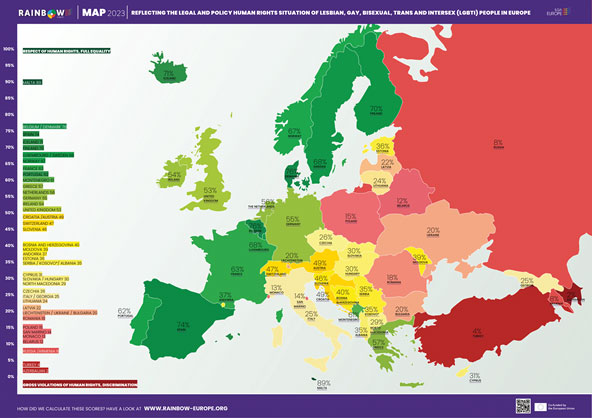
Beyond the legal sphere, the biggest challenge will come in influencing public attitudes, as signalled by Latvia’s scores on Equaldex’s Equality Index. This ranking combines a legal index that assesses key laws and a public opinion index that measures attitudes towards LGBTQI+ people. Latvia scores far lower for public opinion than for its laws. A 2019 Special Eurobarometer poll found that only 49 per cent of Latvians thought that LGBTQI+ people should have the same rights as heterosexuals.

The message is clear: changing laws and policies won’t be enough – and any legal victories will remain in peril unless social attitudes change.

Latvian LGBTQI+ organisations are fully aware of this, which is why they’ve worked on both fronts for many years. A centrepiece of their work to challenge prejudice is the annual Pride event, which Latvia pioneered for the Baltic region in 2005. As recounted by its organisers, Latvia’s Pride grew from 70 participants who faced 3,000 protesters in 2005 to 5,000 participants at EuroPride 2015, held in Latvia’s capital Riga, and 8,000 in the 2018 Baltic Pride, also held in Riga. Pride was repeatedly banned by Riga City Council, and it invariably faced hostile counter-protesters – but fewer each time, while the number of Pride participants has grown, boosting people’s self-confidence.

Global trends show progress towards the recognition of LGBTQI+ rights to be much stronger than regression. Latvian LGBTQI+ advocates will continue to push forward on both the policy and awareness-raising fronts. They’ll continue working to secure what they’ve already achieved while striving for more. They’re on the right course.

Inés M. Pousadela is CIVICUS Senior Research Specialist, co-director and writer for CIVICUS Lens and co-author of the State of Civil Society Report.

  Source

Global Civil Society Launches Manifesto for Ethical AI

Civil Society, Climate Change, Environment, Global, Headlines, Human Rights, Indigenous Rights, Inequality, Labour, TerraViva United Nations

Opinion

Credit: Forus

NEW DELHI, India, Dec 6 2023 (IPS) – We, a global coalition of over 50 civil society and human rights organizations from over 30 countries have co-developed the “Civil Society Manifesto for Ethical AI”, a groundbreaking initiative aiming to steer AI policies towards safeguarding rights and deconolonising AI discourse. We question, and we are not the only ones: whose voices, ideas and values matter in AI ?


“If Silicon Valley was a country it would probably be the richest in the world. So how genuinely committed is Big Tech and AI to funding and fostering human rights over profits? The barebones truth is that if democracy was profitable, human rights lawyers and defenders including techtivists from civil society organizations wouldn’t be sitting around multistakeholder engagement tables demanding accountability from Big Tech and AI. How invested are they in real social impact centred on rights despite glaring evidence to the contrary?,” asks Nina Sangma, of the Asia Indigenous Peoples Pact, a regional organization founded in 1992 by Indigenous Peoples’ movements with over 40 members across 14 countries in the Asia-Pacific region.

We are currently at a critical juncture where most countries lack a comprehensive AI policy or regulatory framework. The sudden reliance on AI and other digital technologies has introduced new – and often “invisible” – vulnerabilities, and we have just seen the tip of the iceberg, literally melting from the effects of climate change.

Some things we have already seen though: AI is still a product of historical data representing inequities and inequalities. A study analyzing 100+ AI-generated images using Midjourney’s diffusion models revealed consistent biases, including depicting older men for specialized jobs, binary gender representations, featuring urban settings regardless of location, and generating images predominantly reinforcing “ageism, sexism and classism”, with a bias toward a Western perspective.

Data sources continue to be “toxic”. AI tools learn from vast amounts of training data, often consisting of billions of inputs scraped from the internet. This data risks to perpetuate harmful stereotypes and often contains toxic content like pornography, misogyny, violence, and bigotry. Furthermore, researchers found bias in up to 38.6% of ‘facts’ used by AI.

Despite increased awareness, the discourse surrounding AI, like the technology itself, has predominantly been shaped by “Western, whiteness, and wealth”. The discrimination that we see today is the result of a cocktail of “things gone wrong” – ranging from discriminatory hiring practices based on gender and race, to the prevalence of algorithms biases.

“Biases are not a coincidence. Artificial intelligence is a machine that draws conclusions from data based on statistical models, therefore, the first thing it eliminates is variations. And in the social sphere that means not giving visibility to the margins,” declares Judith Membrives i Llorens, head of digital policies at Lafede.cat – Organitzacions per la Justícia Global.

“AI development isn’t the sole concern here. The real issue stems from keeping citizens in the dark, restricting civic freedoms and the prevalence of polarisation and prejudice on several dimensions of our societies. This results in unequal access, prevalent discrimination, and a lack of transparency in technological processes and beyond. Despite acknowledging the potential and power of these technologies, it is clear that many are still excluded and left at the margins due to systemic flaws. Without addressing this, the global development of AI and other emerging technologies won’t be inclusive. Failure to act now and to create spaces of discussion for new visions to emerge, will mean these technologies continue to reflect and exacerbate these disparities,” says Mavalow Christelle Kalhoule, civil society leader in Burkina Faso and across the Sahel region, and Chair of the global civil society network Forus.

The Civil Society Manifesto for Ethical AI asks, what are the potential pitfalls of using current AI systems to inform future decisions, particularly in terms of reinforcing prevailing disparities?

Today, as EU policymakers are expected to close a political agreement for the AI Act, we ask, do international standards for regulating machine learning include the voice of the people? With the Manifesto we explore, challenge, disrupt, and reimagine the underlying assumptions within this discourse but also to broaden the discussion to incorporate communities beyond the traditional “experts.” Nothing about us, without us.

“We want Artificial Intelligence, but created by and for everyone, not only for a few,” adds Judith Membrives i Llorens.

From the “Internet of Cows” to the impact of AI on workers’ rights and on civic space, developed by over 50 civil society organisations, the Manifesto includes 17 case studies on their experiences, visions and stories around AI. With each story, we want to weave a different path to build new visions on AI systems that expand rather than restrict freedoms worldwide.

“The current development of AI is by no means an inevitable path. It is shaped by Big Tech companies because we let them. It is time for the civil society to stand up for their data rights,” says Camilla Lohenoja, of SASK, the workers’ rights organisation of the trade unions of Finland.

“Focusing on ethical and transparent technology also means giving equal attention to the fairness and inclusivity of its design and decision-making processes. The integrity of AI is shaped as much by its development as by its application,” says Hanna Pishchyk of the youth group Digital Grassroots.

Ultimately, the Manifesto aims to trigger a global – and not just sectorial and Western-dominated dialogue – on AI development and application.

Civil society is here not just as a mere token in multistakeholder spaces, we bring forward what others often dismiss, and we actively participate worldwide in shaping a technological future that embraces inclusivity, accountability, and ethical advancements.

Bibbi Abruzzini, Forus and Nina Sangma, Asia Indigenous Peoples Pact (AIPP)

IPS UN Bureau

  Source

The Intergenerational Impact of Nuclear Testing in Polynesian States

Asia-Pacific, Civil Society, Environment, Global, Headlines, Health, Human Rights, Nuclear Energy – Nuclear Weapons, TerraViva United Nations

Communities affected by nuclear testing, many originating from island nations in the South Pacific, share their experiences at the Nuclear Survivors Forum. Credit: ICAN / Haruka Sakaguchi

UNITED NATIONS, Dec 5 2023 (IPS) – The language used in the Treaty of the Prohibition of Nuclear Weapons (TPNW) is unambiguous on its focus of the grave humanitarian impact of nuclear weapons. The TPNW also recognizes the influence of the public conscience “in the furthering of the principles of humanity as evidenced by the call for total elimination of nuclear weapons”.


This public conscience has been shaped by what we know already of the consequences of nuclear testing. Hiroshima and Nagasaki are the historic reasons to argue for nuclear disarmament. Decades later, the hibakusha – the term used to refer to survivors of the Japanese nuclear bombings – continue to be vocal in their pleas to world leaders to end nuclear weapon proliferation. Beyond Hiroshima and Nagasaki, the experiences in other affected regions – as represented by second- and third- generation survivors – stand as clear reminders of the intergenerational impact of nuclear testing.

While the Second Meeting of State Parties was an opportunity for member states and NGOs to support the Treaty and express solidarity with affected communities, it has been through a side-events hosted by civil society that those affected can directly testify to their own experiences. It has been through holding such events that the narratives built around nuclear survivors can be expanded, be made more inclusive.

On November 30, the International Campaign for Abolishing Nuclear Weapons (ICAN), along with partner organizations such as Peace Boat and Nuclear Age Peace Foundation, convened the Nuclear Survivors Forum. Hosted at the Church Center for the United Nations, the event saw people from communities around the world commiserate over their experiences with nuclear testing and their impact on their homes and communities.

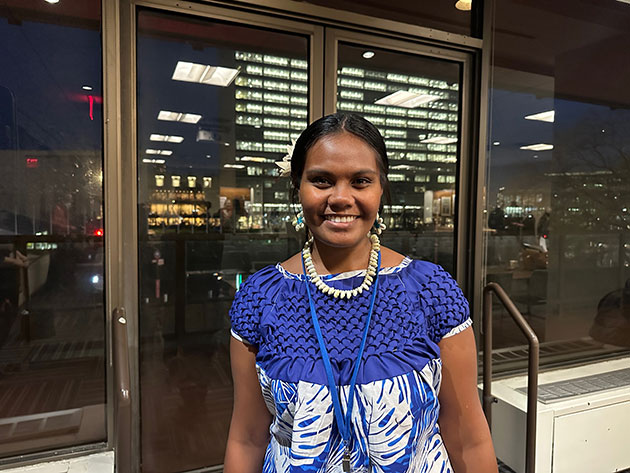
Taraem Taukaro, nuclear survivors forum. Credit: Katsuhiro Asagiri

The forum created a space where views, ideas, and common experiences were shared, especially for communities that “rarely have such opportunities”, according to Taraem Taukaro, a youth delegate who came to the event with the Kiribati government representatives. The Republic of Kiribati has been one of several island nations in the Pacific that were impacted by nuclear tests, notably conducted by British and American military forces in the mid-20th century. The Kiritimari island, which is part of the Republic, was previously the site of multiple nuclear bombing tests between 1956 and 1962.

Taukaro’s mother, who lived through the testing, suffers from health issues which is believed to have been caused by exposure to radiation from the fallout. This exposure also resulted in health complications for the next generation, like with Taukaro’s sister, who was born deaf. It is a challenge for this family to have been impacted this way. One of the direct impacts has been that the indigenous Kiribati people that lived through the tests are afflicted with health problems and have suffered losses in their environment and biodiversity. Their descendants now contend with the same issues.

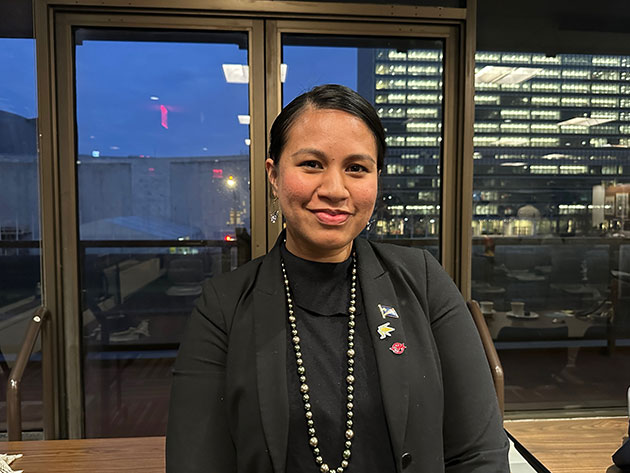
Bedi Racule, nuclear survivors forum. Credit: Katsuhiro Asagiri

Bedi Racule, an activist with the Pacific Conference of Churches, provided perspective on the impact of nuclear testing on the Marshall Islands and the greater South Pacific region. The US military conducted nuclear tests in the region, notably on Bikini Atoll between 1946 and 1958. As Racule noted, many Pacific communities continue to feel the impact of nuclear testing, which encompass cancer, displacement, and ecological contamination.

“There is a loss of our wellbeing and our quality of life and our connection to land and ancestors and culture,” she said. “…There is a lot of pain and trauma.”

When speaking of the nuclear survivors who attended the forum, she added: “I really feel for this community, and for my people. I also want to highlight their resilience, their strength. Having vulnerability is not weakness. It is strength… I just want to commend all of these people that have stood up now and in the past for a better world that’s free of nuclear weapons. And specifically, have a nuclear-free zone, and the first nuclear-free constitution.”

For young people, there is a greater responsibility to them to educate them on the impact of nuclear testing; to contextualize the history and the way their connection to culture has shifted, including what has been lost.

Racule remarked that during the forum, there was a call from the affected communities to establish an advisory group. “The core of [the TPNW] is the humanitarian response to nuclear weapons, knowing what has happened in the past and seeking justice for that and preventing these experiences from ever being felt again by anyone.”

Taukaro remarked that the international community, including the British government, could do more to provide funding and support for medical resources and environmental clean-up, as part of the compensation towards the affected communities in Kiritimari and its neighboring islands.

Racule expressed a different view. “Among our network of nuclear justice advocates, it is very well-acknowledged that nuclear issues are intrinsically linked to issues of colonization, of self-determination,” she said. “Even our countries in the Pacific that are free and independent and sovereign, they still have trouble voicing their wants… because of geopolitical interests, because of aid donor funding. We also see this development aid as a way to come in and influence what is happening, to take away our freedom not only politically but economically, financially, socially.”

With real life testimonies from survivors and their descendants, the event was a reminder that nuclear disarmament must be effective sooner rather than later to ensure that our future generations can live in peace and pursue decent lives. The public conscience must be respectful and elevate the voices of the indigenous communities who have been disproportionately affected by nuclear testing and live through its fallout, well into the new millennium.

IPS UN Bureau

  Source