MONTEVIDEO, Uruguay, Jan 8 2025 (IPS) – Colombia has just marked a historic milestone in the global campaign against child marriage, with the Senate passing one of Latin America and the Caribbean’s most comprehensive bans on child marriage and early unions. In a country where one in five girls under 18 and one in 10 under 14 are married or live in marriage-like conditions, the new law raises the minimum age to 18 with no exceptions, eliminating a 137-year-old Civil Code provision that allowed children over 14 to marry with parental consent. This achievement aligns with goal 5 of the Sustainable Development Goals (SDGs), which has a target of eliminating harmful practices like child marriage by 2030. The new law now awaits the signature of President Gustavo Petro to come into effect.
The breakthrough
Child marriage disproportionately affects Colombia’s most vulnerable communities, with rates of between 40 and 65 per cent among rural, Indigenous and Afro-Colombian populations. In some communities, girls as young as 10 are married off. These early unions expose girls to unequal power relations, deny them education, limit their bodily and economic autonomy and lead to higher rates of gender-based violence and health issues linked to early pregnancy.
The passage of the #SonNiñasNoEsposas (‘They are girls, not wives’) bill reflected the power of persistent civil society advocacy. After several failed attempts since 2007, the bill, authored by two congresswomen, passed with unanimous support. This success was driven by a coalition of Colombian civil society organisations as part of the Girls Not Brides global network, including the Foundation for Gender and Family Development, Fundación Plan and Profamilia, working alongside international partners such as Equality Now and Plan International, with Girls Not Brides directly supporting legislative advocacy and media campaigns.
Beyond raising the marriage age, the new law establishes the National Comprehensive Programme for Life Projects for Children and Adolescents. This preventive initiative targets the structural causes of early unions – poverty and lack of education – particularly in remote rural areas. The programme includes the participation of Indigenous communities through their own governance structures, recognising the importance of cultural sensitivity in implementation.
The global landscape
Colombia is by no means alone in having a child marriage problem. Around the world, some 12 million girls are married each year, two million before the age of 15. While child marriage can affect boys as well, girls are six times more likely to be married as children than boys.
According to the Child Marriage Monitoring Mechanism, a collaborative initiative to generate evidence to support efforts to end child marriage, one in five young women worldwide are married before their 18th birthday, with rates highest in sub-Saharan Africa.
To tackle this problem, The Elders, a group of senior public figures, launched the global Girls Not Brides partnership in 2011. With over 1,400 member organisations in more than 100 countries, Girls Not Brides works to prevent under-age marriage, recognising it as both a human rights violation and an obstacle to development. It identifies four main drivers of child marriage: poverty, limited educational and economic opportunities, gender inequality and insecurity in conflict or disaster situations. It tackles the problem with awareness-raising campaigns, national and international policy advocacy and community engagement to challenge social norms that perpetuate child marriage.
Since then, efforts have multiplied. In 2016, the United Nations Population Fund and the United Nations Children’s Fund (UNICEF) launched the Global Programme to End Child Marriage. Now in its third phase, set to run until 2030, the programme operates in 12 high-prevalence countries in Africa, the Middle East and South Asia. Working directly with governments, it has reached millions of adolescent girls, focusing on education, healthcare and economic opportunities.
Many more initiatives work at national and local levels. They combine multiple responses, including working with religious and community leaders to change social norms, supporting girls’ education and economic empowerment, engaging with men and boys on gender equality, advocating for stronger laws and their enforcement, providing support services to girls at risk of child marriage, using media and technology to raise awareness and change attitudes and building networks of young advocates and change-makers.
Progress and challenges
These efforts have contributed to a global decline in child marriage rates. According to UNICEF, the proportion of young women married as children has decreased from 25 per cent to 21 per cent over the past decade, meaning that 25 million child marriages have been prevented. However, the global number of child brides is still estimated at 650 million, including girls under 18 who have already married and adult women who married as children.
The average annual rate of reduction has been 0.7 per cent over the past 25 years and 1.9 per cent over the past decade, showing the impact of recent initiatives. But at this rate, the SDG target of eliminating the practice by 2030 won’t be achieved.
Setbacks have been caused by the COVID-19 pandemic, climate change, conflict and economic instability. Wherever insecurity rises, so does child marriage, as parents see early marriage of daughters as a financial and security solution. During Syria’s conflict, for example, the rate of child marriages shot up among refugees in countries such as Jordan and Lebanon.
Looking ahead
Colombia’s new law marks significant progress, but it’s just the beginning, as evidenced by the fact that many of the early marriages that take place in Colombia would have been illegal under the old law.
The real work of implementation begins now. Colombia’s efforts over the next few years will be crucial in demonstrating how legislative change can translate into real protection for vulnerable girls. For Latin America and the Caribbean, it should open up opportunities for strengthened cross-border cooperation and similar legislative reforms.
Colombia’s comprehensive approach could serve as a model for change in a region where many countries still have legal exceptions that allow child marriage under some circumstances, while others have strong laws that aren’t adequately implemented.
While the declining trend in global child marriage rates offers hope, the current pace of change remains far too slow. Colombia’s example shows that significant progress is possible through sustained, multi-stakeholder commitment and comprehensive approaches that change laws but also address underlying social dynamics. The international community must build on this momentum. This means scaling up successful initiatives, increasing funding for civil society organisations and maintaining political pressure.
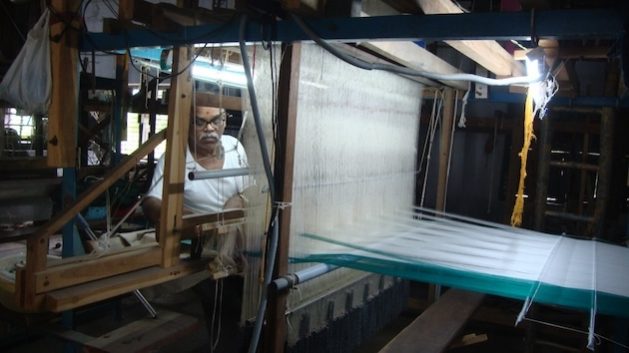
Siddipet cotton fabric being woven. Credit: Rina Mukherji/IPS
SIDDIPET, POCHAMPALLY & KOYALAGUDDEM, India, Jan 8 2025 (IPS) – The southern Indian state of Telangana has always been home to exquisite cotton and silk weaves. But in recent years, lack of market access, expensive inputs, and government apathy have taken their toll on the weaving community. As a result, the younger generation is refraining from pursuing this traditional occupation and opting for more lucrative pursuits.
This is evident when one visits the weaving towns of the state. Take Siddipet, which is about 100 km from the metropolitan city of Hyderabad. Siddipet has always been known for its exquisite cotton saris and stoles. But today, only about a hundred wizened individuals, spread over seven handloom cooperatives, still weave.
Srivikailasam is a renowned middle-aged weaver who was honoured by the Chief Minister with the Konda Laxman Bapuji Award. His saris, dupattas and stoles are prized items in the export market. Yet none of his children—a son and two daughters—want to inherit his craft.
Another weaver, known as Ilaiyah, has been weaving for the past 60 years, since he turned 15. Yet his children have turned their backs to weaving.
Yadagiri has also been weaving for the past 60 years, like his fellow weavers. But neither his son nor daughter are interested in learning to weave.
Master weaver Mallikarjun Siddi, who also owns a marketing outlet in Siddipet, followed his father, renowned weaver Buchaiah Siddi, into the profession. But his children have opted out of this traditional occupation.
However, Siddi defends the youngsters.
“Why would youngsters want to adopt a profession that pays so little? A weaver earns Rs 1000 (USD 11.82) a day here, and it takes three full days to weave a sari. A job in the IT hub of HiTech City in Hyderabad fetches a lot more.”
Worse, the Telangana government does not subsidize electricity; this has resulted in the Siddipet weavers continuing to use handlooms instead of switching to powerlooms, making their work even more tedious and hard. Electricity is Rs 10 (USD 0.12) a unit. If subsidized, the cost comes down to Rs 1 (US$ 0.012) per unit. Power loom machinery is expensive, ranging from Rs 1.5 lakh to 6 lakh (USD 1773.5 to USD 7101). With electricity subsidy, a weaver can bear the burden. Otherwise, it is not possible. Hence, even today, you see only handlooms here,” explains Siddi.
Master weaver Laxman Tadaka prepares his materials. Credit: Rina Mukherji/IPS
Marketing the product is also tough. The government buys the product at higher rates but does so lackadaisically. “Their representatives come only once a year, and although the payment is higher, it is not immediate. Private parties come regularly, and often, pay immediately,” say weavers.
The story is hardly any different in Pochampally, world-renowned for its ikat silk weaves. Ikat here can be either single ikat or double ikat, with the second being even more expensive. The yarn has to be initially soaked and then dyed before weaving. Since ikat weaves require every thread of the yarn to be dyed separately, a power loom can never be used. Thus, ikat weaves, whether cotton or silk, must be woven on a handloom, as master weaver Laxman Tadaka points out. The silk yarn comes from Bengaluru and is priced at Rs 4500 (USD 53.20) per kilogram. A weaver needs an average of 6 kg of yarn to weave seven saris a month. To bear the cost of inputs and the effort, a weaver must make enough sales. “The 15 percent subsidy extended by the government can hardly suffice,” Tadaka points out.
Rudra Anjanelu, manager of the Pochampally Handloom Weavers Cooperative Society, says they are dependent on subsidies.
“Our silk saris are expensive. But we cannot afford to give discounts unless the government supports us. A major problem is the 5 percent Goods and Services Tax (GST) that has now been imposed by the central government. It makes saris and other silk products even more expensive.”
In the past, the state government used to render marketing support through its outlets, offering the products to customers at discounted prices, especially during the festive season, while subsidizing weavers. This is not forthcoming anymore, making it tough for weavers.
Most weavers have to rely on the Telangana State Handloom Weavers Cooperative Society Limited (TSCO), their apex cooperative, to sell their product.
“We had suggested a method to jack up our sales. The Telangana government has a Kalyanalakshmi scheme, wherein parents of girls are given Rs 1 lakh (USD 1182.32) for their daughter’s wedding. Along with the money, the government could easily provide a sari worth Rs 10,000 (USD 118.23) for the bride. This will help us weavers too, while helping the parents with the bridal trousseau,” Anjanelu says.
Besides, most weavers are not happy with the quality of the subsidized yarn provided by the government through the National Handloom Development Corporation.
Muralikrishnan, a weaver from Koyalaguddem, a village renowned for its cotton ikat, laments, “The yarn provided by the government is of inferior quality and this, in turn, can affect the quality of our end product. It is unlike what we get from private traders.”
Moreover, as Anjanelu points out, “Yarn has to be paid for. When sales are down, how can weavers buy any yarn?”
A big challenge for handloom weavers remains the flooding of markets by printed duplicates, which sell at a fraction of the price of handloom fabric.
On hindsight, though, it is not as if nothing was done for weavers by the Telangana government. However, if weavers have not experienced long-term benefits, could this be attributed to the outcome of the ballot?
The previous Chandrashekhar Reddy (state) government, for instance, introduced a 36-month savings-cum-insurance scheme for weavers termed the Thrift Scheme, wherein the government contributed an amount matching the investment made by an individual.
In Pochampally, land was also sanctioned for a handloom institute, and a handloom park was set up on the outskirts of the town. However, with a new Chief Minister getting elected, the plans came to naught. The Handloom Park too suffered from bad planning. Weavers who had set up shop at the park now have to market their products from their homes.
It is ironical that the weavers of Pochampally, Koyalaguddem and Siddipet find it tough to sell their exquisite weaves, despite being located in the vicinity of metropolitan Hyderabad, which boasts of an upwardly mobile population with high disposable income.
Notwithstanding the problems faced, there are a few who have found a solution. Dudyala Shankar and Muralikrishnan of Koyalaguddem have diversified their range of products to include ikat fabric and bedsheets, alongside traditional saris, dupattas, and stoles. Muralikrishnan has been accessing markets all over India through the internet, from his dusty little village.
“It is the only way out,” he tells me.
Indeed, the World Wide Web can certainly fill in where humans cannot. Product diversification and market access translating into sales may ultimately wean back the younger generation to keep the weaving tradition alive in Telangana and prevent it from dying out.
• YS Schools students created and released a short film, “OTIS” — described as a meta meditation on the unpredictable nature of art, among other themes — on the “MLQ Productions” YouTube channel.
April
• Yellow Springs Film Festival, which debuted in fall 2023, presented a Mini-Fest at the Little Art Theatre. The event was a prelude to the main festival held in October.
Actor Chris Young, center, and crew prepare to roll camera for a scene in the horror-comedy short film “…And Then She Laughed.” The film, written and directed by Amy Taylor and produced by local resident Ben Guenther, was shot at a village home on Orton Road. (Photo by Lauren “Chuck” Shows)
May
• Honoring the legacy of the late Julia Reichert, the Yellow Springs Film Festival and PNC Bank announced the creation of the Julia Reichert Award, a $3,000 short film prize to be given to an emerging female documentarian.
• A five-day shoot for a short horror-comedy film was held at a home on the south end of town. “…And Then She Laughed” was written and directed by Virginia-based filmmaker Amy Taylor and is currently in post-production.
October
• The annual YS Film Festival returned for the second year, featuring a lineup of screenings of narrative and documentary films, several of which premiered or received awards this year at the prestigious Sundance, Tribeca and Cannes film festivals — as well as guest performances and Q&A sessions.
December
• The Little Art Theatre announced the launch of a new website and a new way for movie-lovers to have some say in what they see on screen on the eve of its95th anniversary next year.
Feufollet of Louisiana blends traditional Cajun sounds with country, rock and swamp pop. The band played at Antioch College’s Foundry Theater on Wednesday, Feb. 21. (Submitted photo)
February
• The Foundry Theater continued its 2023–24 live performance series by welcoming the Southwest Louisiana band Feufollet.
• The theater also brought famed singer-songwriter and cult icon Jonathan Richman to the stage for a bare-bones, acoustic set, which was a departure from the high-voltage sounds of Richman’s early musical career.
March
• The World House Choir joined forces with MUSE: Cincinnati’s Women’s Choir for the locally based community choir’s second annual “BREAD & ROSES: A Celebration of International Women’s Day” concert atthe Foundry Theater.
Yellow Springs resident Kylle Harewood, otherwise known as X the Detective, launched a hip-hop night at the Gulch Saloon — a community-oriented night of beats and wordsmithery for listeners and lyricists alike. (Photo by Reilly Dixon)
• Bringing people together through the power of Hip-Hop, Kylle Harewood, whose musical moniker is “X the Detective,” transformed a simple beat machine into a community-building force by hosting Wednesday night beats and rhyme sessions for freestylers and hip-hop enthusiasts at the Gulch Saloon.
• The News featured local resident and music producer Justin “UnJust” Herman, for his efforts to expand the local hip-hop scene through the OPEN Project, where beats flow freely and artists find solace in shared expression.
• The Yellow Springs Hardware Store began hosting musical performances, benefits and comedic improv shows and workshops throughout the year as part of its Hardware Store Sessions.
April
• The World House Choir returned to its home stage in the Foundry Theater to perform a program of music that included the 20-minute choral piece “Weather: Stand the Storm,” written by composer Rollo Dilworth, a music professor at Temple University, setting music to the Claudia Rankine poem “Weather.”
• The Yellow Springs Community Band performed Songs of the Sea, which included everything from traditional sailing songs to the theme for Pirates of the Caribbean.
May
• The Foundry Theater presented a performance by musicians Marisa Anderson and Jim White, with former Yellow Springs resident Porter Fitch opening; welcomed string duo Larry & Joe. Both based in North Carolina; and held the final performance of its inaugural programming season with folk duo Kristin Andreassen and Chris “Critter” Eldridge.
• Yellow Springs Community Music: the Yellow Springs Chamber Orchestra performed the program “Spaces and Textures,” which included pieces by Aaron Copland, Alexander Borodin and Franz Schubert. The Yellow Springs Community Chorus presented “Songs of Spring,” which featured songs and choral pieces by Franz Schubert, Charles Ives, Antonin Dvorak and Ralph Vaughan Williams.
June
“The Outside Presents,” an experimental music performance series had its final show of the first season on Monday, June 10, at the Antioch College Foundry Theater. The series is hosted by Evan Miller, shown here at a performance from earlier this year. (Photo courtesy of Ruthie Herman)
• Experimental music performance series “The Outside Presents” wrapped up its the seasonin the Foundry Theater’s black box space. The series — a kind of off-shoot of WYSO 91.3’s late-Sunday-night show “The Outside” aims to expose audiences to experimental music acts from both the Southwest Ohio region and beyond.
• Twenty-seven incarcerated men, members of the NIA Men’s Chorus at Chillicothe Correctional Institution under the direction of local resident Catherine Roma, performed “Les Mis Inside,” a pared-down version of the popular musical with choral arrangements before an audience of invited guests, including a large contingent of Yellow Springers.
July
• Crowds gathered at Tuck-N-Reds Spirits & Wine to benefit Charles “Chuck” Arthur Williams, a local musician fighting cancer. Organized by local musician Danny Sauers, the event, “A Bad Day for Cancer,” featured a host of local acts and raised $1,876 toward Williams’ medical expenses.
August
• Local musicians and educators Cammy Dell Grote, Caryn Diamond, Barbara Leeds and Nancy Lineburgh, revived a local piano ensemble with a history stretching back decades, performing as an eight-hands ensemble as part of the Dayton Music Club’s season-opening September Musicale at Epiphany Lutheran Church in Dayton.
November
• The Yellow Springs Youth Orchestra Association held a benefit for its summer camp that featured performances by young band, orchestra and chorus members.
• Yellow Springs Community Music: the Yellow Springs Chorus and Chamber Orchestra presented W. A. Mozart’s dramatic Requiem (K 626), his final — and uncompleted work — in the newly reopened First Presbyterian Church’s sanctuary, which had been cleared of birds and bats. The Yellow Springs Community Band presented “Forgotten Gems from the Library,” a collection of pieces not often performed anymore.
December
The Yellow Springs Community Band, McKinney Middle School and YSHS choirs, as well as some members of the World House Choir performed a holiday concert to a capacity crowd in the First Presbyterian Church’s Westminster Hall.
A holiday concert played to a capacity crowd Monday evening, Dec. 16, in Westminster Hall at the First Presbyterian Church. It was a collaboration between the Yellow Springs Community Band, the McKinney Middle School and YSHS choirs, and several members of the World House Choir. (Photo by Matt Minde)
Yellow Springs Community Music: The Yellow Springs Community Orchestra presented a Winter Solstice concert, featuring works by nordic composers Jean Sibelius, Edvard Grieg and a commissioned piece by Oliver Kentish, featuring David Coleman, trumpet soloist.
January
In January, a new play by Mad River Theater Works, “Keep Marching: The Road to the March on Washington,” delved deeper into the grassroots history of the historic event, particularly what it was like for the thousands who marched, demanding fair wages, voting rights and civil rights protection and an end to segregation for Black Americans. The play — aimed at young audiences, but appropriate for all ages — debuted in the Foundry Theater at Antioch College.
Diana Slickman, left, as Ludwig van Beethoven and Colm O’Reilly as Quasimodo in “The Hunchback Variations,” which the two actors performed March 15–17 in the Foundry Theater at Antioch College. (Submitted photo)
March
• After an eight-year absence, Women’s Voices Out Loud, a long-loved staple of local women’s art and expression, returned to the village at the Herndon Gallery on Antioch’s campus, with an accompanying art installation.
• The Foundry Theater welcomed Chicago-based theater collective Theater Oobleck to its experimental black box theater stage for three performances of “The Hunchback Variations.”
“Roof Man,” Yellow Springs Theater Company’s comedy was performed at First Presbyterian Church earlier this year. The play, written by Yellow Springs local Robb Willoughby, starred Thor Sage, center, as the titular character who refuses to get down from his roof. “Roof Man” also featured, clockwise from bottom left, actors Ellen Ballerene, Seth Ratliff, Saul Caplan, Libby Holley Scancarello and Kayla Graham. (Photo by Reilly Dixon)
April
• The Yellow Springs Theater Company presented the “Roof Man,” a story of world-weary, blue-collar Charlie who refuses to come down from his suburban roof after mounting middle-class problems become too much.
• Young thespians of YS High and McKinney Middle schools presented four performances of “The Addams Family” at the John Legend Theater in Springfield.
May
• The annual 10-Minute Play Festival, sponsored by the YS Theater Company, was staged on the grounds of Yellow Springs High School.
June
• The Mad River Theater Works summer youth theater residency kicked off its second year at the Foundry Theater. Young thespians ranging in age from 8 to 17 were introduced to the ideas and methods of devised theater, or theater created collaboratively without a script from a unifying theme. The residency focused on the theme of “Mystery.”
Local thespians and funny guys Charlie Cromer, Adam Zaremsky and Elliot Cromer took the Foundry Theater stage, Thursday–Saturday, July 18–20, to perform a characteristically over-the-top sketch comedy show, titled “Bigger and Better.” (Photo by Lauren “Chuck” Shows)
• “Bigger and Better,” the third sketch comedy show produced by local duo Elliot Cromer and Adam Zaremsky, and the second accompanied by band The Boogie Bros, elicited laughs from audiences with the staging of three shows at the Foundry Theater.
July
• GravityWorks Circus took to the air for the first time in their home venue, the Foundry Theater, with three performances of “She Grows Wings.” GravityWorks opened in March 2023 as the brainchild of two local residents, Maya Trujillo and Kayla Graham.
October
• Friendship, love, betrayal, reconciliation and a band of forest marauders were enacted when YS High School theater department staged Shakespeare’s “The Two Gentlemen of Verona,” at the Turner Studio Theater in Springfield.
Local resident Louise Smith, left, and New York residents Lizzie Olesker, center, and Peggy Pettitt presented “The Language of Dolls” — a play they wrote collaboratively and which centered questions of racial and cultural identity — at the Foundry Theater. The artists are pictured holding handmade dolls they created for the show. (Photo by Lauren “Chuck” Shows)
• Local resident Louise Smith and New York residents Lizzie Olesker and Peggy Pettitt starred in “The Language of Dolls” — a play they wrote collaboratively and which centers questions of racial and cultural identity — at the Foundry Theater.
December
• All 209 of the fairy tales collected by The Brothers Grimm were presented in a little over an hour through the production “The Brothers Grimm Spectaculathon.” The winter play, presented by the young thespians of McKinney Middle and YS High schools, was a one-act play performed at the Clifton Opera House.
Visual Arts
January
• The News interviewed participants in an Art Book Circle about their months-long artistic collaboration. Ten artists and/or creatives spent the better part of 2023 making 10 books with original art, a page at a time. A new cohort of 30 participants repeated the project over 10 months in 2024. The results were displayed at the library in November and December.
March
• “My Name is Iden” News columnist Iden Crockett,explored her “dual selves” in the “4 a.m. Girl” exhibition at the Yellow Springs Arts Council Gallery.
The late artist and Yellow Springs resident Raymond P. Harris amid some of his work, in a photo from a 1953 LIFE magazine profile about a group of American artists working in Paris, of which Harris was a part. “Artistry Re-Kindled: The Raymond P. Harris Retrospective Exhibit,” a retrospective exhibition of the work of Harris — who lived in the village from the 1950s until his death in the 1980s — opened April 6 in the Herndon Gallery at Antioch College. (Submitted photo, originally published in ‘LIFE’ magazine)
April
• The artistic legacy of mid-century artist and former Yellow Springs resident Raymond Perret Harris was celebrated through the exhibition “Artistry Re-Kindled: The Raymond P. Harris Retrospective Exhibit,” curated by local resident Ena Nearon, of Ten Talents Network.
June
• The themes of community, nature, connection, heart, people, memory, energy and healing were explored in a News feature about local artist Chris Glaser, who 25 years ago started painting more seriously after a back injury.
• The exhibition “Simple Steps” opened to the public. Curated by Dayton-based mixed-media collage artist and creator Carly Evans, it featured the curator’s work, as well as that of four other creators: Tink, a.k.a. Ashlyn Zerangue, Teri Campell, Becky Potts and Bartek Karas.
Sumayah Chappelle (right) was artist-in-residence at Crome Architecture, where “Renaissance,” an exhibition of ceramic relief works was on display earlier this year. (Photo by Truth Garrett)
July
• “Renaissance,” an exhibition by artist and local resident Sumayah Chappelle, opened at Crome YS. The exhibition both reflected her journeys with her Islamic faith and personal growth.
October
YellowSprings hosted two exhibits for the fall 2024 FotoFocus event, “backstories”: photographers Shem Schutte, whose work, “Thinking Positive, Capturing Negatives,” was displayed at Crome YS; and Juan-Sí González, whose exhibition, “Looking for Cuba Inside,” was featured at Antioch College’s Herndon Gallery.
January
• Jane Blakelock, a retired senior lecturer emerita of Wright State University and a 38-year resident of Yellow Springs reviewed local author Jo Ann Kiser’s new novel, “A Young Woman from the Provinces,” which according to Blakelock, “unspools a journey to the self, the only reliable home that is everyone’s birthright.”
April
• The News interviewed author and Yellow Springs residentLucrecia Guerrero about her new novel, “On the Mad River,” about life in a fictional 1980s Ohio town and its inhabitants as they confront a changing world and their own changing desires.
Antioch professor of writing and aesthetics Brooke Bryan began the work of reviving some much beloved literary institutions: the Antioch Review as well as the Writers’ Workshop. The first, re-inaugural workshop was held at Antioch’s campus July 8–12. (Photo by Reilly Dixon)
May
• After a four-year hiatus, Antioch College announced that the Antioch Review — the college’s independent literary magazine founded in 1941 —had re-emerged with a new editorial vision and business model, which included the revival of the Antioch Writers’ Workshop. The workshop, held in July, offered morning seminars, afternoon author meetings, writing practices and other literary events. Featured writers included Kashmiri novelist Feroz Rather and Yellow Springs-based authors Rebecca Kuder and Robin Littell.
August
• The News interviewed Brooklyn-based author and illustrator Nina Crews about her newly published children’s biography, “Extraordinary Magic: The Storytelling Life of Virginia Hamilton.” In her lyrical picture book biography, Crews utilized poetry to tell the story of Hamilton’s life.
September
• The News interviewed local resident and writer Cyndi Pauwels — known to readers by her nom de plume, C.L. Pauwels — about her novel “Fatal Errors.” Fatal Errors is Pauwels’ fourth novel, a crime thriller and mystery, published in August by Crossroad Press.
October
• The Senior Center held a Local Writer’s Series in September and October that brought together established and emerging literary voices.
December
• The News interviewed Dr. John E. Fleming about his memoir, “Mission to Malawi,” which was published in spring. The book details Fleming’s service in the early years of the Peace Corps— during which he was the only Black American in his cohort — against the backdrop of the U.S. Civil Rights Movement.
The Solstice Poetry Reading, presented by Tecumseh Land Trust and Glen Helen, was held Friday, Dec. 6, 7 p.m., at the Glen’s Vernet Ecology Center. (Photo by Audrey Hackett)
• The 13th Annual Winter Solstice Poetry Reading was held at Glen Helen’s Vernet Ecological Center with the theme “Stillness.” The event featured 10 poets, an open mic, wine reception and the opportunity to purchase publications from the featured poets.
• Local human rights organization H.U.M.A.N., or Help Us Make a Nation, gave the community a way to process post-election worry and rage and ask the question “What now?” through a coffeehouse event co-sponsored by Mad River Theater Works at the Foundry Theater. During the event, villagers were given the opportunity to express themselves through poetry and music, or to say what was on their hearts and minds in conversation.
ATLANTA, Georgia, Jan 3 2025 (IPS) – The fireplace in the State Dining Room of the White House that says, “May none but honest and wise men ever rule under this roof.” President John Adams wrote that in a letter to his wife Abigail in 1800.
Jimmy Carter was by all accounts a wise, just, and decent man—a man of deep religious faith, who was also circumspect—some may say old fashioned—about his rhetoric.
He was refreshingly candid in using the country-boy phrase “I’ll whip his ass!” against Democratic primary opponent Sen. Edward Kennedy. Most reporters in that era considered it too harsh or nearly obscene, so instead, they wrote, “I’ll whip his donkey!”
Carter was honest. When asked by a reporter amid stories of the Kennedy brothers’ sexual indulgences, if he had ever had lust in his heart, he responded straightforwardly, “Yes.” That’s something no other politician would ever do. But it was easy for Carter to admit because he followed the Christian and Calvinist doctrine that “We are all sinners.”
Historians view his administration as a watershed in the civil rights struggle, especially in the South. As president he negotiated the first ever peace agreement between Israel and the Arabs. In his post-presidential years, he made a worldwide impact as a humanitarian.
Civic virtue must be faithful to the original concept of American nationhood—favoring citizens ahead of government. Liberty and justice are the watchwords of democracy, not blind obedience to politicians.
George Washington said, “There exists an indissoluble union between virtue and happiness.” Lincoln advised “Malice toward none…charity for all…firmness in the right.” Carter followed these sentiments at his inauguration with a pledge from the Biblical Prophet Micah: “Do justly, love mercy, walk humbly.”
There are two ways of recognizing people as honest and wise—by their words and by their deeds. Carter told the truth straight out—even if it was inconvenient or might hurt him. His policies were based on simple fairness, especially in his efforts to overcome the endemic racism of the Old South.
By contrast, President-elect Trump is famous for the lies and invective-filled slander constantly dripping from his lips: “When somebody hurts you, just go after them as viciously and as violently as you can…. When somebody screws you, screw them back in spades.” Trump’s brand, he said, means, “Power is the only true value.”
We teach our kids differently. “Be nice,” we always say. Sesame Street TV and First Grade teachers call out children for “Courtesy Lacking.” Why can’t we demand as much from our leaders?
Trump is a symptom of the ills of our society, not the cause. Today most of us tolerate curses and obscenities that would have scandalized our grandmothers. Trump is simply riding the crest of a flood of indecency that already exists among the public.
Let’s bring back civic virtue. Jimmy Carter may be the best example of personal rectitude among US leaders in our lifetimes. Let him be your model—not the empty, sleazy suit that is soon to be the next occupant of the White House.
James E. Jennings PhD is President of Conscience International.
OHRLLS Office Banner. Credit: The United Nations Office of the High Representative for the Least Developed Countries, Landlocked Developing Countries and Small Island Developing States (UN-OHRLLS)
UNITED NATIONS, Jan 3 2025 (IPS) – Over 570 million people live in the world’s 32 Landlocked Developing Countries (LLDCs), spanning across Africa, Asia, Europe, and Latin America. These nations face unique and complex development challenges. Their lack of direct access to the sea, geographical isolation, limited infrastructure, and difficulty integrating into global trade and value chains hinder sustainable development and progress.
The lingering impacts of the COVID-19 pandemic, rising vulnerability to external shocks, climate change, and mounting debt burdens have further compounded these challenges, eroding progress achieved under the last developmental roadmap for LLDCs—the Vienna Programme of Action.
However, a pivotal moment for LLDCs is at hand. In the lead-up to the Third United Nations Conference on LLDCs (LLDC3), to be held next year, the international community has adopted a new Programme of Action (PoA) to guide LLDCs’ development from 2025 to 2035.
UN Under-Secretary-General (USG) and High Representative, cr. Credit: OHRLLS
A new decade of opportunity and progress
The new PoA is a landmark achievement designed to address the structural challenges of LLDCs and accelerate their socio-economic integration into the global economy. This vision focuses on five priority areas critical to transforming LLDCs into resilient and competitive economies:
Structural Transformation and Science, Technology, and Innovation (STI)
Economic diversification is crucial for LLDCs. Their dependence on a narrow range of commodities leaves them highly vulnerable to external shocks. The new PoA prioritizes value-added industries and leveraging technology and innovation to help LLDCs integrate more effectively into global value chains and build more resilient economies.
Digital connectivity, which is pivotal for sustainable development, is also an important focus of the PoA. In 2023, only 39% of LLDC populations used the internet, compared to the global average of 67%. The PoA aims to create regional digital platforms for peer learning and capacity building while increasing support to LLDCs to leverage technology for sustainable growth.
Trade, Trade Facilitation, and Regional Integration
Trade drives economic growth, yet LLDCs account for just 1.1% of global merchandise exports. High trade costs—averaging 30% more than coastal countries—significantly hamper their competitiveness.
The new PoA highlights LLDCs’ interest in establishing a dedicated work programme at the World Trade Organization (WTO) to address their unique needs. It also recommends developing a high-level panel of experts to examine the application of existing international laws on freedom of transit for LLDCs, ensuring that LLDCs can engage in international trade under fairer conditions.
Transit, Transport, and Connectivity
Transport infrastructure is a critical link for LLDCs to global markets. Bridging the current gap—nearly 200,000 km of paved roads and over 46,000 km of railways—will require over half a trillion dollars.
To address this, the PoA proposes an Infrastructure Investment Finance Facility (IIFF) for LLDCs to mobilize resources for sustainable transport infrastructure, thereby reducing trade costs and enhancing connectivity.
Enhancing Adaptive Capacity and Resilience to Climate Change and Disasters
LLDCs face significant vulnerabilities to climate-related disasters. Between 2012 and 2022, 447 such events affected 170 million people in LLDCs—double the global average.
The PoA emphasizes climate-resilient infrastructure, sustainable agriculture, and improved access to climate finance. It also notes LLDCs’ interest in developing a dedicated work programme under the United Nations Framework Convention on Climate Change (UNFCCC).
Lastly, but more importantly,
Means of Implementation
The success of the new Programme of Action depends on robust means of implementation, including adequate resources, technical support, and strong partnerships. The PoA calls for increased development assistance and emphasizes the role of public-private partnerships in realizing its ambitious goals.
Driving Progress through Partnerships – a call for global solidarity and action
The adoption of the new Programme of Action is more than a commitment—it is a renewed call to action. Global solidarity is essential to provide LLDCs with the financial, technical, and capacity-building support they need. Strengthened partnerships and concerted efforts will enable LLDCs to leverage their potential and contribute meaningfully to the global economy.
The upcoming LLDC3 Conference in 2025 will serve as a critical platform to build this momentum and strengthen international collaboration and multi-sectoral partnerships for the implementation of the PoA.
With political resolve, enhanced partnerships, and tangible actions, LLDCs can emerge as dynamic contributors to the global economy, charting a path toward sustainable prosperity over the coming decade.
Ms. Rabab Fatima, United Nations Under-Secretary-General and High Representative for the Least Developed Countries, Landlocked Developing Countries and Small Island Developing States.
Jan 2 2025 (IPS) – CIVICUS discusses the challenges Palestinian civil society faces in resisting digital suppression and advocating for justice with Palestinian lawyer and researcher Dima Samaro.
How are digital platforms influencing the narrative on Palestine?
Digital platforms have become key to shaping narratives about Palestine, often amplifying the Israeli narrative while systematically silencing Palestinian voices. Platforms such as Meta, TikTok and X, formerly Twitter, routinely remove Palestinian content under vague ‘policy violations’. This has intensified since October 2023, with the Israeli Cyber Unit issuing over 9,500 takedown requests, 94 per cent of which were approved. These actions have resulted in the removal of posts, shadow bans – a form of censorship that limits visibility of pro-Palestinian content without user notification – and account suspensions, and have extended to the censorship of hashtags such as #FreePalestine.
Algorithmic bias further marginalises Palestinian narratives. For example, Instagram once mistranslated the Arabic phrase ‘alhamdulillah’ – praise be to God – next to a Palestinian flag as ‘terrorists fighting for their freedom’. On WhatsApp, AI-generated images depicted militarised scenes as illustrations for ‘Palestinian’ but benign cartoons for terms such as ‘Israeli boy’ or ‘Israeli army’. While these incidents are often dismissed as technical errors, they reveal a systemic bias.
Policies such as Meta’s Dangerous Organisations and Individuals framework are heavily influenced by US terrorism designations and stifle Palestinian discourse by prohibiting expressions of ‘praise’ or ‘support’ for major political movements. Meanwhile, hate speech targeting Palestinians – including posts celebrating violence or calling for the destruction of Gaza – often goes unchecked. While ads inciting violence against Palestinians are allowed, the use of terms like ‘Zionist’ is flagged as hate speech. This double standard silences Palestinian voices while enabling propaganda that justifies collective punishment and shields atrocities from scrutiny.
Platform complicity goes beyond censorship. In April, +972 Magazine reported that WhatsApp, which belongs to Meta, played a role in supporting the Israeli AI surveillance system Lavender, which has been linked to the killing of civilians in Gaza. These disturbing revelations suggest direct corporate complicity in violations of international law.
Digital platforms are distorting narratives, dehumanising Palestinians and normalising violence against an already oppressed and besieged population. They actively suppress efforts to document war crimes and manipulate information. They must be held accountable for this.
What challenges does Palestinian civil society encounter?
Palestinian CSOs work under immense pressure, facing arbitrary arrests, travel bans, funding cuts and violence. In October 2021, Israel designated six prominent Palestinian human rights groups as terrorist organisations. These unfounded accusations delegitimised their work, fuelling defamation campaigns and enabling harassment and other restrictions on their work.
Many human rights defenders have also become targets of digital surveillance. Pegasus spyware, developed by the Israeli company NSO Group, has been used to hack the devices of Palestinian activists and human rights defenders, putting their safety and work at risk. This surveillance has been widely condemned by organisations such as Amnesty International and Human Rights Watch.
But the crackdown on Palestinian civil society goes beyond digital tactics: human rights defenders are harassed, arbitrarily detained and physically attacked. In Gaza, the situation has worsened after October 2023. Several civil society workers have been killed, injured or detained, and many have been displaced by the ongoing bombardment. The destruction of infrastructure has further hampered their work.
Journalists also face violence. Gaza has become the world’s deadliest place for journalists, with 195 media workers killed to date, many of them deliberately targeted while carrying out their duties. This loss of independent reporting creates a massive information gap, leaving human rights violations unreported and unchecked.
To make matters worse, international donors such as Germany, Sweden and Switzerland have suspended funding over unsubstantiated allegations of links to terrorism. The European Union’s imposition of ‘anti-incitement’ clauses also stigmatises Palestinian CSOs by forcing them to prove their neutrality, limiting their ability to document human rights violations without risking their safety.
How is Skyline International helping address these challenges?
We work at the intersection of technology, social media and human rights in Palestine and the region. We track, monitor and document human rights violations committed by states and corporations, particularly in the digital sphere. This includes tracking digital surveillance, analysing the ethical implications of AI in conflict settings and advocating for the protection of fundamental online rights such as freedom of expression, access to information and the right to privacy.
In Palestine, we support civil society activists and journalists by tackling online censorship and digital bias. We work closely with human rights defenders to document cases of over-enforcement of policies, content takedowns, account suspensions and algorithmic bias by social media platforms, as well as the illegal use of spyware and new technologies to target media workers. We also condemn Israel’s use of digital tools to target journalists in Gaza and Lebanon. Our aim is to draw national and international attention to these violations and advocate for the protection of press and online freedoms, ensuring that journalists can report without fear of retribution.
We also hold technology companies to account for their impact on human rights. In September, for example, we sent an open letter to Binance, a leading cryptocurrency exchange, expressing serious concerns about allegations of a mass seizure of Palestinian crypto wallets at Israel’s request. These actions exacerbate the economic and financial blockade of Gaza, making it even more difficult to access essential resources such as water, food and medical supplies. We demanded transparency regarding the criteria used to determine which accounts were frozen and immediate action to mitigate the humanitarian impact on Palestinian users. Although Binance responded, it didn’t provide a clear explanation or take any action.
What can the international community do to support Palestinian civil society?
Support for the work of Palestinian civil society is crucial to documenting abuses and advocating for justice. But this support must go beyond expressions of solidarity or charity. We need our allies to support our struggle for freedom and dignity.
The international community must move beyond empty rhetoric and take tangible action. It must also do more than just provide financial aid: it must put political pressure on Israel to end its occupation and respect Palestinian human rights. This includes protecting activists, fighting Israel’s constant attempts to criminalise and silence our work and holding accountable those who profit from the ongoing genocide. It means stopping arms exports to Israel and holding tech platforms accountable for their complicity in suppressing Palestinian voices, amplifying hate speech and facilitating Israeli surveillance and repression.