IUCN Congress to Push for Stronger Regulations against ‘Imported Deforestation’

Biodiversity, Conferences, Conservation, Economy & Trade, Editors’ Choice, Environment, Featured, Global, Headlines, Sustainability, TerraViva United Nations
Conservation

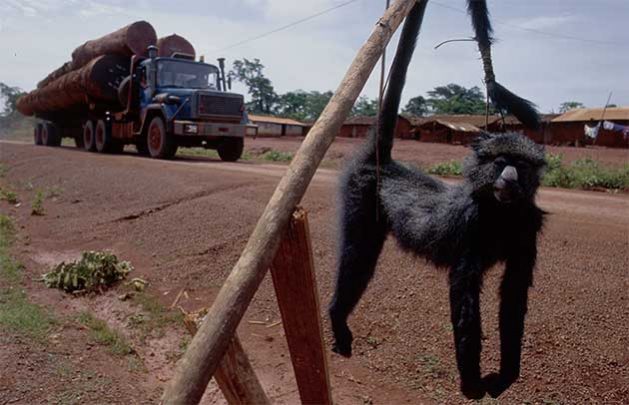
Golden Monkey (Cercopithecus mitis ssp. kandti) Endangered in IUCN Red List. In Cameroon, 1999 bushmeat was openly on sale along the road as 100-year-old trees were illegally logged and transported. Today large primates face the same fate, even if not so openly. Credit: Steve Morgan / Greenpeace

BHUBANESWAR, India, Sep 2 2021 (IPS) – As Arti Prasad rode the Kuala Lumpur Pavilion mall escalator up to the third floor, a pair of luscious lips pouted down at her. Next to the towering and oversized lips, the vibrant red shades of lipstick on the giant screen immediately caught the 36-year-old Indian tourist’s fancy.


Prasad headed straight to the cosmetic outlet and bought all four of the advertised lipsticks. She, like many others, is oblivious to a baby Orangutan’s plight – orphaned when its forest home was burned down to grow the palm oil that went into these beauty products. Primary forest losses mean that only 10% of gorilla habitat will remain in the Congo Basin by 2032.

Deforestation, a significant threat to biodiversity and climate change, is accelerated by global demand for commodities. However, a considerable share of this agro-commodity production is intended for export – driving massive deforestation and conversion of natural ecosystems in the global south.

The Food and Agriculture Organization of the United Nations (FAO) estimates global forest areas declined by 129 million hectares between 1990-2015, equivalent in size to South Africa.

Data from satellite imagery released on Global Forest Watch in June 2020 recorded 3.75 million hectares of tree cover loss in humid primary forests in the tropics in 2019, an almost 3% increase from 2018 and the third-largest tropical forest loss since 2000. 

Consumption patterns of G7 countries (Canada, France, Germany, Italy, Japan, Britain, and the US) drive an average loss of 3.9 trees per person per year, over 15 years from 2001-2015, says a study published this year in Nature.

The International Union for Conservation of Nature (IUCN) will hold the IUCN World Conservation Congress in Marseille, France, from 3-11 September 2021. This premier conservation event will address global deforestation. More importantly, Congress motion 012 – the fight against imported deforestation – was co-sponsored by numerous IUCN Members and voted on and approved before Congress.

The IUCN Congress meets every four years to tackle the most pressing issues impacting people and the planet. This IUCN Congress in Marseille will drive action on nature-based recovery, climate change, and biodiversity for decades to come.

Congress motion 012 calls on countries to stop imported deforestation through several ambitious strategies, including imposing additional taxes on imported products that generate deforestation.
The aim is to recommend that private companies establish concrete action plans to guarantee supplies that did not result in deforestation.

Red-faced spider monkeys (Ateles paniscus) are found in undisturbed primary rainforests, in northern Brazil, Suriname, Guyana, French Guiana and Venezuela. Because of its ability to climb and jump, it tends to live in the upper layers of the rainforest trees and forages in the high canopy. With habitat loss and hunting it is listed as Vulnerable on the IUCN Red List. Credit: la Vallee des Singes

The list of imported agricultural products contains, first and foremost, soy, palm oil, cacao, beef and its by-products, rubber, timber, and derived products that do not come from sustainably managed forests. Others include coffee, tea, or even cane sugar, which impact the deforestation and conversion of natural ecosystems.

“The most recent IPCC and IPBES reports show that we are now at the point where significant and permanent changes to consumption patterns and legislative regulation can no longer be delayed,” David Williams-Mitchell, Director of Communications, European Association of Zoos and Aquaria (EAZA) told IPS via email. Netherlands-based EAZA, an IUCN member, is one of the co-sponsors of Congress motion 012.

More than 50% of global forest loss and land conversion is attributable to the production of agricultural commodities, and forestry products are driven by consumer demand, as shown by a 2020 WWF study on Switzerland’s overseas footprint for forest-risk commodities.

To end deforestation, companies must eliminate 5 million hectares of conversion from supply chains each year.

“The concept of imported deforestation is still quite new to the public in Europe. For EAZA, the key issue is to establish understanding globally that imported deforestation is one of the root causes of climate change and biodiversity loss,” Williams-Mitchell said.

He cited examples of a hugely expanded meat industry leading to increases in greenhouse gases, carbon sink capacity loss, and biodiversity loss through habitat conversion.

In 2017 alone, the international trade of agricultural products was associated with 1.3 million hectares of tropical deforestation emitting some 740 million tonnes of carbon dioxide – this is equivalent to nearly a fifth of the EU28’s total greenhouse gas emissions that year.

“We need countries all over the world to participate in the fight against imported deforestation. We need to learn to use local resources and establish sustainable sources for exported products, especially without harming the forests,” says Jean-Pascal Guéry of Primate Conservation Trust. This France-based IUCN member also co-sponsors Congress motion 012.

The world’s forests absorb 2.4 billion tons of carbon dioxide (CO2) per year, one-third of the annual CO2 released from burning fossil fuels. Forest destruction emits further carbon into the atmosphere, with 4.3–5.5 gigatons of total anthropogenic Green House Gas (GHG) emissions per year, generated annually mainly from deforestation and forest degradation, according to Cameroon-based NGO Environment and Rural Development Foundation (ERuDeF).

IUCN Member ERuDeF, co-sponsor of Congress motion 012, estimates that half of the tropical forests worldwide have been destroyed since the 1960s. Every second, more than one hectare of tropical forest is destroyed or drastically degraded.

“Deforestation and conversion-free supply chains must protect not only forests, but all the terrestrial natural ecosystems threatened by the expansion of commodity production and trade including savannahs, grasslands, and peatlands among others,” Romain Deveze, WWF Switzerland’s senior manager, sustainable commodities & markets and co-author of the WWF 2020 study told IPS.
“It is vital that people understand that their choices and the frameworks that allow them to make those choices are at the heart of the solution,” Williams-Mitchell concurs.

“As governments, science engagement institutions, schools, and other providers and facilitators of education, we need to act to ensure this level of understanding at all levels of society,” Williams-Mitchell says, explaining why EAZA is sponsoring the motion.

Guéry is critical of some of the efforts to combat deforestation.

“There is awareness (too late, in our opinion) in certain European countries of the deleterious effects of this imported deforestation, and the French initiative to establish a national strategy to combat imported deforestation is commendable, but it lacks ambition and does not set binding and short-term goals,” he said.

“The assessments of companies including distributors, manufacturers, operators, rely too much on self-assessment rather than establishing an independent external certification,” Guéry said.

WWF also mentions that despite more initiatives to halt deforestation, including certification, corporate commitments, and market incentives, the rate of commodity-driven land use doesn’t appear to be declining. This means the negative impacts on local people and nature continue.
A full truck loaded with 60-70 Mukula logs at Katanga Province, the Democratic Republic of the Congo, 2016. Around 8-10 trucks transported out Mukula logs every day. Mukula is a rare and slow-growing hardwood unique to southern and central Africa, illegally logged and traded from Zambia and DRC. Credit: Lu Guang / Greenpeace

In a study earlier this year, Greenpeace said that “certification is a weak tool to address global forest and ecosystem
destruction.”

By certifying their products as ‘sustainable,’ some certification schemes can help guide consumption choices and have a positive impact locally, “but it is (largely) greenwashing destruction of ecosystems and violations of Indigenous and labour rights.”

So, while buyers think they are making the right ethical choice, they might still buy products linked to abuse and destruction.

However, WWF’s Deveze says, “certification and legality are critical to halt deforestation at scale. A hectare of conversion is just equally as harmful to people and nature whether or not it is done legally.”

Ranece Jovial Ndjeudja, Greenpeace Africa’s campaign manager in Cameroon, told IPS in a Zoom interview, “the limitations to the policy effectiveness for the IUCN Congress motion on imported deforestation is increased taxation aimed at deterring forest clearing. This, however, cannot always prevent deforestation.”

“Companies would just increase production to compensate for the tax hikes,” Ndjeudja said, speaking from Yaoundé, where Cameroonians rallied in early August to demand EU stop deforestation for rubber production.
“It is industrial logging and industrial agriculture which is the problem. Are these industrial productions really bringing in a large revenue to the exporting governments? No. If it did, Cameroon and Congo would not be so poor. A small group gets rich. While Cameroon’s natives lose access to food, health, and their culture,” Tal Harris, Greenpeace Africa’s international communications coordinator, told IPS from Dakar, Senegal.

The Democratic Republic of the Congo (DRC) hosts the second-largest contiguous tract of tropical forests globally, including roughly 60 percent of the Congo Basin rainforest. It is home to plants and animals found nowhere else on earth.

“A government cannot work out of a capital city thousands of miles distant from such extensive forests,” Harris said. “Devolution of power to the local population is necessary.”

Local communities play a vital role in wildlife conservation and environment protection. Comprising less than 5 percent of the world’s population, indigenous communities protect 80 percent of global biodiversity, says ERuDeF.

Cameroon’s Ndjeaudja echoes this. To ensure trees are not cut, there is the need to work with local communities because, for generations, they have been living with forests and have the knowledge of their sustainable management.

“We have a lot to learn from them and must allow indigenous communities to share this knowledge,” he said.

Deveze concluded: “Economic and technical incentives are required to shift producer behaviour. At an international policy level, go for differentiated custom tariffs based on sustainability requirements and due diligence processes. Compensation mechanisms to support farmers in protecting high conservation value areas should be amplified.”
 

South Korea’s Women Fire Back

Civil Society, Featured, Gender, Gender Violence, Global, Headlines, Human Rights, IPS UN: Inside the Glasshouse, Poverty & SDGs, TerraViva United Nations, Women’s Health

Opinion

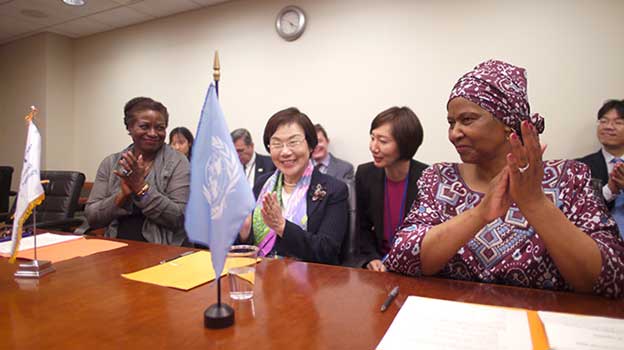
UNFPA Executive Director Dr. Natalia Kanem, KOICA President Lee Mikyung and UN Women Executive Director Phumzile Mlambo-Ngcuka (from left) launched a partnership in 2018 that Ms. Lee characterized as “a key foundation and platform for solidarity and collective engagement for gender equality.” The new tripartite agreement– between UNFPA, the Korea International Cooperation Agency (KOICA) and UN Women—has combined the strengths of the three partners to improve the lives of women and girls and accelerate the achievement of gender equality, as expressed in Sustainable Development Goal (SDG) 5.
Credit: UNFPA/Tara Milutis

SEOUL, South Korea, Sep 1 2021 (IPS) – A strong movement of feminism is sweeping South Korea. While women feel empowered to stand their ground, the men are retaliating.

When South Korean archer An San won two gold medals in just two days during the recent Tokyo Olympics, the response the 20-year-old received at home was a mixed. Some men were angered and said her medals should be taken away. Why? Because her short hair was a sign that she was a ‘man-hating’ feminist.


As bizarre and surreal as it may sound, the attack on An is a bleak reminder of the deep-rooted gender stereotypes in the economically advanced, yet deeply sexist South Korea – and the enormous pressure on women and girls to look and act ‘feminine’. It’s also another episode of the escalating culture war between the country’s increasingly outspoken feminists – and antifeminists seeking to silence their voices.

Lowest in the ranks

South Korea is the world’s 10th largest economy, a tech giant that is home to Samsung, the world’s largest smartphone maker, and a cultural powerhouse whose K-pop stars like BTS enjoy global followings. But despite all the economic and technological advances, the deep-seated patriarchy and gender discrimination remained little changed.

South Korea is ranked at the 102nd in the world in terms of gender parity, according to the World Economic Forum. The gender pay gap in the country is the widest among the advanced economies of the OECD member nations.

It has consistently ranked as the worst place to be a working woman in the Economist magazine’s Glass Ceiling Index. Women account for 19 per cent of parliamentary seats, almost on par with North Korea.

Hawon Jung

Women are under enormous pressure to look perfect at all times and all costs – as shown in the country’s reputation as the world’s capital of plastic surgery. On the busy streets of Seoul, it’s not difficult to find plastic surgery adverts screaming ‘being pretty is everything!’ and rail-thin K-pop starlets presented as role models for teenage girls and young women. The stars’ extreme diet regimens are widely shared on social media and avidly followed by many.

Typical beauty ideals in South Korea for women include pale yet glowing skin, a youthful ‘babyface’, long and luminous hair, wide eyes, a thin nose, and pin-thin body (nearly 17 per cent of South Korean women in their 20s are underweight, compared to less than 5 per cent for their male counterparts, according to a study in 2019).

The pressure begins early: more than 40 per cent of female elementary school students wear makeup, and the number goes up to over 70 per cent for middle schoolers.

Escape the Corset

But women started to fight back. A powerful wave of feminist movement has taken the country by storm in recent years, allowing many women to speak up against sexual discrimination, assault, and objectification like never before.

Since 2018, women have rallied together to bring down many sexual predators, including a popular presidential contender, in one of the most successful cases of #MeToo in Asia.

Tens of thousands took to the streets for months in 2018 to call for tougher crackdown on the so-called ‘spycam porn’ crimes that secretly film women in public space from workplaces to public toilets and share the footage on the internet.

They successfully campaigned to end the abortion ban. The so-called ‘Escape the Corset’ movement was part of that awakening, meant to defy the pressure to follow the rigid beauty ideals.

Women and girls who joined the campaign cut their hair short, destroyed their makeup, refused to wear tight, revealing, or uncomfortable clothes to instead opt for something more comfortable and practical. Since then, short hair has become something of a political statement among many young feminists.

The wave of awakening, however, has also drawn a strong pushback by men who thought – like many around the world – that the women had gone too far, and many labelled feminists as ‘man haters’ who should be punished.

More than 40 per cent of female elementary school students wear makeup, and the number goes up to over 70 per cent for middle schoolers.

The backlash has reached a fever pitch since May when members of many online forums popular among men started to cry ‘misandry’ over a adds that use an image of a pinching finger, a universal gesture to indicate something small.

Online crusade

In a campaign likened by many as a McCarthyian witch-hunt, they claimed whoever created the image must be feminists and out to ridicule the size of their genitals. Despite having no possibility of any political plot, many of the accused companies and government institutions – including the national police agency and the defense ministry – bent down quickly, apologized for hurting the men’s feelings and removed the images from their posters.

These online mobs even enjoyed political backing; Lee Jun-Seok, a young member of the rightwing People’s Power Party, rose to prominence by amplifying the conspiracy theory over the ‘misandrist’ finger gesture, and eventually became the leader of the party in July.

Feeling supported by a powerful politician and emboldened by groveling apologies from companies and the government, the online mobs moved on to their next target—the star Olympian whose appearance didn’t fit into their ideal of traditional femininity.

‘Why did you cut your hair?’ An was asked on her social media, to which she replied, ‘’coz it’s convenient’. The answer was not enough.

A campaign to extract an apology from An for being a feminist began, with some even demanding that the Korea Archery Association take away the gold medals from the ‘man hater’.

But women fought back again. Lawmakers, activists, entertainers, and thousands of ordinary women rallied behind An, many sharing the photos of their short hair on social media as a show of support.

And as the cyber-bullying targeting An raged on, many women across the country watched as An won yet another gold – becoming the first archer in Olympic history to win three golds at a single Game.

Hawon Jung is a journalist and former Seoul correspondent for the AFP news agency. She is the author of ‘Flowers of Fire,’ a book about South Korea’s #MeToo campaign.

Source: International Politics and Society (IPS), published by the Global and European Policy Unit of the Friedrich-Ebert-Stiftung, Hiroshimastrasse 28, D-10785 Berlin.

  Source

NDC Partnership: Supporting a Global Network of Youth Climate Advocates

Biodiversity, Civil Society, Climate Change, Combating Desertification and Drought, Development & Aid, Environment, Featured, Global, Green Economy, Headlines, Humanitarian Emergencies, Inequity, Natural Resources, NDC Partnership, Sustainability, TerraViva United Nations, Water & Sanitation, Youth

Climate Change

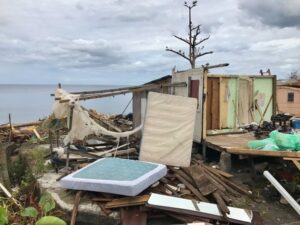
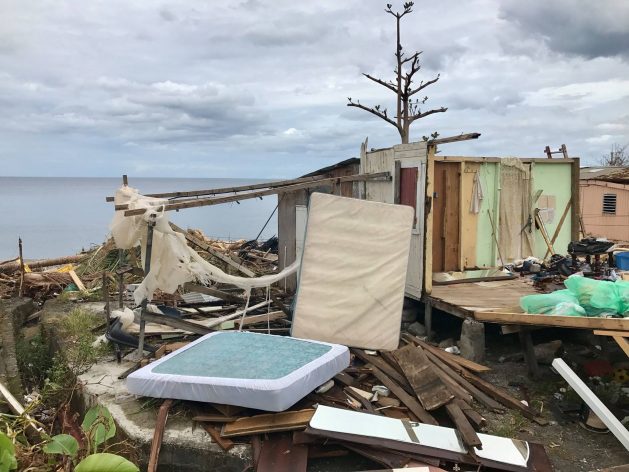
Madrelle, Loubiere, Dominica 2017, a few days after Category 5 Hurricane Maria struck the island. Credit: Alison Kentish/IPS

UNITED NATIONS, Aug 19 2021 (IPS) – Just over six months after launching its Youth Engagement Plan, the NDC Partnership, the coalition assisting governments with their climate action plans, has brought together youth climate advocates for its inaugural NDC Global Youth Engagement Forum.


NDCs, or Nationally Determined Contributions, refer to governments’ commitments to reduce greenhouse gas emissions, an integral part of the Paris Climate Agreement. NDCs are scheduled for revision every five years and are expected to be increasingly ambitious to tackle the climate crisis effectively.

Countries and the NDC Partnership want to ensure that, as agents of implementation, young people have platforms for engagement and a say in national climate action.

The Partnership recently brought youth together in 3 regional groupings: Africa, the Middle East, and Europe, Asia and the Pacific, and Latin America and the Caribbean. The young people engaged with representatives of partners such as the Food and Agriculture Organization (FAO) and the United Nations Children’s Emergency Fund (UNICEF) through sessions like ‘agriculture and climate change,’ and ‘equipping young people to engage in the NDC process.’

The NDC Partnership, the coalition assisting governments with their climate action plans, has brought together youth climate advocates for its inaugural NDC Global Youth Engagement Forum. Credit: NDC Partnership

The participants say the teaching element was bolstered by the opportunity to be heard, as the organizers asked for their input in areas that include NDC enhancement, structures needed to strengthen youth involvement, and ways young people are already impacting climate action.

For youth like Natalia Gómez Solano of Costa Rica, the forum provided a space to share experiences and ideas.

“Working for a more resilient and a more just, low-emissions world moves us, and that is why we are here today,” she told the virtual event.

“We are already experiencing the impacts of climate change, and they are worsening. We need increased adaptation and mitigation action, and the NDCs are the key instruments to achieve that. The NDCs are the roadmaps for climate ambition in which young people are key in bringing new climate solutions to the conversations and to raise action.”

Jamaica’s Permanent Secretary in the Ministry of Housing, Urban Renewal, Environment, and Climate Change, Dr Alwin Hales, told the Latin America and Caribbean forum that the virtual event and Youth Engagement Plan hope to leverage the ‘leadership and power’ of youth into NDC implementation and enhancement.

“Today’s children and young people are caught in the center of climate change, for it is they who have to live with and manage its consequences,” he said.

“The NDC Partnership launched the Youth Engagement Plan (YEP). It aims is to build young people’s capacity on climate change matters and engage the youth in global NDC partnership activities. This is in direct support of our mission to increase alignment, coordination, and access to resources to link needs with solutions.”

The forum was proposed by the NDC Partnership’s Youth Task Force but is a priority of the NDC Partnership’s Steering Committee and Co-Chairs, Jamaican Minister of Housing, Urban Renewal, Environment, and Climate Change Pearnel Charles Jr. and U.K. Minister Alok Sharma, who also serves as President of COP 26.

Noting that young people are vital to effective action on climate change, NDC Partnership Global Director Pablo Vieira Samper reminded them that their input also ensures that action is inclusive.

“We want to hear about what capacity or technical support is still needed and what learning you are eager to share with your peers,” he said.

“The Youth Engagement Plan was the starting point for greater action for youth engagement in NDCs. Today the NDC Partnership is thrilled to be turning this plan into concrete steps for more meaningful engagement and bringing new ideas to this framework to inspire action. We look forward to your insights as we collaborate across the Partnership to build a low carbon, climate-resilient future by supporting sustainable development.”

The youth attending the forum have described it as an important platform for highlighting the challenges faced by young climate activists.

“It is important to increase climate finance to support projects that are led by children and youth and integrate a rights-focused education curriculum in schools and universities,” said Xiomara Acevedo, the Founder and Chief Executive of Barranquilla+20, an NGO run by young people who empower their peers to tackle issues of biodiversity, sustainability, policy inclusion, and climate change.

Acevedo’s NGO has reached over 2,000 young people. She says it is clear that youth have a unique role to play in climate activism.

“We have seen that involving young people at the local and subnational level has also helped to ensure that a lot of citizens are seeing that climate action is not something beyond their territories, or is not only a topic that is managed at the national level. They can relate our message to their narrative, to their realities. We engage climate action as an important topic in the local agendas,” she said.

According to UNICEF, including youth in climate change action is important to achieving Sustainable Development Goals 13,2 which urges urgent action to combat climate change and its impacts; 16,3 which calls for the promotion of peaceful, inclusive societies for sustainable development and 17,4 with its target of assistance to developing countries in attaining debt sustainability.

The United Nations Framework Convention on Climate Change (UNFCCC) released its NDCs scorecard in February. It applauded countries for strengthening their commitments to the Paris Agreement but encouraged them to further step up their mitigation pledges, adding that greenhouse gas emissions targets were falling ‘far short’ of what is required to achieve the Agreement’s goals.

Young people like Natalia Gómez Solano say as custodians of the planet, youth must be mobilized, and their voices amplified to arrive at the deep emissions reductions needed in the NDCs.

“We need to integrate more voices and reach more places. As the Latin America and Caribbean Region, we need to keep working, keep asking, keep demanding, and doing more. Not all youth know how to be involved in climate action, and we need to work with more young people, for example, in the rural areas,” she said.

The delegates at the NDC Partnership’s inaugural Youth Engagement Forum say they are hoping for more opportunities at the table.

They say it takes persistence, organization, time, and passion to achieve climate goals. It also takes an empowered, well-connected, and financed global network of youth.

  Source

Multilateral Peace Operations in 2020: Developments & Trends

Armed Conflicts, Civil Society, Crime & Justice, Featured, Global, Global Governance, Headlines, Human Rights, Humanitarian Emergencies, IPS UN: Inside the Glasshouse, TerraViva United Nations

Opinion

The writer is a Researcher with the Peace Operations and Conflict Management Programme at the Stockholm International Peace Research Institute (SIPRI)

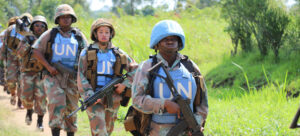
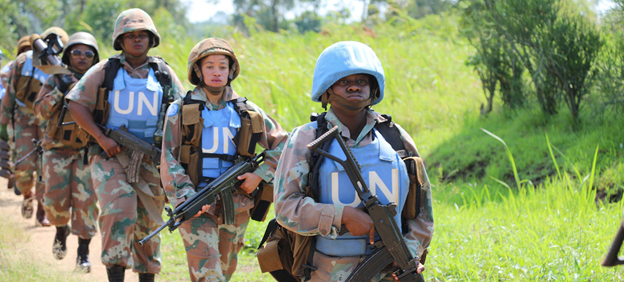
Female peacekeepers from South Africa on patrol in the Democratic Republic of the Congo. July 2021. Credit: MONUSCO/Michael Ali

STOCKHOLM / THE HAGUE, Aug 4 2021 (IPS) – The first year of the Covid-19 pandemic saw wide-ranging impacts on multilateral peace operations.

The crisis simultaneously affected all operations, host nations, headquarters and contributing countries. It caused major disruption—from the political-strategic level where mandates are drawn up, down to the operational and tactical levels.


Operations were forced to adapt in order to preserve continuity as far as was possible. While some of the effects of the pandemic are clearly reflected in the data—most notably in mission mortality rates—others are not.

For example, SIPRI data on personnel deployments cannot always capture delays in troop rotations or whether mission personnel were evacuated or working remotely for part of the year.

However, there is some evidence that Covid considerations did affect deployments, as is noted below.

Operations close in Guinea-Bissau and Sudan

There were 62 multilateral peace operations active in 2020, the same number as in 2019. The largest share of these (21) were conducted by the UN. Regional organizations such as the African Union (AU) and the European Union (EU) and alliances (such as the North Atlantic Treaty Organization, NATO) together conducted 36 operations. Ad hoc coalitions of states conducted 5 peace operations in 2020.

Two small operations in Guinea-Bissau closed in 2020. One was conducted by the Economic Community of West African States (ECOWAS): the ECOWAS Mission in Guinea-Bissau (ECOMIB), the other by the UN: the UN Integrated Peacebuilding Office in Guinea-Bissau (UNIOGBIS).

One other operation that closed during the year was the AU–UN Hybrid Operation in Darfur (UNAMID), which was launched in 2007. UNAMID had deployed between 20 000 and 25 000 international personnel at its height in 2009–14, and it still deployed around 6500 in 2020.

A small political mission based in Khartoum, the UN Integrated Transition Assistance Mission in the Sudan (UNITAMS), opened on 1 January 2021.

UNAMID’s closure is a landmark in contemporary peacekeeping. It is the fourth major UN peacekeeping operation to close since 2017; the UN Stabilization Mission in Haiti (MINUSTAH) and the UN Operation in Côte d’Ivoire (UNOCI) both closed in 2017 and the UN Mission in Liberia (UNMIL) in 2018.

Only seven operations comprising more than 5000 international personnel were still active at the start of 2021, and no operation deploying more than 1500 international personnel has been launched since 2014.

Three smaller operations open in CAR and Libya

The three operations that opened in 2020 were also in Africa. Two opened in the Central African Republic (CAR), in the wake of the 2019 Political Agreement for Peace and Reconciliation.

The AU Military Observers Mission to the CAR (MOUACA) was authorized in July 2020 to help monitor implementation of the agreement.

The EU Advisory Mission in the CAR (EUAM RCA), mandated to support security sector reform, had been established in December 2019 but was not launched until August 2020. Both operations have an authorized strength below 100 international personnel.

The AU Mission in Libya, the third new operation, was established by a decision of the AU Assembly in February 2020 to ‘upgrade’ the AU Liaison Office in Libya ‘to the level of mission’.

The Covid-19 pandemic seems to have complicated the deployment and build-up of these operations. In fact, while EUAM RCA was up and running at the end of 2020, albeit not at full capacity, there is little public information available on the status and activities of MOUACA or the AU Mission in Libya.

The latest edition of SIPRI’s Map of Multilateral Peace Operations shows all operations active as of 1 May 2021—including some that are outside the scope of SIPRI’s definition, such as the Multinational Joint Task Force (MNJTF) against Boko Haram, the Joint Force of the Group of Five for the Sahel (JF-G5S) and the EU Naval Force in the Mediterranean Sea (Operation Irini).

Personnel deployments fall

The number of international personnel deployed in multilateral peace operations globally fell by 7.7 per cent, from 137 781 in 2019 to 127 124 in 2020.

This was the largest year-on-year decrease since the drawdown of the International Security Assistance Force (ISAF) in Afghanistan in 2012–14. Around 87 per cent were military personnel, roughly the same proportion as in 2019.

Almost two-thirds of the deployed personnel in 2020 were serving in UN peace operations (66 per cent on average over the year). Almost three-quarters (74 per cent at the end of the year) were deployed in sub-Saharan Africa (both UN and non-UN operations).

The number of personnel deployed in UN peace operations globally and in multilateral peace operations (UN and non-UN) in sub-Saharan Africa declined for the fifth year in a row.

Both had peaked in 2015–16 following a period of rapid growth driven by the establishment of major operations in CAR and Mali and the expansion of major operations in Somalia and South Sudan.

The number of personnel deployed in UN peace operations fell by 2.4 per cent between 2019 and 2020 (from 88 849 to 86 712), reaching its lowest level since 2007.

Meanwhile, the number of personnel deployed in multilateral peace operations in sub-Saharan Africa decreased by 3.4 per cent (from 97 519 on 31 December 2019 to 94 201 on 31 December 2020), reaching its lowest level since December 2012.

Women continued to be under-represented among multilateral peace operations personnel in 2020, as reported in a SIPRI publication prepared for the 20th anniversary of UN Security Council Resolution 1325 on Women, Peace and Security last year.

Afghanistan: The end of NATO deployments imminent

The development that contributed most to the net reduction of peace operations personnel deployments last year was the agreement reached on 29 February 2020 between the United States Government and the Taliban on the withdrawal of all US forces from Afghanistan within 14 months.

Due to the subsequent drawdown of most US troops, the NATO-led Resolute Support Mission (RSM) shrank from 16 551 to 9592 personnel over the course of 2020.

The RSM was launched on 1 January 2015 and was mandated to train, advise and assist the Afghan National Security and Defense Forces following the departure of ISAF, which had been active from 2001 to 2014.

The new operation was originally supposed to end on 31 December 2016, but it was not until April 2021 that NATO leaders formally announced their intention to terminate the RSM. The decision came shortly after US President Joe Biden had ordered the withdrawal of the remaining US troops from Afghanistan by 11 September 2021.

As a result of the withdrawal of most US troops from the RSM, the USA started 2020 as the second largest troop contributor to multilateral peace operations (after Ethiopia) and ended the year as the tenth largest.

Fewer blue helmets killed in action, more by illness than in previous years

In 2020, UN peace operations lost 78 uniformed personnel, 13 international civilian personnel and 32 local staff. The fatality rate for uniformed personnel was 0.9 per 1000.

This was noticeably higher than in 2018 and 2019, but around the average for the period 2011–20.

Despite this, the rate of hostile deaths (i.e. deaths caused by malicious acts) among uniformed personnel was at its lowest since 2011, at 0.15 per 1000.

This decline could conceivably be partly an effect of the pandemic, for example because peacekeepers were not able to patrol as much as usual or were otherwise less exposed to the risk of violence due to pandemic-related restrictions.

Meanwhile, the number of deaths due to illness among international and local personnel in UN peace operations in 2020 was almost double that in 2019 (83 compared to 42), with most of these deaths occurring between June and September 2020.

This difference is almost certainly linked in large part to the Covid-19 pandemic and its impacts, which contributed to a record number of deaths across the UN during the year.

  Source

After Vilifying the UN, US Returns to the World Body

Civil Society, Development & Aid, Featured, Global, Global Governance, Headlines, Human Rights, IPS UN: Inside the Glasshouse, TerraViva United Nations

Credit: UN Photo/Evan Schneider

UNITED NATIONS, Aug 2 2021 (IPS) – Ed Koch, a sharp-tongued Mayor of New York city (1978-89), once stopped short of using a four-letter word to denounce the United Nations.

Instead, he opted for a five-letter word dismissing the UN as a “sewer” relegating it to the lower depths of degradation.


In a bygone era, some of the most vociferous rightwing, conservative US politicians never ceased to denounce the world body primarily because of a rash of UN resolutions condemning Israel for human rights violations in the occupied territories or for resolutions mis-perceived as anti-American.

The late Senator Jesse Helms, a Republican chairman of the powerful US Senate Foreign Relations Committee, once said “providing funds to the UN was like pouring money into a rat hole.”

“I disagree with the premises upon which the United Nations is built and with the illusion that it propagates,” Senator Helms, said in a letter to the World Federalist Association. “It would be one thing if the United Nations were just an international side show, but it plays a greater role. It is a vast engine for the promotion of socialism, and to promote this purpose the U.S. provides a quarter of its budget,” he said.

Helms, said he has long called for “our country’s departure from this Organization, and vice versa.”

Charles Lichtenstein, a former U.S. Deputy Permanent Representative to the U.N. Mission, once said he would urge members of the United Nations to move out of New York if they did not like the treatment they were receiving in the United States.

Helms — with tongue firmly entrenched in cheek — said he would join Lichtenstein in waving goodbye to U.N. member- states “as they sail away into the sunset.”

When the 193-member UN General Assembly elected some of the so-called “repressive regimes” as members of the Human Rights Commission (later the Human Rights Council), Congressman Dana Rohrabacher (Republican of California) hollered: “The inmates have taken over the asylum. And I don’t plan to give the lunatics any more American tax dollars to play with.”

And more recently, former President Donald Trump not only decried multilateralism and challenged the effectiveness of the world body but also dismissed it as “a club for people to get together, talk and have a good time.”

Trump pulled out of two historic international agreements: the Paris climate change agreement and the nuclear deal with Iran.

But things have dramatically changed since he was ousted from the White House— and the US is gradually returning to the UN, whose primary home is New York, even though most of its agencies are based outside the US, including in Geneva, Rome, Vienna, Paris, Bonn and Nairobi.

The administration of President Joe Biden, which took over from the Trump administration about six months ago, has not only returned to multilateralism but has also pledged to re-engage both with the World Health Organization (WHO) in Geneva and the UN Educational, Scientific and Cultural Organization (UNESCO) in Paris.

Additionally, the US has agreed to restore funding to the UN Relief and Works Agency for Palestine Refugees in the Near East (UNRWA) and the UN Population Fund (UNFPA), both of which suffered funding cuts under Trump.

Last April, the Biden’s administration said it plans to provide $235 million to Palestinians, restoring part of the assistance cut by Trump. Two-thirds will go to UNRWA, which has suffered a financial crisis since it lost $360 million of US funding in 2018.

In 2016, UNFPA received $69 million in funding from the U.S. And in July 2019, UNFPA expressed concerns over US withholding funds for the third consecutive year The Biden administration is expected to restore US funding.

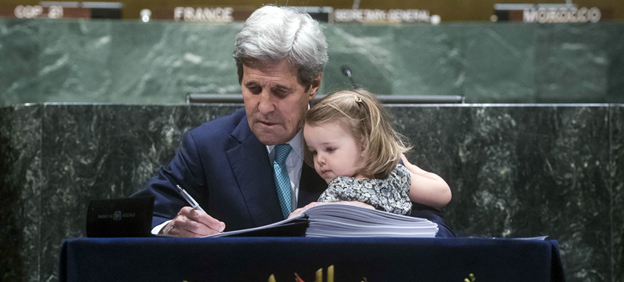
Former US Secretary of State John Kerry, accompanied by his grand-daughter, signs the Paris Agreement at UN headquarters in April 2016. Credit: UN Photo/Amanda Voisard

Penny Abeywardena, Commissioner for International Affairs at the Office of the New York city Mayor Bill de Blasio, welcomed the move by the United Nations to gradually return to near-normal after a 16-month pandemic lock down.

She said “the UN General Assembly has for decades been a staple of Fall in New York and as Host City to the UN, we have always been proud to welcome the international community who gather here”.

Kul Gautam, a former UN assistant secretary-general, told IPS the whole world, including the United Nations, breathed a sigh of relief at the advent of the Joe Biden administration in the US, following four years of the erratic and unpredictable Donald Trump presidency.

Mirroring Trump’s “America First” bravado, his senior diplomatic team, including Secretary of State Mike Pompeo and Ambassador Niki Haley showed little regard or diplomatic finesse in dealing with the complex issues high on the UN’s agenda, he pointed out.

Trump’s National Security Adviser John Bolton had so little respect for the UN that as the US Ambassador to the UN, he had once proclaimed that if the UN Secretariat building in New York “lost 10 stories, it wouldn’t make a bit of difference,” said Gautam, a former deputy executive director of the UN children’s agency UNICEF.

Similarly, his Trump-era successor Niki Haley told a Republican National Convention that the “UN was a place where dictators, murderers and thieves denounce America, and demand that we pay their bills.”

Gautam said in contrast to the Trump-era narrative of the UN being a largely bureaucratic and profligate anti-American organization, dominated by China and Third World countries, the Biden administration quickly proclaimed that “America was back” at the UN and would provide constructive leadership and support a multilateral approach to solving the world’s most pressing issues from COVID-19 to climate change.

Not only is Joe Biden himself a seasoned statesman in international affairs, said Gautam, but his senior aides, including Secretary of State Tony Blinken, UN Ambassador Linda Thomas-Greenfield, National Security Adviser Jake Sullivan and Special Envoy John Kerry are all consummate diplomats who believe in multilateralism.

Mandeep S. Tiwana, Chief Programmes Officer at CIVICUS, a global alliance of civil society organizations (CSOs) , told IPS the United States played a key role in establishing the UN Charter who’s opening words, ‘We the Peoples’, mirror the opening words of the US Constitution. Eleanor Roosevelt stewarded the drafting of what is arguably the UN’s finest achievement – adoption of the Universal Declaration of Human Rights.

“The Trump administration’s disdain for the UN devalued these historical achievements. Traditionally, the United States has been a supporter of rights and democratic values at the UN as core pillars of its foreign policy,” he said.

The Biden administration’s commitment to re-engage at the UN is being welcomed by many in civil society working to challenge discrimination and oppression, he said, pointing out, that it’s a step in the right direction for people-centered multilateralism which lies at the core of the UN’s founding.

Tiwana also said the Biden administration has an opportunity not just to repair the damage of the Trump years but to demonstrate commitment to laying the ground work for the ambitious advancement of justice, equality and sustainability for future generations.

Gautam said while Secretary-General Antonio Guterres was severely constrained from taking some bold initiatives during his first term due to fear of the veto-wielding and chest-thumping Trump administration’s non-cooperation, he should, in his second term, feel more empowered to act more decisively to push for the kind of bold vision he outlined in July 2020 in his Nelson Mandela Lecture: “Tackling the Inequality Pandemic: A New Social Contract for a New Era”.

The early and quick gestures of the Biden administration rejoining the Paris Climate Accord, the World Health Organization, the UN Human Rights Council, funding for UNFPA and COVAX and paying outstanding US arrears to the UN peace-keeping budget are all encouraging signs, he noted.

“The ball is now in Guterres’ —and his senior management team’s– court to harness the potential of the Biden administration’s goodwill to assert UN’s proactive role to help tackle the most pressing global challenges of our times”, said Gautam, author of “Global Citizen from Gulmi: My Journey from the Hills of Nepal to the Halls of the United Nations” (Nepalaya Publications 2018)

Thalif Deen, Senior Editor and Director at the UN Bureau of Inter Press Service (IPS) news agency, is the author of a newly-released book on the United Nations titled “No Comment -– and Don’t Quote Me on That.” Peppered with scores of anecdotes-– from the serious to the hilarious-– the book is available on Amazon worldwide. The link to Amazon via the author’s website follows: https://www.rodericgrigson.com/no-comment-by-thalif-deen/

  Source

Latin America Sets an Example in Welcoming Displaced Venezuelans

Civil Society, Development & Aid, Editors’ Choice, Featured, Global Governance, Headlines, Human Rights, Humanitarian Emergencies, IPS UN: Inside the Glasshouse, Latin America & the Caribbean, Migration & Refugees, Population, Regional Categories, TerraViva United Nations

Migration & Refugees

A Venezuelan family carrying a few belongings crosses the Simon Bolivar Bridge at the border into Colombia. Over the years, the migration flow has grown due to increasing numbers of people with unsatisfied basic needs. CREDIT: Siegfried Modola/UNHCR

A Venezuelan family carrying a few belongings crosses the Simon Bolivar Bridge at the border into Colombia. Over the years, the migration flow has grown due to increasing numbers of people with unsatisfied basic needs. CREDIT: Siegfried Modola/UNHCR

CARACAS, Jul 26 2021 (IPS) – The exodus of more than five million Venezuelans in the last six years has led countries in the developing South, Venezuela’s neighbours, to set an example with respect to welcoming and integrating displaced populations, with shared benefits for the new arrivals and the nations that receive them.


In this region “there is a living laboratory, where insertion and absorption efforts are working. The new arrivals are turning what was seen as a burden into a contribution to the host communities and nations,” Eduardo Stein, head of the largest assistance programme for displaced Venezuelans, told IPS.

According to figures from the United Nations refugee agency, the UNHCR, and the International Organisation for Migration (IOM), 5,650,000 people have left Venezuela, mainly crossing into neighbouring countries, as migrants, displaced persons or refugees, as of July 2021.

“This is the largest migration crisis in the history of Latin America,” Stein said by phone from his Guatemala City office in the Interagency Coordination Platform for Venezuelan Refugees and Migrants (R4V), created by the UNHCR and IOM in partnership with 159 other diverse entities working throughout the region.

“This region is a living laboratory, where insertion and absorption efforts are working. The new arrivals are turning what was seen as a burden into a contribution to the host communities and nations.” — Eduardo Stein

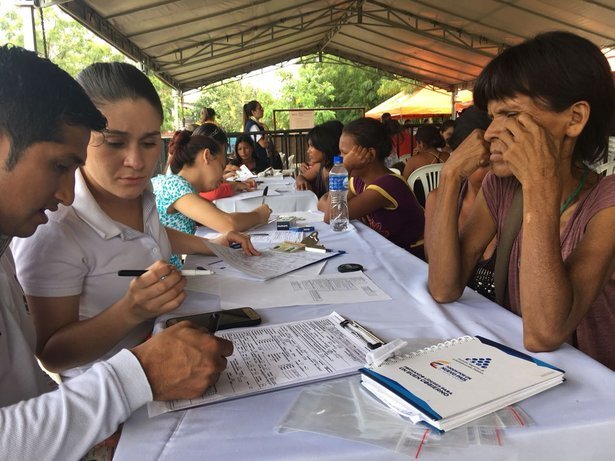
Colombia, the neighbour with the most intense historical relationship, stands out for receiving daily flows of hundreds and even thousands of Venezuelans, who already number almost 1.8 million in the country, and for providing them with Temporary Protection Status that grants them documentation and access to jobs, services and other rights.

Colombia’s Fundación Renacer, which has assisted thousands of child and adolescent survivors of commercial sexual exploitation and other types of sexual and gender-based violence, is a model for how to welcome and help displaced persons.

Renacer, staffed by activists such as Mayerlin Vergara, 2020 winner of the UNHCR’s annual Nansen Refugee Award for outstanding aid workers who help refugees, displaced and stateless people, rescues girls and young women from places like brothels and bars where they are forced into sexual or labour exploitation, often by trafficking networks that capture the most vulnerable migrants.

“In Colombian society as a whole there has been a process of understanding, after the phenomenon was the other way around for several decades in the 20th century, of people displaced by the violence and crisis in Colombia being welcomed in Venezuela,” Camilo González, president of the Colombian Institute for Development and Peace Studies, told IPS.

When the great migratory wave began in 2014-2015, “many Venezuelans were taken on as half-price cheap labour by businesses, such as coffee harvesters and others in the big cities, but that situation has improved, even despite the slowdown of the pandemic,” said González.

Stein mentioned the positive example set by Colombia’s flower exporters, which employed many Venezuelan women in cutting and packaging, a task that did not require extensive training.

The head of the R4V, who was vice-president of Guatemala between 2004 and 2008 and has held various international positions, noted that in the first phase, the receiving countries appreciated the arrival of “highly prepared Venezuelans, very well trained professionals.”

Yukpa Indians from Venezuela register upon arrival at a border post in Colombia. The legalisation and documentation of migrants arranged by the Colombian government allows migrants to access services and exercise rights in the neighbouring country. CREDIT: Johanna Reina/UNHCR

Yukpa Indians from Venezuela register upon arrival at a border post in Colombia. The legalisation and documentation of migrants arranged by the Colombian government allows migrants to access services and exercise rights in the neighbouring country. CREDIT: Johanna Reina/UNHCR

“One example would be the thousands of Venezuelan engineers who arrived in Argentina and were integrated into productive activities in a matter of weeks,” he said.

But, Stein pointed out, “the following wave of Venezuelans leaving their country was not made up of professionals; the profile changed to people with huge unsatisfied basic needs, without a great deal of training but with basic skills, and nevertheless the borders remained open, and they received very generous responses.”

But, he acknowledged, in some cases “the arrival of this irregular, undocumented migration was linked to acts of violence and violations of the law, which created internal tension.”

Iván Briscoe, regional head of the Brussels-based conflict observatory International Crisis Group, told IPS that in the case of Colombia, “it has been impressive to receive almost two million Venezuelans, in a country of 50 million inhabitants, 40 percent of whom live in poverty.”

Colombia continues to be plagued by social problems, as shown by the street protests raging since April, “and therefore the temporary protection status, a generous measure by President Iván Duque’s government, does not guarantee that Venezuelan migrants will have access to the social services they may demand,” Briscoe said.

The large number of Venezuelans “means an additional cost of 100 million dollars per year for the health services alone,” said González, who spoke to IPS by telephone from the Colombian capital.

Against this backdrop, there have been expressions of xenophobia, as various media outlets interpreted statements by Bogotá Mayor Claudia López, who after a crime committed by a Venezuelan, suggested the deportation of “undesirable” nationals from that country.

There were also demonstrations against the influx of Venezuelans in Ecuador and Panama, as well as Peru, where the policy of President-elect Pedro Castillo towards the one million Venezuelan immigrants is still unclear, as well as deportations from Chile and Trinidad and Tobago, and new obstacles to their arrival in the neighbouring Dutch islands.

“Not everything has been rosy,” Stein admitted, “as there are still very complex problems, such as the risks that, between expressions of xenophobia and the danger of trafficking, the most vulnerable migrant girls and young women face.”

However, the head of the R4V considered that “we have entered a new phase, beyond the immediate assistance that can and should be provided to those who have just arrived, and that is the insertion and productive or educational integration in the communities.”

Migrants who have benefited from Operation Welcome in Brazil, where there are more than 260,000 Venezuelans, shop at a market in the largest city in the country, São Paulo. CREDIT: Mauro Vieira/MDS-UNHCR

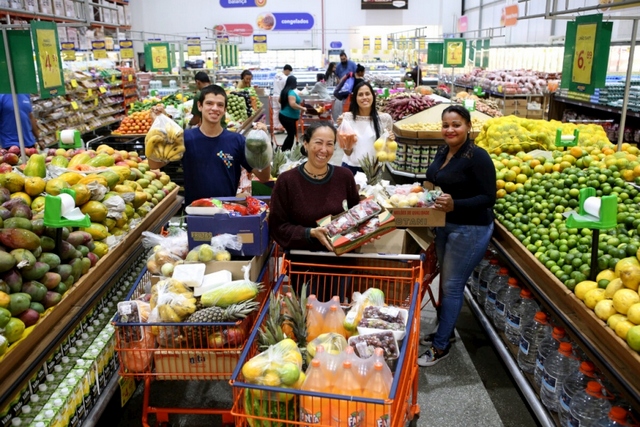
Migrants who have benefited from Operation Welcome in Brazil, where there are more than 260,000 Venezuelans, shop at a market in the largest city in the country, São Paulo. CREDIT: Mauro Vieira/MDS-UNHCR

Throughout the region “there are places that have seen that immigrants represent an attraction for investment and labour and productive opportunities for the host communities themselves.”

Another example is provided by Brazil, with its Operação Acolhida (Operation Welcome), which includes a programme to disperse throughout its vast territory Venezuelans who came in through the northern border and first settled, precariously, in cities in the state of Amazonas.

More than 260,000 Venezuelans have arrived in Brazil – among them some 5,000 indigenous Waraos, from the Orinoco delta, and a similar number of Pemon Indians, close to the border – and some 50,000 have been recognised as refugees by the Brazilian government.

Brazil has the seventh largest Venezuelan community, after Colombia, Peru, the United States, Chile, Ecuador and Spain. It is followed by Argentina, Panama, the Dominican Republic and Mexico.

Throughout the region, organisations have mushroomed, not only to provide relief but also to actively seek the insertion of Venezuelans, in some cases headed by Venezuelans themselves, as in the case of the Fundacolven foundation in Bogota.

“We are active on two fronts, because first we motivate companies to take on workers who, as immigrants, are willing to go the ‘extra mile’,” said Venezuelan Mario Camejo, one of the directors of Fundacolven.

As for the immigrants, “we help them prepare and polish their skills so that they can successfully search for and find stable employment, if they have already ‘burned their bridges’ and do not plan to return,” he added.

On this point, Stein commented that the growing insertion of Venezuelans “shows how this crisis can evolve without implying an internal solution in Venezuela,” a country whose projected population according to the census of 10 years ago should have been 32.9 million and is instead around 28 million.

Based on surveys carried out in several countries, the head of R4V indicated that “the majority of Venezuelans who have migrated and settled in these host countries are not interested in going back in the short term.”

Julio Meléndez is a young Venezuelan who has found employment in food distribution at a hospital in Cali, in western Colombia. Labour insertion is key for the integration of migrants in host communities. CREDIT: Laura Cruz Cañón/UNHCR

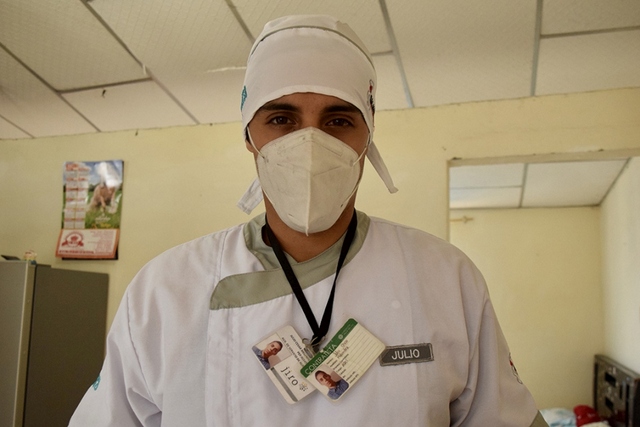
Julio Meléndez is a young Venezuelan who has found employment in food distribution at a hospital in Cali, in western Colombia. Labour insertion is key for the integration of migrants in host communities. CREDIT: Laura Cruz Cañón/UNHCR

According to Filippo Grandi, the United Nations High Commissioner for Refugees, they have benefited from the fact that the countries of the region “are an example, and the rest of the world can learn a lot about the inclusion and integration of refugees in Latin America and the Caribbean.”

In the north of the region, Mexico is dealing with a migration phenomenon on four fronts. On one hand, 12 million Mexicans live in the United States. And on the other, every year hundreds of thousands of migrants make their way through the country, mainly Central Americans and in recent years also people from the Caribbean, Venezuelans and Africans.

In addition, the United States sends back to Mexico hundreds of thousands of people who cross its southern border without the required documents. And in fourth place, the least well-known aspect: Mexico is home to more than one million migrants and refugees who have chosen to make their home in that country.

Major recipients of refugees and asylum seekers in other regions are Turkey, in the eastern Mediterranean, hosting 3.7 million (92 percent Syrians), and, with 1.4 million displaced persons each, Pakistan (which has received a massive influx of people from Afghanistan) and Uganda (refugees from the Democratic Republic of Congo and other neighbouring countries).

In Sudan there are one million refugees, Bangladesh, Iran and Lebanon host 900,000 each, while in the industrialised North the cases of Germany, which received 1.2 million refugees from the Middle East, and the United States, which has 300,000 refugees and one million asylum seekers in its territory, stand out.

  Source